Overview
Causation is a critical statistical concept that appears regularly on the ACT Math test, particularly within the Statistics and Probability content area. Understanding causation involves recognizing the difference between relationships where one variable directly causes changes in another versus situations where variables are merely associated or correlated without a causal mechanism. This distinction is fundamental to interpreting data correctly and avoiding logical fallacies when analyzing statistical information.
On the ACT, causation questions test a student's ability to think critically about data relationships rather than simply perform calculations. These questions often present scenarios involving surveys, experiments, or observational studies, then ask students to determine whether the data supports a causal claim or merely shows correlation. The ACT frequently includes questions that require students to identify flawed reasoning in statistical arguments, particularly when researchers or studies incorrectly claim that correlation implies causation. Mastering this topic is essential because it represents a higher-order thinking skill that separates students who can mechanically apply formulas from those who truly understand statistical reasoning.
ACT causation questions connect to broader mathematical concepts including experimental design, data analysis, and logical reasoning. This topic bridges pure mathematics with real-world applications, requiring students to evaluate the validity of conclusions drawn from data. Understanding causation also supports critical thinking skills tested throughout the ACT Science section and strengthens overall analytical abilities that extend beyond standardized testing into academic research and everyday decision-making.
Learning Objectives
- [ ] Identify when Causation is being tested in ACT questions
- [ ] Explain the core rule or strategy behind Causation and its relationship to correlation
- [ ] Apply Causation concepts to ACT-style questions accurately
- [ ] Distinguish between observational studies and controlled experiments
- [ ] Recognize confounding variables that prevent causal conclusions
- [ ] Evaluate whether study designs support causal claims
- [ ] Identify language that signals causal versus correlational relationships
Prerequisites
- Basic understanding of correlation: Students must know that correlation measures the strength and direction of relationships between variables, as causation builds upon but differs fundamentally from correlation.
- Familiarity with variables: Understanding independent and dependent variables is essential because causal relationships involve one variable (independent) affecting another (dependent).
- Reading comprehension of data scenarios: Students need to interpret written descriptions of studies and experiments, as ACT questions present causation concepts through word problems rather than pure calculations.
- Basic logic and reasoning: Recognizing valid versus invalid arguments is necessary because causation questions test logical thinking about whether conclusions follow from evidence.
Why This Topic Matters
Understanding causation has profound real-world significance that extends far beyond standardized testing. In everyday life, people constantly encounter claims about cause-and-effect relationships in news articles, advertisements, health recommendations, and policy debates. The ability to distinguish genuine causal relationships from mere correlations protects against manipulation, helps evaluate medical advice, and supports informed decision-making. For example, recognizing that "people who drink coffee live longer" might reflect correlation rather than causation prevents drawing incorrect conclusions about health behaviors.
On the ACT Math test, causation appears in approximately 1-2 questions per exam, typically within the Statistics and Probability content area that comprises about 5-8 questions total. While this might seem like a small proportion, these questions are often among the most challenging because they test conceptual understanding rather than procedural knowledge. Students who master causation concepts gain a significant competitive advantage, as these questions frequently separate high scorers from perfect scorers. The difficulty level is medium to high, and these questions often appear in the latter portion of the test where more challenging problems are concentrated.
Common question formats include: presenting a study's findings and asking whether a causal conclusion is justified; describing an experiment and asking what could be concluded; providing scenarios with confounding variables and asking students to identify why causation cannot be established; or presenting multiple study designs and asking which one would best establish causation. The ACT particularly favors questions that require students to identify flawed reasoning in statistical arguments, making this topic essential for achieving top scores.
Core Concepts
The Fundamental Distinction: Correlation vs. Causation
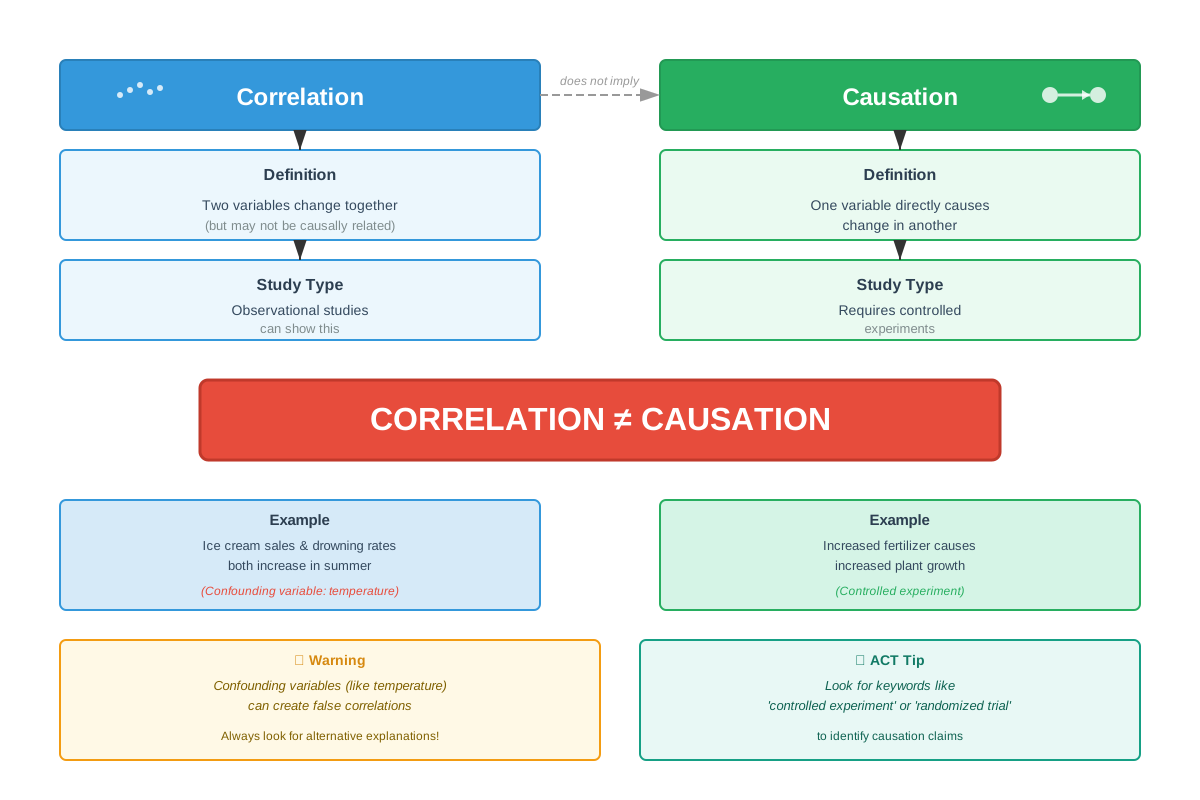
The cornerstone principle of this topic is that correlation does not imply causation. Correlation exists when two variables show a statistical relationship—when one variable changes, the other tends to change in a predictable way. However, this relationship alone does not prove that one variable causes the other to change. Causation specifically means that changes in one variable directly produce changes in another variable through a cause-and-effect mechanism.
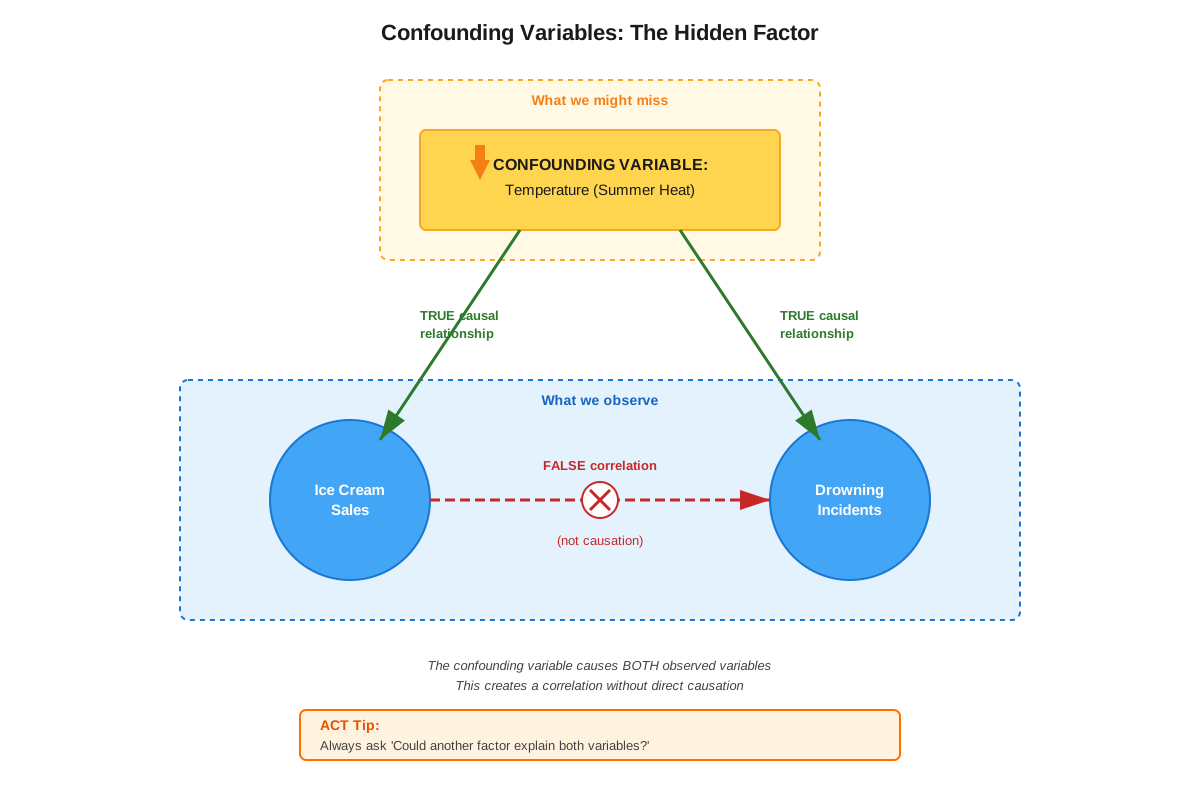
Consider this example: Ice cream sales and drowning deaths are positively correlated—both increase during the same time periods. However, ice cream consumption does not cause drowning deaths. Instead, a third variable (hot weather) causes both phenomena. This illustrates why correlation alone cannot establish causation.
Three Explanations for Correlation
When two variables are correlated, three possible explanations exist:
- Direct causation: Variable A causes Variable B (A → B)
- Reverse causation: Variable B causes Variable A (B → A)
- Confounding variable: A third variable C causes both A and B (C → A and C → B)
The ACT frequently tests whether students can recognize which explanation applies to a given scenario. Without additional evidence from properly designed studies, correlation alone cannot distinguish among these three possibilities.
Controlled Experiments vs. Observational Studies
The type of study conducted determines whether causal conclusions are justified. A controlled experiment involves:
- Random assignment of subjects to treatment and control groups
- Manipulation of the independent variable by researchers
- Control of other variables that might affect outcomes
- Comparison between groups that differ only in the treatment received
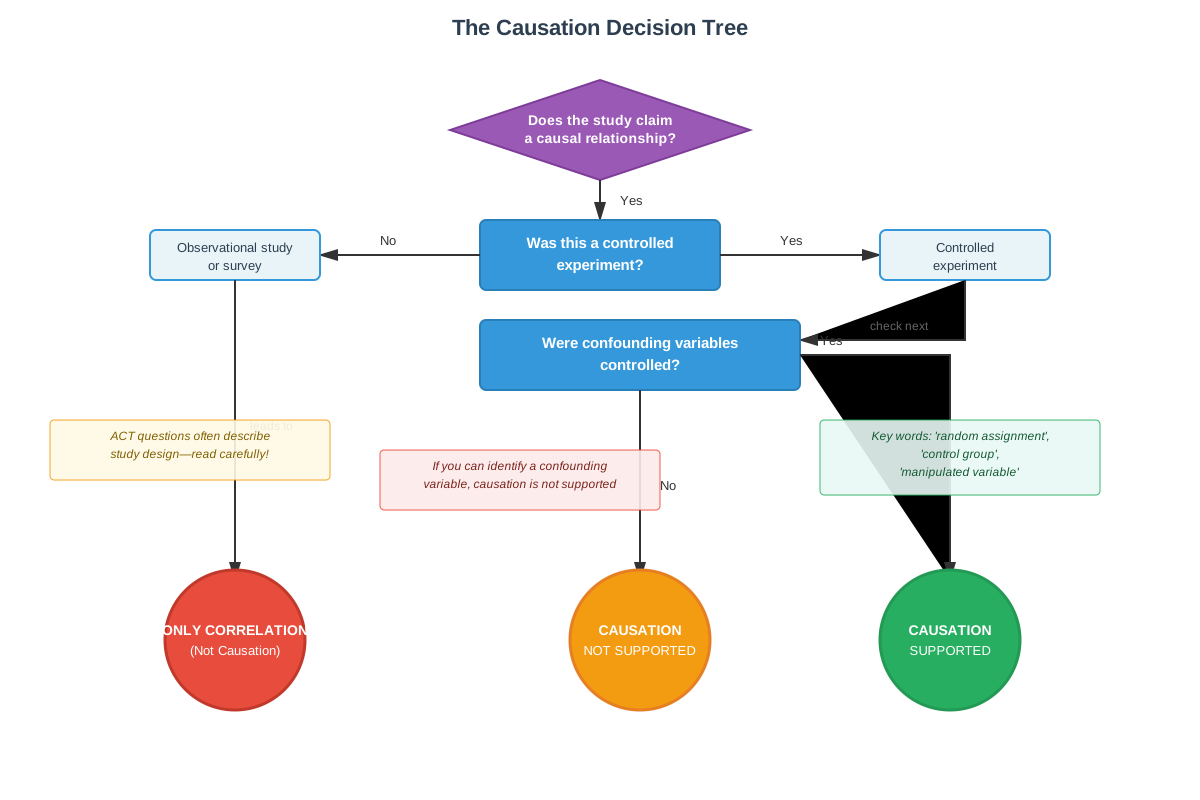
Only controlled experiments with proper randomization can establish causation because they eliminate confounding variables and ensure that observed differences result from the treatment rather than pre-existing differences between groups.
An observational study, by contrast, involves:
- Observing subjects without intervention or manipulation
- No random assignment to groups
- Subjects self-select into groups or are naturally divided
- Inability to control for all potential confounding variables
Observational studies can identify correlations and suggest possible causal relationships, but they cannot definitively establish causation because confounding variables cannot be ruled out.
| Study Type | Random Assignment | Researcher Control | Can Establish Causation | Example |
|---|---|---|---|---|
| Controlled Experiment | Yes | Yes | Yes | Testing a new medication by randomly assigning patients to receive either the drug or placebo |
| Observational Study | No | No | No | Surveying coffee drinkers and non-drinkers about their health outcomes |
Confounding Variables
A confounding variable (also called a lurking variable) is a third factor that influences both the independent and dependent variables, creating a spurious correlation between them. Confounding variables are the primary reason why correlation does not imply causation in observational studies.
For example, suppose a study finds that students who eat breakfast score higher on tests. Before concluding that breakfast causes better test performance, consider potential confounding variables:
- Family income (wealthier families can afford breakfast and may provide more educational support)
- Sleep quality (students who wake up early enough for breakfast may be better rested)
- Overall health consciousness (families that prioritize breakfast may also prioritize education)
Any of these confounding variables could explain the correlation without breakfast directly causing improved test scores.
Establishing Causation: The Three Criteria
For a causal relationship to be established, three criteria should be met:
- Temporal precedence: The cause must occur before the effect
- Covariation: Changes in the cause must be associated with changes in the effect
- No plausible alternative explanations: Other potential causes (confounding variables) must be ruled out
The ACT often presents scenarios where one or more of these criteria are not satisfied, then asks students to identify why a causal conclusion is not justified.
Language Signals in ACT Questions
The ACT uses specific language to signal whether causation or correlation is being discussed:
Causal language (implies cause-and-effect):
- "causes," "leads to," "produces," "results in"
- "is responsible for," "brings about," "makes"
- "due to," "because of," "as a result of"
Correlational language (implies association only):
- "is associated with," "is related to," "is linked to"
- "corresponds with," "tends to occur with"
- "is correlated with," "shows a relationship with"
Recognizing these linguistic cues helps students identify what type of claim is being made and whether the evidence supports that claim.
Concept Relationships
The concepts within causation form a logical hierarchy. Understanding correlation is the foundation, as students must first recognize that variables can be related. This leads to the critical distinction between correlation and causation, which is the central concept. From there, understanding branches into two pathways: recognizing confounding variables that explain why correlation doesn't imply causation, and understanding study design (controlled experiments vs. observational studies) that determines when causal conclusions are justified.
The relationship map flows as follows:
Correlation → Correlation vs. Causation distinction → branches into:
- Confounding Variables (why causation cannot be assumed)
- Study Design (when causation can be established)
Both branches converge at Evaluating Causal Claims, which represents the application skill tested on the ACT.
This topic connects to prerequisite knowledge of variables (independent and dependent) because causal relationships specifically involve independent variables affecting dependent variables. It also relates to experimental design concepts that may appear in ACT Science passages, creating cross-section synergy. Furthermore, causation connects to probability concepts because random assignment in experiments uses probability principles to create equivalent groups.
Understanding causation enables progression to more advanced statistical topics including statistical significance, hypothesis testing, and research methodology—concepts that become important in college-level coursework and scientific literacy.
High-Yield Facts
⭐ Correlation does not imply causation—this is the single most important principle for ACT causation questions.
⭐ Only controlled experiments with random assignment can establish causation—observational studies can only show correlation.
⭐ Confounding variables are third factors that influence both variables being studied, creating spurious correlations.
⭐ Random assignment eliminates confounding variables by distributing them equally between treatment and control groups.
⭐ Temporal precedence is necessary for causation—the cause must occur before the effect.
- Observational studies can suggest possible causal relationships but cannot prove them.
- Self-selection bias occurs when subjects choose their own groups, introducing confounding variables.
- The phrase "is associated with" indicates correlation, not causation.
- Reverse causation means the supposed effect actually causes the supposed cause.
- Even strong correlations (close to +1 or -1) do not prove causation without proper experimental design.
- Causal language like "causes" or "leads to" requires experimental evidence to be justified.
- Sample size does not determine whether causation can be established—study design does.
- Multiple studies showing the same correlation strengthen the case for causation but still don't prove it without experimental evidence.
Quick check — test yourself on Causation so far.
Try Flashcards →Common Misconceptions
Misconception: If two variables are strongly correlated, one must cause the other.
Correction: Strong correlation indicates a relationship but does not reveal its nature. A confounding variable could cause both, or the correlation could be coincidental. Only controlled experiments can establish causation.
Misconception: Large sample sizes in observational studies allow causal conclusions.
Correction: Sample size affects statistical power and reliability but does not address confounding variables. Even a perfectly conducted observational study with millions of participants cannot establish causation because it lacks random assignment and experimental control.
Misconception: If A happens before B, then A causes B.
Correction: Temporal precedence is necessary but not sufficient for causation. Many events occur in sequence without causal relationships. For example, sunrise occurs before breakfast, but sunrise doesn't cause breakfast.
Misconception: Controlling for confounding variables in statistical analysis makes observational studies equivalent to experiments.
Correction: Statistical controls can only adjust for measured confounding variables. Unknown or unmeasured confounders may still exist, preventing definitive causal conclusions. Only random assignment addresses both known and unknown confounders.
Misconception: If researchers use causal language ("causes," "leads to"), the relationship must be causal.
Correction: Language choice doesn't determine the nature of relationships. The ACT specifically tests whether causal language is justified by the study design. Students must evaluate the evidence, not just accept the language used.
Misconception: Correlation and causation are completely unrelated concepts.
Correction: Causation always involves correlation—if A causes B, they will be correlated. However, correlation can exist without causation. Correlation is necessary but not sufficient for causation.
Worked Examples
Example 1: Identifying Unjustified Causal Claims
Question: A researcher surveys 500 high school students and finds that students who participate in sports have higher GPAs than students who don't participate in sports. The researcher concludes that playing sports causes improved academic performance. Is this conclusion justified?
Solution:
Step 1: Identify the study type.
This is an observational study because the researcher surveyed existing groups (students who already chose to play sports vs. those who didn't). There was no random assignment or experimental manipulation.
Step 2: Determine what the study can establish.
Observational studies can show correlation but cannot establish causation. The study shows that sports participation is associated with higher GPAs.
Step 3: Identify potential confounding variables.
Several confounding variables could explain this correlation:
- Time management skills (students with better time management might both play sports and maintain high GPAs)
- Family support (families that encourage sports might also emphasize academics)
- School resources (schools with better sports programs might also have better academic programs)
- Physical health (healthier students might both participate in sports and perform better academically)
Step 4: Evaluate the conclusion.
The conclusion is not justified. While the data shows correlation, the observational study design cannot rule out confounding variables. The researcher cannot conclude that sports participation causes improved academic performance.
Correct interpretation: "Students who participate in sports tend to have higher GPAs, but this association does not prove that sports participation causes academic improvement."
Learning objective addressed: This example demonstrates how to identify when causation is being tested and apply the core rule that observational studies cannot establish causation.
Example 2: Evaluating Study Designs
Question: A pharmaceutical company wants to determine whether a new medication reduces blood pressure. Which study design would best establish whether the medication causes reduced blood pressure?
A) Survey 1,000 people taking the medication about their blood pressure levels
B) Compare blood pressure between people who chose to take the medication and those who chose not to
C) Randomly assign 500 participants to receive either the medication or a placebo, then compare blood pressure changes
D) Track blood pressure changes in 500 people who start taking the medication
Solution:
Step 1: Analyze each option for key features of causal inference.
Option A: This is an observational study with no control group. Cannot establish causation because there's no comparison and no way to know if blood pressure would have changed anyway.
Option B: This is an observational study with self-selection. People who choose to take medication might differ systematically from those who don't (confounding variables like health consciousness, severity of condition, access to healthcare). Cannot establish causation.
Option C: This is a controlled experiment with random assignment. Random assignment creates equivalent groups, and the placebo control ensures that any differences result from the medication rather than expectations or other factors. Can establish causation.
Option D: This is an observational study with no control group. Cannot determine if blood pressure changes result from the medication or other factors (time, lifestyle changes, regression to the mean). Cannot establish causation.
Step 2: Select the design that meets causation criteria.
Answer: C
Only the randomized controlled experiment (Option C) can establish causation because it includes:
- Random assignment (eliminates confounding variables)
- Experimental manipulation (researchers control who receives medication)
- Control group (placebo allows comparison)
- Ability to isolate the medication's effect
Learning objective addressed: This example shows how to identify when causation is being tested and apply understanding of study design to determine when causal conclusions are justified.
Exam Strategy
Approaching ACT Causation Questions
When encountering a question about causation on the ACT, follow this systematic approach:
- Identify the study type: Determine whether the scenario describes a controlled experiment (with random assignment) or an observational study (without random assignment).
- Look for trigger words: Causal language like "causes," "leads to," or "results in" signals that you need to evaluate whether a causal claim is justified.
- Check for random assignment: This is the single most important factor. If subjects were randomly assigned to groups, causation can potentially be established. If not, only correlation can be shown.
- Consider confounding variables: If the question asks why a causal conclusion isn't justified, think about third variables that could explain the correlation.
- Match conclusion to evidence: Ensure that the strength of the conclusion matches what the study design can support.
Process of Elimination Tips
- Eliminate answers that claim causation from observational studies: If the study lacks random assignment, any answer choice claiming "proves," "causes," or "establishes" causation is incorrect.
- Eliminate answers that ignore confounding variables: If an answer choice draws a causal conclusion without addressing potential confounders, it's likely wrong.
- Favor answers with cautious language: Correct answers often use phrases like "suggests," "is associated with," "may indicate," or "shows a relationship" rather than definitive causal language.
- Watch for reversed causation: Sometimes the ACT includes answer choices that reverse the cause and effect. Eliminate these by checking temporal order.
Time Allocation Advice
Causation questions typically require 60-90 seconds—slightly longer than computational problems because they involve reading comprehension and logical reasoning. Don't rush these questions; the time investment is worthwhile because they're often worth the same points as simpler calculations. However, if you're uncertain, make an educated guess and move on rather than spending more than 2 minutes on a single question.
Exam Tip: The ACT rarely asks you to perform calculations for causation questions. If you find yourself doing complex math, you may be overthinking the problem. Focus on the logic of the study design instead.
Memory Techniques
The RACE Acronym for Establishing Causation
Random assignment
Actual manipulation (experimental control)
Control group for comparison
Elimination of confounders
If a study has all four RACE elements, it can establish causation. If any element is missing, only correlation can be shown.
The "Ice Cream Drowning" Reminder
Whenever you see a correlation, think of the classic ice cream and drowning example. This memorable scenario reminds you that correlation doesn't imply causation and that confounding variables (hot weather) can explain correlations.
Visualization Strategy: The Three-Way Fork
Visualize correlation as a fork in the road with three paths:
- Left path: A causes B
- Right path: B causes A
- Middle path: C causes both A and B
Without experimental evidence, you can't determine which path is correct. This mental image helps remember that correlation alone doesn't reveal the direction or nature of relationships.
The "Random is Magic" Phrase
Remember that "random assignment is magic" because it's the key that unlocks causal conclusions. This phrase emphasizes that random assignment is the critical feature distinguishing experiments from observational studies.
Summary
Causation is a fundamental statistical concept that tests critical thinking about data relationships on the ACT Math exam. The core principle is that correlation does not imply causation—two variables can be statistically related without one causing the other. Confounding variables, which influence both variables being studied, often explain correlations without causal mechanisms. Only controlled experiments with random assignment can establish causation because random assignment eliminates confounding variables by distributing them equally between groups. Observational studies, which lack random assignment, can identify correlations and suggest possible causal relationships but cannot definitively prove causation. The ACT tests this concept by presenting study scenarios and asking students to evaluate whether causal conclusions are justified based on the study design. Success requires recognizing study types, identifying confounding variables, understanding the limitations of different research methods, and matching conclusions to the evidence provided. Students must pay attention to language cues that signal causal versus correlational claims and apply logical reasoning to determine whether the data supports the conclusions drawn.
Key Takeaways
- Correlation does not imply causation—this is the foundational principle for all causation questions on the ACT
- Random assignment is the key feature that allows controlled experiments to establish causation while observational studies cannot
- Confounding variables are third factors that create spurious correlations by influencing both variables being studied
- Study design determines what can be concluded—identify whether a scenario describes an experiment or observational study before evaluating claims
- Causal language requires experimental evidence—phrases like "causes" or "leads to" are only justified when supported by controlled experiments
- Three possible explanations exist for any correlation: A causes B, B causes A, or a confounding variable C causes both
- Temporal precedence, covariation, and elimination of alternative explanations are the three criteria for establishing causation
Related Topics
Experimental Design: Understanding the components of well-designed experiments, including control groups, blinding, and replication, builds directly on causation concepts and helps evaluate research quality.
Sampling Methods: Different sampling techniques (random, stratified, convenience) affect the validity of conclusions drawn from data, connecting to how study design influences causal inference.
Statistical Significance: Once causation is established through proper experimental design, statistical significance tests determine whether observed effects are likely due to the treatment rather than chance.
Bias in Data Collection: Various types of bias (selection bias, response bias, survivorship bias) can create misleading correlations, reinforcing why proper study design is essential for valid conclusions.
Regression Analysis: Advanced statistical techniques that attempt to control for confounding variables in observational studies, though they cannot fully replace experimental design for establishing causation.
Mastering causation provides the logical foundation for evaluating all types of statistical claims, making it essential preparation not only for the ACT but for scientific literacy in college and beyond.
Practice CTA
Now that you've mastered the concepts of causation and understand how to distinguish correlation from cause-and-effect relationships, it's time to apply this knowledge! Work through the practice questions to test your ability to identify study types, recognize confounding variables, and evaluate causal claims. Use the flashcards to reinforce key terminology and principles. Remember, causation questions reward careful logical thinking rather than computational speed—take your time to analyze each scenario thoroughly. With practice, you'll develop the critical thinking skills that separate good scores from great scores on the ACT Math test. You've got this!
Sign up free to keep reading
Create a free AnvayaPrep account to finish this ACT guide on Causation — plus flashcards and practice questions.