Overview
Experimental design is one of the most critical skills tested in the ACT Science section, particularly within Research Summaries passages. These passages present students with descriptions of experiments, including their setup, procedures, and results. Understanding experimental design means recognizing how scientists structure investigations to test hypotheses, control variables, and draw valid conclusions from data. This topic appears in approximately 3-4 passages per ACT Science test, making it a high-frequency, high-impact area for score improvement.
The ACT tests experimental design through questions that ask students to identify independent and dependent variables, recognize control groups, understand the purpose of specific experimental steps, and evaluate whether an experiment adequately tests a hypothesis. Unlike data representation passages that focus primarily on graph interpretation, Research Summaries passages require students to think like scientists—understanding not just what happened in an experiment, but why it was designed that way. Mastery of ACT experimental design questions separates average scorers from those achieving 30+ on the Science section.
Experimental design connects to virtually every other concept in ACT Science. It provides the framework for understanding how data is collected (data representation), how multiple experiments relate to each other (conflicting viewpoints), and how scientific conclusions are justified. Strong experimental design knowledge also enhances critical thinking skills applicable to reading comprehension and even mathematical problem-solving, as it trains students to identify relationships between variables and evaluate logical reasoning.
Learning Objectives
- [ ] Identify when Experimental design is being tested in ACT Science passages
- [ ] Explain the core rule or strategy behind Experimental design questions
- [ ] Apply Experimental design principles to ACT-style questions accurately
- [ ] Distinguish between independent variables, dependent variables, and controlled variables in any experiment
- [ ] Evaluate whether an experimental procedure adequately tests a stated hypothesis
- [ ] Predict how changes to experimental design would affect results and conclusions
- [ ] Compare multiple experiments to identify what variables differ between them
Prerequisites
- Basic scientific method understanding: Recognizing that experiments test hypotheses through systematic observation is fundamental to understanding why experiments are designed with specific features.
- Variable identification skills: The ability to distinguish what changes, what is measured, and what stays the same forms the foundation of experimental analysis.
- Graph and table reading: Since experimental results are presented visually, interpreting data displays is necessary to connect design to outcomes.
- Cause-and-effect reasoning: Understanding that experiments establish relationships between causes (independent variables) and effects (dependent variables) is essential for design analysis.
Why This Topic Matters
Experimental design represents the backbone of scientific inquiry and appears in 40-50% of ACT Science questions. Research Summaries passages, which constitute 3 of the 6 passages on each test, are built entirely around experimental design principles. These passages typically present 2-4 related experiments and ask 6 questions per passage, meaning students encounter approximately 18-24 experimental design questions per test. Questions range from straightforward variable identification to complex analysis of experimental validity and proposed modifications.
In real-world applications, experimental design is how scientists discover new medicines, engineers test materials, psychologists understand behavior, and environmental scientists track climate change. Every controlled study, clinical trial, and laboratory investigation relies on the same principles tested on the ACT. Understanding experimental design develops critical thinking skills that extend far beyond test-taking—it teaches students to evaluate claims, identify flawed reasoning, and distinguish correlation from causation in everyday life.
On the ACT, experimental design appears in several predictable formats: questions asking students to identify the purpose of a control group, determine what variable was manipulated between experiments, predict results if a variable were changed, identify what additional data would strengthen a conclusion, or evaluate whether an experiment's design matches its stated purpose. Recognizing these question types allows students to approach them systematically rather than rereading entire passages under time pressure.
Core Concepts
Variables in Experimental Design
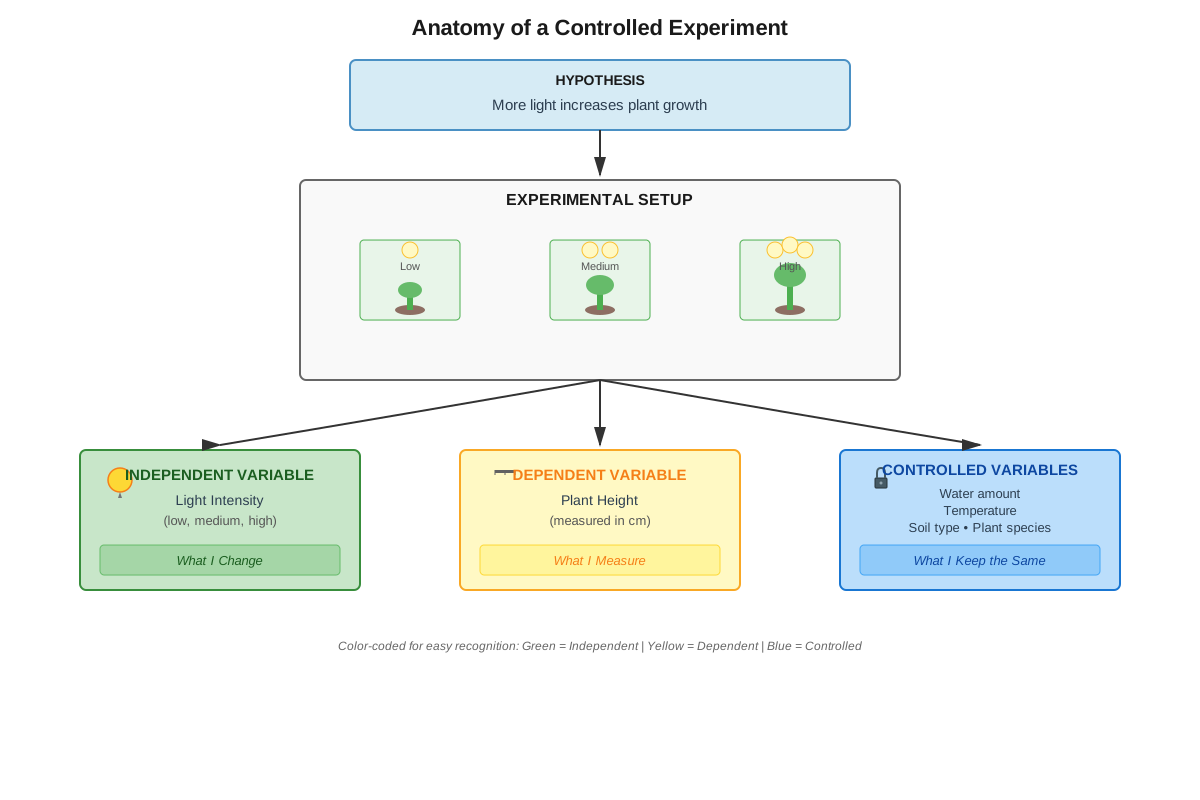
Every experiment involves three types of variables that students must identify quickly and accurately. The independent variable is what the experimenter deliberately changes or manipulates. It represents the potential cause being investigated. For example, if scientists test how temperature affects plant growth, temperature is the independent variable because researchers control and vary it systematically.
The dependent variable is what the experimenter measures or observes. It represents the potential effect. In the plant growth example, the dependent variable might be plant height, leaf count, or biomass—whatever outcome the researchers measure to see if temperature had an impact. The dependent variable "depends on" the independent variable.
Controlled variables (also called constants) are all other factors that could affect the outcome but are deliberately kept the same across all experimental conditions. In the plant experiment, controlled variables would include light exposure, water amount, soil type, plant species, and pot size. Controlling these variables ensures that any observed differences in the dependent variable are due to the independent variable, not other factors.
| Variable Type | Definition | Example (Plant Growth Study) | ACT Question Clues |
|---|---|---|---|
| Independent | What is deliberately changed | Temperature (10°C, 20°C, 30°C) | "What was varied between experiments?" |
| Dependent | What is measured/observed | Plant height after 30 days | "What was measured?" "What was the outcome?" |
| Controlled | What is kept constant | Water, light, soil, species | "What was the same in all trials?" |
Control Groups and Experimental Groups
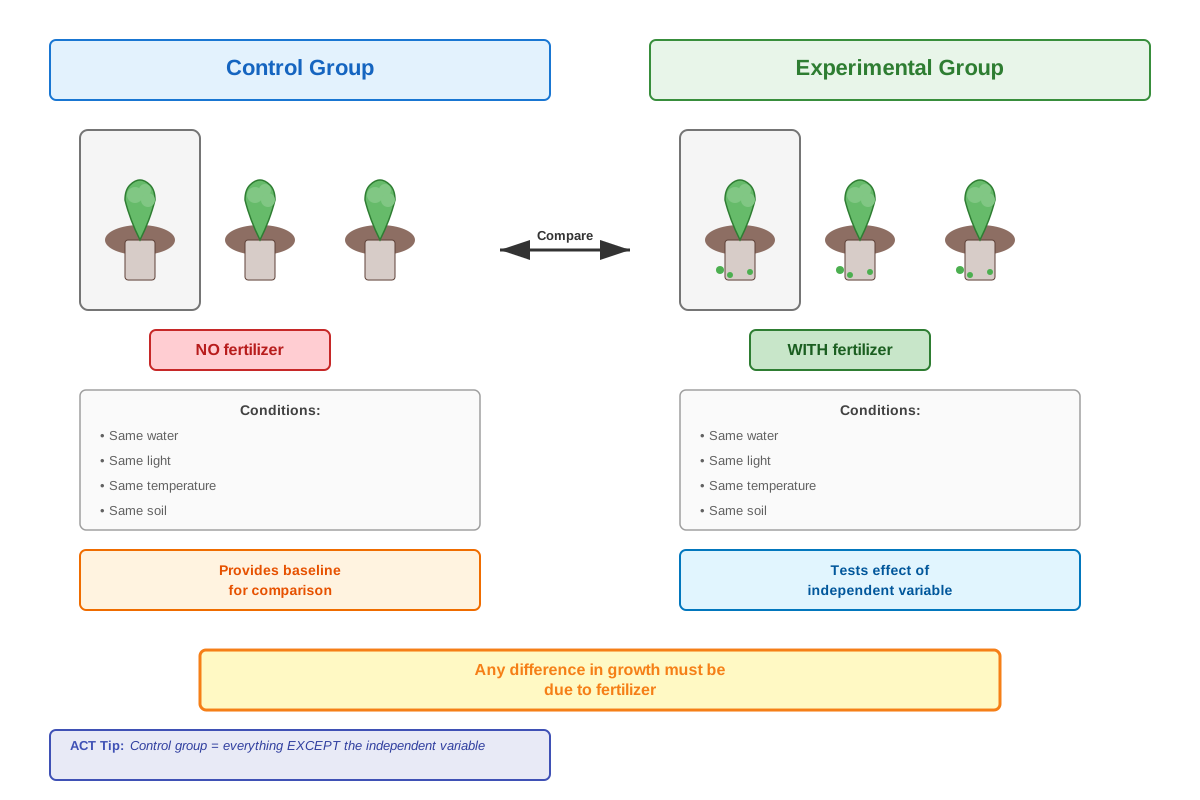
A control group serves as a baseline for comparison. It either receives no treatment or receives a standard treatment, allowing researchers to determine whether the experimental treatment produces a different result than would occur naturally or under standard conditions. For instance, in a drug trial, the control group might receive a placebo while experimental groups receive different doses of the medication.
Experimental groups receive the treatment or condition being tested. There may be multiple experimental groups if the experiment tests different levels of the independent variable (low dose, medium dose, high dose). The ACT frequently asks students to identify which group serves as the control or to explain why a control group is necessary—the answer is always that it provides a comparison baseline to isolate the effect of the independent variable.
Experimental Trials and Replication
Trials refer to the number of times an experiment is repeated under identical conditions. Multiple trials increase reliability by reducing the impact of random errors or unusual results. If an experiment is conducted only once, an anomalous result might lead to incorrect conclusions. With multiple trials, researchers can calculate averages and identify outliers.
The ACT may present experiments with different numbers of trials and ask students to evaluate which provides more reliable data. More trials always increase reliability, though the improvement diminishes with each additional trial (10 trials is much better than 1, but 100 trials is only marginally better than 50).
Hypothesis Testing Through Design
A hypothesis is a testable prediction about the relationship between variables. Well-designed experiments must actually test the stated hypothesis. ACT questions often ask whether a proposed experiment would adequately test a hypothesis or what additional information would be needed.
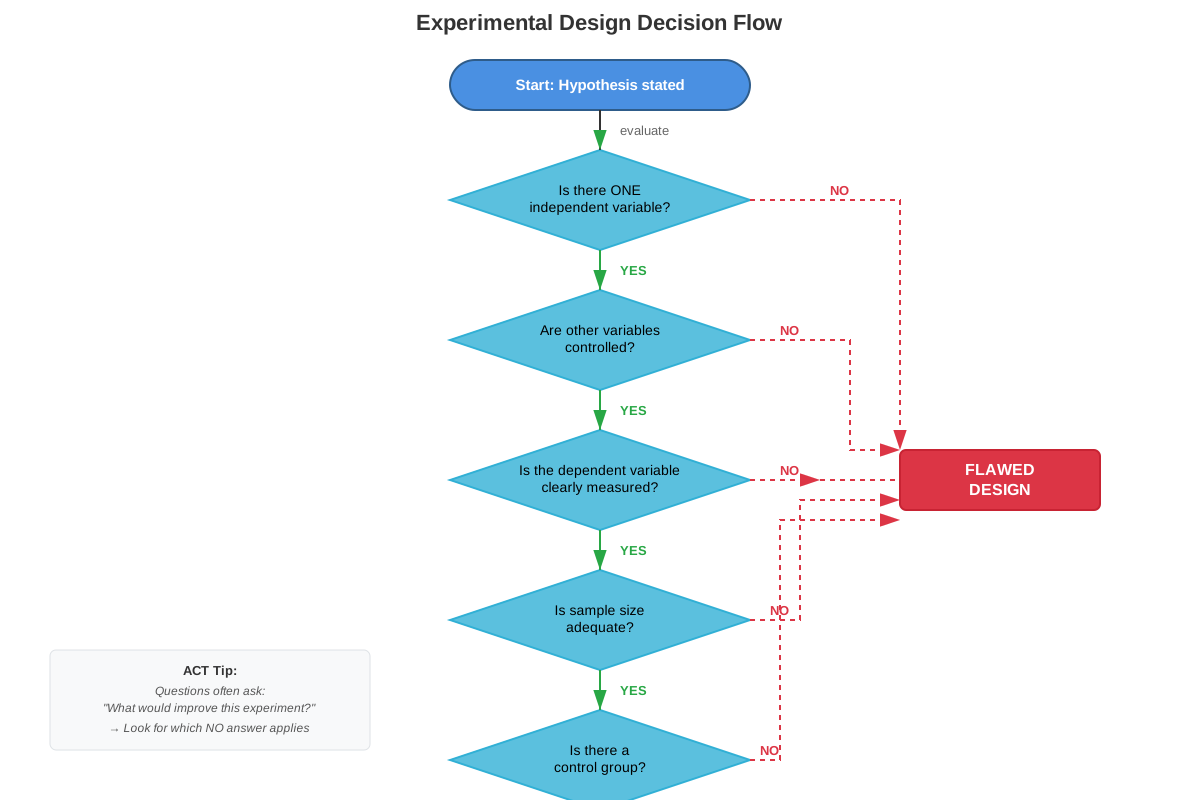
For an experiment to test a hypothesis effectively, it must:
- Manipulate the independent variable mentioned in the hypothesis
- Measure the dependent variable mentioned in the hypothesis
- Control other variables that could affect the outcome
- Include appropriate comparison groups
- Collect sufficient data to identify patterns
Experimental Procedures and Methodology
The procedure describes the step-by-step process researchers follow. ACT passages present abbreviated procedures, and questions may ask about the purpose of specific steps. Common procedural elements include:
- Sample preparation: How materials or subjects are selected and prepared
- Treatment application: How the independent variable is applied to different groups
- Measurement protocols: When and how the dependent variable is measured
- Data recording: How results are documented
Understanding why each step exists helps students answer questions about experimental design. For example, if a procedure includes "samples were allowed to equilibrate for 10 minutes," this step ensures temperature or pressure stabilizes before measurements, controlling for time-dependent effects.
Comparing Multiple Experiments
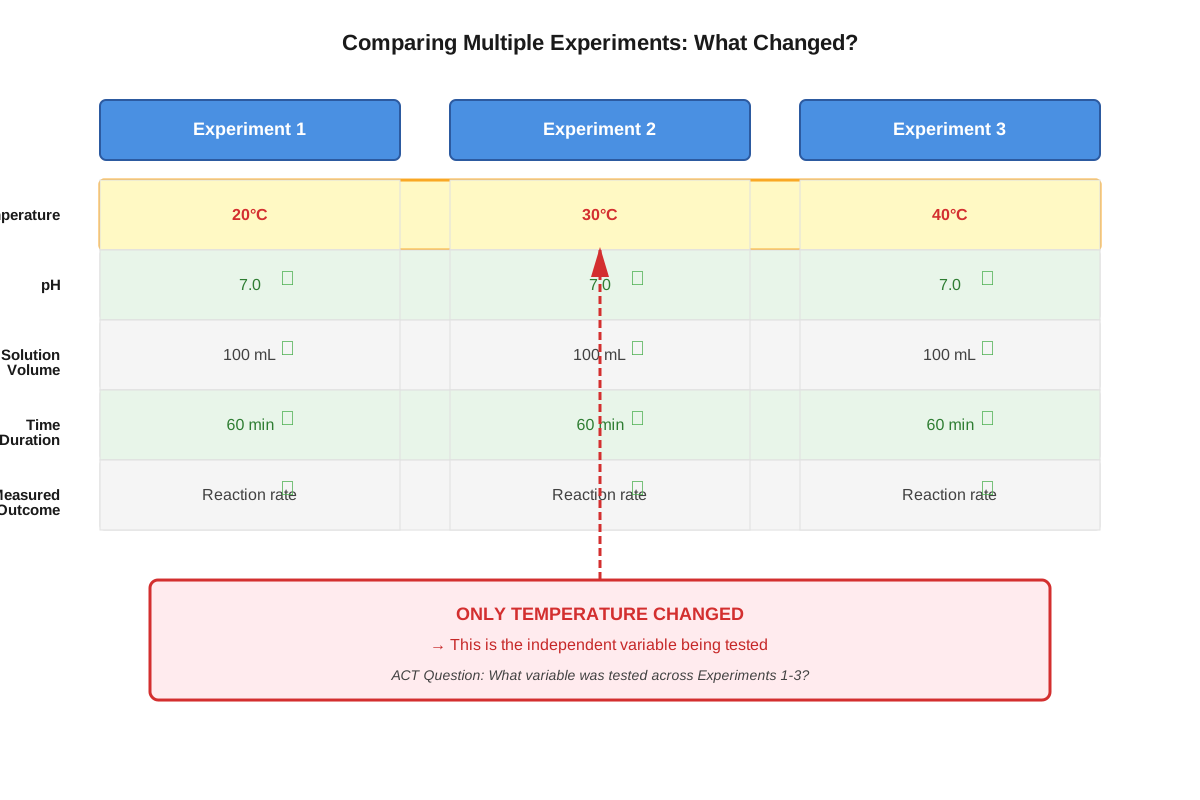
Research Summaries passages typically present 2-4 related experiments. These experiments usually differ in one key aspect, allowing researchers to investigate multiple factors or test hypotheses under different conditions. The ACT frequently asks: "How did Experiment 2 differ from Experiment 1?"
To answer these questions efficiently:
- Identify the independent variable in each experiment
- Note what values or conditions were tested
- Check if the dependent variable changed
- Verify which controlled variables remained the same
Often, successive experiments build on each other—Experiment 1 might establish a basic relationship, while Experiment 2 tests that relationship under different conditions or with a modified variable.
Concept Relationships
Experimental design concepts form an interconnected system where each element supports the others. Variables (independent, dependent, controlled) form the foundation → these determine what control and experimental groups are needed → which influences how many trials should be conducted → all of which must align with the hypothesis being tested → and are implemented through the experimental procedure.
The relationship between control groups and controlled variables often confuses students, but they serve different purposes: controlled variables are factors kept constant across all groups, while a control group is a specific group that receives no treatment or standard treatment for comparison purposes.
Multiple experiments within a passage connect through systematic variation. Experiment 1 might test Variable A while controlling Variables B and C. Experiment 2 might then test Variable B while controlling Variables A and C. This systematic approach allows researchers to isolate the effect of each variable independently—a concept the ACT tests frequently by asking students to identify what changed between experiments.
Understanding experimental design also connects to data interpretation skills. The way an experiment is designed determines what conclusions can be drawn from the data. If an experiment lacks a control group, students should recognize that conclusions about treatment effects are weakened. If controlled variables aren't properly maintained, students should identify that results might be confounded by uncontrolled factors.
Quick check — test yourself on Experimental design so far.
Try Flashcards →High-Yield Facts
⭐ The independent variable is what the experimenter deliberately changes; the dependent variable is what the experimenter measures in response.
⭐ Controlled variables must remain constant across all experimental groups to ensure valid comparisons.
⭐ A control group provides a baseline for comparison and typically receives no treatment or a standard treatment.
⭐ Multiple trials increase the reliability of experimental results by reducing the impact of random errors.
⭐ When comparing experiments in a passage, identify what single variable changed while others remained constant.
- The purpose of any experimental step is either to manipulate the independent variable, measure the dependent variable, or control other variables.
- An experiment can only test a hypothesis if it manipulates the variables mentioned in that hypothesis and measures the predicted outcome.
- Larger sample sizes generally produce more reliable results than smaller sample sizes.
- Random assignment of subjects to groups helps ensure that groups are comparable at the start of an experiment.
- If an experiment lacks a control group, it becomes difficult to determine whether observed changes are due to the treatment or would have occurred anyway.
- Replication by other researchers strengthens confidence in experimental findings beyond what multiple trials by the same researcher provide.
- The experimental design must match the research question—testing plant growth requires measuring growth-related variables, not unrelated factors.
Common Misconceptions
Misconception: The independent variable is always listed first in tables or graphs.
Correction: While independent variables often appear on the x-axis of graphs or in the first column of tables, this is a convention, not a rule. Students must identify the independent variable by determining what the experimenter manipulated, regardless of how data is presented.
Misconception: Control groups receive nothing, while experimental groups receive treatments.
Correction: Control groups may receive standard treatments, placebos, or represent natural conditions—they don't necessarily receive "nothing." The key is that they provide a comparison baseline, not that they're untreated.
Misconception: More controlled variables make an experiment worse because scientists should test everything at once.
Correction: Controlling variables is essential for valid experiments. Testing multiple variables simultaneously without proper controls makes it impossible to determine which variable caused observed effects. Well-designed experiments isolate variables systematically.
Misconception: If two experiments have different results, one must be wrong.
Correction: Different results from different experiments often reflect different conditions being tested. Experiments 1 and 2 in a passage typically test different aspects of a phenomenon, and different results provide complementary information rather than contradictory findings.
Misconception: The dependent variable is always numerical.
Correction: While dependent variables are often quantitative (height, temperature, count), they can be qualitative (color change, presence/absence of a characteristic, behavioral category). What matters is that the dependent variable is systematically observed and recorded.
Misconception: Experimental design questions require detailed scientific knowledge about the topic being studied.
Correction: ACT experimental design questions test reasoning about how experiments are structured, not content knowledge about specific scientific fields. Students can answer these questions by analyzing the experimental setup, regardless of whether they've studied that particular topic.
Worked Examples
Example 1: Identifying Variables and Purpose
Passage Summary: Scientists investigated how light intensity affects the rate of photosynthesis in aquatic plants. They placed identical plants in separate tanks with the same water temperature, volume, and plant species. Each tank was exposed to a different light intensity (low, medium, high, very high) for 2 hours. The scientists measured the amount of oxygen produced by each plant.
Question: What was the dependent variable in this experiment?
Step 1 - Identify what was measured: The passage states scientists "measured the amount of oxygen produced." The dependent variable is always what researchers measure or observe as the outcome.
Step 2 - Verify it's not what was manipulated: Light intensity was deliberately changed (low, medium, high, very high), making it the independent variable, not the dependent variable.
Step 3 - Confirm it could vary in response: Oxygen production could logically vary depending on light intensity, confirming it's the dependent variable.
Answer: The dependent variable was the amount of oxygen produced by the plants.
Connection to Learning Objectives: This example demonstrates how to identify when experimental design is being tested (the question asks about variables) and how to apply the core strategy (dependent variable = what is measured).
Example 2: Comparing Experiments
Passage Summary:
- Experiment 1: Researchers tested how temperature (10°C, 20°C, 30°C) affects enzyme activity in Solution A at pH 7.
- Experiment 2: Researchers tested how temperature (10°C, 20°C, 30°C) affects enzyme activity in Solution B at pH 7.
- Experiment 3: Researchers tested how pH (5, 7, 9) affects enzyme activity in Solution A at 20°C.
Question: How did Experiment 3 differ from Experiment 1?
Step 1 - Identify the independent variable in each experiment:
- Experiment 1: Temperature was varied (10°C, 20°C, 30°C)
- Experiment 3: pH was varied (5, 7, 9)
Step 2 - Note what was held constant in each:
- Experiment 1: pH was constant at 7, solution type was constant (Solution A)
- Experiment 3: Temperature was constant at 20°C, solution type was constant (Solution A)
Step 3 - Identify the key difference: The independent variable changed from temperature to pH, while temperature became a controlled variable and pH changed from controlled to independent.
Step 4 - Check for other differences: Both used Solution A and presumably measured the same dependent variable (enzyme activity), so the solution type remained constant.
Answer: In Experiment 3, pH was the independent variable and temperature was held constant at 20°C, whereas in Experiment 1, temperature was the independent variable and pH was held constant at 7.
Connection to Learning Objectives: This example shows how to compare multiple experiments by identifying what variables changed between them—a high-frequency ACT question type that tests whether students can systematically analyze experimental modifications.
Exam Strategy
When approaching ACT experimental design questions, first determine the question type. Questions typically fall into these categories: variable identification, purpose of experimental steps, comparison between experiments, evaluation of experimental validity, or prediction of results under modified conditions. Recognizing the question type immediately tells you what information to extract from the passage.
Trigger words for variable identification questions:
- "What was the independent variable?"
- "What was measured?"
- "What was held constant?"
- "What was the dependent variable?"
Trigger words for comparison questions:
- "How did Experiment X differ from Experiment Y?"
- "What was varied between experiments?"
- "Unlike Experiment X, Experiment Y..."
Trigger words for design evaluation questions:
- "To test the hypothesis, the scientists should..."
- "Which of the following would strengthen the conclusion?"
- "What additional information is needed?"
- "Was the experiment designed to test...?"
For variable identification, scan the procedure for action verbs. Words like "varied," "changed," "adjusted," or "set to different values" indicate the independent variable. Words like "measured," "recorded," "observed," or "determined" indicate the dependent variable. Everything else mentioned in the procedure is likely a controlled variable.
When comparing experiments, create a mental or written table with columns for each experiment and rows for independent variable, dependent variable, and key controlled variables. This systematic comparison reveals exactly what changed between experiments, which is almost always what the question asks.
For time management, spend 30-40 seconds initially scanning the experimental setup before attempting questions. Identify the independent and dependent variables for each experiment immediately—this investment saves time on multiple questions. Don't reread the entire passage for each question; instead, refer back to specific experiments as needed.
Process of elimination works particularly well for experimental design questions. If a question asks what was held constant, eliminate any answer choice that mentions the independent variable (which was deliberately changed) or the dependent variable (which varied in response). If asked what would strengthen an experiment, eliminate choices that introduce confounding variables or reduce sample size.
Memory Techniques
DIM for Variables: Dependent variable is what you Measure; Independent variable is what you Intentionally change. The middle letter (M) goes with the middle word (Dependent), and the matching first letters (I-I) connect Independent with Intentionally.
CONTROL Acronym for Control Groups:
- Comparison baseline
- Only difference is the treatment
- No experimental treatment (or standard treatment)
- Tests whether treatment has an effect
- Reference point for experimental groups
- Outcome measured same way as experimental groups
- Lacks the independent variable manipulation
The "Recipe" Analogy: Think of an experiment like testing a recipe. The independent variable is the ingredient you change (sugar amount), the dependent variable is the outcome you taste (sweetness), and controlled variables are everything else you keep the same (oven temperature, baking time, other ingredients). The control group is the original recipe for comparison.
Visualization Strategy: When reading an experiment, visualize the physical setup. Picture multiple groups side-by-side with only one thing different between them. This mental image makes it easier to identify what varies (independent variable) versus what stays the same (controlled variables).
The "One Thing Different" Rule: In well-designed experiments, when comparing any two groups or conditions, only ONE thing should be different. If you identify multiple differences, you've likely misunderstood the experimental design or found a flaw in the experiment.
Summary
Experimental design forms the foundation of ACT Science Research Summaries passages, appearing in approximately 40-50% of all Science questions. Mastery requires the ability to quickly identify three types of variables: independent variables (what experimenters deliberately change), dependent variables (what experimenters measure), and controlled variables (what experimenters keep constant). Understanding the purpose of control groups—providing a comparison baseline—is essential for evaluating experimental validity. The ACT frequently tests whether students can compare multiple experiments by identifying what single variable changed while others remained constant, and whether students can evaluate if an experimental design adequately tests a stated hypothesis. Success on these questions comes not from scientific content knowledge but from systematic analysis of experimental structure: identifying what was manipulated, what was measured, what was controlled, and how these elements connect to the research question. Students who approach experimental design questions methodically, using trigger words to identify question types and creating mental frameworks to organize experimental components, consistently outperform those who rely on rereading passages under time pressure.
Key Takeaways
- The independent variable is what the experimenter deliberately changes; the dependent variable is what the experimenter measures in response to those changes.
- Controlled variables must remain constant across all experimental conditions to ensure that observed effects are due to the independent variable alone.
- Control groups provide essential comparison baselines, typically receiving no treatment or standard treatment while experimental groups receive the treatment being tested.
- When comparing experiments in ACT passages, identify the single variable that changed while others remained constant—this is almost always what the question asks.
- Multiple trials increase reliability by reducing random error; larger sample sizes produce more dependable results than smaller samples.
- Experimental design questions test reasoning about experimental structure, not content knowledge about specific scientific topics.
- Systematic analysis using trigger words and mental frameworks is more efficient than rereading entire passages for each question.
Related Topics
Data Representation and Graph Interpretation: After understanding how experiments are designed, students must interpret the data these experiments produce through graphs, tables, and charts. Mastering experimental design provides context for why data is displayed in particular formats and what patterns to expect.
Conflicting Viewpoints Passages: These passages present different scientific hypotheses or theories, each supported by different types of evidence. Understanding experimental design helps students evaluate which viewpoint has stronger experimental support and identify what additional experiments could resolve disagreements.
Scientific Method and Hypothesis Formation: Experimental design is the practical application of the scientific method. Deeper study of how hypotheses are formed and tested strengthens the ability to evaluate whether experiments adequately address research questions.
Statistical Significance and Error Analysis: Advanced understanding of experimental design includes recognizing sources of error, understanding why replication matters, and evaluating whether observed differences are meaningful or due to chance—concepts that occasionally appear in higher-difficulty ACT questions.
Practice CTA
Now that you understand the core principles of experimental design, it's time to apply this knowledge to ACT-style practice questions. Focus on identifying variables quickly, comparing experiments systematically, and evaluating experimental validity. The flashcards will help you memorize key definitions and relationships, while practice questions will develop your ability to analyze passages under timed conditions. Remember: experimental design questions reward systematic thinking over content memorization. Every practice question you complete strengthens your pattern recognition and builds the confidence needed to tackle any Research Summaries passage on test day. You've got this!
Sign up free to keep reading
Create a free AnvayaPrep account to finish this ACT guide on Experimental design — plus flashcards and practice questions.