Overview
Combinations represent one of the most powerful counting techniques tested on the ACT Math section, appearing in approximately 1-2 questions per exam. Unlike permutations where order matters, combinations focus on selecting groups where the arrangement is irrelevant—choosing 3 students from a class of 20 doesn't change based on which student you pick first, second, or third. This fundamental distinction makes combinations essential for solving problems involving team selection, committee formation, and probability scenarios where you're counting possible outcomes.
Understanding ACT combinations requires recognizing when a problem asks "how many ways can we choose" versus "how many ways can we arrange." The ACT frequently disguises combination problems within word problems about selecting pizza toppings, forming study groups, or choosing representatives. These questions typically appear in the latter half of the Math section (questions 40-60), signaling their medium-to-high difficulty level. Mastering combinations not only helps you solve direct counting problems but also strengthens your foundation for probability questions, where combinations often determine the numerator or denominator of probability fractions.
Combinations connect directly to fundamental counting principles, factorials, and probability theory. They represent a bridge between basic multiplication principles and more sophisticated statistical reasoning. On the ACT, combination problems reward students who can quickly identify the problem type, apply the correct formula, and perform calculations efficiently—often under significant time pressure. The ability to distinguish combinations from permutations and recognize when to apply the combinations formula can mean the difference between a good score and an excellent one.
Learning Objectives
- [ ] Identify when Combinations is being tested in ACT word problems and mathematical scenarios
- [ ] Explain the core rule or strategy behind Combinations, including why order doesn't matter
- [ ] Apply Combinations to ACT-style questions accurately using the formula and conceptual understanding
- [ ] Distinguish between combination problems and permutation problems based on context clues
- [ ] Calculate combinations efficiently using both the formula and calculator techniques
- [ ] Solve multi-step problems that require combinations as an intermediate step
- [ ] Recognize common ACT question formats that test combinations indirectly through probability
Prerequisites
- Factorial notation and calculation: Understanding that n! = n × (n-1) × (n-2) × ... × 1 is essential because the combinations formula relies on factorials
- Basic multiplication and division: Combinations require computing products and quotients of large numbers, often requiring simplification before calculation
- Fundamental counting principle: Knowing how to count outcomes using multiplication provides the foundation for understanding why the combinations formula works
- Fraction simplification: The combinations formula produces fractions that must be simplified, requiring comfort with canceling common factors
Why This Topic Matters
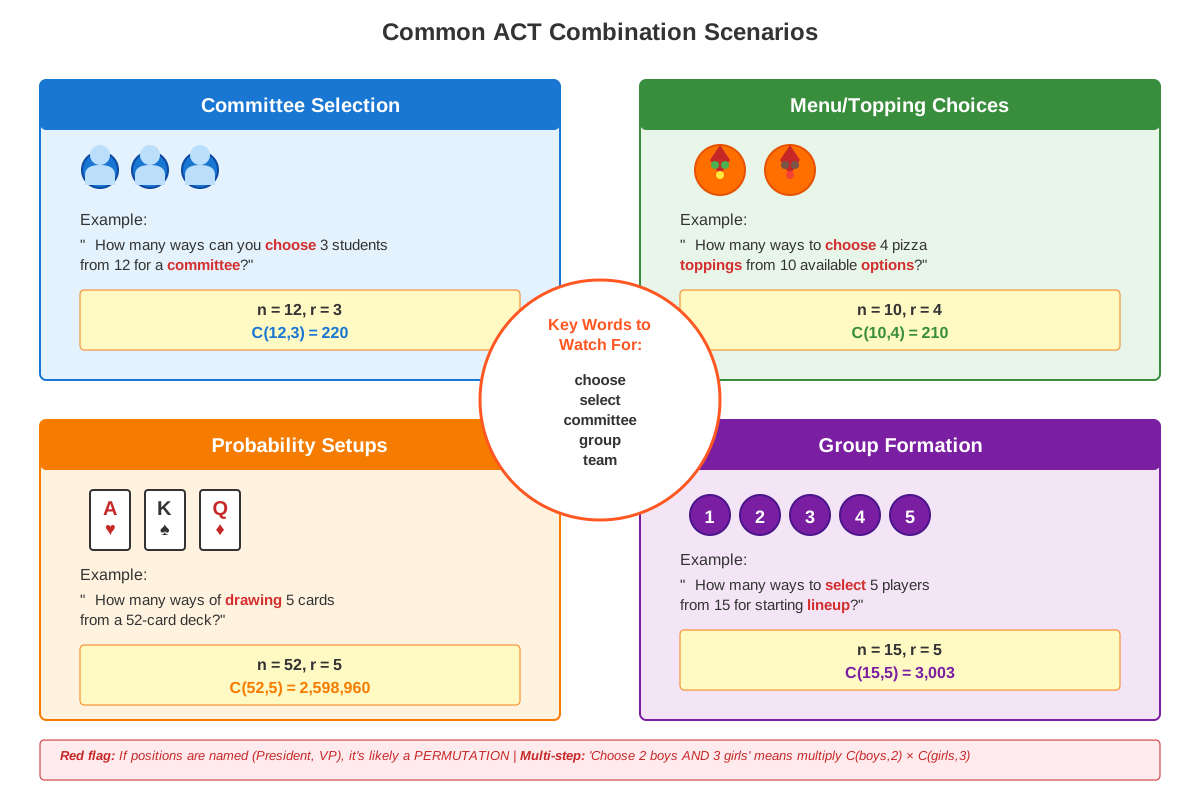
Combinations appear throughout real-world decision-making scenarios. Businesses use combinations to determine how many different product bundles they can offer, sports leagues use them to calculate tournament schedules, and geneticists apply them to predict inheritance patterns. In everyday life, combinations help answer questions like "How many different 5-card poker hands exist?" or "How many ways can I choose 3 vacation destinations from 10 options?"
On the ACT Math section, combinations appear in 1-2 questions per test, representing approximately 1.5-3% of the total Math score. These questions typically appear as:
- Direct counting problems ("How many ways can you select...")
- Probability problems requiring combinations to count favorable outcomes
- Word problems involving team selection, committee formation, or group arrangements
- Multi-step problems where combinations represent one calculation step
The ACT favors combination problems with relatively small numbers (typically selecting 2-5 items from groups of 5-15 items) to keep calculations manageable without a scientific calculator. Questions often include distractors that represent permutation answers or incorrect applications of the formula, testing whether students truly understand when order matters versus when it doesn't.
Core Concepts
The Fundamental Definition of Combinations
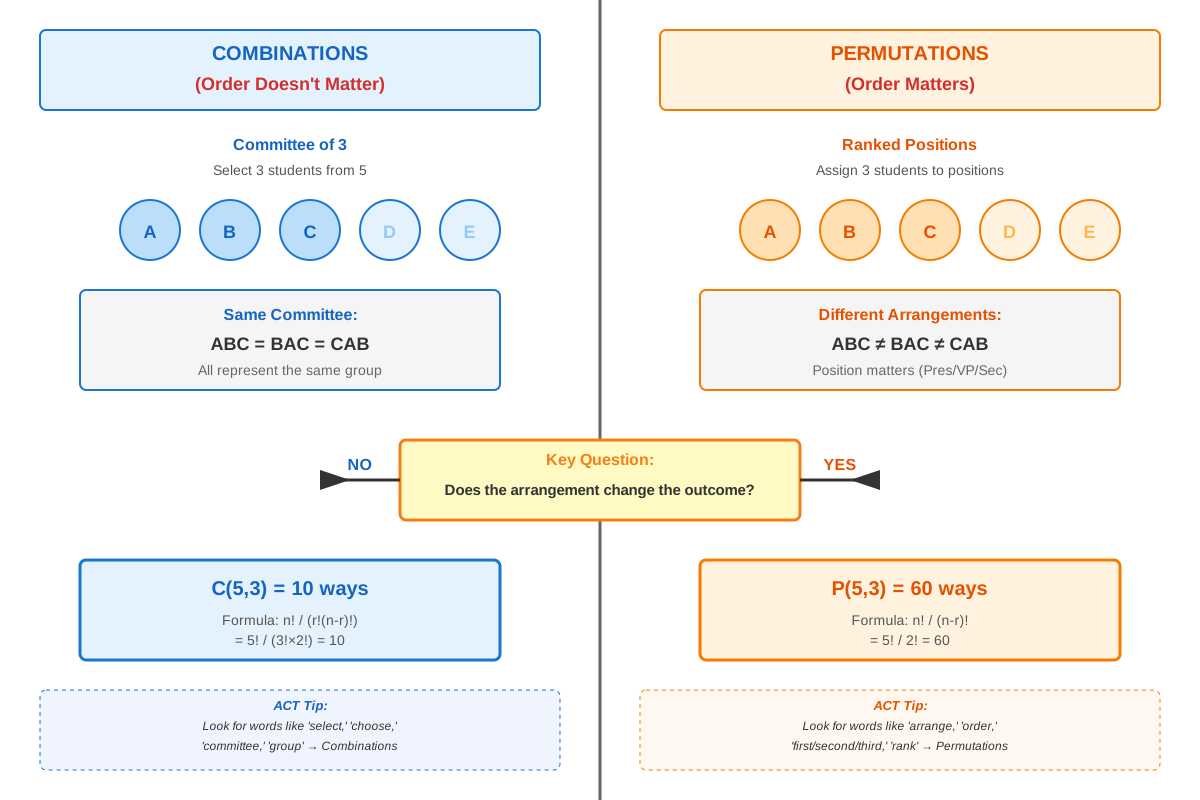
A combination is a selection of items from a larger set where the order of selection does not matter. When choosing 3 students from a class of 10 to form a study group, selecting Amy-Bob-Carlos produces the same group as selecting Carlos-Amy-Bob. This "order doesn't matter" characteristic distinguishes combinations from permutations.
The mathematical notation for combinations is C(n,r), nCr, or the binomial coefficient notation ⁿCᵣ, where:
- n represents the total number of items available
- r represents the number of items being selected
All three notations mean "the number of ways to choose r items from n items."
The Combinations Formula
The combinations formula calculates how many ways you can select r items from n total items:
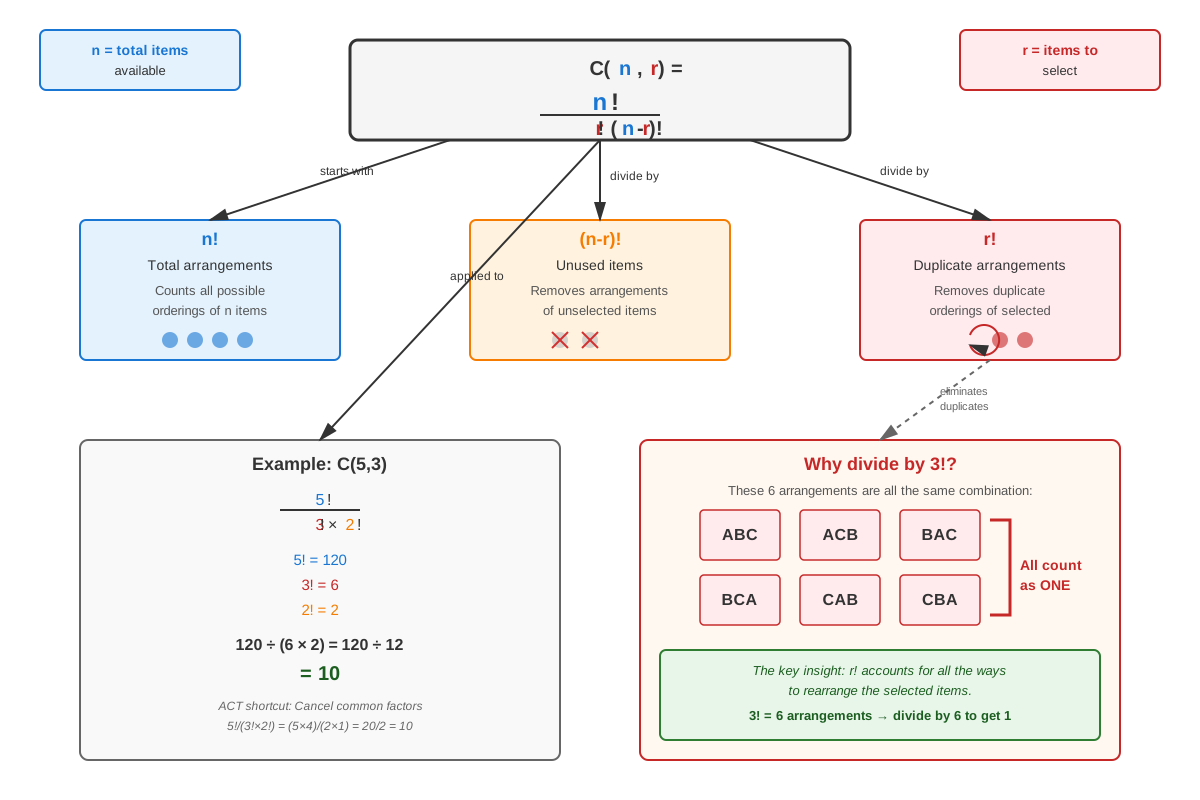
C(n,r) = n! / (r! × (n-r)!)This formula works by:
- Starting with n! (all possible arrangements of n items)
- Dividing by r! to eliminate the different orderings within the selected group
- Dividing by (n-r)! to eliminate the arrangements of the items not selected
Example: To find C(5,2)—choosing 2 items from 5:
C(5,2) = 5! / (2! × 3!)
       = (5 × 4 × 3 × 2 × 1) / ((2 × 1) × (3 × 2 × 1))
       = 120 / (2 × 6)
       = 120 / 12
       = 10
Simplified Calculation Method
Rather than computing full factorials, efficient calculation involves canceling common terms before multiplying:
C(n,r) = (n × (n-1) × (n-2) × ... × (n-r+1)) / r!This means you only multiply r consecutive numbers starting from n, then divide by r!.
Example: For C(8,3):
C(8,3) = (8 × 7 × 6) / (3 × 2 × 1)
       = 336 / 6
       = 56
This method dramatically reduces calculation time and error potential on the ACT.
Key Properties of Combinations
Several mathematical properties help verify answers and solve problems more efficiently:
| Property | Formula | Explanation |
|---|---|---|
| Symmetry | C(n,r) = C(n,n-r) | Choosing r items to include equals choosing (n-r) items to exclude |
| Boundary | C(n,0) = 1 | There's exactly one way to choose nothing |
| Boundary | C(n,n) = 1 | There's exactly one way to choose everything |
| Boundary | C(n,1) = n | Choosing one item from n gives n possibilities |
| Sum | C(n,r) + C(n,r+1) = C(n+1,r+1) | Pascal's triangle relationship |
The symmetry property proves especially useful on the ACT: C(20,18) = C(20,2), making the calculation much simpler.
Distinguishing Combinations from Permutations
The critical skill for ACT success involves recognizing whether order matters:
Combinations (order doesn't matter):
- Selecting committee members
- Choosing pizza toppings
- Picking lottery numbers
- Forming teams
- Selecting cards from a deck
Permutations (order matters):
- Assigning positions (president, vice president, secretary)
- Determining race finishing order
- Creating passwords or lock combinations (ironically!)
- Arranging books on a shelf
- Scheduling presentations
Trigger phrases for combinations:
- "How many groups..."
- "How many ways to select/choose..."
- "How many different teams..."
- "How many combinations..." (when truly asking about combinations)
Calculator Techniques
Most scientific and graphing calculators include a combinations function:
- Often labeled "nCr" or found in a probability menu
- Typically requires entering n, pressing the nCr button, then entering r
- On TI calculators: MATH → PRB → nCr
For the ACT, knowing your calculator's combinations function saves valuable time, but understanding the manual calculation ensures you can verify answers and solve problems even if calculator access is limited.
Combinations in Probability
Combinations frequently appear in probability calculations where you need to count favorable outcomes and total possible outcomes. The probability formula becomes:
P(event) = (favorable combinations) / (total combinations)Example: The probability of drawing exactly 2 aces from a 5-card hand:
- Favorable: C(4,2) × C(48,3) (choose 2 aces from 4, and 3 non-aces from 48)
- Total: C(52,5) (all possible 5-card hands)
Concept Relationships
The combinations concept builds directly on factorial notation, as the formula requires computing factorials and simplifying their quotients. Understanding factorials enables students to manually calculate combinations when calculators aren't available or when verifying calculator results.
Combinations connect intimately with permutations through the relationship: P(n,r) = C(n,r) × r!. This equation shows that permutations equal combinations multiplied by the number of ways to arrange the selected items. Recognizing this relationship helps students check their work and understand why combination values are always less than or equal to corresponding permutation values.
The fundamental counting principle provides the conceptual foundation for combinations. When students understand that multiplying gives total outcomes for sequential choices, they can grasp why the combinations formula divides out the arrangements that don't matter.
Probability theory relies heavily on combinations for counting outcomes. Many ACT probability problems require calculating C(n,r) to determine either favorable outcomes or total possible outcomes, making combinations an essential intermediate skill for probability mastery.
Relationship flow: Fundamental Counting Principle → Factorials → Permutations → Combinations → Probability Applications → Binomial Probability
Within combinations themselves, the symmetry property connects C(n,r) to C(n,n-r), creating computational shortcuts. The boundary conditions (C(n,0), C(n,1), C(n,n)) provide verification points for understanding and checking work.
High-Yield Facts
⭐ The combinations formula is C(n,r) = n! / (r! × (n-r)!), where n is the total items and r is the number selected
⭐ Combinations apply when order doesn't matter; permutations apply when order matters
⭐ C(n,r) = C(n,n-r) due to symmetry—choosing items to include equals choosing items to exclude
⭐ The simplified calculation method multiplies r consecutive integers starting from n, then divides by r!
⭐ Common ACT trigger phrases include "how many ways to select," "how many groups," and "how many teams"
- C(n,0) = 1 and C(n,n) = 1 for any positive integer n
- C(n,1) = n because there are n ways to choose one item from n items
- Combinations always produce whole number results—if your calculation gives a decimal, you've made an error
- The maximum value of C(n,r) occurs when r = n/2 (or the closest integers if n is odd)
- Most ACT combination problems involve selecting 2-5 items from groups of 5-20 items
- Calculator nCr functions save time but require knowing where to find them on your specific calculator model
- Combination problems often appear disguised as probability questions requiring counting outcomes
- When a problem asks about "at least" or "at most," it may require calculating multiple combinations and adding them
Quick check — test yourself on Combinations so far.
Try Flashcards →Common Misconceptions
Misconception: Combinations and permutations are the same thing, just with different formulas.
Correction: Combinations and permutations solve fundamentally different problems. Combinations count selections where order doesn't matter (choosing team members), while permutations count arrangements where order matters (assigning team positions). The permutation formula P(n,r) = n!/(n-r)! is larger than C(n,r) by exactly a factor of r! because it includes all the different orderings.
Misconception: The phrase "lock combination" means order doesn't matter.
Correction: Despite the name, a "lock combination" is actually a permutation problem because the order of numbers matters (1-2-3 is different from 3-2-1). This is a historical misnomer that confuses many students. On the ACT, focus on whether the problem's context requires order to matter, not on the specific words used.
Misconception: You can only use the combinations formula when selecting items from a single group.
Correction: Many ACT problems require multiple combination calculations. For example, "Choose 2 boys from 5 boys and 3 girls from 7 girls" requires calculating C(5,2) × C(7,3) and multiplying the results. The multiplication principle applies to combinations just as it does to other counting methods.
Misconception: C(n,r) can be larger than n.
Correction: The number of ways to choose r items from n items can never exceed the total number of items when r > 1. However, C(n,r) can be larger than n when r is close to n/2. For example, C(10,5) = 252, which is much larger than 10. The misconception confuses the number of combinations with the number of items available.
Misconception: When calculating C(n,r), you must compute the full factorials before dividing.
Correction: Computing full factorials wastes time and increases error risk. Instead, cancel common factors before multiplying. For C(8,3), write (8×7×6)/(3×2×1) and cancel the 6 with 3×2 to get (8×7)/1 = 56. This simplified method is faster and less error-prone, crucial for ACT time management.
Misconception: If a problem mentions "probability," you don't need combinations.
Correction: Many ACT probability problems require combinations to count favorable or total outcomes. For example, "What's the probability of drawing 3 red cards from a deck?" requires C(26,3) for favorable outcomes and C(52,3) for total outcomes. Combinations and probability frequently appear together on the ACT.
Worked Examples
Example 1: Direct Combination Problem
Problem: A student council must select 4 representatives from 9 qualified candidates. How many different groups of 4 representatives can be formed?
Solution:
Step 1: Identify the problem type.
The question asks "how many different groups," which signals combinations because the order of selection doesn't matter. Selecting Amy-Bob-Carlos-Diana creates the same group as Diana-Carlos-Amy-Bob.
Step 2: Identify n and r.
- n = 9 (total candidates)
- r = 4 (representatives to select)
Step 3: Apply the combinations formula using the simplified method.
C(9,4) = (9 × 8 × 7 × 6) / (4 × 3 × 2 × 1)Step 4: Simplify before calculating.
Notice that 8 = 4 × 2 and 6 = 3 × 2, so we can cancel:
C(9,4) = (9 × 8 × 7 × 6) / (4 × 3 × 2 × 1)
       = (9 × 2 × 7 × 2) / 1
       = 9 × 7 × 4
       = 252
Step 5: Verify using symmetry.
C(9,4) = C(9,5), so we could also calculate (9×8×7×6×5)/(5×4×3×2×1) = 126, but this is incorrect—we made an error. Let's recalculate:
C(9,4) = (9 × 8 × 7 × 6) / 24
       = 3024 / 24
= 126Answer: 126 different groups can be formed.
Connection to learning objectives: This problem directly tests the ability to identify when combinations apply (order doesn't matter in group selection) and apply the formula accurately.
Example 2: Combination with Probability
Problem: A bag contains 5 red marbles, 4 blue marbles, and 3 green marbles. If you randomly select 3 marbles without replacement, what is the probability that exactly 2 are red?
Solution:
Step 1: Identify what's being asked.
We need P(exactly 2 red marbles in 3 selections), which requires counting favorable outcomes and total outcomes using combinations.
Step 2: Calculate total possible outcomes.
Total marbles: 5 + 4 + 3 = 12
Total ways to select 3 marbles from 12:
C(12,3) = (12 × 11 × 10) / (3 × 2 × 1)
        = 1320 / 6
        = 220
Step 3: Calculate favorable outcomes.
"Exactly 2 red" means 2 red marbles AND 1 non-red marble.
- Ways to choose 2 red from 5 red: C(5,2)
- Ways to choose 1 non-red from 7 non-red: C(7,1)
- Total favorable outcomes: C(5,2) × C(7,1)
C(5,2) = (5 × 4) / (2 × 1) = 20 / 2 = 10
C(7,1) = 7
Favorable = 10 × 7 = 70
Step 4: Calculate probability.
P(exactly 2 red) = 70 / 220 = 7 / 22Answer: The probability is 7/22 (approximately 0.318 or 31.8%).
Connection to learning objectives: This problem demonstrates how combinations appear in multi-step ACT problems, requiring students to recognize that probability calculations often depend on combination calculations for counting outcomes.
Exam Strategy
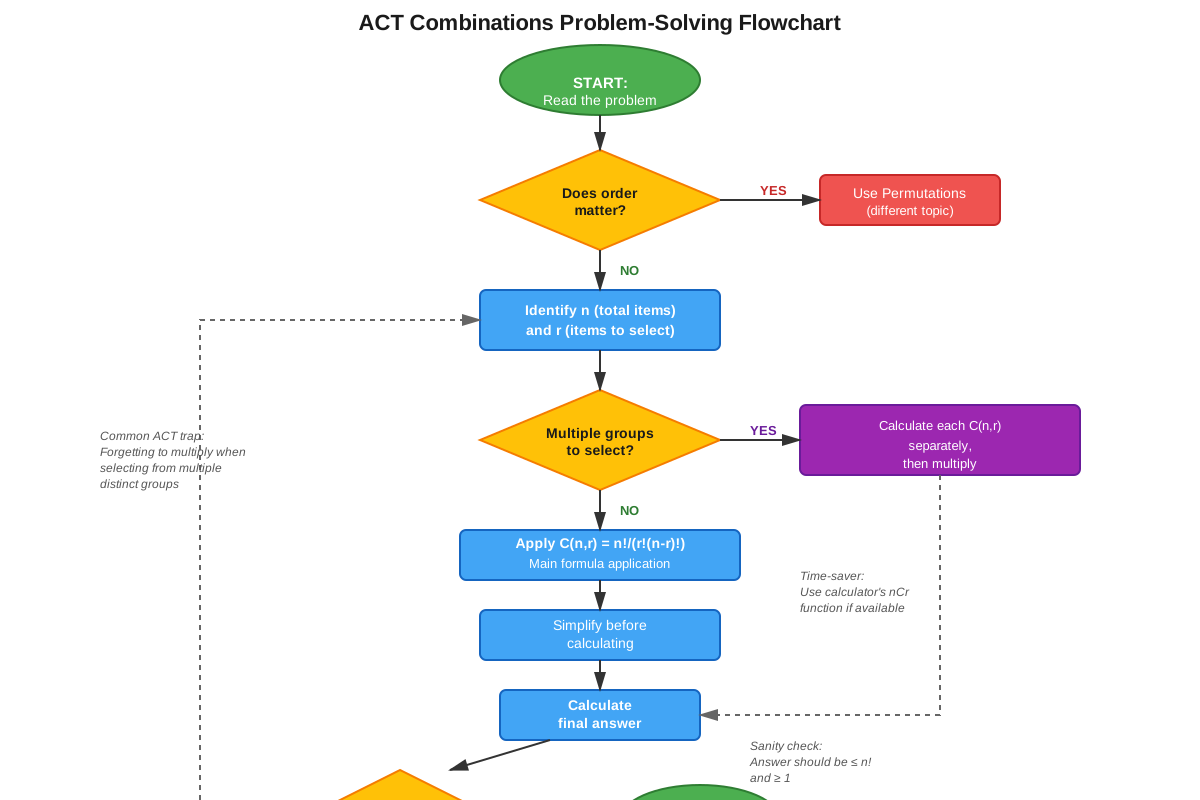
When approaching ACT combinations questions, follow this systematic process:
Step 1: Identify the problem type (15-20 seconds)
Look for trigger phrases:
- "How many ways to select/choose"
- "How many different groups/teams/committees"
- "How many combinations"
Ask yourself: "Does the order of selection matter?" If no, it's combinations.
Step 2: Extract n and r (10 seconds)
- n = total items available
- r = number of items being selected
- Watch for problems requiring multiple combinations (selecting from different groups)
Step 3: Choose your calculation method (5 seconds)
- If your calculator has nCr and you know how to use it: use it
- If n and r are small (both under 10): manual calculation is often faster
- If one of r or (n-r) is very small: use the simplified formula
Step 4: Calculate and simplify (30-45 seconds)
- Cancel common factors before multiplying
- Verify your answer makes sense (should be a whole number)
- Use symmetry if it simplifies calculation: C(20,18) = C(20,2)
Step 5: Check answer choices (10 seconds)
- Eliminate answers that represent permutations (usually much larger)
- Eliminate answers that exceed n when r is small
- Verify your answer appears among the choices
Time-saving tip: If you see C(n,r) where r > n/2, immediately convert to C(n,n-r) for easier calculation.
Process of elimination strategies:
- If an answer choice equals n!/(n-r)!, it's the permutation answer—eliminate it
- If an answer choice equals n×r, it's from incorrectly applying the multiplication principle—eliminate it
- If an answer choice is larger than the permutation answer, it's mathematically impossible—eliminate it
Common trap answers:
- P(n,r) instead of C(n,r)—the permutation answer
- n×r—from misapplying the fundamental counting principle
- C(n,r)×r!—an intermediate calculation, not the final answer
Time allocation: Budget 60-90 seconds for straightforward combination problems, up to 2 minutes for multi-step problems involving probability or multiple selections.
Memory Techniques
Mnemonic for Combinations vs. Permutations: "Combinations = Choosing (order doesn't matter); Permutations = Positions (order matters)"
Formula memory: Think "n Choose r" = n! / (r! × rest!)
The "rest" is (n-r), the items not chosen. This helps remember both factorials in the denominator.
Visualization strategy: Picture a lineup of people. For permutations, they're standing in specific positions (order matters). For combinations, they're in a group photo where position doesn't matter—you're just counting who's in the photo.
Acronym for problem-solving steps: ICES
- Identify (is it combinations?)
- Count (what are n and r?)
- Evaluate (calculate C(n,r))
- Simplify (reduce the fraction)
Symmetry reminder: "Selecting is the Same as excluding" helps remember C(n,r) = C(n,n-r)
Boundary conditions memory: "Zero ways to choose nothing? No—One way!" (C(n,0) = 1) and "One way to choose One? No—N ways!" (C(n,1) = n)
Summary
Combinations represent a fundamental counting technique for selecting items when order doesn't matter, appearing regularly on the ACT Math section in both direct counting problems and probability applications. The combinations formula C(n,r) = n!/(r!×(n-r)!) calculates how many ways to choose r items from n total items by dividing out the arrangements that don't affect the selection. Success on ACT combination problems requires three core skills: recognizing when order doesn't matter (distinguishing combinations from permutations), efficiently calculating using the simplified method that multiplies r consecutive integers starting from n then divides by r!, and applying combinations to multi-step problems involving probability or multiple selections. The symmetry property C(n,r) = C(n,n-r) provides computational shortcuts, while boundary conditions like C(n,0) = 1 and C(n,1) = n help verify understanding. Most ACT problems involve selecting 2-5 items from groups of 5-20 items, making manual calculation feasible even without calculator functions, though knowing your calculator's nCr function saves valuable time under test conditions.
Key Takeaways
- Combinations apply when order doesn't matter—selecting team members, choosing toppings, or forming committees all use combinations because rearranging the selection doesn't create a different outcome
- The formula C(n,r) = n!/(r!×(n-r)!) simplifies to multiplying r consecutive integers from n, then dividing by r!, making calculation faster and reducing errors
- Trigger phrases like "how many ways to select," "how many groups," and "how many teams" signal combination problems on the ACT
- The symmetry property C(n,r) = C(n,n-r) provides calculation shortcuts—always choose the smaller value between r and (n-r) for easier computation
- Combinations frequently appear in probability problems where you must count favorable outcomes and total possible outcomes
- Distinguish combinations from permutations by asking "Does order matter?"—if yes, use permutations; if no, use combinations
- Verify answers are whole numbers and reasonable—combinations always produce integers, and C(n,r) should never exceed the permutation value P(n,r)
Related Topics
Permutations: While combinations count selections where order doesn't matter, permutations count arrangements where order matters. Mastering combinations provides the foundation for understanding permutations through the relationship P(n,r) = C(n,r) × r!.
Probability: Many probability problems require combinations to count favorable and total outcomes. Understanding combinations enables solving complex probability questions involving card games, lottery odds, and random selection scenarios.
Binomial Probability: The binomial probability formula uses combinations to calculate the probability of exactly k successes in n trials. The term C(n,k) appears directly in the binomial probability formula.
Pascal's Triangle: This triangular array of numbers contains all combination values, with C(n,r) appearing in row n, position r. Understanding combinations helps interpret Pascal's Triangle patterns and properties.
Factorial Properties: Deeper exploration of factorial notation, including Stirling's approximation and factorial simplification techniques, builds on the factorial foundation required for combinations.
Practice CTA
Now that you've mastered the core concepts of combinations, it's time to solidify your understanding through practice! Attempt the practice questions to test your ability to identify combination problems, apply the formula efficiently, and distinguish combinations from permutations under timed conditions. Use the flashcards to reinforce the formula, key properties, and trigger phrases that signal combination problems on the ACT. Remember: combinations appear on virtually every ACT Math section, so investing time in practice now will pay dividends on test day. You've built the foundation—now strengthen it through deliberate practice!
Sign up free to keep reading
Create a free AnvayaPrep account to finish this ACT guide on Combinations — plus flashcards and practice questions.