Overview
Permutations represent one of the most frequently tested counting principles on the ACT Math section, appearing in approximately 1-2 questions per exam. Understanding permutations is essential for solving problems that ask "in how many ways" something can be arranged or ordered. These questions test a student's ability to count arrangements systematically without listing every possibility—a critical skill when dealing with large numbers of options. The ACT specifically favors permutation problems involving arranging people in a line, selecting officers for distinct positions, or determining the number of ways to order items where sequence matters.
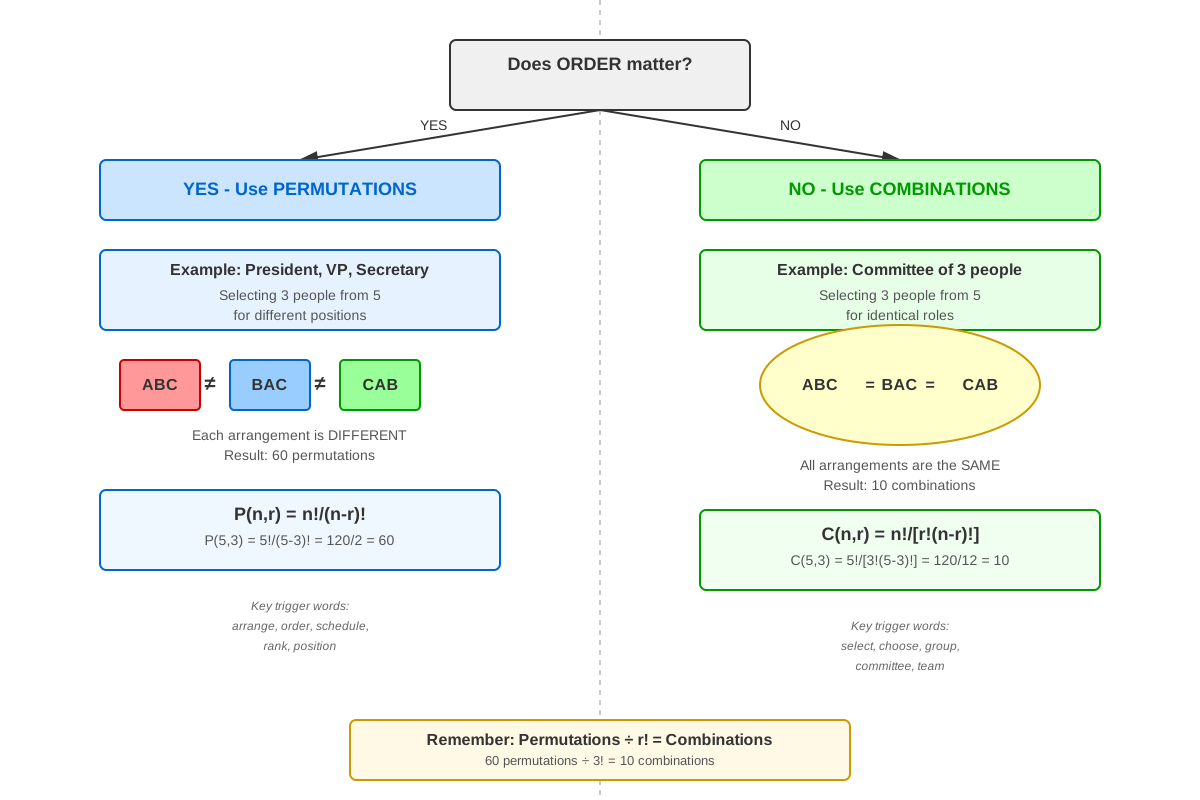
The fundamental principle behind permutations is that order matters. When arranging five books on a shelf, placing Book A first and Book B second creates a different arrangement than placing Book B first and Book A second. This distinguishes permutations from combinations, where order is irrelevant. The ACT tests this distinction regularly, making it crucial to identify whether a problem requires permutations or combinations. Mastering ACT permutations requires recognizing trigger words, applying the correct formula, and understanding when to account for restrictions or repetitions.
Permutations connect to broader mathematical concepts including factorial notation, the fundamental counting principle, and probability. Many ACT probability questions require calculating permutations as an intermediate step. Additionally, permutation problems often integrate with other algebra concepts such as solving equations and simplifying expressions. This topic serves as a bridge between basic counting and more advanced probability theory, making it a high-yield area for score improvement.
Learning Objectives
- [ ] Identify when Permutations is being tested
- [ ] Explain the core rule or strategy behind Permutations
- [ ] Apply Permutations to ACT-style questions accurately
- [ ] Distinguish between permutation and combination problems based on context
- [ ] Calculate permutations with and without restrictions (such as fixed positions or repeated elements)
- [ ] Solve multi-step problems that combine permutations with other counting principles
- [ ] Recognize and apply factorial notation efficiently in permutation calculations
Prerequisites
- Factorial notation (n!): Understanding that n! = n × (n-1) × (n-2) × ... × 2 × 1 is essential because permutation formulas are expressed using factorials
- Basic multiplication principle: The fundamental counting principle (if event A can occur in m ways and event B in n ways, both can occur in m × n ways) forms the foundation of permutation logic
- Order of operations: Correctly simplifying expressions with factorials, division, and multiplication is necessary for calculating permutation values
- Basic algebraic manipulation: Solving equations involving permutations requires isolating variables and simplifying factorial expressions
Why This Topic Matters
Permutations have practical applications throughout daily life and professional fields. Event planners use permutations to determine seating arrangements for guests. Computer scientists apply permutations in algorithm design and cryptography. Geneticists calculate permutations when analyzing DNA sequences. Businesses use permutations to schedule employees, arrange product displays, and optimize processes. Understanding permutations develops logical thinking and systematic problem-solving skills that extend far beyond mathematics.
On the ACT Math section, permutation questions typically appear 1-2 times per exam, usually in the latter half of the test where questions increase in difficulty. These problems are worth the same single point as easier questions, making them high-value targets for students aiming for scores above 28. The ACT presents permutation problems in several formats: direct calculation questions ("How many ways can 5 people be arranged in a line?"), word problems requiring interpretation ("How many different 4-letter passwords can be formed?"), and multi-step problems combining permutations with other concepts.
Common ACT question types include: arranging distinct objects in a line, selecting and arranging a subset of objects, arranging objects with restrictions (such as certain items that must be adjacent or separated), and circular arrangements. The test writers frequently include combination problems alongside permutation problems to assess whether students can distinguish between scenarios where order matters versus where it doesn't. Recognizing the difference between these problem types is often the key to selecting the correct answer.
Core Concepts
Definition of Permutations
A permutation is an arrangement of objects in a specific order. The defining characteristic is that changing the order creates a different permutation. For example, the letters A, B, and C can be arranged in six different permutations: ABC, ACB, BAC, BCA, CAB, and CBA. Each arrangement is distinct because the position of each letter matters.
The number of permutations of n distinct objects taken all at once is calculated using the formula:
P(n) = n!Where n! (read as "n factorial") equals n × (n-1) × (n-2) × ... × 2 × 1. For instance, 5! = 5 × 4 × 3 × 2 × 1 = 120, meaning five distinct objects can be arranged in 120 different ways.
Permutations of n Objects Taken r at a Time
Often, problems require selecting and arranging only some objects from a larger set. The formula for the number of permutations of n objects taken r at a time is:
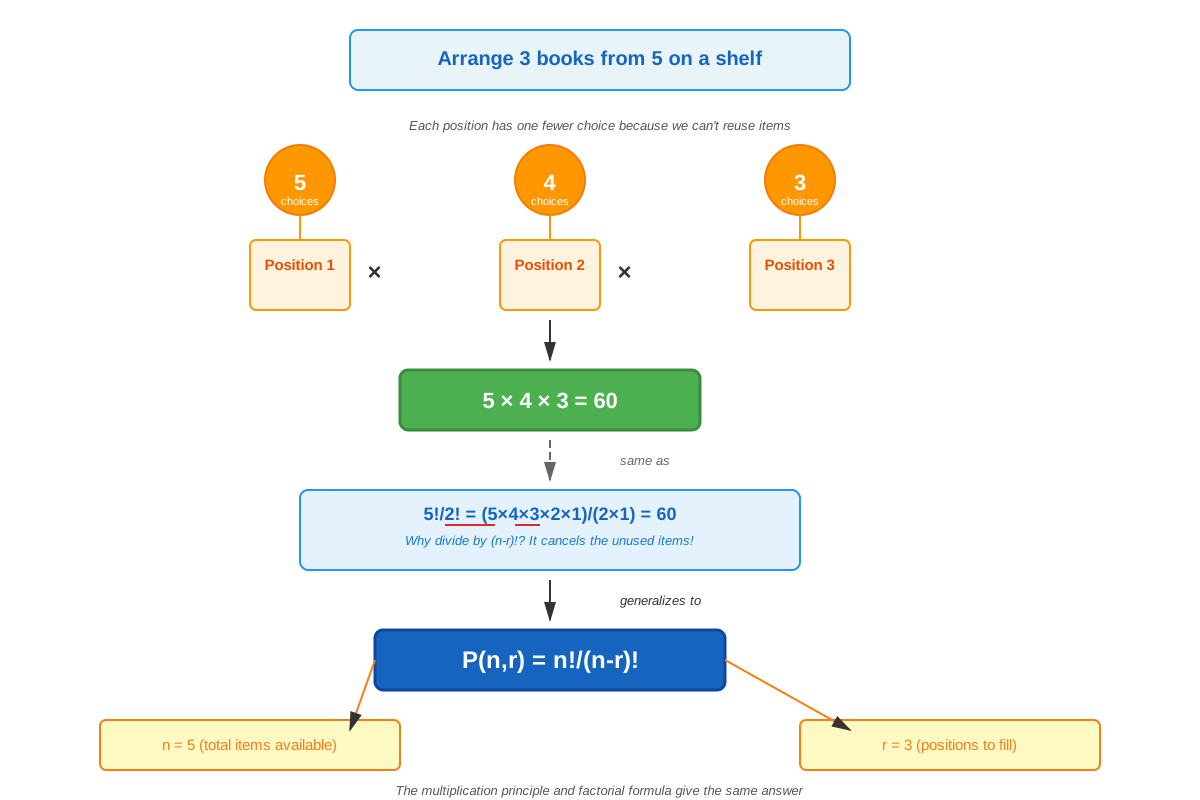
P(n,r) = n!/(n-r)!This formula can also be written as nPr. For example, if selecting and arranging 3 books from a shelf of 7 books, the calculation would be:
P(7,3) = 7!/(7-3)! = 7!/4! = (7 × 6 × 5 × 4!)/(4!) = 7 × 6 × 5 = 210The logic behind this formula: there are 7 choices for the first position, 6 remaining choices for the second position, and 5 remaining choices for the third position. Multiplying these gives 7 × 6 × 5 = 210.
The Fundamental Counting Principle Applied to Permutations
The fundamental counting principle states that if one event can occur in m ways and a second independent event can occur in n ways, then both events can occur in m × n ways. This principle underlies all permutation calculations.
When arranging objects in sequence:
- Count the number of choices for the first position
- Count the number of remaining choices for the second position
- Continue for all positions
- Multiply all the choices together
For example, arranging 4 different colored flags in a row: 4 choices for first position × 3 choices for second × 2 choices for third × 1 choice for fourth = 4! = 24 permutations.
Permutations with Restrictions
ACT problems frequently include restrictions that limit how objects can be arranged. Common restriction types include:
Fixed Position Restrictions: When certain objects must occupy specific positions, handle the restricted positions first, then arrange the remaining objects.
Example: Arranging 5 people in a line where person A must be first. Since position 1 is fixed (1 way), arrange the remaining 4 people in the other 4 positions: 1 × 4! = 24 permutations.
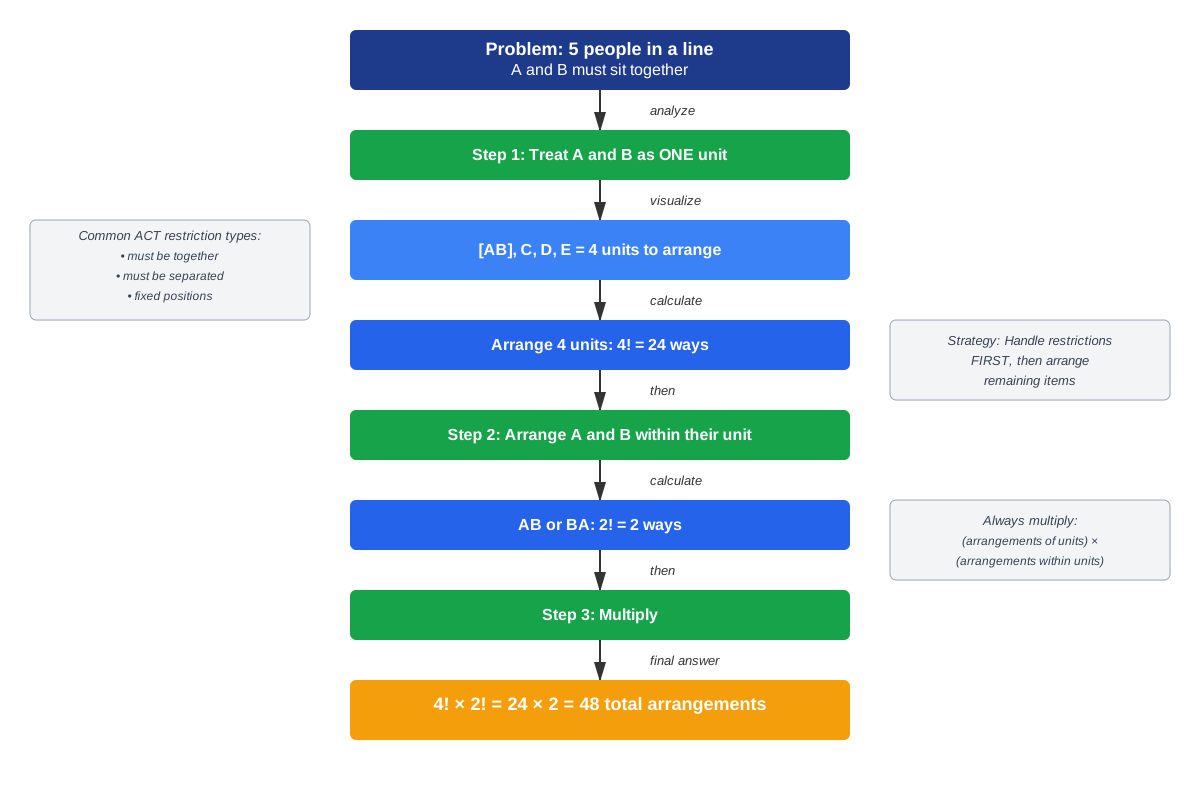
Adjacent Objects: When certain objects must be next to each other, treat them as a single unit, calculate arrangements of the units, then calculate arrangements within the unit.
Example: Arranging 5 people where two specific people must stand together. Treat the pair as one unit, giving 4 units to arrange (4! ways). The pair can be arranged internally in 2! ways. Total: 4! × 2! = 24 × 2 = 48 permutations.
Separated Objects: When certain objects must NOT be adjacent, calculate total permutations without restrictions, then subtract the permutations where the objects are adjacent.
Permutations with Repetition
When objects are not all distinct (some are identical), the formula adjusts to avoid overcounting:
P = n!/(n₁! × n₂! × ... × nₖ!)Where n is the total number of objects, and n₁, n₂, ..., nₖ are the frequencies of each repeated object.
Example: Arranging the letters in MISSISSIPPI (11 letters total: 1 M, 4 I's, 4 S's, 2 P's):
P = 11!/(1! × 4! × 4! × 2!) = 34,650Circular Permutations
When arranging objects in a circle, rotations that look identical are considered the same arrangement. The number of circular permutations of n distinct objects is:
P_circular = (n-1)!This formula accounts for the fact that rotating everyone one position clockwise creates the same circular arrangement. For 5 people sitting around a circular table: (5-1)! = 4! = 24 distinct arrangements.
Comparison Table
| Scenario | Formula | Example | Result |
|---|---|---|---|
| All n objects arranged | n! | 5 books on shelf | 5! = 120 |
| r objects from n arranged | n!/(n-r)! | 3 books from 7 | 7!/4! = 210 |
| n objects with repetition | n!/(n₁!×n₂!×...) | Letters in NOON | 4!/(2!×2!) = 6 |
| n objects in circle | (n-1)! | 6 people at round table | 5! = 120 |
| Objects with restrictions | Varies | A must be first from 5 | 1 × 4! = 24 |
Concept Relationships
The concepts within permutations build hierarchically. Understanding factorial notation forms the foundation → which enables calculating basic permutations of n objects → which extends to permutations of r objects from n → which then incorporates restrictions and special cases (adjacent, separated, fixed positions) → and finally addresses permutations with repetition and circular permutations.
Permutations connect directly to prerequisite topics: the fundamental counting principle provides the logical basis for why permutation formulas work, while factorial notation provides the mathematical language for expressing permutation calculations efficiently. Strong algebraic manipulation skills enable students to simplify complex permutation expressions and solve equations involving permutations.
Permutations relate closely to combinations (the next topic in most curricula). The key relationship: combinations count selections without regard to order, while permutations count arrangements where order matters. Mathematically, P(n,r) = C(n,r) × r!, showing that permutations equal combinations multiplied by the arrangements of the selected objects.
Permutations also connect to probability. Many probability problems require calculating favorable permutations divided by total permutations. For example, finding the probability that two specific people sit together in a random arrangement requires calculating permutations with restrictions (numerator) divided by total permutations (denominator).
Quick check — test yourself on Permutations so far.
Try Flashcards →High-Yield Facts
⭐ The fundamental distinction: Permutations are used when order matters; combinations are used when order doesn't matter
⭐ The basic permutation formula: P(n,r) = n!/(n-r)! calculates arrangements of r objects selected from n objects
⭐ Factorial definition: n! = n × (n-1) × (n-2) × ... × 2 × 1, with the special case that 0! = 1
⭐ Permutations of all n objects: When arranging all n distinct objects, the answer is simply n!
⭐ The multiplication principle: When making sequential choices, multiply the number of options at each step
- Circular permutations of n objects equal (n-1)! because rotations are considered identical
- When objects must be adjacent, treat them as a single unit, then multiply by arrangements within the unit
- When calculating permutations with repetition, divide n! by the factorial of each repeated element's frequency
- To handle "must not be adjacent" restrictions, subtract adjacent arrangements from total arrangements
- The number of ways to arrange n objects where some are identical is always less than n!
Common Misconceptions
Misconception: Permutations and combinations are the same thing → Correction: Permutations count arrangements where order matters (ABC ≠ BAC), while combinations count selections where order doesn't matter (choosing {A,B,C} is the same as choosing {C,B,A}). ACT questions test this distinction by using trigger words: "arrange," "order," "schedule" suggest permutations, while "select," "choose," "committee" suggest combinations.
Misconception: The formula P(n,r) = n!/r! → Correction: The correct formula is P(n,r) = n!/(n-r)!. The denominator is (n-r)!, not r!. This error leads to dramatically incorrect answers. For P(7,3), the correct calculation is 7!/4! = 210, not 7!/3! = 840.
Misconception: When two people must sit together, just multiply the total arrangements by 2 → Correction: Treat the pair as a single unit, calculate arrangements of the units, then multiply by arrangements within the unit. For 5 people where 2 must sit together: treat as 4 units, giving 4! arrangements, then multiply by 2! internal arrangements of the pair: 4! × 2! = 48, not 5! × 2 = 240.
Misconception: Circular permutations equal regular permutations → Correction: Circular permutations equal (n-1)! because rotations are identical. Five people in a line can be arranged in 5! = 120 ways, but around a circular table only (5-1)! = 24 ways because each arrangement has 5 rotational equivalents.
Misconception: All permutation problems use the formula P(n,r) → Correction: Many ACT permutation problems are solved more efficiently using the fundamental counting principle directly. For a 3-digit code using digits 1-9 without repetition: 9 × 8 × 7 = 504 is faster than writing P(9,3) = 9!/6! = 504. Choose the method that's quickest for the specific problem.
Misconception: When letters repeat in a word, use the regular permutation formula → Correction: Use the adjusted formula n!/(n₁!×n₂!×...) to avoid overcounting. The letters in BOOK can be arranged in 4!/(2!) = 12 ways, not 4! = 24 ways, because the two O's are indistinguishable.
Worked Examples
Example 1: Basic Permutation with Selection
Problem: A student must read 4 books from a list of 9 books, and the order in which they're read matters for a class presentation. How many different reading orders are possible?
Solution:
Step 1: Identify that this is a permutation problem because order matters (reading Book A first then Book B second is different from reading Book B first then Book A second).
Step 2: Recognize this is selecting and arranging r objects from n objects: n = 9 books, r = 4 books to select and arrange.
Step 3: Apply the permutation formula P(n,r) = n!/(n-r)!
P(9,4) = 9!/(9-4)! = 9!/5!Step 4: Simplify by canceling the common factorial:
P(9,4) = (9 × 8 × 7 × 6 × 5!)/(5!) = 9 × 8 × 7 × 6Step 5: Calculate:
9 × 8 = 72
72 × 7 = 504
504 × 6 = 3,024Answer: 3,024 different reading orders are possible.
Connection to Learning Objectives: This example demonstrates identifying a permutation problem (order matters), applying the correct formula P(n,r), and accurately calculating the result—addressing all three primary learning objectives.
Example 2: Permutation with Restrictions
Problem: Seven students are arranged in a row for a photograph. If two specific students (Alice and Bob) must NOT stand next to each other, how many arrangements are possible?
Solution:
Step 1: Use the complementary counting strategy: Total arrangements minus arrangements where Alice and Bob ARE adjacent.
Step 2: Calculate total arrangements without restrictions:
- 7 students can be arranged in 7! ways
- 7! = 5,040
Step 3: Calculate arrangements where Alice and Bob ARE adjacent:
- Treat Alice and Bob as a single unit
- Now have 6 units to arrange: 6! ways
- Alice and Bob can be arranged within their unit: 2! ways
- Total with Alice and Bob adjacent: 6! × 2! = 720 × 2 = 1,440
Step 4: Subtract to find arrangements where they're NOT adjacent:
Total - Adjacent = 5,040 - 1,440 = 3,600Answer: 3,600 arrangements are possible where Alice and Bob do not stand next to each other.
Connection to Learning Objectives: This example shows how to handle restrictions in permutation problems, demonstrating advanced application of permutation concepts to ACT-style questions with constraints.
Exam Strategy
When approaching ACT permutations questions, follow this systematic process:
Step 1: Identify if order matters. Look for trigger words:
- Permutation indicators: "arrange," "order," "schedule," "sequence," "first, second, third," "different passwords," "license plates"
- Combination indicators: "select," "choose," "committee," "group," "team" (where positions aren't specified)
Step 2: Determine what's being counted. Ask: "Am I arranging all objects or selecting some?" This determines whether to use n! or P(n,r).
Step 3: Check for restrictions. Common ACT restrictions include:
- Fixed positions ("Person A must be first")
- Adjacent requirements ("Two people must sit together")
- Separation requirements ("Two people must NOT sit together")
- Repetition ("Letters can be repeated" vs. "without repetition")
Step 4: Choose your calculation method:
- For straightforward problems, use the fundamental counting principle (multiply choices at each step)
- For problems with the phrase "n objects taken r at a time," use P(n,r) = n!/(n-r)!
- For restrictions, use complementary counting or the unit method
Exam Tip: On the ACT, if a problem seems to require calculating a factorial larger than 10!, you've likely misunderstood the problem. The test is designed for non-calculator solutions, so answers typically involve simplification before calculation.
Time allocation: Spend 30-45 seconds identifying the problem type and strategy, then 45-60 seconds calculating. If you're not making progress after 1 minute, mark the question and return to it later.
Process of elimination tips:
- If order doesn't matter but you calculated a permutation, your answer will be too large (eliminate smaller answer choices)
- Permutation answers are always whole numbers (eliminate decimals and fractions)
- For "n objects taken r at a time," the answer must be less than n! (eliminate larger values)
- If restrictions reduce possibilities, the answer must be less than the unrestricted case
Common trap answers: ACT test writers often include:
- The combination value when permutation is needed (or vice versa)
- The result of using n!/r! instead of n!/(n-r)!
- The unrestricted total when restrictions apply
- Results from forgetting to multiply by internal arrangements
Memory Techniques
Mnemonic for Permutation vs. Combination: "Permutation = Position matters" (both start with P). When position/order matters, use permutations.
Factorial Visualization: Picture factorial as a "shrinking choice" scenario. For 5!, imagine: 5 choices for first position, then 4 remaining choices, then 3, then 2, then 1. Visualizing the choices decreasing helps remember why we multiply descending numbers.
Formula Memory Device: For P(n,r) = n!/(n-r)!, remember "Numerator has Nothing removed" (full n!), while the denominator has r removed from n (n-r)!.
Restriction Strategy Acronym - FAST:
- Fix restricted positions first
- Adjacent items become units
- Subtract when items must separate
- Treat identical items with division
Circular Permutation Reminder: "Circular = Cut one" (both start with C). For circular arrangements, "cut" one position by using (n-1)! instead of n!.
Repetition Formula Memory: "Divide by the Repeat Factorials" - when letters or objects repeat, divide n! by the factorial of each repeated element's frequency.
Summary
Permutations represent a fundamental counting principle where order matters, distinguishing them from combinations where order is irrelevant. The ACT tests permutations through direct calculation problems, word problems requiring interpretation, and multi-step problems with restrictions. The core formula P(n,r) = n!/(n-r)! calculates arrangements of r objects selected from n total objects, while n! handles arrangements of all n objects. Success on ACT permutation questions requires recognizing trigger words that indicate order matters, applying the appropriate formula or counting principle, and correctly handling restrictions such as fixed positions, adjacent requirements, or repeated elements. The fundamental counting principle—multiplying the number of choices at each sequential step—underlies all permutation calculations and often provides the most efficient solution path. Students must distinguish between scenarios requiring permutations versus combinations, as this distinction appears frequently on the ACT. Mastering permutations involves understanding when to use formulas versus direct counting, how to handle special cases like circular arrangements and repetition, and how to apply complementary counting for restriction problems.
Key Takeaways
- Permutations count arrangements where order matters; the sequence ABC is different from BAC, making this distinct from combinations
- The formula P(n,r) = n!/(n-r)! calculates permutations of r objects selected from n objects, while arranging all n objects simply equals n!
- Identify permutation problems through trigger words like "arrange," "order," "schedule," and "sequence" that indicate position matters
- Handle restrictions systematically: fix required positions first, treat adjacent items as single units, or use complementary counting for separation requirements
- The fundamental counting principle (multiplying choices at each step) often provides the fastest solution method for ACT permutation questions
- Circular permutations equal (n-1)! because rotations are considered identical arrangements
- When objects repeat, divide n! by the factorial of each repeated element's frequency to avoid overcounting identical arrangements
Related Topics
Combinations: After mastering permutations, study combinations where order doesn't matter. Understanding the relationship P(n,r) = C(n,r) × r! connects these concepts and helps distinguish between problem types on the ACT.
Probability with Counting Principles: Many ACT probability questions require calculating permutations or combinations to determine favorable outcomes and total possible outcomes, making permutations essential for advanced probability problems.
Binomial Theorem: The binomial expansion uses combination notation C(n,r), and understanding permutations provides foundation for grasping why combinations appear in polynomial expansions.
Factorial Equations: Some ACT algebra problems involve solving equations with factorials, requiring manipulation of permutation formulas and factorial properties.
Sequences and Series: Permutation problems sometimes connect to arithmetic sequences when counting arrangements with patterns, bridging counting principles with sequence concepts.
Practice CTA
Now that you've mastered the core concepts of permutations, it's time to solidify your understanding through practice! Attempt the practice questions to apply these strategies to ACT-style problems, testing your ability to identify permutation scenarios, select appropriate formulas, and handle restrictions efficiently. Use the flashcards to reinforce key formulas, trigger words, and common problem types. Remember: permutation problems appear on every ACT, and mastering this topic can secure valuable points in the high-difficulty range where score improvements matter most. With focused practice, you'll develop the pattern recognition and calculation speed needed to confidently tackle any permutation question on test day!
Sign up free to keep reading
Create a free AnvayaPrep account to finish this ACT guide on Permutations — plus flashcards and practice questions.