Overview
Conditional probability is a fundamental concept in statistics that measures the likelihood of an event occurring given that another event has already occurred. On the ACT Math test, this topic appears regularly in the Statistics and Probability content area, typically in 1-3 questions per exam. Understanding conditional probability is essential not only for direct probability questions but also for interpreting data tables, Venn diagrams, and two-way frequency tables—all common question formats on the ACT.
The power of conditional probability lies in its ability to refine predictions based on new information. Rather than asking "What's the probability of Event A happening?", conditional probability asks "What's the probability of Event A happening if we already know Event B has occurred?" This shift in perspective is crucial for real-world decision-making and appears frequently in ACT questions that present scenarios involving surveys, medical testing, quality control, or demographic data.
Within the broader landscape of ACT Math, conditional probability connects directly to basic probability concepts, set theory, and data interpretation. It serves as a bridge between simple probability calculations and more sophisticated statistical reasoning. Mastering this topic will strengthen overall mathematical reasoning skills and provide a significant advantage on test day, as these questions often separate high-scoring students from average performers.
Learning Objectives
- [ ] Identify when conditional probability is being tested in ACT questions
- [ ] Explain the core rule or strategy behind conditional probability
- [ ] Apply conditional probability to ACT-style questions accurately
- [ ] Calculate conditional probabilities using the formula P(A|B) = P(A and B) / P(B)
- [ ] Interpret two-way frequency tables to extract conditional probability information
- [ ] Distinguish between P(A|B) and P(B|A) and recognize when each is appropriate
- [ ] Solve multi-step problems involving both independent and conditional probabilities
Prerequisites
- Basic probability concepts: Understanding simple probability as favorable outcomes divided by total outcomes provides the foundation for conditional probability calculations
- Fractions and ratios: Conditional probability problems require fluency in manipulating fractions, converting between fractions and decimals, and simplifying ratios
- Set notation and Venn diagrams: Familiarity with intersection (AND) and union (OR) operations helps visualize conditional probability relationships
- Reading and interpreting tables: Two-way frequency tables are the most common format for ACT conditional probability questions, requiring strong table-reading skills
Why This Topic Matters
Conditional probability has profound real-world applications across medicine, finance, law, and everyday decision-making. Medical professionals use it to interpret diagnostic test results, determining the probability a patient has a disease given a positive test. Insurance companies calculate premiums based on conditional probabilities of accidents given various risk factors. Weather forecasters predict rain probabilities conditional on current atmospheric conditions. Understanding conditional probability enables critical evaluation of statistics presented in news media and research studies.
On the ACT Math test, act conditional probability questions appear with high regularity, typically 1-3 times per exam. These questions most commonly present data in two-way frequency tables (also called contingency tables), though they may also appear as word problems, Venn diagram scenarios, or survey result interpretations. The ACT favors practical, real-world contexts such as student surveys, product quality testing, or demographic breakdowns. Questions range from straightforward single-step calculations to more complex multi-step problems requiring careful identification of the given condition.
The ACT specifically tests whether students can distinguish between joint probability (both events occurring), marginal probability (one event occurring regardless of others), and conditional probability (one event occurring given another has occurred). This distinction is crucial and frequently appears in answer choices designed to trap students who confuse these concepts. Approximately 3-5% of ACT Math questions involve probability concepts, with conditional probability representing a significant portion of these items.
Core Concepts
Definition of Conditional Probability
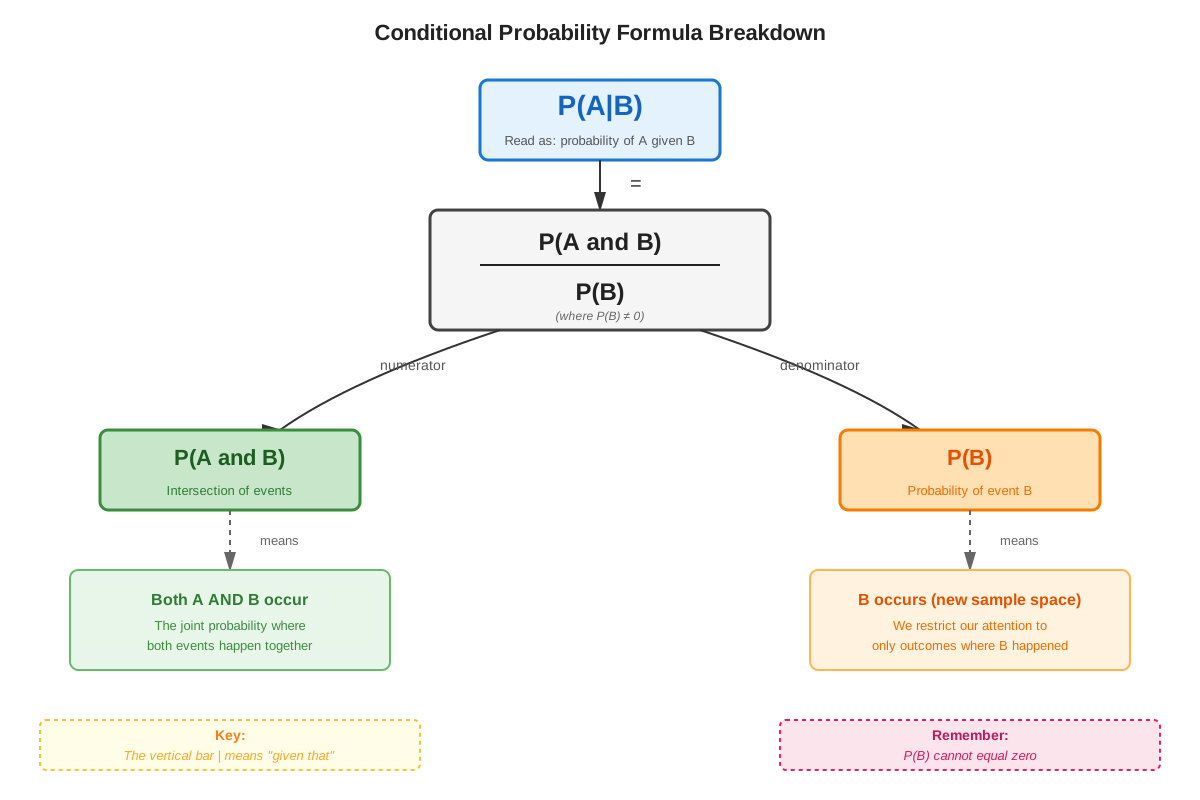
Conditional probability measures the probability of an event A occurring given that event B has already occurred or is known to be true. The notation P(A|B) is read as "the probability of A given B." This vertical bar "|" is the conditional symbol and represents the phrase "given that" or "knowing that."
The fundamental insight of conditional probability is that new information changes the sample space. When we know event B has occurred, we no longer consider all possible outcomes—only those outcomes where B is true. This restricted sample space is what makes conditional probability different from regular probability.
The Conditional Probability Formula
The mathematical definition of conditional probability is:
P(A|B) = P(A and B) / P(B)where P(B) > 0 (we cannot condition on an impossible event).
This formula states that the conditional probability equals the probability of both events occurring divided by the probability of the condition. Breaking this down:
- P(A and B): The probability that both A and B occur (the intersection)
- P(B): The probability that B occurs (the condition)
- P(A|B): The probability that A occurs in the restricted world where B is true
Working with Two-Way Frequency Tables
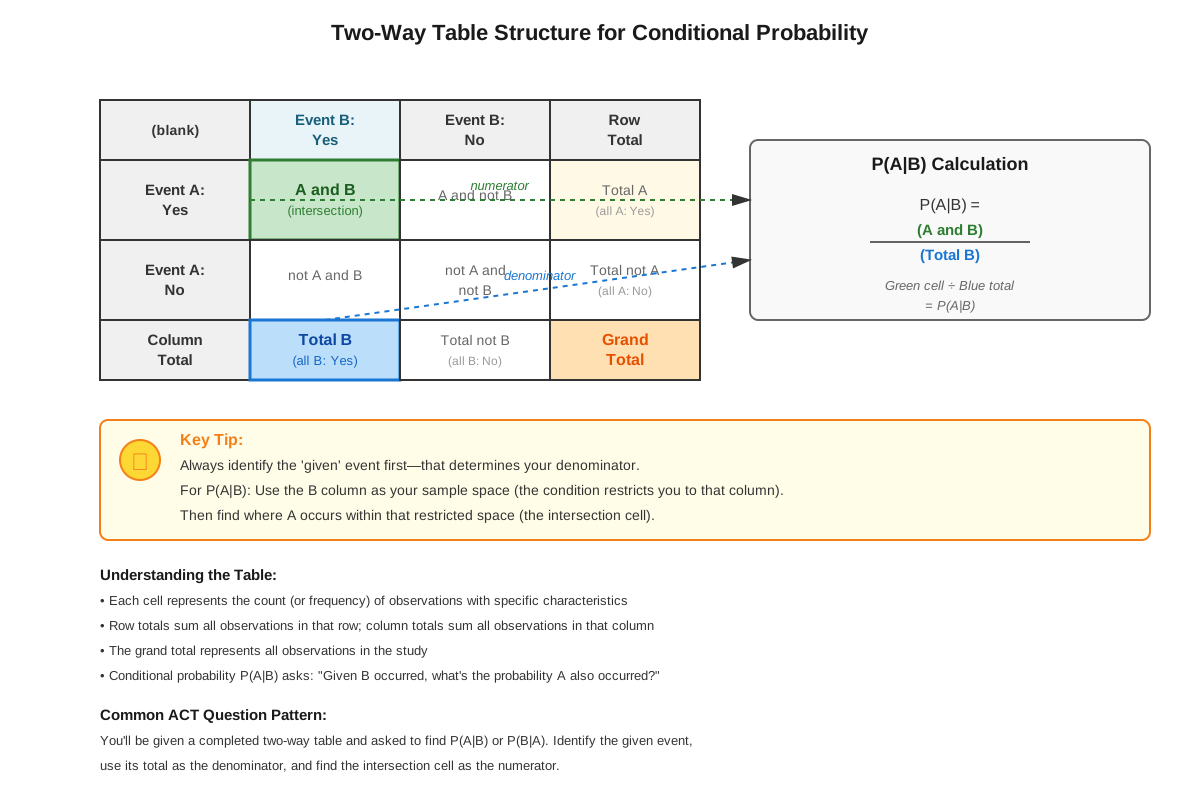
Two-way frequency tables (contingency tables) are the most common format for ACT conditional probability questions. These tables organize data by two categorical variables, showing frequencies in each combination of categories.
Consider this example table showing student participation in sports and music:
| Plays Sports | Doesn't Play Sports | Total | |
|---|---|---|---|
| In Band | 45 | 30 | 75 |
| Not in Band | 85 | 40 | 125 |
| Total | 130 | 70 | 200 |
To find P(Plays Sports | In Band), we restrict our attention to only the "In Band" row. Of the 75 students in band, 45 play sports. Therefore:
P(Plays Sports | In Band) = 45/75 = 3/5 = 0.6The key insight: when given a condition, focus only on the row or column corresponding to that condition, then find the proportion within that restricted group.
The Multiplication Rule
Rearranging the conditional probability formula gives us the multiplication rule:
P(A and B) = P(A|B) × P(B) = P(B|A) × P(A)This rule is essential for multi-step probability problems where events occur in sequence. For example, if drawing two cards without replacement, the probability of drawing two aces is:
P(1st ace and 2nd ace) = P(2nd ace | 1st ace) × P(1st ace)Independence vs. Dependence
Two events A and B are independent if knowing one occurred doesn't change the probability of the other. Mathematically:
- Events are independent if P(A|B) = P(A)
- If independent, then P(A and B) = P(A) × P(B)
Events are dependent if P(A|B) ≠ P(A). Most conditional probability problems on the ACT involve dependent events, where the condition genuinely affects the probability.
Common Calculation Steps
When solving ACT conditional probability problems:
- Identify the condition: What event is given or known to have occurred?
- Restrict the sample space: Focus only on outcomes where the condition is true
- Find favorable outcomes: Within the restricted space, count outcomes where the desired event occurs
- Calculate the ratio: Divide favorable outcomes by total outcomes in the restricted space
Complementary Conditional Probabilities
Just as with regular probability, conditional probabilities have complements:
P(A|B) + P(not A|B) = 1This relationship is useful when it's easier to calculate the probability of the complement.
Concept Relationships
Conditional probability builds directly on basic probability concepts by adding the dimension of given information. The relationship flows: Simple Probability → introduces the concept of likelihood → Conditional Probability → refines likelihood based on known conditions → Multiplication Rule → enables calculation of joint probabilities.
Within conditional probability itself, the concepts interconnect as follows:
Two-Way Tables → provide organized data → Restricted Sample Space → enables identification of relevant outcomes → Conditional Probability Formula → calculates the final probability
The connection to set theory is fundamental: Intersection (AND) represents P(A and B) in the numerator, while Individual Sets represent P(B) in the denominator. Understanding Venn diagrams helps visualize these relationships.
Conditional probability also connects forward to more advanced topics. It forms the foundation for Bayes' Theorem (not typically tested on the ACT but important in advanced statistics) and probability trees (sometimes appearing in ACT questions). The multiplication rule derived from conditional probability enables solving complex sequential probability problems.
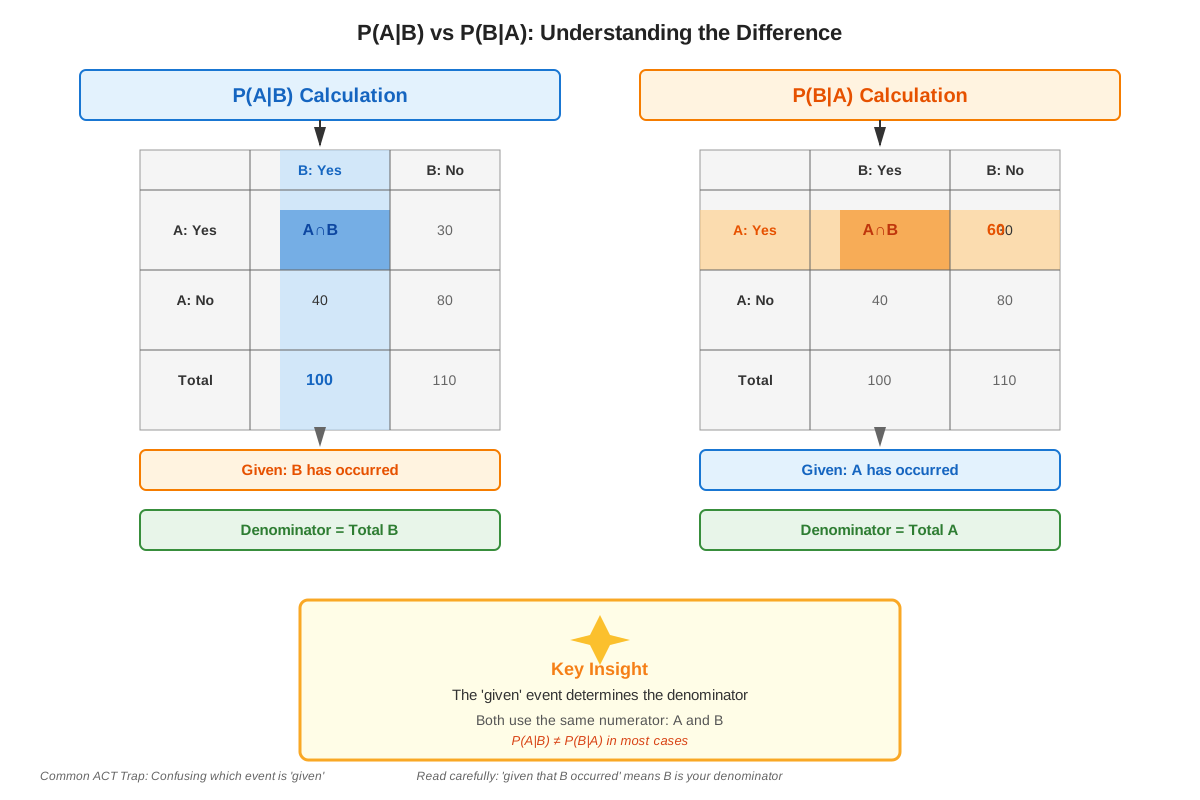
The distinction between P(A|B) and P(B|A) is crucial and represents a common source of confusion. These are generally NOT equal—the probability of rain given clouds is very different from the probability of clouds given rain. This asymmetry connects to logical reasoning and careful reading comprehension, skills tested throughout the ACT.
High-Yield Facts
⭐ The conditional probability formula is P(A|B) = P(A and B) / P(B), where P(B) > 0
⭐ In two-way tables, to find P(A|B), restrict attention to the row or column representing B, then find the proportion where A occurs
⭐ P(A|B) and P(B|A) are generally different values and should not be confused
⭐ When a condition is given, the denominator becomes the total for that condition, not the grand total
⭐ The multiplication rule P(A and B) = P(A|B) × P(B) is essential for sequential probability problems
- Events A and B are independent if and only if P(A|B) = P(A)
- The sum P(A|B) + P(not A|B) always equals 1
- In "without replacement" problems, the second probability is always conditional on the first outcome
- The vertical bar "|" in probability notation always means "given that" or "conditional on"
- Conditional probabilities must be between 0 and 1, inclusive
- When calculating from a table, always verify you're using the correct row/column total as your denominator
- The phrase "among those who" or "of those who" signals a conditional probability question
Quick check — test yourself on Conditional probability so far.
Try Flashcards →Common Misconceptions
Misconception: P(A|B) equals P(B|A) because they both involve the same two events.
Correction: These are generally different values. P(A|B) restricts to cases where B occurred and asks about A, while P(B|A) restricts to cases where A occurred and asks about B. The condition (what comes after the "|") determines which sample space is restricted.
Misconception: When finding conditional probability from a table, always divide by the grand total.
Correction: The denominator should be the total for the condition (the given event), not the grand total. If finding P(A|B), divide by the total for B, which is typically a row or column total, not the overall total.
Misconception: If P(A|B) = 0.6, then 60% of all outcomes satisfy event A.
Correction: P(A|B) = 0.6 means that among outcomes where B occurs, 60% also satisfy A. This says nothing about the overall percentage of outcomes satisfying A, which is P(A).
Misconception: Conditional probability only applies when events happen in sequence.
Correction: While sequential events often involve conditional probability, the concept applies whenever we have information about one event and want to know about another, regardless of timing. Survey data and demographic tables involve conditional probability even though no temporal sequence exists.
Misconception: Independent events cannot have conditional probabilities calculated.
Correction: Conditional probabilities can always be calculated for any events with P(B) > 0. For independent events, P(A|B) simply equals P(A), but the calculation is still valid. Independence is a special case, not an exception to conditional probability.
Misconception: The multiplication rule P(A and B) = P(A) × P(B) always applies.
Correction: This simplified multiplication rule only applies when A and B are independent. For dependent events (most ACT problems), you must use P(A and B) = P(A|B) × P(B) or P(B|A) × P(A).
Worked Examples
Example 1: Two-Way Table Analysis
Problem: A school surveyed 250 students about their study habits and grades. The results are shown below:
| A or B Grade | C or Lower | Total | |
|---|---|---|---|
| Studies 2+ hrs | 85 | 35 | 120 |
| Studies < 2 hrs | 45 | 85 | 130 |
| Total | 130 | 120 | 250 |
What is the probability that a randomly selected student who studies 2 or more hours per day has an A or B grade?
Solution:
Step 1: Identify what's being asked. We need P(A or B grade | Studies 2+ hrs). The condition is "studies 2+ hours," and we want the probability of "A or B grade" given this condition.
Step 2: Locate the condition in the table. "Studies 2+ hrs" is the first row. This becomes our restricted sample space.
Step 3: Find the total for the condition. The total for students who study 2+ hours is 120 students.
Step 4: Find favorable outcomes within the condition. Among students who study 2+ hours, 85 have an A or B grade.
Step 5: Calculate the conditional probability:
P(A or B | Studies 2+ hrs) = 85/120 = 17/24 ≈ 0.708Answer: The probability is 17/24 or approximately 0.71 or 71%.
Key Insight: Notice we did NOT divide by 250 (the grand total). We divided by 120 because that's the total for our condition. This addresses Learning Objective 3 (applying conditional probability accurately) and demonstrates the core strategy from Learning Objective 2.
Example 2: Sequential Events Without Replacement
Problem: A bag contains 5 red marbles and 7 blue marbles. Two marbles are drawn without replacement. What is the probability that both marbles are red?
Solution:
Step 1: Recognize this as a conditional probability problem. The second draw's probability depends on what happened in the first draw (without replacement means the first marble isn't returned).
Step 2: Identify the events:
- Event A: First marble is red
- Event B: Second marble is red (given first was red)
Step 3: Calculate P(first marble is red):
P(1st red) = 5/12(5 red marbles out of 12 total)
Step 4: Calculate P(second marble is red | first marble was red):
After removing one red marble, there are 4 red marbles left and 11 total marbles remaining.
P(2nd red | 1st red) = 4/11Step 5: Apply the multiplication rule:
P(both red) = P(1st red and 2nd red) = P(2nd red | 1st red) × P(1st red)
P(both red) = (4/11) × (5/12) = 20/132 = 5/33Answer: The probability that both marbles are red is 5/33 or approximately 0.152 or 15.2%.
Key Insight: This problem demonstrates the multiplication rule derived from conditional probability. The second probability (4/11) is conditional on the first event occurring. This connects to Learning Objective 2 (explaining the core strategy) and shows how conditional probability applies to sequential scenarios.
Exam Strategy
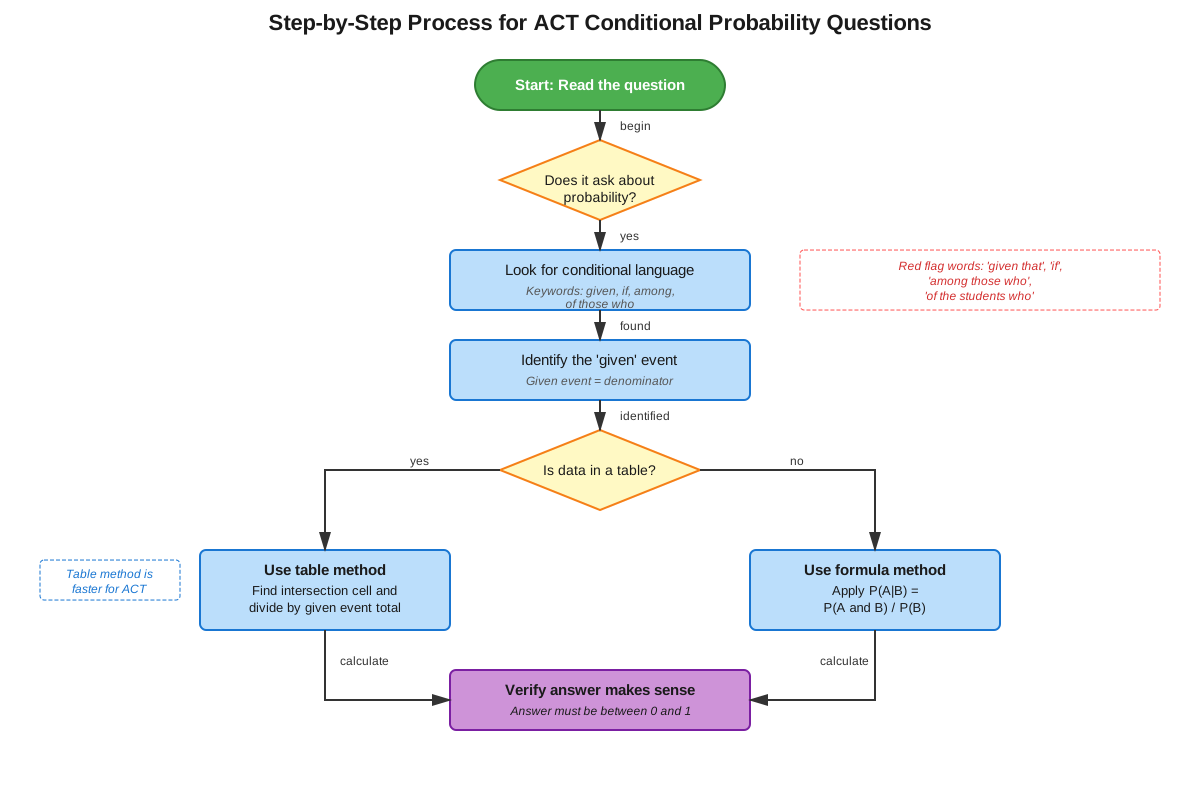
When approaching ACT conditional probability questions, follow this systematic process:
Recognition Triggers: Watch for these phrases that signal conditional probability:
- "given that"
- "if we know that"
- "among those who"
- "of the students who"
- "what percent of [group] also [condition]"
- "if [condition] is true, what is the probability"
Step-by-Step Approach:
- Read carefully to identify the condition: What information is given or known? This determines your restricted sample space.
- Locate the condition in any provided table or diagram: Find the row, column, or region corresponding to the given information.
- Identify what probability is being asked: What event's likelihood do you need to find within the restricted space?
- Use the appropriate denominator: For tables, use the row/column total for the condition, NOT the grand total.
- Double-check the direction: Ensure you haven't reversed P(A|B) and P(B|A).
Process of Elimination Tips:
- Eliminate any answer that uses the grand total as denominator when a specific condition is given
- Eliminate answers greater than 1 or less than 0 (impossible for probabilities)
- If the question asks for P(A|B), eliminate any answer that would be P(B|A)
- Check if answer choices are in different forms (fractions, decimals, percentages)—convert to compare
- For "NOT" or complement questions, verify that probabilities sum to 1
Time Management:
Conditional probability questions typically require 45-90 seconds. Spend the first 15-20 seconds carefully reading and identifying the condition—rushing this step causes most errors. Two-way table questions are usually faster (45-60 seconds) than word problems requiring formula application (60-90 seconds). If a problem requires multiple conditional probability calculations, it may take up to 2 minutes; consider marking it for review if time is tight and returning after completing faster questions.
Common Traps to Avoid:
- Using the wrong total (grand total instead of conditional total)
- Confusing P(A|B) with P(B|A)
- Forgetting to restrict the sample space
- Treating dependent events as independent
- Misreading table rows and columns
Memory Techniques
The "Given" Mnemonic: Remember G.I.V.E.N.
- Go to the condition first
- Identify the restricted space
- Verify what's being asked
- Evaluate within that space only
- Never use the grand total
The Vertical Bar Visualization: Think of the vertical bar "|" in P(A|B) as a wall that blocks out everything except B. You're now living in "B-world" and asking about A within that world.
The "Denominator Determines" Rule: In conditional probability, the denominator is determined by what comes after the vertical bar. P(A|B) means B is in the denominator: P(A and B)/P(B).
The Direction Matters Phrase: Create a sentence to remember P(A|B) ≠ P(B|A):
"The probability of rain given clouds is NOT the same as the probability of clouds given rain."
Rain often requires clouds, but clouds don't always produce rain—the direction matters!
Table Reading Acronym - R.O.C.K.:
- Read the question for the condition
- Orient to the correct row or column
- Count favorable outcomes in that row/column
- Keep the row/column total as denominator
The Multiplication Rule Reminder: "Conditional Times Total" = CTT
P(A and B) = P(A|B) × P(B)
The Conditional probability Times the Total probability of the condition
Summary
Conditional probability is a high-yield ACT Math topic that measures the probability of an event occurring given that another event has already occurred or is known to be true. The fundamental formula P(A|B) = P(A and B) / P(B) expresses this concept mathematically, but most ACT questions present data in two-way frequency tables where the key strategy is to restrict attention to the row or column representing the given condition, then calculate the proportion of favorable outcomes within that restricted space. Success requires distinguishing between P(A|B) and P(B|A), recognizing that these are generally different values, and understanding that the denominator in conditional probability calculations should be the total for the condition, not the grand total. The multiplication rule, derived from conditional probability, enables solving sequential probability problems where events occur without replacement or where later events depend on earlier outcomes. Mastering this topic requires careful reading to identify conditions, systematic table analysis, and avoiding common traps like using incorrect denominators or confusing the direction of conditioning.
Key Takeaways
- Conditional probability P(A|B) measures the probability of A occurring in the restricted world where B is known to be true
- The formula P(A|B) = P(A and B) / P(B) is fundamental, but table-based problems use restricted row/column totals
- P(A|B) and P(B|A) are generally different—the direction of conditioning matters significantly
- In two-way tables, the denominator for P(A|B) is the total for B (row or column total), never the grand total
- The multiplication rule P(A and B) = P(A|B) × P(B) enables solving sequential and multi-step probability problems
- Recognition phrases like "given that," "among those who," and "of the [group] who" signal conditional probability
- Careful identification of the condition is the most critical first step—rushing this causes most errors
Related Topics
Independent Events and Probability: Understanding when events are independent (P(A|B) = P(A)) versus dependent deepens conditional probability mastery and appears in comparison questions on the ACT.
Venn Diagrams and Set Theory: Visual representation of overlapping events helps conceptualize P(A and B), P(A or B), and conditional relationships, providing an alternative approach to table-based problems.
Probability Trees: Multi-stage probability problems often use tree diagrams where each branch represents a conditional probability, extending the concepts learned here to more complex scenarios.
Expected Value: Combining conditional probabilities with outcomes and values leads to expected value calculations, a related probability topic on the ACT.
Statistical Inference: Conditional probability forms the foundation for understanding sensitivity, specificity, and predictive values in medical testing and quality control—concepts that appear in ACT Science passages and advanced Math problems.
Mastering conditional probability creates a strong foundation for these related topics and significantly improves overall probability problem-solving skills.
Practice CTA
Now that you've mastered the core concepts of conditional probability, it's time to solidify your understanding through practice! Attempt the practice questions to test your ability to identify conditions, restrict sample spaces, and calculate conditional probabilities accurately. Use the flashcards to reinforce key formulas, recognition triggers, and common traps. Remember, conditional probability questions are high-yield on the ACT—investing time in practice now will pay dividends on test day. Each practice problem you solve strengthens your pattern recognition and builds the confidence needed to tackle these questions quickly and accurately under timed conditions. You've got this!
Sign up free to keep reading
Create a free AnvayaPrep account to finish this ACT guide on Conditional probability — plus flashcards and practice questions.