Overview
Independent events form a cornerstone of probability theory tested on the ACT Math section. Understanding this concept is essential for solving a variety of probability questions that appear regularly on the exam. At its core, the concept addresses how the occurrence of one event affects—or more precisely, does not affect—the probability of another event occurring. When two events are independent, the outcome of the first event has absolutely no influence on the probability of the second event happening. This fundamental principle allows test-takers to calculate combined probabilities using straightforward multiplication rather than complex conditional probability formulas.
The ACT frequently tests independent events through real-world scenarios involving coin flips, dice rolls, card draws with replacement, and everyday situations like weather predictions or multiple-choice test guessing. Questions may ask students to calculate the probability of multiple independent outcomes occurring together, or they may require students to first identify whether events are truly independent before performing calculations. Mastery of this topic directly impacts performance on 2-4 questions per ACT Math test, making it a high-yield area for focused study.
This topic connects intimately with fundamental probability concepts, including sample spaces, basic probability calculations, and the multiplication principle of counting. It also serves as a foundation for understanding dependent events and conditional probability, though those topics represent more advanced applications. Students who thoroughly understand independent events gain the analytical framework needed to approach complex multi-step probability problems with confidence and accuracy.
Learning Objectives
- [ ] Identify when independent events is being tested in ACT Math questions
- [ ] Explain the core rule or strategy behind independent events and why multiplication is used
- [ ] Apply independent events to ACT-style questions accurately and efficiently
- [ ] Distinguish between independent and dependent events in various contexts
- [ ] Calculate compound probabilities for multiple independent events occurring in sequence
- [ ] Recognize common ACT scenarios that involve independent events (with and without replacement)
Prerequisites
- Basic probability concepts: Understanding that probability represents the ratio of favorable outcomes to total possible outcomes (P = favorable/total) is essential for calculating individual event probabilities before combining them
- Fraction and decimal operations: Independent events problems require multiplying fractions or decimals, so computational fluency ensures accuracy and speed
- Basic counting principles: Knowing how to determine the total number of possible outcomes in a sample space provides the foundation for calculating individual probabilities
- Percentage conversions: ACT questions often present probabilities as percentages, requiring conversion skills to work with the multiplication rule
Why This Topic Matters
Independent events probability appears in everyday decision-making scenarios ranging from weather forecasting (the probability it rains today and tomorrow) to quality control in manufacturing (the probability multiple products pass inspection) to genetics (the probability of inheriting specific traits). Understanding independence helps people make informed decisions about risk, insurance, investments, and medical treatments. The mathematical framework developed through studying independent events also underpins statistical analysis, data science, and machine learning algorithms that power modern technology.
On the ACT Math section, independent events questions appear with high frequency—typically 2-4 questions per 60-question test. These questions usually fall within the "Probability and Statistics" content area, which comprises approximately 12-15% of the entire Math section. The ACT presents independent events problems in various formats: straightforward calculation questions, word problems requiring interpretation, and questions that combine probability with other mathematical concepts like percentages or ratios.
Common ACT question formats include: calculating the probability of getting specific outcomes on multiple coin flips or dice rolls; determining the likelihood of randomly selecting certain items from a group multiple times with replacement; finding the probability that multiple independent conditions are all satisfied; and identifying whether described events are independent or dependent. Questions may also present scenarios involving spinners, card decks, colored marbles, or real-world situations like weather patterns or test-taking strategies.
Core Concepts
Definition of Independent Events
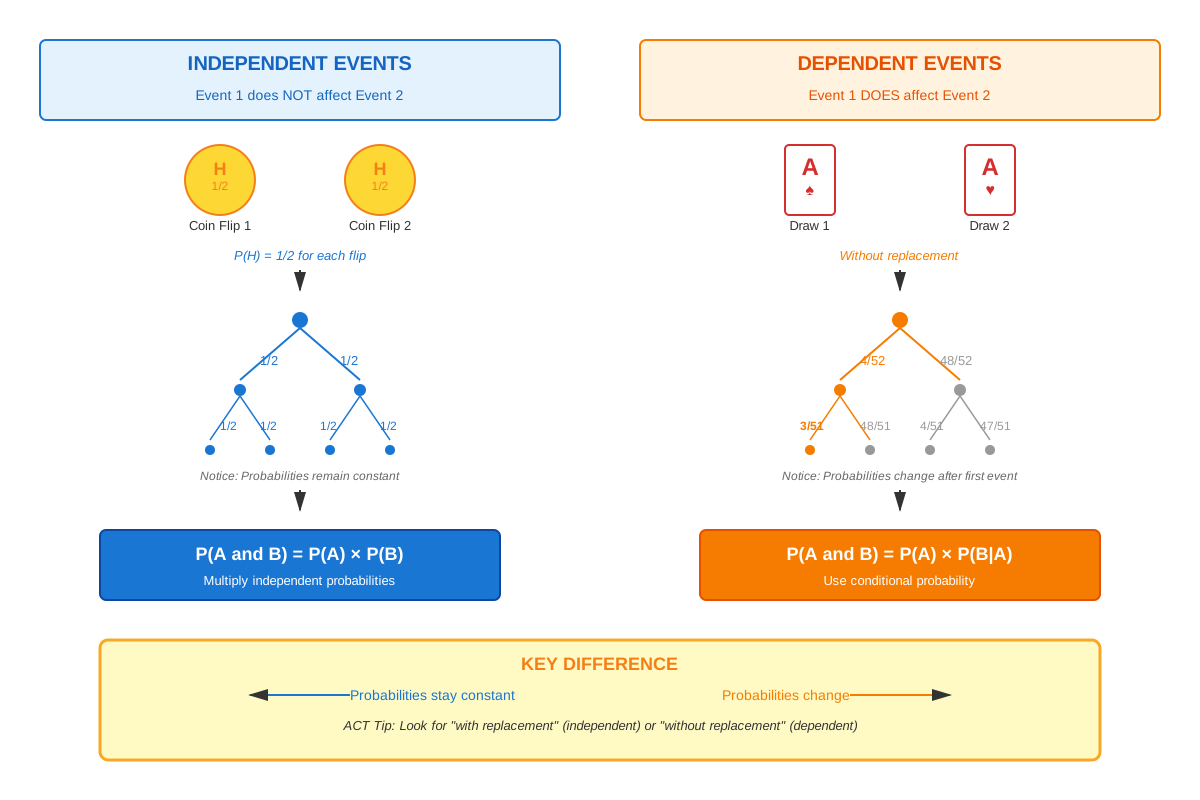
Two events are independent events if the occurrence of one event does not change the probability of the other event occurring. Mathematically, events A and B are independent if and only if P(A and B) = P(A) × P(B). This multiplication rule represents the fundamental principle for working with independent events on the ACT independent events questions.
The key characteristic distinguishing independent events from dependent events is that knowing the outcome of one event provides no information about the other event's outcome. For example, flipping a coin and rolling a die are independent because the coin's result (heads or tails) tells us nothing about what number the die will show. The die has the same probability distribution regardless of the coin flip outcome.
The Multiplication Rule for Independent Events
When calculating the probability that multiple independent events all occur, multiply the individual probabilities together:
P(A and B and C) = P(A) × P(B) × P(C)This rule extends to any number of independent events. The logic behind multiplication stems from the fundamental counting principle: if event A can occur in m ways and event B can occur in n ways independently, then both events occurring together can happen in m × n ways.
For example, if the probability of rain on Monday is 0.3 and the probability of rain on Tuesday is 0.4 (assuming these are independent), then the probability of rain on both days is 0.3 × 0.4 = 0.12 or 12%.
Identifying Independence in ACT Scenarios
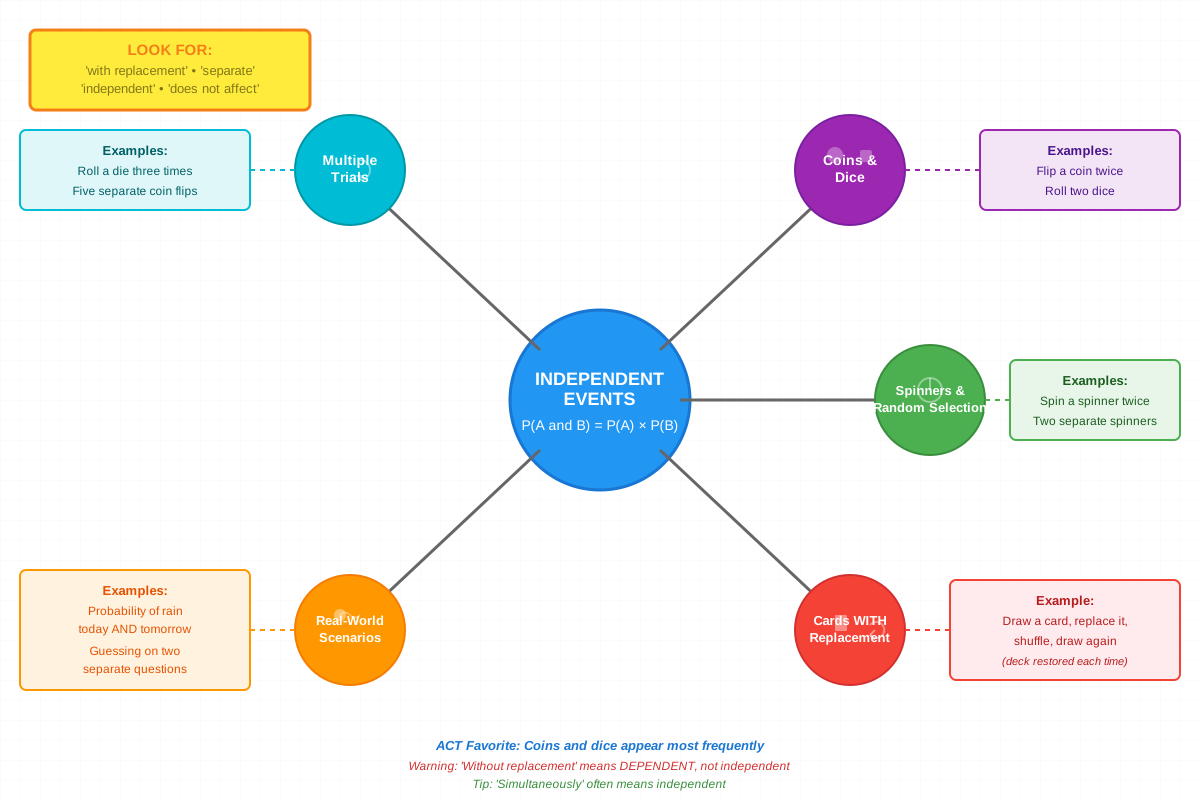
The ACT tests whether students can recognize independent versus dependent situations. Here are the most common scenarios:
| Scenario Type | Independence Status | Reason |
|---|---|---|
| Coin flips (multiple) | Independent | Each flip has no memory of previous flips |
| Dice rolls (multiple) | Independent | Each roll is unaffected by previous rolls |
| Card draws WITH replacement | Independent | Replacing the card restores original probabilities |
| Card draws WITHOUT replacement | Dependent | Removing cards changes remaining probabilities |
| Spinner spins (multiple) | Independent | Each spin starts with the same configuration |
| Random selection with replacement | Independent | Population is restored between selections |
| Random selection without replacement | Dependent | Population changes affect subsequent probabilities |
Calculating Compound Probabilities
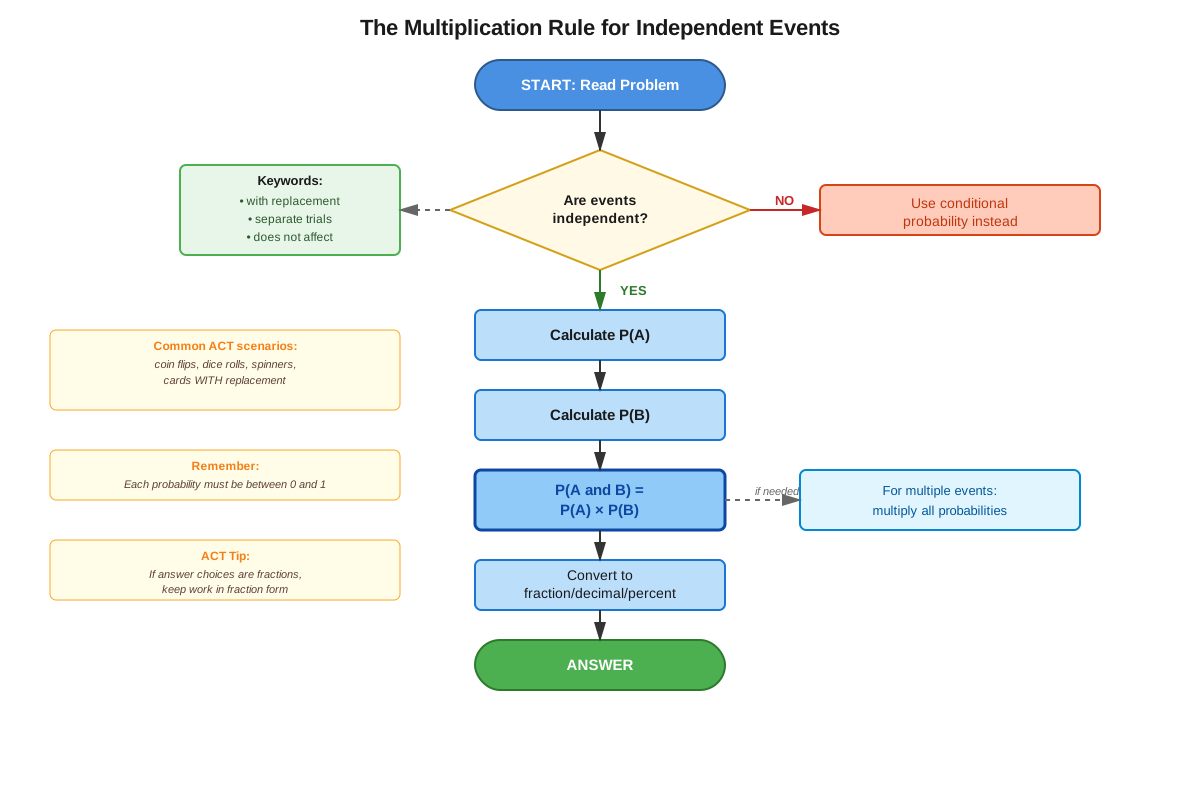
To solve ACT problems involving independent events, follow this systematic process:
- Identify each individual event and determine whether the events are truly independent
- Calculate the probability of each event separately using P = favorable outcomes / total outcomes
- Apply the multiplication rule by multiplying all individual probabilities together
- Simplify the result to match the answer format (fraction, decimal, or percentage)
For instance, if asked to find the probability of rolling a 4 on a standard die AND flipping heads on a fair coin:
- P(rolling 4) = 1/6
- P(heads) = 1/2
- P(both) = 1/6 × 1/2 = 1/12
"At Least One" Problems
A particularly common ACT question type asks for the probability that "at least one" event occurs. The most efficient approach uses the complement rule:
P(at least one) = 1 - P(none)This strategy works because "at least one" means "one or more," which is the complement of "zero occurrences." Calculating P(none) is often simpler than calculating P(exactly one) + P(exactly two) + P(exactly three), etc.
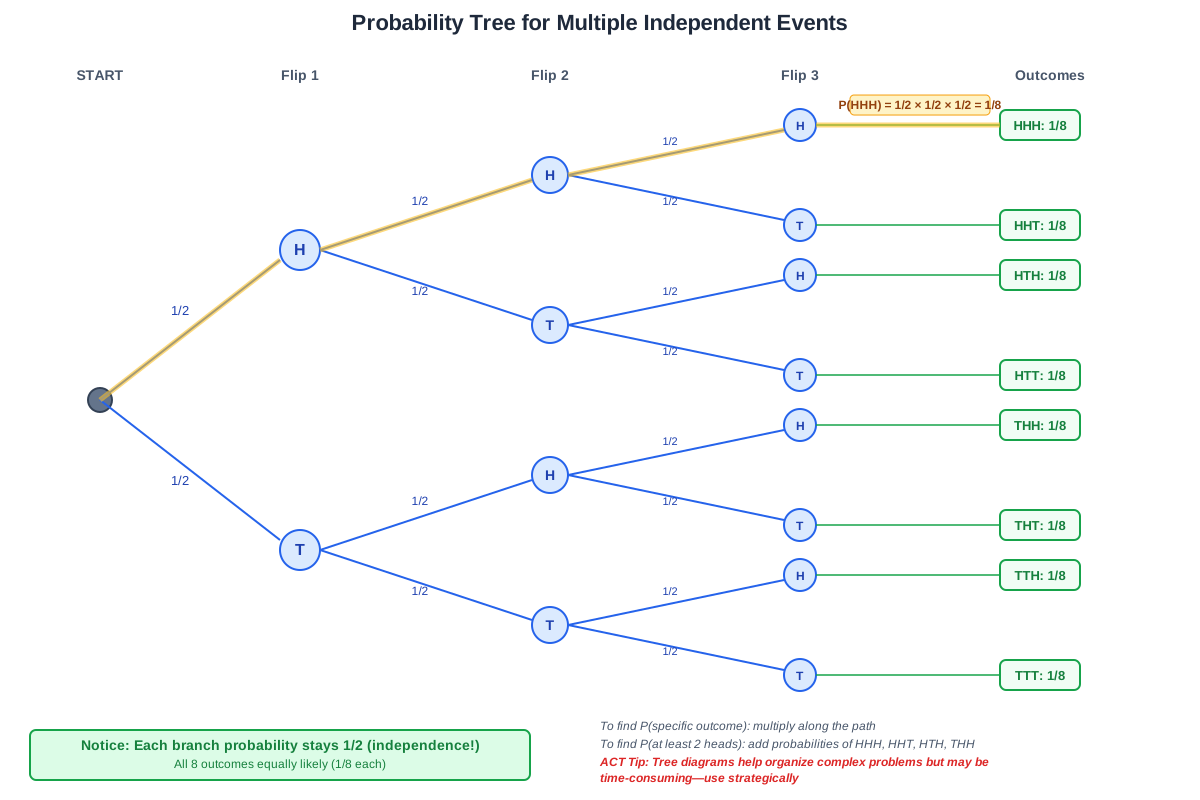
Example: What is the probability of getting at least one heads in three coin flips?
- P(no heads) = P(all tails) = (1/2)³ = 1/8
- P(at least one heads) = 1 - 1/8 = 7/8
Replacement and Independence
The concept of replacement is crucial for determining independence in selection problems. When an item is selected and then replaced before the next selection, the probabilities remain constant, ensuring independence. Without replacement, the sample space changes, creating dependence.
Consider drawing cards from a standard 52-card deck:
- With replacement: P(two aces) = (4/52) × (4/52) = 1/169 (independent)
- Without replacement: P(two aces) = (4/52) × (3/51) = 1/221 (dependent)
The ACT explicitly states whether replacement occurs, so read questions carefully to identify this critical detail.
Concept Relationships
The foundation of independent events rests on basic probability principles, where individual event probabilities are calculated using the favorable/total outcomes ratio. This foundational concept → leads to → understanding how to calculate single-event probabilities, which → combines with → the multiplication principle to determine compound probabilities.
The multiplication rule for independent events → contrasts with → dependent events and conditional probability, where the formula becomes P(A and B) = P(A) × P(B|A). Recognizing the difference between these scenarios is essential for selecting the correct calculation method.
The concept of replacement → directly determines → whether events are independent or dependent, which → dictates → which probability formula to apply. This decision point represents a critical juncture in problem-solving.
"At least one" problems → connect to → the complement rule (P(A) = 1 - P(not A)), demonstrating how independent events concepts integrate with broader probability strategies. This relationship → enables → efficient solutions to otherwise complex counting problems.
Understanding independent events → serves as prerequisite knowledge for → more advanced topics including binomial probability, expected value calculations, and statistical inference, all of which build upon the multiplication rule for independent events.
High-Yield Facts
- ⭐ Independent events satisfy the equation: P(A and B) = P(A) × P(B)
- ⭐ The multiplication rule applies to any number of independent events: multiply all individual probabilities together
- ⭐ Replacement creates independence: selecting with replacement keeps probabilities constant between trials
- ⭐ Coin flips and dice rolls are always independent: each trial has no memory of previous outcomes
- ⭐ "At least one" problems are solved efficiently using: P(at least one) = 1 - P(none)
- Without replacement creates dependence: the sample space changes after each selection
- Independence means knowing one outcome provides no information about the other: the events are completely unrelated
- Multiple independent events occurring together have lower probability than individual events: multiplying fractions less than 1 produces smaller results
- The order of multiplication doesn't matter: P(A) × P(B) = P(B) × P(A) due to the commutative property
- Probabilities of independent events must each be between 0 and 1: and their product will also fall in this range
- Real-world independence is an assumption: the ACT will clearly indicate when events should be treated as independent
Quick check — test yourself on Independent events so far.
Try Flashcards →Common Misconceptions
Misconception: If two events are independent, they cannot both happen at the same time.
→ Correction: Independence refers to whether one event affects the probability of another, not whether they can occur simultaneously. Independent events can absolutely occur together; in fact, calculating P(A and B) for independent events is a primary application of the multiplication rule.
Misconception: The probability of multiple independent events occurring is found by adding their individual probabilities.
→ Correction: For independent events occurring together (A AND B), multiply the probabilities: P(A) × P(B). Addition is used for mutually exclusive events (A OR B), which is a completely different scenario. The ACT specifically tests whether students confuse these operations.
Misconception: If you flip a coin three times and get heads each time, the next flip is more likely to be tails to "balance out."
→ Correction: This is the gambler's fallacy. Each coin flip is independent with P(heads) = 0.5 regardless of previous outcomes. The coin has no memory, and past results do not influence future probabilities. Each flip starts fresh with the same 50-50 chance.
Misconception: Drawing cards without replacement still represents independent events because you're randomly selecting each time.
→ Correction: Random selection does not guarantee independence. Without replacement, the sample space changes after each draw, altering subsequent probabilities. For example, after drawing one ace from a deck, only 3 aces remain among 51 cards, changing P(ace) from 4/52 to 3/51.
Misconception: If P(A) = 0.4 and P(B) = 0.6, then P(A and B) must equal 1.0 because 0.4 + 0.6 = 1.0.
→ Correction: This confuses addition with multiplication and misunderstands what "and" means in probability. For independent events, P(A and B) = 0.4 × 0.6 = 0.24. The sum equaling 1.0 is coincidental and irrelevant to the compound probability calculation.
Misconception: Independence and mutual exclusivity are the same concept.
→ Correction: These are opposite concepts. Mutually exclusive events cannot occur together (if A happens, B cannot), while independent events can occur together, and one occurring doesn't affect the other's probability. If events are mutually exclusive, they are dependent because knowing A occurred tells you P(B) = 0.
Worked Examples
Example 1: Multiple Independent Events
Question: A fair coin is flipped three times. What is the probability of getting exactly two heads and one tail in any order?
Solution:
Step 1: Identify the individual events and their probabilities.
- Each coin flip is independent
- P(heads on any single flip) = 1/2
- P(tails on any single flip) = 1/2
Step 2: Determine the number of ways to arrange two heads and one tail.
The possible sequences are: HHT, HTH, THH
There are 3 different arrangements.
Step 3: Calculate the probability of any single arrangement.
For any specific sequence (like HHT):
- P(HHT) = P(H) × P(H) × P(T) = (1/2) × (1/2) × (1/2) = 1/8
Step 4: Account for all possible arrangements.
Since there are 3 arrangements, each with probability 1/8:
- P(exactly two heads) = 3 × (1/8) = 3/8
Answer: 3/8 or 0.375 or 37.5%
Connection to learning objectives: This problem demonstrates applying the multiplication rule for independent events and recognizing that coin flips are always independent, regardless of previous outcomes.
Example 2: "At Least One" Problem
Question: A student randomly guesses on three true/false questions. What is the probability that the student gets at least one question correct?
Solution:
Step 1: Recognize this as an "at least one" problem.
"At least one correct" means one, two, or three correct answers.
Step 2: Use the complement approach for efficiency.
- P(at least one correct) = 1 - P(none correct)
- P(none correct) = P(all wrong)
Step 3: Calculate P(all wrong).
- P(wrong on any single question) = 1/2
- Since the questions are independent:
- P(all three wrong) = (1/2) × (1/2) × (1/2) = 1/8
Step 4: Apply the complement rule.
- P(at least one correct) = 1 - 1/8 = 7/8
Answer: 7/8 or 0.875 or 87.5%
Alternative approach (less efficient):
Calculate P(exactly 1 correct) + P(exactly 2 correct) + P(exactly 3 correct):
- P(exactly 1) = 3 × (1/2)³ = 3/8
- P(exactly 2) = 3 × (1/2)³ = 3/8
- P(exactly 3) = 1 × (1/2)³ = 1/8
- Sum = 3/8 + 3/8 + 1/8 = 7/8 ✓
Connection to learning objectives: This demonstrates the efficient complement strategy for "at least one" problems and reinforces that independent events (random guesses on different questions) follow the multiplication rule.
Exam Strategy
When approaching ACT independent events questions, begin by carefully reading the problem to identify whether events are truly independent. Look for explicit indicators like "with replacement," "each time," "independently," or scenarios involving coins, dice, or spinners. These trigger words signal that the multiplication rule applies.
Key trigger phrases to watch for:
- "with replacement" → independent events
- "without replacement" → dependent events (different formula needed)
- "each time" or "every time" → suggests independence
- "at least one" → use complement rule: 1 - P(none)
- "both," "all," or "and" → multiply probabilities for independent events
- "either," "or" → different rule (addition for mutually exclusive events)
Process-of-elimination strategies:
- Eliminate answers greater than the smallest individual probability (compound probability of independent events cannot exceed any single event's probability)
- Eliminate answers that result from adding instead of multiplying (common trap answer)
- For "at least one" problems, eliminate answers less than 0.5 when individual probabilities are 0.5 or greater
- Check whether the answer makes intuitive sense (multiple events occurring together should generally have lower probability than single events)
Time allocation advice:
Independent events problems typically require 45-60 seconds on the ACT. Spend 10-15 seconds identifying independence and the appropriate formula, 20-30 seconds performing calculations, and 10-15 seconds checking your work. If a problem involves more than three independent events or requires extensive calculation, consider marking it for review and returning after completing easier questions. The ACT doesn't penalize guessing, so always select an answer even if time runs short.
Common calculation shortcuts:
- Recognize that (1/2)ⁿ = 1/2ⁿ for quick mental math with coins
- For dice, remember common probabilities: P(specific number) = 1/6, P(even) = 1/2, P(greater than 4) = 1/3
- Convert percentages to decimals before multiplying (easier calculation)
- Use the complement rule whenever you see "at least one" to avoid multiple calculations
Memory Techniques
Mnemonic for Independence: "CRIME"
- Coin flips are independent
- Replacement creates independence
- Independent means multiply
- Memory-less events (no effect on future)
- Each trial starts fresh
Visualization strategy: Picture a brick wall between two events. If the wall is solid (independent), information cannot pass through—knowing what happens on one side tells you nothing about the other side. If there's a door in the wall (dependent), information flows through, and one event affects the other.
Multiplication vs. Addition acronym: "AND-M, OR-A"
- AND requires Multiplication (for independent events)
- OR requires Addition (for mutually exclusive events)
"At least one" memory device: Think "ALONE" = At Least One = Not Equal to none
This reminds you to use: P(at least one) = 1 - P(none)
Replacement reminder: "Replace to Repeat" - when you replace the item, you repeat the same probability. No replacement means no repeating the same probability.
Summary
Independent events represent a fundamental probability concept where one event's occurrence does not affect another event's probability. The ACT tests this concept through various scenarios including coin flips, dice rolls, card draws with replacement, and real-world situations. The core principle involves using the multiplication rule: P(A and B) = P(A) × P(B) for independent events. Students must distinguish between independent events (with replacement, separate trials) and dependent events (without replacement, conditional situations). The most efficient approach to "at least one" problems uses the complement rule: P(at least one) = 1 - P(none). Success on ACT independent events questions requires recognizing trigger words, applying the correct formula, performing accurate calculations with fractions or decimals, and avoiding common misconceptions like the gambler's fallacy or confusing multiplication with addition. Mastery of this high-yield topic directly impacts performance on multiple questions per test and provides the foundation for more advanced probability concepts.
Key Takeaways
- Independent events occur when one event's outcome does not affect another event's probability; calculate compound probability by multiplying: P(A and B) = P(A) × P(B)
- Replacement is the key factor determining independence in selection problems: with replacement creates independence, without replacement creates dependence
- Coin flips, dice rolls, and spinner spins are always independent events, regardless of previous outcomes—each trial has no memory
- "At least one" problems are solved most efficiently using the complement rule: P(at least one) = 1 - P(none)
- The multiplication rule applies to any number of independent events: multiply all individual probabilities together
- Watch for trigger words like "with replacement," "each time," and "independently" to identify when to apply the multiplication rule
- Avoid the gambler's fallacy: previous outcomes of independent events do not influence future probabilities
Related Topics
Dependent Events and Conditional Probability: After mastering independent events, students should explore dependent events where P(A and B) = P(A) × P(B|A). This builds directly on the multiplication rule but accounts for how one event affects another's probability.
Mutually Exclusive Events: Understanding the difference between independent events (can occur together) and mutually exclusive events (cannot occur together) clarifies when to multiply versus add probabilities.
Binomial Probability: This advanced topic extends independent events to situations with exactly two outcomes repeated multiple times, using the formula involving combinations and the multiplication rule.
Expected Value: Calculating expected value for multiple independent events requires multiplying probabilities (from independent events) by outcomes and summing the results.
Counting Principles and Combinations: The fundamental counting principle underlies why we multiply probabilities for independent events, connecting probability to combinatorics.
Practice CTA
Now that you've mastered the core concepts of independent events, it's time to solidify your understanding through active practice. Attempt the practice questions designed specifically for this topic, focusing on identifying independence, applying the multiplication rule accurately, and using efficient strategies like the complement rule for "at least one" problems. Work through the flashcards to reinforce key definitions and formulas until they become automatic. Remember, the ACT rewards both accuracy and speed—consistent practice with these high-yield concepts will build the confidence and efficiency you need to excel on test day. Every practice problem you solve strengthens your probability intuition and brings you closer to your target score!
Sign up free to keep reading
Create a free AnvayaPrep account to finish this ACT guide on Independent events — plus flashcards and practice questions.