Overview
Data interpretation is one of the most frequently tested skills on the ACT Math section, appearing in approximately 15-20% of all questions. This topic requires students to extract, analyze, and draw conclusions from information presented in various visual formats including tables, charts, graphs, and diagrams. Unlike purely computational problems, data interpretation questions assess a student's ability to understand relationships between variables, identify trends, and make logical inferences based on presented information.
The ACT consistently includes ACT data interpretation questions because they mirror real-world analytical skills essential for college success and professional careers. These questions test not just mathematical computation but also critical reading of quantitative information—a skill that spans disciplines from economics to biology. Students must quickly process visual information, identify relevant data points, and perform appropriate calculations or comparisons within strict time constraints.
Data interpretation connects to virtually every other mathematical concept tested on the ACT, including algebra (solving for unknowns based on graph data), geometry (interpreting coordinate planes and spatial diagrams), statistics (analyzing measures of central tendency and spread), and probability (calculating likelihoods from frequency tables). Mastering this topic provides a foundation for success across the entire Math section while developing transferable analytical skills applicable to the Science section as well.
Learning Objectives
- [ ] Identify when Data interpretation is being tested
- [ ] Explain the core rule or strategy behind Data interpretation
- [ ] Apply Data interpretation to ACT-style questions accurately
- [ ] Extract specific numerical values from tables, bar graphs, line graphs, pie charts, and scatterplots within 15 seconds
- [ ] Calculate rates of change, percentages, and ratios directly from visual data representations
- [ ] Compare multiple data sets and identify relationships between variables across different visual formats
- [ ] Recognize when data requires interpolation versus extrapolation and apply appropriate reasoning
Prerequisites
- Basic arithmetic operations: Essential for performing calculations with extracted data values including addition, subtraction, multiplication, and division
- Fraction, decimal, and percentage conversions: Required for interpreting proportional relationships and converting between different numerical representations in charts
- Coordinate plane fundamentals: Necessary for reading x and y values from graphs and understanding ordered pairs
- Basic algebraic manipulation: Needed to set up and solve equations based on relationships shown in data displays
- Understanding of ratios and proportions: Critical for comparing quantities and scaling information from visual representations
Why This Topic Matters
Data interpretation skills extend far beyond standardized testing into virtually every academic discipline and professional field. Scientists analyze experimental results in tables and graphs, business professionals examine sales trends and market data, healthcare workers interpret patient statistics, and policymakers evaluate demographic information—all requiring the exact skills tested in ACT data interpretation questions. The ability to quickly extract meaningful insights from visual data representations is a fundamental literacy skill in our information-rich society.
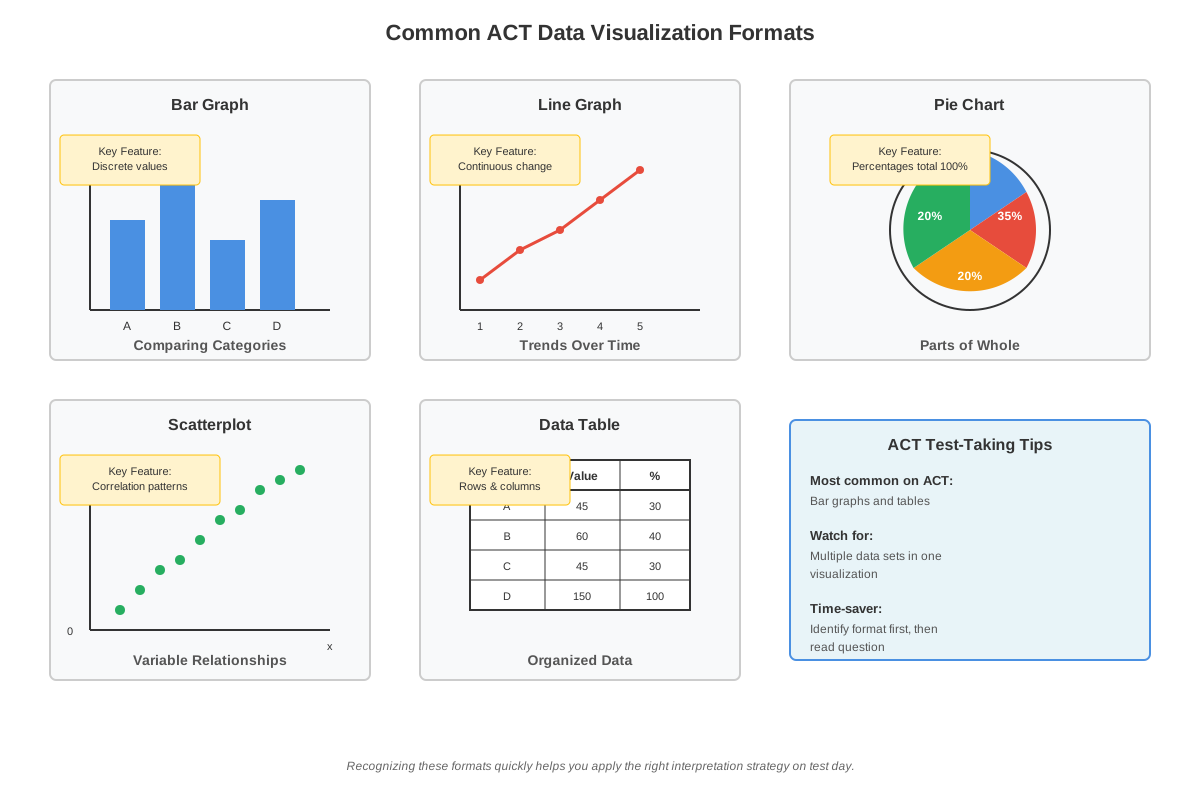
On the ACT Math section, data interpretation questions appear with remarkable consistency, typically comprising 8-12 questions out of the 60 total math problems. These questions span difficulty levels from straightforward data extraction to complex multi-step problems requiring synthesis of information from multiple sources. The ACT frequently presents data interpretation in the following formats: bar graphs (comparing categories), line graphs (showing trends over time), pie charts (displaying proportional relationships), scatterplots (revealing correlations), two-way tables (cross-tabulating categorical data), and box plots (summarizing distributions).
The strategic importance of mastering data interpretation cannot be overstated. These questions often appear early in the test when students have maximum mental energy, and they typically require less time than complex algebraic or geometric proofs when approached systematically. Students who develop efficient data interpretation skills can bank time for more challenging problems later in the section. Additionally, the Science section of the ACT heavily relies on data interpretation abilities, making this mathematical skill doubly valuable for overall test performance.
Core Concepts
Reading Tables and Charts
Tables organize data in rows and columns, allowing for systematic comparison of values across categories. When approaching table-based questions, students must first identify the variables represented (typically labeled in headers) and understand the units of measurement. The key strategy involves locating the intersection of relevant row and column information. ACT tables may include summary rows (totals or averages) that provide shortcuts for certain calculations.
Bar graphs display categorical data using rectangular bars whose lengths correspond to values. These visualizations excel at showing comparisons between discrete categories. Students should note whether bars are vertical or horizontal, identify the scale on the value axis, and check for breaks in the axis that might distort visual perception. Grouped bar graphs compare multiple variables across categories simultaneously, requiring careful attention to the legend.
Pie charts represent parts of a whole, with each slice corresponding to a percentage or proportion of the total. The entire circle always represents 100% or the complete data set. ACT questions often require calculating the actual value of a slice when given only percentages, necessitating multiplication by the total. Students must remember that all slices must sum to the whole.
Interpreting Line Graphs
Line graphs display continuous data, most commonly showing how a variable changes over time. The horizontal axis (x-axis) typically represents the independent variable (often time), while the vertical axis (y-axis) shows the dependent variable. Key skills include identifying specific coordinate points, calculating slope (rate of change) between two points, and recognizing trends (increasing, decreasing, constant, or fluctuating).
When multiple lines appear on the same graph, students must carefully match each line to its corresponding legend entry. The ACT frequently tests the ability to identify where lines intersect (representing equal values) or which line shows the greatest/least value at a specific point. Interpolation—estimating values between known data points—requires assuming a linear relationship unless the graph suggests otherwise.
Analyzing Scatterplots
Scatterplots display individual data points as coordinates on a plane, revealing relationships between two quantitative variables. Each point represents one observation with values for both variables. The ACT tests recognition of correlation patterns: positive correlation (upward trend), negative correlation (downward trend), or no correlation (random scatter). Students should distinguish between correlation and causation—scatterplots show association but not necessarily cause-and-effect relationships.
Trend lines or lines of best fit may appear on scatterplots, representing the general pattern in the data. Questions might ask students to use the trend line to predict values (extrapolation when predicting beyond the data range) or to identify outliers—points that deviate significantly from the overall pattern.
Understanding Box Plots and Statistical Displays
Box plots (box-and-whisker plots) summarize data distribution using five key values: minimum, first quartile (Q1), median (Q2), third quartile (Q3), and maximum. The "box" spans from Q1 to Q3, representing the middle 50% of data (the interquartile range or IQR). The line inside the box marks the median. "Whiskers" extend to the minimum and maximum values, though outliers may be plotted separately.
Box plots allow quick comparison of distributions, revealing which data set has greater spread, higher central tendency, or more symmetry. The ACT may present multiple box plots side-by-side for comparison or ask students to match a box plot to summary statistics.
Multi-Step Data Problems
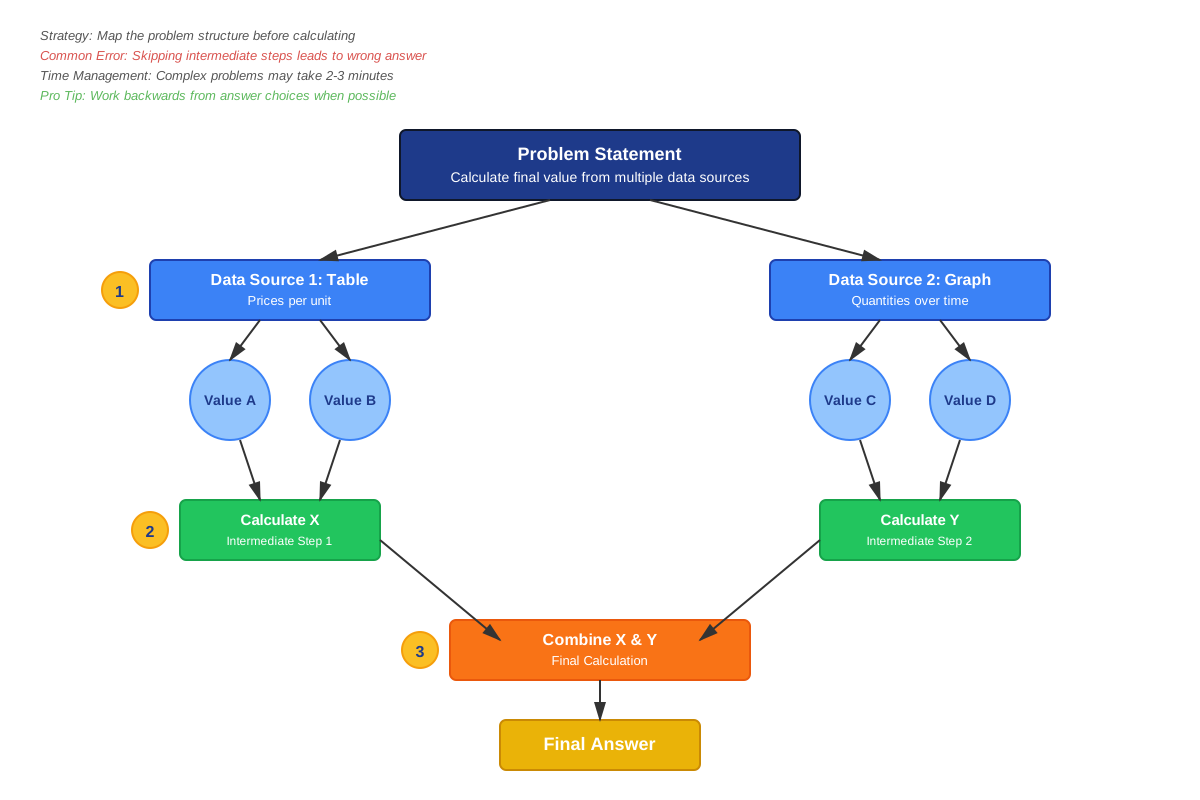
Complex ACT data interpretation questions require combining information from multiple sources or performing sequential calculations. A typical multi-step problem might require: (1) extracting values from a table, (2) calculating a percentage or ratio, and (3) comparing the result to another data point. Success requires systematic organization—writing down intermediate results prevents errors in longer calculations.
Some questions present data in one format and ask students to determine how it would appear in another format (e.g., "Which pie chart correctly represents the data in this table?"). These questions test deep understanding of how different visualizations represent the same underlying information.
Units and Scale Considerations
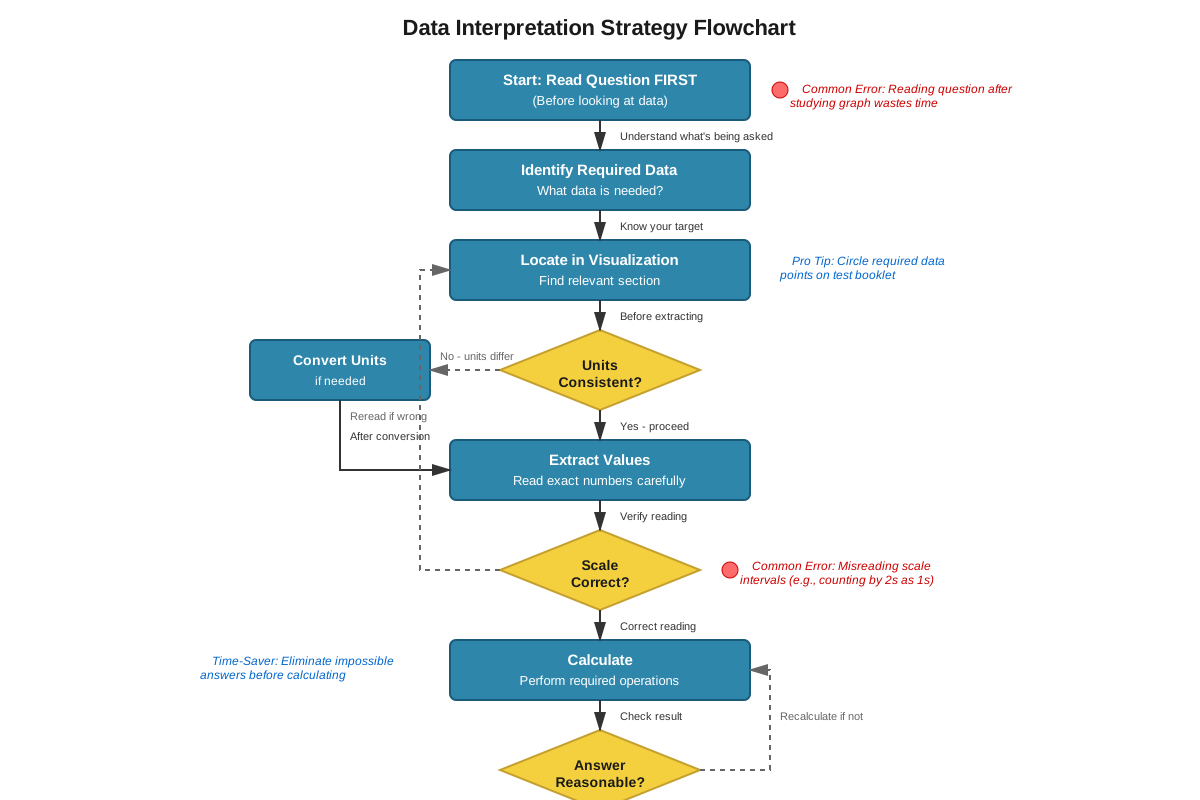
The ACT frequently includes questions where careful attention to units and scale is critical. A graph might display values in thousands, requiring multiplication to find actual amounts. Time might be represented in various units (seconds, minutes, hours), necessitating conversion. Students must read axis labels completely, noting any multipliers or unit specifications.
Axis breaks or non-zero origins can create visual distortions. A bar graph starting at 50 rather than 0 might make small differences appear dramatic. Recognizing these features prevents misinterpretation of relative magnitudes.
Concept Relationships
Data interpretation concepts form an interconnected web where mastery of foundational skills enables success with more complex applications. Basic data extraction (reading individual values from tables and simple graphs) serves as the entry point, leading directly to comparative analysis (determining which category is largest, smallest, or shows the greatest change). These comparison skills then enable calculation-based interpretation (finding percentages, averages, or rates of change using extracted values).
The relationship flows as: Data Extraction → Comparison → Calculation → Synthesis. Synthesis represents the highest level, where students integrate information from multiple visual sources or combine data interpretation with algebraic reasoning.
Within graph types, understanding coordinate planes from geometry directly supports reading line graphs and scatterplots, both of which plot points using (x, y) coordinates. Similarly, percentage concepts from basic arithmetic underpin interpretation of pie charts and calculation of proportional changes in any data format.
Statistical concepts connect deeply to data interpretation: measures of central tendency (mean, median, mode) often appear as questions about table data, while box plots explicitly display quartiles and ranges. Understanding probability enhances interpretation of frequency tables and two-way tables that show categorical relationships.
The progression from prerequisite knowledge follows this path: Arithmetic operations → Ratio and proportion → Percentage calculations → Coordinate reading → Statistical measures → Complex data synthesis. Each level builds upon previous skills while adding new interpretive demands.
Quick check — test yourself on Data interpretation so far.
Try Flashcards →High-Yield Facts
- ⭐ Bar graphs compare discrete categories; line graphs show continuous change over time
- ⭐ In pie charts, all slices must sum to 100% or the total value
- ⭐ The slope of a line segment on a graph represents the rate of change between two points
- ⭐ Scatterplots show correlation (relationship) but do not prove causation
- ⭐ In box plots, the box itself contains the middle 50% of the data (IQR)
- Tables organize data at row-column intersections; always check headers for variable identification
- Positive correlation means both variables increase together; negative correlation means one increases as the other decreases
- Interpolation estimates values within the data range; extrapolation predicts beyond it
- Axis breaks or non-zero origins can visually exaggerate differences between values
- When multiple data sets appear on one graph, the legend is essential for correct identification
- Percentage increase is calculated as (new value - old value) / old value × 100%
- The median divides a data set in half; it appears as the middle line in a box plot
- Outliers are data points that fall far from the general pattern or trend
- Two-way tables allow calculation of conditional probabilities by focusing on specific rows or columns
- Reading axis labels completely prevents unit conversion errors and scale misinterpretation
Common Misconceptions
Misconception: The tallest bar in a bar graph always represents the largest actual value. → Correction: Students must check the scale and starting point of the axis. If the axis begins at a non-zero value or uses a logarithmic scale, visual height may not directly correspond to actual magnitude. Always read the numerical values rather than relying solely on visual comparison.
Misconception: A line connecting two points on a graph means all intermediate values actually occurred. → Correction: Lines between data points often represent interpolation or assumed continuity, but the actual phenomenon might have fluctuated differently between measurements. Only the plotted points represent confirmed data; the line shows a model or trend.
Misconception: Correlation shown in a scatterplot proves that one variable causes changes in the other. → Correction: Correlation indicates association but not causation. Both variables might be influenced by a third factor, or the relationship might be coincidental. The ACT specifically tests understanding of this distinction.
Misconception: In a pie chart, the largest slice always represents more than 50% of the total. → Correction: The largest slice is simply bigger than any other individual slice but may represent less than half the total. For example, if five slices represent 25%, 20%, 20%, 18%, and 17%, the 25% slice is largest but far from a majority.
Misconception: The median and mean of a data set are always approximately equal. → Correction: In skewed distributions, the median and mean can differ substantially. Outliers pull the mean toward extreme values while leaving the median relatively unaffected. Box plots display the median, not the mean.
Misconception: Every point on a scatterplot must fall exactly on the trend line for the line to be valid. → Correction: Trend lines represent the general pattern in data, not exact predictions for every observation. Variation around the trend line is normal and expected; the line shows the overall relationship despite individual deviations.
Worked Examples
Example 1: Multi-Step Table Analysis
Problem: The table below shows the number of books sold by a bookstore over four months:
| Month | Fiction | Non-Fiction | Children's |
|---|---|---|---|
| Jan | 245 | 180 | 95 |
| Feb | 290 | 165 | 110 |
| Mar | 310 | 200 | 125 |
| Apr | 275 | 190 | 105 |
What percentage of the total books sold in March were Fiction books? Round to the nearest whole percent.
Solution:
Step 1: Identify relevant data
We need March data: Fiction = 310, Non-Fiction = 200, Children's = 125
Step 2: Calculate total books sold in March
Total = 310 + 200 + 125 = 635 books
Step 3: Calculate the percentage
Percentage = (Fiction books / Total books) × 100%
Percentage = (310 / 635) × 100%
Percentage = 0.4882 × 100%
Percentage = 48.82%
Step 4: Round to nearest whole percent
Answer: 49%
This problem demonstrates the core data interpretation skill of extracting specific values from a table, performing calculations with those values, and converting to the requested format. The ACT frequently requires percentage calculations from tabular data.
Example 2: Line Graph Rate of Change
Problem: A line graph shows the temperature throughout a day. At 6:00 AM, the temperature was 52°F. At 2:00 PM, the temperature was 76°F. What was the average rate of temperature increase in degrees Fahrenheit per hour during this time period?
Solution:
Step 1: Identify the change in temperature
Temperature change = 76°F - 52°F = 24°F
Step 2: Identify the time elapsed
From 6:00 AM to 2:00 PM = 8 hours
Step 3: Calculate the rate of change
Rate = Change in temperature / Time elapsed
Rate = 24°F / 8 hours
Rate = 3°F per hour
Answer: 3°F per hour
This problem illustrates how line graphs test understanding of slope and rate of change. The ACT commonly asks students to calculate rates from coordinate points, connecting data interpretation to algebraic concepts. The key insight is recognizing that "average rate" corresponds to the slope of the line segment connecting the two points.
Exam Strategy
When approaching ACT data interpretation questions, begin by investing 5-10 seconds to fully understand the visual representation before reading the question. Identify what each axis represents, note the units and scale, and check for any legends or keys. This upfront investment prevents misreading and reduces the need to re-examine the figure multiple times.
Trigger words that signal data interpretation questions include: "according to the graph," "based on the table," "as shown in the figure," "the data indicate," and "which of the following best represents." These phrases tell you that the answer must come directly from or be calculated from the provided visual information rather than from memorized formulas or theorems.
For process of elimination, immediately eliminate answer choices that require values outside the displayed data range (unless the question explicitly asks for extrapolation). If a question asks about March data and an answer choice references February values, it's likely incorrect unless the question involves comparison. Also eliminate choices with incorrect units or impossible values (like percentages over 100% when that's not possible given the context).
Time allocation for data interpretation questions should average 45-60 seconds per question. Simple extraction questions ("What was the value in 2015?") should take 30 seconds or less. Multi-step problems requiring calculations may need 90 seconds. If a question requires more than two minutes, mark it and return later—data interpretation questions should be time-efficient compared to complex geometry proofs.
Develop a systematic approach: (1) Read the question first to know what you're looking for, (2) Locate the relevant data in the visual, (3) Extract or calculate the needed value, (4) Check that your answer matches the requested units and format, (5) Verify your answer makes logical sense given the context. This five-step process prevents careless errors and ensures efficient problem-solving.
Exam Tip: When a question provides both a graph and specific numerical data in the question text, double-check that these align. Occasionally, the ACT tests whether students notice discrepancies or can reconcile information from multiple sources.
Memory Techniques
SCALE - A mnemonic for approaching any data visualization:
- Source: What is being measured?
- Categories: What groups or time periods are shown?
- Axes: What do the x and y axes represent?
- Legend: What do colors, symbols, or lines indicate?
- Extremes: What are the maximum and minimum values?
"Pie Pieces Part the Whole" - Remember that pie charts always represent parts of a complete whole, and all slices must sum to 100% or the total value. This prevents errors when calculating individual slice values.
"Line = Time" - As a general rule, line graphs typically show change over time, while bar graphs compare categories. This quick association helps you immediately understand the graph's purpose.
"Box = Middle" - In box plots, remember that the box itself contains the middle 50% of data. The line inside the box is the median (middle value), not the mean.
Correlation Visualization: Picture a positive correlation as climbing uphill (both variables increase together) and negative correlation as going downhill (one increases as the other decreases). No correlation looks like a flat, scattered field with no clear path.
The "Read-Extract-Calculate-Check" (RECC) Process: This acronym provides a systematic approach to every data interpretation question, ensuring no steps are skipped under time pressure.
Summary
Data interpretation represents a critical ACT Math skill that bridges mathematical computation with analytical reading of visual information. Success requires fluency in extracting values from tables, graphs, charts, and plots, combined with the ability to perform calculations and comparisons using that data. The ACT tests data interpretation through various formats including bar graphs (categorical comparisons), line graphs (continuous trends), pie charts (proportional relationships), scatterplots (correlations), box plots (distribution summaries), and tables (organized numerical data). Students must master both straightforward extraction of specific values and complex multi-step problems that synthesize information from multiple sources. Key strategies include carefully reading axis labels and units, distinguishing between correlation and causation, understanding that visual representations can distort perception through scale manipulation, and systematically approaching each question by first understanding the visualization before attempting calculations. The high frequency of these questions on the ACT (15-20% of Math section) and their appearance across difficulty levels makes data interpretation mastery essential for achieving competitive scores.
Key Takeaways
- Data interpretation questions comprise 15-20% of ACT Math, making them one of the highest-yield topics for focused study
- Always read axis labels, units, and scales completely before attempting to extract or calculate values from visual data
- Different graph types serve different purposes: bar graphs for categorical comparison, line graphs for trends over time, pie charts for parts of a whole, and scatterplots for relationships between variables
- Multi-step problems require systematic organization—write down intermediate calculations to prevent errors in complex problems
- Correlation does not imply causation; scatterplots show relationships but not necessarily cause-and-effect
- Box plots display five key values (minimum, Q1, median, Q3, maximum) with the box containing the middle 50% of data
- Time efficiency is crucial: simple extraction should take 30 seconds, while complex calculations may require 90 seconds
Related Topics
Measures of Central Tendency and Spread: Building on data interpretation skills, this topic explores calculating and interpreting mean, median, mode, range, and standard deviation from data sets. Mastering data interpretation provides the foundation for understanding how these statistical measures summarize information.
Probability and Two-Way Tables: Data interpretation skills directly enable analysis of frequency tables and calculation of conditional probabilities. The ability to extract and compare values from tables is essential for probability questions involving multiple categories.
Functions and Their Graphs: Understanding line graphs and coordinate planes in data interpretation contexts prepares students for more abstract function analysis, including identifying domain, range, and transformations of algebraic functions.
Linear Equations and Slope: The rate-of-change calculations practiced in line graph interpretation connect directly to algebraic concepts of slope, y-intercept, and linear modeling. Data interpretation provides concrete, visual contexts for these abstract algebraic ideas.
Practice CTA
Now that you've mastered the core concepts of data interpretation, it's time to solidify your understanding through active practice. The practice questions and flashcards designed for this topic will challenge you to apply these strategies to authentic ACT-style problems, building both speed and accuracy. Remember that data interpretation is one of the most frequently tested topics on the ACT Math section—every minute you invest in practice directly translates to points on test day. Approach each practice problem systematically using the SCALE and RECC techniques, and review any mistakes to identify patterns in your thinking. You've built a strong foundation; now transform that knowledge into test-day confidence through deliberate practice!
Sign up free to keep reading
Create a free AnvayaPrep account to finish this ACT guide on Data interpretation — plus flashcards and practice questions.