Overview
Percent change in data is a fundamental quantitative skill tested extensively on the ACT Math section. This topic requires students to calculate and interpret how values increase or decrease relative to their original amounts, expressed as percentages. Unlike simple arithmetic operations, percent change questions demand that students understand the relationship between initial values, final values, and the proportional difference between them.
The ACT frequently embeds percent change problems within real-world contexts such as price increases, population growth, sales tax calculations, discount scenarios, and statistical data analysis. These questions appear across multiple difficulty levels and often combine percent change with other mathematical concepts like ratios, proportions, and algebraic expressions. Mastering ACT percent change in data is essential because these questions typically appear 3-5 times per test and serve as building blocks for more complex problems involving compound interest, exponential growth, and data interpretation.
Understanding percent change connects directly to broader mathematical literacy in statistics, algebra, and data analysis. The concept bridges arithmetic fundamentals with more sophisticated topics like rates of change in functions, slope interpretation, and statistical measures of variability. Students who master percent change develop critical thinking skills for comparing quantities across different scales and contexts—abilities that extend beyond the ACT into college-level coursework and professional applications.
Learning Objectives
- [ ] Identify when Percent change in data is being tested in ACT questions
- [ ] Explain the core rule or strategy behind Percent change in data calculations
- [ ] Apply Percent change in data to ACT-style questions accurately
- [ ] Distinguish between percent change, percent of a number, and percentage point difference
- [ ] Calculate percent increase and percent decrease using the standard formula
- [ ] Solve multi-step problems involving sequential percent changes
- [ ] Interpret percent change in tables, graphs, and word problems
Prerequisites
- Basic percentage calculations: Understanding how to convert between decimals, fractions, and percentages is essential for setting up percent change formulas correctly
- Order of operations: Necessary for evaluating complex expressions involving subtraction, division, and multiplication in percent change calculations
- Algebraic manipulation: Required for solving equations where the original value, final value, or percent change is unknown
- Fraction and decimal operations: Critical for working with percentage values and performing accurate calculations without a calculator
Why This Topic Matters
Percent change represents one of the most practical mathematical concepts students encounter in daily life. From understanding inflation rates and investment returns to interpreting sales discounts and population statistics, percent change provides the framework for comparing quantities across time and contexts. In professional fields ranging from business and economics to science and healthcare, the ability to calculate and interpret percent change is indispensable.
On the ACT Math section, percent change questions appear with high frequency—typically 3-5 questions per 60-question test, representing approximately 5-8% of the exam. These questions span difficulty levels from straightforward single-step calculations to complex multi-step problems involving tables, graphs, or algebraic expressions. The ACT tests percent change through various question formats: direct calculation problems, word problems requiring setup and interpretation, data analysis questions involving tables or charts, and algebraic problems where percent change is embedded within equations.
Common ACT scenarios include: calculating the percent increase in a company's revenue between two years, determining the sale price after a percent discount, finding the original price before a percent increase, analyzing percent changes in survey data, and solving problems involving sequential percent changes (such as a price increase followed by a decrease). The topic frequently appears in questions 20-40 of the Math section, where medium-difficulty problems are concentrated, though it can also appear in easier early questions and more challenging later questions when combined with other concepts.
Core Concepts
The Percent Change Formula
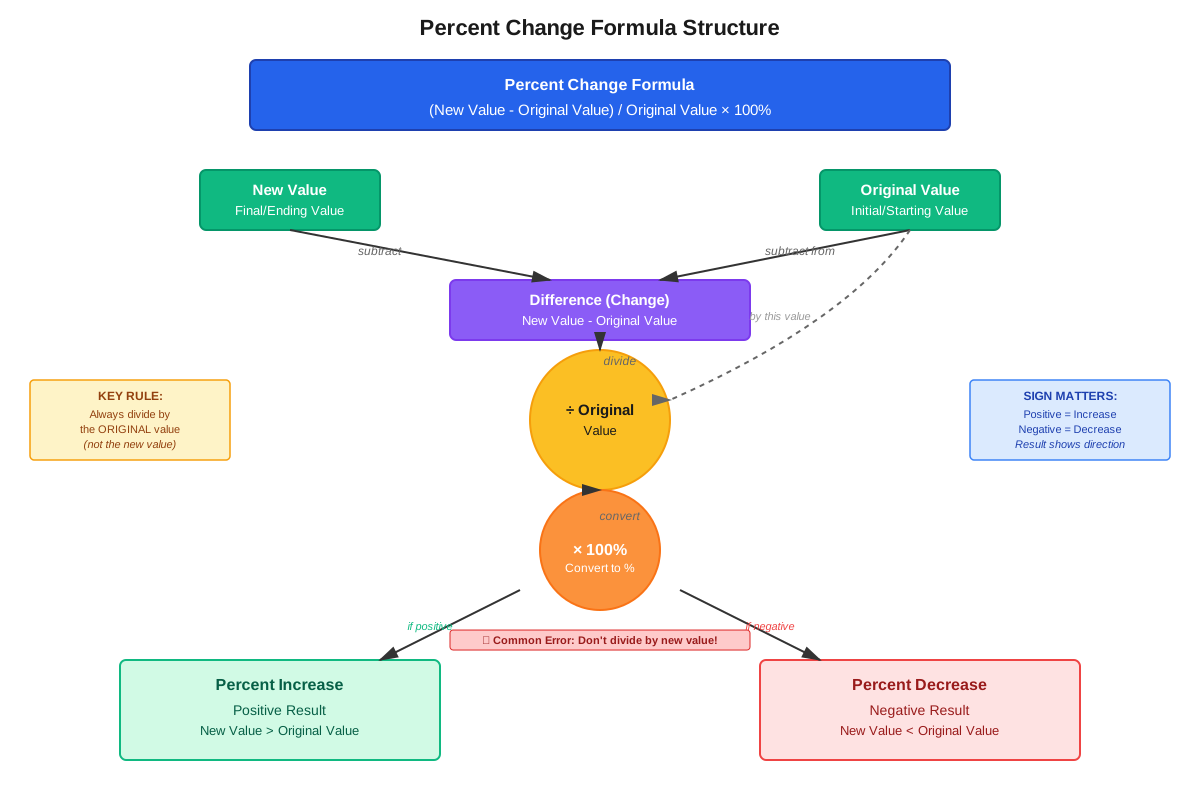
The fundamental formula for percent change in data is:
Percent Change = (New Value - Original Value) / Original Value × 100%This formula calculates the proportional difference between two values relative to the starting point. The numerator represents the absolute change (the difference between values), while the denominator normalizes this change relative to the original value. Multiplying by 100 converts the decimal result to a percentage.
Key components:
- Original Value: The starting amount or initial quantity (also called the base value)
- New Value: The ending amount or final quantity after the change
- Absolute Change: The raw difference between new and original values (New - Original)
- Relative Change: The absolute change expressed as a proportion of the original value
Percent Increase vs. Percent Decrease
The sign of the result determines whether the change represents an increase or decrease:
| Type | Condition | Formula Result | Interpretation |
|---|---|---|---|
| Percent Increase | New Value > Original Value | Positive percentage | The value grew by this percent |
| Percent Decrease | New Value < Original Value | Negative percentage | The value declined by this percent |
| No Change | New Value = Original Value | 0% | The value remained constant |
When reporting percent decrease, the ACT typically expects the absolute value (positive number) with the word "decrease" or "decline" in the answer. For example, if the calculation yields -15%, the answer would be stated as "a 15% decrease."
Alternative Calculation Methods
Method 1: Using the difference directly
For percent increase:
Percent Increase = (Amount of Increase / Original Value) × 100%For percent decrease:
Percent Decrease = (Amount of Decrease / Original Value) × 100%Method 2: Working backwards from a final value
When given a final value after a percent change and asked to find the original:
Original Value = Final Value / (1 + Percent Change as decimal)For increases, add the percent change; for decreases, subtract it.
Sequential Percent Changes
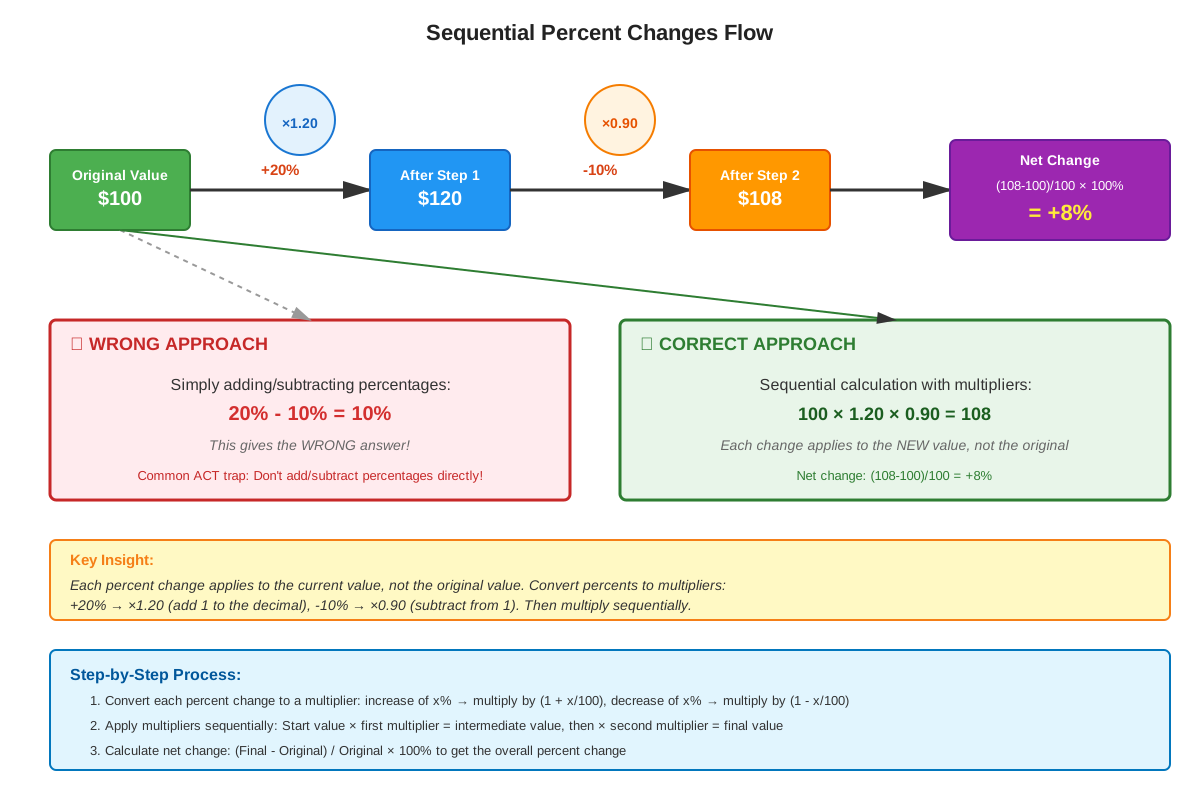
A critical concept that frequently appears on the ACT involves applying multiple percent changes consecutively. Sequential percent changes do not add directly—this is a major source of errors.
Example scenario: A price increases by 20%, then decreases by 20%.
Incorrect approach: +20% - 20% = 0% (no net change)
Correct approach:
- After 20% increase: New Value = Original × 1.20
- After 20% decrease: Final Value = (Original × 1.20) × 0.80 = Original × 0.96
- Net change: 4% decrease from original
The key principle: Each percent change applies to the value at that stage, not the original value.
Percent Change in Data Tables and Graphs
The ACT frequently presents data in tables or graphs and asks students to calculate percent changes between values. The process remains the same:
- Identify the original value (typically the earlier time period or baseline category)
- Identify the new value (typically the later time period or comparison category)
- Apply the percent change formula
- Interpret the result in context
Critical consideration: Always verify which value serves as the base (denominator). The question wording determines this: "percent increase FROM 2010 TO 2015" means 2010 is the original value.
Percentage Points vs. Percent Change
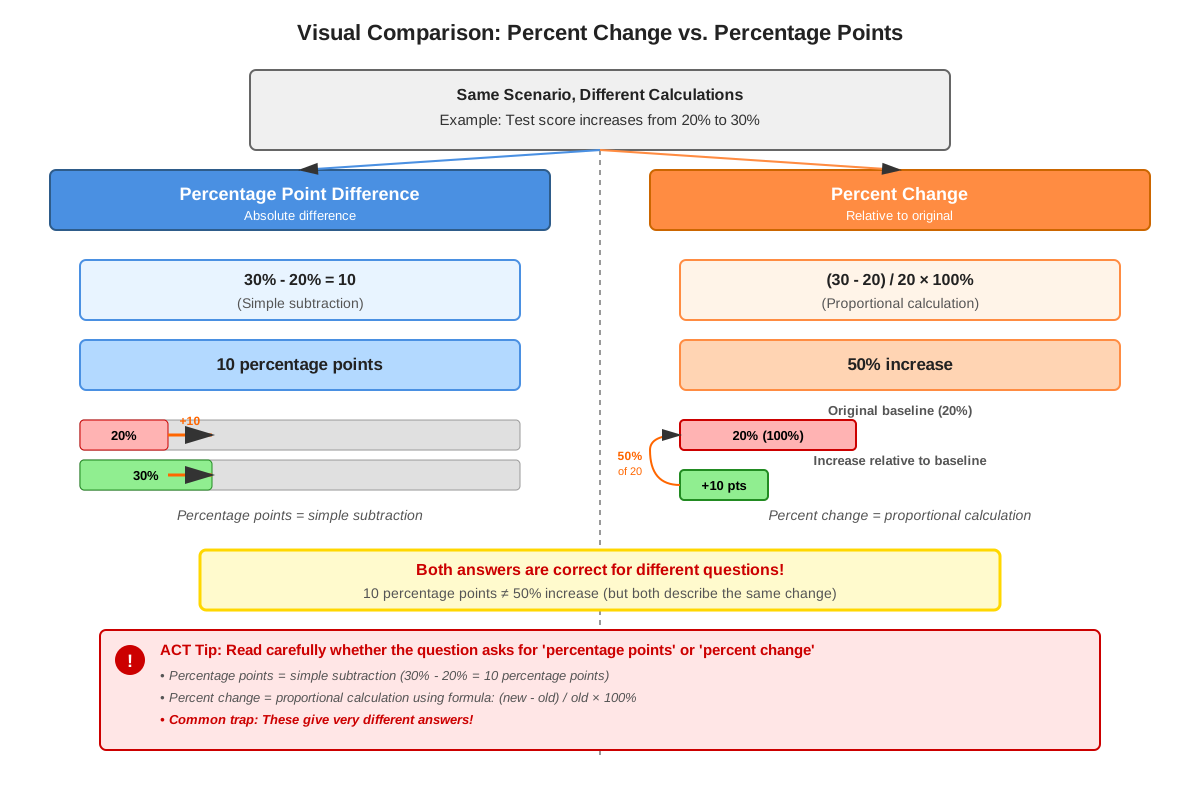
This distinction is crucial for ACT success. Percentage points represent absolute differences between percentages, while percent change represents relative differences.
Example: A test score increases from 60% to 75%.
- Percentage point increase: 75% - 60% = 15 percentage points
- Percent change: (75 - 60) / 60 × 100% = 25% increase
The ACT may test whether students recognize this difference, particularly in questions involving rates, proportions, or survey data.
Concept Relationships
The concepts within percent change form a hierarchical structure. The fundamental percent change formula serves as the foundation, from which percent increase and percent decrease emerge as specific applications based on the direction of change. Understanding these basic calculations enables students to tackle sequential percent changes, which require applying the formula multiple times while recognizing that each change builds on the previous result rather than the original value.
Percent change in data tables and graphs represents an application of the basic formula to real-world data presentations, requiring students to extract values correctly before performing calculations. The distinction between percentage points and percent change operates as a parallel concept that tests deeper understanding of what percentages represent—absolute versus relative measures.
These concepts connect to prerequisite knowledge through several pathways: Basic percentage calculations → Percent change formula → ACT problem applications. Similarly, Algebraic manipulation → Solving for unknown values → Complex percent change problems. The topic also connects forward to more advanced concepts: Percent change → Exponential growth and decay → Compound interest → Function transformations.
Understanding percent change enhances comprehension of ratios and proportions (both express relative relationships), rates of change (percent change is a specific type of rate), and statistical measures (percent change quantifies variability between data points).
High-Yield Facts
⭐ The percent change formula always uses the original value as the denominator: (New - Original) / Original × 100%
⭐ Sequential percent changes multiply, they don't add: A 10% increase followed by a 10% decrease does NOT return to the original value
⭐ Percent decrease cannot exceed 100%: The maximum decrease is 100% (reducing to zero)
⭐ When finding an original value after a percent increase, divide by (1 + percent as decimal): If a value increased 25% to reach 150, the original was 150 ÷ 1.25 = 120
⭐ The ACT often asks for percent change between data points in tables: Always identify which value is the "original" based on question wording
- A 50% decrease followed by a 100% increase returns to the original value (half, then doubled)
- Percentage points and percent change are different: moving from 20% to 30% is a 10 percentage point increase but a 50% increase
- When a question asks "what percent of the original," it's asking for the final value as a percent of the original, not the percent change
- Percent increase problems can be solved by multiplying the original by (1 + percent as decimal): a 15% increase means multiply by 1.15
- The phrase "percent more than" indicates percent increase; "percent less than" indicates percent decrease
Quick check — test yourself on Percent change in data so far.
Try Flashcards →Common Misconceptions
Misconception: Sequential percent changes can be added or subtracted directly (e.g., +20% then -20% = 0% net change)
Correction: Each percent change applies to the current value, not the original. A 20% increase followed by a 20% decrease results in a 4% net decrease because the second change applies to the already-increased value.
Misconception: The denominator in percent change can be either the original or new value
Correction: The percent change formula specifically requires the original value as the denominator. Using the new value produces a different calculation (sometimes called "percent difference") that doesn't represent standard percent change.
Misconception: A 100% increase means doubling, so a 200% increase means tripling
Correction: A 100% increase does mean doubling (original + 100% of original = 2× original), and a 200% increase means tripling (original + 200% of original = 3× original). This misconception is actually correct, but students often confuse it by thinking 200% increase means doubling.
Misconception: Percentage points and percent change are the same thing
Correction: Percentage points measure absolute differences between percentages (30% - 20% = 10 percentage points), while percent change measures relative differences ((30-20)/20 × 100% = 50% increase). The ACT specifically tests this distinction.
Misconception: To find the original value after a 20% increase, subtract 20% from the final value
Correction: This approach is incorrect because 20% of the final value differs from 20% of the original value. Instead, divide the final value by 1.20 to find the original.
Misconception: Percent decrease can exceed 100%
Correction: A 100% decrease means reducing to zero. Values cannot decrease by more than 100% in standard percent change calculations, as this would imply negative values.
Worked Examples
Example 1: Basic Percent Change with Data Table
Problem: The table below shows the population of Springfield in two different years.
| Year | Population |
|---|---|
| 2010 | 45,000 |
| 2020 | 54,000 |
What was the percent increase in Springfield's population from 2010 to 2020?
Solution:
Step 1: Identify the original and new values
- Original Value (2010): 45,000
- New Value (2020): 54,000
Step 2: Calculate the absolute change
- Absolute Change = 54,000 - 45,000 = 9,000
Step 3: Apply the percent change formula
- Percent Change = (Absolute Change / Original Value) × 100%
- Percent Change = (9,000 / 45,000) × 100%
- Percent Change = 0.20 × 100%
- Percent Change = 20%
Answer: The population increased by 20%
Connection to Learning Objectives: This problem demonstrates identifying percent change in data tables (Objective 1), applying the core formula (Objective 2), and calculating accurately (Objective 3).
Example 2: Sequential Percent Changes
Problem: A store marks up the wholesale price of a jacket by 60%. During a sale, the store then reduces the marked-up price by 25%. If the wholesale price was $80, what is the final sale price?
Solution:
Step 1: Calculate the price after the 60% markup
- A 60% increase means multiplying by 1.60
- Price after markup = $80 × 1.60 = $128
Step 2: Calculate the price after the 25% reduction
- A 25% decrease means multiplying by 0.75 (or subtracting 25%)
- Final sale price = $128 × 0.75 = $96
Alternative approach: Combine the multipliers
- Final price = Original × 1.60 × 0.75
- Final price = $80 × 1.20 = $96
Step 3: Verify the net percent change (optional but instructive)
- Net change = ($96 - $80) / $80 × 100% = 20% increase
- Note: This is NOT 60% - 25% = 35%
Answer: The final sale price is $96
Connection to Learning Objectives: This problem illustrates sequential percent changes (Objective 6), demonstrates why percent changes don't add directly (Objective 4), and shows multi-step problem-solving (Objective 3).
Example 3: Finding Original Value
Problem: After a 15% price increase, a concert ticket costs $69. What was the original price before the increase?
Solution:
Step 1: Set up the relationship
- Let x = original price
- After 15% increase: x × 1.15 = $69
Step 2: Solve for the original price
- x = $69 ÷ 1.15
- x = $60
Step 3: Verify the answer
- Check: $60 × 1.15 = $69 ✓
Answer: The original price was $60
Connection to Learning Objectives: This problem demonstrates working backwards from a final value (Objective 5), requires algebraic manipulation (prerequisite application), and shows an alternative problem format (Objective 1).
Exam Strategy
Trigger Words and Phrases:
- "Percent increase/decrease" → Apply the standard percent change formula
- "From [year/value] to [year/value]" → First value is the original (denominator)
- "Marked up by" or "marked down by" → Direct percent change application
- "After a [percent] increase/decrease" → May need to work backwards to find original
- "Percentage point" → Absolute difference between percentages, NOT percent change
- "What percent of the original" → Final value ÷ original value × 100%
Approach Strategy:
- Identify the question type: Determine whether you're calculating percent change, finding an original value, or dealing with sequential changes
- Label your values: Clearly mark which value is "original" and which is "new" based on the question wording
- Choose your method: Decide whether to use the formula directly or work with multipliers (1 + percent for increases, 1 - percent for decreases)
- Watch for traps: Be alert for percentage points vs. percent change, and remember sequential changes multiply
- Verify reasonableness: Check if your answer makes logical sense (e.g., a percent decrease should yield a smaller final value)
Process of Elimination Tips:
- Eliminate answers that show the wrong direction of change (increase vs. decrease)
- Rule out answers that treat sequential changes as additive
- Eliminate options that confuse percentage points with percent change
- Discard answers greater than 100% for decrease problems
- Remove answers that result from using the wrong denominator (new value instead of original)
Time Allocation:
- Simple one-step percent change: 30-45 seconds
- Multi-step or table-based problems: 60-90 seconds
- Complex sequential change problems: 90-120 seconds
Exam Tip: When dealing with tables or graphs, circle or underline the values you're using and draw an arrow showing which is the original value. This prevents denominator errors.
Memory Techniques
NEW-OLD-OLD Mnemonic: For the percent change formula, remember "NEW minus OLD, divided by OLD, times 100"
- New - Old / Old × 100%
MADS for Sequential Changes: Multiply, Always Don't Subtract
- Sequential percent changes multiply their multipliers; they don't add or subtract
The 1-Plus/1-Minus Rule:
- Increase by x% → multiply by (1 + x as decimal)
- Decrease by x% → multiply by (1 - x as decimal)
- Visualize: "1" represents the original (100%), then add or subtract the change
Percentage Points vs. Percent Change: Think "Points = Plain subtraction" (just subtract the percentages), while percent change requires the full formula
The Denominator Rule: "Original is Down" (Original value goes in the Denominator)
Visualization Strategy: Draw a simple number line or arrow diagram:
- Original Value → [arrow with +/- percent] → New Value
- This visual helps track sequential changes and prevents confusion about which value is the base
Summary
Percent change in data is a high-yield ACT Math topic that measures how values increase or decrease relative to their starting points. The fundamental formula—(New Value - Original Value) / Original Value × 100%—serves as the foundation for all percent change calculations, with the critical requirement that the original value always serves as the denominator. Students must distinguish between percent increase (positive result) and percent decrease (negative result), recognize that sequential percent changes multiply rather than add, and differentiate between percentage points (absolute differences) and percent change (relative differences). The ACT tests this concept through direct calculations, data table analysis, word problems, and multi-step scenarios involving sequential changes. Success requires identifying which value serves as the original based on question wording, applying the correct formula or multiplier method, and avoiding common traps like adding sequential changes or confusing percentage points with percent change. Mastery of percent change enables students to tackle 3-5 questions per test confidently and builds foundational skills for more advanced topics in statistics, exponential functions, and financial mathematics.
Key Takeaways
- The percent change formula always uses the original value as the denominator: (New - Original) / Original × 100%
- Sequential percent changes multiply their effects—they never add or subtract directly
- Percentage points (absolute difference) and percent change (relative difference) are fundamentally different concepts
- To find an original value after a percent increase, divide the final value by (1 + percent as decimal)
- The ACT frequently embeds percent change in data tables and graphs—always identify the original value based on question wording
- Percent increase uses multiplier (1 + percent), while percent decrease uses multiplier (1 - percent)
- Watch for trigger phrases like "from [value] to [value]" to identify which value is the base
Related Topics
Ratios and Proportions: Percent change represents a specific type of ratio comparing the change to the original value; mastering percent change strengthens proportional reasoning skills essential for rate problems and scaling questions.
Exponential Growth and Decay: Sequential percent changes form the foundation for understanding exponential functions, where a constant percent change occurs repeatedly over time—a concept tested in higher-level ACT problems.
Statistics and Data Analysis: Percent change is fundamental to interpreting statistical data, comparing distributions, and analyzing trends in graphs and tables—skills tested throughout the ACT Math and Science sections.
Financial Mathematics: Compound interest, investment returns, and loan calculations all build directly on percent change concepts, particularly sequential changes applied over multiple time periods.
Algebraic Problem Solving: Many percent change problems require setting up and solving equations, strengthening algebraic manipulation skills that transfer to numerous other ACT Math topics.
Practice CTA
Now that you've mastered the core concepts of percent change in data, it's time to solidify your understanding through active practice. Work through the practice questions to apply these strategies to ACT-style problems, and use the flashcards to reinforce the formulas, distinctions, and common traps. Remember: percent change appears on every ACT Math section, so investing 20 minutes to master this topic will directly translate to points on test day. Approach each practice problem systematically, identify the question type, label your values clearly, and verify your answers make logical sense. You've got this!
Sign up free to keep reading
Create a free AnvayaPrep account to finish this ACT guide on Percent change in data — plus flashcards and practice questions.