Overview
Ratios are one of the most fundamental and frequently tested concepts on the ACT Math section, appearing in approximately 3-5 questions per exam. A ratio expresses the relationship between two or more quantities, showing how many times one value contains or is contained within another. Understanding ratios is essential not only for direct ratio problems but also for solving questions involving proportions, rates, scale factors, and probability—making this topic a cornerstone of ACT mathematics.
The ACT tests ratios in various contexts, from simple part-to-part comparisons to complex multi-step problems involving ratio manipulation, scaling, and real-world applications. Students who master ACT ratios gain a significant advantage because ratio concepts appear across multiple question types, including word problems, geometry questions involving similar figures, and data interpretation scenarios. The ability to quickly identify ratio relationships and convert between different representations (such as ratio notation, fractions, and percentages) is crucial for efficient problem-solving under timed conditions.
Ratios connect deeply with other mathematical concepts tested on the ACT, including fractions, proportions, percentages, rates, and algebraic reasoning. They serve as a bridge between arithmetic and algebra, requiring both computational accuracy and conceptual understanding. Mastery of ratios enables students to tackle more advanced topics such as trigonometric ratios, probability calculations, and geometric similarity—all of which appear regularly on the exam. This interconnectedness makes ratios a high-yield study topic that provides returns across multiple areas of the ACT Math section.
Learning Objectives
- [ ] Identify when Ratios is being tested in ACT questions
- [ ] Explain the core rule or strategy behind Ratios
- [ ] Apply Ratios to ACT-style questions accurately
- [ ] Convert between different ratio representations (ratio notation, fractions, percentages)
- [ ] Solve multi-step ratio problems involving scaling and distribution
- [ ] Recognize and apply ratio concepts in geometry, probability, and rate problems
- [ ] Manipulate ratios algebraically to find unknown quantities
Prerequisites
- Basic fraction operations: Ratios are fundamentally related to fractions, and students must be comfortable simplifying, multiplying, and dividing fractions to work with ratio problems efficiently.
- Algebraic equation solving: Many ratio problems require setting up and solving equations with variables, making basic algebra skills essential.
- Multiplication and division fluency: Ratio problems often involve scaling quantities up or down, requiring quick and accurate multiplication and division.
- Understanding of proportional relationships: Recognizing when two quantities maintain a constant relationship is foundational to ratio problem-solving.
Why This Topic Matters
Ratios appear in countless real-world situations, from cooking recipes and map scales to financial planning and scientific measurements. Understanding ratios enables practical problem-solving in everyday life, such as adjusting ingredient quantities, comparing prices, analyzing statistics, and interpreting data visualizations. In professional contexts, ratios are fundamental to fields including engineering, architecture, finance, medicine, and data science.
On the ACT Math section, ratio questions appear with high frequency and in diverse formats. Approximately 5-8% of all ACT Math questions directly test ratio concepts, while many additional questions incorporate ratio reasoning as part of multi-step solutions. The ACT presents ratio problems in several common formats: direct comparison problems ("The ratio of boys to girls is 3:5"), part-to-whole problems ("3 out of every 8 students"), scaling problems ("If the recipe serves 4 but you need to serve 10"), and geometric similarity problems involving proportional dimensions.
The ACT particularly favors ratio questions because they efficiently test multiple skills simultaneously: reading comprehension, algebraic reasoning, arithmetic fluency, and logical thinking. Ratio questions often appear in word problem format, requiring students to extract relevant information, identify the appropriate mathematical relationship, and execute calculations accurately. Additionally, ratio concepts frequently appear in data interpretation questions involving tables, graphs, and charts, making this topic essential for success across the entire Math section.
Core Concepts
Understanding Ratio Notation and Meaning
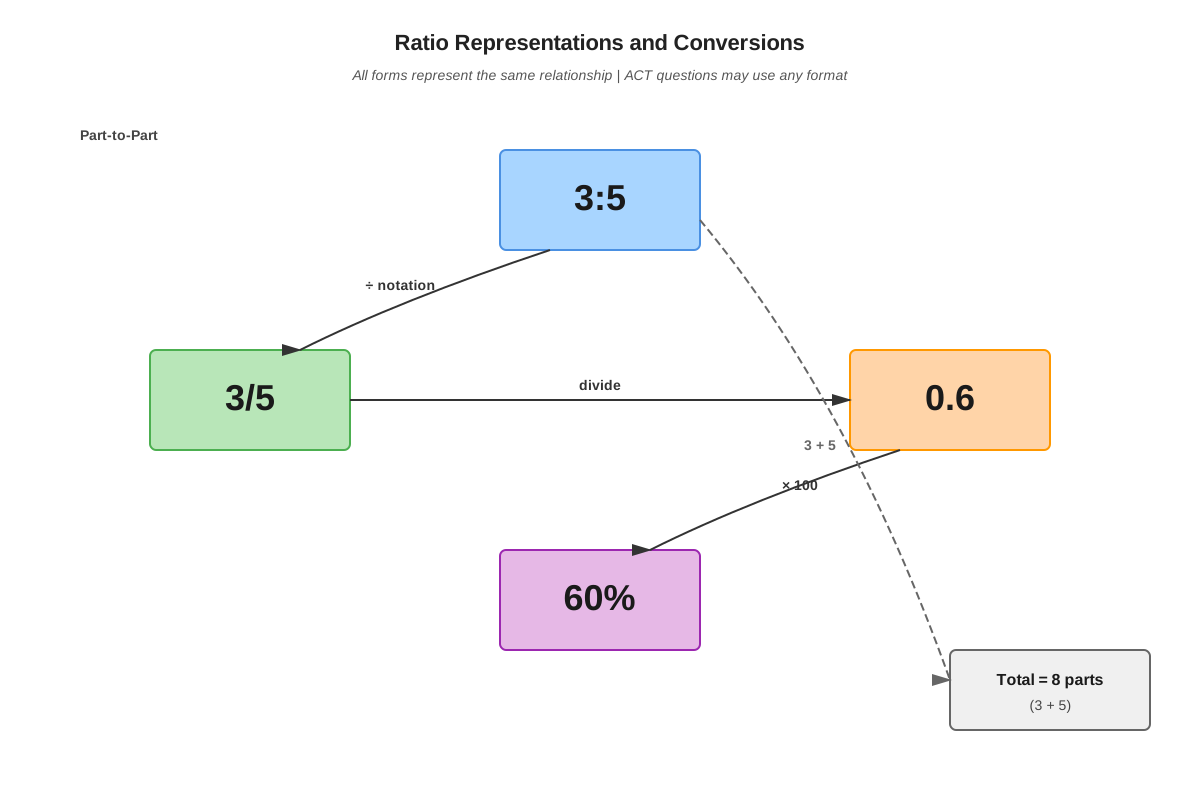
A ratio is a comparison of two or more quantities that shows their relative sizes. Ratios can be expressed in several equivalent forms: using the colon notation (3:5), as a fraction (3/5), or in words ("3 to 5"). Each representation conveys the same relationship but may be more useful in different contexts. The order of terms in a ratio is crucial—the ratio 3:5 is fundamentally different from 5:3.
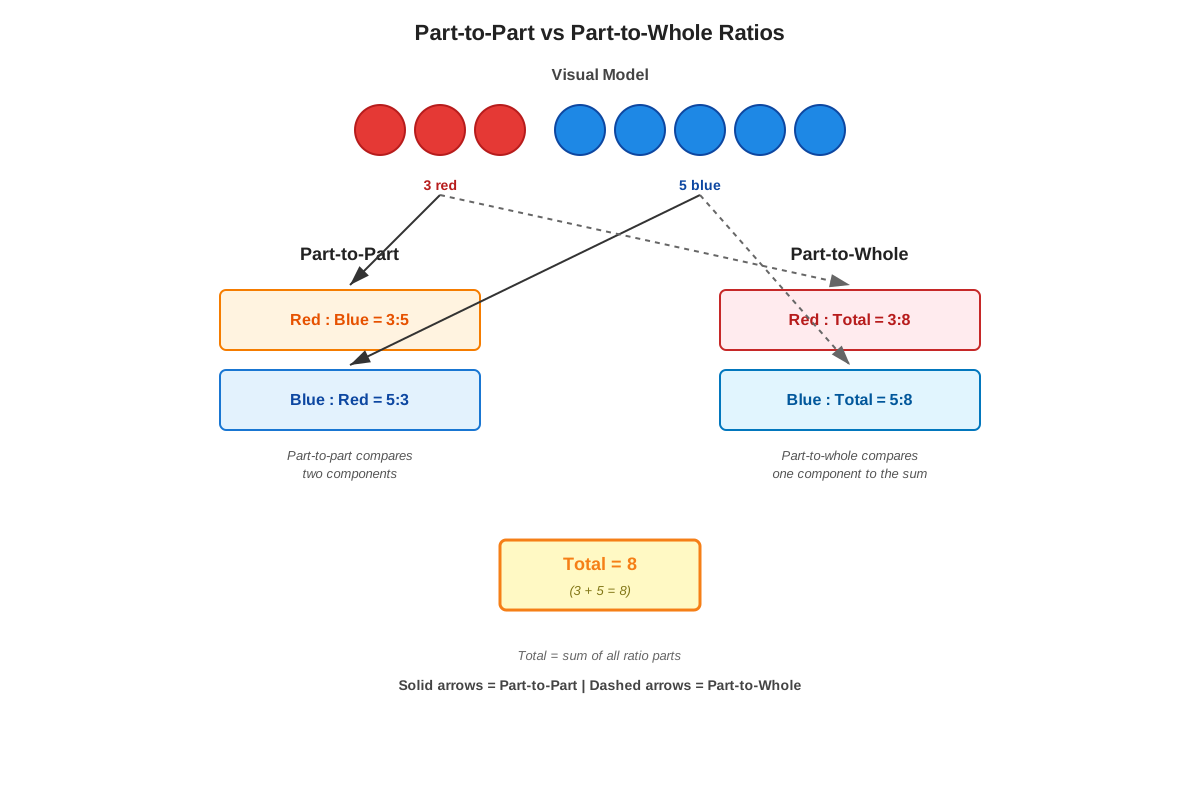
Ratios can represent part-to-part relationships or part-to-whole relationships. In a part-to-part ratio, each term represents a distinct portion of the total. For example, if a classroom has boys and girls in a ratio of 3:5, this means for every 3 boys there are 5 girls, and the total number of students would be represented by 3 + 5 = 8 parts. In a part-to-whole ratio, one term represents a portion while another represents the entire quantity, such as "3 out of 8 students are boys."
Simplifying and Scaling Ratios
Ratios can be simplified just like fractions by dividing all terms by their greatest common factor. The ratio 12:18 simplifies to 2:3 by dividing both terms by 6. Simplified ratios are easier to work with and often reveal the fundamental relationship more clearly. On the ACT, answer choices frequently present ratios in simplified form, so recognizing equivalent ratios is essential.
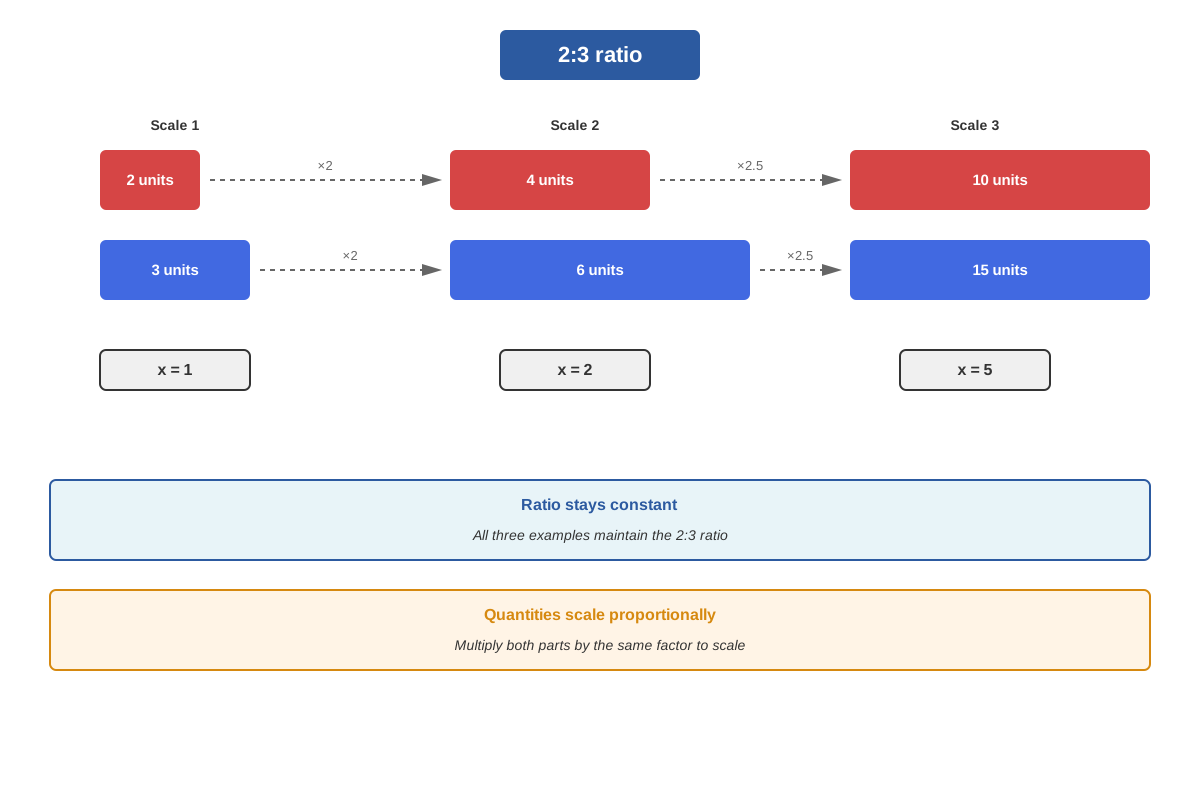
Scaling ratios involves multiplying or dividing all terms by the same factor to find equivalent ratios that represent the same relationship with different actual quantities. If the ratio of flour to sugar is 2:3, then 4:6, 6:9, and 10:15 all represent the same proportional relationship. This scaling property is fundamental to solving problems where you know the ratio but need to find actual quantities, or vice versa.
Converting Between Ratios, Fractions, and Percentages
The ability to fluidly convert between different representations is crucial for ACT success. A ratio of 3:5 can be expressed as the fraction 3/8 when considering the first term as a part of the whole (3 out of 3+5=8 total parts). This fraction can then be converted to a percentage: 3/8 = 0.375 = 37.5%.
| Representation | Example | When to Use |
|---|---|---|
| Ratio notation | 3:5 | Comparing two distinct quantities |
| Fraction | 3/8 | Finding part of a whole or performing calculations |
| Percentage | 37.5% | Expressing part-to-whole relationships clearly |
| Decimal | 0.375 | Performing calculations or comparing values |
Solving Ratio Problems with Algebra
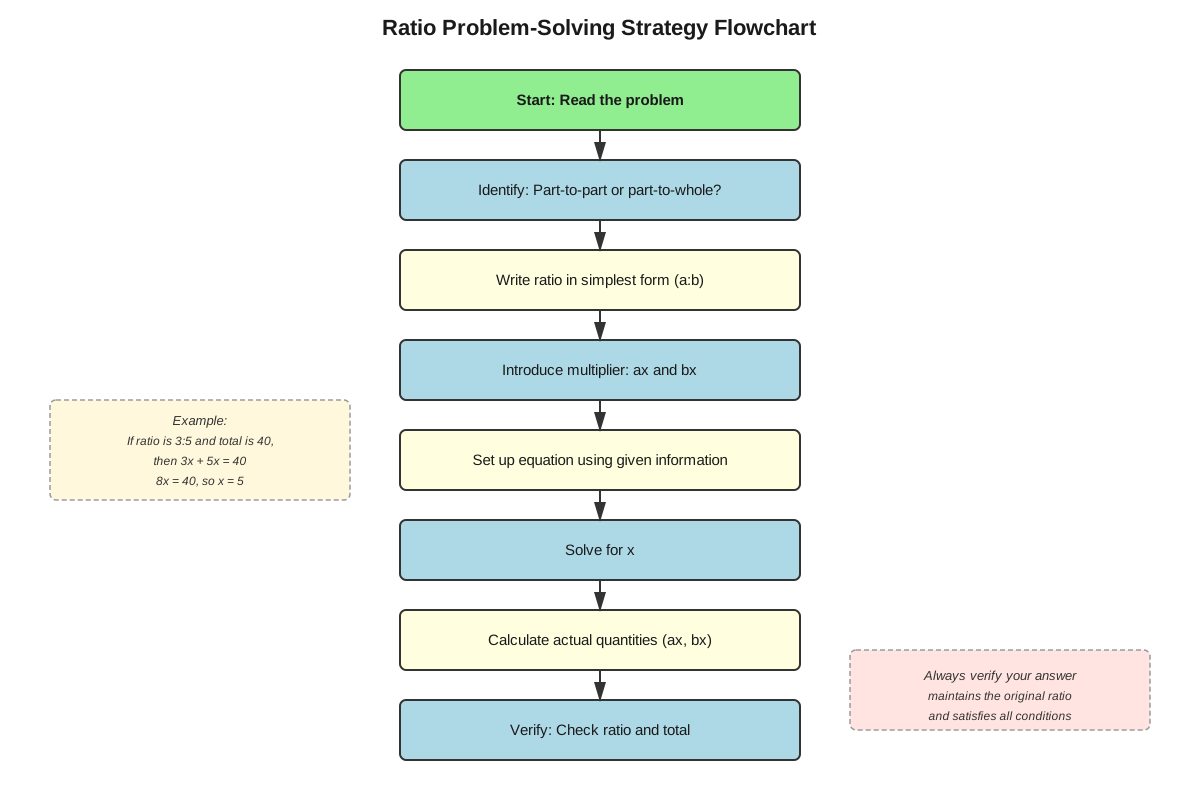
Many ACT ratio problems require setting up algebraic equations. The key strategy is to use a multiplier variable (often represented as x or k) to represent the common factor. If the ratio of boys to girls is 3:5, we can represent the actual number of boys as 3x and girls as 5x, where x is the multiplier that scales the ratio to the actual quantities.
For example, if the ratio of boys to girls is 3:5 and there are 40 students total, we set up the equation: 3x + 5x = 40, which simplifies to 8x = 40, giving x = 5. Therefore, there are 3(5) = 15 boys and 5(5) = 25 girls. This algebraic approach is powerful and works for virtually all ratio problems on the ACT.
Multi-Part Ratios
Some ACT problems involve ratios with three or more terms, such as "the ratio of red to blue to green marbles is 2:3:5." These work exactly like two-term ratios but require careful tracking of all components. The total number of parts is the sum of all terms (2+3+5=10 parts in this example). Each color represents its respective fraction of the whole: red is 2/10 = 1/5 of the total, blue is 3/10, and green is 5/10 = 1/2.
Ratio Applications in Geometry
Ratios appear frequently in ACT geometry questions, particularly in problems involving similar figures. When two figures are similar, all corresponding lengths are in the same ratio. If two triangles are similar with a ratio of corresponding sides of 2:3, then all pairs of corresponding sides maintain this 2:3 ratio. Importantly, the ratio of areas of similar figures equals the square of the ratio of corresponding lengths (2²:3² = 4:9), and the ratio of volumes equals the cube of the linear ratio (2³:3³ = 8:27).
Scale drawings and maps also rely on ratios. A map scale of "1 inch : 50 miles" means every inch on the map represents 50 miles in reality, establishing a ratio of 1:316,800 (since 50 miles = 50 × 5,280 × 12 inches).
Rate Problems as Ratios
Rates are special types of ratios that compare quantities with different units, such as miles per hour, dollars per pound, or problems per minute. The ACT frequently tests rate problems that require ratio reasoning. For example, if a car travels 180 miles in 3 hours, the rate is 180:3 = 60:1, or 60 miles per hour. Understanding rates as ratios allows students to solve complex problems involving multiple rates, combined work, and unit conversions.
Concept Relationships
The concepts within ratio problems form a hierarchical structure. Understanding basic ratio notation and meaning → enables simplification and scaling → which supports conversion between representations → allowing algebraic problem-solving → which extends to multi-part ratios and specialized applications.
Ratios connect directly to prerequisite topics: they build upon fraction operations (ratios are essentially comparisons expressed as fractions), require algebraic equation-solving skills (for finding unknown quantities), and depend on proportional reasoning (recognizing constant relationships). The relationship can be mapped as: Fractions → Ratios → Proportions → Rates → Percentages.
Ratios also connect forward to more advanced topics. Mastering ratios enables understanding of trigonometric ratios (sine, cosine, and tangent are ratios of triangle sides), probability (expressed as ratios of favorable to total outcomes), and statistical concepts (such as odds ratios). In geometry, ratio concepts are essential for understanding similarity, scale factors, and coordinate geometry slopes (which are ratios of vertical to horizontal change).
The algebraic approach to ratios (using multiplier variables) bridges arithmetic and algebra, demonstrating how abstract algebraic thinking can solve concrete numerical problems. This connection reinforces the power of algebraic reasoning and prepares students for more complex problem-solving across the ACT Math section.
High-Yield Facts
⭐ A ratio compares quantities by division; the ratio a:b means a÷b and can be written as the fraction a/b
⭐ In a part-to-part ratio a:b, the total is represented by (a+b) parts
⭐ Ratios can be scaled by multiplying or dividing all terms by the same non-zero number
⭐ To solve ratio problems algebraically, represent quantities as multiples of a variable (3x and 5x for a 3:5 ratio)
⭐ The ratio of areas of similar figures equals the square of the ratio of corresponding lengths
- Ratios must maintain consistent units for meaningful comparison (convert units before forming ratios)
- A ratio of 0:n or n:0 is either zero or undefined, depending on context
- Equivalent ratios represent the same proportional relationship (2:3 = 4:6 = 6:9)
- Part-to-whole ratios can be converted to percentages by dividing the part by the whole and multiplying by 100
- In three-term ratios a:b:c, each term represents its fraction of the total: a/(a+b+c), b/(a+b+c), c/(a+b+c)
- The ratio of volumes of similar three-dimensional figures equals the cube of the ratio of corresponding lengths
- Rates are ratios with different units (miles/hour, dollars/pound) and follow the same mathematical rules as pure ratios
- When combining ratios (such as a:b and b:c to find a:c), the common term must be made equal first
Quick check — test yourself on Ratios so far.
Try Flashcards →Common Misconceptions
Misconception: The ratio 3:5 means there are exactly 3 of one item and 5 of another.
Correction: The ratio 3:5 means the quantities are in that proportion, but actual amounts could be 6 and 10, or 30 and 50, or any multiple of 3 and 5. The ratio describes the relationship, not the absolute quantities.
Misconception: Ratios and fractions are completely different concepts.
Correction: Ratios and fractions are closely related. A ratio can be expressed as a fraction, though the interpretation differs slightly. The ratio 3:5 as a part-to-part comparison becomes the fraction 3/8 when expressing the first part as a fraction of the whole.
Misconception: You can add the same number to both terms of a ratio to create an equivalent ratio.
Correction: Ratios are multiplicative relationships, not additive. To create equivalent ratios, you must multiply or divide both terms by the same factor. The ratio 2:3 is NOT equivalent to 3:4 (adding 1 to each term), but IS equivalent to 4:6 (multiplying each term by 2).
Misconception: In a ratio problem, you can simply add the ratio terms to find the total.
Correction: While this works for part-to-part ratios (3:5 means 8 total parts), you must first understand what type of ratio is given. If told "the ratio of boys to total students is 3:8," adding 3+8 would be incorrect—there are already 8 total parts, with 3 being boys and 5 being girls.
Misconception: The order of terms in a ratio doesn't matter.
Correction: Order is crucial in ratios. The ratio of boys to girls being 3:5 is fundamentally different from the ratio being 5:3. Always match the order of terms in your ratio to the order specified in the problem.
Misconception: When figures are similar with a ratio of sides of 2:3, their areas are also in the ratio 2:3.
Correction: The ratio of areas equals the square of the ratio of corresponding lengths. If sides are in ratio 2:3, areas are in ratio 4:9 (2²:3²). Similarly, volumes would be in ratio 8:27 (2³:3³).
Misconception: All ratio problems require complex algebra to solve.
Correction: While the algebraic multiplier method is powerful and reliable, some simple ratio problems can be solved through logical reasoning or by recognizing patterns. However, learning the algebraic approach provides a consistent strategy that works for all ratio problems, including complex ones.
Worked Examples
Example 1: Part-to-Part Ratio with Total Given
Problem: In a bag of marbles, the ratio of red marbles to blue marbles is 5:7. If there are 84 marbles total, how many red marbles are in the bag?
Solution:
Step 1: Identify the type of ratio. This is a part-to-part ratio (red to blue).
Step 2: Find the total number of parts. Since the ratio is 5:7, the total parts = 5 + 7 = 12 parts.
Step 3: Set up the algebraic representation. Let the multiplier be x.
- Red marbles = 5x
- Blue marbles = 7x
- Total marbles = 5x + 7x = 12x
Step 4: Use the given total to find x.
- 12x = 84
- x = 84 ÷ 12 = 7
Step 5: Calculate the number of red marbles.
- Red marbles = 5x = 5(7) = 35
Answer: There are 35 red marbles in the bag.
Connection to Learning Objectives: This problem demonstrates identifying ratio problems (the phrase "ratio of...to..." is a key trigger), applying the core algebraic strategy (using a multiplier variable), and accurately solving an ACT-style question.
Example 2: Ratio Application in Geometry
Problem: Two similar triangles have corresponding side lengths in the ratio 3:5. If the area of the smaller triangle is 27 square inches, what is the area of the larger triangle?
Solution:
Step 1: Recognize this as a similar figures problem involving ratios.
Step 2: Recall the key relationship: when linear dimensions are in ratio a:b, areas are in ratio a²:b².
Step 3: Calculate the ratio of areas.
- Linear ratio = 3:5
- Area ratio = 3²:5² = 9:25
Step 4: Set up the proportion using the area ratio.
- Let the area of the larger triangle be A.
- 9:25 = 27:A
- This can be written as 9/25 = 27/A
Step 5: Solve for A.
- Cross-multiply: 9A = 25 × 27
- 9A = 675
- A = 675 ÷ 9 = 75
Answer: The area of the larger triangle is 75 square inches.
Alternative approach: Since areas scale by the square of the linear ratio, the larger triangle's area is (5/3)² times the smaller triangle's area: 27 × (25/9) = 27 × 25/9 = 3 × 25 = 75 square inches.
Connection to Learning Objectives: This problem shows how ratio concepts extend to geometry, requires understanding the relationship between linear and area ratios, and demonstrates multiple solution approaches—all valuable skills for ACT success.
Exam Strategy
When approaching ACT ratio questions, begin by carefully reading the problem to identify what type of ratio is given (part-to-part or part-to-whole) and what the question asks you to find. Look for trigger words and phrases such as "ratio of...to...", "for every...", "out of every...", "proportional to", and "in the ratio". These phrases signal that ratio reasoning will be required.
Exam Tip: Always write down the ratio with clear labels. If the problem states "the ratio of boys to girls is 3:5," write "B:G = 3:5" to avoid confusion about which quantity corresponds to which term.
The most reliable strategy for solving ratio problems is the algebraic multiplier method: represent each quantity as a multiple of a variable (x or k), then use given information to solve for that variable. This approach works consistently across all ratio problem types and reduces the chance of arithmetic errors. Even if you can solve a problem through logical reasoning, the algebraic method provides a systematic check.
For process of elimination, be aware that incorrect answer choices often result from common errors: adding instead of multiplying ratio terms, confusing part-to-part with part-to-whole ratios, or forgetting to square the ratio when dealing with areas. If your answer doesn't match any choice, check whether you've made one of these typical mistakes.
Time allocation for ratio problems should be approximately 45-60 seconds for straightforward problems and up to 90 seconds for complex multi-step problems. If a ratio problem involves geometry or requires multiple conversions, budget extra time. However, if you're stuck after 90 seconds, mark the question and move on—you can return if time permits.
Watch for problems that require unit conversion before forming ratios. If comparing speeds in miles per hour and feet per second, convert to common units first. Similarly, be alert for problems where ratios are given in one form (such as "3 out of 8") but the question asks for a different form (such as a percentage).
Memory Techniques
Mnemonic for ratio problem-solving steps: "WRITE"
- Write the ratio with labels
- Represent quantities as multiples (3x, 5x)
- Identify what's given and what's asked
- Total the parts if needed
- Equate and solve
Visualization strategy: Picture ratios as physical objects in containers. If the ratio of red to blue marbles is 3:5, visualize three red marbles and five blue marbles as one "unit" that can be repeated. If there are 24 marbles total, you have three complete units (3×3=9 red, 3×5=15 blue).
Acronym for similar figures: "LSA-V" represents the scaling pattern:
- Length ratio: a:b
- Surface area ratio: a²:b²
- Area ratio: a²:b² (for 2D figures)
- Volume ratio: a³:b³
Memory aid for ratio equivalence: "Multiply or divide, never add or subtract" reminds you that equivalent ratios are created through multiplication or division, not addition or subtraction.
Fraction connection reminder: "Ratio to fraction: part over total" helps remember that converting a part-to-part ratio to a fraction requires putting one part over the sum of all parts (3:5 becomes 3/8 or 5/8, not 3/5).
Summary
Ratios are fundamental mathematical relationships that compare quantities through division, appearing frequently on the ACT Math section in diverse contexts including word problems, geometry, and data interpretation. Understanding that ratios can be expressed in multiple equivalent forms—colon notation (3:5), fractions (3/8), and percentages (37.5%)—enables flexible problem-solving. The distinction between part-to-part and part-to-whole ratios is crucial for accurate interpretation. The most reliable solution strategy involves representing ratio quantities algebraically as multiples of a variable (3x and 5x for a 3:5 ratio), then using given information to solve for that variable. Ratios scale multiplicatively, meaning equivalent ratios are created by multiplying or dividing all terms by the same factor. In geometric applications, the ratio of areas of similar figures equals the square of the linear ratio, while volume ratios equal the cube of the linear ratio. Mastering these core concepts and the systematic algebraic approach ensures success on ACT ratio questions, which typically account for 5-8% of the Math section and connect to numerous other mathematical topics.
Key Takeaways
- Ratios express relationships between quantities and can be written as a:b, a/b, or "a to b"—all representing the same comparison
- Use the algebraic multiplier method (representing quantities as 3x and 5x for a 3:5 ratio) for reliable, systematic problem-solving
- Part-to-part ratios require adding terms to find the total (3:5 means 8 total parts), while part-to-whole ratios already include the total
- Equivalent ratios are created by multiplying or dividing all terms by the same factor, never by adding or subtracting
- For similar geometric figures, if linear dimensions are in ratio a:b, then areas are in ratio a²:b² and volumes are in ratio a³:b³
- Always identify what type of ratio is given and what the question asks for before beginning calculations
- Ratio problems connect to fractions, proportions, percentages, rates, and geometric similarity—making this a high-yield topic for ACT preparation
Related Topics
Proportions: Direct extensions of ratios, proportions are equations stating that two ratios are equal (a/b = c/d). Mastering ratios provides the foundation for solving proportion problems, which appear frequently on the ACT in contexts like similar triangles, scale drawings, and unit conversions.
Percentages: Percentages are special ratios comparing quantities to 100. Understanding ratios enables quick conversion between ratio notation and percentages, essential for data interpretation and word problems involving percent increase, decrease, and comparison.
Rates and Unit Rates: Rates are ratios comparing quantities with different units (miles per hour, dollars per item). The ratio concepts learned here apply directly to rate problems, which constitute a significant portion of ACT word problems.
Similar Figures and Scale Factor: Geometric similarity relies entirely on ratio relationships between corresponding parts. Mastering ratios enables solving problems involving similar triangles, scale drawings, and proportional reasoning in coordinate geometry.
Probability: Probability can be expressed as a ratio of favorable outcomes to total outcomes. Understanding ratios provides a foundation for probability calculations and interpreting odds.
Practice CTA
Now that you've mastered the core concepts of ratios, it's time to solidify your understanding through practice! Work through the practice questions to apply these strategies to ACT-style problems, and use the flashcards to reinforce key facts and formulas. Remember, ratio problems reward systematic thinking and careful attention to detail—skills that improve dramatically with focused practice. Each problem you solve strengthens your pattern recognition and builds the confidence you need to tackle any ratio question on test day. You've got this!
Sign up free to keep reading
Create a free AnvayaPrep account to finish this ACT guide on Ratios — plus flashcards and practice questions.