Overview
Amplitude is a fundamental concept in trigonometry that describes the vertical stretch or compression of periodic functions, particularly sine and cosine waves. On the ACT Math test, amplitude questions assess a student's ability to analyze and interpret the graphical and algebraic representations of trigonometric functions. Understanding amplitude is crucial because it directly affects how trigonometric functions model real-world phenomena such as sound waves, light waves, and cyclical patterns.
The concept of amplitude appears regularly on the ACT, typically integrated into questions about function transformations, graph interpretation, and equation analysis. Students must recognize how changes in amplitude affect the visual appearance of a graph and how to extract amplitude values from both equations and graphical representations. Mastery of this topic enables students to quickly identify key characteristics of trigonometric functions and solve complex problems involving periodic behavior.
Amplitude connects directly to broader mathematical concepts including function transformations, absolute value, and the general behavior of periodic functions. It serves as a bridge between algebraic manipulation and graphical interpretation, requiring students to move fluidly between different representations of the same mathematical relationship. This dual perspective—seeing amplitude both as a coefficient in an equation and as a measurable feature on a graph—is essential for ACT success.
Learning Objectives
- [ ] Identify when Amplitude is being tested in ACT questions
- [ ] Explain the core rule or strategy behind Amplitude calculations
- [ ] Apply Amplitude concepts to ACT-style questions accurately
- [ ] Determine amplitude from both equation form and graphical representations
- [ ] Distinguish between amplitude and other trigonometric transformations (period, phase shift, vertical shift)
- [ ] Solve real-world application problems involving amplitude
- [ ] Recognize how negative coefficients affect amplitude versus reflection
Prerequisites
- Basic trigonometric functions (sine and cosine): Understanding the standard graphs and behavior of sin(x) and cos(x) is essential because amplitude modifies these base functions
- Function transformations: Knowledge of how coefficients and constants affect function graphs provides the foundation for understanding amplitude as a vertical stretch/compression
- Coordinate plane graphing: Ability to read and interpret graphs is necessary to identify amplitude visually and connect it to algebraic representations
- Absolute value: Understanding absolute value is critical because amplitude is always expressed as a positive value, regardless of the sign of the coefficient
Why This Topic Matters
Amplitude has significant real-world applications across physics, engineering, music, and natural sciences. Sound volume is determined by the amplitude of sound waves—larger amplitudes produce louder sounds. Ocean tides, seasonal temperature variations, and electrical current all exhibit periodic behavior where amplitude represents the magnitude of change from the average value. In medical applications, amplitude measurements in EKG readings help diagnose heart conditions, while seismologists use amplitude to measure earthquake intensity.
On the ACT Math test, amplitude questions appear with moderate to high frequency, typically 1-2 questions per exam. These questions most commonly appear in two formats: (1) identifying amplitude from a given equation, and (2) determining the equation of a trigonometric function from its graph. The ACT specifically tests whether students can recognize the relationship between the coefficient in front of a trigonometric function and the resulting vertical stretch of the graph. Questions may also involve comparing multiple functions or determining which equation matches a given scenario.
ACT amplitude questions often appear disguised within word problems about real-world periodic phenomena, requiring students to translate contextual information into mathematical representations. The exam may present a graph and ask students to identify the correct equation, or provide an equation and ask about specific graphical features. Understanding amplitude is considered high-yield because it frequently appears alongside other transformation concepts, making it a gateway to solving more complex multi-step problems.
Core Concepts
Definition of Amplitude
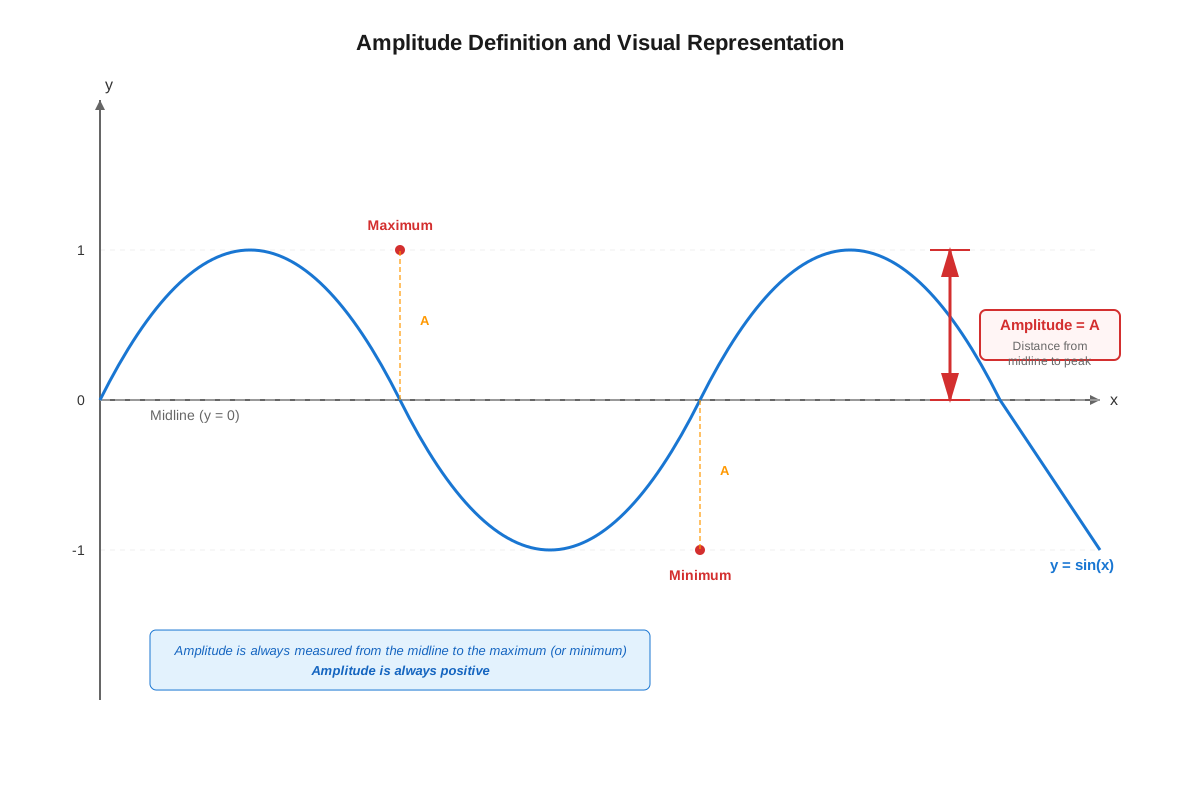
The amplitude of a trigonometric function represents the distance from the midline (or average value) of the function to its maximum or minimum value. More precisely, amplitude measures the vertical distance between the center line of a periodic function and its peak (or trough). For the standard sine and cosine functions, which oscillate between -1 and +1, the amplitude is 1.
Mathematically, for functions in the form:
f(x) = A·sin(Bx + C) + D
f(x) = A·cos(Bx + C) + D
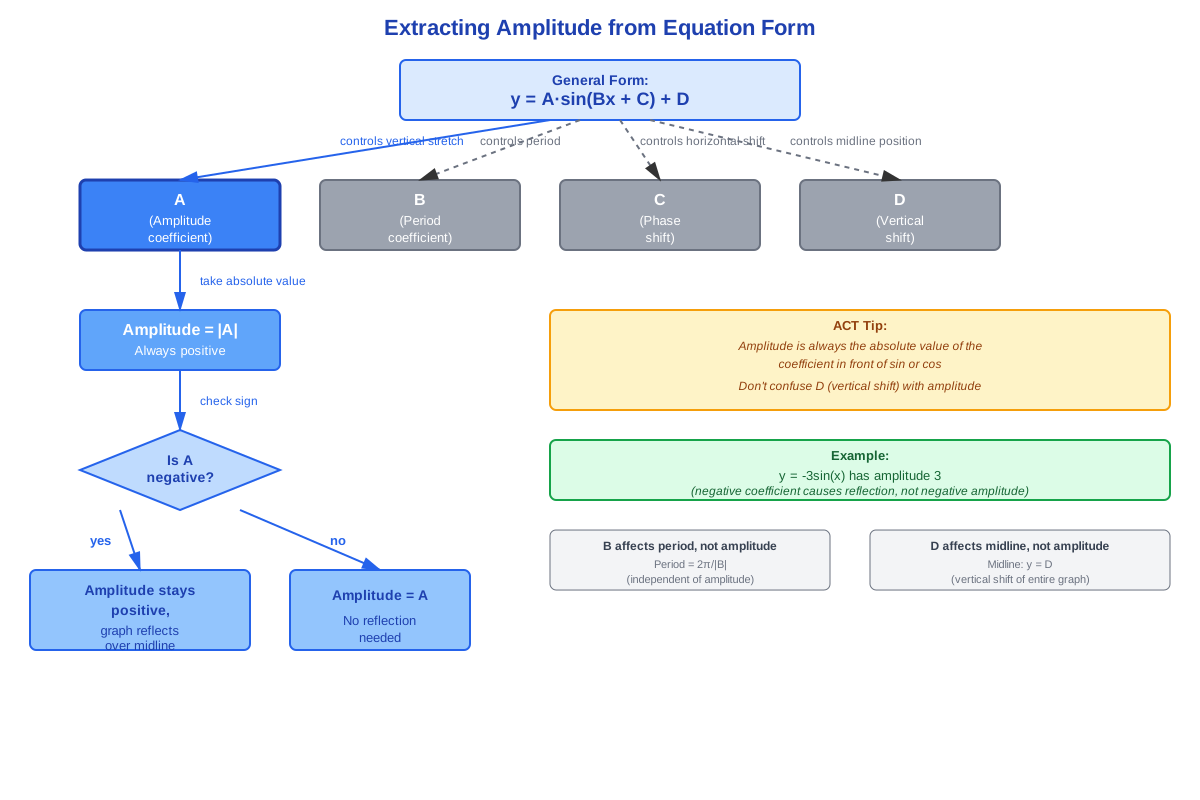
The amplitude is given by |A| (the absolute value of the coefficient A). The absolute value is crucial because amplitude is always expressed as a positive quantity, representing a distance measurement.
Identifying Amplitude from Equations
When examining a trigonometric equation, the amplitude can be extracted directly from the coefficient multiplying the sine or cosine function. Consider these examples:
| Equation | Coefficient A | Amplitude |
|---|---|---|
| y = 3sin(x) | 3 | 3 |
| y = -5cos(2x) | -5 | 5 |
| y = 0.5sin(x) + 2 | 0.5 | 0.5 |
| y = -2sin(3x) - 1 | -2 | 2 |
Notice that negative coefficients do not produce negative amplitudes. The negative sign indicates a reflection across the x-axis, but the amplitude itself remains positive. This distinction is critical for ACT questions that attempt to confuse students by using negative coefficients.
Identifying Amplitude from Graphs
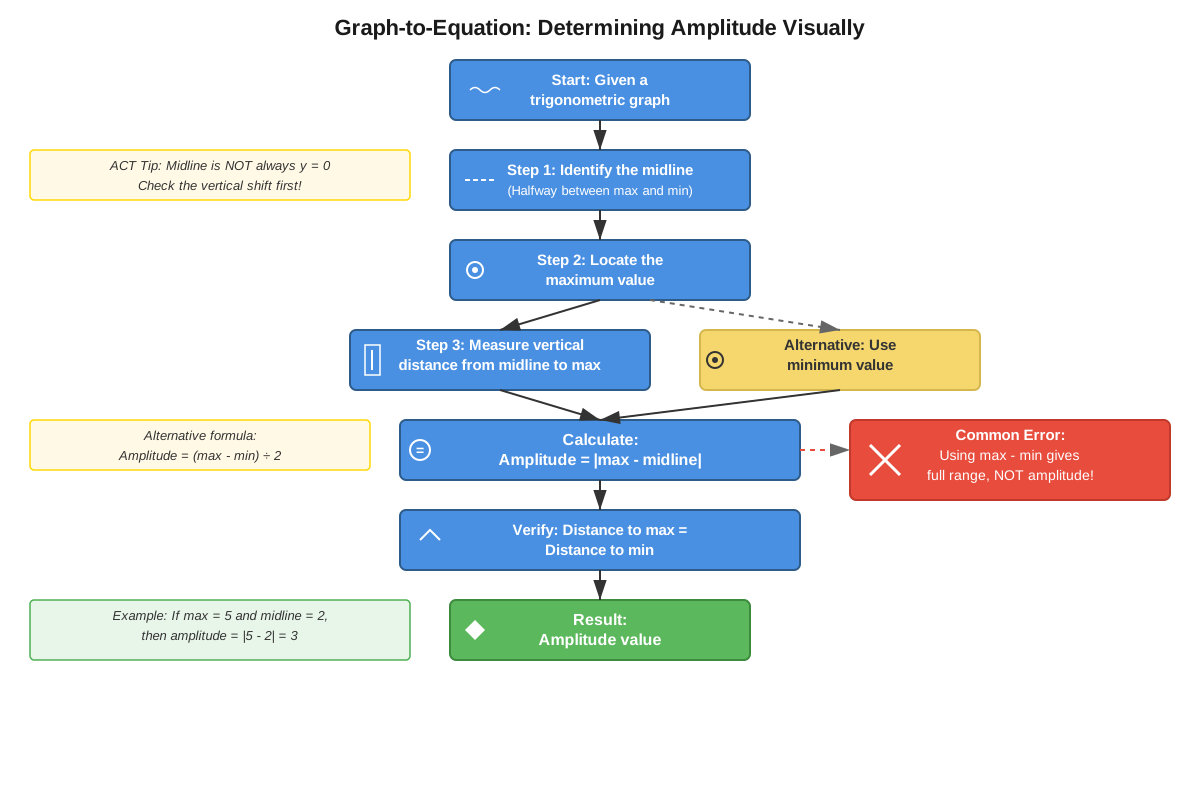
When amplitude is presented graphically, students must identify the maximum and minimum values of the function, then calculate the amplitude using the formula:
Amplitude = (Maximum value - Minimum value) / 2Alternatively, if the midline is easily identifiable:
Amplitude = |Maximum value - Midline value|
Amplitude = |Midline value - Minimum value|
Both calculations yield the same result. For example, if a trigonometric function has a maximum value of 7 and a minimum value of 1, the amplitude is (7 - 1) / 2 = 3. The midline would be at y = 4, and the function oscillates 3 units above and below this center line.
Amplitude vs. Other Transformations
Understanding amplitude requires distinguishing it from other trigonometric transformations:
Amplitude (coefficient A): Controls vertical stretch/compression
- Affects the height of peaks and depth of troughs
- Does not change the period or horizontal spacing
- Always measured as a positive value
Period (coefficient B): Controls horizontal stretch/compression
- Affects how quickly the function completes one full cycle
- Period = 2π/|B| for sine and cosine
- Does not affect the vertical height
Phase Shift (constant C): Controls horizontal translation
- Shifts the graph left or right
- Does not affect amplitude or period
Vertical Shift (constant D): Controls vertical translation
- Moves the entire graph up or down
- Changes the midline but not the amplitude
- The amplitude is measured from the new midline
The Role of Negative Coefficients
When the coefficient A is negative, two things happen simultaneously:
- The graph reflects across the x-axis (flips upside down)
- The amplitude remains |A| (positive)
For example, y = -4sin(x) has an amplitude of 4, not -4. The negative sign means the function starts by going downward (if it's sine) rather than upward, but the vertical distance from the midline to the extremes is still 4 units. This is a frequent source of ACT test questions designed to catch students who forget to take the absolute value.
Amplitude in Context
Real-world problems often describe amplitude without using the term explicitly. Students must recognize phrases like:
- "varies by 10 units above and below the average"
- "oscillates between 5 and 15"
- "reaches a maximum height of 8 and minimum height of 2"
- "deviates 6 units from the center"
Each of these descriptions provides information about amplitude that must be translated into mathematical form. The first and last examples directly state the amplitude (10 and 6, respectively), while the second example requires calculation: amplitude = (15 - 5) / 2 = 5.
Concept Relationships
Amplitude functions as one component within the broader framework of trigonometric function transformations. The relationship flows as follows:
Base Functions (sin x, cos x) → Vertical Stretch/Compression (Amplitude) → Combined Transformations → Real-World Applications
Amplitude directly modifies the base trigonometric functions, working in conjunction with period changes (B coefficient), phase shifts (C constant), and vertical shifts (D constant). Understanding amplitude is prerequisite to analyzing complete transformed functions because it represents the first and most visually obvious modification to standard sine and cosine graphs.
The connection to prerequisite knowledge operates through function transformations: just as multiplying any function f(x) by a constant A creates a vertical stretch when |A| > 1 or compression when 0 < |A| < 1, the same principle applies specifically to trigonometric functions. The absolute value concept from algebra directly informs why amplitude must be positive, reinforcing the idea that amplitude measures distance.
Amplitude also connects forward to more advanced topics including harmonic motion in physics, Fourier analysis, and wave mechanics. On the ACT, amplitude knowledge enables students to tackle composite questions involving multiple transformations, where identifying each component separately leads to the correct answer.
Quick check — test yourself on Amplitude so far.
Try Flashcards →High-Yield Facts
⭐ Amplitude is always the absolute value of the coefficient in front of the trigonometric function: |A| in y = A·sin(x) or y = A·cos(x)
⭐ Amplitude is always expressed as a positive number, even when the coefficient is negative
⭐ From a graph, amplitude = (Maximum - Minimum) / 2
⭐ A negative coefficient reflects the graph across the x-axis but does not change the amplitude value
⭐ Standard sine and cosine functions (without coefficients) have an amplitude of 1
- Amplitude measures the distance from the midline to the maximum or minimum point
- Amplitude does not affect the period of a trigonometric function
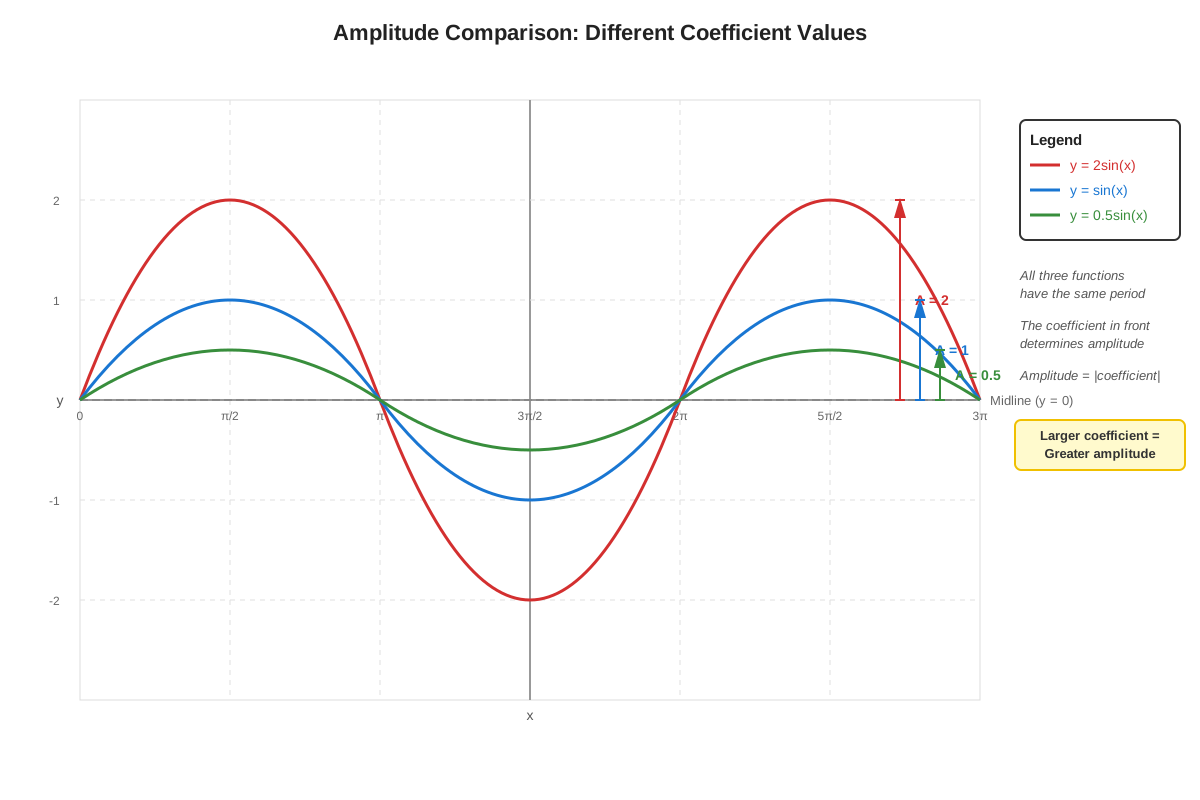
- Multiplying the function by a fraction between 0 and 1 compresses the graph vertically (amplitude < 1)
- Multiplying the function by a number greater than 1 stretches the graph vertically (amplitude > 1)
- The midline of a function is determined by the vertical shift (D), not the amplitude
- When comparing two functions, the one with larger amplitude has greater vertical variation
- Amplitude can be any positive real number, including fractions and decimals
Common Misconceptions
Misconception: The amplitude of y = -3sin(x) is -3.
→ Correction: Amplitude is always positive and represents a distance. The amplitude is |-3| = 3. The negative sign indicates reflection, not a negative amplitude.
Misconception: Amplitude and period are the same thing.
→ Correction: Amplitude measures vertical stretch (how tall the waves are), while period measures horizontal stretch (how wide the waves are). They are independent properties controlled by different coefficients.
Misconception: The vertical shift (D) affects the amplitude.
→ Correction: Vertical shift moves the entire graph up or down, changing the midline position, but the amplitude (distance from midline to peak) remains unchanged. If y = 2sin(x) + 3, the amplitude is still 2.
Misconception: To find amplitude from a graph, subtract the minimum from the maximum.
→ Correction: This calculation gives the total vertical span (peak-to-peak distance), which is twice the amplitude. The correct formula is (Maximum - Minimum) / 2, or measure from the midline to either extreme.
Misconception: Amplitude can be zero.
→ Correction: If the coefficient A = 0, the function becomes a horizontal line (y = D), which is no longer a periodic trigonometric function. For actual sine and cosine functions, amplitude must be positive.
Misconception: The amplitude of y = sin(2x) is 2.
→ Correction: The coefficient 2 is inside the function with x, affecting the period, not the amplitude. The amplitude remains 1 because there is no coefficient multiplying the entire sine function.
Worked Examples
Example 1: Identifying Amplitude from an Equation
Problem: What is the amplitude of the function f(x) = -7cos(3x - π) + 2?
Solution:
Step 1: Identify the general form of the equation.
The function is in the form f(x) = A·cos(Bx + C) + D, where:
- A = -7 (coefficient of cosine)
- B = 3 (coefficient of x)
- C = -π (phase shift component)
- D = 2 (vertical shift)
Step 2: Recall that amplitude = |A|.
The amplitude is determined solely by the coefficient multiplying the cosine function.
Step 3: Calculate the absolute value.
Amplitude = |-7| = 7
Step 4: Verify understanding of each component.
- The amplitude is 7 (vertical distance from midline to peak)
- The negative sign means the graph is reflected across the x-axis
- The +2 shifts the midline to y = 2, but doesn't change the amplitude
- The 3 affects the period, not the amplitude
Answer: The amplitude is 7.
Connection to Learning Objectives: This example demonstrates how to identify when amplitude is being tested (recognizing the coefficient A) and apply the core rule (amplitude = |A|) to ACT-style questions.
Example 2: Determining Amplitude from a Graph
Problem: A trigonometric function is graphed on a coordinate plane. The function reaches a maximum value of 11 and a minimum value of -3. What is the amplitude of this function?
Solution:
Step 1: Identify the given information.
- Maximum value = 11
- Minimum value = -3
Step 2: Apply the amplitude formula for graphical data.
Amplitude = (Maximum - Minimum) / 2
Step 3: Substitute the values.
Amplitude = (11 - (-3)) / 2
Amplitude = (11 + 3) / 2
Amplitude = 14 / 2
Amplitude = 7
Step 4: Verify using the midline method.
First, find the midline: Midline = (Maximum + Minimum) / 2 = (11 + (-3)) / 2 = 8 / 2 = 4
Then, calculate distance from midline to maximum: 11 - 4 = 7 ✓
Or distance from midline to minimum: 4 - (-3) = 7 ✓
Step 5: Write the partial equation.
Based on this information, the function could be written as f(x) = 7·sin(Bx + C) + 4 or f(x) = 7·cos(Bx + C) + 4, where the amplitude is 7 and the vertical shift is 4.
Answer: The amplitude is 7.
Connection to Learning Objectives: This example shows how to determine amplitude from graphical representations and reinforces the distinction between amplitude and vertical shift.
Exam Strategy
When approaching ACT amplitude questions, follow this systematic process:
Step 1: Identify the question type
- Equation-to-amplitude: Extract coefficient A and take absolute value
- Graph-to-amplitude: Locate maximum and minimum, apply formula
- Context-to-equation: Translate word problem into mathematical form
Step 2: Watch for trigger words and phrases
- "amplitude" (direct terminology)
- "maximum height" and "minimum height" (calculate from these)
- "varies by X units" (this is often the amplitude directly)
- "oscillates between" (requires calculation)
- "distance from center" (direct amplitude reference)
- "coefficient" (may be asking about A specifically)
Step 3: Apply process of elimination
- Eliminate any negative answer choices for amplitude questions (amplitude is always positive)
- Eliminate answers that confuse amplitude with period (check if the number relates to horizontal vs. vertical change)
- Eliminate answers that represent the full peak-to-peak distance rather than half that distance
- Check whether the question asks for amplitude or the coefficient A (they differ when A is negative)
Step 4: Time allocation
- Straightforward amplitude identification: 30-45 seconds
- Graph interpretation with calculation: 60-90 seconds
- Multi-step word problems involving amplitude: 90-120 seconds
Step 5: Verification techniques
- Quick mental check: Does the amplitude make sense given the graph or context?
- If time permits, verify that your amplitude value represents the distance from midline to peak
- Ensure you took the absolute value if the coefficient was negative
Exam Tip: If a question shows a graph and asks for the equation, identify amplitude first (easiest to spot visually), then tackle period, phase shift, and vertical shift in that order.
Memory Techniques
Mnemonic for transformation order: "A-B-C-D, Easy as 1-2-3-D"
- A = Amplitude (vertical stretch)
- B = B affects period (horizontal stretch)
- C = C causes phase shift (horizontal shift)
- D = D delivers vertical shift (up/down movement)
Visualization strategy: Picture amplitude as the "volume knob" on a radio
- Turning it up (larger A) makes the waves taller (louder)
- Turning it down (smaller A) makes the waves shorter (quieter)
- The knob only goes positive (amplitude is always positive)
- It doesn't change the station (period) or timing (phase shift)
Acronym for graph analysis: "M-M-D-A" (pronounced "Emma-Dee-Ay")
- Maximum: Find the highest point
- Minimum: Find the lowest point
- Divide: Calculate (Max - Min) / 2
- Amplitude: That's your answer!
Absolute value reminder: "Amplitude is Always Absolute"
- The three A's remind you to take |A| every time
Negative coefficient memory aid: "Negative flips, doesn't shrink"
- A negative coefficient reflects the graph but doesn't reduce amplitude
- Think: -5 has the same amplitude as +5 (both equal 5)
Summary
Amplitude represents the vertical distance from the midline of a trigonometric function to its maximum or minimum value, serving as a measure of the function's vertical stretch or compression. For functions in the form y = A·sin(Bx + C) + D or y = A·cos(Bx + C) + D, the amplitude is always |A|, the absolute value of the coefficient multiplying the trigonometric function. When analyzing graphs, amplitude can be calculated as (Maximum - Minimum) / 2. This concept is essential for ACT success because it appears frequently in both direct identification questions and within more complex problems involving multiple transformations. Students must remember that amplitude is always positive, that negative coefficients indicate reflection rather than negative amplitude, and that amplitude is independent of period, phase shift, and vertical shift. Mastery requires fluency in moving between algebraic and graphical representations, recognizing contextual descriptions of amplitude in word problems, and quickly extracting the relevant coefficient from equations.
Key Takeaways
- Amplitude = |A| where A is the coefficient multiplying the sine or cosine function
- Amplitude is always expressed as a positive value, regardless of whether the coefficient is negative
- From a graph, calculate amplitude using (Maximum - Minimum) / 2
- Amplitude measures vertical stretch/compression and is independent of period, phase shift, and vertical shift
- Negative coefficients cause reflection across the x-axis but do not change the amplitude value
- Standard sine and cosine functions have an amplitude of 1
- ACT questions test amplitude through equation analysis, graph interpretation, and real-world context problems
Related Topics
Period of Trigonometric Functions: Understanding how the B coefficient affects the horizontal stretch of sine and cosine functions complements amplitude knowledge, enabling complete analysis of transformed trigonometric functions.
Phase Shift: Learning how horizontal translations affect trigonometric graphs builds on amplitude mastery, allowing students to identify all components of the general form y = A·sin(Bx + C) + D.
Vertical Shift and Midline: Exploring how the D constant moves graphs up or down connects directly to amplitude because amplitude is measured from the midline, not from the x-axis.
Function Transformations: Studying how transformations apply to all function types (not just trigonometric) provides a broader framework for understanding amplitude as one specific type of transformation.
Graphing Trigonometric Functions: Mastering amplitude enables students to accurately sketch complete trigonometric graphs and interpret complex periodic behavior.
Practice CTA
Now that you've mastered the fundamentals of amplitude, it's time to solidify your understanding through active practice. Work through the practice questions to test your ability to identify amplitude from equations and graphs, and use the flashcards to reinforce key definitions and formulas. Remember, the ACT rewards both speed and accuracy—consistent practice with amplitude problems will help you recognize patterns instantly on test day. Each practice problem you complete strengthens your mathematical intuition and builds the confidence you need to tackle even the most challenging trigonometry questions. You've got this!
Sign up free to keep reading
Create a free AnvayaPrep account to finish this ACT guide on Amplitude — plus flashcards and practice questions.