Overview
The period of a trigonometric function is one of the most fundamental concepts tested on the ACT Math section, appearing in approximately 2-4 questions per exam. Understanding period allows students to analyze how trigonometric functions repeat their values over specific intervals, which is essential for graphing, solving equations, and interpreting real-world cyclical phenomena. The ACT period questions typically involve identifying the period from a graph, calculating the period from a function's equation, or determining how transformations affect the period of sine, cosine, tangent, and other trigonometric functions.
Mastering period is crucial because it serves as a gateway to understanding more complex trigonometric transformations, including amplitude, phase shift, and vertical translation. Questions involving period often appear alongside other transformation concepts, requiring students to identify multiple characteristics of a function simultaneously. The ACT frequently tests period in the context of word problems involving cyclical patterns such as tides, seasonal temperatures, or rotating objects, making this concept both theoretically important and practically applicable.
The period concept connects directly to the unit circle, radian and degree measure, and the fundamental definitions of trigonometric functions. Students who thoroughly understand period will find themselves better equipped to tackle advanced topics in precalculus and calculus, including harmonic motion, Fourier analysis, and differential equations. For the ACT specifically, period questions reward students who can quickly recognize standard forms and apply transformation rules without lengthy calculations.
Learning Objectives
- [ ] Identify when Period is being tested in ACT Math questions
- [ ] Explain the core rule or strategy behind Period calculations
- [ ] Apply Period concepts to ACT-style questions accurately
- [ ] Calculate the period of transformed sine and cosine functions from their equations
- [ ] Determine the period of tangent, cotangent, secant, and cosecant functions
- [ ] Identify the period of a trigonometric function from its graph
- [ ] Solve real-world problems involving periodic phenomena using period concepts
Prerequisites
- Basic trigonometric functions (sine, cosine, tangent): Understanding the fundamental definitions and graphs of these functions is essential because period describes how these functions repeat
- Unit circle knowledge: The unit circle provides the foundation for understanding why trigonometric functions are periodic and what their standard periods are
- Radian and degree measure: Period can be expressed in either unit, and converting between them is often necessary for ACT questions
- Function transformations: General knowledge of how coefficients affect function graphs helps students understand how period transformations work
- Graph interpretation: Reading and analyzing function graphs is crucial for identifying period visually
Why This Topic Matters
Period appears in numerous real-world applications that make it both practically significant and frequently tested. Engineers use period to analyze oscillating systems like springs and pendulums. Meteorologists rely on periodic functions to model seasonal temperature variations and tidal patterns. Musicians understand period as it relates to sound wave frequencies and harmonics. These practical applications make period a favorite topic for ACT word problems that test mathematical modeling skills.
On the ACT Math section, period-related questions appear with high frequency, typically 2-4 times per 60-question exam. These questions usually fall into the "Preparing for Higher Mathematics" category, specifically within the Functions subcategory. Period questions often appear at medium to medium-hard difficulty levels, making them critical for students aiming for scores above 28. The ACT tests period through multiple question formats: identifying period from graphs, calculating period from equations, determining how transformations affect period, and applying period concepts to real-world scenarios.
Common ACT question patterns include: presenting a transformed trigonometric function and asking for its period; showing a graph and requesting the period value; describing a cyclical phenomenon and asking students to determine the period from context; or providing multiple function characteristics and asking students to identify which function matches given criteria. Understanding period is often the key to unlocking these multi-step problems efficiently.
Core Concepts
Definition of Period
The period of a function is the smallest positive value for which the function repeats its values. For a function f(x), if there exists a positive number P such that f(x + P) = f(x) for all x in the domain, then P is the period of the function. This means that after traveling a horizontal distance of P units, the function's graph looks identical to its starting position and the pattern begins again.
For trigonometric functions, the period represents one complete cycle of the function's behavior. Understanding this definition is crucial because ACT questions often require students to identify when a function has completed exactly one full cycle, whether from a graph or an equation.
Standard Periods of Trigonometric Functions
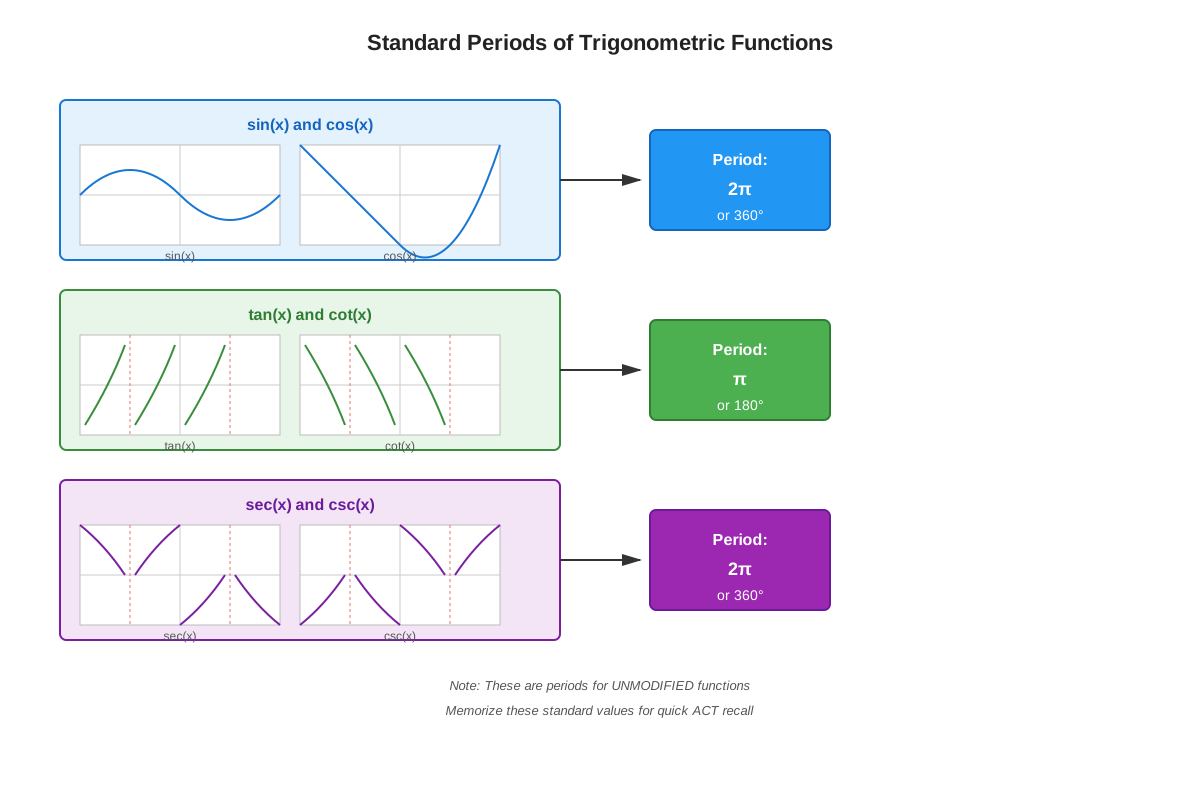
Each basic trigonometric function has a standard period that students must memorize:
| Function | Standard Period (radians) | Standard Period (degrees) |
|---|---|---|
| sin(x) | 2π | 360° |
| cos(x) | 2π | 360° |
| tan(x) | π | 180° |
| cot(x) | π | 180° |
| sec(x) | 2π | 360° |
| csc(x) | 2π | 360° |
The sine and cosine functions complete one full wave cycle over 2π radians because they trace the entire unit circle once. The tangent and cotangent functions have a period of π because they repeat their values twice as frequently due to their relationship with sine and cosine (tan(x) = sin(x)/cos(x)). Secant and cosecant, being reciprocals of cosine and sine respectively, maintain the 2π period.
Period Formula for Transformed Functions
When trigonometric functions undergo horizontal stretching or compression, their periods change according to a specific formula. For functions in the form:
f(x) = A·sin(Bx + C) + D
f(x) = A·cos(Bx + C) + D
The period is calculated as:
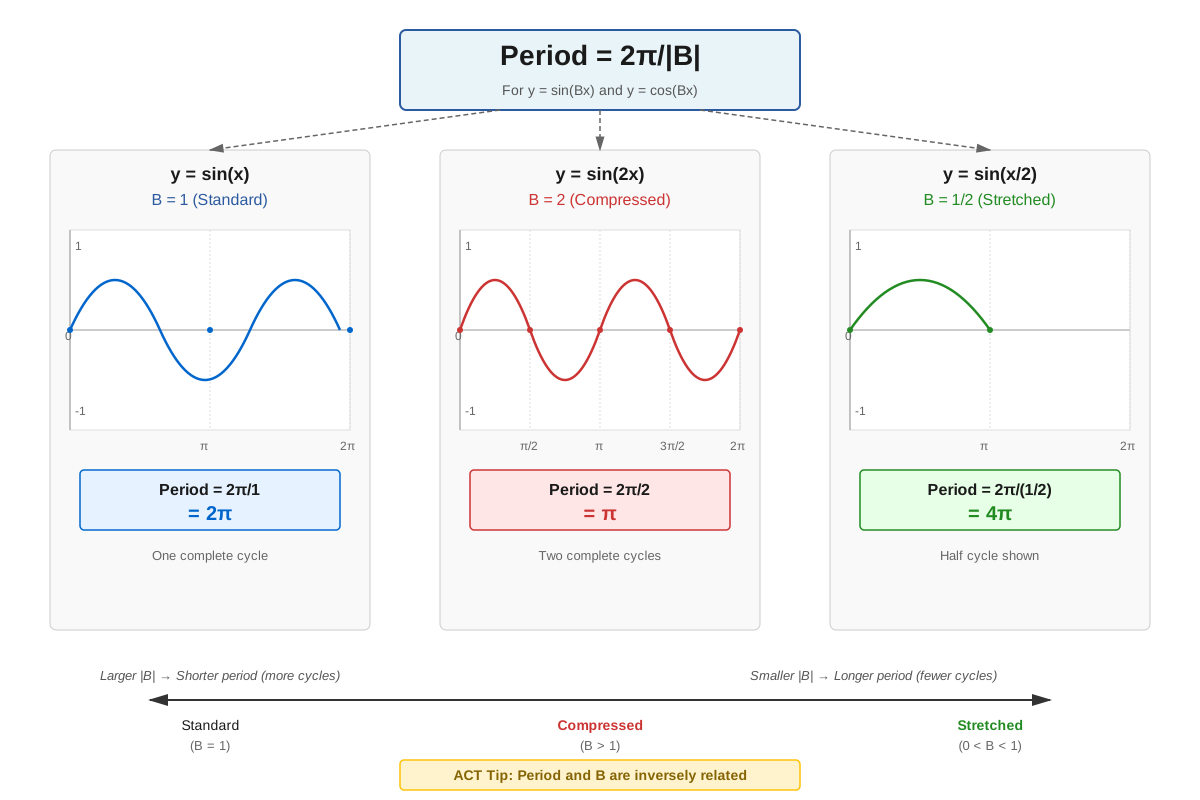
Period = (2π)/|B|For tangent and cotangent functions in the form:
f(x) = A·tan(Bx + C) + D
f(x) = A·cot(Bx + C) + D
The period is:
Period = π/|B|The coefficient B is the frequency multiplier that determines how many cycles occur in the standard period interval. A larger |B| value means more cycles fit into the same space, resulting in a shorter period. Conversely, a smaller |B| value (between 0 and 1) stretches the function horizontally, creating a longer period.
Important note: Only the B coefficient affects the period. The amplitude (A), phase shift (C), and vertical shift (D) do not change how long it takes for the function to complete one cycle.
Identifying Period from Graphs
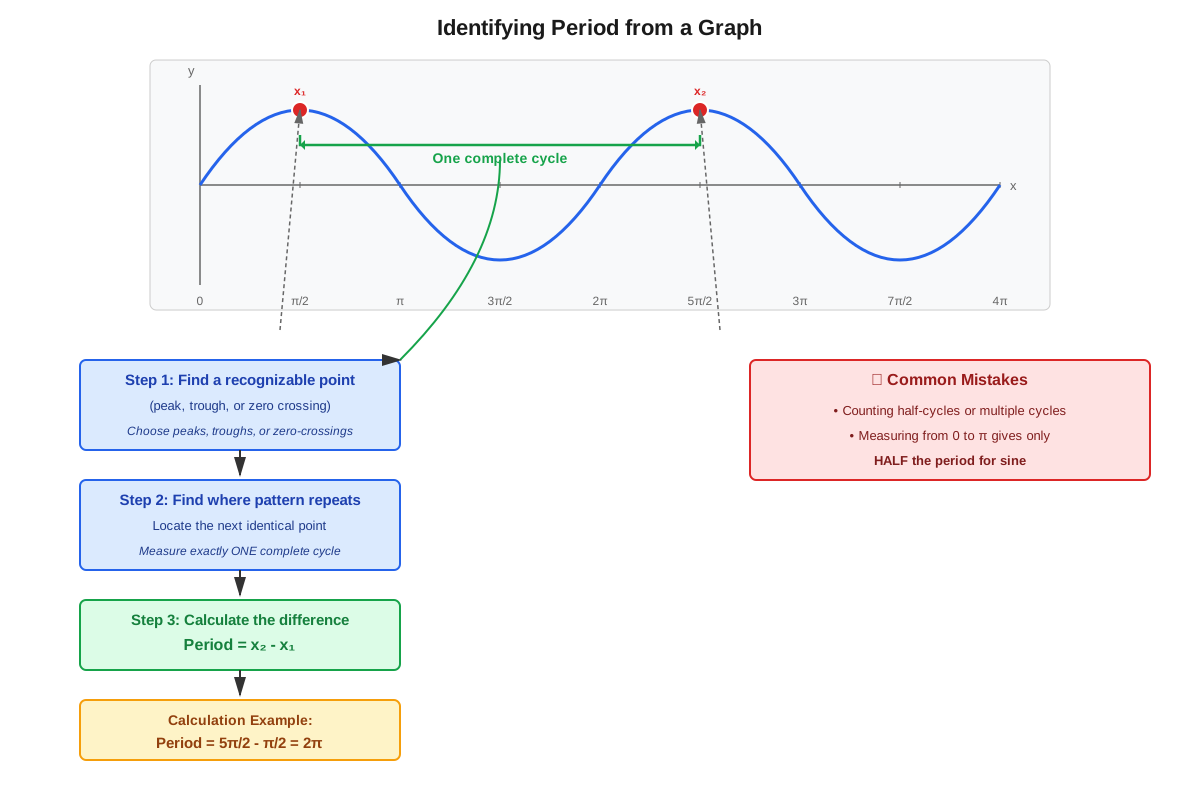
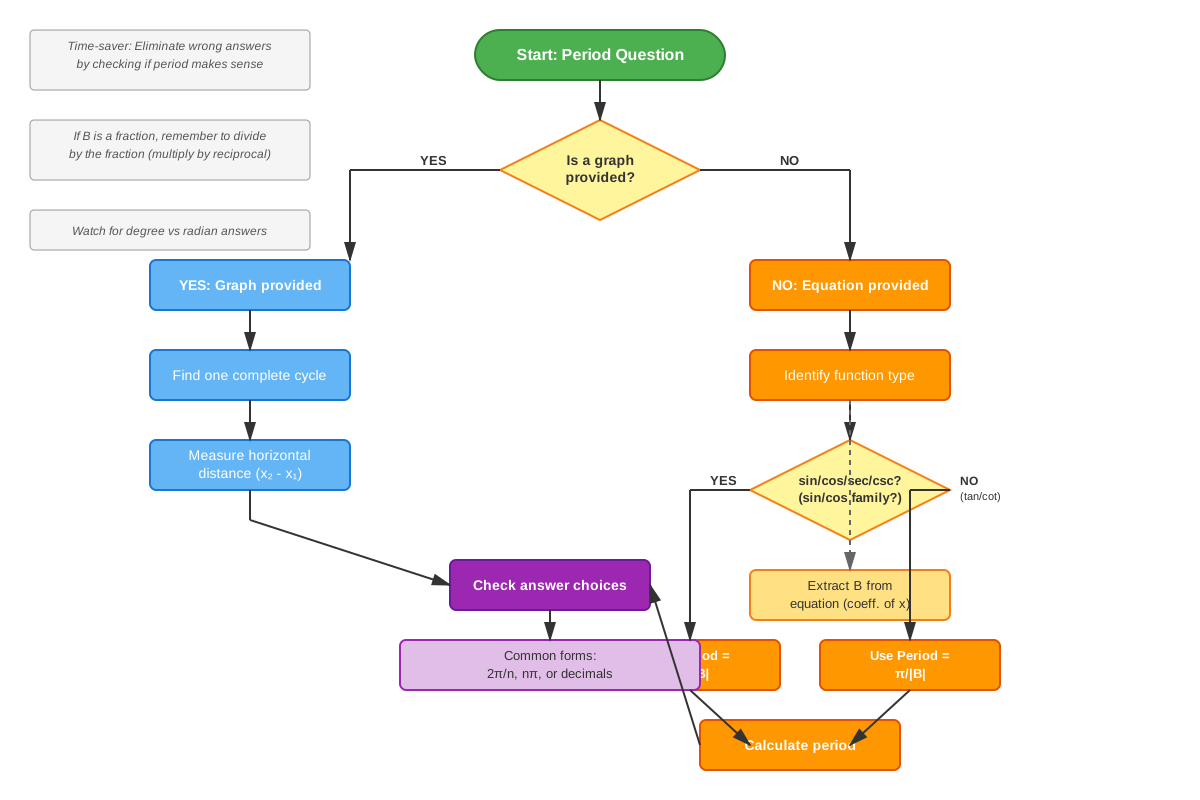
When presented with a trigonometric graph on the ACT, students can identify the period by finding the horizontal distance required for the function to complete one full cycle. The process involves:
- Identify a starting point: Choose a distinctive feature such as a maximum, minimum, or zero crossing
- Locate the next identical point: Find where that same feature occurs again with the function moving in the same direction
- Measure the horizontal distance: Calculate the difference between the x-coordinates of these two points
- Verify: Check that the pattern truly repeats by examining another cycle
For sine and cosine graphs, one complete period includes one peak, one trough, and a return to the starting position. For tangent graphs, one period spans from one asymptote to the next asymptote in the same direction.
Relationship Between Period and Frequency
The concept of frequency is closely related to period and occasionally appears on the ACT. Frequency represents how many complete cycles occur in a unit interval (typically 2π for trigonometric functions). The relationship is:
Frequency = 1/PeriodOr equivalently:
Period = 1/FrequencyIn the function form f(x) = A·sin(Bx + C) + D, the coefficient B represents the frequency. This explains why the period formula is (2π)/|B|: as frequency increases, period decreases proportionally.
Period in Real-World Applications
ACT word problems often describe cyclical phenomena and ask students to determine or use the period. Common scenarios include:
- Tidal patterns: The time between consecutive high tides
- Temperature cycles: The time for seasonal temperatures to complete one full year cycle
- Rotating objects: The time for one complete rotation (like a Ferris wheel)
- Sound waves: The time for one complete wave oscillation
- Biological rhythms: Circadian cycles or heartbeat patterns
In these problems, students must translate the real-world description into mathematical terms, identify the period from context, and often write or identify the appropriate trigonometric function.
Concept Relationships
The period concept sits at the center of a web of interconnected trigonometric ideas. Unit circle knowledge → provides the foundation for → standard period values, because one complete trip around the unit circle (2π radians) defines why sine and cosine have a period of 2π.
Standard periods → combine with → horizontal transformations → to determine → transformed function periods. The B coefficient in the general form creates a horizontal scaling that directly affects how quickly the function completes its cycle.
Period identification → enables → graph sketching and analysis, because knowing the period allows students to determine the horizontal extent of one complete cycle. This connects to amplitude (vertical extent) and phase shift (horizontal translation) to provide a complete picture of the transformed function.
Period calculations → support → equation solving, particularly when finding all solutions to trigonometric equations within a specified interval. Understanding that solutions repeat every period allows students to generate complete solution sets efficiently.
Real-world modeling → requires → period interpretation, as students must translate between the mathematical period and the physical time or distance the period represents in context. This connection makes period a bridge between abstract mathematics and practical applications.
Quick check — test yourself on Period so far.
Try Flashcards →High-Yield Facts
⭐ The standard period of sin(x) and cos(x) is 2π radians or 360 degrees
⭐ The standard period of tan(x) and cot(x) is π radians or 180 degrees
⭐ For f(x) = A·sin(Bx + C) + D, the period equals (2π)/|B|
⭐ Only the B coefficient affects the period; A, C, and D do not change the period
⭐ To find period from a graph, measure the horizontal distance for one complete cycle
- The period of sec(x) and csc(x) is 2π, the same as cos(x) and sin(x) respectively
- A coefficient B > 1 compresses the function horizontally, creating a shorter period
- A coefficient 0 < B < 1 stretches the function horizontally, creating a longer period
- Period is always expressed as a positive value
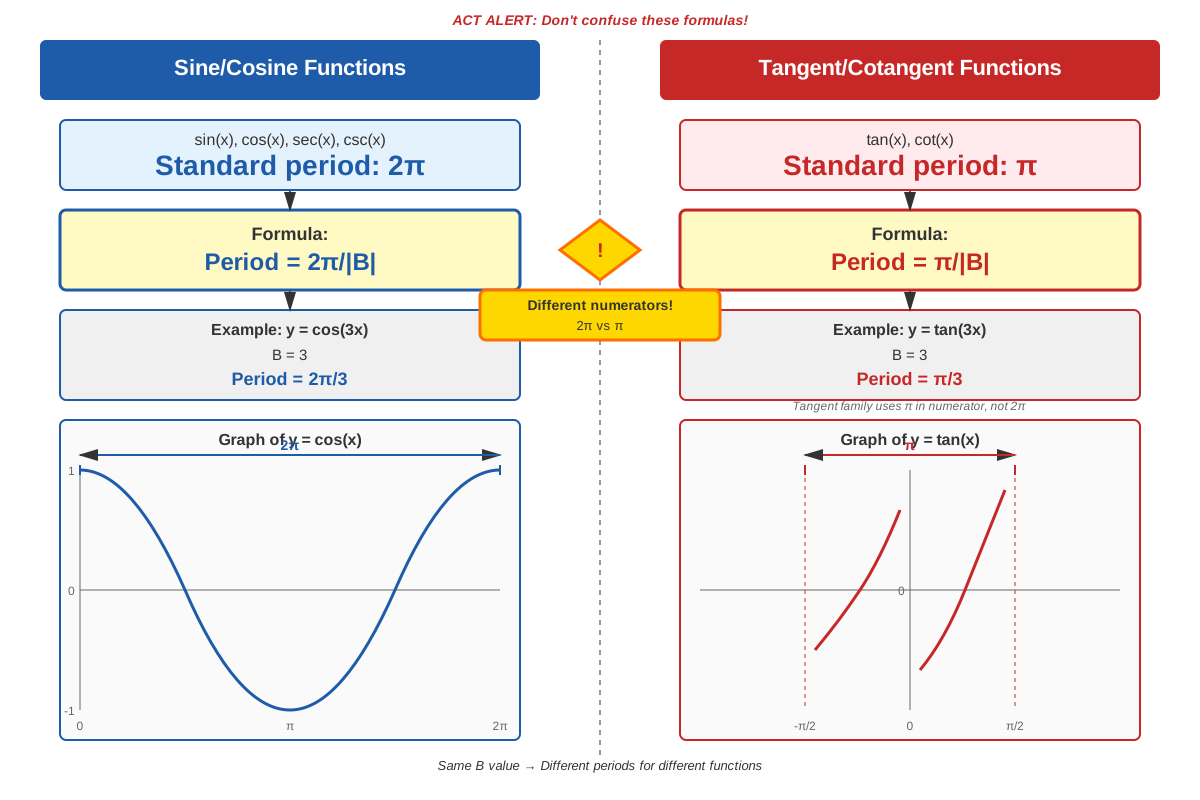
- The period of tan(Bx) is π/|B|, exactly half the period formula for sine and cosine
- Frequency and period are reciprocals: frequency = 1/period
- Multiple cycles can occur within a given interval; divide the interval length by the period to find how many
Common Misconceptions
Misconception: The amplitude (A coefficient) affects the period of a trigonometric function → Correction: Only the B coefficient (the coefficient of x inside the function) affects the period. Amplitude controls vertical stretching/compression but has no impact on how long it takes to complete one cycle.
Misconception: The period of all trigonometric functions is 2π → Correction: While sin(x), cos(x), sec(x), and csc(x) have a period of 2π, the tangent and cotangent functions have a period of π. Students must distinguish between these two groups.
Misconception: Phase shift (C coefficient) changes the period → Correction: Phase shift only translates the graph horizontally without changing the length of one cycle. The period remains determined solely by the B coefficient.
Misconception: When B is negative, the period formula changes → Correction: The period formula uses |B| (absolute value of B), so negative B values produce the same period as their positive counterparts. The negative sign only reflects the graph, not the period.
Misconception: To find the period from a graph, measure from any maximum to any minimum → Correction: The distance from a maximum to the adjacent minimum is only half a period for sine and cosine functions. A complete period requires measuring from one maximum to the next maximum (or one minimum to the next minimum, or one zero crossing to the next identical zero crossing).
Worked Examples
Example 1: Finding Period from an Equation
Question: What is the period of the function f(x) = 3sin(4x - π) + 2?
Solution:
Step 1: Identify the function type and standard form. This is a sine function in the form f(x) = A·sin(Bx + C) + D.
Step 2: Identify the coefficients:
- A = 3 (amplitude)
- B = 4 (frequency multiplier)
- C = -π (phase shift component)
- D = 2 (vertical shift)
Step 3: Apply the period formula for sine functions. Since only B affects the period:
Period = (2π)/|B| = (2π)/|4| = (2π)/4 = π/2Step 4: Verify the answer makes sense. Since B = 4 is greater than 1, the function should complete cycles more frequently than the standard sine function, meaning the period should be less than 2π. Indeed, π/2 ≈ 1.57, which is much less than 2π ≈ 6.28.
Answer: The period is π/2 radians.
Connection to learning objectives: This example demonstrates applying the period formula to ACT-style questions and explaining the core strategy of identifying the B coefficient.
Example 2: Identifying Period from a Graph and Real-World Context
Question: A Ferris wheel's height above ground can be modeled by a cosine function. The graph shows that a passenger reaches maximum height at t = 0 seconds and again at t = 45 seconds. What is the period of this function, and how long does one complete rotation take?
Solution:
Step 1: Understand what the graph shows. The passenger reaches maximum height at t = 0 and the next maximum at t = 45.
Step 2: Recall that the period is the horizontal distance for one complete cycle. For a cosine function, the distance from one maximum to the next maximum represents exactly one complete period.
Step 3: Calculate the period:
Period = 45 - 0 = 45 secondsStep 4: Interpret in context. Since one period represents one complete cycle of the function, and the Ferris wheel's height completes one full pattern in one period, one complete rotation takes 45 seconds.
Step 5: Verify by considering the function's behavior. In 45 seconds, the passenger goes from maximum height → down to minimum height → back up to maximum height, which represents one complete rotation of the Ferris wheel.
Answer: The period is 45 seconds, and one complete rotation takes 45 seconds.
Connection to learning objectives: This example demonstrates identifying period from a graph and applying period concepts to real-world ACT-style problems.
Exam Strategy
When approaching ACT period questions, follow this systematic process:
Step 1: Identify the question type. Determine whether you need to find the period from an equation, identify it from a graph, or apply it to a word problem. Look for trigger phrases like "how often does the function repeat," "what is the period," "one complete cycle," or "time between consecutive maximums."
Step 2: For equation-based questions, immediately identify the B coefficient (the number multiplying x inside the trigonometric function). Ignore all other coefficients and constants—they don't affect the period. Apply the appropriate formula: (2π)/|B| for sine/cosine, or π/|B| for tangent/cotangent.
Step 3: For graph-based questions, locate a distinctive feature (maximum, minimum, or zero crossing) and measure the horizontal distance to where that identical feature next occurs. Be careful to measure a full period, not a half period. Mark the starting and ending points clearly on your test booklet.
Step 4: For word problems, translate the real-world description into mathematical terms. Identify what represents one complete cycle in the context (one full rotation, one complete day, one full year, etc.), and that time or distance is the period.
Exam Tip: If a question asks about multiple function characteristics (amplitude, period, phase shift), tackle the period first since it's usually the most straightforward to identify and calculate.
Time allocation: Period questions typically require 30-60 seconds. If you find yourself spending more than 90 seconds, you may be overcomplicating the problem. Remember that only B affects the period—this single fact eliminates most complexity.
Process of elimination strategies:
- Eliminate any answer choice that equals 2π when the function is tangent or cotangent (their period is π)
- Eliminate any answer choice that equals π when the function is sine or cosine (their period is 2π/|B|)
- If B > 1, eliminate answer choices larger than the standard period
- If 0 < B < 1, eliminate answer choices smaller than the standard period
Trigger words to watch for: "repeats," "cycle," "periodic," "oscillates," "completes one full," "returns to," "between consecutive," "how often," "frequency."
Memory Techniques
Mnemonic for standard periods: "Silly Cats Sleep Comfortably for 2π, but Tired Cats only need π"
- Sine, Cosine, Secant, Cosecant have period 2π
- Tangent, Cotangent have period π
The "B is the Boss" rule: When finding period, remember that B is the Boss—only B controls the period. All other letters (A, C, D) are just along for the ride.
Visual memory technique: Picture a sine wave as a roller coaster. The period is how far you travel horizontally to get back to the same height moving in the same direction. If the track is compressed (B > 1), you complete the loop faster (shorter period). If the track is stretched (0 < B < 1), the loop takes longer (longer period).
Formula memory: Remember "2π over B" by thinking "To π or B"—for sine and cosine, you need to get to 2π, but you divide by B. For tangent, just remember it's half that: "π over B."
Acronym for graph analysis: FIND the period
- Feature: Pick a distinctive feature (max, min, zero)
- Identical: Find where it occurs identically again
- Number: Calculate the numerical distance
- Double-check: Verify it's a full cycle, not half
Summary
Period is a fundamental characteristic of trigonometric functions that describes the horizontal length of one complete cycle. For ACT Math success, students must master three core skills: calculating period from equations using the formula (2π)/|B| for sine and cosine or π/|B| for tangent and cotangent; identifying period from graphs by measuring the distance between identical features; and applying period concepts to real-world cyclical phenomena. The critical insight is that only the B coefficient (the multiplier of x inside the function) affects the period—amplitude, phase shift, and vertical shift are irrelevant to period calculations. Standard periods must be memorized: 2π for sine, cosine, secant, and cosecant; π for tangent and cotangent. ACT questions test period through direct calculation, graph interpretation, and contextual word problems, making this concept both frequently tested and highly valuable for achieving competitive scores.
Key Takeaways
- The period of a trigonometric function is the smallest positive horizontal distance for one complete cycle
- For f(x) = A·sin(Bx + C) + D or f(x) = A·cos(Bx + C) + D, the period equals (2π)/|B|
- For f(x) = A·tan(Bx + C) + D or f(x) = A·cot(Bx + C) + D, the period equals π/|B|
- Only the B coefficient affects period; amplitude (A), phase shift (C), and vertical shift (D) do not change the period
- Standard periods: sin(x) and cos(x) have period 2π; tan(x) and cot(x) have period π
- To find period from a graph, measure the horizontal distance from one distinctive feature to where it next occurs identically
- Period appears in 2-4 questions per ACT Math section, making it a high-yield topic for test preparation
Related Topics
Amplitude: The vertical distance from the midline to the maximum or minimum of a trigonometric function. Mastering period enables students to combine it with amplitude to fully describe the vertical and horizontal extent of transformed functions.
Phase Shift: The horizontal translation of a trigonometric function, determined by the C coefficient. Understanding that phase shift doesn't affect period helps students isolate these two transformation types.
Frequency: The number of complete cycles in a unit interval, calculated as the reciprocal of period. This concept extends period understanding to applications in physics and engineering.
Trigonometric Equations: Solving equations like sin(x) = 0.5 requires understanding period to find all solutions within a given interval, as solutions repeat every period.
Harmonic Motion: Advanced applications of period in physics and calculus, where periodic functions model oscillating systems like springs, pendulums, and waves.
Practice CTA
Now that you've mastered the concept of period in trigonometric functions, it's time to solidify your understanding through active practice. Work through the practice questions to test your ability to calculate periods from equations, identify them from graphs, and apply them to real-world scenarios. Use the flashcards to reinforce the key formulas and standard period values until they become automatic. Remember: period questions are high-yield on the ACT, and with focused practice, they can become some of your quickest and most reliable points. You've got this—let's turn this knowledge into test-day success!
Sign up free to keep reading
Create a free AnvayaPrep account to finish this ACT guide on Period — plus flashcards and practice questions.