Overview
The angle of depression is a fundamental concept in trigonometry that appears regularly on the ACT Math test, particularly in problems involving right triangles and real-world applications. This angle represents the downward measurement from a horizontal line of sight to an object below the observer's eye level. Understanding this concept is crucial because it frequently appears in word problems involving heights, distances, and practical scenarios such as calculating the distance from the top of a building to a point on the ground, or determining how far a pilot must travel to reach a landing point.
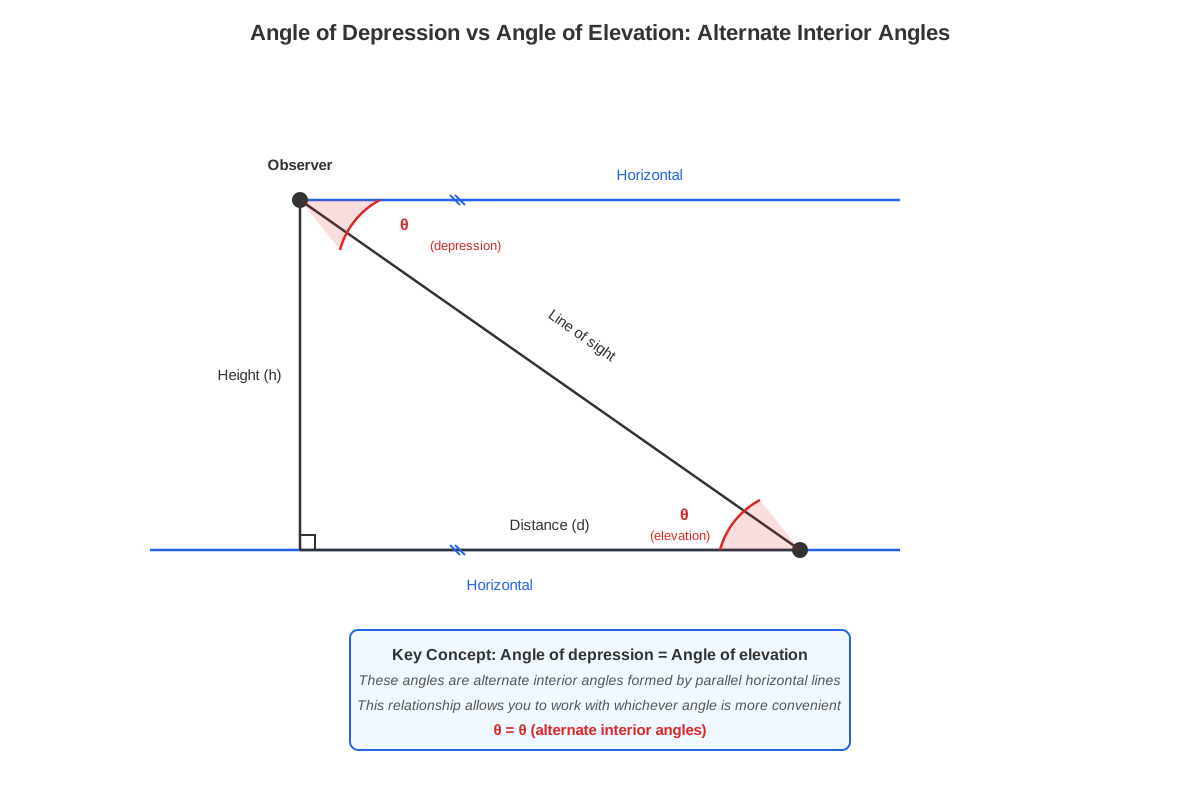
On the ACT, angle of depression questions test a student's ability to visualize spatial relationships, translate word problems into geometric diagrams, and apply trigonometric ratios correctly. These problems often combine multiple skills: reading comprehension, diagram interpretation, and computational accuracy. The angle of depression is mathematically equivalent to the angle of elevation from the lower point looking up, which is a key relationship that simplifies many problems. This equivalence stems from the alternate interior angles theorem when parallel lines (horizontal lines of sight) are cut by a transversal.
Mastering this topic connects directly to broader trigonometry concepts including right triangle trigonometry, the Pythagorean theorem, and practical applications of sine, cosine, and tangent ratios. The ACT angle of depression problems typically appear 1-2 times per test and are considered medium difficulty, making them high-yield targets for score improvement. Students who can quickly identify these problems, draw accurate diagrams, and apply the correct trigonometric ratios will gain a significant advantage in the trigonometry portion of the ACT Math section.
Learning Objectives
- [ ] Identify when Angle of depression is being tested in ACT word problems and diagrams
- [ ] Explain the core rule or strategy behind Angle of depression, including its relationship to angle of elevation
- [ ] Apply Angle of depression to ACT-style questions accurately using appropriate trigonometric ratios
- [ ] Construct accurate diagrams from verbal descriptions involving angles of depression
- [ ] Recognize the alternate interior angles relationship that makes angle of depression equal to angle of elevation
- [ ] Solve multi-step problems that combine angle of depression with distance, height, and trigonometric functions
Prerequisites
- Right triangle trigonometry: Understanding sine, cosine, and tangent ratios is essential because angle of depression problems always involve right triangles where these ratios are applied to find unknown sides
- Alternate interior angles theorem: This geometric principle explains why the angle of depression equals the angle of elevation, forming the foundation for solving these problems
- Basic angle measurement: Familiarity with measuring angles from horizontal and vertical reference lines helps visualize the problem setup correctly
- Pythagorean theorem: Often needed to find missing sides when only one side and an angle are given, or to verify solutions
- Unit conversions: Many problems involve converting between feet, miles, meters, or other units to maintain consistency in calculations
Why This Topic Matters
In real-world applications, the angle of depression is used extensively in navigation, aviation, architecture, surveying, and engineering. Pilots calculate angles of depression to determine their descent path to runways. Architects use these angles to design ramps and staircases with proper slopes. Surveyors measure angles of depression to calculate distances across valleys or to inaccessible points. Search and rescue teams use these calculations to locate objects or people from elevated positions like helicopters or mountain peaks.
On the ACT Math test, angle of depression problems appear with consistent frequency—typically 1-2 questions per exam, representing approximately 2-3% of the 60 math questions. These problems are classified as medium difficulty, meaning they require multiple steps and conceptual understanding rather than simple formula application. The ACT specifically favors these problems because they test multiple competencies simultaneously: spatial reasoning, trigonometric knowledge, and problem-solving skills.
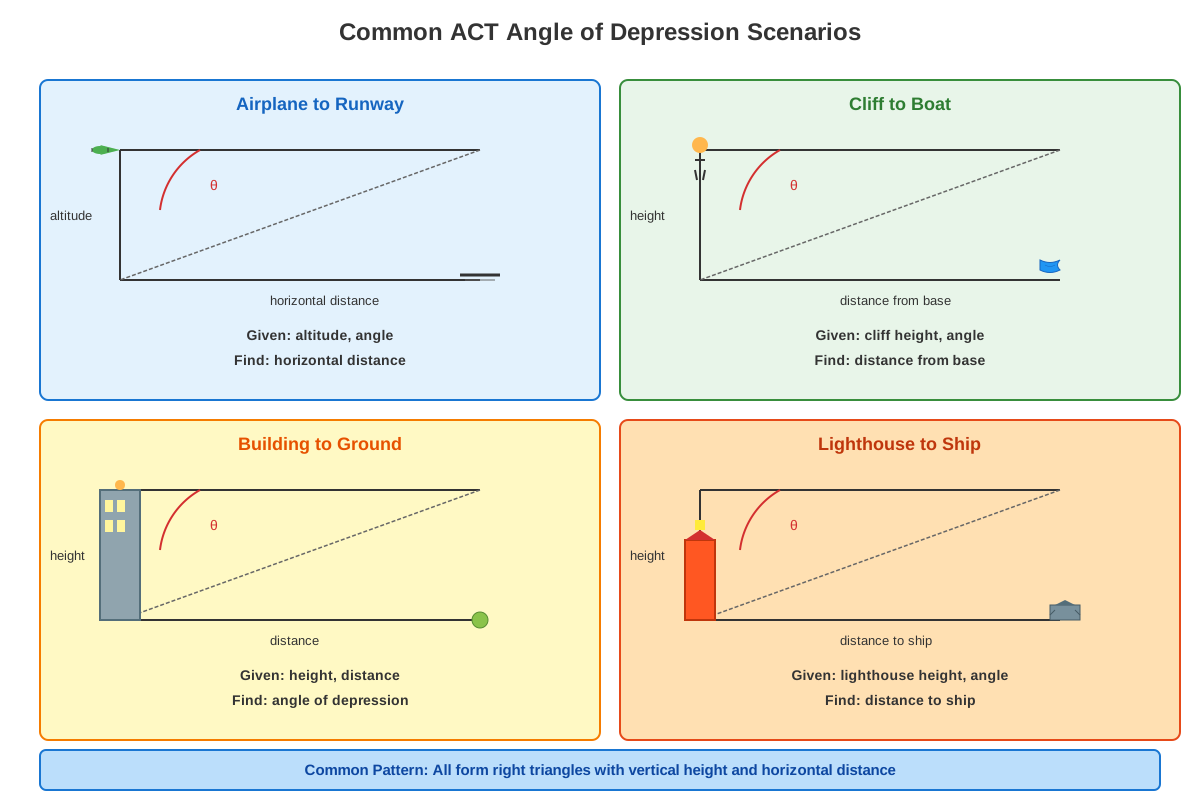
Common ACT presentations include: a person standing on a cliff looking down at a boat, an airplane descending toward a landing point, a lifeguard in a tower spotting a swimmer, or an observer on a building looking down at a car. The problems typically provide two pieces of information (such as height and angle) and ask students to find a third (such as horizontal distance). Recognition of these standard scenarios allows students to quickly categorize the problem type and select the appropriate solution strategy.
Core Concepts
Definition of Angle of Depression
The angle of depression is defined as the angle formed between a horizontal line extending from an observer's eye level and the line of sight down to an object below that horizontal plane. This angle is always measured downward from the horizontal, never from the vertical. The horizontal reference line is crucial—it represents the observer's eye level extending parallel to the ground or horizon. When an observer looks down at an object, their line of sight drops below this horizontal reference, creating the angle of depression.
The Horizontal Reference Line
Understanding the horizontal reference line is critical for correctly identifying angles of depression. This imaginary line extends horizontally from the observer's position, parallel to the ground or sea level. It represents what the observer would see if looking straight ahead without tilting their head up or down. All angle of depression measurements begin from this horizontal line and measure downward. In diagrams, this line is typically drawn as a dashed horizontal line extending from the observer's eye position.
Relationship to Angle of Elevation
The most powerful concept for solving angle of depression problems is the alternate interior angles relationship. When an observer at point A looks down at an object at point B, the angle of depression from A equals the angle of elevation from B looking up to A. This equality occurs because:
- The horizontal line at the observer's eye level is parallel to the horizontal line at ground level
- The line of sight acts as a transversal cutting these parallel lines
- By the alternate interior angles theorem, these angles are congruent
This relationship allows students to "flip" the problem: instead of working with the angle of depression from the top, they can work with the equivalent angle of elevation from the bottom, which often creates a more intuitive right triangle setup.
Setting Up the Right Triangle
Every angle of depression problem involves a right triangle with three key components:
| Component | Description | Typical Label |
|---|---|---|
| Vertical side | Height of observer above the object | Opposite side (relative to angle of elevation) |
| Horizontal side | Horizontal distance between observer and object | Adjacent side (relative to angle of elevation) |
| Hypotenuse | Direct line of sight from observer to object | Hypotenuse |
| Angle | Angle of elevation (equal to angle of depression) | θ or given angle measure |
The right angle is formed where the vertical height meets the horizontal distance, creating the foundation for applying trigonometric ratios.
Selecting the Correct Trigonometric Ratio
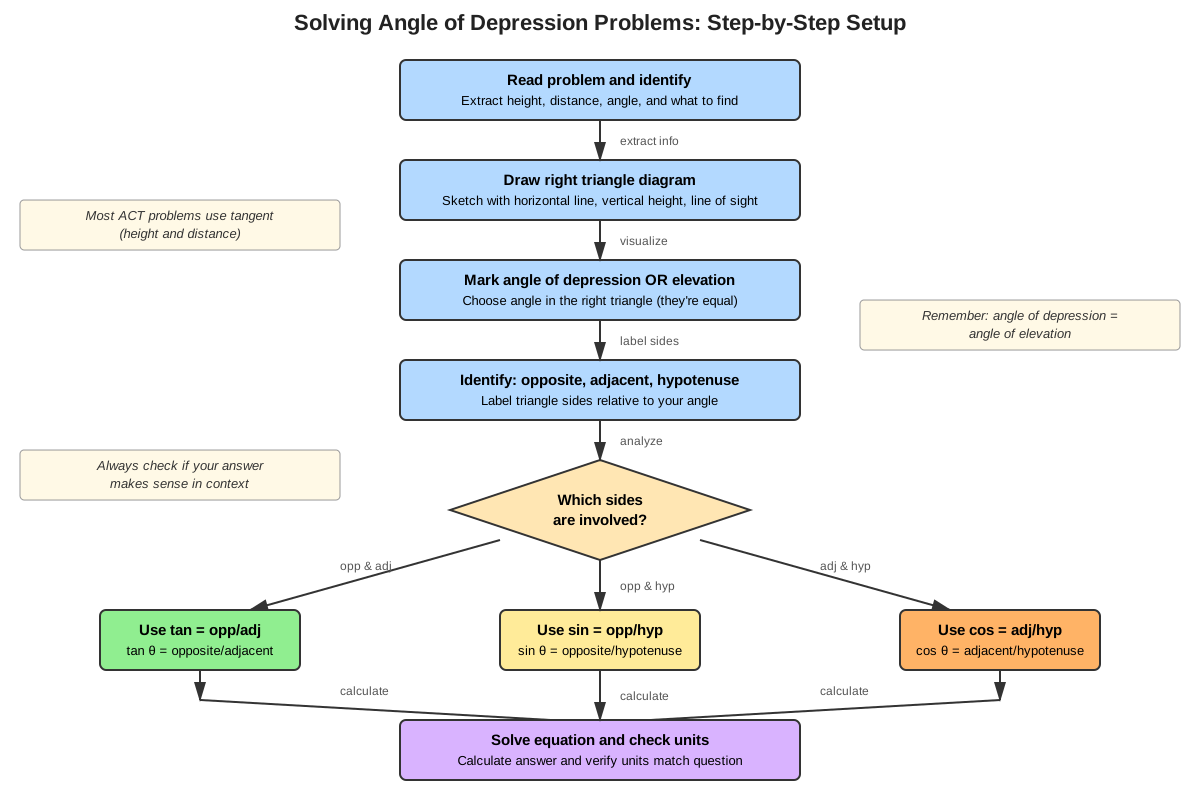
Once the right triangle is established, selecting the appropriate trigonometric ratio depends on which sides are known and which are unknown:
Tangent (most common): When the problem involves the vertical height and horizontal distance
tan(θ) = opposite/adjacent = height/distanceSine: When the problem involves the vertical height and the line of sight (hypotenuse)
sin(θ) = opposite/hypotenuse = height/line_of_sightCosine: When the problem involves the horizontal distance and the line of sight (hypotenuse)
cos(θ) = adjacent/hypotenuse = distance/line_of_sightFor ACT angle of depression problems, tangent is used in approximately 70% of cases because problems typically provide height and ask for distance, or vice versa.
Problem-Solving Steps
- Read carefully and identify the scenario: Determine who is observing and what they're looking at
- Draw a diagram: Sketch the horizontal reference line, mark the observer's position, mark the object's position, and draw the line of sight
- Label the angle of depression: Mark it from the horizontal line down to the line of sight
- Identify the equivalent angle of elevation: Mark this angle at the bottom of the triangle (it equals the angle of depression)
- Label known and unknown sides: Write given measurements on the diagram
- Choose the trigonometric ratio: Select based on which sides are involved
- Set up the equation: Write the ratio with the known and unknown values
- Solve algebraically: Isolate the unknown variable
- Check units and reasonableness: Ensure the answer makes sense in context
Concept Relationships
The angle of depression concept builds directly on right triangle trigonometry, which provides the mathematical tools (sine, cosine, tangent) needed to solve these problems. Without understanding how to apply these ratios, students cannot calculate unknown distances or heights. The alternate interior angles theorem from geometry creates the bridge that allows angle of depression problems to be reframed as angle of elevation problems, simplifying the solution process.
Within the topic itself, the relationships flow as follows: Definition of angle of depression → Recognition of horizontal reference line → Application of alternate interior angles → Construction of right triangle → Selection of trigonometric ratio → Algebraic solution. Each step depends on the previous one, creating a linear problem-solving pathway.
The angle of depression connects forward to more advanced topics including vectors (where angles from horizontal are common), polar coordinates (which use angles from reference lines), and calculus applications (optimization problems involving angles). It also relates laterally to angle of elevation problems, which use identical mathematical techniques but with the observer positioned below the object rather than above.
Understanding that the angle of depression and angle of elevation are equal (alternate interior angles) is the conceptual linchpin that makes these problems manageable. This relationship transforms a potentially confusing downward-looking scenario into a familiar upward-looking triangle problem that students have practiced extensively.
High-Yield Facts
⭐ The angle of depression from point A to point B equals the angle of elevation from point B to point A due to alternate interior angles formed by parallel horizontal lines.
⭐ The angle of depression is always measured downward from a horizontal reference line, never from a vertical line.
⭐ Tangent is the most frequently used trigonometric ratio in ACT angle of depression problems because these problems typically involve height and horizontal distance.
⭐ The right angle in angle of depression problems is always at the base, where the vertical height meets the horizontal distance.
⭐ Drawing an accurate diagram is essential—most errors occur from misidentifying which angle or side corresponds to which part of the problem.
- The horizontal reference line extends from the observer's eye level, parallel to the ground or horizon.
- When solving for horizontal distance given height and angle: distance = height / tan(angle).
- When solving for height given distance and angle: height = distance × tan(angle).
- The line of sight (hypotenuse) is always longer than either the height or the horizontal distance.
- Calculator mode matters: ensure the calculator is in degree mode for ACT problems, as angles are given in degrees, not radians.
- If a problem asks for the angle of depression and you calculate the angle of elevation, they are the same value—no conversion needed.
- Multi-step problems may require finding an intermediate value (like the hypotenuse) before finding the final answer.
Quick check — test yourself on Angle of depression so far.
Try Flashcards →Common Misconceptions
Misconception: The angle of depression is measured from the vertical line downward.
Correction: The angle of depression is always measured from the horizontal reference line (eye level) downward to the line of sight. Measuring from vertical would give the complementary angle, leading to incorrect calculations.
Misconception: The angle of depression and angle of elevation are supplementary angles (add to 180°).
Correction: These angles are equal (congruent), not supplementary. They are alternate interior angles formed when parallel horizontal lines are cut by the line of sight as a transversal.
Misconception: The angle given in the problem is always the angle to use in the trigonometric ratio.
Correction: Sometimes the problem states the angle of depression, but you must use the equal angle of elevation in your right triangle setup. Always identify which angle in your triangle you're actually using.
Misconception: The hypotenuse is always the unknown value in angle of depression problems.
Correction: While the hypotenuse is sometimes unknown, ACT problems more commonly ask for the horizontal distance (adjacent side) or the height (opposite side). The hypotenuse is actually given or irrelevant in most problems.
Misconception: You can use any trigonometric ratio and get the same answer.
Correction: You must select the ratio that relates the two sides you're working with (one known, one unknown). Using the wrong ratio will involve a side you don't have information about, making the problem unsolvable.
Misconception: If the angle of depression is 30°, then the angle at the top of the triangle is also 30°.
Correction: The angle of depression (30°) is outside the right triangle, measured from the horizontal. The angle inside the triangle at the top is the complement: 90° - 30° = 60°. However, the angle at the bottom of the triangle (angle of elevation) is 30°, which is why we use that angle in calculations.
Worked Examples
Example 1: Finding Horizontal Distance
Problem: A lifeguard sitting in a tower 30 feet above the beach spots a swimmer in distress. The angle of depression from the lifeguard to the swimmer is 25°. How far is the swimmer from the base of the tower?
Solution:
Step 1: Draw a diagram. The lifeguard is at the top, 30 feet above ground. The horizontal reference line extends from the lifeguard's position. The angle of depression (25°) is measured downward from this horizontal line to the line of sight to the swimmer.
Step 2: Identify the right triangle. The vertical side is 30 feet (height of tower), the horizontal side is the unknown distance we need to find, and the right angle is at the base of the tower.
Step 3: Recognize that the angle of depression (25°) equals the angle of elevation from the swimmer looking up to the lifeguard. This 25° angle is at the bottom of our right triangle.
Step 4: Identify known and unknown values:
- Opposite side (height) = 30 feet
- Adjacent side (distance) = unknown (let's call it d)
- Angle = 25°
Step 5: Select the trigonometric ratio. We have opposite and need adjacent, so we use tangent:
tan(25°) = opposite/adjacent = 30/dStep 6: Solve for d:
d = 30/tan(25°)
d = 30/0.4663
d ≈ 64.3 feetAnswer: The swimmer is approximately 64.3 feet from the base of the tower.
Connection to learning objectives: This problem demonstrates identifying angle of depression in a word problem, applying the alternate interior angles relationship, and using the correct trigonometric ratio (tangent) to solve accurately.
Example 2: Finding Angle of Depression
Problem: An airplane is flying at an altitude of 5,000 feet. The pilot spots the airport runway, which is 12,000 feet away horizontally from the plane's current position. What is the angle of depression from the plane to the runway?
Solution:
Step 1: Draw a diagram. The plane is 5,000 feet above ground, the runway is 12,000 feet away horizontally, and we need to find the angle of depression.
Step 2: Set up the right triangle:
- Opposite side (altitude) = 5,000 feet
- Adjacent side (horizontal distance) = 12,000 feet
- Angle of elevation from runway to plane = unknown (let's call it θ)
Step 3: Recognize that the angle of elevation from the runway to the plane equals the angle of depression from the plane to the runway.
Step 4: Select the trigonometric ratio. We have opposite and adjacent, so we use tangent:
tan(θ) = opposite/adjacent = 5,000/12,000Step 5: Simplify and solve:
tan(θ) = 5,000/12,000 = 5/12 ≈ 0.4167
θ = arctan(0.4167)
θ ≈ 22.6°Answer: The angle of depression from the plane to the runway is approximately 22.6°.
Connection to learning objectives: This problem requires working backward from sides to find the angle, demonstrating flexibility in applying angle of depression concepts. It reinforces that the angle of depression equals the angle of elevation and shows how to use inverse trigonometric functions.
Exam Strategy
When approaching ACT angle of depression questions, begin by scanning for trigger words and phrases: "looking down," "from the top of," "spots below," "angle of depression," "descending," "from an elevated position," or "observes from above." These phrases immediately signal that you're dealing with an angle of depression problem.
Step-by-step approach:
- Immediately draw a diagram (15-20 seconds): Even if the problem includes a diagram, redraw it with clear labels. This prevents misidentification of angles and sides.
- Mark the horizontal reference line: Draw a dashed horizontal line from the observer's position. This helps you correctly identify the angle of depression.
- Label the angle of elevation: Mark the equal angle at the bottom of the triangle—this is the angle you'll use in calculations.
- Identify the question: Underline what you're solving for (distance, height, or angle).
- Choose your ratio before calculating: Write "tan," "sin," or "cos" based on which sides are involved. This prevents mid-problem confusion.
Process of elimination tips:
- If answer choices vary by a factor of 2 or more, you likely need tangent rather than sine or cosine (tangent values change more dramatically with angle changes).
- Eliminate answers that are larger than the hypotenuse if you're solving for a leg of the triangle.
- If solving for an angle, eliminate any answer greater than 90° (angles of depression are acute).
- Check if your answer makes physical sense: a 1,000-foot tall building shouldn't have someone 50 feet away at a 5° angle of depression.
Time allocation: Budget 60-90 seconds for straightforward angle of depression problems. If you're past 90 seconds, make your best educated guess and move on—these problems shouldn't consume more than 1.5% of your total test time.
Calculator efficiency: Pre-set your calculator to degree mode before the test begins. Know where your inverse trigonometric functions (arctan, arcsin, arccos) are located. Practice the key sequence: for tan(25°), you typically press "tan," then "25," then "enter" or ")".
Memory Techniques
Mnemonic for trigonometric ratios: SOH-CAH-TOA
- Sine = Opposite / Hypotenuse
- Cosine = Adjacent / Hypotenuse
- Tangent = Opposite / Adjacent
Visualization strategy: Picture yourself standing on a cliff looking down at a boat. Your eye level extends horizontally like a shelf. The angle of depression is how much you tilt your head down from that shelf. Now imagine the boat looking up at you—that's the same angle, just from below.
Acronym for problem-solving steps: DDLCSE
- Draw the diagram
- Determine the angle of elevation (equals angle of depression)
- Label all known values
- Choose the trigonometric ratio
- Solve the equation
- Evaluate for reasonableness
Memory anchor: "Depression goes DOWN, Elevation goes UP, but they're EQUAL." This reminds you that angle of depression is measured downward, angle of elevation upward, but they have the same measure.
Tangent reminder: "Tangent is the TAN-gent you need for distance problems"—since most ACT problems involve finding horizontal distance from height and angle, tangent is your go-to ratio.
Summary
The angle of depression is a critical ACT Math concept that measures the downward angle from a horizontal reference line to an object below an observer's eye level. The key insight is that the angle of depression equals the angle of elevation due to alternate interior angles formed by parallel horizontal lines. This equivalence allows students to reframe problems as familiar right triangle scenarios. Success requires: (1) correctly identifying angle of depression problems from word problems, (2) drawing accurate diagrams with horizontal reference lines, (3) recognizing the angle of elevation at the base of the triangle, (4) selecting the appropriate trigonometric ratio (usually tangent for height-distance problems), and (5) solving algebraically. The most common errors stem from measuring angles from the wrong reference line or confusing which angle to use in calculations. Mastery of this topic provides a reliable 1-2 points on the ACT and builds essential spatial reasoning skills applicable to broader trigonometry concepts.
Key Takeaways
- The angle of depression is measured downward from a horizontal reference line at the observer's eye level, and it equals the angle of elevation from the object looking up
- Always draw a diagram marking the horizontal reference line, the angle of depression, and the equivalent angle of elevation at the base of the right triangle
- Tangent is the most commonly used ratio for ACT angle of depression problems because they typically involve height and horizontal distance
- The right angle is always at the base where the vertical height meets the horizontal distance
- Use SOH-CAH-TOA to select the correct trigonometric ratio based on which sides are known and unknown
- Ensure your calculator is in degree mode before solving, as ACT problems use degrees, not radians
- Check that your answer makes physical sense—distances should be reasonable given the height and angle provided
Related Topics
Angle of Elevation: The complementary concept where an observer looks upward to an object above eye level; uses identical mathematical techniques but with reversed positioning. Mastering angle of depression makes angle of elevation problems immediately accessible.
Law of Sines and Law of Cosines: Advanced trigonometric tools for non-right triangles that build on the foundational skills developed through angle of depression problems. These laws extend trigonometry beyond the right triangle constraint.
Vectors and Components: Angles from horizontal reference lines appear frequently in vector problems, where magnitude and direction must be decomposed into horizontal and vertical components using the same trigonometric ratios.
Three-Dimensional Geometry: Angle of depression concepts extend into 3D space, where problems may involve angles in multiple planes simultaneously, requiring spatial visualization skills developed through 2D angle of depression practice.
Trigonometric Applications in Physics: Projectile motion, inclined planes, and force resolution all use angles measured from horizontal reference lines, making angle of depression a gateway to physics problem-solving.
Practice CTA
Now that you've mastered the core concepts of angle of depression, it's time to solidify your understanding through active practice. Complete the practice questions to test your ability to identify, set up, and solve angle of depression problems under timed conditions. Use the flashcards to reinforce the key relationships, formulas, and problem-solving steps until they become automatic. Remember: the difference between understanding a concept and scoring points on test day is deliberate practice. Each problem you work through builds the pattern recognition and computational speed you need for ACT success. You've got this!
Sign up free to keep reading
Create a free AnvayaPrep account to finish this ACT guide on Angle of depression — plus flashcards and practice questions.