Overview
The angle of elevation is one of the most frequently tested trigonometry concepts on the ACT Math section. This topic combines spatial reasoning with right triangle trigonometry, requiring students to translate real-world scenarios into mathematical models. An angle of elevation represents the angle formed between a horizontal line of sight and an upward line of sight to an object above the observer. Understanding this concept is crucial because it appears in approximately 2-3 questions per ACT exam, often disguised within word problems involving buildings, airplanes, mountains, or other vertical structures.
Mastering the angle of elevation requires strong visualization skills and the ability to identify right triangles within contextual problems. Students must recognize when a problem describes an angle of elevation scenario, draw an appropriate diagram, label the components correctly, and apply the appropriate trigonometric ratio (sine, cosine, or tangent) to solve for unknown values. This topic serves as a practical application of abstract trigonometric concepts, demonstrating how mathematical principles solve real-world measurement problems.
The ACT angle of elevation questions connect directly to broader trigonometry concepts including right triangle relationships, trigonometric ratios, and the Pythagorean theorem. Success with angle of elevation problems builds confidence in spatial reasoning and prepares students for more complex trigonometry applications. This topic also reinforces the importance of careful diagram construction—a skill that transfers to geometry, physics, and other mathematical domains tested on the ACT.
Learning Objectives
- [ ] Identify when Angle of elevation is being tested in ACT word problems and contextual scenarios
- [ ] Explain the core rule or strategy behind Angle of elevation, including proper diagram construction
- [ ] Apply Angle of elevation to ACT-style questions accurately using appropriate trigonometric ratios
- [ ] Distinguish between angle of elevation and angle of depression in problem contexts
- [ ] Construct accurate right triangle diagrams from verbal descriptions of elevation scenarios
- [ ] Select the correct trigonometric ratio (sine, cosine, or tangent) based on given and unknown values
- [ ] Solve multi-step problems involving angle of elevation combined with other geometric concepts
Prerequisites
- Right triangle properties: Understanding the relationship between legs and hypotenuse is essential for identifying which measurements correspond to which triangle components in elevation problems
- Trigonometric ratios (SOH-CAH-TOA): The ability to apply sine, cosine, and tangent functions forms the computational foundation for all angle of elevation calculations
- Basic angle measurement: Familiarity with degrees and how angles are measured from reference lines enables proper interpretation of elevation angles
- Pythagorean theorem: This theorem provides an alternative solution method and helps verify answers in elevation problems
- Calculator proficiency: Knowing how to use inverse trigonometric functions and handle degree mode is necessary for efficient problem-solving on the ACT
Why This Topic Matters
Angle of elevation problems represent practical applications of trigonometry that students encounter in fields ranging from architecture and engineering to aviation and surveying. Professionals use these calculations to determine building heights, measure distances to inaccessible objects, plan flight paths, and design structures. The ability to translate three-dimensional spatial relationships into two-dimensional mathematical models demonstrates critical thinking and problem-solving skills valued across STEM disciplines.
On the ACT Math section, angle of elevation appears in 3-5% of questions, typically in the trigonometry content area that comprises 7-10% of the entire exam. These questions usually appear in the medium to difficult range (questions 30-50 out of 60), making them crucial for students aiming for scores above 25. The ACT presents angle of elevation in several formats: direct calculation problems, word problems requiring diagram construction, and multi-step problems combining elevation with other geometric concepts.
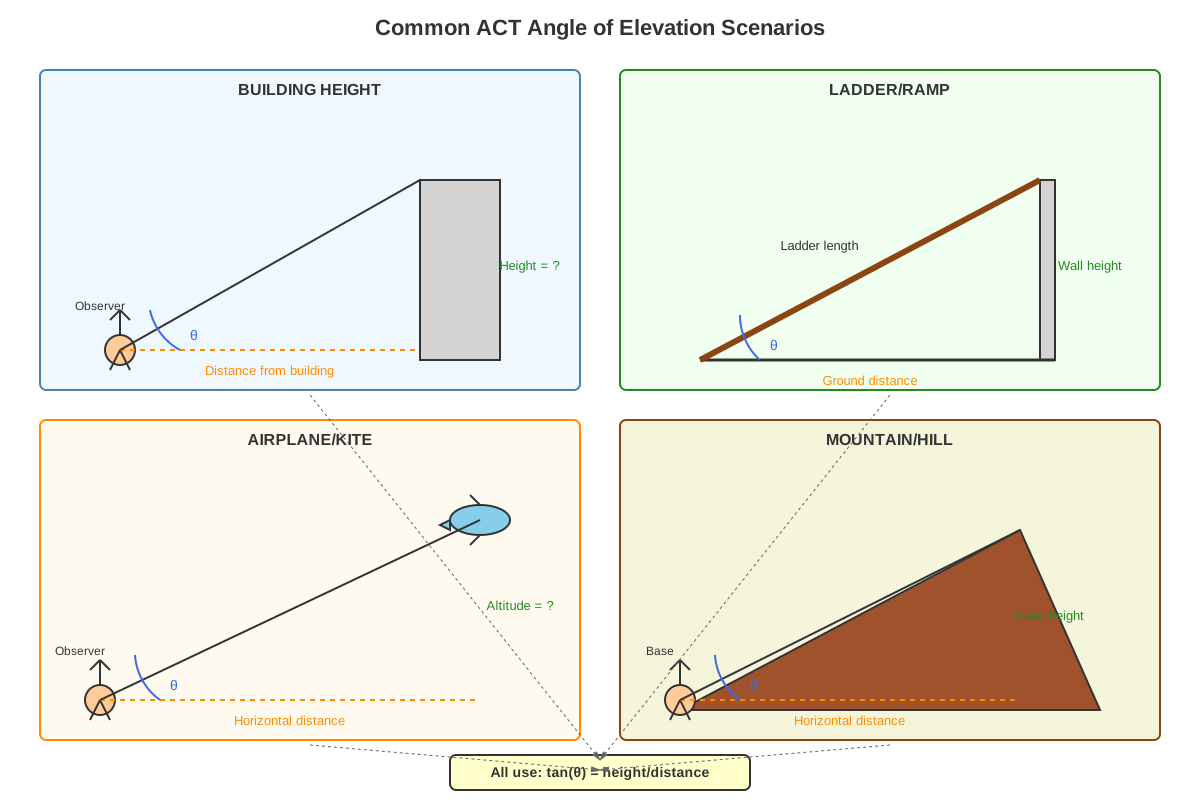
Common ACT presentations include scenarios involving: a person looking up at the top of a building or tree, an airplane ascending at a specific angle, a surveyor measuring mountain heights, a ladder leaning against a wall, or a ramp rising to a platform. The exam frequently tests whether students can correctly identify which side of the triangle represents the height (opposite side), which represents the horizontal distance (adjacent side), and which trigonometric ratio applies to the given information. Recognition of these patterns significantly improves accuracy and speed.
Core Concepts
Definition and Components
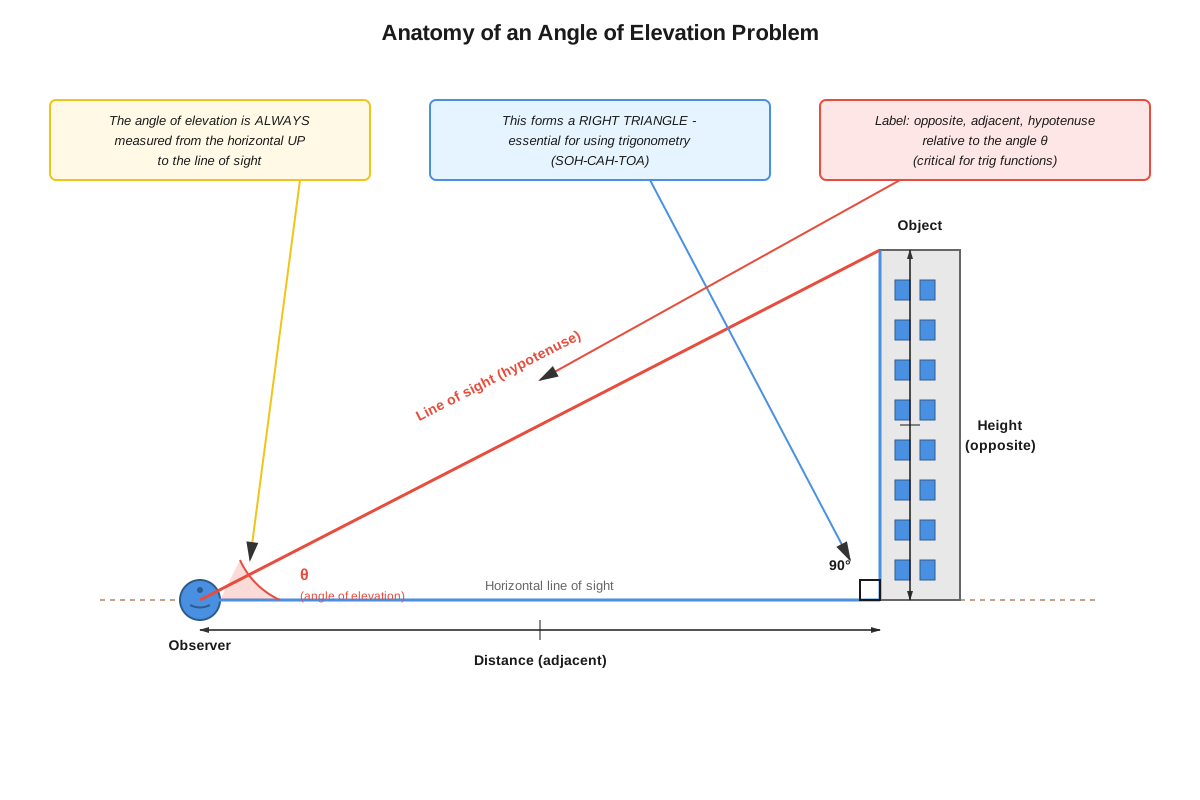
The angle of elevation is defined as the angle formed between a horizontal reference line and the line of sight when looking upward at an object. This angle is always measured from the horizontal upward, never downward. The angle originates at the observer's position and opens upward toward the object being viewed. Three essential components define every angle of elevation scenario: the observer's position (vertex of the angle), the horizontal reference line (adjacent side of the resulting right triangle), and the line of sight to the elevated object (hypotenuse of the resulting right triangle).
When an angle of elevation problem is presented, it inherently creates a right triangle. The right angle forms where the vertical height meets the horizontal distance. The angle of elevation itself is one of the two acute angles in this right triangle. Understanding this geometric structure is fundamental because it allows the application of trigonometric ratios to solve for unknown measurements.
Diagram Construction Strategy
Proper diagram construction is the most critical skill for solving angle of elevation problems accurately. Follow this systematic approach:
- Draw a horizontal reference line representing the ground or baseline from which measurements are taken
- Mark the observer's position at one end of this horizontal line
- Draw a vertical line representing the height of the object being observed
- Connect the observer to the top of the vertical line creating the hypotenuse (line of sight)
- Label the angle of elevation at the observer's position, between the horizontal and the line of sight
- Mark the right angle where the vertical and horizontal lines meet
- Label all known measurements and use variables for unknown values
Trigonometric Ratio Selection
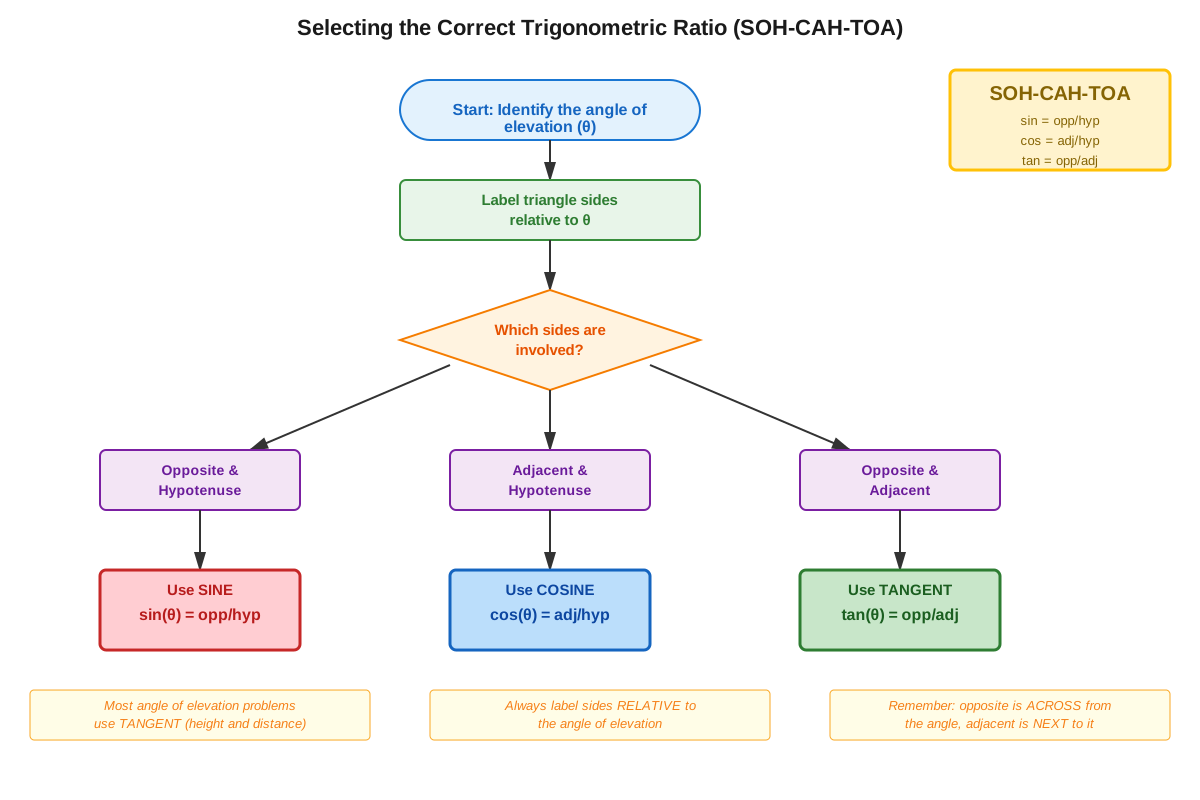
Selecting the correct trigonometric ratio depends on which sides of the right triangle are known or unknown. The three primary ratios are:
| Ratio | Formula | When to Use |
|---|---|---|
| Sine | sin(θ) = opposite/hypotenuse | When working with height and line of sight distance |
| Cosine | cos(θ) = adjacent/hypotenuse | When working with horizontal distance and line of sight distance |
| Tangent | tan(θ) = opposite/adjacent | When working with height and horizontal distance (most common for elevation) |
The tangent ratio is most frequently applicable in angle of elevation problems because these scenarios typically provide or ask for the vertical height (opposite side) and horizontal distance (adjacent side), while the hypotenuse (line of sight) is less commonly involved. Remember the mnemonic SOH-CAH-TOA: Sine = Opposite/Hypotenuse, Cosine = Adjacent/Hypotenuse, Tangent = Opposite/Adjacent.
Solving for Unknown Values
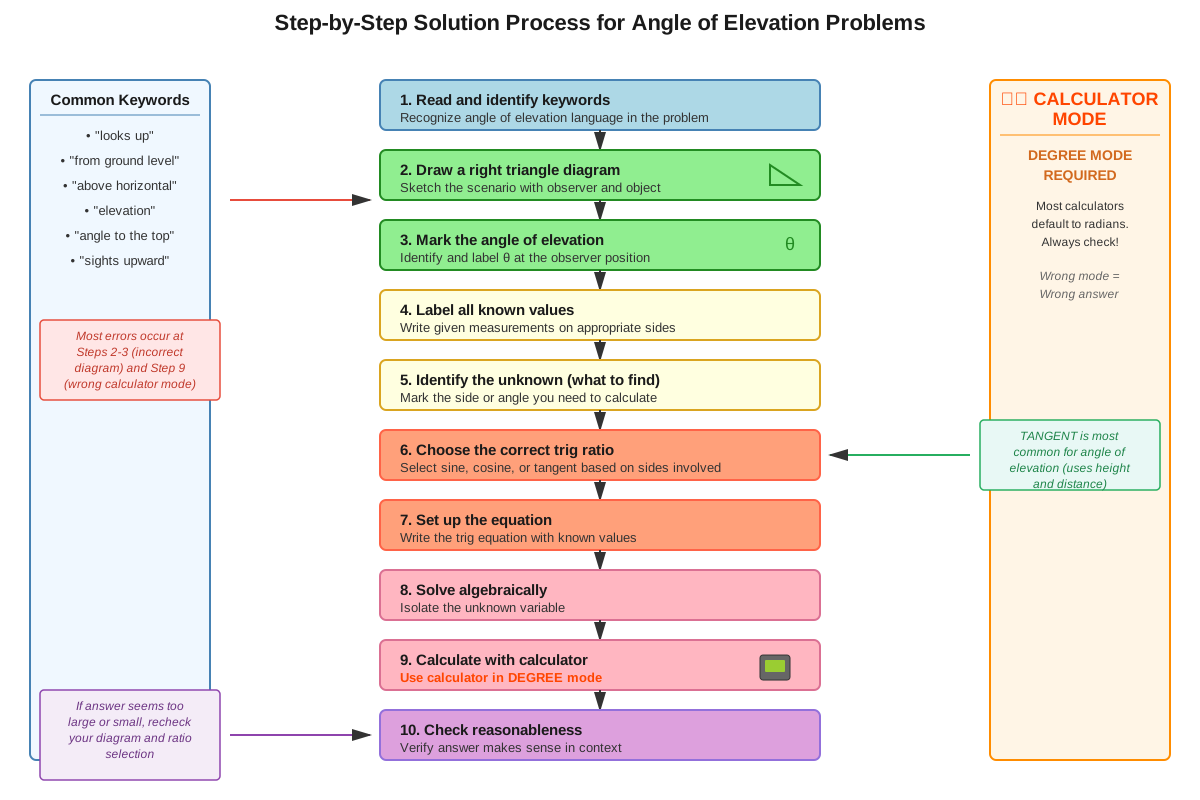
When the angle of elevation and one side length are known, use the appropriate trigonometric ratio to find the unknown side. The solution process follows these steps:
- Identify the given information: angle measure and one side length
- Identify what needs to be found: which side is unknown
- Determine which ratio connects the known and unknown sides
- Set up the equation using the trigonometric ratio
- Solve algebraically by multiplying or dividing to isolate the unknown
- Calculate using a calculator in degree mode
- Check reasonableness of the answer in context
For example, if a person stands 50 feet from a building and looks up at a 35° angle of elevation to see the top, the height can be found using: tan(35°) = height/50, therefore height = 50 × tan(35°) ≈ 35.0 feet.
Inverse Trigonometric Functions
When the two side lengths are known but the angle of elevation is unknown, inverse trigonometric functions (arcsin, arccos, arctan) must be used. These functions are typically accessed on calculators using the "2nd" or "shift" key followed by the trigonometric function button. The process involves:
- Determine which ratio applies based on the known sides
- Set up the ratio as a fraction
- Apply the inverse function to both sides of the equation
- Calculate the angle ensuring the calculator is in degree mode
- Verify the angle is reasonable (typically between 0° and 90° for elevation)
For instance, if a ladder reaches 20 feet up a wall and extends 15 feet from the base, the angle of elevation is: tan(θ) = 20/15, so θ = arctan(20/15) ≈ 53.1°.
Angle of Elevation vs. Angle of Depression
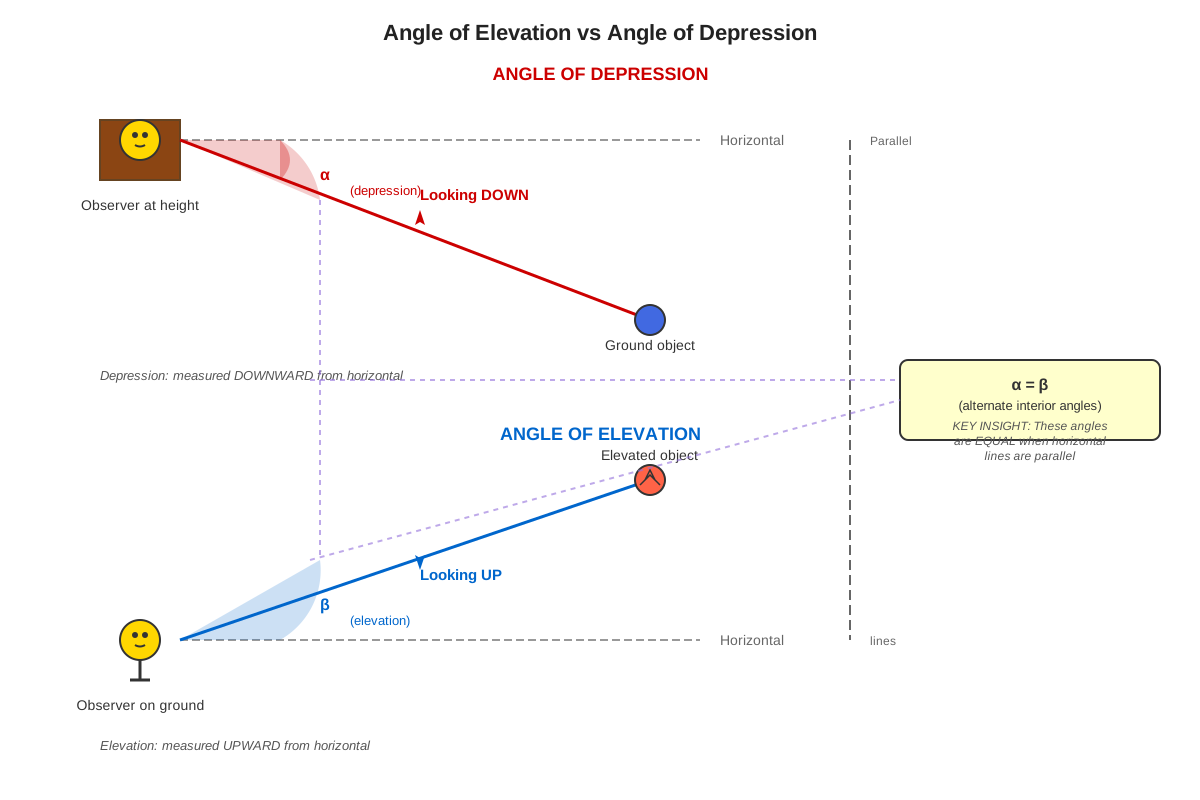
While this guide focuses on angle of elevation, understanding its counterpart helps avoid confusion. The angle of depression is measured downward from a horizontal line when an observer looks down at an object below. A crucial geometric principle states that the angle of elevation from point A to point B equals the angle of depression from point B to point A (they are alternate interior angles formed by parallel horizontal lines). This relationship occasionally appears in ACT problems requiring students to recognize that these angles are congruent.
Concept Relationships
The angle of elevation concept builds directly upon foundational right triangle trigonometry. The relationship flows as follows: Right Triangle Properties → establishes the geometric framework → Trigonometric Ratios (SOH-CAH-TOA) → provides the computational tools → Angle of Elevation → applies these tools to real-world vertical measurement scenarios.
Within angle of elevation problems, several internal connections exist. Diagram Construction → enables → Side Identification → determines → Ratio Selection → leads to → Equation Setup → results in → Solution. Each step depends on the previous one, making the process sequential and systematic.
The angle of elevation also connects to other ACT Math topics. It relates to coordinate geometry when problems involve points in a coordinate plane, to word problem translation skills needed across all math domains, and to multi-step problem solving when combined with other geometric concepts. Additionally, understanding angle of elevation enhances comprehension of vectors, projectile motion (in science contexts), and three-dimensional geometry.
The relationship between angle of elevation and the Pythagorean theorem provides an alternative solution pathway. After using trigonometry to find one unknown side, the Pythagorean theorem (a² + b² = c²) can verify the answer or find a third side if needed. This interconnection demonstrates how multiple mathematical concepts work together to solve complex problems.
High-Yield Facts
⭐ The angle of elevation is always measured upward from a horizontal reference line, never from a vertical line
⭐ Tangent is the most commonly used trigonometric ratio in angle of elevation problems because most scenarios involve height (opposite) and horizontal distance (adjacent)
⭐ Drawing an accurate diagram is the single most important step in solving angle of elevation problems correctly
⭐ The angle of elevation from point A to point B equals the angle of depression from point B to point A due to alternate interior angles
⭐ Calculator must be in degree mode (not radian mode) for all ACT angle of elevation problems
- The right angle in an elevation problem always forms where the vertical height meets the horizontal distance
- When solving for an angle (not a side), inverse trigonometric functions (arcsin, arccos, arctan) must be used
- The hypotenuse in an angle of elevation problem represents the direct line of sight from observer to object
- Angle of elevation problems always create right triangles, making them solvable with basic trigonometry
- Common ACT scenarios include buildings, trees, airplanes, ladders, ramps, and mountains
- The vertical side (height) is always opposite to the angle of elevation
- The horizontal side (distance) is always adjacent to the angle of elevation
- Multi-step problems may require finding one measurement before calculating the final answer
Quick check — test yourself on Angle of elevation so far.
Try Flashcards →Common Misconceptions
Misconception: The angle of elevation is measured from the vertical line or from the object being viewed → Correction: The angle of elevation is always measured from the horizontal reference line at the observer's position, opening upward toward the object. The angle originates where the observer stands, not at the elevated object.
Misconception: Sine should be used for all angle of elevation problems → Correction: The appropriate trigonometric ratio depends on which sides are known or unknown. Tangent (opposite/adjacent) is most common because elevation problems typically involve height and horizontal distance, not the hypotenuse. Always identify the known and unknown sides before selecting a ratio.
Misconception: The angle of elevation and angle of depression are supplementary angles that sum to 180° → Correction: The angle of elevation from one point to another equals (is congruent to) the angle of depression from the second point back to the first. They are equal angles, not supplementary, because they are alternate interior angles formed by parallel horizontal lines.
Misconception: The height of an object equals the hypotenuse of the triangle in elevation problems → Correction: The height is the vertical leg (opposite side) of the right triangle, while the hypotenuse is the direct line of sight from observer to the top of the object. The hypotenuse is always longer than the height.
Misconception: Angle of elevation problems can be solved without drawing a diagram → Correction: While theoretically possible, attempting to solve these problems mentally dramatically increases error rates. Drawing a labeled diagram ensures correct identification of sides, proper ratio selection, and accurate equation setup. The few seconds spent drawing saves time by preventing mistakes.
Misconception: When given an angle in degrees, the calculator mode doesn't matter → Correction: Calculator mode is critical. If the calculator is in radian mode when the problem provides degrees, the calculated answer will be completely incorrect. Always verify degree mode before computing trigonometric values on the ACT.
Worked Examples
Example 1: Finding Height Using Angle of Elevation
Problem: A surveyor stands 80 feet from the base of a building. She measures the angle of elevation to the top of the building as 62°. What is the height of the building to the nearest foot?
Solution:
Step 1 - Draw and label a diagram:
- Draw a horizontal line representing the ground (80 feet)
- Draw a vertical line at the right end representing the building height (unknown, call it h)
- Draw the line of sight from the surveyor to the building top
- Mark the 62° angle at the surveyor's position
- Mark the right angle where building meets ground
Step 2 - Identify known and unknown values:
- Angle of elevation: 62°
- Horizontal distance (adjacent to angle): 80 feet
- Height (opposite to angle): h (unknown)
Step 3 - Select appropriate trigonometric ratio:
Since we have the adjacent side and need the opposite side, use tangent:
tan(θ) = opposite/adjacent
Step 4 - Set up equation:
tan(62°) = h/80
Step 5 - Solve for h:
h = 80 × tan(62°)
h = 80 × 1.8807
h ≈ 150.5 feet
Step 6 - Round as requested:
h ≈ 151 feet
Answer: The building is approximately 151 feet tall.
Connection to Learning Objectives: This problem demonstrates identification of angle of elevation testing (objective 1), application of the core strategy including diagram construction (objective 2), and accurate application to an ACT-style question (objective 3). The tangent ratio was correctly selected based on the given adjacent side and unknown opposite side (objective 6).
Example 2: Finding Angle of Elevation Using Two Distances
Problem: A 25-foot ladder leans against a wall, reaching a point 24 feet above the ground. What is the angle of elevation of the ladder to the nearest tenth of a degree?
Solution:
Step 1 - Draw and label a diagram:
- Draw a vertical wall with height marked as 24 feet
- Draw the ground as a horizontal line
- Draw the ladder as the hypotenuse connecting ground to wall (25 feet)
- Mark the angle of elevation at the base of the ladder (unknown, call it θ)
- Mark the right angle where wall meets ground
Step 2 - Identify known and unknown values:
- Height (opposite to angle): 24 feet
- Ladder length (hypotenuse): 25 feet
- Angle of elevation: θ (unknown)
Step 3 - Select appropriate trigonometric ratio:
Since we have the opposite side and hypotenuse, use sine:
sin(θ) = opposite/hypotenuse
Step 4 - Set up equation:
sin(θ) = 24/25
sin(θ) = 0.96
Step 5 - Solve for θ using inverse sine:
θ = arcsin(0.96)
θ = sin⁻¹(0.96)
θ ≈ 73.74°
Step 6 - Round as requested:
θ ≈ 73.7°
Answer: The angle of elevation of the ladder is approximately 73.7°.
Connection to Learning Objectives: This problem requires constructing a diagram from a verbal description (objective 5), using inverse trigonometric functions to find an angle rather than a side, and demonstrates accurate application to ACT-style questions (objective 3). The sine ratio was correctly selected based on the known opposite side and hypotenuse (objective 6).
Exam Strategy
Trigger Words: Watch for phrases like "looks up at," "angle to the top," "ascending at an angle," "elevation to," "from ground level," and "line of sight upward." These signal angle of elevation problems.
When approaching ACT angle of elevation questions, follow this systematic process:
Time Management: Allocate 60-90 seconds for straightforward angle of elevation problems and up to 2 minutes for multi-step problems. If a diagram isn't provided, spend 15-20 seconds drawing one—this investment prevents costly errors.
Initial Assessment Strategy:
- Read the entire problem first to understand the scenario
- Identify what is given (angle, sides) and what must be found
- Determine if a diagram is provided or must be drawn
- Check answer choices to understand required precision (nearest whole number, tenth, etc.)
Diagram Strategy: If no diagram is provided (common on the ACT), immediately draw one before attempting calculations. Even if a diagram exists, consider redrawing it with clearer labels. Mark the right angle explicitly, label the angle of elevation clearly, and use variables for unknowns.
Ratio Selection Strategy: Use this decision tree:
- If you have/need height and horizontal distance → use tangent
- If you have/need height and line of sight → use sine
- If you have/need horizontal distance and line of sight → use cosine
Calculator Strategy: Before beginning any calculation, verify degree mode by checking that sin(30°) = 0.5. If this doesn't hold, switch modes. When using inverse functions, remember to press "2nd" or "shift" before the trig function button.
Process of Elimination Tips:
- Eliminate answers that are larger than the hypotenuse when solving for a leg
- Eliminate angles greater than 90° or less than 0° for elevation problems
- Eliminate heights that exceed the line of sight distance
- Use estimation: if the angle is close to 45°, the height and horizontal distance should be similar
Common Trap Avoidance: The ACT often includes the reciprocal of the correct answer as a distractor. If you set up tan(θ) = opposite/adjacent but accidentally calculate adjacent/opposite, you'll get an incorrect answer that appears in the choices. Always verify your ratio setup matches your diagram.
Memory Techniques
SOH-CAH-TOA Mnemonic: "Some Old Hippie Caught Another Hippie Tripping On Acid" helps remember:
- Sine = Opposite/Hypotenuse
- Cosine = Adjacent/Hypotenuse
- Tangent = Opposite/Adjacent
Elevation vs. Depression Memory Aid: "Elevation = Up, Depression = Down" - the words themselves indicate direction. Visualize an elevator going up for elevation, and feeling depressed (down) for depression.
Diagram Construction Acronym - HOLD:
- Horizontal line first (ground/baseline)
- Observer position marked
- Line of sight drawn (hypotenuse)
- Degree angle labeled
Tangent Dominance Rule: "Tangent Takes The Test" - remember that tangent is the most common ratio for angle of elevation problems because these typically involve height and distance, not the hypotenuse.
Degree Mode Check: Before any ACT math section, write "DEG" at the top of your scratch paper as a reminder to verify calculator mode. Make checking degree mode a ritual before the first trigonometry problem.
Opposite Side Visualization: The side opposite the angle of elevation is always the vertical height. Visualize the angle "looking across" at the height to remember this relationship.
Summary
Angle of elevation problems represent a high-yield application of right triangle trigonometry on the ACT Math section, appearing in 3-5% of questions typically in the medium-to-difficult range. The angle of elevation is defined as the angle measured upward from a horizontal reference line to the line of sight of an elevated object, always creating a right triangle. Success requires three core competencies: constructing accurate diagrams from verbal descriptions, identifying which sides of the triangle are known and unknown, and selecting the appropriate trigonometric ratio (sine, cosine, or tangent) to solve for the desired value. The tangent ratio (opposite/adjacent) is most frequently applicable because elevation scenarios typically involve vertical height and horizontal distance. Students must ensure their calculators are in degree mode and must be comfortable with both finding sides using trigonometric ratios and finding angles using inverse trigonometric functions. The systematic approach of diagram construction, side identification, ratio selection, equation setup, and calculation provides a reliable framework for solving any angle of elevation problem encountered on the ACT.
Key Takeaways
- Angle of elevation is always measured upward from a horizontal line at the observer's position, creating a right triangle with the vertical height and horizontal distance
- Drawing a labeled diagram is essential for correctly identifying the opposite side (height), adjacent side (horizontal distance), and hypotenuse (line of sight)
- Tangent is the most common ratio for angle of elevation problems because they typically involve height and horizontal distance: tan(θ) = opposite/adjacent
- Calculator must be in degree mode for all ACT problems; verify by checking that sin(30°) = 0.5 before beginning calculations
- Use inverse trigonometric functions (arcsin, arccos, arctan) when solving for an angle rather than a side length
- The angle of elevation from A to B equals the angle of depression from B to A due to alternate interior angles formed by parallel horizontal lines
- Systematic problem-solving following the sequence of diagram → identification → ratio selection → equation → solution minimizes errors and maximizes accuracy
Related Topics
Angle of Depression: The complementary concept to angle of elevation, measured downward from a horizontal line. Mastering angle of elevation provides the foundation for understanding depression angles and their relationship through alternate interior angles.
Law of Sines and Law of Cosines: Advanced trigonometric tools for solving non-right triangles. After mastering angle of elevation in right triangles, these laws extend trigonometric problem-solving to any triangle configuration.
Three-Dimensional Geometry: Angle of elevation concepts extend into 3D space when problems involve angles in multiple planes. Strong elevation skills prepare students for spatial reasoning in three dimensions.
Vectors and Components: Understanding how to break down diagonal measurements into horizontal and vertical components builds directly on angle of elevation skills, particularly in physics applications.
Trigonometric Identities: Deeper exploration of relationships between sine, cosine, and tangent functions. Mastery of basic ratios in elevation problems provides context for understanding more complex trigonometric identities.
Practice CTA
Now that you've mastered the core concepts, strategies, and common pitfalls of angle of elevation problems, it's time to solidify your understanding through active practice. Complete the practice questions to apply these techniques to ACT-style problems, and use the flashcards to reinforce key definitions and formulas. Remember, angle of elevation appears on virtually every ACT exam, making your investment in this topic highly valuable for test day success. Approach each practice problem systematically: draw your diagram, identify your sides, select your ratio, and calculate confidently. Your preparation today translates directly into points on test day!
Sign up free to keep reading
Create a free AnvayaPrep account to finish this ACT guide on Angle of elevation — plus flashcards and practice questions.