Overview
Cosecant (abbreviated as csc) is one of the six fundamental trigonometric functions tested on the ACT Math section. While sine, cosine, and tangent receive more attention in typical trigonometry instruction, understanding cosecant is essential for achieving top scores on the exam. Cosecant is defined as the reciprocal of the sine function, meaning csc(θ) = 1/sin(θ). This reciprocal relationship forms the foundation for solving a variety of trigonometric problems that appear regularly on the ACT.
The ACT cosecant questions typically test students' ability to recognize reciprocal relationships, manipulate trigonometric expressions, and solve equations involving multiple trigonometric functions. These questions often appear in the later portion of the 60-question Math section, where difficulty increases and point values become more critical for achieving scores in the 30+ range. Students who master cosecant gain a significant advantage because many test-takers struggle with the reciprocal trigonometric functions, making these questions excellent opportunities to distinguish oneself from the competition.
Understanding cosecant connects directly to broader trigonometric concepts including the unit circle, right triangle trigonometry, and trigonometric identities. The function plays a crucial role in simplifying complex expressions, solving trigonometric equations, and understanding the behavior of periodic functions. Mastery of cosecant also reinforces understanding of domain and range restrictions, as the function is undefined wherever sine equals zero—a concept that frequently appears in ACT questions testing mathematical reasoning and function analysis.
Learning Objectives
- [ ] Identify when Cosecant is being tested in ACT Math questions
- [ ] Explain the core rule or strategy behind Cosecant and its reciprocal relationship to sine
- [ ] Apply Cosecant to ACT-style questions accurately and efficiently
- [ ] Convert between cosecant and other trigonometric functions using fundamental identities
- [ ] Determine the domain and range of cosecant functions
- [ ] Evaluate cosecant values for common angles without a calculator
- [ ] Recognize and avoid common errors involving cosecant in algebraic manipulations
Prerequisites
- Sine function definition and properties: Cosecant is defined as the reciprocal of sine, making thorough understanding of sine essential
- Right triangle trigonometry: The relationship between sides and angles in right triangles provides the geometric foundation for cosecant
- Unit circle values: Common angle measures and their sine values are necessary for evaluating cosecant
- Reciprocal operations: Understanding how to work with fractions and reciprocals is fundamental to manipulating cosecant expressions
- Basic trigonometric identities: Familiarity with Pythagorean and reciprocal identities enables efficient problem-solving
Why This Topic Matters
Cosecant appears in approximately 2-4 questions per ACT Math section, making it a high-yield topic for focused study. These questions typically appear in the difficulty range of questions 40-60, where each correct answer significantly impacts scaled scores. Students aiming for scores above 28 must demonstrate proficiency with all six trigonometric functions, including the reciprocal functions that many test-takers neglect.
In real-world applications, cosecant appears in physics (wave mechanics and oscillations), engineering (signal processing and structural analysis), and advanced mathematics (calculus and differential equations). While the ACT focuses on algebraic manipulation and conceptual understanding rather than applications, recognizing the practical significance of cosecant helps students appreciate why mastery matters beyond test day.
On the ACT, cosecant most commonly appears in three contexts: (1) simplifying trigonometric expressions where reciprocal identities reduce complexity, (2) solving trigonometric equations that require converting between functions, and (3) analyzing function properties including domain, range, and periodicity. Questions may present cosecant explicitly or require students to recognize when converting to cosecant simplifies the problem. The ability to quickly identify these opportunities separates high-scoring students from those who struggle with time management on the Math section.
Core Concepts
Definition and Reciprocal Relationship
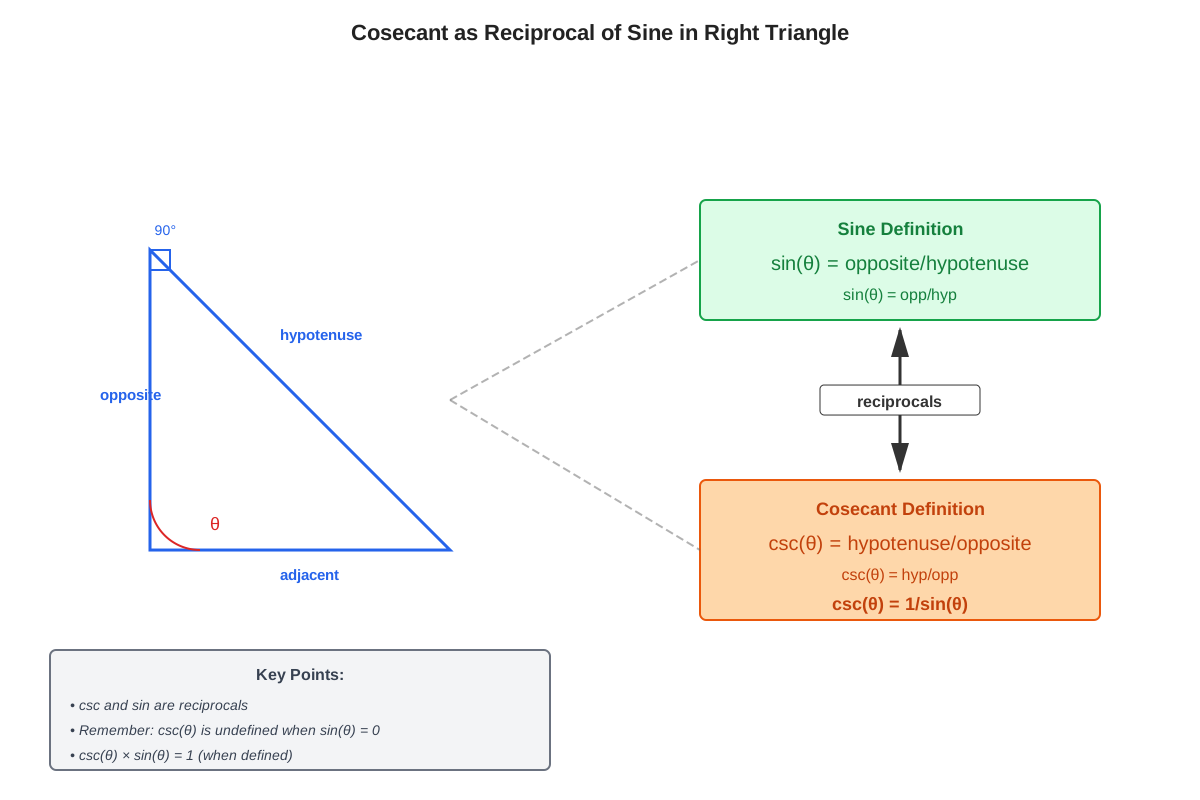
Cosecant is defined as the reciprocal of the sine function. For any angle θ, the relationship is expressed as:
csc(θ) = 1/sin(θ)This definition holds true provided that sin(θ) ≠ 0, since division by zero is undefined. The reciprocal relationship means that wherever sine has a value, cosecant equals one divided by that value. For example, if sin(30°) = 1/2, then csc(30°) = 1/(1/2) = 2.
In right triangle trigonometry, cosecant can be understood geometrically. For an angle θ in a right triangle:
csc(θ) = hypotenuse/oppositeThis is the reciprocal of the sine ratio (opposite/hypotenuse). Understanding both the algebraic and geometric definitions provides flexibility in problem-solving approaches on the ACT.
Domain and Range
The domain of the cosecant function consists of all real numbers except where sine equals zero. Since sin(θ) = 0 at integer multiples of π (or 180°), the domain excludes these values:
Domain: θ ≠ nπ, where n is any integerIn degree measure: θ ≠ 0°, ±180°, ±360°, ±540°, etc.
The range of cosecant includes all real numbers with absolute value greater than or equal to 1:
Range: (-∞, -1] ∪ [1, ∞)This range restriction occurs because sine values are bounded between -1 and 1. When |sin(θ)| ≤ 1, taking the reciprocal produces |csc(θ)| ≥ 1. The function never takes values between -1 and 1, a fact frequently tested on the ACT through questions about function behavior and possible output values.
Common Angle Values
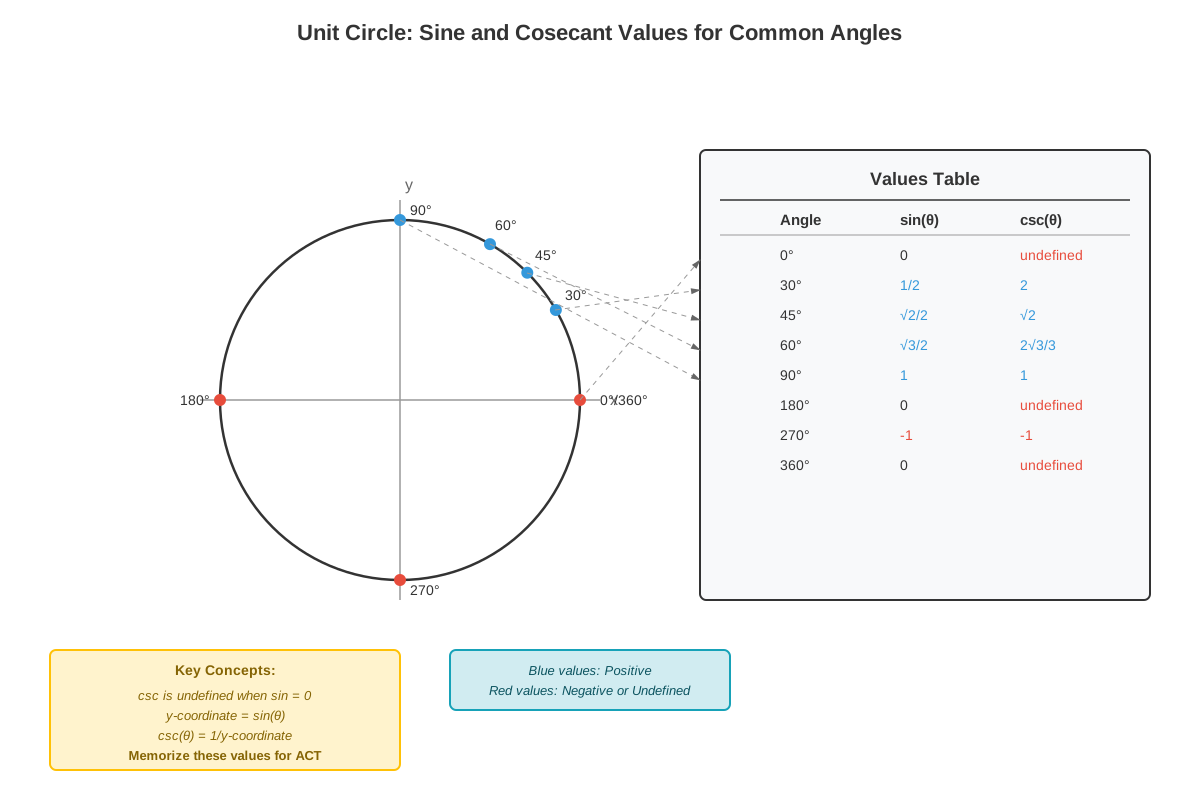
Memorizing cosecant values for standard angles accelerates problem-solving on the ACT. The following table presents essential values:
| Angle (degrees) | Angle (radians) | sin(θ) | csc(θ) |
|---|---|---|---|
| 30° | π/6 | 1/2 | 2 |
| 45° | π/4 | √2/2 | √2 |
| 60° | π/3 | √3/2 | 2√3/3 |
| 90° | π/2 | 1 | 1 |
| 150° | 5π/6 | 1/2 | 2 |
| 180° | π | 0 | undefined |
| 210° | 7π/6 | -1/2 | -2 |
| 270° | 3π/2 | -1 | -1 |
Notice that cosecant values for 30° and 150° are identical because these angles have the same sine value. Understanding symmetry in the unit circle helps predict cosecant values across all four quadrants.
Trigonometric Identities Involving Cosecant
Several fundamental identities incorporate cosecant, and recognizing these patterns is crucial for ACT success:
Reciprocal Identity:
csc(θ) = 1/sin(θ) and sin(θ) = 1/csc(θ)Pythagorean Identity:
1 + cot²(θ) = csc²(θ)This identity derives from the fundamental Pythagorean identity sin²(θ) + cos²(θ) = 1 by dividing all terms by sin²(θ).
Quotient Relationship:
csc(θ)/sec(θ) = cot(θ)This follows from the definitions: (1/sin(θ))/(1/cos(θ)) = cos(θ)/sin(θ) = cot(θ).
Graph Characteristics
The graph of y = csc(x) exhibits distinctive features that occasionally appear in ACT questions:
- Vertical asymptotes occur at x = nπ (where n is any integer), corresponding to zeros of the sine function
- Period equals 2π (or 360°), matching the period of sine
- No x-intercepts exist because the range excludes values between -1 and 1
- Local extrema occur at odd multiples of π/2, where csc(x) = ±1
- Symmetry: The function is odd, meaning csc(-θ) = -csc(θ)
Understanding these graphical properties helps answer questions about function behavior, transformations, and equation solving.
Concept Relationships
The cosecant function exists within an interconnected web of trigonometric concepts. At the foundation lies the sine function, from which cosecant derives through reciprocal relationship. This connection means that any property of sine directly influences cosecant behavior—when sine increases, cosecant decreases (for positive values), and where sine equals zero, cosecant becomes undefined.
The relationship flows as: Right Triangle Ratios → Sine Definition → Cosecant as Reciprocal → Trigonometric Identities → Equation Solving
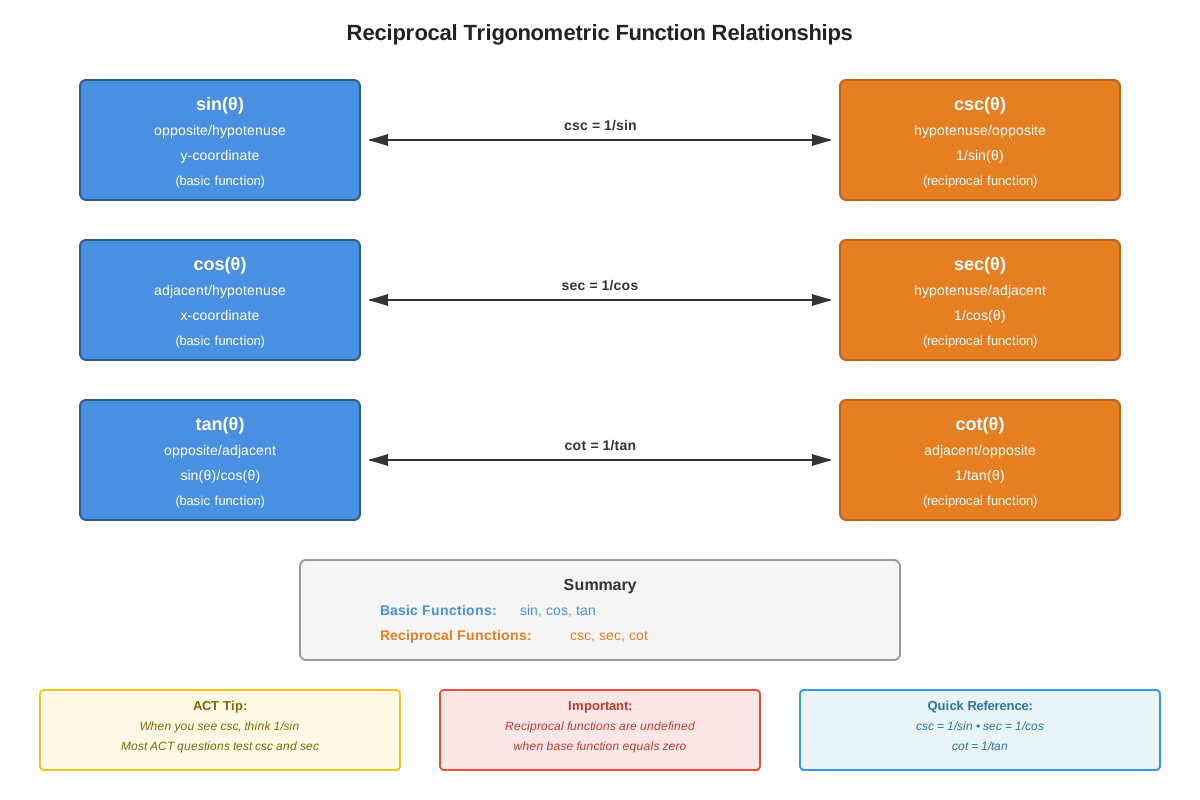
Cosecant connects horizontally to the other reciprocal functions: secant (reciprocal of cosine) and cotangent (reciprocal of tangent). These three functions share similar domain restrictions and range characteristics, forming a parallel family to the primary trigonometric functions.
The Pythagorean identity 1 + cot²(θ) = csc²(θ) links cosecant to cotangent, enabling conversion between these functions. This identity proves particularly valuable when simplifying expressions or solving equations where multiple trigonometric functions appear together.
Moving upward in complexity, cosecant appears in advanced identities, trigonometric equations, and calculus applications (though calculus remains outside ACT scope). The function also connects to inverse trigonometric functions through the relationship between csc(θ) and arcsin(1/csc(θ)).
Quick check — test yourself on Cosecant so far.
Try Flashcards →High-Yield Facts
⭐ Cosecant equals the reciprocal of sine: csc(θ) = 1/sin(θ) for all θ where sin(θ) ≠ 0
⭐ Cosecant is undefined when sine equals zero: This occurs at θ = 0°, 180°, 360°, and all integer multiples of 180°
⭐ The range of cosecant is (-∞, -1] ∪ [1, ∞): Cosecant never takes values between -1 and 1
⭐ csc(30°) = 2 and csc(60°) = 2√3/3: These are the most frequently tested specific values on the ACT
⭐ The Pythagorean identity 1 + cot²(θ) = csc²(θ) enables conversion between cotangent and cosecant
- Cosecant has the same period as sine: 2π radians or 360 degrees
- In right triangles, csc(θ) = hypotenuse/opposite side
- Cosecant is an odd function: csc(-θ) = -csc(θ)
- csc(90°) = 1 and csc(270°) = -1 are the extreme values of the function
- When |sin(θ)| is small, |csc(θ)| is large, and vice versa
- Cosecant and sine always have the same sign (both positive or both negative)
- The graph of cosecant has vertical asymptotes wherever sine crosses the x-axis
Common Misconceptions
Misconception: Cosecant is the inverse function of sine (like arcsin). → Correction: Cosecant is the reciprocal of sine (1/sin(θ)), not the inverse function. The inverse sine function is arcsin or sin⁻¹, which answers "what angle has this sine value?" while cosecant answers "what is one divided by this sine value?"
Misconception: csc(θ) can equal any real number. → Correction: The range of cosecant is restricted to (-∞, -1] ∪ [1, ∞). Values between -1 and 1 are impossible because they would require |sin(θ)| > 1, which cannot occur.
Misconception: csc(0°) = 0 because it involves zero. → Correction: csc(0°) is undefined, not zero. Since sin(0°) = 0, calculating csc(0°) = 1/sin(0°) = 1/0, which is undefined. Confusing undefined values with zero is a critical error on the ACT.
Misconception: csc²(θ) means csc(θ²). → Correction: The notation csc²(θ) means (csc(θ))², which is the cosecant of θ, squared. The exponent applies to the function output, not the input angle. This notation appears frequently in trigonometric identities.
Misconception: If sin(θ) = 0.5, then csc(θ) = 0.5. → Correction: If sin(θ) = 0.5, then csc(θ) = 1/0.5 = 2. Students sometimes forget to take the reciprocal and simply repeat the sine value, leading to incorrect answers.
Misconception: Cosecant and secant are the same function. → Correction: Cosecant is the reciprocal of sine (csc(θ) = 1/sin(θ)), while secant is the reciprocal of cosine (sec(θ) = 1/cos(θ)). These are distinct functions with different values for the same angle.
Worked Examples
Example 1: Simplifying a Trigonometric Expression
Problem: Simplify the expression: (sin(θ) · csc(θ)) / (1 + cot²(θ))
Solution:
Step 1: Recognize that sin(θ) · csc(θ) simplifies using the reciprocal relationship.
sin(θ) · csc(θ) = sin(θ) · (1/sin(θ)) = 1Step 2: Apply the Pythagorean identity to the denominator.
1 + cot²(θ) = csc²(θ)Step 3: Substitute the simplified forms.
(sin(θ) · csc(θ)) / (1 + cot²(θ)) = 1 / csc²(θ)Step 4: Simplify using the reciprocal relationship.
1 / csc²(θ) = 1 / (1/sin(θ))² = sin²(θ)Answer: sin²(θ)
Connection to Learning Objectives: This example demonstrates applying cosecant to ACT-style questions by recognizing when reciprocal identities and Pythagorean identities simplify complex expressions. The problem tests the core strategy of converting between trigonometric functions.
Example 2: Solving a Trigonometric Equation
Problem: If csc(x) = 2 and 0° ≤ x ≤ 180°, find all possible values of x.
Solution:
Step 1: Convert from cosecant to sine using the reciprocal relationship.
csc(x) = 2
1/sin(x) = 2
sin(x) = 1/2
Step 2: Identify angles in the given range where sin(x) = 1/2.
In the first quadrant (0° to 90°): sin(30°) = 1/2, so x = 30°
In the second quadrant (90° to 180°): sin(150°) = 1/2, so x = 150°
Step 3: Verify both solutions.
csc(30°) = 1/sin(30°) = 1/(1/2) = 2 ✓
csc(150°) = 1/sin(150°) = 1/(1/2) = 2 ✓Answer: x = 30° or x = 150°
Connection to Learning Objectives: This problem illustrates identifying when cosecant is being tested (recognizing that csc(x) = 2 requires converting to sine) and applying the core strategy of using reciprocal relationships to solve equations. It also demonstrates understanding of the unit circle and angle properties.
Exam Strategy
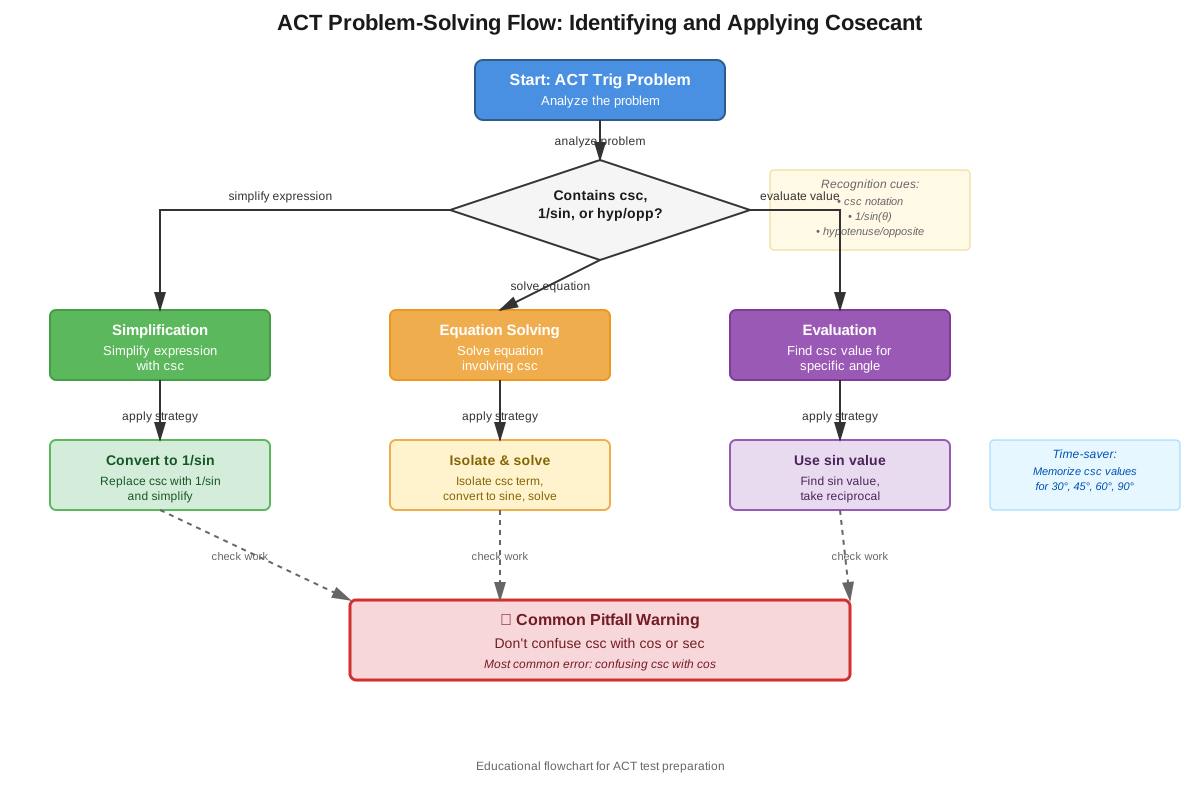
When approaching ACT cosecant questions, begin by identifying whether the problem explicitly mentions cosecant or whether recognizing the reciprocal relationship would simplify the work. Look for trigger phrases such as "reciprocal of sine," "1/sin(θ)," or expressions that would simplify if converted to cosecant form.
Exam Tip: If a problem contains multiple trigonometric functions and appears complex, check whether converting everything to sines and cosines (the fundamental functions) simplifies the expression. Then look for opportunities to reintroduce cosecant if it makes the final form cleaner.
Process of elimination strategies specific to cosecant:
- Eliminate any answer choice suggesting cosecant can equal a value between -1 and 1 (excluding -1 and 1 themselves)
- Eliminate choices that confuse cosecant with arcsine or other inverse functions
- Eliminate answers that ignore domain restrictions (suggesting cosecant is defined at multiples of 180°)
- When evaluating expressions, eliminate choices that don't respect the sign of cosecant (which always matches the sign of sine)
Time allocation: Cosecant questions typically require 45-90 seconds. If a problem takes longer, consider whether you're missing a key identity or simplification. The ACT rewards efficient pattern recognition over lengthy calculations.
Common question types:
- Simplification problems: Reduce complex expressions involving multiple trigonometric functions
- Equation solving: Find angle measures given a cosecant value
- Identity verification: Prove or apply identities involving csc²(θ)
- Function analysis: Determine domain, range, or graphical properties
When you see csc²(θ) in an expression, immediately consider whether the Pythagorean identity 1 + cot²(θ) = csc²(θ) applies. This substitution frequently unlocks solutions that otherwise appear intractable.
Memory Techniques
Mnemonic for Reciprocal Functions: "Cats Sleep Comfortably" reminds you that Cosecant is the reciprocal of Sine (CSC ↔ S).
Visualization Strategy: Picture the unit circle with sine as the y-coordinate. When sine is small (near zero), imagine flipping the fraction—cosecant becomes very large. When sine reaches its maximum (1), cosecant also equals 1. This mental image helps remember that cosecant and sine move in opposite directions in magnitude.
Acronym for Domain Restrictions: "Zero Sine Means Undefined" (ZSMU) reminds you that wherever sine equals zero, cosecant is undefined—at multiples of 180°.
Range Memory Device: Hold your hands apart at shoulder width. Your left hand represents -1 and your right hand represents +1. The space between your hands is the "forbidden zone" where cosecant cannot exist. Everything to the left of your left hand (≤ -1) and everything to the right of your right hand (≥ 1) represents valid cosecant values.
Identity Pattern: Remember "Pythagoras Calls Cosecant Squared" for the identity 1 + Cot² = Csc². The two C's help you remember which functions appear in this particular Pythagorean identity.
Summary
Cosecant represents the reciprocal of the sine function and appears regularly on the ACT Math section in questions testing trigonometric manipulation, equation solving, and function analysis. Defined as csc(θ) = 1/sin(θ), cosecant is undefined wherever sine equals zero (at integer multiples of 180°) and has a range of (-∞, -1] ∪ [1, ∞), never taking values between -1 and 1. Mastery requires memorizing common angle values (particularly csc(30°) = 2 and csc(60°) = 2√3/3), understanding the Pythagorean identity 1 + cot²(θ) = csc²(θ), and recognizing when converting between trigonometric functions simplifies problems. Success on ACT cosecant questions depends on quickly identifying reciprocal relationships, avoiding confusion between reciprocal and inverse functions, and efficiently applying trigonometric identities to reduce complex expressions to simpler forms.
Key Takeaways
- Cosecant is the reciprocal of sine: csc(θ) = 1/sin(θ), not the inverse function
- Cosecant is undefined at all integer multiples of 180° (where sine equals zero)
- The range of cosecant excludes all values between -1 and 1
- The Pythagorean identity 1 + cot²(θ) = csc²(θ) enables powerful simplifications
- Common angle values (30°, 45°, 60°, 90°) appear frequently and should be memorized
- Converting complex expressions to sines and cosines often reveals simplification opportunities
- Cosecant and sine always share the same sign (both positive or both negative)
Related Topics
Secant and Cotangent: The other reciprocal trigonometric functions share similar properties with cosecant, including domain restrictions and range characteristics. Mastering cosecant provides a template for understanding these related functions.
Trigonometric Identities: Advanced identities including sum and difference formulas, double angle formulas, and half angle formulas often incorporate cosecant. Building fluency with cosecant enables tackling more complex identity problems.
Trigonometric Equations: Solving equations involving multiple trigonometric functions requires facility with all six functions, including cosecant. This topic extends equation-solving skills to more challenging scenarios.
Graphing Trigonometric Functions: Understanding how transformations affect the cosecant graph (shifts, stretches, reflections) builds on the foundational knowledge of basic cosecant properties.
Practice CTA
Now that you've mastered the core concepts of cosecant, it's time to solidify your understanding through active practice. Attempt the practice questions to test your ability to identify, explain, and apply cosecant in ACT-style problems. Use the flashcards to reinforce memorization of key values and identities. Remember: consistent practice with immediate feedback is the most effective way to transform understanding into test-day performance. Each problem you solve correctly builds confidence and speed—two essential ingredients for ACT success. You've invested the time to learn the material; now invest the time to prove you own it!
Sign up free to keep reading
Create a free AnvayaPrep account to finish this ACT guide on Cosecant — plus flashcards and practice questions.