Overview
The secant function is one of the six fundamental trigonometric functions, and while it may receive less attention than sine, cosine, and tangent in typical trigonometry instruction, it appears regularly on the ACT Math test. Understanding secant is essential for achieving a top score, as questions involving this function often separate high-performing students from those who have only surface-level trigonometry knowledge. The secant function is defined as the reciprocal of the cosine function, which means that mastering secant requires a solid understanding of cosine and the unit circle.
On the ACT, ACT secant questions typically appear in the context of trigonometric identities, right triangle problems, or coordinate plane scenarios involving the unit circle. These questions may ask students to evaluate secant at specific angles, simplify expressions containing secant, or apply secant in problem-solving contexts. The ACT tends to test secant in ways that require students to recognize relationships between trigonometric functions rather than simply memorizing isolated facts. This means that understanding how secant relates to cosine, tangent, and other trigonometric functions is crucial for success.
The secant function connects to broader mathematical concepts including reciprocal relationships, periodic functions, and the behavior of trigonometric ratios. It plays a particularly important role in advanced trigonometric identities and calculus, making it a foundational concept for students planning to pursue STEM fields. On the ACT specifically, secant questions often appear alongside other trigonometric concepts, requiring students to demonstrate flexible thinking and the ability to convert between different trigonometric representations.
Learning Objectives
- [ ] Identify when Secant is being tested in ACT Math questions
- [ ] Explain the core rule or strategy behind Secant and its relationship to cosine
- [ ] Apply Secant to ACT-style questions accurately and efficiently
- [ ] Convert between secant and other trigonometric functions using reciprocal identities
- [ ] Evaluate secant values for common angles using the unit circle
- [ ] Recognize and simplify expressions involving secant in trigonometric identities
- [ ] Solve right triangle problems that require the use of secant
Prerequisites
- Cosine function and its values: Secant is defined as the reciprocal of cosine, making cosine knowledge essential
- Unit circle familiarity: Understanding angle measures and coordinate positions enables secant evaluation
- Right triangle trigonometry: The foundation for understanding all trigonometric ratios including secant
- Reciprocal operations: Secant requires comfort with taking reciprocals and working with fractions
- Radian and degree measures: ACT questions may present angles in either format
- Basic trigonometric identities: Understanding how trigonometric functions relate to each other
Why This Topic Matters
Secant appears on virtually every ACT Math test, typically in 1-3 questions that test students' depth of trigonometry knowledge. These questions are often positioned in the higher-difficulty range (questions 40-60 on the Math section), making them critical for students aiming for scores above 30. The ACT specifically uses secant to differentiate between students who have memorized basic sine and cosine values versus those who understand the complete system of trigonometric relationships.
In real-world applications, secant appears in physics (particularly in optics and wave mechanics), engineering (structural analysis and signal processing), and navigation. The secant function describes relationships in scenarios where the reciprocal of a ratio is more meaningful than the ratio itself. For example, in optics, the secant of an angle relates to how light refracts through different media.
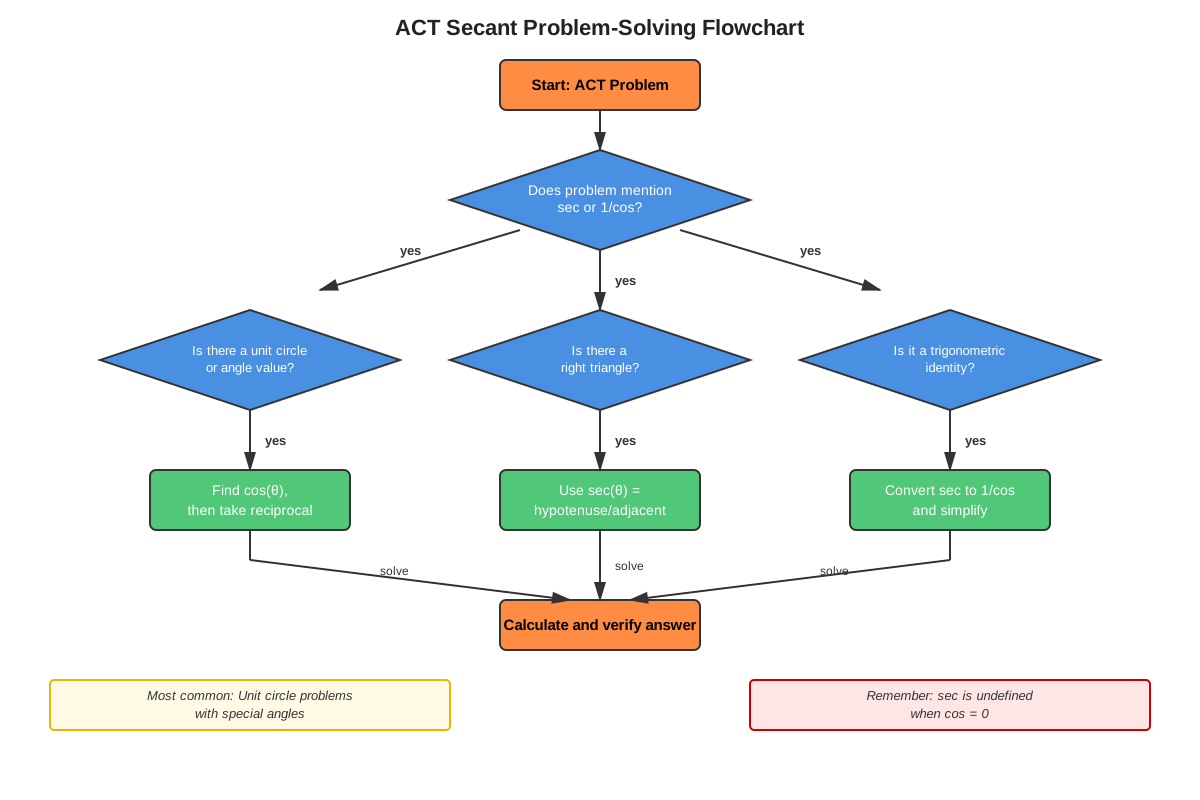
On the ACT, secant most commonly appears in three contexts: (1) direct evaluation questions asking for sec(θ) at specific angles, (2) trigonometric identity simplification problems where secant must be converted to cosine or other functions, and (3) right triangle problems where the secant ratio provides the most direct path to the solution. Questions may also involve graphing secant functions or identifying properties of secant, though these are less common. The key to success is recognizing when a problem involves secant, even when the word "secant" doesn't explicitly appear in the question.
Core Concepts
Definition of Secant
The secant function, abbreviated as sec, is defined as the reciprocal of the cosine function. For any angle θ:
sec(θ) = 1/cos(θ)This fundamental relationship means that secant is undefined whenever cosine equals zero, which occurs at odd multiples of π/2 (or 90°). Understanding this reciprocal relationship is the foundation for all work with secant on the ACT.
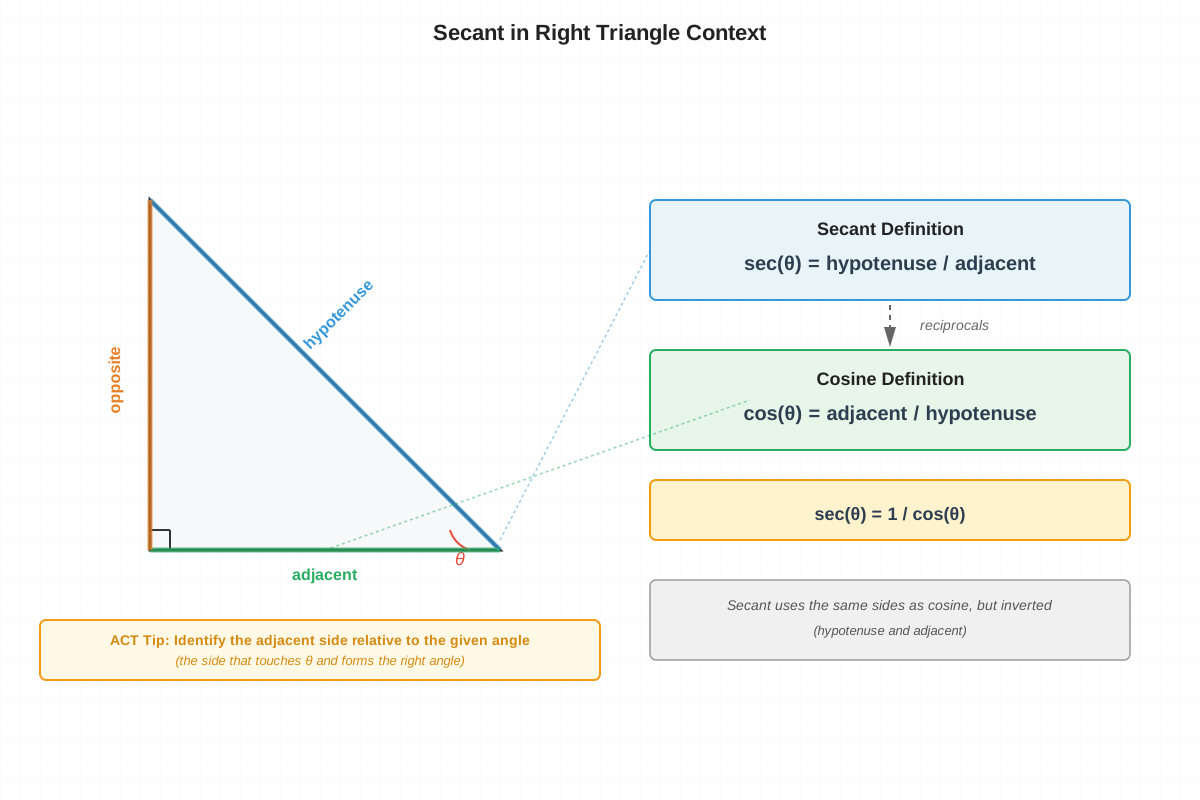
In the context of a right triangle, secant can be defined using the sides of the triangle. If θ is an acute angle in a right triangle, then:
sec(θ) = hypotenuse/adjacentThis definition mirrors the cosine definition (adjacent/hypotenuse) but with the ratio inverted. This makes secant particularly useful when solving problems where the hypotenuse is the unknown quantity and the adjacent side is known.
Secant Values for Common Angles
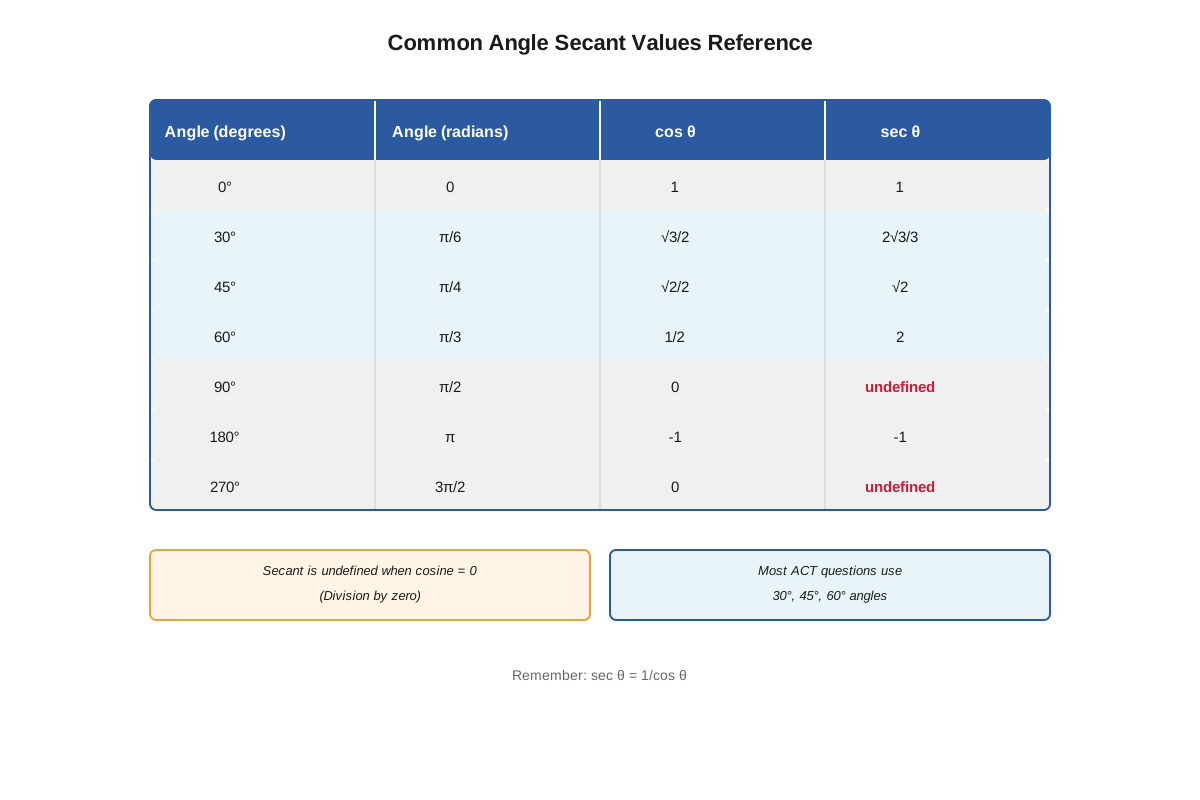
The ACT frequently tests knowledge of secant values at standard angles. Since sec(θ) = 1/cos(θ), students can derive these values from cosine values:
| Angle (degrees) | Angle (radians) | cos(θ) | sec(θ) |
|---|---|---|---|
| 0° | 0 | 1 | 1 |
| 30° | π/6 | √3/2 | 2√3/3 |
| 45° | π/4 | √2/2 | √2 |
| 60° | π/3 | 1/2 | 2 |
| 90° | π/2 | 0 | undefined |
| 120° | 2π/3 | -1/2 | -2 |
| 135° | 3π/4 | -√2/2 | -√2 |
| 150° | 5π/6 | -√3/2 | -2√3/3 |
| 180° | π | -1 | -1 |
Notice that secant maintains the same sign as cosine (both positive in quadrants I and IV, both negative in quadrants II and III) because secant is simply the reciprocal of cosine. The magnitude of secant is always greater than or equal to 1, since it represents the reciprocal of a value between -1 and 1.
Secant in Trigonometric Identities
Secant appears in numerous trigonometric identities that are tested on the ACT. The most important identity involving secant is the Pythagorean identity:
sec²(θ) = 1 + tan²(θ)This identity derives from the fundamental Pythagorean identity sin²(θ) + cos²(θ) = 1 by dividing all terms by cos²(θ). This identity is particularly useful for simplifying expressions and solving equations involving both secant and tangent.
Other important relationships include:
- sec(θ) · cos(θ) = 1 (definition of reciprocal)
- sec(-θ) = sec(θ) (secant is an even function)
- sec(θ) = 1/cos(θ) = hypotenuse/adjacent (multiple representations)
Domain and Range of Secant
Understanding where secant is defined and what values it can take is crucial for avoiding errors on the ACT. The domain of secant consists of all real numbers except odd multiples of π/2 (where cosine equals zero). In interval notation:
Domain: (-∞, ∞) excluding {(2n+1)π/2 : n is an integer}The range of secant includes all real numbers with absolute value greater than or equal to 1:
Range: (-∞, -1] ∪ [1, ∞)This means secant can never equal values between -1 and 1. This property often appears in ACT questions that ask about possible values or require students to identify invalid expressions.
Secant on the Unit Circle
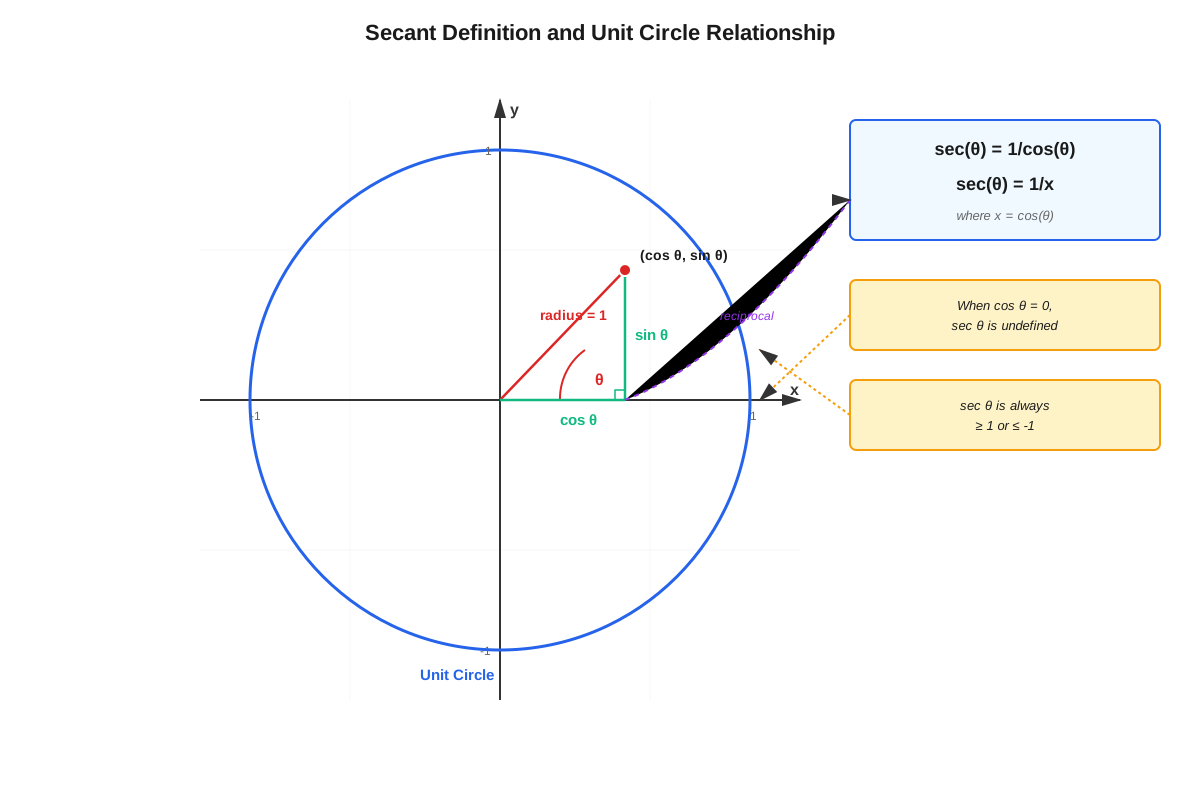
On the unit circle, secant has a geometric interpretation that helps visualize its behavior. For an angle θ in standard position, if the terminal side intersects the unit circle at point (x, y), then cos(θ) = x and sec(θ) = 1/x. This means secant represents the reciprocal of the x-coordinate of the point on the unit circle.
Geometrically, secant can be visualized as the length of the line segment from the origin to a point on the tangent line to the circle at (1, 0), measured along a line that makes angle θ with the positive x-axis. This geometric interpretation, while less commonly tested directly, helps students understand why secant becomes undefined at 90° and 270° and why it has the range it does.
Concept Relationships
The secant function exists within a web of interconnected trigonometric relationships. At the most fundamental level, secant is the reciprocal of cosine, which means any knowledge about cosine directly translates to knowledge about secant through the reciprocal operation. This reciprocal relationship → enables conversion between secant and cosine → which facilitates solving complex trigonometric equations.
Secant also connects to tangent through the Pythagorean identity sec²(θ) = 1 + tan²(θ). This relationship → allows students to convert between secant and tangent → which is particularly useful when simplifying trigonometric expressions or solving equations where both functions appear.
The relationship to right triangle trigonometry provides another crucial connection. Secant as hypotenuse/adjacent → relates to cosine as adjacent/hypotenuse → which connects to tangent as opposite/adjacent and sine as opposite/hypotenuse → forming a complete system of trigonometric ratios that describe all aspects of right triangles.
On the unit circle, secant's connection to the x-coordinate (as its reciprocal) → parallels cosecant's connection to the y-coordinate → both representing reciprocal functions that extend the basic sine and cosine framework → enabling more sophisticated analysis of periodic phenomena.
Finally, secant's behavior as an even function (sec(-θ) = sec(θ)) → connects it to cosine's even function property → distinguishing both from sine and tangent, which are odd functions → a pattern that helps students predict function behavior and simplify expressions involving negative angles.
High-Yield Facts
⭐ Secant is defined as the reciprocal of cosine: sec(θ) = 1/cos(θ)
⭐ Secant is undefined when cosine equals zero: at θ = 90°, 270°, and all odd multiples of π/2
⭐ The range of secant is (-∞, -1] ∪ [1, ∞): secant can never equal values between -1 and 1
⭐ Key Pythagorean identity: sec²(θ) = 1 + tan²(θ)
⭐ Common angle values: sec(0°) = 1, sec(60°) = 2, sec(45°) = √2, sec(30°) = 2√3/3
- Secant is an even function: sec(-θ) = sec(θ)
- In right triangles: sec(θ) = hypotenuse/adjacent
- Secant has the same sign as cosine in all four quadrants
- The reciprocal of secant is cosine: 1/sec(θ) = cos(θ)
- Secant has vertical asymptotes at all values where cosine equals zero
- The period of secant is 2π (or 360°), the same as cosine
- When |cos(θ)| is small, |sec(θ)| is large, and vice versa
Quick check — test yourself on Secant so far.
Try Flashcards →Common Misconceptions
Misconception: Secant is the reciprocal of sine.
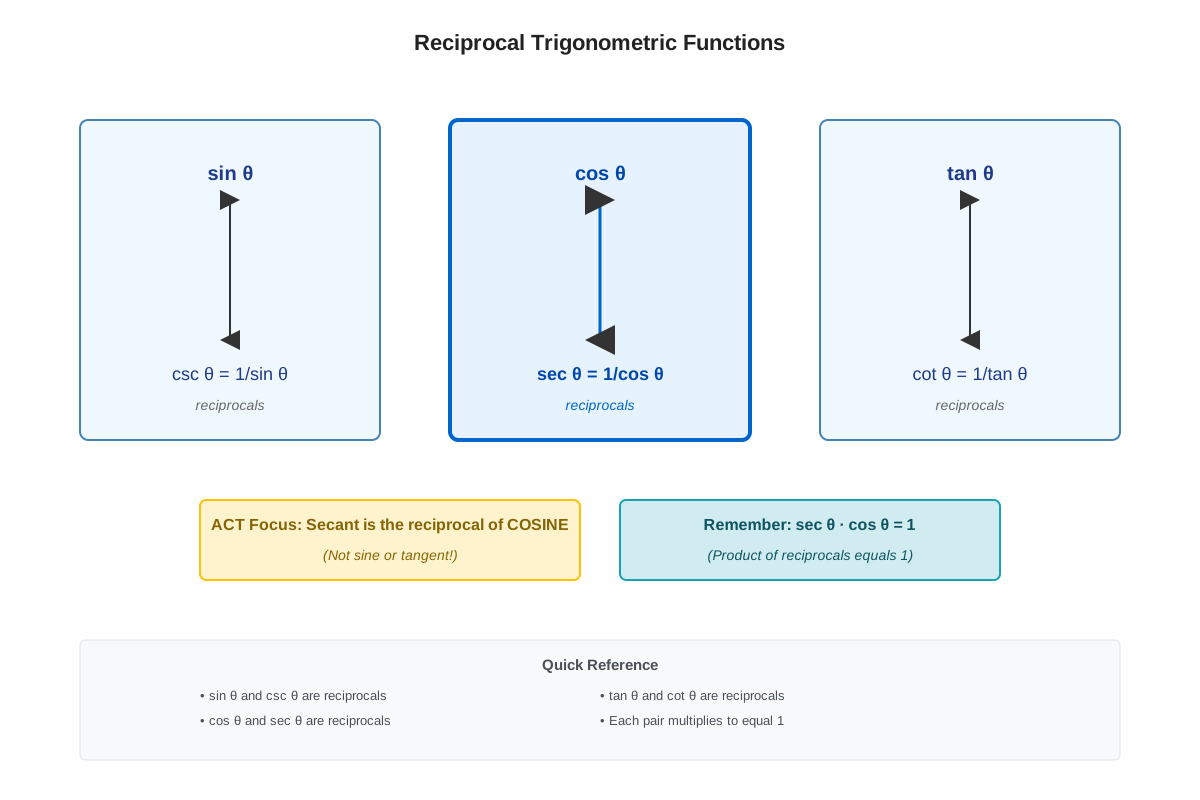
Correction: Secant is the reciprocal of cosine, not sine. The reciprocal of sine is cosecant (csc). This confusion often stems from the similar-sounding names, but remembering that "secant" and "cosine" both relate to the adjacent side in right triangles can help maintain the correct association.
Misconception: Secant can equal any real number.
Correction: Secant can only equal values in the range (-∞, -1] ∪ [1, ∞). It cannot equal any value between -1 and 1 (exclusive). This is because cosine is bounded between -1 and 1, so its reciprocal must have absolute value at least 1.
Misconception: sec(90°) = 0 because cos(90°) = 0.
Correction: sec(90°) is undefined, not zero. When cosine equals zero, secant involves division by zero, which is undefined. This is a critical distinction that frequently appears in ACT questions asking about domain restrictions.
Misconception: In a right triangle, sec(θ) = adjacent/hypotenuse.
Correction: In a right triangle, sec(θ) = hypotenuse/adjacent (not adjacent/hypotenuse). The ratio is inverted compared to cosine. Students often confuse this because they're more familiar with the cosine ratio and forget to flip it.
Misconception: Secant is an odd function like sine and tangent.
Correction: Secant is an even function, meaning sec(-θ) = sec(θ). This property matches cosine's behavior (since secant is cosine's reciprocal) and differs from sine and tangent, which are odd functions. This affects how secant behaves with negative angles.
Misconception: The Pythagorean identity for secant is sec²(θ) + tan²(θ) = 1.
Correction: The correct identity is sec²(θ) = 1 + tan²(θ), which can also be written as sec²(θ) - tan²(θ) = 1. The secant squared term equals the sum of 1 and tangent squared, not part of a sum that equals 1.
Worked Examples
Example 1: Evaluating Secant Using the Unit Circle
Problem: If cos(θ) = -3/5 and θ is in Quadrant II, find sec(θ).
Solution:
Step 1: Recall the definition of secant.
Since sec(θ) = 1/cos(θ), we need to find the reciprocal of the given cosine value.
Step 2: Calculate the reciprocal.
sec(θ) = 1/cos(θ) = 1/(-3/5) = -5/3Step 3: Verify the sign makes sense.
In Quadrant II, cosine is negative, so secant must also be negative (since it's the reciprocal of cosine). Our answer of -5/3 is negative, which confirms our calculation is correct.
Step 4: Check the magnitude.
Since |cos(θ)| = 3/5 < 1, we expect |sec(θ)| > 1. Indeed, |-5/3| = 5/3 ≈ 1.67 > 1, which confirms our answer is reasonable.
Answer: sec(θ) = -5/3
Connection to Learning Objectives: This problem demonstrates the core strategy of using the reciprocal relationship between secant and cosine, and shows how to identify when secant is being tested (when cosine information is provided).
Example 2: Simplifying a Trigonometric Expression
Problem: Simplify the expression: (sec²(x) - 1)/sec²(x)
Solution:
Step 1: Recognize the Pythagorean identity.
We know that sec²(x) = 1 + tan²(x), which means sec²(x) - 1 = tan²(x).
Step 2: Substitute into the expression.
(sec²(x) - 1)/sec²(x) = tan²(x)/sec²(x)Step 3: Convert to sine and cosine.
tan²(x)/sec²(x) = (sin²(x)/cos²(x))/(1/cos²(x))Step 4: Simplify the complex fraction.
= sin²(x)/cos²(x) · cos²(x)/1 = sin²(x)Alternative approach using the identity directly:
(sec²(x) - 1)/sec²(x) = sec²(x)/sec²(x) - 1/sec²(x) = 1 - cos²(x) = sin²(x)Answer: sin²(x)
Connection to Learning Objectives: This problem shows how to apply secant in ACT-style questions by recognizing when the Pythagorean identity involving secant should be used, and demonstrates the strategy of converting between trigonometric functions to simplify expressions.
Example 3: Right Triangle Application
Problem: In a right triangle, the adjacent side to angle A measures 8 units, and the hypotenuse measures 17 units. Find sec(A).
Solution:
Step 1: Identify what secant represents in a right triangle.
sec(A) = hypotenuse/adjacent
Step 2: Substitute the given values.
sec(A) = 17/8Step 3: Verify using the cosine relationship.
First, find cos(A) = adjacent/hypotenuse = 8/17
Then, sec(A) = 1/cos(A) = 1/(8/17) = 17/8 ✓
Answer: sec(A) = 17/8
Connection to Learning Objectives: This problem demonstrates identifying when secant is being tested in a right triangle context and applying the definition directly to solve ACT-style geometry problems.
Exam Strategy
When approaching ACT secant questions, the first critical step is recognition: identify whether the problem explicitly mentions secant or whether it provides cosine information that requires you to find secant. Look for trigger phrases like "find sec(θ)," "the secant of angle," or problems that give you cosine values and ask for reciprocal relationships.
Trigger words and phrases to watch for include:
- "Reciprocal of cosine"
- "sec(θ)" or "secant"
- Problems involving the identity "sec²(θ) - tan²(θ) = 1"
- Right triangle problems asking for hypotenuse/adjacent ratios
- Questions about undefined trigonometric values at 90° or 270°
For process of elimination, remember these key facts:
- Eliminate any answer choice between -1 and 1 (exclusive) when asked for a secant value
- If cosine is positive, secant must be positive; if cosine is negative, secant must be negative
- If an angle is 90° or 270° (or odd multiples of π/2), secant is undefined, not zero
- When simplifying expressions, answers involving only sine and cosine are often simpler than those with secant
Time allocation strategy: Most secant questions on the ACT can be solved in 30-60 seconds if you immediately recognize the reciprocal relationship. If a problem seems to require more than 90 seconds, check whether you're overcomplicating it—often there's a direct reciprocal relationship or identity that provides a shortcut. Don't waste time deriving secant values from scratch; instead, convert to cosine, use known values, then convert back.
Strategic approach sequence:
- Identify what the question is asking (secant value, simplification, or application)
- Determine what information is given (cosine value, angle measure, or triangle sides)
- Apply the reciprocal relationship or appropriate identity
- Check that your answer makes sense (correct sign, appropriate magnitude)
- Verify using an alternative method if time permits
Memory Techniques
Mnemonic for reciprocal pairs: "Silly Cows Can Sing" helps remember that Secant goes with Cosine, and Cosecant goes with Sine. The first letter of each word in the pair matches.
Visualization for secant definition: Picture a security guard standing at the hypotenuse of a right triangle, looking down at the adjacent side. The guard's height-to-distance ratio is secant: hypotenuse/adjacent.
Acronym for when secant is undefined: "NO" at Ninety and Odd multiples (of 90°). This reminds you that secant is undefined at 90°, 270°, 450°, etc.
Memory aid for the Pythagorean identity: Think "second place gets 1 plus tan" → sec² = 1 + tan². The "second place" reference helps you remember that sec² is on one side by itself.
Range visualization: Hold your hands at arm's length (representing -1 and 1). Secant values are everything beyond your hands—either less than -1 or greater than 1. Nothing in between your hands is a valid secant value.
Sign memory technique: Secant and cosine are "sign buddies"—they always have the same sign in every quadrant because secant is just cosine flipped upside down (reciprocal).
Summary
Secant is a fundamental trigonometric function defined as the reciprocal of cosine: sec(θ) = 1/cos(θ). On the ACT Math test, secant appears regularly in questions testing trigonometric relationships, identities, and right triangle applications. The most critical facts to remember are that secant equals hypotenuse/adjacent in right triangles, is undefined when cosine equals zero (at odd multiples of 90°), and has a range of (-∞, -1] ∪ [1, ∞). The key Pythagorean identity sec²(θ) = 1 + tan²(θ) frequently appears in simplification problems. Success with secant questions requires recognizing when secant is being tested (even when not explicitly mentioned), understanding the reciprocal relationship with cosine, and knowing common angle values. Students should be comfortable converting between secant and other trigonometric functions, evaluating secant using the unit circle, and applying secant in both abstract algebraic contexts and concrete geometric problems. Mastering secant is essential for achieving high scores on the ACT Math section, as these questions often appear in the higher-difficulty range and separate students with deep trigonometry understanding from those with only surface-level knowledge.
Key Takeaways
- Secant is the reciprocal of cosine: sec(θ) = 1/cos(θ), making it undefined wherever cosine equals zero
- Range restriction: Secant can only equal values with absolute value ≥ 1; it never equals values between -1 and 1
- Right triangle definition: sec(θ) = hypotenuse/adjacent, the inverse of the cosine ratio
- Essential Pythagorean identity: sec²(θ) = 1 + tan²(θ) is crucial for simplifying expressions
- Common angle values: Memorize sec(0°) = 1, sec(60°) = 2, sec(45°) = √2, and sec(30°) = 2√3/3
- Sign matching: Secant always has the same sign as cosine in all four quadrants
- Recognition is key: ACT questions may test secant indirectly by providing cosine values or using identities
Related Topics
Cosecant (csc): The reciprocal of sine, cosecant parallels secant's relationship with cosine. Mastering secant provides a framework for understanding cosecant, as both are reciprocal trigonometric functions with similar properties and behaviors.
Cotangent (cot): The reciprocal of tangent completes the set of reciprocal trigonometric functions. Understanding how secant relates to tangent through the Pythagorean identity prepares students for working with cotangent.
Trigonometric Identities: Advanced identities involving secant, including sum and difference formulas, double-angle formulas, and half-angle formulas, build directly on the foundational secant concepts covered here.
Inverse Trigonometric Functions: Understanding secant prepares students for arcsecant and other inverse functions, which appear in more advanced mathematics and occasionally on challenging ACT questions.
Graphing Trigonometric Functions: The graph of y = sec(x) with its vertical asymptotes and periodic behavior extends the concepts learned here into visual and analytical representations.
Practice CTA
Now that you've mastered the fundamentals of secant, it's time to solidify your understanding through practice! Work through the practice questions to test your ability to recognize secant problems, apply the reciprocal relationship, and use trigonometric identities effectively. Use the flashcards to drill the common angle values and key identities until they become automatic. Remember, secant questions on the ACT are often designed to reward students who truly understand trigonometric relationships rather than those who simply memorize formulas. Your investment in mastering this topic will pay dividends not only on test day but also in future mathematics courses. You've got this—practice with purpose and confidence!
Sign up free to keep reading
Create a free AnvayaPrep account to finish this ACT guide on Secant — plus flashcards and practice questions.