Overview
The cosine function is one of the three fundamental trigonometric ratios tested extensively on the ACT Math section. Understanding cosine is essential for solving problems involving right triangles, the unit circle, trigonometric identities, and periodic functions. On the ACT, cosine appears in approximately 3-5 questions per test, making it a high-yield topic that directly impacts your score. Mastery of cosine enables students to tackle geometry problems, coordinate plane questions, and function analysis with confidence.
The cosine function represents the ratio of the adjacent side to the hypotenuse in a right triangle, but its applications extend far beyond basic triangle geometry. On the ACT, ACT cosine questions test your ability to evaluate cosine values for specific angles, apply the cosine function in coordinate geometry, use cosine in the law of cosines for non-right triangles, and interpret cosine graphs. These questions often integrate multiple mathematical concepts, requiring students to recognize when cosine is the appropriate tool and how to apply it efficiently under time pressure.
Cosine connects deeply to other trigonometric functions (sine and tangent), the Pythagorean theorem, circle geometry, and function transformations. Understanding these relationships allows students to approach complex problems systematically and verify answers using multiple methods. The reciprocal relationship between cosine and secant, the complementary relationship between cosine and sine, and the fundamental trigonometric identities all build upon the core concept of cosine, making it a cornerstone of ACT trigonometry.
Learning Objectives
- [ ] Identify when Cosine is being tested in ACT questions
- [ ] Explain the core rule or strategy behind Cosine
- [ ] Apply Cosine to ACT-style questions accurately
- [ ] Calculate cosine values for common angles (0°, 30°, 45°, 60°, 90°) without a calculator
- [ ] Use the unit circle to determine cosine values for angles in all four quadrants
- [ ] Apply the Law of Cosines to solve non-right triangle problems
- [ ] Interpret and analyze cosine function graphs including amplitude, period, and phase shifts
Prerequisites
- Right triangle geometry: Understanding the parts of a right triangle (hypotenuse, legs, opposite, adjacent) is fundamental to defining cosine as a ratio
- Pythagorean theorem: Essential for calculating missing side lengths when applying cosine and for deriving the Pythagorean identity
- Angle measurement: Familiarity with both degree and radian measures enables interpretation of cosine values across different problem formats
- Basic algebra: Solving equations and manipulating expressions is necessary for isolating variables in cosine equations
- Coordinate plane: Understanding x and y coordinates is crucial for unit circle applications of cosine
Why This Topic Matters
Cosine has practical applications in physics (calculating force components), engineering (analyzing structural loads), navigation (determining distances and bearings), and computer graphics (modeling rotations and oscillations). Understanding cosine develops spatial reasoning and analytical thinking skills that extend beyond mathematics into scientific and technical fields.
On the ACT Math section, cosine appears in 5-8% of questions, typically 3-5 questions per 60-question test. These questions fall into several categories: right triangle problems requiring direct application of the cosine ratio, unit circle questions asking for cosine values at specific angles, Law of Cosines problems involving non-right triangles, coordinate geometry questions using cosine to find distances or angles, and function analysis problems involving cosine graphs. The difficulty ranges from straightforward ratio calculations to multi-step problems integrating several concepts.
Common ACT question formats include: "What is cos(60°)?", "In right triangle ABC with angle A measuring 30° and hypotenuse of length 10, what is the length of the side adjacent to angle A?", "Using the Law of Cosines, find the length of side c in triangle ABC where a = 5, b = 7, and angle C = 60°", and "What is the amplitude of the function f(x) = 3cos(2x)?" Recognizing these patterns helps students quickly identify the appropriate strategy and execute efficiently.
Core Concepts
Definition of Cosine in Right Triangles
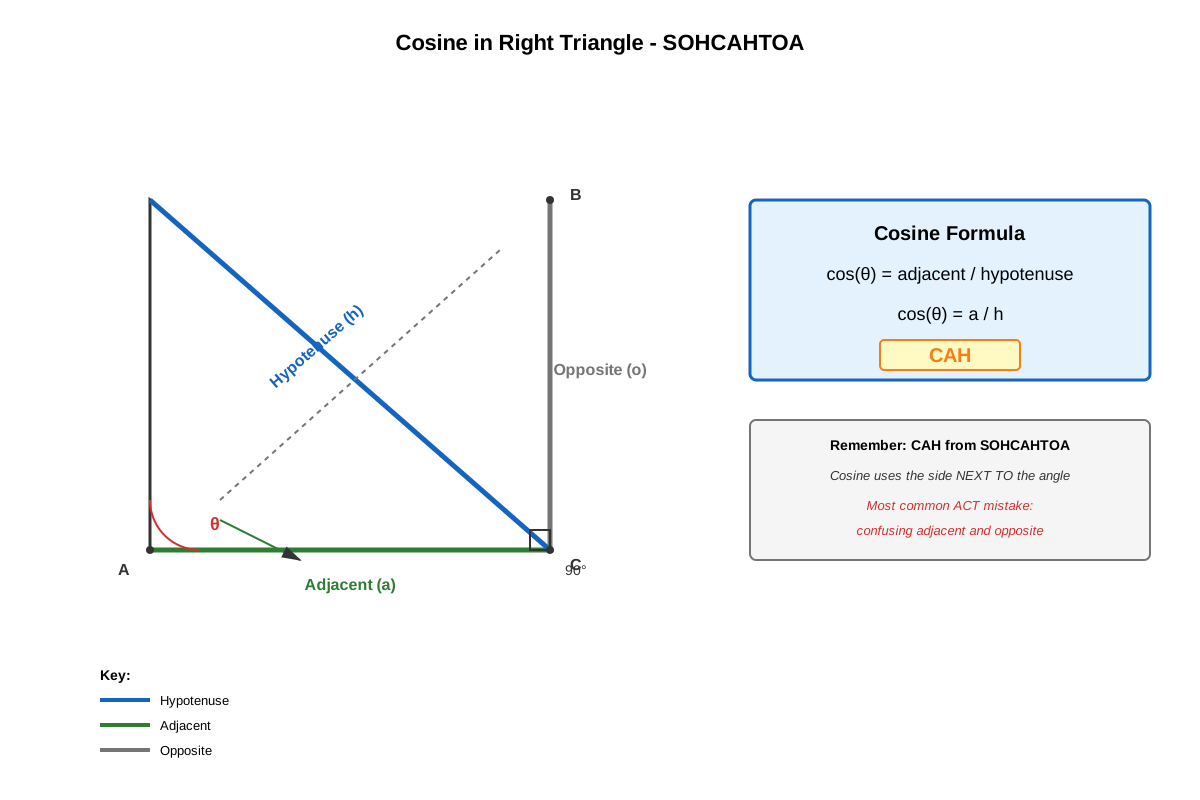
The cosine of an acute angle in a right triangle is defined as the ratio of the length of the adjacent side to the length of the hypotenuse. This can be expressed as:
cos(θ) = adjacent/hypotenuseThe adjacent side is the leg of the right triangle that forms one side of the angle in question (not the hypotenuse), while the hypotenuse is always the longest side opposite the right angle. This definition is the foundation for all cosine applications and is frequently tested directly on the ACT.
For example, in a right triangle where the angle measures 60°, the adjacent side measures 5 units, and the hypotenuse measures 10 units, the cosine of 60° equals 5/10 = 0.5. This ratio remains constant for all right triangles with a 60° angle, regardless of size, which is why cosine values are consistent for specific angles.
Special Angle Values
The ACT frequently tests cosine values for special angles that students should memorize. These angles appear repeatedly across different question types:
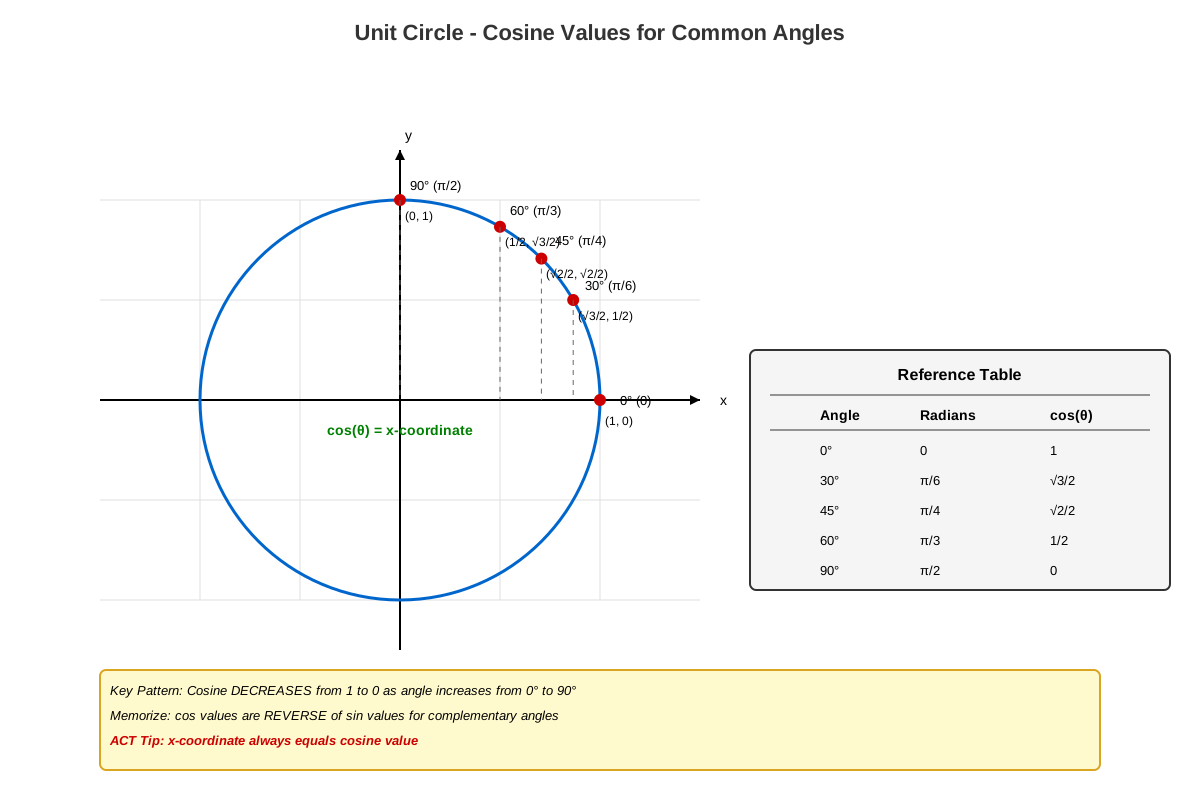
| Angle (Degrees) | Angle (Radians) | Cosine Value | Exact Form |
|---|---|---|---|
| 0° | 0 | 1 | 1 |
| 30° | π/6 | 0.866... | √3/2 |
| 45° | π/4 | 0.707... | √2/2 |
| 60° | π/3 | 0.5 | 1/2 |
| 90° | π/2 | 0 | 0 |
These values derive from the properties of special right triangles: the 30-60-90 triangle (with sides in ratio 1:√3:2) and the 45-45-90 triangle (with sides in ratio 1:1:√2). Understanding these triangles allows students to reconstruct cosine values even if momentarily forgotten.
The Unit Circle and Cosine
On the unit circle (a circle with radius 1 centered at the origin), the cosine of an angle represents the x-coordinate of the point where the terminal side of the angle intersects the circle. This definition extends cosine beyond acute angles to all real numbers, enabling evaluation of cosine for angles greater than 90° and negative angles.
The unit circle reveals important patterns:
- Cosine values range from -1 to 1
- Cosine is positive in Quadrants I and IV (where x-coordinates are positive)
- Cosine is negative in Quadrants II and III (where x-coordinates are negative)
- Cosine has a period of 360° (2π radians), meaning cos(θ) = cos(θ + 360°)
For example, cos(120°) can be found by recognizing that 120° is in Quadrant II, where cosine is negative. The reference angle is 180° - 120° = 60°, so cos(120°) = -cos(60°) = -1/2.
Law of Cosines
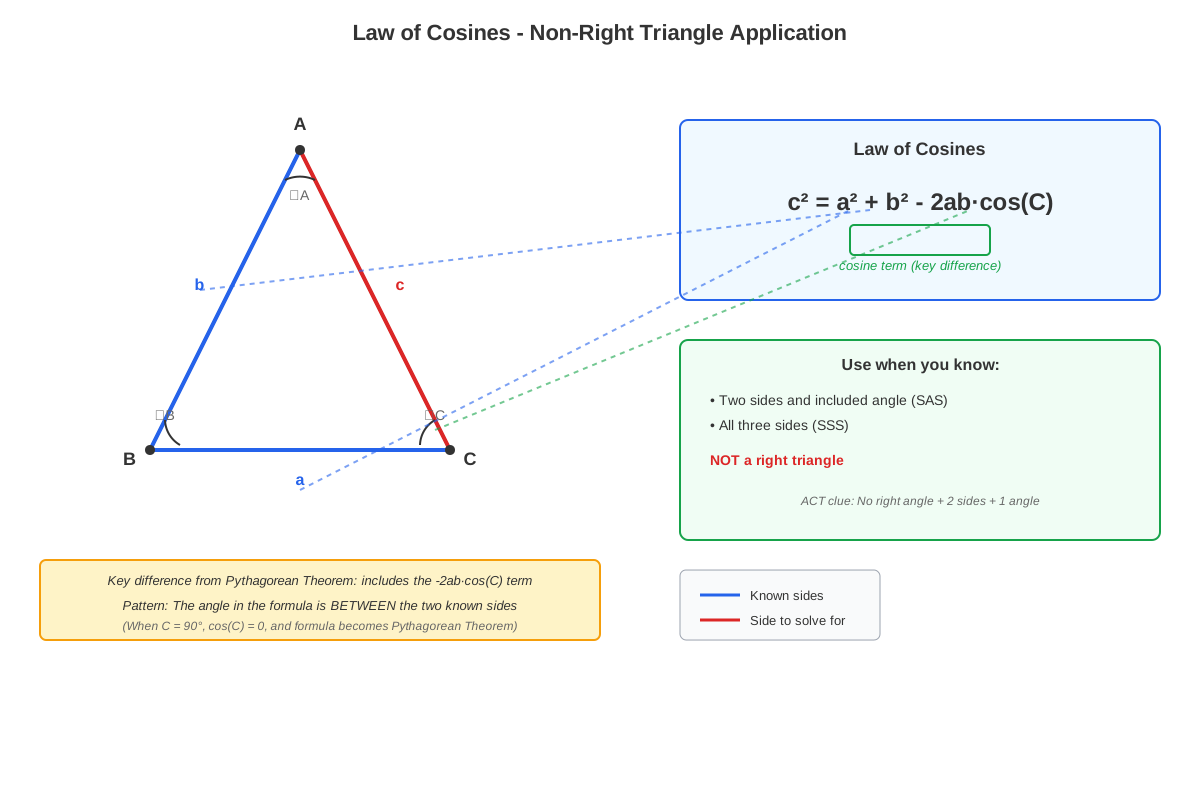
The Law of Cosines extends the Pythagorean theorem to non-right triangles, allowing calculation of unknown sides or angles when given sufficient information. The law states:
c² = a² + b² - 2ab·cos(C)where a, b, and c are the sides of the triangle, and C is the angle opposite side c. This formula can be rearranged to solve for any side or angle:
cos(C) = (a² + b² - c²)/(2ab)The Law of Cosines is particularly useful when given:
- Two sides and the included angle (SAS)
- Three sides (SSS)
ACT questions often provide these configurations and ask students to find a missing measurement. Recognizing when to apply the Law of Cosines versus basic trigonometric ratios is a key skill.
Cosine Function and Graphs
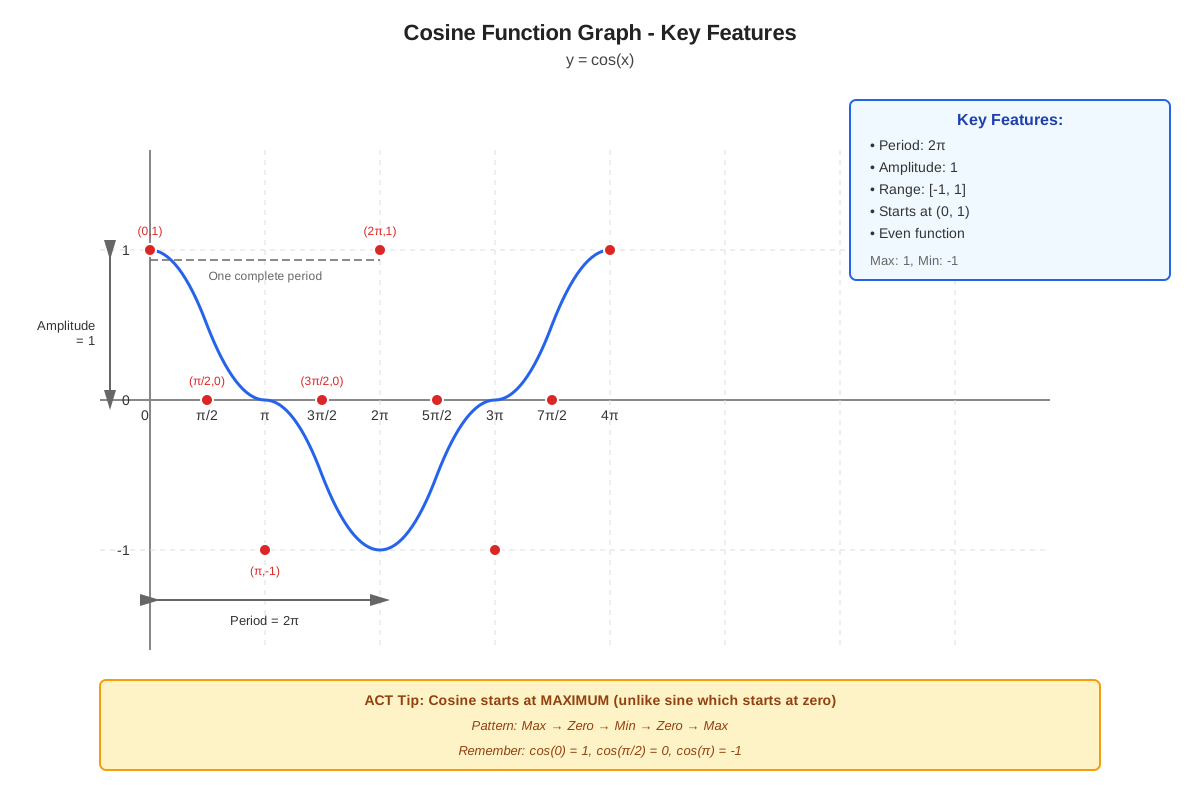
The cosine function f(x) = cos(x) produces a periodic wave that oscillates between -1 and 1. Key characteristics include:
- Amplitude: The maximum distance from the midline (1 for basic cosine)
- Period: The horizontal length of one complete cycle (360° or 2π for basic cosine)
- Phase shift: Horizontal translation left or right
- Vertical shift: Movement of the midline up or down
The general form is:
f(x) = A·cos(B(x - C)) + Dwhere:
- A = amplitude
- B affects period (period = 360°/B or 2π/B)
- C = phase shift (positive shifts right)
- D = vertical shift
ACT questions may ask students to identify these parameters from a graph or equation, or to determine specific function values.
Pythagorean Identity
The fundamental Pythagorean identity connects cosine and sine:
sin²(θ) + cos²(θ) = 1This identity can be rearranged to solve for cosine when sine is known:
cos²(θ) = 1 - sin²(θ)
cos(θ) = ±√(1 - sin²(θ))
The sign depends on which quadrant the angle terminates in. This identity is essential for solving equations involving multiple trigonometric functions and appears frequently in ACT problems requiring algebraic manipulation.
Concept Relationships
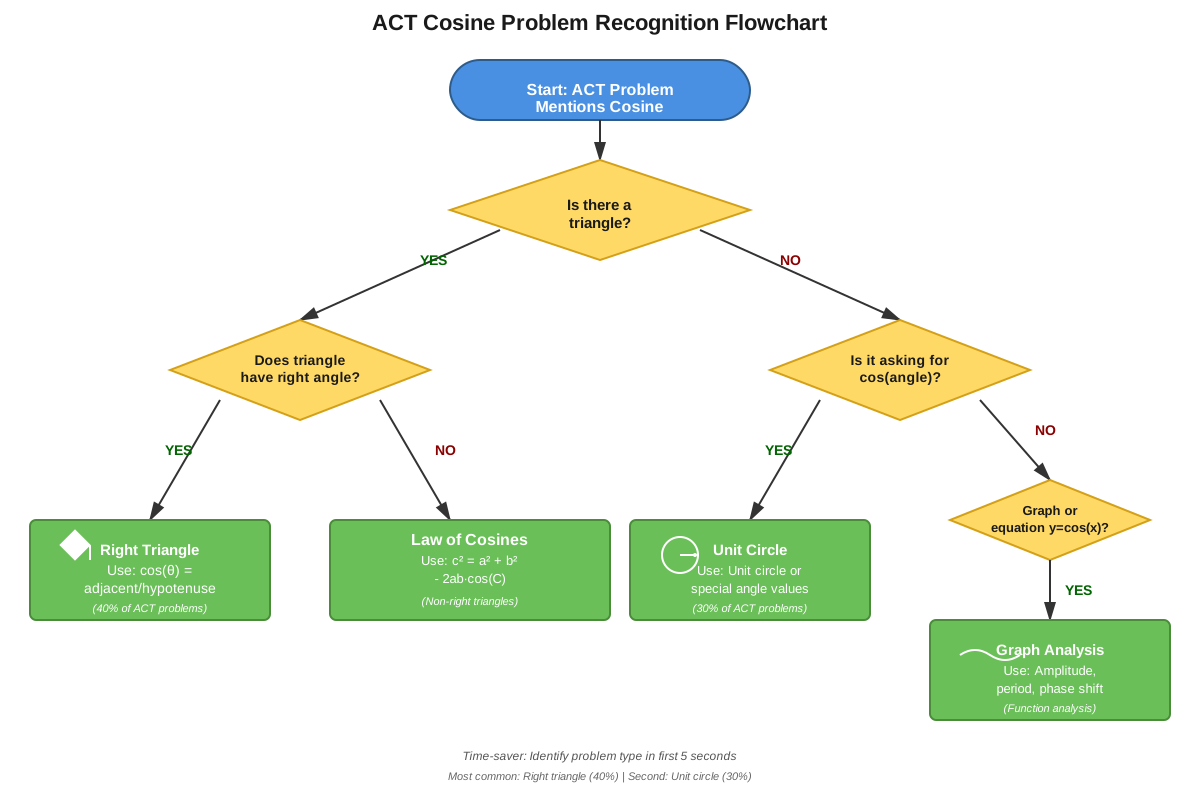
The cosine function connects to multiple mathematical concepts in a hierarchical structure. At the foundation, right triangle geometry provides the basic definition of cosine as a ratio. This definition leads directly to special angle values, which students memorize for efficient problem-solving. The special angles connect to special right triangles (30-60-90 and 45-45-90), which themselves derive from the Pythagorean theorem.
The unit circle extends the right triangle definition of cosine to all angles, creating a bridge between geometry and function analysis. This extension enables understanding of cosine graphs and periodic behavior. The unit circle also reveals the relationship between cosine and the x-coordinate, connecting trigonometry to coordinate geometry.
The Law of Cosines generalizes the Pythagorean theorem (when the angle is 90°, the Law of Cosines reduces to a² + b² = c²), providing a tool for non-right triangles. This law connects to triangle solving strategies and geometric problem-solving.
The Pythagorean identity links cosine to sine, creating a system where knowing one trigonometric value often allows calculation of others. This identity connects to algebraic manipulation and equation solving.
Finally, all these concepts feed into ACT problem-solving strategies, where recognizing which tool to apply (basic ratio, unit circle, Law of Cosines, or identity) determines success. The relationship map flows: Basic Definition → Special Values → Unit Circle → Function Analysis, with the Law of Cosines and Pythagorean Identity as parallel extensions that integrate with the main pathway.
High-Yield Facts
⭐ Cosine is defined as adjacent/hypotenuse in a right triangle
⭐ cos(0°) = 1, cos(30°) = √3/2, cos(45°) = √2/2, cos(60°) = 1/2, cos(90°) = 0
⭐ On the unit circle, cosine represents the x-coordinate
⭐ Cosine is positive in Quadrants I and IV, negative in Quadrants II and III
⭐ The Law of Cosines is c² = a² + b² - 2ab·cos(C)
- Cosine has a period of 360° (2π radians), meaning the pattern repeats every full rotation
- The range of cosine is [-1, 1], meaning cosine values never exceed these bounds
- Cosine is an even function: cos(-θ) = cos(θ)
- The Pythagorean identity states sin²(θ) + cos²(θ) = 1
- For complementary angles, cos(θ) = sin(90° - θ)
- The amplitude of f(x) = A·cos(Bx) is |A|
- The period of f(x) = cos(Bx) is 360°/B (or 2π/B in radians)
- Cosine reaches its maximum value of 1 at 0°, 360°, 720°, etc.
- Cosine equals zero at 90°, 270°, 450°, etc. (odd multiples of 90°)
- The reciprocal of cosine is secant: sec(θ) = 1/cos(θ)
Quick check — test yourself on Cosine so far.
Try Flashcards →Common Misconceptions
Misconception: Cosine is always opposite/hypotenuse → Correction: Cosine is adjacent/hypotenuse; sine is opposite/hypotenuse. Students often confuse these definitions, leading to incorrect ratio setup. Remember "CAH" from SOH-CAH-TOA: Cosine = Adjacent/Hypotenuse.
Misconception: cos(A + B) = cos(A) + cos(B) → Correction: Cosine is not distributive over addition. The correct sum formula is cos(A + B) = cos(A)cos(B) - sin(A)sin(B), but this is rarely needed on the ACT. Simply evaluate each angle separately rather than trying to combine them.
Misconception: Cosine values can exceed 1 or be less than -1 → Correction: The range of cosine is strictly [-1, 1]. If a calculation yields cos(θ) = 1.5 or cos(θ) = -2, an error has occurred. This range restriction comes from the unit circle definition where cosine represents an x-coordinate on a circle of radius 1.
Misconception: The adjacent side is always the horizontal side → Correction: The adjacent side depends on which angle is being considered. In a right triangle, each acute angle has its own adjacent side. The adjacent side is the leg that forms one side of the angle in question, not the opposite leg.
Misconception: Cosine only works for acute angles → Correction: While the basic right triangle definition applies to acute angles (0° to 90°), the unit circle extends cosine to all real numbers. Cosine can be evaluated for obtuse angles, negative angles, and angles greater than 360° using reference angles and quadrant analysis.
Misconception: The Law of Cosines can be used for any triangle configuration → Correction: While the Law of Cosines works for all triangles, it's most efficient when you have SAS (two sides and the included angle) or SSS (three sides). For other configurations like ASA or AAS, the Law of Sines is typically more direct.
Misconception: cos(2θ) = 2cos(θ) → Correction: Cosine does not distribute over multiplication. The double angle formula is cos(2θ) = cos²(θ) - sin²(θ), but memorizing this is unnecessary for the ACT. Instead, evaluate cos(2θ) directly using the given angle value.
Worked Examples
Example 1: Right Triangle Application
Problem: In right triangle ABC, angle A measures 30°, and the hypotenuse measures 20 units. What is the length of the side adjacent to angle A?
Solution:
Step 1: Identify what is being asked. We need the length of the adjacent side to angle A.
Step 2: Recognize that we have an angle and the hypotenuse, and we need the adjacent side. This is a direct application of cosine.
Step 3: Set up the cosine ratio:
cos(30°) = adjacent/hypotenuseStep 4: Substitute known values:
cos(30°) = adjacent/20Step 5: Recall that cos(30°) = √3/2 ≈ 0.866:
√3/2 = adjacent/20Step 6: Solve for the adjacent side:
adjacent = 20 × (√3/2) = 10√3 ≈ 17.32Answer: The length of the side adjacent to angle A is 10√3 or approximately 17.32 units.
Connection to Learning Objectives: This example demonstrates identifying when cosine is being tested (right triangle with known angle and hypotenuse), explaining the core strategy (using the adjacent/hypotenuse ratio), and applying it accurately to find the solution.
Example 2: Law of Cosines Application
Problem: Triangle DEF has sides d = 8, e = 10, and angle F = 60°. Find the length of side f.
Solution:
Step 1: Recognize that we have two sides and the included angle (SAS), which signals the Law of Cosines.
Step 2: Recall the Law of Cosines formula. Since we're finding side f and we know angle F:
f² = d² + e² - 2de·cos(F)Step 3: Substitute the known values:
f² = 8² + 10² - 2(8)(10)·cos(60°)Step 4: Evaluate cos(60°) = 1/2:
f² = 64 + 100 - 2(8)(10)(1/2)
f² = 64 + 100 - 80
f² = 84
Step 5: Take the square root:
f = √84 = 2√21 ≈ 9.17Answer: The length of side f is 2√21 or approximately 9.17 units.
Connection to Learning Objectives: This example shows identifying when the Law of Cosines is appropriate (non-right triangle with SAS configuration), applying the formula correctly, and using the memorized value of cos(60°) to reach an accurate solution.
Example 3: Unit Circle and Quadrant Analysis
Problem: What is the value of cos(150°)?
Solution:
Step 1: Determine which quadrant contains 150°. Since 90° < 150° < 180°, the angle is in Quadrant II.
Step 2: Recall that cosine is negative in Quadrant II (x-coordinates are negative).
Step 3: Find the reference angle: 180° - 150° = 30°.
Step 4: The cosine value has the same magnitude as the reference angle but opposite sign:
cos(150°) = -cos(30°) = -√3/2 ≈ -0.866Answer: cos(150°) = -√3/2 or approximately -0.866.
Connection to Learning Objectives: This demonstrates using the unit circle to determine cosine values beyond acute angles, applying quadrant analysis to determine sign, and using reference angles to find exact values.
Exam Strategy
When approaching ACT cosine questions, first identify the problem type by scanning for key information. If you see a right triangle with an angle and one side given, immediately consider whether cosine (adjacent/hypotenuse) is the appropriate ratio. If the problem involves a non-right triangle with two sides and an included angle, or three sides, recognize this as a Law of Cosines situation.
Trigger words and phrases to watch for include: "adjacent side," "right triangle," "angle measures," "find the length," "Law of Cosines," "unit circle," "cos(θ) =," and "periodic function." Questions asking for "the x-coordinate" in a unit circle context are testing cosine knowledge. Graph problems mentioning "amplitude" or "period" often involve cosine functions.
For process of elimination, remember these constraints:
- Cosine values must be between -1 and 1; eliminate any answer choices outside this range
- For acute angles in right triangles, cosine must be positive; eliminate negative values
- Larger acute angles have smaller cosine values (cos(60°) < cos(30°)); use this to eliminate unreasonable answers
- If the problem gives you enough information to use the Pythagorean theorem, verify your answer using that method
Time allocation: Simple cosine ratio problems should take 30-45 seconds. Law of Cosines problems typically require 60-90 seconds due to more complex calculations. Unit circle problems asking for memorized values should take 15-30 seconds, while those requiring reference angle analysis may take 45-60 seconds. If a problem is taking longer than 90 seconds, mark it and return later.
Strategic approach sequence:
- Identify the problem type (right triangle, Law of Cosines, unit circle, or function)
- Determine what information is given and what is being asked
- Select the appropriate formula or strategy
- Execute the calculation carefully
- Check if the answer is reasonable (right magnitude, correct sign)
- Verify using an alternative method if time permits
Exam Tip: If you forget a special angle value during the test, quickly sketch the appropriate special right triangle (30-60-90 or 45-45-90) and derive the ratio. This takes only 10-15 seconds and ensures accuracy.
Memory Techniques
SOH-CAH-TOA is the classic mnemonic for trigonometric ratios:
- Sine = Opposite/Hypotenuse
- Cosine = Adjacent/Hypotenuse
- Tangent = Opposite/Adjacent
Focus on the "CAH" portion for cosine: Cosine Adjacent Hypotenuse.
Special angle values can be memorized using the "counting pattern":
- For 0°, 30°, 45°, 60°, 90°
- Cosine values follow: √4/2, √3/2, √2/2, √1/2, √0/2
- Simplified: 1, √3/2, √2/2, 1/2, 0
Notice this is the reverse of the sine pattern, which helps if you know sine values.
Quadrant signs can be remembered with "All Students Take Calculus":
- Quadrant I: All functions positive
- Quadrant II: Sine (and cosecant) positive, cosine negative
- Quadrant III: Tangent (and cotangent) positive, cosine negative
- Quadrant IV: Cosine (and secant) positive
Visualization strategy: Picture the unit circle as a clock face. Cosine represents how far left or right you are from the center. At 3 o'clock (0°), you're all the way right (cos = 1). At 12 o'clock (90°), you're at the center horizontally (cos = 0). At 9 o'clock (180°), you're all the way left (cos = -1).
Law of Cosines memory aid: Think "c-squared equals the other two squared, minus two times those sides times cosine of the angle between them." The formula mirrors the Pythagorean theorem but subtracts a correction term.
Summary
Cosine is a fundamental trigonometric function defined as the ratio of the adjacent side to the hypotenuse in a right triangle, and as the x-coordinate on the unit circle. Mastery of cosine requires memorizing special angle values (particularly cos(30°) = √3/2, cos(45°) = √2/2, and cos(60°) = 1/2), understanding how to apply the basic ratio in right triangles, using the unit circle to evaluate cosine for any angle, and applying the Law of Cosines for non-right triangles. On the ACT, cosine appears in multiple contexts: direct ratio calculations, triangle solving, coordinate geometry, and function analysis. Success requires recognizing which approach is appropriate based on the given information, executing calculations accurately, and verifying that answers fall within the valid range of [-1, 1]. The connections between cosine and other trigonometric functions, particularly through the Pythagorean identity, enable sophisticated problem-solving strategies that integrate multiple concepts.
Key Takeaways
- Cosine equals adjacent/hypotenuse in right triangles and represents the x-coordinate on the unit circle
- Memorize special angle values: cos(0°) = 1, cos(30°) = √3/2, cos(45°) = √2/2, cos(60°) = 1/2, cos(90°) = 0
- Cosine is positive in Quadrants I and IV, negative in Quadrants II and III
- The Law of Cosines (c² = a² + b² - 2ab·cos(C)) extends the Pythagorean theorem to non-right triangles
- All cosine values must fall between -1 and 1; use this to eliminate impossible answer choices
- Use reference angles and quadrant analysis to find cosine values for angles beyond 90°
- The Pythagorean identity sin²(θ) + cos²(θ) = 1 connects cosine to sine and enables solving complex problems
Related Topics
Sine and Tangent: The other primary trigonometric ratios that work alongside cosine to solve triangle problems. Mastering cosine provides the foundation for understanding these related functions and how they interact through identities.
Law of Sines: An alternative method for solving non-right triangles, particularly useful when given angle-side-angle (ASA) or angle-angle-side (AAS) configurations. Understanding when to use Law of Cosines versus Law of Sines is essential for efficient problem-solving.
Trigonometric Identities: Advanced relationships between trigonometric functions including double angle formulas, sum and difference formulas, and reciprocal identities. The Pythagorean identity involving cosine is the gateway to these more complex relationships.
Polar Coordinates: A coordinate system using radius and angle rather than x and y, where cosine plays a crucial role in converting between polar and rectangular coordinates.
Vectors: Mathematical objects with magnitude and direction, where cosine is used to find components and calculate dot products. Understanding cosine in triangles prepares students for vector analysis.
Practice CTA
Now that you've mastered the core concepts of cosine, it's time to solidify your understanding through practice. Attempt the practice questions to test your ability to identify when cosine is being tested, apply the appropriate strategy, and execute accurately under test-like conditions. Use the flashcards to reinforce special angle values and key formulas until they become automatic. Remember, consistent practice with immediate feedback is the most effective way to build the speed and confidence needed for ACT success. Each problem you solve strengthens your pattern recognition and deepens your understanding—you're building the skills that will earn you points on test day!
Sign up free to keep reading
Create a free AnvayaPrep account to finish this ACT guide on Cosine — plus flashcards and practice questions.