Overview
The sine function is one of the three fundamental trigonometric ratios that appears consistently on the ACT Math test. Understanding sine is essential for solving problems involving right triangles, the unit circle, and periodic functions. On the ACT, sine questions typically appear in 2-4 questions per test, making it a high-yield topic that can significantly impact your score. The sine function relates an angle in a right triangle to the ratio of the opposite side to the hypotenuse, and this simple relationship unlocks solutions to complex geometric and trigonometric problems.
Mastering sine requires understanding both its geometric interpretation in right triangles and its analytical representation on the coordinate plane and unit circle. The ACT sine questions range from straightforward right triangle problems to more sophisticated applications involving the unit circle, special angle values, and sine function properties. Students who can quickly recognize when sine is the appropriate tool and apply it accurately will gain a significant advantage on test day.
The sine function connects deeply to other mathematical concepts tested on the ACT, including the Pythagorean theorem, similar triangles, coordinate geometry, and function transformations. It serves as a foundation for understanding all trigonometric functions and their applications. Beyond the ACT, sine appears in physics, engineering, music theory, and any field involving periodic phenomena or wave behavior, making it one of the most practically useful mathematical concepts students will encounter.
Learning Objectives
- [ ] Identify when Sine is being tested in ACT questions
- [ ] Explain the core rule or strategy behind Sine
- [ ] Apply Sine to ACT-style questions accurately
- [ ] Calculate sine values for special angles (30°, 45°, 60°) without a calculator
- [ ] Use the unit circle to determine sine values for angles in all four quadrants
- [ ] Recognize and apply the relationship between sine and complementary angles
- [ ] Solve real-world problems involving sine in context
Prerequisites
- Right triangle properties: Understanding the relationship between sides and angles in right triangles is fundamental to defining sine
- Angle measurement: Familiarity with both degree and radian measures enables working with sine in various contexts
- Basic algebra: Solving equations and manipulating expressions is necessary for applying sine in problem-solving
- Pythagorean theorem: This theorem connects the three sides of a right triangle and helps find missing sides when using sine
- Coordinate plane: Understanding x and y coordinates is essential for working with sine on the unit circle
Why This Topic Matters
Sine appears in numerous real-world applications that make it far more than an abstract mathematical concept. Engineers use sine to analyze forces, architects apply it to calculate structural angles, and physicists rely on it to describe wave motion, sound, and light. Navigation systems, from ancient maritime tools to modern GPS, depend on trigonometric functions including sine. Understanding sine provides the foundation for modeling any periodic or cyclical phenomenon, from tides and seasons to electrical currents and sound waves.
On the ACT Math test, sine-related questions appear with remarkable consistency. Approximately 2-4 questions per test directly involve sine, and several additional questions may require trigonometric knowledge as part of a multi-step solution. These questions typically fall into several categories: right triangle problems where students must identify and apply the sine ratio, unit circle questions requiring knowledge of special angle values, word problems involving angles of elevation or depression, and occasionally, questions about the sine function's graph or properties. The ACT tests sine at a medium difficulty level, meaning questions go beyond simple memorization but rarely require advanced calculus-level understanding.
Common question formats include: providing a right triangle diagram and asking for the sine of a marked angle, giving a sine value and asking students to find an angle or side length, presenting real-world scenarios involving heights and distances that require sine to solve, and asking about sine values for specific angles on the unit circle. The ACT may also test understanding of sine through coordinate geometry problems where students must recognize that the y-coordinate on the unit circle represents the sine value. Recognizing these patterns helps students quickly identify when sine is the key to unlocking a solution.
Core Concepts
Definition of Sine in Right Triangles
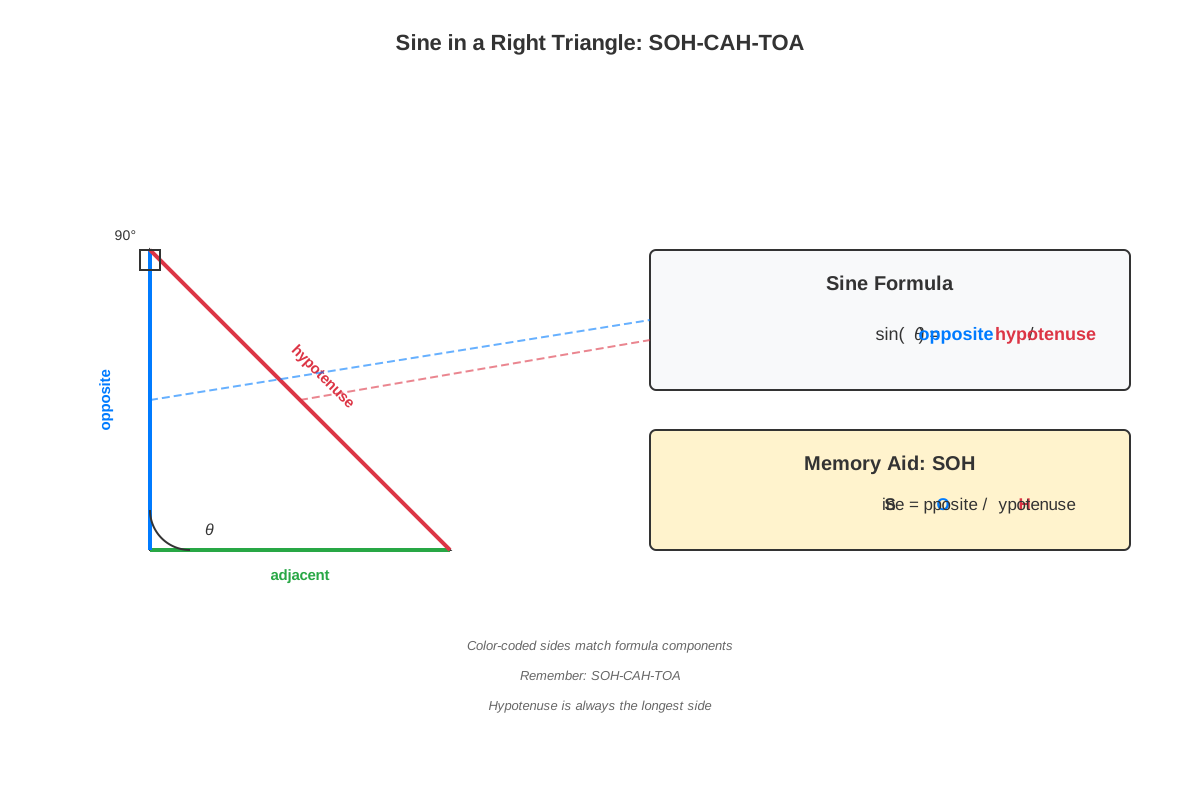
The sine of an angle in a right triangle is defined as the ratio of the length of the side opposite the angle to the length of the hypotenuse. This can be expressed as:
sin(θ) = opposite/hypotenuseThis definition is the foundation of all sine applications. In any right triangle, regardless of size, the sine of a given angle remains constant—this is why sine is so powerful for solving problems. The mnemonic SOH-CAH-TOA helps remember this relationship, where SOH stands for "Sine = Opposite over Hypotenuse."
When working with right triangles, always identify the angle in question first, then locate the side opposite to that angle and the hypotenuse (the longest side, opposite the right angle). The sine ratio will always be a value between 0 and 1 for acute angles in right triangles, since the opposite side can never be longer than the hypotenuse.
Special Angle Values
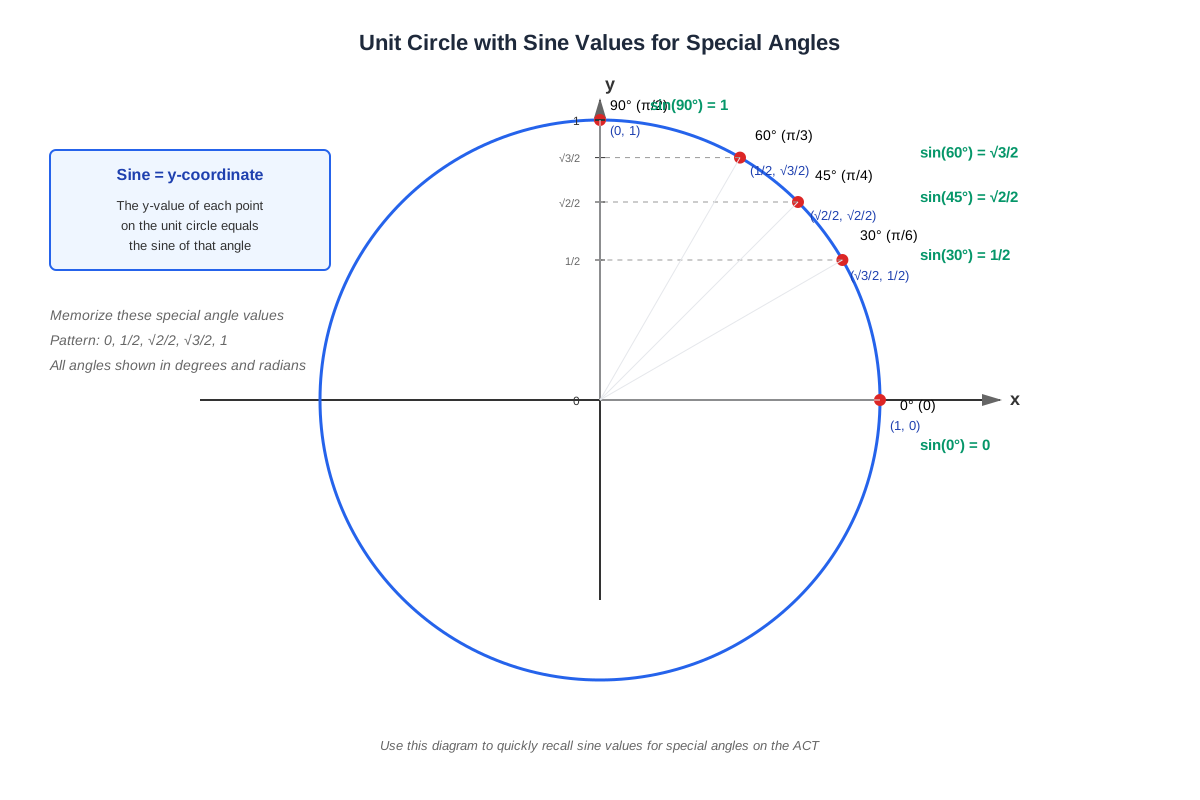
Certain angles appear so frequently on the ACT that memorizing their sine values is essential. These special angles are 30°, 45°, and 60° (or π/6, π/4, and π/3 in radians):
| Angle (degrees) | Angle (radians) | Sine Value |
|---|---|---|
| 0° | 0 | 0 |
| 30° | π/6 | 1/2 |
| 45° | π/4 | √2/2 |
| 60° | π/3 | √3/2 |
| 90° | π/2 | 1 |
These values derive from the properties of two special right triangles: the 30-60-90 triangle (with sides in ratio 1:√3:2) and the 45-45-90 triangle (with sides in ratio 1:1:√2). Understanding where these values come from helps with memorization and provides a check against errors.
For a 30-60-90 triangle with hypotenuse 2, the side opposite the 30° angle has length 1, giving sin(30°) = 1/2. The side opposite the 60° angle has length √3, giving sin(60°) = √3/2. For a 45-45-90 triangle with hypotenuse √2, each leg has length 1, giving sin(45°) = 1/√2 = √2/2 (after rationalizing the denominator).
The Unit Circle and Sine
The unit circle extends the definition of sine beyond right triangles to all angles, including those greater than 90° and negative angles. The unit circle is a circle with radius 1 centered at the origin of a coordinate plane. For any angle θ measured counterclockwise from the positive x-axis, the point where the terminal side of the angle intersects the unit circle has coordinates (cos(θ), sin(θ)).
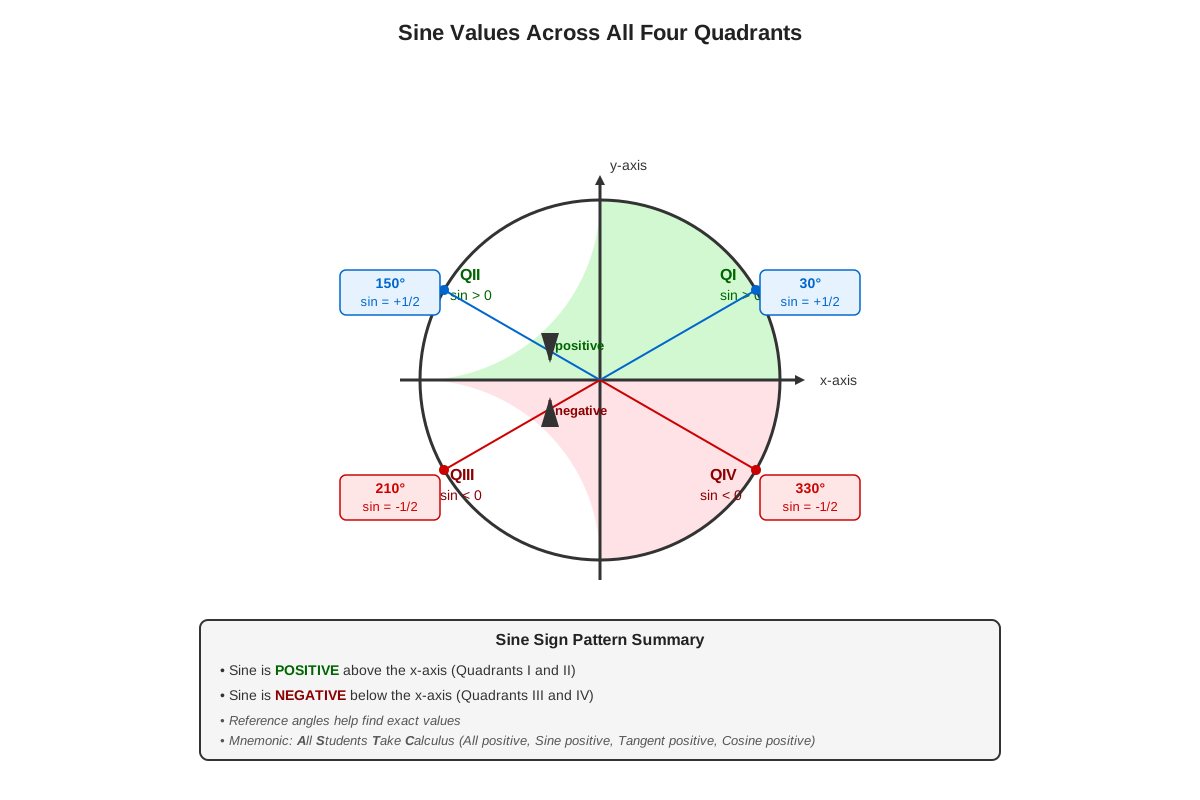
This means the y-coordinate of any point on the unit circle equals the sine of the angle that point makes with the positive x-axis. This geometric interpretation is crucial for understanding sine values in all four quadrants:
- Quadrant I (0° to 90°): sine is positive
- Quadrant II (90° to 180°): sine is positive
- Quadrant III (180° to 270°): sine is negative
- Quadrant IV (270° to 360°): sine is negative
The unit circle also reveals important symmetries. For example, sin(180° - θ) = sin(θ), which explains why sin(150°) = sin(30°) = 1/2. Similarly, sin(180° + θ) = -sin(θ), so sin(210°) = -sin(30°) = -1/2.
Complementary Angle Relationship
A powerful property of sine involves complementary angles (two angles that sum to 90°). The sine of an angle equals the cosine of its complement:
sin(θ) = cos(90° - θ)This relationship, called a cofunction identity, appears frequently on the ACT. For example, sin(30°) = cos(60°) = 1/2, and sin(70°) = cos(20°). Recognizing this pattern can help solve problems more efficiently and provides a way to check answers.
Sine Function Properties
Understanding the properties of the sine function helps with more advanced ACT questions:
- Domain: All real numbers (sine is defined for any angle)
- Range: [-1, 1] (sine values never exceed 1 or fall below -1)
- Period: 360° or 2π radians (the sine function repeats every full rotation)
- Odd function: sin(-θ) = -sin(θ) (the function has rotational symmetry about the origin)
These properties help eliminate incorrect answer choices and verify solutions. For instance, if a calculation yields sin(θ) = 1.5, you know immediately that an error occurred since sine cannot exceed 1.
Applications and Problem-Solving
ACT problems often embed sine within real-world contexts. Common scenarios include:
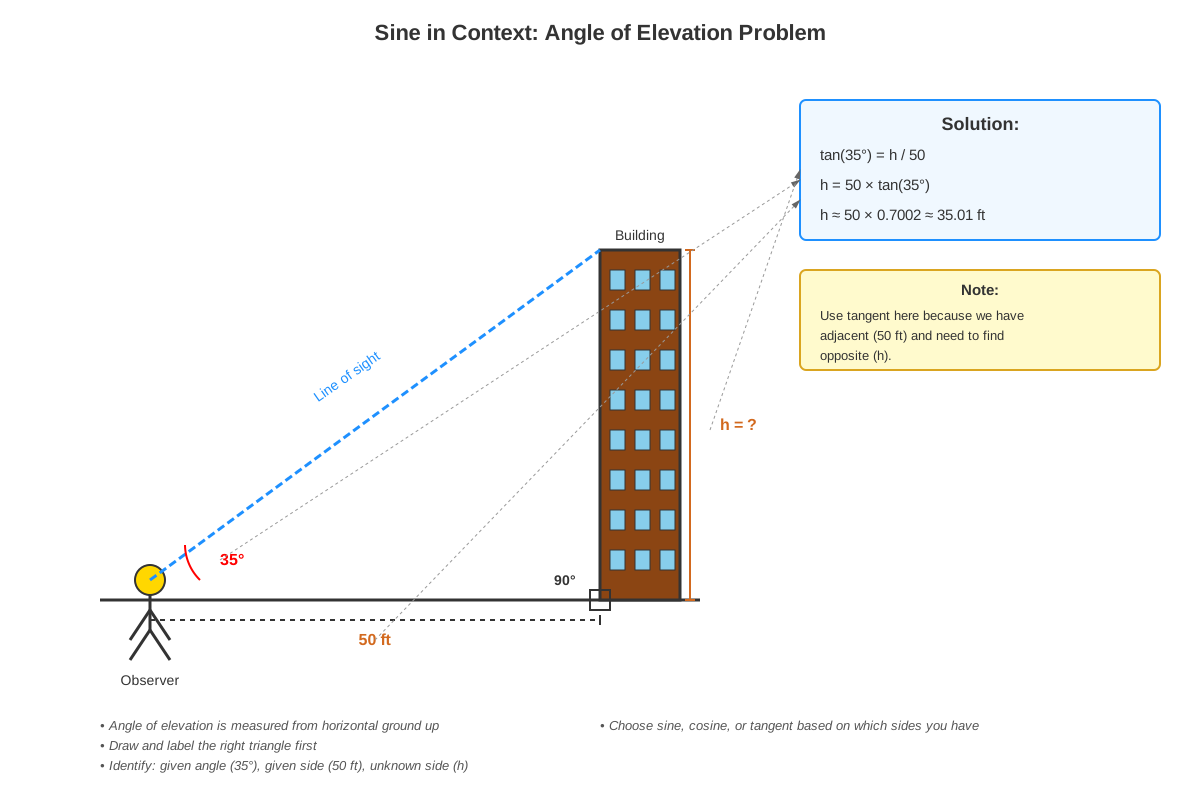
- Angles of elevation and depression: When looking up at an object (elevation) or down from a height (depression), the angle from horizontal creates a right triangle where sine relates the vertical distance to the line-of-sight distance.
- Height and distance problems: Finding the height of a building, tree, or mountain often involves sine when you know an angle and one distance.
- Component problems: Breaking a force, velocity, or other vector into vertical and horizontal components uses sine and cosine.
The key to solving these problems is drawing a clear diagram, identifying the right triangle, labeling the known and unknown quantities, and determining which trigonometric ratio applies.
Concept Relationships
The sine function sits at the center of a web of interconnected mathematical concepts. At its foundation, sine builds directly on right triangle geometry and the Pythagorean theorem. When you know two sides of a right triangle, the Pythagorean theorem finds the third, and then sine (along with cosine and tangent) describes the angle relationships.
The relationship flows as: Right Triangle Properties → Sine Definition → Unit Circle Extension → Trigonometric Identities. Understanding sine in right triangles provides the geometric intuition, while the unit circle generalizes this to all angles. From there, various identities (like the complementary angle relationship) emerge from the unit circle's symmetries.
Sine connects horizontally to its sibling functions: cosine (through the complementary angle relationship and the Pythagorean identity sin²(θ) + cos²(θ) = 1) and tangent (since tan(θ) = sin(θ)/cos(θ)). These three functions form the foundation of all trigonometry.
Looking forward, sine enables understanding of function transformations (vertical and horizontal shifts, amplitude changes, period modifications), trigonometric equations, and eventually calculus applications involving rates of change and periodic motion. On the ACT specifically, sine knowledge supports solving coordinate geometry problems, vector problems, and complex word problems involving indirect measurement.
Quick check — test yourself on Sine so far.
Try Flashcards →High-Yield Facts
⭐ The sine of an angle in a right triangle equals opposite/hypotenuse (SOH from SOH-CAH-TOA)
⭐ sin(30°) = 1/2, sin(45°) = √2/2, sin(60°) = √3/2
⭐ On the unit circle, sine equals the y-coordinate of the point
⭐ Sine is positive in Quadrants I and II, negative in Quadrants III and IV
⭐ The range of sine is [-1, 1]; any value outside this range is impossible
- sin(0°) = 0 and sin(90°) = 1
- The sine function has period 360° (or 2π radians)
- sin(θ) = cos(90° - θ) for complementary angles
- sin(-θ) = -sin(θ) (sine is an odd function)
- In a 30-60-90 triangle, sides are in ratio 1:√3:2
- In a 45-45-90 triangle, sides are in ratio 1:1:√2
- sin(180° - θ) = sin(θ) (supplementary angle property)
- The sine of an obtuse angle (90° < θ < 180°) is positive
- Angles of elevation and depression create right triangles where sine often applies
- When given sin(θ) and asked for the angle, use inverse sine (sin⁻¹ or arcsin)
Common Misconceptions
Misconception: Sine can be greater than 1 or less than -1 → Correction: The sine function is bounded between -1 and 1 for all angles. If a calculation yields a value outside this range, an error has occurred. This follows from the unit circle definition, where sine represents a y-coordinate on a circle of radius 1.
Misconception: Sine only applies to acute angles in right triangles → Correction: While sine is introduced through right triangles with acute angles, the unit circle extends sine to all angles, including obtuse angles, angles greater than 180°, and negative angles. The ACT tests this extended understanding.
Misconception: sin(A + B) = sin(A) + sin(B) → Correction: Sine is not a linear function, so you cannot distribute it over addition. For example, sin(30° + 60°) = sin(90°) = 1, but sin(30°) + sin(60°) = 1/2 + √3/2 ≈ 1.37. The correct formula is sin(A + B) = sin(A)cos(B) + cos(A)sin(B), though this is rarely needed on the ACT.
Misconception: The opposite side is always the vertical side → Correction: The "opposite" side depends on which angle you're considering. In a right triangle, each acute angle has its own opposite side. Always identify the angle first, then locate the side across from it.
Misconception: Sine and cosine are unrelated functions → Correction: Sine and cosine are intimately connected through complementary angles (sin(θ) = cos(90° - θ)), the Pythagorean identity (sin²(θ) + cos²(θ) = 1), and their unit circle definitions. Understanding one helps understand the other.
Misconception: You need a calculator for all sine problems → Correction: While calculators help with non-special angles, the ACT frequently tests special angles (30°, 45°, 60°) that you should know by memory. Recognizing these angles saves time and reduces calculator dependency.
Misconception: Sine in Quadrant II is negative → Correction: Sine is positive in both Quadrants I and II (where y-coordinates are positive) and negative in Quadrants III and IV (where y-coordinates are negative). This is a common error that leads to sign mistakes.
Worked Examples
Example 1: Right Triangle Application
Problem: In right triangle ABC, angle C is the right angle, AC = 12, and AB = 15. What is sin(A)?
Solution:
Step 1: Draw and label the triangle. We have a right triangle with the right angle at C, one leg AC = 12, and hypotenuse AB = 15.
Step 2: Identify what we need. We need sin(A), which means we need the ratio of the side opposite angle A to the hypotenuse.
Step 3: Determine which side is opposite angle A. The side opposite angle A is BC (the side that doesn't touch angle A).
Step 4: Find the length of BC using the Pythagorean theorem:
AC² + BC² = AB²
12² + BC² = 15²
144 + BC² = 225
BC² = 81
BC = 9
Step 5: Calculate sin(A):
sin(A) = opposite/hypotenuse = BC/AB = 9/15 = 3/5Answer: sin(A) = 3/5 or 0.6
Connection to Learning Objectives: This problem demonstrates identifying when sine is being tested (a right triangle with an angle and sides given) and applying the core sine ratio accurately.
Example 2: Unit Circle and Special Angles
Problem: A point P on the unit circle corresponds to an angle of 150° measured counterclockwise from the positive x-axis. What is the sine of 150°?
Solution:
Step 1: Recognize that 150° is in Quadrant II (between 90° and 180°), where sine values are positive.
Step 2: Find the reference angle. The reference angle is the acute angle between the terminal side and the x-axis:
Reference angle = 180° - 150° = 30°Step 3: Recall that sin(30°) = 1/2 (special angle value).
Step 4: Apply the Quadrant II property. Since sine is positive in Quadrant II and the reference angle is 30°:
sin(150°) = sin(30°) = 1/2Alternatively, using the supplementary angle property: sin(180° - θ) = sin(θ), so sin(150°) = sin(180° - 150°) = sin(30°) = 1/2.
Answer: sin(150°) = 1/2 or 0.5
Connection to Learning Objectives: This problem requires using the unit circle to determine sine values in different quadrants and applying knowledge of special angles, demonstrating mastery of multiple learning objectives simultaneously.
Exam Strategy
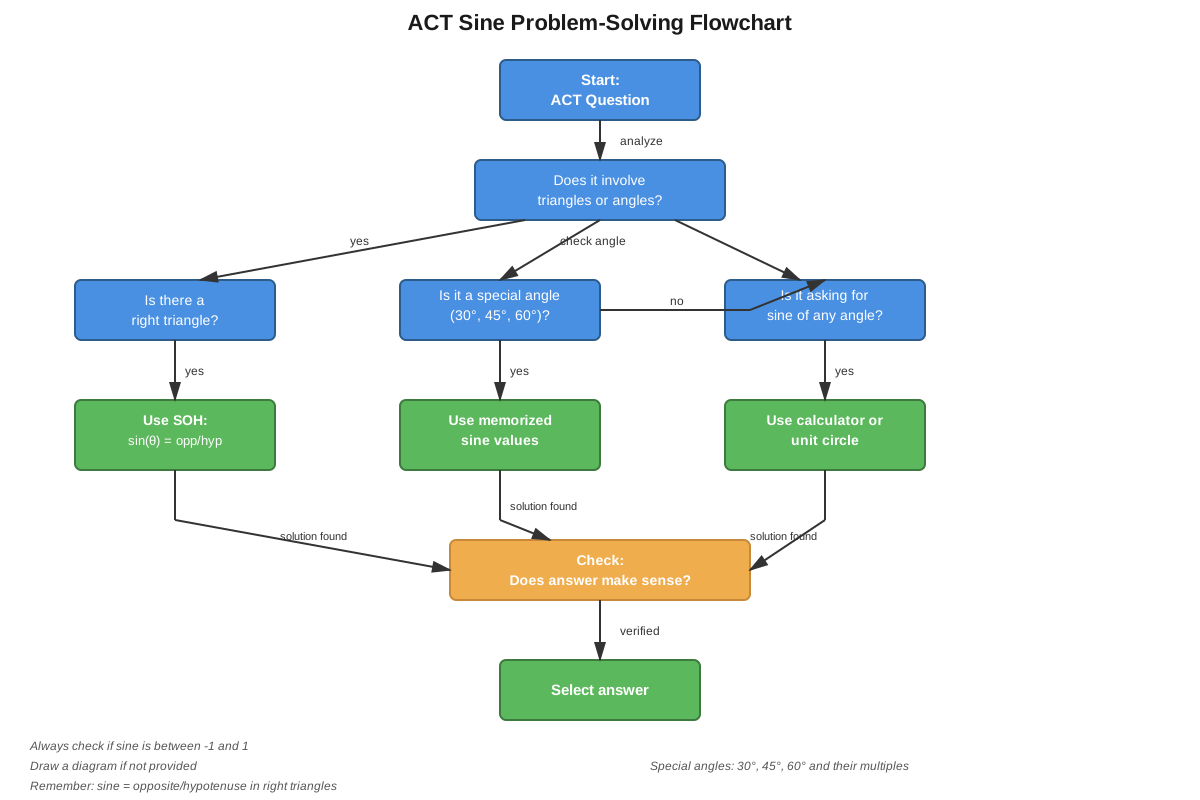
When approaching ACT sine questions, follow this systematic process:
- Identify the trigger words: Look for "sine," "sin," right triangle diagrams, unit circle references, or phrases like "angle of elevation/depression." These signal that sine is likely the key to solving the problem.
- Determine the context: Is this a right triangle problem (use opposite/hypotenuse), a unit circle problem (use y-coordinate or reference angles), or a word problem (draw a diagram first)?
- Check for special angles: Before reaching for your calculator, see if the angle is 30°, 45°, 60°, or a related angle (like 150°, 210°, etc.). Knowing these values saves time and avoids rounding errors.
- Draw a diagram: For word problems, always sketch the situation. Label known values and mark what you're looking for. This visual representation often makes the solution path obvious.
- Verify the range: After calculating, check that your sine value falls between -1 and 1. If it doesn't, you've made an error.
Process of elimination tips:
- Eliminate any answer choice with sine values greater than 1 or less than -1
- If the angle is in Quadrant I or II, eliminate negative sine values
- If the angle is in Quadrant III or IV, eliminate positive sine values
- For special angles, eliminate decimal approximations when exact values are possible
Time allocation: Most sine problems should take 30-60 seconds once you've identified the approach. If you're spending more than 90 seconds, mark the question and return to it later. The ACT rewards efficient problem-solving, and sometimes a fresh look reveals the solution path more clearly.
Calculator usage: Use your calculator for non-special angles, but ensure it's in the correct mode (degrees vs. radians). Double-check by testing a known value like sin(30°) = 0.5 before the test begins.
Memory Techniques
SOH-CAH-TOA: This classic mnemonic encodes all three basic trigonometric ratios. For sine, remember SOH: Sine = Opposite over Hypotenuse. Some students remember the phrase "Some Old Hippie Caught Another Hippie Tripping On Acid" (though any memorable phrase works).
Special angle values: Visualize the pattern for sine values at 0°, 30°, 45°, 60°, and 90°:
sin(0°) = √0/2 = 0
sin(30°) = √1/2 = 1/2
sin(45°) = √2/2
sin(60°) = √3/2
sin(90°) = √4/2 = 1
Notice the pattern: √0/2, √1/2, √2/2, √3/2, √4/2. The numerators count up from 0 to 4 under the square root!
Quadrant signs: Use the phrase "All Students Take Calculus" to remember which functions are positive in which quadrants:
- All (Quadrant I): All trig functions positive
- Students (Quadrant II): Sine positive
- Take (Quadrant III): Tangent positive
- Calculus (Quadrant IV): Cosine positive
Unit circle visualization: Picture the unit circle as a clock. At 12 o'clock (90°), sine = 1 (highest point). At 6 o'clock (270°), sine = -1 (lowest point). At 3 and 9 o'clock (0° and 180°), sine = 0 (on the x-axis).
Complementary angles: Remember "co-functions of complementary angles are equal." Sine and cosine are cofunctions, so sin(θ) = cos(90° - θ).
Summary
The sine function is a fundamental trigonometric ratio that relates an angle in a right triangle to the ratio of the opposite side to the hypotenuse. On the ACT, sine appears in multiple contexts: right triangle problems requiring the basic ratio, unit circle questions testing special angle values and quadrant signs, and real-world applications involving angles of elevation or depression. Mastering sine requires memorizing special angle values (sin(30°) = 1/2, sin(45°) = √2/2, sin(60°) = √3/2), understanding the unit circle interpretation where sine equals the y-coordinate, and recognizing that sine is positive in Quadrants I and II but negative in Quadrants III and IV. The sine function always produces values between -1 and 1, and this range check serves as a powerful error-detection tool. Success with ACT sine questions comes from quickly identifying when sine applies, knowing special values by memory, and systematically applying the opposite-over-hypotenuse ratio or unit circle properties depending on the problem type.
Key Takeaways
- Sine equals opposite over hypotenuse in right triangles (SOH from SOH-CAH-TOA)
- Memorize special angle values: sin(30°) = 1/2, sin(45°) = √2/2, sin(60°) = √3/2
- On the unit circle, sine is the y-coordinate, which determines its sign in each quadrant
- Sine is always between -1 and 1; values outside this range indicate an error
- Sine is positive in Quadrants I and II, negative in Quadrants III and IV
- Complementary angle relationship: sin(θ) = cos(90° - θ)
- Draw diagrams for word problems to identify the right triangle and relevant sides
Related Topics
Cosine: The complementary function to sine, cosine relates the adjacent side to the hypotenuse in right triangles and represents the x-coordinate on the unit circle. Mastering sine makes learning cosine straightforward due to their cofunction relationship.
Tangent: Defined as sine divided by cosine (or opposite over adjacent), tangent completes the three basic trigonometric ratios. Understanding sine and cosine makes tangent accessible.
Law of Sines: This advanced topic extends sine to non-right triangles, allowing you to solve any triangle when given certain combinations of sides and angles. It builds directly on the sine foundation.
Trigonometric Identities: Relationships like sin²(θ) + cos²(θ) = 1 and double-angle formulas emerge from the unit circle definitions of sine and cosine. These occasionally appear on harder ACT questions.
Graphing Trigonometric Functions: Understanding how the sine function's graph relates to the unit circle and how transformations affect amplitude, period, and phase shift represents the next level of trigonometric mastery.
Practice CTA
Now that you've mastered the core concepts of sine, it's time to cement your understanding through practice! Work through the practice questions to apply these concepts to ACT-style problems, and use the flashcards to drill the special angle values until they become automatic. Remember, the difference between knowing sine and mastering it comes down to practice. Each problem you solve strengthens your pattern recognition and builds the confidence you need to tackle any sine question on test day. You've got this!
Sign up free to keep reading
Create a free AnvayaPrep account to finish this ACT guide on Sine — plus flashcards and practice questions.