Overview
Finding missing sides is a fundamental skill in trigonometry that appears consistently on the ACT Math test. This topic requires students to determine unknown side lengths in triangles using various mathematical relationships, including the Pythagorean theorem, trigonometric ratios (sine, cosine, and tangent), and special right triangle properties. Mastery of this skill is essential because it forms the foundation for solving more complex geometry and trigonometry problems that regularly appear on the exam.
The ACT frequently tests finding missing sides through direct calculation problems, word problems involving real-world scenarios, and multi-step questions that combine trigonometry with other mathematical concepts. Students who can quickly identify which method to apply and execute the calculations accurately gain a significant advantage, as these questions typically appear 3-5 times per test and are considered medium-difficulty points that separate average scorers from high achievers.
Understanding how to find missing sides connects directly to broader mathematical reasoning skills tested on the ACT. This topic bridges basic geometry (triangle properties, angle relationships) with more advanced trigonometry (unit circle, inverse functions), and it frequently appears alongside coordinate geometry, vectors, and even some word problems involving rates and distances. The ability to visualize triangles, identify given information, and select the appropriate formula represents exactly the kind of mathematical maturity the ACT seeks to measure.
Learning Objectives
- [ ] Identify when Finding missing sides is being tested
- [ ] Explain the core rule or strategy behind Finding missing sides
- [ ] Apply Finding missing sides to ACT-style questions accurately
- [ ] Distinguish between right triangle and non-right triangle scenarios requiring different approaches
- [ ] Select the most efficient method (Pythagorean theorem, trigonometric ratios, or special triangles) based on given information
- [ ] Solve multi-step problems that require finding intermediate sides before determining the final answer
Prerequisites
- Right triangle properties: Understanding that right triangles contain one 90-degree angle is essential for recognizing when to apply the Pythagorean theorem or trigonometric ratios
- Basic trigonometric ratios (SOH-CAH-TOA): Knowledge of sine, cosine, and tangent definitions enables the application of these functions to find unknown sides
- Pythagorean theorem (a² + b² = c²): This fundamental relationship between sides of right triangles is the most frequently used tool for finding missing sides
- Special right triangles (30-60-90 and 45-45-90): Recognizing these triangles allows for immediate side length calculations without complex computations
- Angle measurement and conversion: Understanding degrees and the relationship between angles helps identify which trigonometric approach to use
- Basic algebraic manipulation: Solving for variables and working with square roots is necessary for isolating unknown side lengths
Why This Topic Matters
In real-world applications, finding missing sides appears in architecture, engineering, navigation, surveying, and physics. Architects use these principles to calculate structural dimensions, engineers determine forces and distances in mechanical systems, and surveyors measure inaccessible distances using angle measurements and known lengths. GPS technology, construction projects, and even video game graphics all rely on the mathematical principles of finding missing triangle sides.
On the ACT Math test, questions involving ACT finding missing sides appear with remarkable consistency. Approximately 3-5 questions per test directly assess this skill, accounting for roughly 5-8% of the total Math section. These questions typically appear in the medium-difficulty range (questions 20-40 out of 60), making them critical for students aiming for scores above 25. The questions may be presented as pure geometry problems, embedded in word problems about ladders leaning against walls, or disguised within coordinate geometry contexts.
Common question formats include: direct right triangle problems with two sides given and one missing; word problems describing real-world scenarios that require triangle modeling; coordinate plane problems where distance formulas connect to triangle side lengths; and multi-step problems where finding one missing side enables calculation of another measurement like area or perimeter. The ACT particularly favors questions that combine finding missing sides with other concepts, testing whether students can integrate multiple skills efficiently.
Core Concepts
The Pythagorean Theorem
The Pythagorean theorem states that in any right triangle, the square of the hypotenuse (the longest side opposite the right angle) equals the sum of the squares of the two legs. Mathematically expressed as:
a² + b² = c²where c represents the hypotenuse and a and b represent the two legs. This theorem applies exclusively to right triangles and is the most fundamental tool for finding missing sides when two sides are known.
To find a missing leg when the hypotenuse and one leg are known, rearrange the formula:
a² = c² - b²To find the hypotenuse when both legs are known, use the standard form directly. Always remember that the hypotenuse is the longest side and must be opposite the right angle.
Trigonometric Ratios (SOH-CAH-TOA)
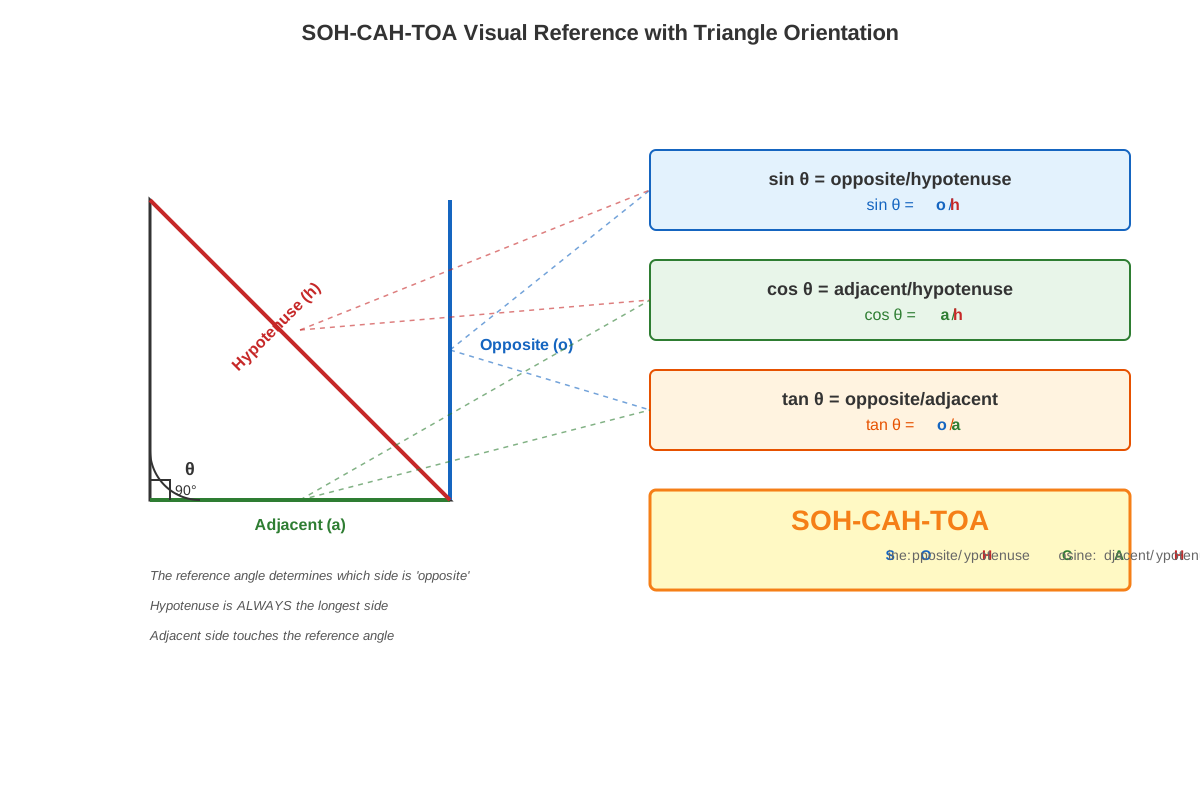
When an angle measure and one side are known in a right triangle, trigonometric ratios provide the most efficient method for finding missing sides. The three primary ratios are:
- Sine (sin): opposite/hypotenuse
- Cosine (cos): adjacent/hypotenuse
- Tangent (tan): opposite/adjacent
The mnemonic SOH-CAH-TOA helps remember these relationships. To apply these ratios:
- Identify the given angle (not the right angle)
- Label sides relative to this angle: opposite (across from the angle), adjacent (next to the angle), and hypotenuse (longest side)
- Determine which ratio involves the known side and unknown side
- Set up the equation and solve for the unknown
For example, if given an angle of 35° and the adjacent side of 10, and asked to find the hypotenuse, use cosine:
cos(35°) = 10/h
h = 10/cos(35°)
Special Right Triangles
Two special right triangles appear frequently on the ACT and allow for immediate side calculation without trigonometric functions or the Pythagorean theorem.
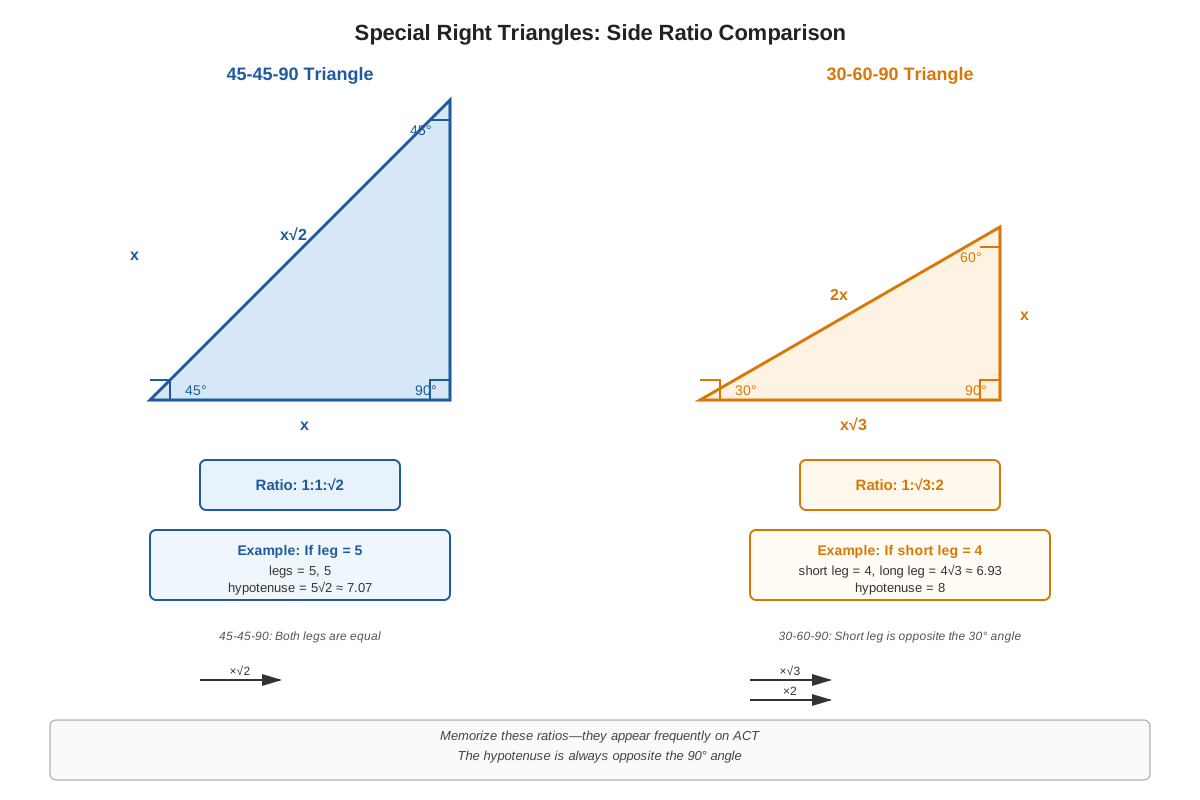
45-45-90 Triangle: This isosceles right triangle has angles of 45°, 45°, and 90°. The side ratio is:
leg : leg : hypotenuse = x : x : x√2If one leg equals 5, the other leg equals 5, and the hypotenuse equals 5√2.
30-60-90 Triangle: This triangle has angles of 30°, 60°, and 90°. The side ratio is:
short leg : long leg : hypotenuse = x : x√3 : 2xThe short leg is opposite the 30° angle, the long leg is opposite the 60° angle, and the hypotenuse is opposite the 90° angle. If the short leg equals 4, the long leg equals 4√3, and the hypotenuse equals 8.
Identifying the Appropriate Method
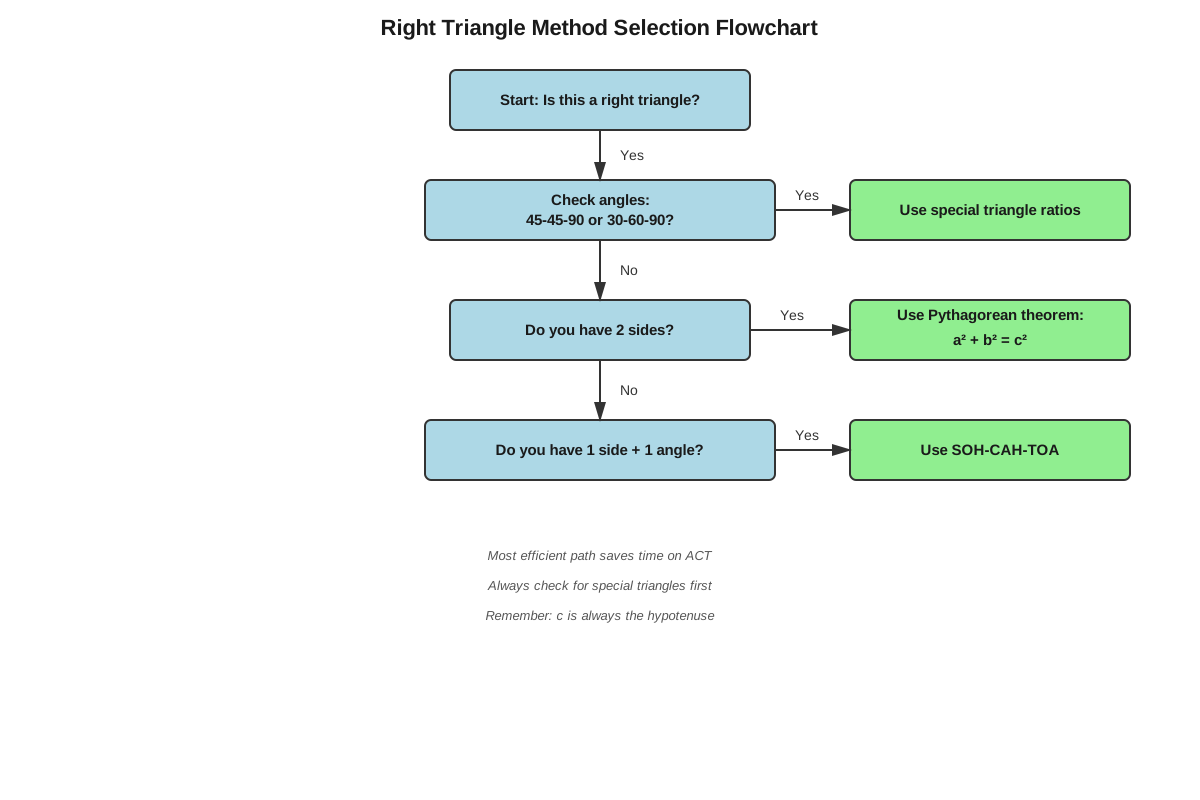
Selecting the correct approach for finding missing sides depends on the given information:
| Given Information | Best Method | Reasoning |
|---|---|---|
| Two sides of a right triangle | Pythagorean theorem | Direct calculation without angles |
| One angle and one side | Trigonometric ratios | Ratios relate angles to sides |
| 45° angle in right triangle | 45-45-90 properties | Immediate ratio application |
| 30° or 60° angle in right triangle | 30-60-90 properties | Immediate ratio application |
| Non-right triangle | Law of Sines or Cosines | Beyond basic ACT scope, rarely tested |
Setting Up the Problem
Successful finding missing sides requires systematic problem setup:
- Draw and label a diagram if one isn't provided, marking all known information
- Identify the triangle type (right triangle, special right triangle, or other)
- Mark the right angle with a small square if present
- Label known sides and angles clearly
- Identify the unknown side with a variable
- Choose the appropriate method based on given information
- Set up the equation carefully, ensuring correct substitution
- Solve algebraically and check that the answer makes geometric sense
Calculator Considerations
The ACT permits calculator use, which is essential for trigonometric calculations. When using trigonometric functions:
- Ensure the calculator is in degree mode (not radians) unless specifically told otherwise
- Round final answers appropriately, typically to the nearest tenth or hundredth
- Use parentheses correctly when dividing by trigonometric values
- Store intermediate values in calculator memory to avoid rounding errors in multi-step problems
Concept Relationships
The concepts within finding missing sides form a hierarchical decision tree. First, students must identify whether they have a right triangle, which determines whether the Pythagorean theorem and trigonometric ratios apply. This identification step → leads to → selecting between the Pythagorean theorem (when two sides are known) or trigonometric ratios (when one side and one angle are known).
Within the trigonometric approach, recognizing special angles (30°, 45°, 60°) → leads to → applying special right triangle ratios, which provides a faster solution than calculating trigonometric functions. This efficiency matters significantly under timed test conditions.
The Pythagorean theorem → connects to → coordinate geometry through the distance formula, which is essentially the Pythagorean theorem applied to points on a coordinate plane. Similarly, trigonometric ratios → extend to → the unit circle and more advanced trigonometry, though the ACT focuses primarily on basic right triangle applications.
Finding missing sides → enables → calculation of other triangle properties such as area (which requires base and height), perimeter (which requires all side lengths), and angles (through inverse trigonometric functions). Many ACT problems use finding a missing side as an intermediate step toward answering questions about these other properties.
The prerequisite knowledge of basic algebra → supports → the manipulation of equations when solving for unknown sides, while understanding of radicals and square roots → facilitates → simplifying answers involving the Pythagorean theorem and special right triangles.
High-Yield Facts
⭐ The Pythagorean theorem (a² + b² = c²) applies only to right triangles, where c is always the hypotenuse
⭐ In a 45-45-90 triangle, if a leg has length x, the hypotenuse has length x√2
⭐ In a 30-60-90 triangle, sides are in the ratio x : x√3 : 2x (short leg : long leg : hypotenuse)
⭐ SOH-CAH-TOA: sin = opposite/hypotenuse, cos = adjacent/hypotenuse, tan = opposite/adjacent
⭐ When given one side and one angle in a right triangle, use trigonometric ratios to find other sides
- The hypotenuse is always the longest side in a right triangle and is always opposite the right angle
- To find a leg when given the hypotenuse and other leg, use a² = c² - b²
- Calculator must be in degree mode for ACT trigonometry problems unless otherwise specified
- If a triangle has a 90° angle marked, immediately consider the Pythagorean theorem or trigonometric ratios
- Special right triangles allow for exact answers without decimal approximations
- The opposite side is across from the reference angle; the adjacent side is next to the reference angle
- When solving for a side using trigonometry, multiply both sides by the denominator to isolate the variable
- Answers involving square roots should be simplified (e.g., √8 = 2√2)
- Drawing and labeling a diagram is essential when one isn't provided in the problem
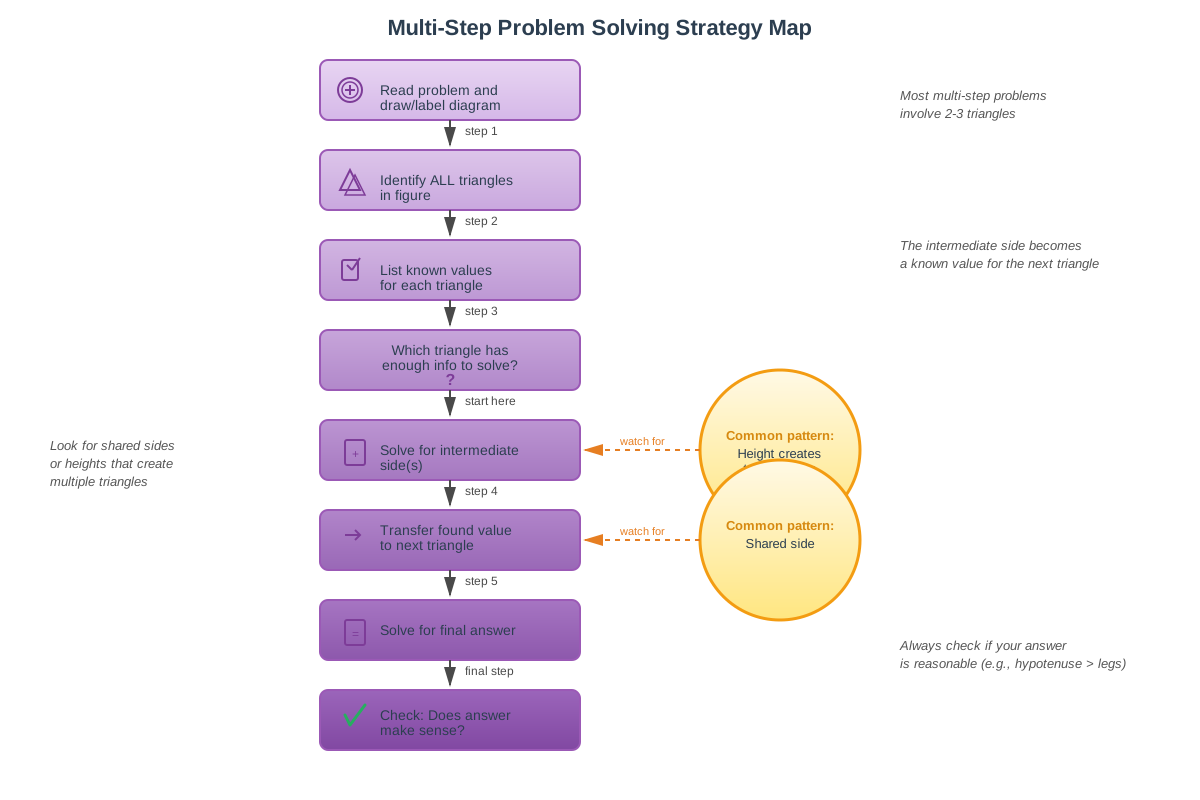
- Multi-step problems often require finding one missing side before calculating another measurement
Quick check — test yourself on Finding missing sides so far.
Try Flashcards →Common Misconceptions
Misconception: The Pythagorean theorem can be used on any triangle, not just right triangles. → Correction: The Pythagorean theorem applies exclusively to right triangles. For non-right triangles, different methods like the Law of Cosines are required, though these rarely appear on the ACT.
Misconception: The hypotenuse can be any side of a right triangle. → Correction: The hypotenuse is specifically the side opposite the right angle and is always the longest side. In the equation a² + b² = c², c must represent the hypotenuse, not just any side.
Misconception: In SOH-CAH-TOA, "opposite" and "adjacent" are fixed properties of the sides. → Correction: "Opposite" and "adjacent" are relative to the specific angle being referenced. The same side can be opposite to one acute angle and adjacent to the other acute angle in the same triangle.
Misconception: Special right triangle ratios work with any numbers. → Correction: The ratios must be proportional. In a 30-60-90 triangle, if the short leg is 5, the long leg must be 5√3 (not just any number with √3), and the hypotenuse must be 10 (exactly double the short leg).
Misconception: When using trigonometric functions to find a side, the answer is simply sin(angle), cos(angle), or tan(angle). → Correction: The trigonometric function equals a ratio of sides. You must set up an equation like "sin(30°) = x/10" and then solve for x by multiplying: x = 10 × sin(30°).
Misconception: Calculators automatically give answers in the correct form. → Correction: Calculator answers for trigonometric calculations are often decimals that need to be matched to answer choices, which may be in exact form (like 5√2) or rounded to specific decimal places.
Misconception: The longest side in any triangle is called the hypotenuse. → Correction: Only right triangles have a hypotenuse. In other triangles, the longest side is simply called the longest side or may be referenced by its position relative to angles.
Worked Examples
Example 1: Using the Pythagorean Theorem
Problem: A right triangle has legs of length 9 and 12. What is the length of the hypotenuse?
Solution:
Step 1: Identify the given information. We have a right triangle with legs a = 9 and b = 12. We need to find the hypotenuse c.
Step 2: Select the appropriate method. Since we have two sides of a right triangle and need the third, use the Pythagorean theorem.
Step 3: Set up the equation:
a² + b² = c²
9² + 12² = c²
Step 4: Calculate:
81 + 144 = c²
225 = c²
Step 5: Solve for c:
c = √225 = 15Step 6: Verify the answer makes sense. The hypotenuse (15) is longer than both legs (9 and 12), which is geometrically correct.
Answer: The hypotenuse has length 15.
Connection to Learning Objectives: This example demonstrates applying the Pythagorean theorem to find a missing side and illustrates the core strategy of identifying given information, selecting the appropriate formula, and executing the calculation accurately.
Example 2: Using Trigonometric Ratios
Problem: In right triangle ABC, angle A measures 40°, and the side adjacent to angle A has length 20. What is the length of the hypotenuse, rounded to the nearest tenth?
Solution:
Step 1: Draw and label a diagram. Mark the right angle at C, angle A as 40°, and label the adjacent side as 20.
Step 2: Identify what we know and what we need. We have an angle (40°) and the adjacent side (20). We need the hypotenuse.
Step 3: Select the appropriate trigonometric ratio. We have adjacent and need hypotenuse, so use CAH (cosine = adjacent/hypotenuse).
Step 4: Set up the equation:
cos(40°) = 20/hwhere h represents the hypotenuse.
Step 5: Solve for h by multiplying both sides by h and dividing by cos(40°):
h = 20/cos(40°)Step 6: Calculate using a calculator (in degree mode):
h = 20/0.766 ≈ 26.1Step 7: Verify the answer makes sense. The hypotenuse (26.1) is longer than the adjacent side (20), which is correct.
Answer: The hypotenuse has length approximately 26.1.
Connection to Learning Objectives: This example shows how to identify when trigonometric ratios are needed, select the correct ratio based on given information, and apply the method to an ACT-style question with appropriate rounding.
Example 3: Special Right Triangle Application
Problem: An isosceles right triangle has legs of length 7. What is the length of the hypotenuse?
Solution:
Step 1: Recognize the triangle type. "Isosceles right triangle" means the two legs are equal and the angles are 45°-45°-90°.
Step 2: Recall the 45-45-90 triangle ratio: leg : leg : hypotenuse = x : x : x√2
Step 3: Identify x. Since each leg has length 7, x = 7.
Step 4: Apply the ratio. The hypotenuse = x√2 = 7√2.
Step 5: This is the exact answer. If a decimal is needed: 7√2 ≈ 9.9.
Answer: The hypotenuse has length 7√2 (or approximately 9.9).
Connection to Learning Objectives: This example demonstrates recognizing when special right triangle properties provide the most efficient solution method and applying those properties accurately.
Exam Strategy
When approaching ACT questions on finding missing sides, begin by quickly scanning for the presence of a right angle symbol (a small square in the corner of a triangle). This visual cue immediately signals that the Pythagorean theorem or trigonometric ratios will likely be useful. If no diagram is provided, invest 10-15 seconds drawing one, as visualization prevents errors and clarifies the relationship between given and unknown values.
Trigger words and phrases that indicate this topic include: "length of the side," "how long is," "what is the distance," "find the hypotenuse," "find the leg," "altitude," "height," and any mention of right triangles, 45-45-90 triangles, or 30-60-90 triangles. Word problems may disguise triangles in scenarios involving "a ladder leaning against a wall," "the distance from point A to point B," "the height of a building," or "the length of a ramp."
For process-of-elimination, first eliminate any answer choices that violate basic geometric principles. If finding a hypotenuse, eliminate any answer smaller than the given legs. If finding a leg, eliminate any answer larger than the hypotenuse. When answer choices include both exact forms (like 5√3) and decimal approximations, calculate the decimal value of exact forms to see which matches your calculated answer. If you've used the Pythagorean theorem and your answer isn't among the choices, check whether you accidentally solved for a² or b² instead of a or b (forgetting to take the square root).
Time allocation for these problems should typically be 45-60 seconds for straightforward applications and up to 90 seconds for multi-step problems. If a problem requires more than two minutes, mark it for review and move on, as the ACT rewards completing more problems over perfecting difficult ones. Practice identifying the method (Pythagorean theorem vs. trigonometric ratios vs. special triangles) within the first 10 seconds, as this decision-making speed is crucial for time management.
When stuck between two methods, default to the Pythagorean theorem if you have two sides, and default to trigonometric ratios if you have one side and one angle. If the problem involves 30°, 45°, or 60° angles, always check whether special right triangle ratios provide a faster path than calculating trigonometric functions.
Memory Techniques
SOH-CAH-TOA is the essential mnemonic for trigonometric ratios. Many students remember it through the phrase "Some Old Hippie Caught Another Hippie Tripping On Acid," though any memorable phrase works. The key is associating S with Opposite/Hypotenuse, C with Adjacent/Hypotenuse, and T with Opposite/Adjacent.
For the Pythagorean theorem, visualize the classic 3-4-5 triangle. This Pythagorean triple (3² + 4² = 5²) and its multiples (6-8-10, 9-12-15, etc.) appear frequently on the ACT. Recognizing these patterns allows for immediate answers without calculation.
For 45-45-90 triangles, remember "one-one-root two" (1:1:√2), emphasizing that the two legs are equal and the hypotenuse is a leg times √2. Visualize a square cut diagonally—this creates two 45-45-90 triangles where the diagonal (hypotenuse) is longer than the sides by a factor of √2.
For 30-60-90 triangles, use "one-root three-two" (1:√3:2), and remember the mnemonic "Small-Medium-Large" corresponding to the angles 30°-60°-90°. The smallest angle (30°) is opposite the smallest side (x), the medium angle (60°) is opposite the medium side (x√3), and the largest angle (90°) is opposite the largest side (2x). Visualize an equilateral triangle cut in half—this creates two 30-60-90 triangles.
Create a visual decision tree: Draw a triangle → Is there a right angle? → If yes, do you have two sides or one side and one angle? → Two sides = Pythagorean theorem; One side and one angle = Trigonometric ratios → Are the angles 30°, 45°, or 60°? → If yes, use special triangle ratios for speed.
Summary
Finding missing sides in triangles is a high-yield ACT Math topic that requires mastery of three primary methods: the Pythagorean theorem for right triangles when two sides are known, trigonometric ratios (SOH-CAH-TOA) when one side and one angle are known, and special right triangle properties for 45-45-90 and 30-60-90 triangles. Success depends on quickly identifying which method applies based on given information, accurately setting up equations, and executing calculations correctly. The Pythagorean theorem (a² + b² = c²) applies exclusively to right triangles with c representing the hypotenuse. Trigonometric ratios relate angles to side lengths through sine (opposite/hypotenuse), cosine (adjacent/hypotenuse), and tangent (opposite/adjacent). Special right triangles offer shortcuts: 45-45-90 triangles have sides in ratio x:x:x√2, while 30-60-90 triangles have sides in ratio x:x√3:2x. Drawing diagrams, labeling known information, and verifying that answers make geometric sense are essential practices for avoiding common errors and achieving accuracy under timed conditions.
Key Takeaways
- The Pythagorean theorem (a² + b² = c²) is the primary tool when two sides of a right triangle are known and applies only to right triangles
- SOH-CAH-TOA provides the framework for using trigonometric ratios when one side and one angle are known in a right triangle
- Special right triangles (45-45-90 with ratio x:x:x√2 and 30-60-90 with ratio x:x√3:2x) allow for immediate calculation without complex formulas
- Always identify whether a triangle is a right triangle before selecting a solution method, as this determines which tools are applicable
- Drawing and labeling diagrams clarifies the relationship between given and unknown values and prevents calculation errors
- The hypotenuse is always the longest side in a right triangle and must be opposite the right angle
- Calculator must be in degree mode for ACT problems, and answers should be rounded appropriately to match answer choices
Related Topics
Law of Sines and Law of Cosines: These advanced techniques extend triangle solving to non-right triangles and occasionally appear on the ACT. Mastering finding missing sides in right triangles provides the foundation for understanding these more complex relationships.
Coordinate Geometry and Distance Formula: The distance formula is essentially the Pythagorean theorem applied to coordinate planes. Understanding finding missing sides enables quick calculation of distances between points.
Trigonometric Functions on the Unit Circle: The sine, cosine, and tangent ratios learned for finding missing sides extend to the unit circle, where these functions are defined for all angle measures, not just acute angles in right triangles.
Area and Perimeter Calculations: Finding missing sides is often an intermediate step in calculating triangle area (which requires base and height) or perimeter (which requires all three side lengths).
Vectors and Components: Vector problems often involve breaking vectors into horizontal and vertical components, which creates right triangles where finding missing sides techniques apply directly.
Practice CTA
Now that you've mastered the concepts and strategies for finding missing sides, it's time to reinforce your learning through active practice. Attempt the practice questions to apply these techniques to ACT-style problems, and use the flashcards to memorize key formulas and ratios until they become automatic. Remember, the difference between knowing these methods and scoring points on test day is consistent, timed practice. Each problem you solve builds the pattern recognition and calculation speed that will make you confident and efficient when these questions appear on your actual ACT. You've got this—start practicing!
Sign up free to keep reading
Create a free AnvayaPrep account to finish this ACT guide on Finding missing sides — plus flashcards and practice questions.