Overview
The distance formula is one of the most fundamental and frequently tested concepts in coordinate geometry on the ACT Math section. This formula allows students to calculate the straight-line distance between any two points on a coordinate plane, making it an essential tool for solving a wide variety of geometry problems. The distance formula appears in approximately 2-3 questions per ACT exam, either directly or as a component of more complex multi-step problems involving circles, triangles, or optimization scenarios.
Understanding the distance formula goes beyond simple memorization—it represents a practical application of the Pythagorean theorem translated into the coordinate plane. When students grasp this connection, they develop a deeper understanding of how algebraic and geometric concepts interweave. The formula serves as a bridge between pure algebra and spatial reasoning, skills that are tested extensively throughout the ACT Math section.
Mastery of the ACT distance formula provides students with a reliable method for tackling questions about geometric shapes, midpoints, perimeters, and even some trigonometry problems. This topic connects directly to other high-yield concepts including the midpoint formula, circle equations, and the Pythagorean theorem. Students who can quickly recognize when to apply the distance formula and execute it accurately gain a significant advantage in both speed and accuracy on test day.
Learning Objectives
- [ ] Identify when Distance formula is being tested
- [ ] Explain the core rule or strategy behind Distance formula
- [ ] Apply Distance formula to ACT-style questions accurately
- [ ] Derive the distance formula from the Pythagorean theorem
- [ ] Recognize distance formula applications in circle equations and geometric figures
- [ ] Solve multi-step problems that combine distance formula with other coordinate geometry concepts
- [ ] Simplify radical expressions resulting from distance calculations
Prerequisites
- Pythagorean Theorem (a² + b² = c²): The distance formula is a direct application of this theorem in coordinate geometry
- Coordinate Plane Basics: Understanding ordered pairs (x, y) and plotting points is essential for identifying the coordinates needed in the formula
- Simplifying Radicals: Distance calculations often result in square roots that require simplification
- Basic Algebra: Substituting values into formulas and performing arithmetic operations with negative numbers
- Squaring Negative Numbers: Recognizing that (−a)² = a² prevents common calculation errors
Why This Topic Matters
The distance formula has practical applications far beyond standardized testing. Engineers use it to calculate distances in design specifications, GPS systems rely on distance calculations to determine routes, and architects apply it when creating blueprints. In physics, the formula helps calculate displacement, while in computer graphics, it determines pixel distances for rendering images. Understanding distance in a coordinate system is fundamental to any field involving spatial relationships or data visualization.
On the ACT Math section, distance formula questions appear with remarkable consistency. Statistical analysis of recent ACT exams shows that 2-3 questions per test directly involve the distance formula, accounting for approximately 3-5% of the entire Math section. These questions typically appear in the medium-to-difficult range (questions 30-50 out of 60), making them crucial for students aiming for scores above 25. The formula appears in various contexts: finding the distance between two points, determining if a point lies on a circle, calculating the perimeter of geometric figures, or verifying properties of triangles and quadrilaterals.
Common question formats include: direct distance calculations between two given points, word problems requiring students to first identify coordinates from a scenario, questions about circles where the radius must be calculated using distance, and problems involving geometric figures where distance helps determine side lengths or diagonals. The ACT frequently embeds distance formula questions within coordinate geometry scenarios, requiring students to recognize the application rather than being explicitly told to "find the distance."
Core Concepts
The Distance Formula Derivation
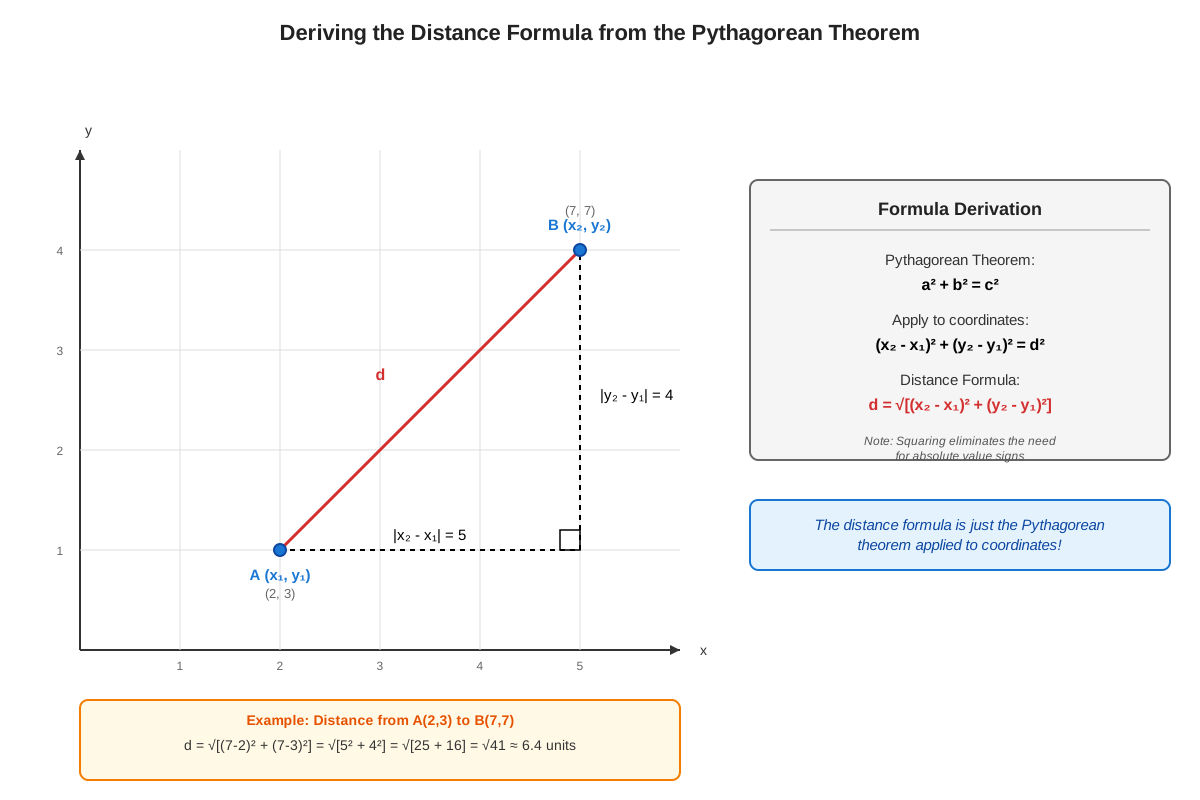
The distance formula states that the distance d between two points (x₁, y₁) and (x₂, y₂) in a coordinate plane is:
d = √[(x₂ - x₁)² + (y₂ - y₁)²]This formula derives directly from the Pythagorean theorem. When two points are plotted on a coordinate plane, they form the endpoints of a line segment. By drawing a right triangle where this segment is the hypotenuse, the horizontal leg has length |x₂ - x₁| and the vertical leg has length |y₂ - y₁|. Applying the Pythagorean theorem gives us: d² = (x₂ - x₁)² + (y₂ - y₁)², and taking the square root of both sides yields the distance formula.
The beauty of this formula lies in its universality—it works regardless of which quadrant the points occupy or whether the coordinates are positive or negative. The squaring operation eliminates concerns about the order of subtraction or the sign of the differences, since (a - b)² = (b - a)².
Components of the Formula
Understanding each component helps prevent errors:
- (x₁, y₁): The coordinates of the first point
- (x₂, y₂): The coordinates of the second point
- (x₂ - x₁): The horizontal distance (change in x-coordinates)
- (y₂ - y₁): The vertical distance (change in y-coordinates)
- Squaring: Ensures all values are positive before addition
- Square root: Returns the result to linear distance units
Step-by-Step Application Process
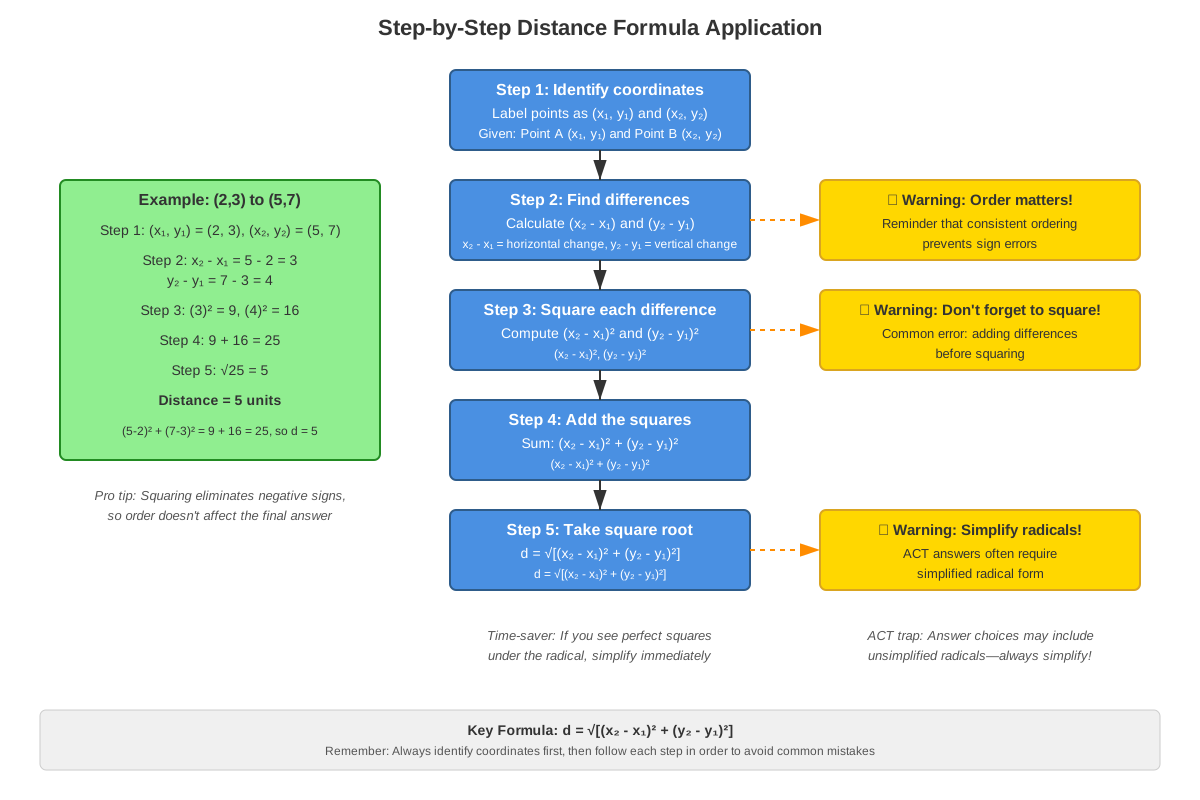
- Identify the two points and label their coordinates clearly as (x₁, y₁) and (x₂, y₂)
- Calculate the difference in x-coordinates: (x₂ - x₁)
- Calculate the difference in y-coordinates: (y₂ - y₁)
- Square both differences: (x₂ - x₁)² and (y₂ - y₁)²
- Add the squared differences: (x₂ - x₁)² + (y₂ - y₁)²
- Take the square root of the sum to find the distance
- Simplify the radical if possible or calculate the decimal approximation
Special Cases and Variations
Horizontal and Vertical Distances: When two points share the same y-coordinate (horizontal line), the distance simplifies to |x₂ - x₁|. When they share the same x-coordinate (vertical line), the distance is |y₂ - y₁|. While the distance formula still works in these cases, recognizing these shortcuts saves time.
Distance from Origin: Finding the distance from any point (x, y) to the origin (0, 0) simplifies the formula to d = √(x² + y²), since x₁ = 0 and y₁ = 0.
Three-Dimensional Extension: Though not tested on the ACT, the distance formula extends to three dimensions as d = √[(x₂ - x₁)² + (y₂ - y₁)² + (z₂ - z₁)²], demonstrating the formula's mathematical elegance.
Connection to Circle Equations
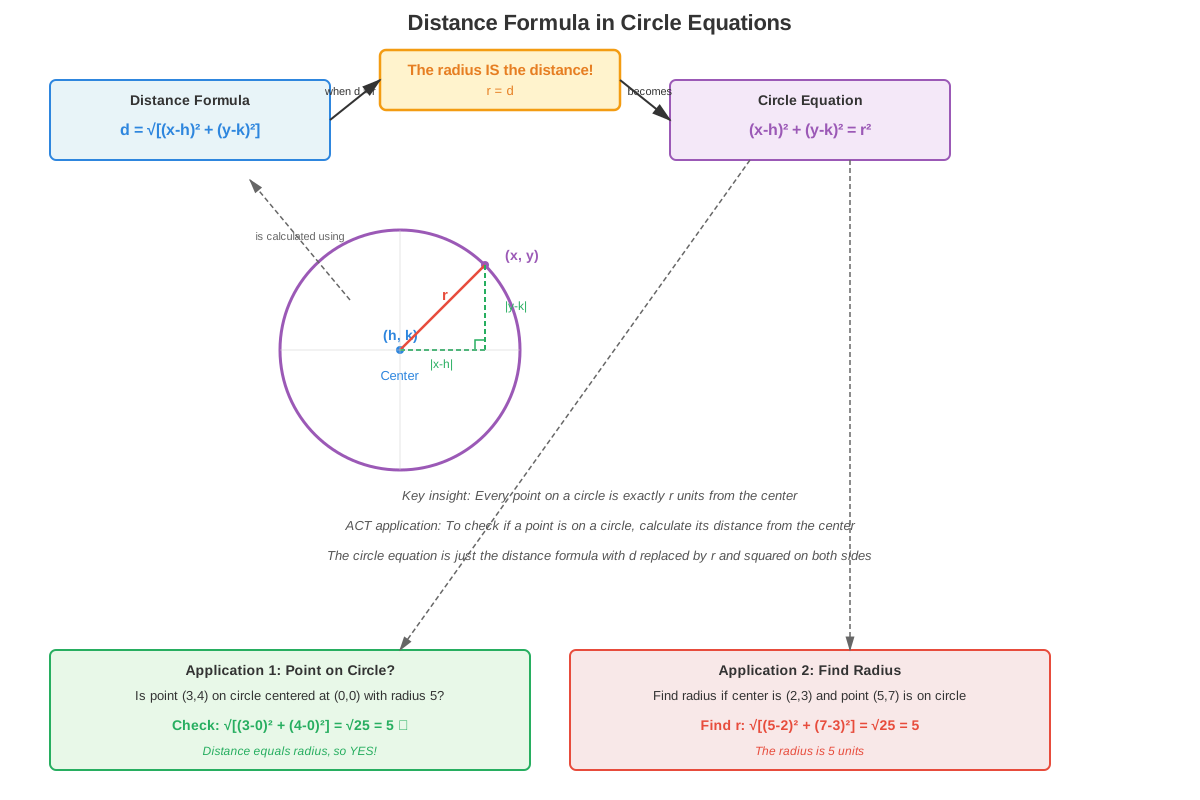
The distance formula is intrinsically linked to the equation of a circle. A circle with center (h, k) and radius r consists of all points (x, y) that are exactly distance r from the center. Applying the distance formula gives:
√[(x - h)² + (y - k)²] = rSquaring both sides produces the standard form of a circle equation: (x - h)² + (y - k)² = r². Many ACT questions test whether students can recognize this relationship and use the distance formula to find a radius or verify if a point lies on a circle.
Practical Calculation Tips
When working with the distance formula on the ACT:
- Write out the formula at the top of your scratch work to avoid errors
- Use parentheses liberally when substituting negative coordinates
- Calculate carefully when subtracting negative numbers: x₂ - (−x₁) = x₂ + x₁
- Check if simplification is needed: The ACT often includes answer choices in both simplified radical form and decimal approximations
- Look for perfect squares under the radical that can be simplified
Concept Relationships
The distance formula serves as a central hub connecting multiple coordinate geometry concepts. It derives from the Pythagorean theorem, demonstrating how a fundamental geometric principle translates into algebraic form. This connection reinforces that coordinate geometry is essentially geometry expressed through algebra.
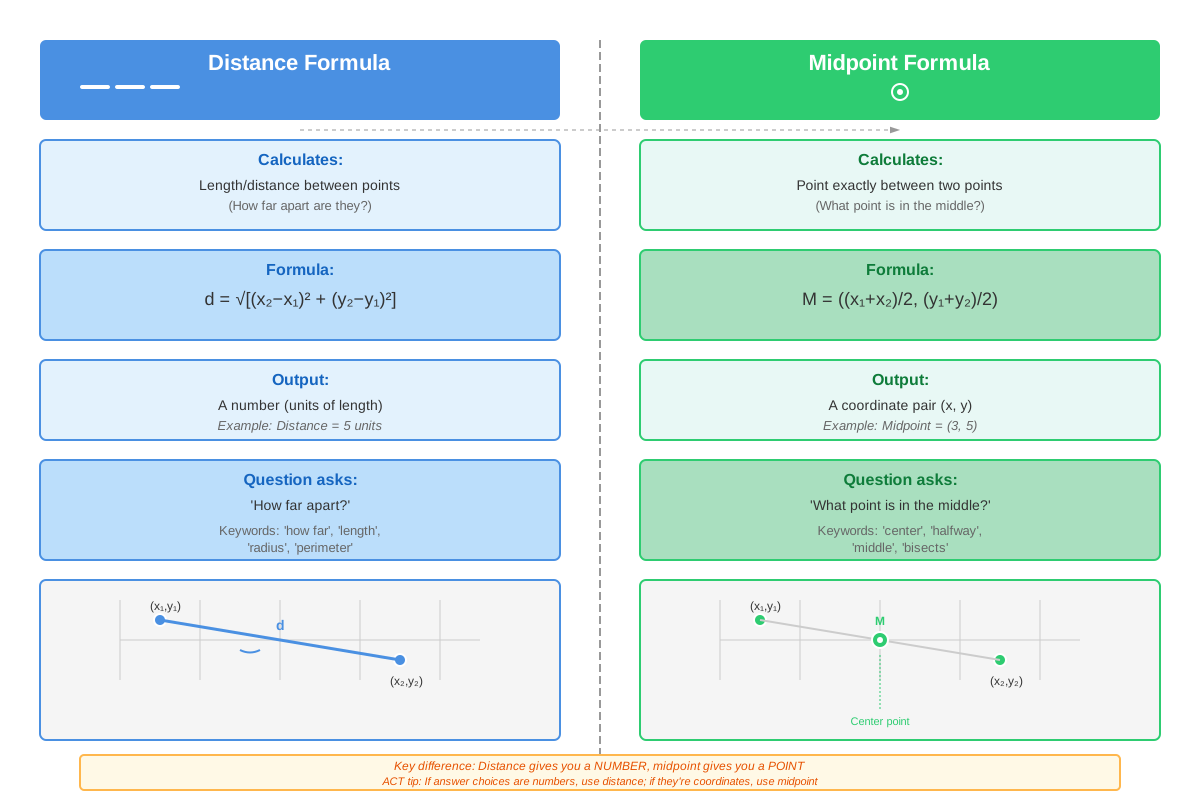
The formula relates directly to the midpoint formula, as both involve the coordinates of two points. While the midpoint formula finds the center point between two locations, the distance formula measures how far apart they are. Together, these formulas provide complete information about any line segment: its length and its center.
Circle equations depend entirely on the distance formula concept. Every point on a circle maintains a constant distance (the radius) from the center, making the distance formula the foundation for deriving and working with circle equations. Questions involving circles often require students to use the distance formula to calculate radii or verify point locations.
The distance formula connects to triangle problems by allowing calculation of side lengths when vertices are given as coordinates. This enables students to classify triangles (equilateral, isosceles, scalene), verify the Pythagorean theorem for right triangles, or calculate perimeters. Similarly, for quadrilaterals and polygons, the distance formula helps find side lengths and diagonals.
Optimization problems sometimes require finding maximum or minimum distances, connecting the distance formula to algebraic problem-solving strategies. The formula also appears in word problems involving maps, grids, or any scenario where locations are described using coordinates.
Relationship flow: Pythagorean Theorem → Distance Formula → Circle Equations → Geometric Figure Analysis → Multi-step Problem Solving
High-Yield Facts
⭐ The distance formula is d = √[(x₂ - x₁)² + (y₂ - y₁)²] and must be memorized for the ACT
⭐ The distance formula is derived from the Pythagorean theorem applied to a coordinate plane
⭐ The order of subtraction doesn't matter because the differences are squared: (a - b)² = (b - a)²
⭐ Distance is always positive or zero; if you get a negative result, you made a calculation error
⭐ The distance from any point (x, y) to the origin (0, 0) is √(x² + y²)
- When two points share the same y-coordinate, the distance is simply |x₂ - x₁|
- When two points share the same x-coordinate, the distance is simply |y₂ - y₁|
- The radius of a circle can be found using the distance formula between the center and any point on the circle
- Simplifying radicals in your final answer is often required to match ACT answer choices
- The distance formula works in all four quadrants without modification
- Squaring negative numbers always yields positive results: (−5)² = 25
- The distance between two identical points is zero
- ACT questions often require using the distance formula as one step in a multi-step problem
- Calculator use is permitted and recommended for complex arithmetic in distance calculations
- The distance formula can be used to verify if three points form a right triangle by checking if a² + b² = c²
Quick check — test yourself on Distance formula so far.
Try Flashcards →Common Misconceptions
Misconception: The order of subtraction matters in the distance formula, and you must always subtract the smaller coordinate from the larger one.
Correction: The order of subtraction is irrelevant because both differences are squared. Whether you calculate (x₂ - x₁)² or (x₁ - x₂)², the result is identical. This is because (a - b)² = (b - a)² for any real numbers a and b.
Misconception: When working with negative coordinates, you should make them positive before substituting into the formula.
Correction: Substitute coordinates exactly as given, including negative signs. The formula handles negative numbers correctly through the squaring operation. For example, if x₁ = −3 and x₂ = 4, calculate (4 - (−3))² = (4 + 3)² = 49, not (4 - 3)² = 1.
Misconception: The distance formula only works for points in the first quadrant where both coordinates are positive.
Correction: The distance formula works universally for any two points in any quadrant of the coordinate plane. The squaring operation ensures that all intermediate calculations remain valid regardless of whether coordinates are positive, negative, or zero.
Misconception: You can add the differences before squaring them: d = √[(x₂ - x₁) + (y₂ - y₁)]².
Correction: Each difference must be squared individually before adding: d = √[(x₂ - x₁)² + (y₂ - y₁)²]. The formula requires squaring first, then adding, then taking the square root. Changing this order produces incorrect results.
Misconception: If the distance calculation results in a radical that cannot be simplified, you made an error.
Correction: Many correct distance calculations result in radicals that cannot be simplified further, such as √13 or √29. Not all distances are whole numbers or simplifiable radicals. The ACT frequently includes these types of answers in the answer choices.
Misconception: The distance formula gives you the shortest path between two points when traveling along grid lines.
Correction: The distance formula calculates the straight-line distance (as the crow flies), not the distance traveled along horizontal and vertical grid lines. The grid-line distance would be |x₂ - x₁| + |y₂ - y₁|, which is always greater than or equal to the straight-line distance.
Worked Examples
Example 1: Direct Distance Calculation
Problem: Find the distance between points A(−2, 5) and B(4, −3).
Solution:
Step 1: Identify the coordinates.
- Point A: (x₁, y₁) = (−2, 5)
- Point B: (x₂, y₂) = (4, −3)
Step 2: Write the distance formula.
d = √[(x₂ - x₁)² + (y₂ - y₁)²]Step 3: Substitute the coordinates.
d = √[(4 - (−2))² + (−3 - 5)²]Step 4: Simplify inside the parentheses.
d = √[(4 + 2)² + (−8)²]
d = √[6² + (−8)²]
Step 5: Calculate the squares.
d = √[36 + 64]Step 6: Add and simplify.
d = √100 = 10Answer: The distance between points A and B is 10 units.
Key Insights: This problem demonstrates proper handling of negative coordinates. Notice that subtracting a negative number (4 - (−2)) becomes addition (4 + 2). Also observe that squaring the negative number (−8)² yields a positive result (64). This example connects to Learning Objective 3 by showing accurate application to an ACT-style calculation.
Example 2: Circle Application Problem
Problem: A circle has its center at point C(1, 2). Point P(5, 5) lies on the circle. What is the radius of the circle?
Solution:
Step 1: Recognize that the radius is the distance from the center to any point on the circle.
- Center C: (x₁, y₁) = (1, 2)
- Point on circle P: (x₂, y₂) = (5, 5)
Step 2: Apply the distance formula.
r = √[(x₂ - x₁)² + (y₂ - y₁)²]
r = √[(5 - 1)² + (5 - 2)²]
Step 3: Simplify.
r = √[4² + 3²]
r = √[16 + 9]
r = √25
r = 5
Step 4: Write the circle equation (bonus verification).
Using the standard form (x - h)² + (y - k)² = r²:
(x - 1)² + (y - 2)² = 25Answer: The radius is 5 units.
Key Insights: This problem illustrates how the distance formula connects to circle equations, addressing Learning Objective 5. Many ACT questions present circle problems without explicitly mentioning "distance," requiring students to recognize that finding a radius means calculating distance from center to circumference. This type of problem tests conceptual understanding, not just mechanical calculation.
Exam Strategy
When approaching distance formula questions on the ACT, begin by identifying trigger phrases that signal the need for this formula. Look for questions asking about "distance between points," "length of a segment," "radius of a circle," or "how far apart" two locations are. Questions involving coordinate geometry that mention circles almost always require the distance formula at some point.
Time management is crucial. A straightforward distance calculation should take 30-45 seconds, while multi-step problems involving the distance formula might require 60-90 seconds. If a problem seems to require more than two minutes, you may be overcomplicating it—look for a simpler approach or move on and return later.
Process of elimination works effectively with distance formula questions. Distance is always non-negative, so immediately eliminate any negative answer choices. If you can estimate the approximate distance by visualizing the coordinate plane, eliminate answers that are unreasonably large or small. For example, if two points are clearly close together (within a few units), an answer of 50 is likely incorrect.
Calculator strategy: Use your calculator for arithmetic, but write out the formula and substitution steps on paper. This prevents input errors and allows you to check your work. When entering complex expressions, use parentheses liberally: calculate (x₂ - x₁)² and (y₂ - y₁)² separately, add them, then take the square root.
Common question variations to watch for:
- Direct calculation: "What is the distance between (a, b) and (c, d)?"
- Circle problems: "What is the radius of the circle with center (h, k) passing through point (x, y)?"
- Geometric figures: "What is the perimeter of triangle ABC with vertices at..."
- Word problems: "A map uses a coordinate system where each unit represents 1 mile..."
Red flag phrases that indicate you might need the distance formula include: "straight-line distance," "as the crow flies," "shortest distance," "radius," "equidistant," and "how far."
Double-check strategy: After calculating, verify that your answer makes intuitive sense. If point A is at (0, 0) and point B is at (3, 4), the distance should be 5 (a 3-4-5 right triangle). Use this type of reasoning to catch calculation errors quickly.
Memory Techniques
Mnemonic for the formula structure: "Difference Squared Add Root" (DSAR)
- Difference: Find the difference in x-coordinates and y-coordinates
- Squared: Square both differences
- Add: Add the squared differences together
- Root: Take the square root of the sum
Visual memory aid: Picture a right triangle on the coordinate plane. The horizontal leg represents the x-difference, the vertical leg represents the y-difference, and the hypotenuse (which you're finding) represents the distance. This visualization reinforces that the distance formula is just the Pythagorean theorem in disguise.
Acronym for avoiding errors: SPIN
- Substitute carefully (watch negative signs)
- Parentheses around negative numbers
- Individually square each difference
- Never forget the square root at the end
Rhyme for remembering: "Square the x's, square the y's, add them up, then root-ify!"
Association technique: Link "distance" with "Pythagorean" by remembering that both involve finding the longest side of a right triangle. Whenever you see a distance problem, immediately think "right triangle" and the connection to a² + b² = c² becomes automatic.
Finger counting method: Use your fingers to track the steps: (1) identify points, (2) find x-difference, (3) find y-difference, (4) square both, (5) add them, (6) take square root. This kinesthetic approach helps ensure you don't skip steps during the test.
Summary
The distance formula is an essential coordinate geometry tool that calculates the straight-line distance between any two points on a coordinate plane. Derived from the Pythagorean theorem, the formula d = √[(x₂ - x₁)² + (y₂ - y₁)²] works universally across all quadrants and handles positive, negative, and zero coordinates seamlessly. Mastery requires understanding both the mechanical application—substituting coordinates, squaring differences, adding, and taking the square root—and the conceptual foundation that connects it to right triangles and circle equations. On the ACT, the distance formula appears in 2-3 questions per exam, either as direct calculations or embedded within problems involving circles, geometric figures, or word problems. Success demands careful attention to negative signs, proper order of operations, and the ability to simplify radicals. Students who can quickly recognize when the distance formula is needed and execute it accurately gain a significant advantage in the coordinate geometry portion of the ACT Math section.
Key Takeaways
- The distance formula d = √[(x₂ - x₁)² + (y₂ - y₁)²] must be memorized and understood as an application of the Pythagorean theorem
- Order of subtraction doesn't matter because differences are squared, making (a - b)² = (b - a)²
- Always use parentheses when substituting negative coordinates to avoid sign errors
- The formula works identically in all four quadrants without any modifications
- Distance formula questions appear 2-3 times per ACT exam and are crucial for circle problems and geometric figure analysis
- Recognize trigger phrases like "distance between," "radius," "how far apart," and "length of segment"
- Distance is always non-negative; negative results indicate a calculation error
Related Topics
Midpoint Formula: Closely related to the distance formula, the midpoint formula finds the point exactly halfway between two given points using M = ((x₁ + x₂)/2, (y₁ + y₂)/2). Mastering both formulas together provides complete information about any line segment.
Circle Equations: The standard form of a circle equation (x - h)² + (y - k)² = r² is derived directly from the distance formula. Understanding this connection enables solving complex circle problems involving tangent lines, intersections, and point verification.
Pythagorean Theorem Applications: Since the distance formula is the Pythagorean theorem in coordinate form, strengthening your understanding of right triangle relationships enhances distance formula mastery and vice versa.
Slope and Linear Equations: While distinct from distance, slope calculations often appear alongside distance problems in coordinate geometry questions, requiring students to analyze line segments from multiple perspectives.
Geometric Proofs in Coordinate Geometry: Advanced applications use the distance formula to prove properties of geometric figures (e.g., proving a quadrilateral is a rhombus by showing all sides are equal length).
Practice CTA
Now that you've mastered the theoretical foundation of the distance formula, it's time to solidify your understanding through practice. Attempt the practice questions to test your ability to recognize when the distance formula is needed and apply it accurately under timed conditions. Use the flashcards to reinforce the formula itself and key concepts until they become automatic. Remember, the difference between knowing the distance formula and mastering it lies in repeated, deliberate practice. Each problem you solve builds the pattern recognition and calculation speed that will serve you on test day. You've got this—start practicing now!
Sign up free to keep reading
Create a free AnvayaPrep account to finish this ACT guide on Distance formula — plus flashcards and practice questions.