Overview
The law of cosines basics represents one of the most powerful tools in trigonometry for solving non-right triangles, and it appears regularly on the ACT Math section. While many students are comfortable with right triangle trigonometry using sine, cosine, and tangent ratios, the law of cosines extends these capabilities to any triangle configuration. This fundamental relationship connects the lengths of a triangle's sides with the cosine of one of its angles, providing a method to find unknown sides or angles when traditional right-triangle approaches fail.
On the ACT, the law of cosines typically appears in 1-2 questions per test, making it a high-yield topic that can directly impact your score. These questions often involve real-world scenarios such as navigation problems, distance calculations, or geometric constructions where you must determine missing measurements in oblique (non-right) triangles. Understanding when and how to apply this law distinguishes students who score in the upper ranges from those who struggle with advanced geometry and trigonometry problems.
The law of cosines serves as a bridge between basic triangle properties (such as the Pythagorean theorem) and more advanced trigonometric concepts. It generalizes the Pythagorean theorem to work for all triangles, not just right triangles, and complements the law of sines as part of the complete toolkit for triangle solving. Mastering this topic strengthens overall geometric reasoning and prepares students for the integrated problem-solving that characterizes higher-difficulty ACT Math questions.
Learning Objectives
- [ ] Identify when Law of cosines basics is being tested
- [ ] Explain the core rule or strategy behind Law of cosines basics
- [ ] Apply Law of cosines basics to ACT-style questions accurately
- [ ] Determine which form of the law of cosines to use based on given information
- [ ] Distinguish between situations requiring law of cosines versus law of sines
- [ ] Solve for both unknown sides and unknown angles using the law of cosines
- [ ] Recognize real-world contexts where the law of cosines provides the solution method
Prerequisites
- Basic trigonometric ratios (sine, cosine, tangent): Understanding these ratios provides the foundation for comprehending how cosine relates angles to side lengths
- Pythagorean theorem: The law of cosines generalizes this theorem, so recognizing their connection aids conceptual understanding
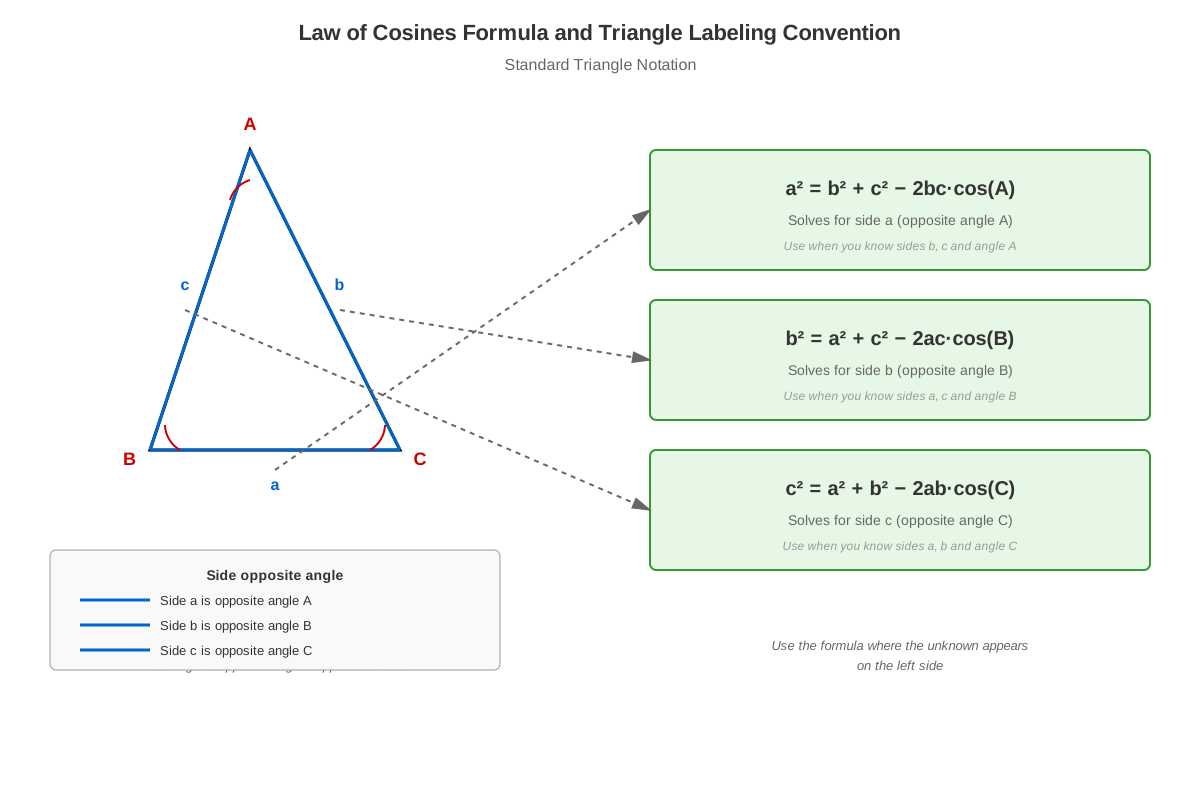
- Triangle properties and notation: Familiarity with standard triangle labeling (sides a, b, c opposite angles A, B, C) ensures proper formula application
- Algebraic manipulation: Solving equations with squares and square roots is essential for isolating variables in law of cosines problems
- Inverse trigonometric functions: Finding angles requires using arccos (cos⁻¹) to reverse the cosine operation
Why This Topic Matters
The law of cosines has extensive real-world applications in fields requiring precise distance and angle measurements. Surveyors use it to determine inaccessible distances, navigators employ it for course plotting when direct paths aren't available, and engineers apply it in structural design when components meet at non-right angles. Architects rely on this principle when designing roof trusses, and physicists use it to resolve force vectors acting at angles. Understanding this concept demonstrates mathematical maturity and problem-solving versatility.
On the ACT Math section, law of cosines questions typically appear 1-2 times per test, usually in the final 20 questions where difficulty increases. These problems are worth the same single point as easier questions, but correctly answering them signals mastery of advanced content and significantly improves scaled scores. The ACT frequently embeds law of cosines within word problems involving navigation, surveying, or geometric design, requiring students to first recognize the triangle configuration before applying the formula.
Common ACT presentations include: providing two sides and the included angle (SAS configuration) and asking for the third side; giving all three sides (SSS configuration) and requesting an angle measure; embedding the triangle within a coordinate plane or real-world scenario; or combining law of cosines with other geometric principles in multi-step problems. Questions may also test whether students can distinguish when law of cosines is appropriate versus when simpler methods (like Pythagorean theorem) or alternative approaches (like law of sines) would be more efficient.
Core Concepts
The Law of Cosines Formula
The law of cosines states that for any triangle with sides of length a, b, and c, and angles A, B, and C opposite those respective sides:
c² = a² + b² - 2ab·cos(C)This formula can be rearranged to solve for any side when you know the other two sides and the included angle. The three equivalent forms are:
a² = b² + c² - 2bc·cos(A)
b² = a² + c² - 2ac·cos(B)
c² = a² + b² - 2ab·cos(C)
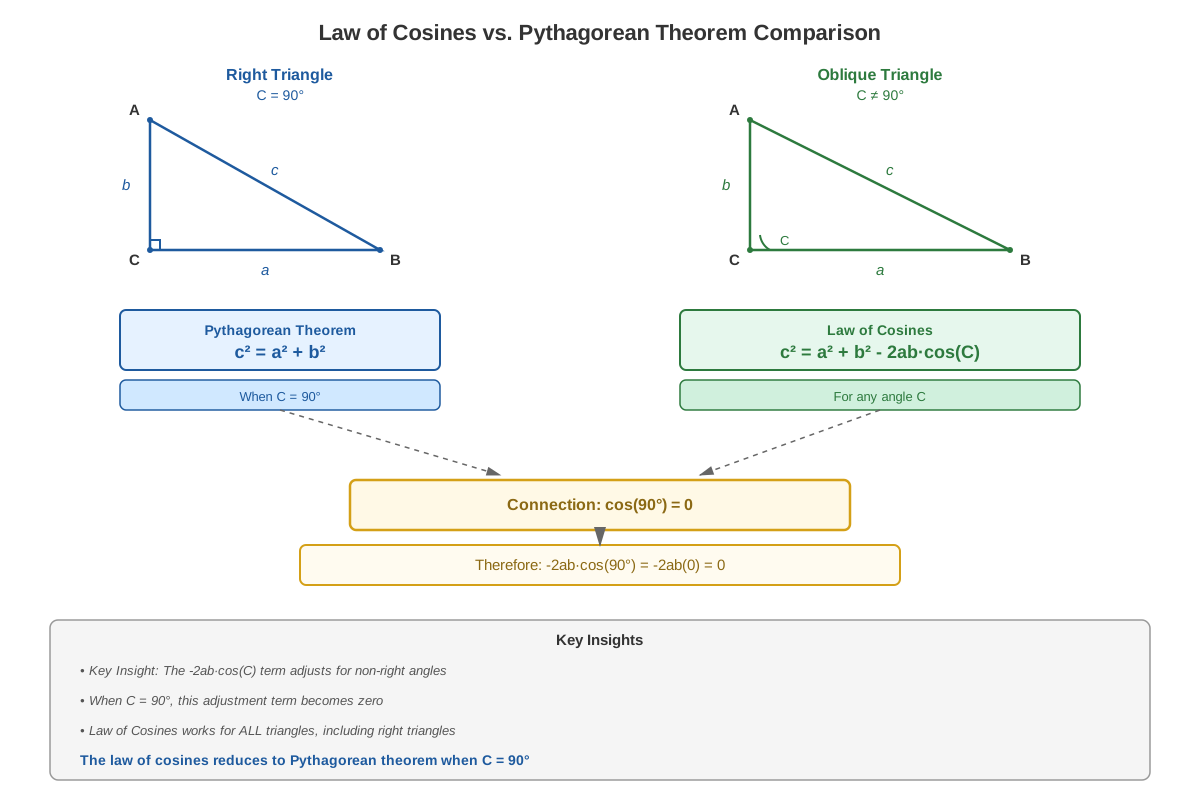
Notice the pattern: the side you're solving for appears squared on the left, while the other two sides appear on the right with a cosine term involving the angle opposite the unknown side. This relationship reveals why the law of cosines generalizes the Pythagorean theorem—when angle C equals 90°, cos(90°) = 0, and the formula reduces to c² = a² + b², the familiar Pythagorean relationship.
When to Use the Law of Cosines
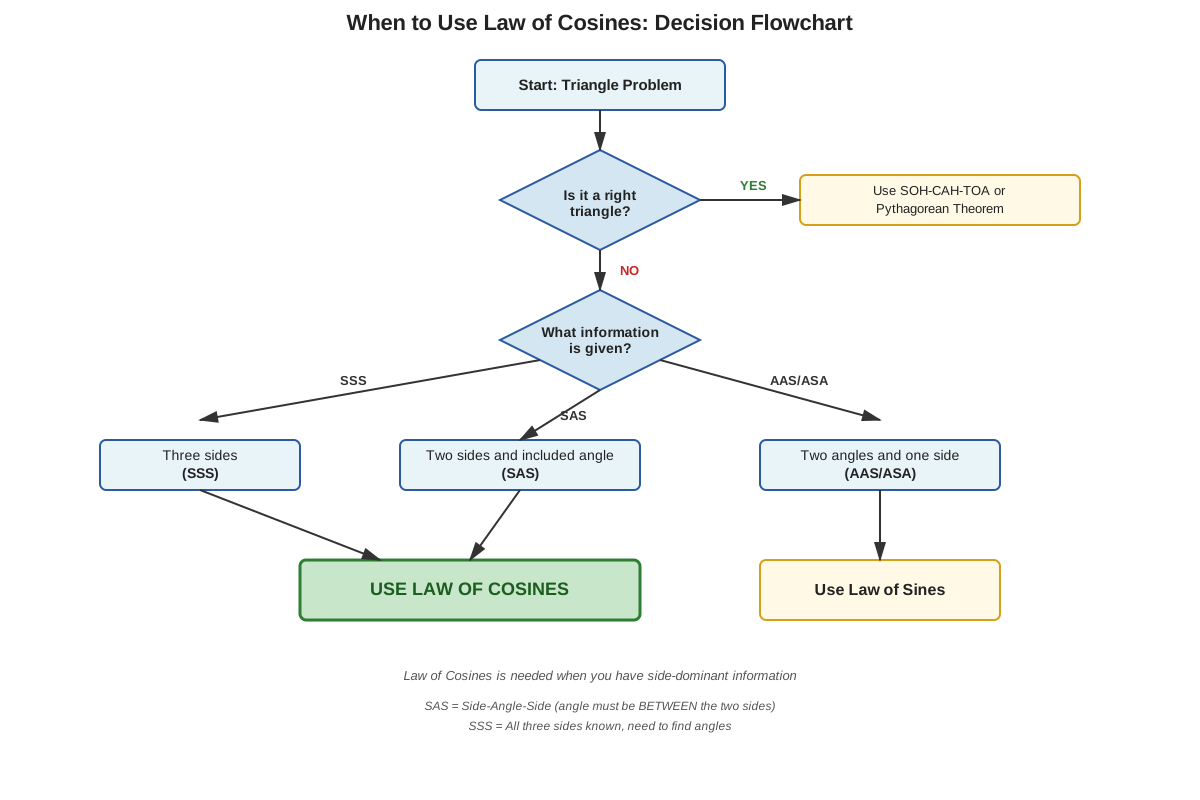
The ACT law of cosines basics requires recognizing two specific triangle configurations:
SAS (Side-Angle-Side): When you know two sides and the angle between them (the included angle), use the law of cosines to find the third side. For example, if you know sides a and b and angle C, you can calculate side c.
SSS (Side-Side-Side): When you know all three sides but need to find an angle, rearrange the law of cosines to solve for the cosine of the angle:
cos(C) = (a² + b² - c²) / (2ab)Then use the inverse cosine function (arccos or cos⁻¹) to find the angle measure.
Solving for an Unknown Side
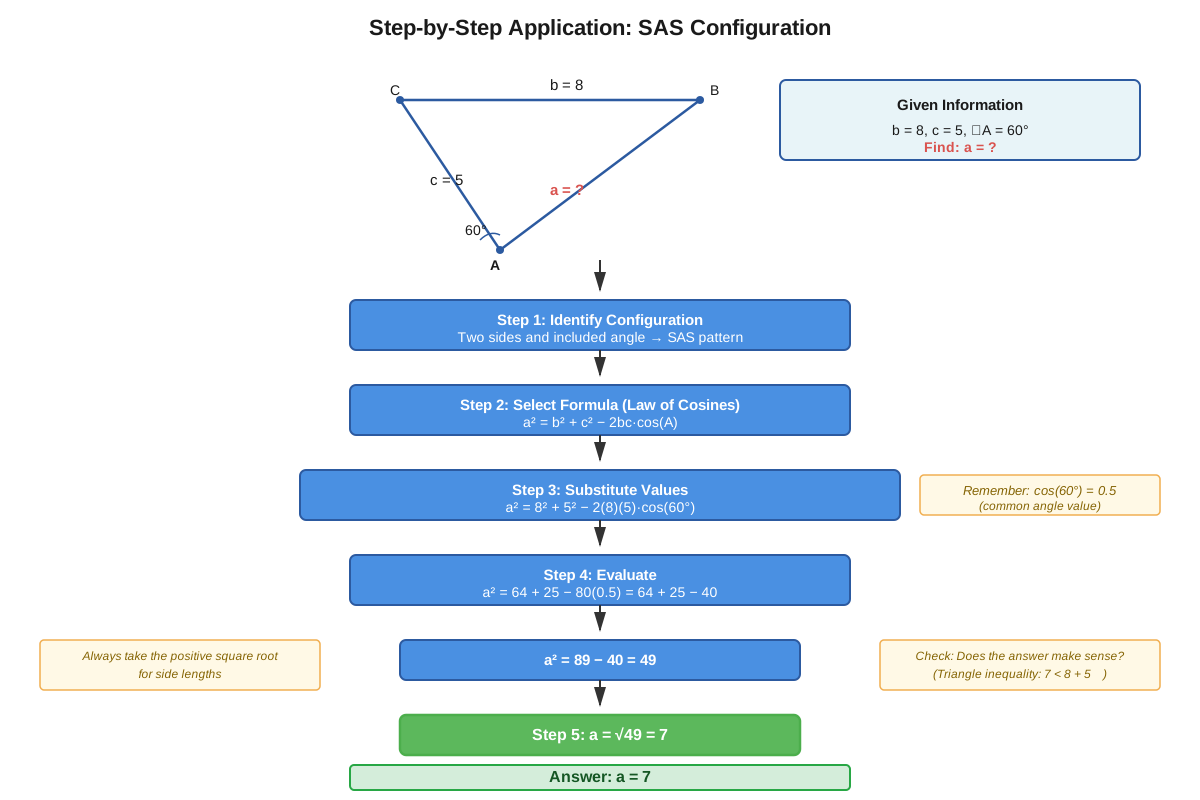
When given two sides and the included angle (SAS configuration), follow these steps:
- Identify the known values: Determine which two sides and which angle you have
- Select the appropriate formula: Choose the version where the unknown side appears on the left
- Substitute values: Plug in the known measurements
- Calculate the cosine: Evaluate cos(angle) using your calculator in degree mode
- Perform arithmetic: Complete the multiplication and subtraction
- Take the square root: Find the positive square root to get the side length
For example, if a = 7, b = 10, and C = 42°, then:
c² = 7² + 10² - 2(7)(10)·cos(42°)
c² = 49 + 100 - 140·cos(42°)
c² = 149 - 140(0.7431)
c² = 149 - 104.03
c² = 44.97
c ≈ 6.71
Solving for an Unknown Angle
When given all three sides (SSS configuration), rearrange the formula to isolate the cosine term:
- Choose which angle to find: Select any angle (often the one the problem asks for)
- Rearrange the formula: Move terms to isolate cos(angle)
- Substitute side lengths: Plug in all three side measurements
- Calculate the fraction: Perform the arithmetic to get a decimal value
- Apply inverse cosine: Use cos⁻¹ to find the angle measure
For example, if a = 5, b = 7, and c = 9, to find angle C:
cos(C) = (a² + b² - c²) / (2ab)
cos(C) = (25 + 49 - 81) / (2·5·7)
cos(C) = -7 / 70
cos(C) = -0.1
C = cos⁻¹(-0.1)
C ≈ 95.7°
Notice that the negative cosine value indicates an obtuse angle (greater than 90°), which makes geometric sense given that the longest side (c = 9) is opposite this angle.
Calculator Considerations
ACT questions involving the law of cosines require a calculator, and proper calculator use is critical:
- Degree mode: Ensure your calculator is set to degrees, not radians, as ACT problems use degree measures
- Order of operations: Use parentheses to ensure correct calculation sequence, especially with the 2ab term
- Inverse functions: Know how to access cos⁻¹ (often a second function above the cosine button)
- Rounding: Keep intermediate values in your calculator to avoid rounding errors, but round final answers appropriately (usually to nearest tenth or hundredth)
Distinguishing from Other Methods
| Given Information | Method to Use | What You Can Find |
|---|---|---|
| Two sides + included angle (SAS) | Law of Cosines | Third side |
| Three sides (SSS) | Law of Cosines | Any angle |
| Two angles + one side (AAS/ASA) | Law of Sines | Other sides or angles |
| Right triangle + one side + one angle | Basic trig ratios (SOH-CAH-TOA) | Other sides or angles |
| Right triangle + two sides | Pythagorean theorem | Third side |
Understanding these distinctions prevents wasting time on inappropriate methods and ensures efficient problem-solving on the time-constrained ACT.
Concept Relationships
The law of cosines connects directly to the Pythagorean theorem as a generalization—when the angle becomes 90°, the cosine term vanishes and the formula reduces to the familiar a² + b² = c². This relationship helps students understand that the law of cosines isn't an entirely new concept but rather an extension of existing knowledge to non-right triangles.
Within triangle-solving techniques, the law of cosines complements the law of sines. While the law of sines works efficiently for AAS, ASA, and SSA configurations, the law of cosines handles SAS and SSS cases. Together, these two laws provide complete coverage for solving any triangle given sufficient information. The decision tree flows: identify given information → determine if it's a right triangle (use basic trig) → if not, check if you have SAS or SSS (use law of cosines) → otherwise use law of sines.
The law of cosines also connects to coordinate geometry when triangles are embedded in the coordinate plane. Students might need to first calculate side lengths using the distance formula, then apply the law of cosines to find angles. This integration of multiple concepts represents the type of sophisticated problem-solving the ACT rewards at higher difficulty levels.
Understanding inverse trigonometric functions becomes essential when using the law of cosines to find angles. The relationship flows: three sides → law of cosines formula → cosine value → inverse cosine function → angle measure. This sequence requires comfort with both forward and backward trigonometric operations.
Quick check — test yourself on Law of cosines basics so far.
Try Flashcards →High-Yield Facts
⭐ The law of cosines formula is c² = a² + b² - 2ab·cos(C), where c is opposite angle C
⭐ Use law of cosines when given two sides and the included angle (SAS) to find the third side
⭐ Use law of cosines when given three sides (SSS) to find any angle
⭐ When the angle is 90°, the law of cosines reduces to the Pythagorean theorem because cos(90°) = 0
⭐ To find an angle, rearrange to cos(C) = (a² + b² - c²)/(2ab), then use inverse cosine
- The law of cosines works for all triangles: acute, right, and obtuse
- A negative cosine value indicates an obtuse angle (greater than 90°)
- Always ensure your calculator is in degree mode for ACT problems
- The longest side of a triangle is always opposite the largest angle
- You can use any of the three equivalent forms of the law of cosines depending on which side or angle you're solving for
- The law of cosines requires knowing either two sides and the included angle, or all three sides
- When using inverse cosine, the result will always be between 0° and 180°, which covers all possible triangle angles
Common Misconceptions
Misconception: The law of cosines only works for right triangles → Correction: The law of cosines works for ALL triangles—acute, right, and obtuse. In fact, it's most useful for non-right triangles, since right triangles can be solved more easily with the Pythagorean theorem and basic trig ratios.
Misconception: You can use any angle with any sides in the formula → Correction: The angle in the formula must be the one opposite the side you're solving for (or between the two sides you're using). The formula c² = a² + b² - 2ab·cos(C) specifically requires angle C to be opposite side c and between sides a and b.
Misconception: A negative result when solving for cos(angle) means you made an error → Correction: Negative cosine values are valid and indicate an obtuse angle (between 90° and 180°). For example, cos(120°) = -0.5, which is perfectly correct for an obtuse triangle.
Misconception: The law of cosines and law of sines are interchangeable → Correction: These laws apply to different configurations. Law of cosines is for SAS and SSS cases, while law of sines works for AAS, ASA, and SSA cases. Using the wrong law for a given configuration will lead to incorrect answers or unsolvable equations.
Misconception: You should always take the positive and negative square root when solving for a side → Correction: Side lengths must be positive, so only the positive square root is meaningful. When you see c² = 44.97, the answer is c ≈ 6.71, not ±6.71.
Misconception: The 2ab term is optional or can be simplified differently → Correction: The 2ab coefficient is essential to the formula. Some students incorrectly write c² = a² + b² - ab·cos(C), forgetting the factor of 2, which leads to completely wrong answers.
Worked Examples
Example 1: Finding an Unknown Side (SAS Configuration)
Problem: A triangular plot of land has two sides measuring 150 feet and 200 feet, with an angle of 65° between them. What is the length of the third side to the nearest foot?
Solution:
Step 1: Identify the given information and what we're solving for
- Side a = 150 feet
- Side b = 200 feet
- Angle C = 65° (the included angle between sides a and b)
- We need to find side c
Step 2: Select the appropriate law of cosines formula
Since we're finding side c and we know sides a and b with included angle C:
c² = a² + b² - 2ab·cos(C)Step 3: Substitute the known values
c² = 150² + 200² - 2(150)(200)·cos(65°)Step 4: Calculate each term
c² = 22,500 + 40,000 - 60,000·cos(65°)Step 5: Evaluate the cosine (ensure calculator is in degree mode)
cos(65°) ≈ 0.4226
c² = 62,500 - 60,000(0.4226)
c² = 62,500 - 25,356
c² = 37,144
Step 6: Take the square root
c = √37,144 ≈ 192.7 feetStep 7: Round to the nearest foot
c ≈ 193 feetAnswer: The third side is approximately 193 feet long.
This problem demonstrates the classic SAS application of the law of cosines, which is the most common way this topic appears on the ACT. The real-world context (land surveying) is typical of how the test embeds mathematical concepts in practical scenarios.
Example 2: Finding an Unknown Angle (SSS Configuration)
Problem: A triangle has sides of length 8 cm, 11 cm, and 15 cm. What is the measure of the largest angle to the nearest degree?
Solution:
Step 1: Identify the given information and strategy
- All three sides are known: a = 8, b = 11, c = 15
- The largest angle is opposite the longest side
- Since c = 15 is the longest side, we need to find angle C
Step 2: Use the rearranged law of cosines to solve for the angle
cos(C) = (a² + b² - c²) / (2ab)Step 3: Substitute the side lengths
cos(C) = (8² + 11² - 15²) / (2·8·11)Step 4: Calculate the numerator
cos(C) = (64 + 121 - 225) / 176
cos(C) = -40 / 176
cos(C) ≈ -0.2273
Step 5: Note that the negative value indicates an obtuse angle
This makes sense because the longest side is opposite the largest angle, and when one angle is obtuse, it's the largest angle in the triangle.
Step 6: Apply inverse cosine
C = cos⁻¹(-0.2273)
C ≈ 103.1°
Step 7: Round to the nearest degree
C ≈ 103°Answer: The largest angle measures approximately 103°.
This example illustrates the SSS application and reinforces the important concept that negative cosine values are valid and indicate obtuse angles. It also demonstrates the geometric principle that the largest angle is always opposite the longest side, which can serve as a check on your answer.
Exam Strategy
When approaching ACT law of cosines basics questions, begin by quickly sketching the triangle and labeling all given information. This visual representation helps identify whether you have an SAS or SSS configuration and prevents confusion about which sides and angles correspond. Even a rough sketch takes only 5-10 seconds but significantly reduces errors.
Trigger words and phrases that signal law of cosines problems include: "two sides and the angle between them," "the included angle," "all three sides are known," "find the third side," "determine the angle opposite," and real-world contexts involving navigation, surveying, or distance problems where right angles aren't mentioned. If a problem describes a triangle without explicitly stating it's a right triangle, consider whether law of cosines might apply.
For process of elimination, recognize that answer choices for side lengths must satisfy the triangle inequality (the sum of any two sides must exceed the third side). If you're solving for an angle, eliminate any answer that would make the angle sum exceed 180° or that contradicts the relationship between side lengths and opposite angles (longest side opposite largest angle). When calculator use is required, extremely simple answers like whole numbers or common fractions are less likely unless the problem is designed to have clean values.
Time allocation for law of cosines problems should be approximately 1.5-2 minutes. These problems typically appear in the final third of the test where you might be time-pressured, so practice efficient calculator use and formula recall. If you're stuck after 30 seconds of reading, mark the question and return to it—don't let one problem consume excessive time. However, these problems are worth attempting because they're worth the same point value as easier questions and demonstrate mastery that can boost your scaled score.
Always verify your answer makes geometric sense: side lengths should be positive and reasonable relative to the given sides, and angles should fall between 0° and 180°. A quick mental check—does the longest side correspond to the largest angle?—can catch calculation errors before you bubble in an incorrect answer.
Memory Techniques
Mnemonic for when to use law of cosines: "SAS and SSS need COSines" helps remember that Side-Angle-Side and Side-Side-Side configurations require the law of cosines (which contains cosine), while other configurations typically use the law of sines.
Formula memory: Think of the law of cosines as "Pythagorean theorem PLUS a correction term." Start with a² + b² (like Pythagorean), then subtract the correction 2ab·cos(C). This framing helps prevent forgetting the 2ab coefficient and reinforces the connection to prior knowledge.
Visualization strategy: Picture the cosine term as an "adjustment factor" that accounts for the angle not being 90°. When the angle is acute (less than 90°), cosine is positive, so you subtract more, making the opposite side shorter. When the angle is obtuse (greater than 90°), cosine is negative, so you subtract a negative (add), making the opposite side longer. This mental model helps you estimate whether your answer is reasonable.
Acronym for solving steps: "ISSCE" = Identify given info, Select formula, Substitute values, Calculate, Check answer, Evaluate reasonableness. This provides a consistent approach for every problem.
Summary
The law of cosines basics represents an essential tool for solving non-right triangles on the ACT Math section, appearing in 1-2 questions per test. The fundamental formula c² = a² + b² - 2ab·cos(C) generalizes the Pythagorean theorem to all triangles and enables solving for unknown sides when given two sides and the included angle (SAS), or for unknown angles when given all three sides (SSS). Success requires recognizing which configuration you're dealing with, selecting the appropriate form of the formula, performing accurate calculator operations in degree mode, and using inverse cosine when solving for angles. The law of cosines complements the law of sines to provide complete triangle-solving capability, and understanding when each applies distinguishes high-scoring students. Mastery involves not just memorizing the formula but developing the geometric intuition to recognize when it's needed and the algebraic skill to manipulate it correctly under time pressure.
Key Takeaways
- The law of cosines formula c² = a² + b² - 2ab·cos(C) works for all triangles and reduces to the Pythagorean theorem when C = 90°
- Use law of cosines for SAS (two sides and included angle) to find the third side, or SSS (three sides) to find any angle
- When solving for an angle, rearrange to cos(C) = (a² + b² - c²)/(2ab) and apply inverse cosine
- Negative cosine values indicate obtuse angles and are mathematically valid—don't assume they're errors
- Always ensure your calculator is in degree mode and use parentheses to maintain correct order of operations
- The law of cosines and law of sines handle different triangle configurations—knowing which to use is as important as knowing the formulas
- Verify answers make geometric sense: positive side lengths, angles between 0° and 180°, longest side opposite largest angle
Related Topics
Law of Sines: After mastering the law of cosines, the law of sines completes your triangle-solving toolkit by handling AAS, ASA, and SSA configurations. Together, these laws enable solving any triangle with sufficient information.
Trigonometric Functions and the Unit Circle: Deeper understanding of how cosine relates to angles and why cosine can be negative strengthens conceptual mastery and helps with more advanced trigonometry problems.
Vectors and Components: The law of cosines appears in physics and engineering contexts involving vector addition, where forces or velocities combine at angles.
Area of Triangles Using Trigonometry: Once you can find all sides and angles using the law of cosines, you can calculate triangle areas using formulas like Area = (1/2)ab·sin(C), extending your geometric problem-solving capabilities.
Practice CTA
Now that you've mastered the core concepts of the law of cosines, it's time to solidify your understanding through active practice. Work through the practice questions to apply these principles to ACT-style problems, and use the flashcards to reinforce formula recall and key concepts. Remember, the difference between understanding a concept and scoring points on test day comes down to practiced application under timed conditions. You've built the foundation—now strengthen it through deliberate practice, and watch your confidence and accuracy soar!
Sign up free to keep reading
Create a free AnvayaPrep account to finish this ACT guide on Law of cosines basics — plus flashcards and practice questions.