Overview
The area of triangles is one of the most frequently tested topics in the Plane Geometry section of the ACT Math test. Understanding how to calculate triangle area using multiple methods is essential because triangles appear not only in standalone geometry problems but also embedded within complex figures, coordinate geometry questions, and word problems. Mastery of this topic enables students to solve approximately 2-3 questions per ACT Math section, making it a high-yield area for score improvement.
Triangle area calculations form the foundation for understanding more complex geometric concepts including polygon decomposition, three-dimensional surface area, and coordinate geometry applications. The ACT tests this concept through direct formula application, multi-step problems requiring auxiliary line construction, and scenarios where students must identify which formula or approach is most efficient. Questions may present triangles in standard orientation, rotated positions, or embedded within other shapes, requiring flexible thinking and pattern recognition.
Beyond isolated triangle problems, this topic connects deeply to coordinate geometry (finding areas using coordinates), trigonometry (using sine formulas for area), and algebraic reasoning (setting up equations when dimensions are unknown). The ACT frequently combines triangle area with concepts like the Pythagorean theorem, special right triangles, and properties of similar figures, making this topic a critical bridge between multiple mathematical domains. Students who develop fluency with triangle area calculations gain significant advantages in time management and problem-solving efficiency on test day.
Learning Objectives
- [ ] Identify when area of triangles is being tested in ACT questions
- [ ] Explain the core rule or strategy behind area of triangles calculations
- [ ] Apply area of triangles formulas to ACT area of triangles questions accurately
- [ ] Determine which area formula is most efficient for a given triangle configuration
- [ ] Calculate triangle areas when triangles are embedded in complex figures or coordinate planes
- [ ] Solve multi-step problems involving unknown dimensions by setting up area equations
- [ ] Recognize when to use alternative methods such as coordinate geometry or trigonometric approaches
Prerequisites
- Basic multiplication and division: Required to compute area using the standard formula and manipulate equations
- Understanding of perpendicular lines: Essential for identifying valid height measurements in triangles
- Coordinate plane fundamentals: Necessary when triangles are presented with vertex coordinates
- Properties of right triangles: Helps identify when legs can serve as base and height
- Algebraic equation solving: Needed when dimensions are expressed as variables or when working backwards from a given area
Why This Topic Matters
Triangle area problems appear with remarkable consistency on the ACT Math test, typically comprising 2-4 questions per exam administration. These questions span difficulty levels from straightforward formula application (easy) to complex multi-step problems involving algebraic reasoning and geometric decomposition (medium to hard). The topic's high frequency and point value make it one of the most efficient areas for focused study, offering substantial return on time investment.
In real-world applications, triangle area calculations are fundamental to fields including architecture, engineering, surveying, computer graphics, and physics. Professionals use these concepts to calculate material quantities, determine structural loads, analyze force vectors, and render three-dimensional objects. Understanding triangle area also develops spatial reasoning skills that transfer to everyday problem-solving, from determining paint coverage for triangular surfaces to optimizing garden layouts.
On the ACT, triangle area questions commonly appear in several formats: direct calculation problems providing base and height; coordinate geometry questions requiring students to find area from vertex coordinates; composite figure problems where triangles must be identified within larger shapes; and word problems describing real-world scenarios. The test also frequently embeds triangle area within multi-step problems, such as finding the area after determining missing dimensions using the Pythagorean theorem or similar triangle properties. Recognizing these patterns enables efficient problem identification and solution strategy selection.
Core Concepts
The Standard Area Formula
The fundamental formula for calculating the area of triangles is:
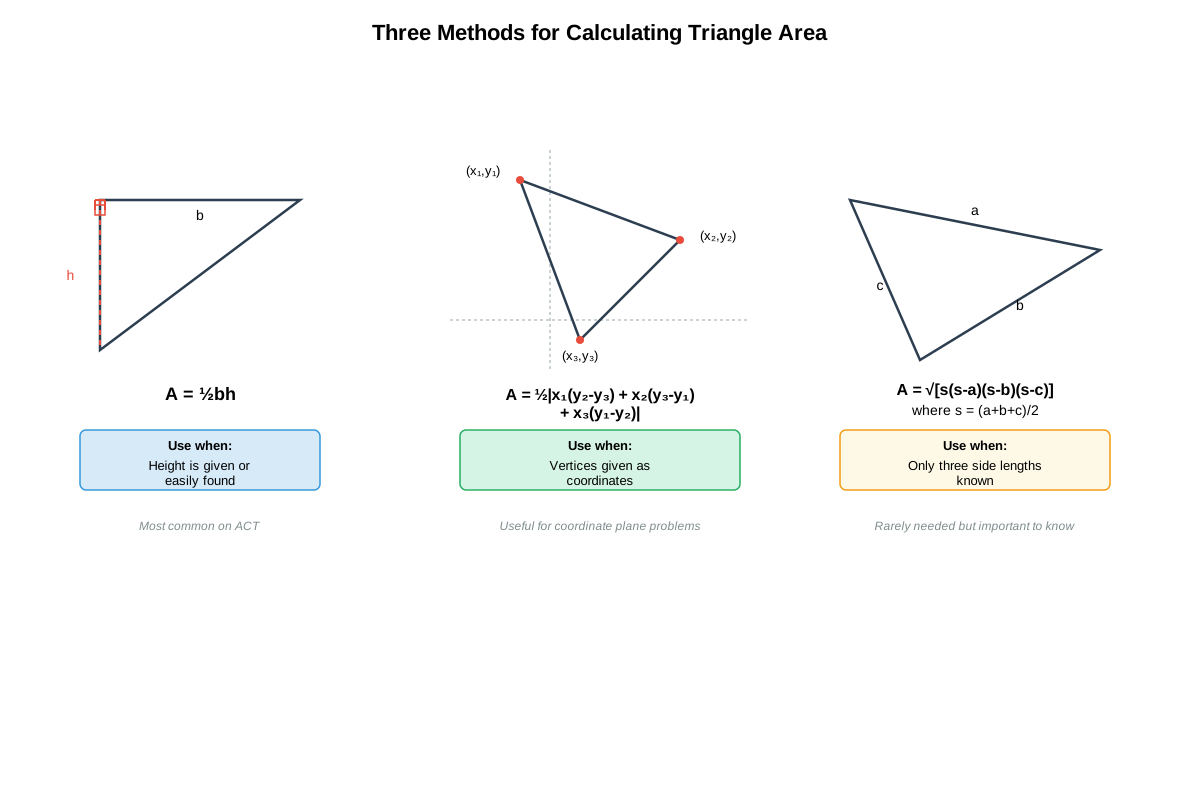
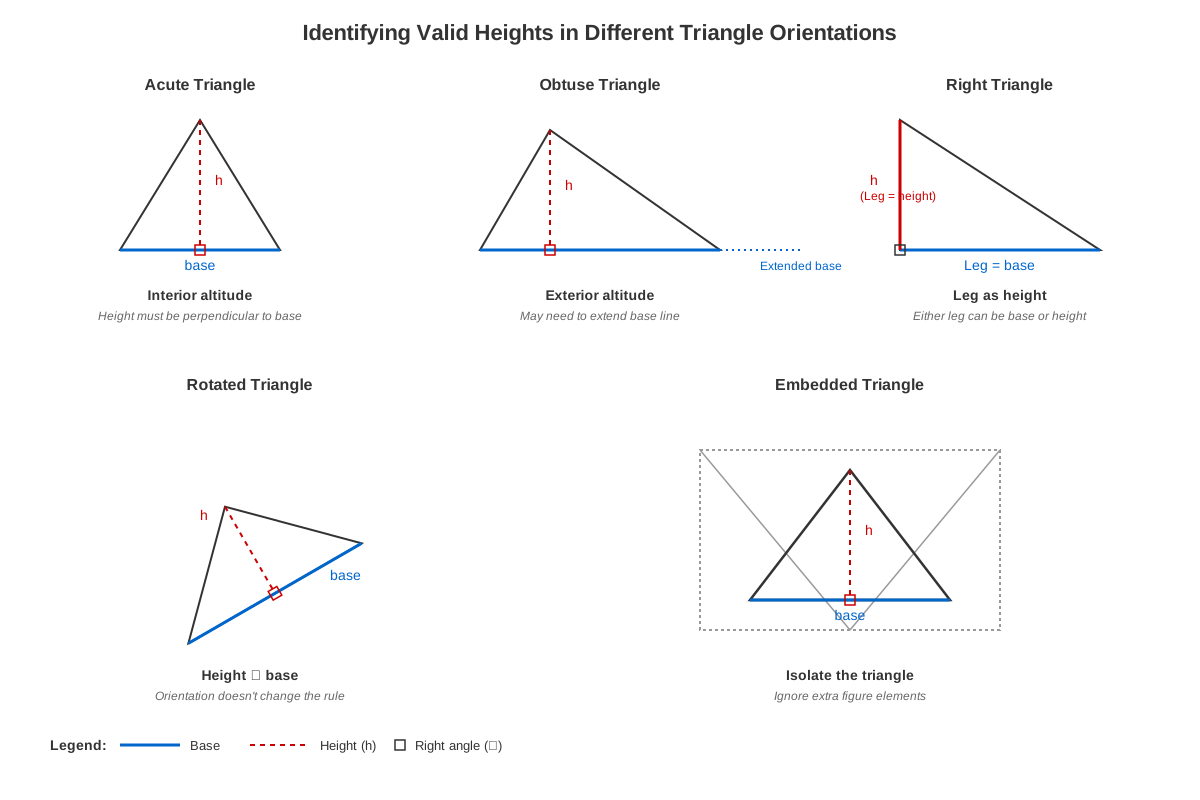
Area = (1/2) × base × heightThis formula applies universally to all triangles regardless of type (scalene, isosceles, equilateral, right, acute, or obtuse). The base can be any side of the triangle, and the height (also called altitude) must be the perpendicular distance from that base to the opposite vertex. This perpendicular requirement is critical—the height must form a 90-degree angle with the base.
The factor of 1/2 exists because a triangle occupies exactly half the area of a parallelogram with the same base and height. Visualizing this relationship helps students understand why the formula works: if you duplicate a triangle and rotate it 180 degrees, the two triangles form a parallelogram with area = base × height, so each triangle has half that area.
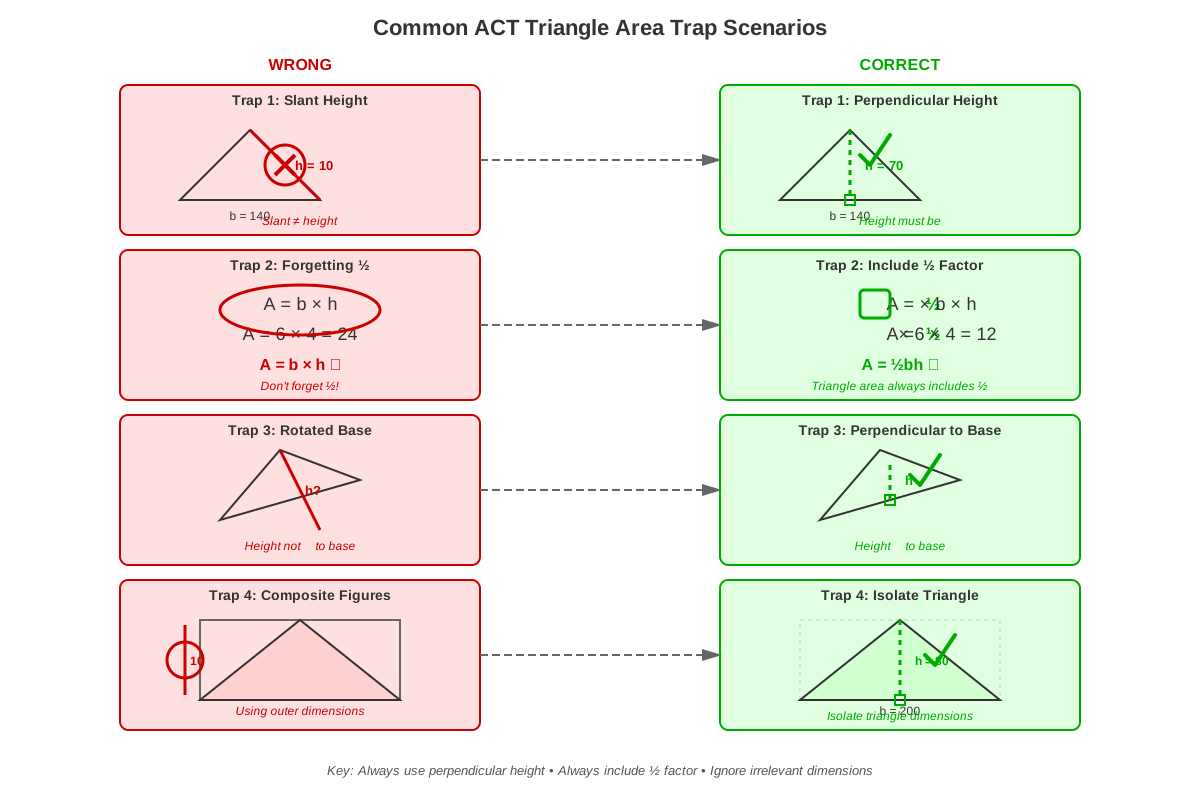
When applying this formula, students must carefully identify valid base-height pairs. A common error involves using two sides of the triangle that are not perpendicular to each other. The height must always be measured perpendicular to the chosen base, which sometimes requires drawing an auxiliary line (altitude) that extends outside the triangle itself, particularly in obtuse triangles.
Right Triangle Area Calculation
Right triangles offer a significant computational advantage because the two legs (sides forming the right angle) are automatically perpendicular to each other. This means either leg can serve as the base, with the other leg serving as the height, eliminating the need to calculate or identify a separate altitude.
For a right triangle with legs of length a and b:
Area = (1/2) × a × bThis simplified approach makes right triangle area problems among the fastest to solve on the ACT. Students should immediately recognize right triangles (indicated by a small square in the corner, explicit statement, or satisfaction of the Pythagorean theorem) and use this direct method rather than attempting to find altitudes.
Area Using Coordinates
When a triangle's vertices are given as coordinate points, the coordinate geometry method provides an efficient calculation approach. For a triangle with vertices at (x₁, y₁), (x₂, y₂), and (x₃, y₃), the area formula is:
Area = (1/2) |x₁(y₂ - y₃) + x₂(y₃ - y₁) + x₃(y₁ - y₂)|The absolute value ensures a positive area regardless of vertex ordering. While this formula appears complex, it's systematic and eliminates the need to calculate base and height separately.
Alternatively, students can use the bounding rectangle method: draw a rectangle that completely contains the triangle with sides parallel to the axes, calculate the rectangle's area, then subtract the areas of the right triangles formed in the corners outside the original triangle. This visual approach often feels more intuitive and reduces calculation errors.
Heron's Formula (Advanced)
When all three side lengths are known but no height is given, Heron's formula calculates area without requiring altitude calculation. First, find the semi-perimeter s:
s = (a + b + c) / 2Then calculate area:
Area = √[s(s-a)(s-b)(s-c)]While powerful, Heron's formula rarely appears on the ACT because it's computationally intensive without a calculator. However, recognizing when it's the only viable approach demonstrates mathematical maturity.
Special Triangle Areas
Equilateral triangles with side length s have a dedicated formula:
Area = (s² √3) / 4This formula derives from the standard area formula using the height of an equilateral triangle (s√3/2), but memorizing it saves time on ACT questions specifically involving equilateral triangles.
For isosceles triangles, drawing the altitude from the vertex angle to the base creates two congruent right triangles, often enabling Pythagorean theorem application to find the height.
Area in Composite Figures
The ACT frequently embeds triangles within larger geometric figures. Key strategies include:
- Decomposition: Breaking complex polygons into triangles and other simple shapes
- Subtraction: Finding the area of a larger shape and subtracting triangular portions
- Recognition: Identifying triangles formed by diagonals, inscribed figures, or overlapping shapes
Students must develop the ability to "see" triangles within complex diagrams, sometimes requiring auxiliary line construction to reveal hidden triangular regions.
Concept Relationships
The standard area formula (Area = 1/2 × base × height) serves as the central concept from which all other triangle area methods derive or relate. This formula connects directly to perpendicular line concepts from prerequisite knowledge, as the height requirement demands understanding of perpendicularity.
Right triangle area calculations represent a special case simplification of the standard formula, where the perpendicular legs eliminate the need for separate altitude identification. This connects to Pythagorean theorem applications, as students often must first find a missing leg length before calculating area.
Coordinate geometry methods extend the standard formula into the coordinate plane, building on coordinate system fundamentals and distance formula knowledge. The bounding rectangle approach specifically connects to rectangle area calculations and subtraction principles.
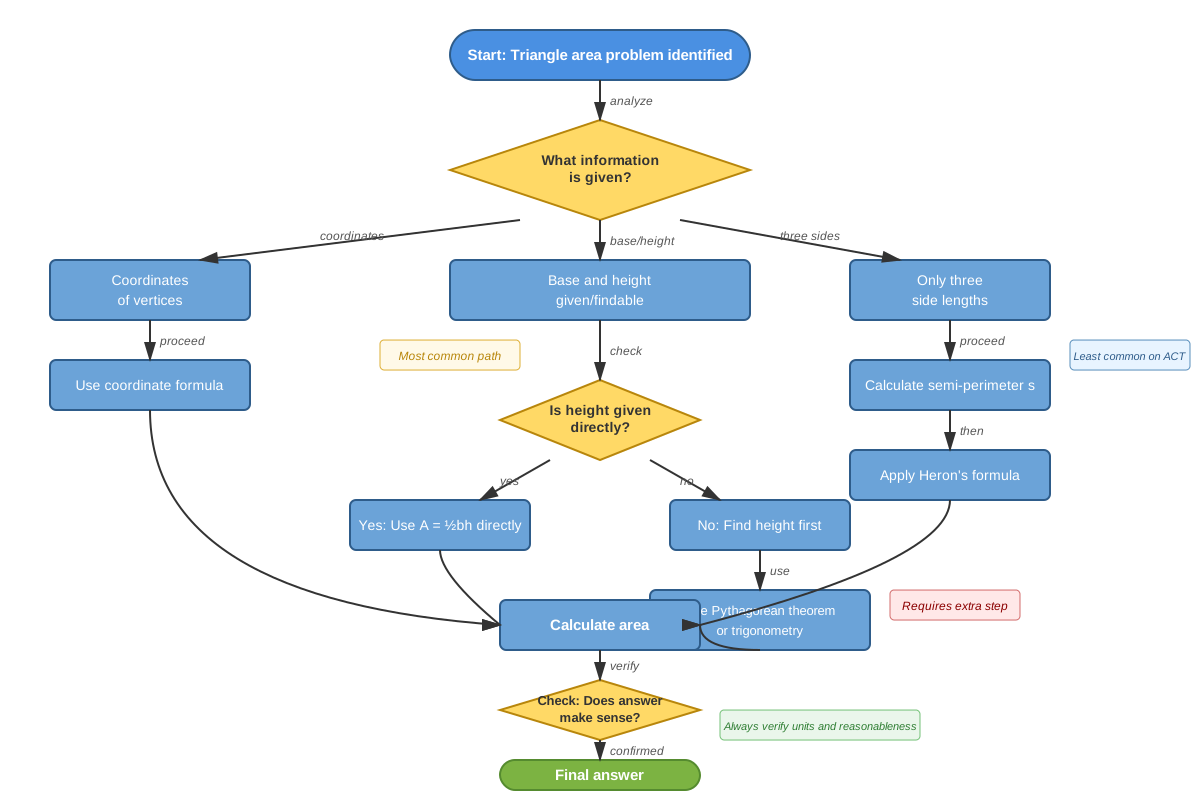
The relationship map flows as follows:
Perpendicular Lines → Standard Area Formula → branches into three paths:
- Right Triangle Recognition → Simplified Leg-Based Calculation
- Coordinate Vertices → Coordinate Formula or Bounding Rectangle Method
- All Sides Known → Heron's Formula (advanced)
Special Triangle Properties (equilateral, isosceles) → Specialized Formulas that connect back to the standard formula through geometric relationships.
Composite Figures integrate triangle area with polygon decomposition, circle sectors, and subtraction methods, representing the highest level of application where multiple geometric concepts converge.
High-Yield Facts
⭐ The standard triangle area formula is Area = (1/2) × base × height, where height must be perpendicular to the base
⭐ For right triangles, the two legs can serve directly as base and height, making Area = (1/2) × leg₁ × leg₂
⭐ Any side of a triangle can be chosen as the base; the height must then be measured perpendicular to that chosen base
⭐ The height of a triangle may fall outside the triangle itself, particularly in obtuse triangles
⭐ When triangle vertices are given as coordinates, the bounding rectangle method often provides the fastest solution path
- The area of an equilateral triangle with side s is (s²√3)/4
- Triangles with the same base and height have equal areas regardless of shape
- The altitude to the hypotenuse of a right triangle creates two smaller triangles similar to the original and to each other
- Doubling the base or height of a triangle doubles its area; doubling both quadruples the area
- The median of a triangle divides it into two triangles of equal area
- In coordinate geometry, if a triangle has a horizontal or vertical side, that side simplifies base-height identification
- The area of a triangle inscribed in a rectangle is exactly half the rectangle's area when vertices touch the midpoints of sides
Quick check — test yourself on Area of triangles so far.
Try Flashcards →Common Misconceptions
Misconception: Any two sides of a triangle can be multiplied and divided by 2 to find area.
Correction: Only perpendicular measurements (base and height) can be used in the standard formula. Two sides that meet at an angle other than 90° cannot be directly substituted into Area = (1/2) × base × height without additional calculations.
Misconception: The height of a triangle must be one of its sides.
Correction: The height is the perpendicular distance from a base to the opposite vertex, which is only a side of the triangle in right triangles. In acute and obtuse triangles, the height is typically an altitude drawn inside or outside the triangle, not an existing side.
Misconception: All triangles with the same perimeter have the same area.
Correction: Triangles with identical perimeters can have vastly different areas. For example, an equilateral triangle with perimeter 12 has area 4√3 ≈ 6.93, while a very flat triangle with sides 5.9, 5.9, and 0.2 has perimeter 12 but area approaching zero.
Misconception: In obtuse triangles, the height cannot be calculated because it falls outside the triangle.
Correction: The height can always be calculated or used even when it extends outside the triangle. The perpendicular distance from the base (or base extended) to the opposite vertex remains valid for the area formula regardless of where the altitude intersects.
Misconception: When using coordinates, the order of vertices doesn't matter in the coordinate area formula.
Correction: While the absolute value in the formula ensures a positive result, the vertices must be applied consistently in the formula. Random ordering can lead to calculation errors. The absolute value corrects for clockwise vs. counterclockwise ordering, but the formula structure must be maintained.
Misconception: The area of a triangle is always less than the area of a square with the same side length.
Correction: This depends on which measurements are being compared. A triangle with base 10 and height 30 has area 150, while a square with side 10 has area 100. The relationship between triangle and square areas depends on specific dimensions, not a universal rule.
Worked Examples
Example 1: Standard Triangle with Given Base and Height
Problem: A triangle has a base of 14 inches and a height of 9 inches. What is the area of the triangle in square inches?
Solution:
Step 1: Identify the given information
- Base (b) = 14 inches
- Height (h) = 9 inches
Step 2: Recognize this as a direct application of the standard area formula
- We have both base and height explicitly stated
- The problem confirms the height is perpendicular to the base
Step 3: Apply the formula Area = (1/2) × base × height
Area = (1/2) × 14 × 9
Area = (1/2) × 126
Area = 63 square inchesAnswer: 63 square inches
Connection to Learning Objectives: This example demonstrates direct application of the core area formula and represents the most straightforward type of ACT triangle area question. Students should complete problems like this in under 30 seconds.
Example 2: Right Triangle in Coordinate Plane
Problem: Triangle ABC has vertices at A(2, 3), B(2, 9), and C(7, 3). What is the area of triangle ABC?
Solution:
Step 1: Plot or visualize the points
- A(2, 3) and B(2, 9) share the same x-coordinate (x = 2), so AB is vertical
- A(2, 3) and C(7, 3) share the same y-coordinate (y = 3), so AC is horizontal
- This means AB and AC are perpendicular—we have a right triangle!
Step 2: Calculate the lengths of the perpendicular sides
- Length of AB (vertical leg) = |9 - 3| = 6 units
- Length of AC (horizontal leg) = |7 - 2| = 5 units
Step 3: Apply the right triangle area formula
Area = (1/2) × leg₁ × leg₂
Area = (1/2) × 6 × 5
Area = (1/2) × 30
Area = 15 square units
Alternative Method: Using the bounding rectangle approach
- The smallest rectangle containing the triangle has width 5 and height 6
- Rectangle area = 5 × 6 = 30
- The triangle occupies exactly half this rectangle (since it's a right triangle with legs along the rectangle sides)
- Triangle area = 30/2 = 15 square units
Answer: 15 square units
Connection to Learning Objectives: This example demonstrates identifying when coordinate geometry presents a right triangle, choosing the most efficient solution method, and verifying the answer using an alternative approach. This multi-method thinking is valuable for checking work on the ACT.
Example 3: Triangle Within a Composite Figure
Problem: A rectangle has dimensions 12 cm by 8 cm. A triangle is formed by connecting one corner of the rectangle to the midpoints of the two non-adjacent sides. What is the area of this triangle?
Solution:
Step 1: Visualize or sketch the figure
- Rectangle ABCD with length 12 cm and width 8 cm
- Let's say the triangle connects corner A to midpoint M of side BC and midpoint N of side CD
Step 2: Determine triangle dimensions
- If A is at origin (0, 0), B at (12, 0), C at (12, 8), and D at (0, 8)
- Midpoint M of BC is at (12, 4)
- Midpoint N of CD is at (6, 8)
- Triangle AMN has vertices at (0, 0), (12, 4), and (6, 8)
Step 3: Use the coordinate formula or decomposition method
Using decomposition (bounding rectangle method):
- The smallest rectangle containing triangle AMN has width 12 and height 8
- This is the entire original rectangle with area 96 cm²
Calculate areas of the three right triangles outside triangle AMN:
- Triangle below AM: base = 12, height = 4, area = (1/2)(12)(4) = 24 cm²
- Triangle right of MN: base = 6, height = 4, area = (1/2)(6)(4) = 12 cm²
- Triangle above AN: base = 6, height = 8, area = (1/2)(6)(8) = 24 cm²
Wait, let me reconsider the geometry more carefully.
Actually, using the coordinate formula directly:
Area = (1/2)|x₁(y₂ - y₃) + x₂(y₃ - y₁) + x₃(y₁ - y₂)|
Area = (1/2)|0(4 - 8) + 12(8 - 0) + 6(0 - 4)|
Area = (1/2)|0 + 96 - 24|
Area = (1/2)|72|
Area = 36 cm²Answer: 36 cm²
Connection to Learning Objectives: This problem demonstrates identifying triangles within composite figures and applying coordinate geometry methods when vertices can be determined. It also shows how the ACT combines multiple geometric concepts in a single problem.
Exam Strategy
When approaching ACT area of triangles questions, begin by quickly classifying the problem type: direct formula application, right triangle, coordinate geometry, or composite figure. This classification determines the most efficient solution path and prevents wasted time on overly complex approaches.
Trigger words and phrases that signal triangle area questions include: "What is the area," "find the area," "square units," "square inches/feet/centimeters," "region enclosed by," and "shaded area." Questions may also ask for dimensions when area is given, requiring algebraic manipulation of the area formula.
For right triangles, immediately check if both legs are provided—if so, use the simplified formula rather than searching for an altitude. The ACT often provides right triangles in non-standard orientations to test whether students recognize the perpendicular relationship regardless of visual presentation.
When coordinates are given, quickly check for horizontal or vertical sides by comparing x- and y-coordinates. If two vertices share an x-coordinate (vertical side) or y-coordinate (horizontal side), you likely have a right triangle or can easily identify base and height. The bounding rectangle method often provides faster solutions than the coordinate formula for ACT timing constraints.
For composite figures, develop a systematic approach: identify all component shapes, determine which areas to add and which to subtract, and check whether the problem asks for a specific region or the entire figure. Drawing auxiliary lines to reveal hidden triangles is a high-yield strategy.
Time allocation: Simple direct application problems should take 30-45 seconds. Coordinate geometry problems typically require 60-90 seconds. Complex composite figures may need 90-120 seconds. If a problem exceeds these timeframes, mark it for review and move forward—the ACT rewards efficient time management.
Process of elimination tips: When answer choices are given, estimate the area before calculating. A triangle with base 10 and height 8 must have area less than 80 (the rectangle with those dimensions). Eliminate any answer choices that violate basic geometric constraints. Also check units—if dimensions are in feet but answers are in square inches, conversion is required.
Memory Techniques
The "Half-Rectangle" Mnemonic: Remember that every triangle is exactly half of a parallelogram (or rectangle) with the same base and height. Visualize folding a rectangle along its diagonal—each resulting triangle has half the area. This reinforces why the formula includes the factor 1/2.
"BASE-HEIGHT-PERPENDICULAR" Acronym (BHP): When identifying measurements, think BHP—the Base and Height must be Perpendicular. This prevents the common error of using two sides that aren't perpendicular.
Right Triangle Shortcut Visualization: Picture a right triangle as "half a rectangle" where the legs form the rectangle's sides. This mental image immediately suggests using the legs as base and height without additional calculation.
Coordinate Triangle Memory Aid: "Box it, subtract it" for the bounding rectangle method. Draw a box around the triangle, then subtract the corner triangles. This rhythmic phrase helps recall the multi-step process under time pressure.
The "Any Side" Reminder: Create a mental image of rotating a triangle so different sides become the base. This reinforces that any side can serve as the base, with the corresponding height always perpendicular to that chosen base.
Equilateral Formula Mnemonic: "Side-squared, root-three, over four" creates a rhythm for the equilateral triangle formula: (s²√3)/4. The rhythm helps recall the formula structure during the exam.
Summary
The area of triangles is a foundational and high-frequency topic on the ACT Math test, requiring mastery of multiple calculation methods and the flexibility to choose the most efficient approach for each problem type. The standard formula Area = (1/2) × base × height applies universally, but recognizing special cases—particularly right triangles where legs serve as base and height, and coordinate geometry problems where vertices determine dimensions—enables faster, more accurate solutions. Students must understand that the height must always be perpendicular to the chosen base, even when this altitude falls outside the triangle. Success on ACT triangle area questions depends on pattern recognition (identifying problem types quickly), formula fluency (applying the correct method without hesitation), and strategic thinking (choosing efficient solution paths). The topic connects deeply to coordinate geometry, composite figures, and algebraic reasoning, making it a critical bridge between multiple mathematical domains. Students who develop systematic approaches to classifying and solving triangle area problems gain significant advantages in both accuracy and time management on test day.
Key Takeaways
- The standard area formula Area = (1/2) × base × height applies to all triangles, with height measured perpendicular to the base
- Right triangles offer a computational shortcut: use the two legs directly as base and height
- Any side of a triangle can serve as the base; the height must then be perpendicular to that chosen side
- Coordinate geometry problems often reveal right triangles or enable the bounding rectangle method for efficient solutions
- Triangle area questions frequently appear embedded in composite figures, requiring decomposition or subtraction strategies
- The height of a triangle may extend outside the triangle itself, particularly in obtuse triangles, but remains valid for area calculations
- Efficient problem classification (direct formula, right triangle, coordinates, composite) determines the fastest solution path and optimizes time management
Related Topics
Pythagorean Theorem and Special Right Triangles: Mastering triangle area enables progression to problems combining area calculations with finding missing side lengths using the Pythagorean theorem or 30-60-90 and 45-45-90 triangle ratios.
Similar Triangles and Proportions: Understanding area relationships in similar triangles (area ratio equals the square of the side ratio) builds on basic area calculation skills.
Coordinate Geometry and Distance Formula: Triangle area in the coordinate plane connects to finding distances between points, slopes of lines, and equations of lines through vertices.
Polygon Area and Decomposition: Complex polygon area problems require decomposing figures into triangles and other simple shapes, making triangle area a prerequisite skill.
Three-Dimensional Geometry: Surface area calculations for pyramids, prisms, and other solids require finding areas of triangular faces, extending two-dimensional triangle area concepts into three dimensions.
Trigonometric Area Formulas: Advanced triangle area calculations using Area = (1/2)ab sin(C) build on the foundational understanding developed in this topic.
Practice CTA
Now that you've mastered the core concepts, formulas, and strategies for triangle area problems, it's time to solidify your understanding through active practice. Attempt the practice questions designed specifically for this topic, focusing on applying the efficient solution methods and pattern recognition skills you've learned. Use the flashcards to reinforce formula recall and key concepts until they become automatic. Remember, the ACT rewards both accuracy and speed—consistent practice with these high-yield problems will build the confidence and fluency you need to excel on test day. Every problem you solve strengthens your geometric intuition and brings you closer to your target score!
Sign up free to keep reading
Create a free AnvayaPrep account to finish this ACT guide on Area of triangles — plus flashcards and practice questions.