Overview
SOHCAHTOA is one of the most fundamental and frequently tested concepts in ACT Math trigonometry questions. This mnemonic device represents the three primary trigonometric ratios—sine, cosine, and tangent—and their relationships to the sides of a right triangle. Understanding and applying act sohcahtoa principles is essential for solving approximately 4-6 questions on every ACT Math section, making it a high-yield topic that directly impacts your score.
The beauty of SOHCAHTOA lies in its simplicity and power. Once mastered, it provides a systematic approach to solving right triangle problems, finding missing side lengths, calculating angles, and understanding the geometric relationships that appear throughout the ACT Math section. This topic serves as the foundation for more advanced trigonometric concepts, including the unit circle, trigonometric identities, and applications involving non-right triangles using the Law of Sines and Law of Cosines.
SOHCAHTOA connects directly to coordinate geometry, where trigonometric ratios help determine slopes and angles of lines, and to real-world application problems involving heights, distances, and angles of elevation or depression. The ACT frequently embeds SOHCAHTOA questions within word problems, requiring students to first identify the appropriate triangle setup before applying the correct ratio. Mastery of this topic not only secures points on direct trigonometry questions but also enables success on complex multi-step problems that integrate algebra, geometry, and trigonometry.
Learning Objectives
- [ ] Identify when SOHCAHTOA is being tested in ACT questions
- [ ] Explain the core rule or strategy behind SOHCAHTOA
- [ ] Apply SOHCAHTOA to ACT-style questions accurately
- [ ] Distinguish between opposite, adjacent, and hypotenuse sides relative to a given angle
- [ ] Select the appropriate trigonometric ratio (sine, cosine, or tangent) based on known and unknown information
- [ ] Solve for missing angles using inverse trigonometric functions
- [ ] Convert between different forms of trigonometric expressions and simplify ratios
Prerequisites
- Basic right triangle properties: Understanding that right triangles contain one 90-degree angle and that the sum of all angles equals 180 degrees is essential for identifying which sides correspond to which trigonometric ratios
- Pythagorean Theorem (a² + b² = c²): This relationship between sides helps verify answers and solve for missing sides when trigonometric ratios alone are insufficient
- Basic algebra skills: Solving equations for variables, cross-multiplication, and isolating variables are necessary for manipulating trigonometric equations
- Calculator proficiency: Knowing how to use sine, cosine, tangent, and their inverse functions on a scientific or graphing calculator is critical for ACT success
- Fraction and decimal operations: Converting between fractions and decimals and simplifying ratios ensures accurate calculations
Why This Topic Matters
SOHCAHTOA represents one of the most practical applications of mathematics in real-world scenarios. Engineers use these ratios to calculate structural angles and load distributions. Architects apply trigonometric principles to design roof pitches and determine building heights. Surveyors rely on angle measurements and trigonometric calculations to map terrain and establish property boundaries. Navigation systems, from maritime to aerospace, depend fundamentally on trigonometric relationships to calculate distances and bearings.
On the ACT Math section, trigonometry accounts for approximately 7% of all questions, with SOHCAHTOA-based problems representing the majority of these. Students can expect 4-6 questions directly testing these concepts, typically appearing in the latter half of the test where higher-difficulty questions cluster. These questions often appear as straightforward ratio calculations, word problems involving angles of elevation or depression, or multi-step problems requiring both trigonometric and algebraic reasoning.
The ACT presents SOHCAHTOA in several common formats: direct calculation problems where a triangle diagram is provided with labeled sides and angles; word problems describing real-world scenarios that must be translated into triangle diagrams; questions asking for angle measures using inverse trigonometric functions; and complex problems combining trigonometry with coordinate geometry or other mathematical concepts. Recognizing these patterns and quickly identifying the appropriate approach is crucial for time management and accuracy.
Core Concepts
The SOHCAHTOA Mnemonic
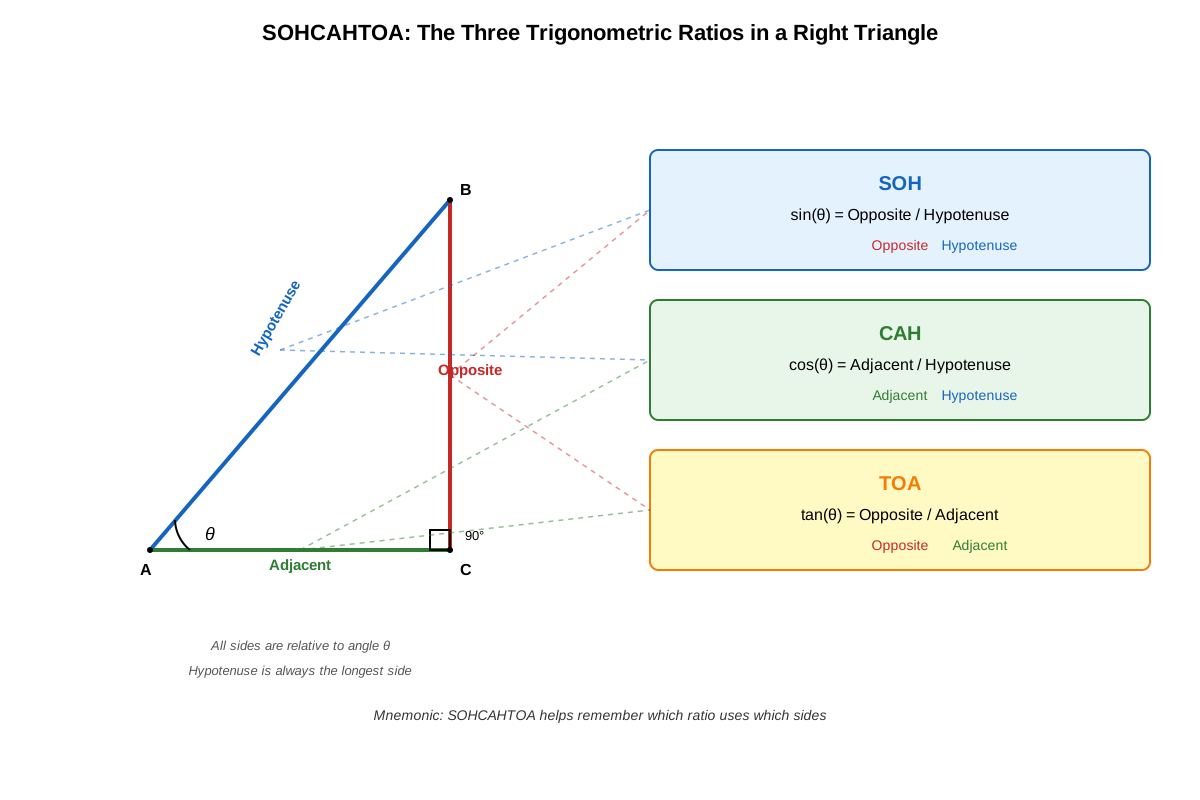
The acronym SOHCAHTOA breaks down into three distinct trigonometric ratios, each representing a relationship between two sides of a right triangle relative to a specific acute angle:
- SOH: Sine = Opposite / Hypotenuse
- CAH: Cosine = Adjacent / Hypotenuse
- TOA: Tangent = Opposite / Adjacent
Each letter in this mnemonic serves as a memory aid: the first letter indicates the trigonometric function (Sine, Cosine, or Tangent), while the following two letters indicate which sides form the ratio (Opposite, Adjacent, or Hypotenuse).
Identifying Triangle Components
Before applying any trigonometric ratio, correctly identifying the three sides of a right triangle relative to the reference angle is essential:
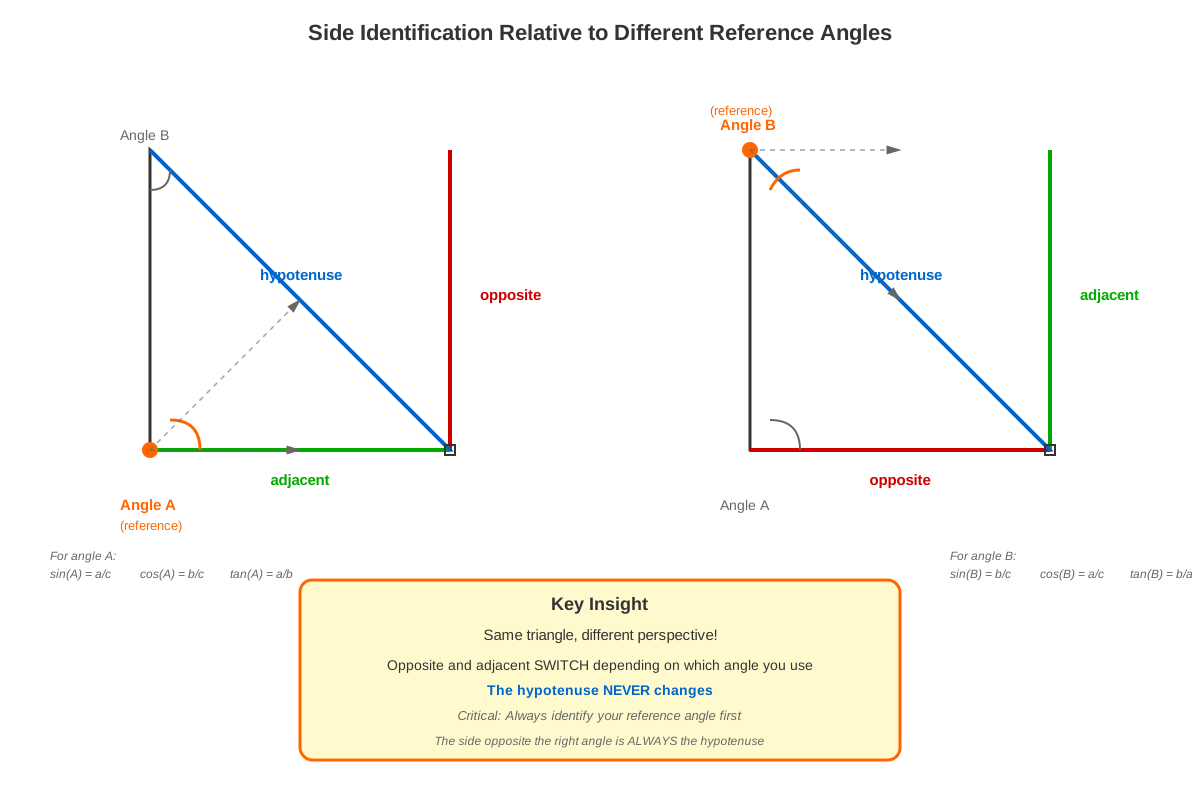
The Hypotenuse: Always the longest side of a right triangle, located opposite the 90-degree angle. This side never changes regardless of which acute angle serves as the reference angle.
The Opposite Side: The side directly across from the reference angle. This side changes depending on which acute angle you're considering.
The Adjacent Side: The side that forms one leg of the reference angle (excluding the hypotenuse). This side also changes based on the reference angle selected.
The Three Primary Ratios
Sine Function
sin(θ) = opposite/hypotenuseThe sine ratio compares the length of the side opposite the reference angle to the hypotenuse. On the ACT, sine problems frequently appear in contexts involving vertical measurements, such as finding the height of a building or the vertical component of a diagonal distance.
Cosine Function
cos(θ) = adjacent/hypotenuseThe cosine ratio compares the length of the side adjacent to the reference angle to the hypotenuse. ACT questions often use cosine when dealing with horizontal distances or when the problem provides the hypotenuse and requires finding a side that lies along the base of the triangle.
Tangent Function
tan(θ) = opposite/adjacentThe tangent ratio compares the opposite side to the adjacent side, notably excluding the hypotenuse entirely. This ratio proves particularly useful when the hypotenuse is unknown or unnecessary for solving the problem. Tangent frequently appears in angle of elevation and depression problems.
Inverse Trigonometric Functions
When the angle measure is unknown but two sides are given, inverse trigonometric functions (also called arc functions) determine the angle:
- sin⁻¹ or arcsin: Given opposite/hypotenuse ratio, finds the angle
- cos⁻¹ or arccos: Given adjacent/hypotenuse ratio, finds the angle
- tan⁻¹ or arctan: Given opposite/adjacent ratio, finds the angle
On calculators, these functions typically appear as sin⁻¹, cos⁻¹, and tan⁻¹, often accessed by pressing a "2nd" or "shift" button before the standard trigonometric function key.
Ratio Selection Strategy
| Given Information | Unknown | Use This Ratio |
|---|---|---|
| Opposite & Hypotenuse | Angle | sin⁻¹(opp/hyp) |
| Adjacent & Hypotenuse | Angle | cos⁻¹(adj/hyp) |
| Opposite & Adjacent | Angle | tan⁻¹(opp/adj) |
| Angle & Hypotenuse | Opposite | sin(θ) × hyp |
| Angle & Hypotenuse | Adjacent | cos(θ) × hyp |
| Angle & Adjacent | Opposite | tan(θ) × adj |
| Angle & Opposite | Adjacent | opp / tan(θ) |
Special Angle Values
While the ACT allows calculator use, recognizing common trigonometric values for special angles can save time and verify calculator results:
| Angle | sin | cos | tan |
|---|---|---|---|
| 30° | 1/2 | √3/2 | √3/3 |
| 45° | √2/2 | √2/2 | 1 |
| 60° | √3/2 | 1/2 | √3 |
Concept Relationships
SOHCAHTOA serves as the bridge connecting basic geometry to advanced trigonometry. The Pythagorean Theorem provides the foundation by establishing relationships between right triangle sides, which SOHCAHTOA then expresses as ratios relative to angles. When a problem provides two sides, the Pythagorean Theorem finds the third side, after which SOHCAHTOA determines angles or verifies relationships.
The three primary ratios (sine, cosine, tangent) interconnect through the fundamental identity: tan(θ) = sin(θ)/cos(θ). This relationship means that if you know two of these values, you can always calculate the third. Additionally, the complementary angle relationship states that sin(θ) = cos(90° - θ), reflecting how the opposite side relative to one acute angle becomes the adjacent side relative to the other acute angle in a right triangle.
SOHCAHTOA extends into coordinate geometry where the unit circle redefines these ratios using x and y coordinates. The tangent function connects to slope calculations since the slope of a line equals the tangent of its angle of inclination. In three-dimensional geometry, SOHCAHTOA applies to right triangles formed by projections onto coordinate planes.
The progression flows: Basic Triangle Properties → Pythagorean Theorem → SOHCAHTOA → Inverse Functions → Unit Circle → Trigonometric Identities → Law of Sines/Cosines. Each concept builds upon the previous, with SOHCAHTOA occupying the critical middle position that transforms geometric relationships into functional relationships.
High-Yield Facts
⭐ The hypotenuse is always the longest side and always opposite the 90-degree angle
⭐ Sine and cosine values always fall between -1 and 1 (or 0 and 1 for acute angles)
⭐ Tangent can equal any real number and has no upper or lower bound
⭐ The opposite and adjacent sides switch when you change the reference angle to the other acute angle
⭐ sin(30°) = cos(60°) and sin(60°) = cos(30°), demonstrating complementary angle relationships
- The mnemonic "Some Old Hippie Caught Another Hippie Tripping On Acid" helps remember SOHCAHTOA
- When using inverse functions on a calculator, ensure the calculator is in degree mode for ACT problems (not radian mode)
- If tan(θ) = 1, then θ = 45°, indicating an isosceles right triangle
- The reciprocal functions (cosecant, secant, cotangent) rarely appear on the ACT but relate as: csc = 1/sin, sec = 1/cos, cot = 1/tan
- In a 30-60-90 triangle, sides are in the ratio 1 : √3 : 2, which can verify SOHCAHTOA calculations
- In a 45-45-90 triangle, sides are in the ratio 1 : 1 : √2
- Angles of elevation and depression are always measured from the horizontal, not the vertical
Quick check — test yourself on SOHCAHTOA so far.
Try Flashcards →Common Misconceptions
Misconception: The hypotenuse changes depending on which angle is the reference angle.
Correction: The hypotenuse is always the side opposite the right angle and never changes regardless of which acute angle you're considering. Only the opposite and adjacent sides switch when the reference angle changes.
Misconception: Sine, cosine, and tangent are only used to find angles, not side lengths.
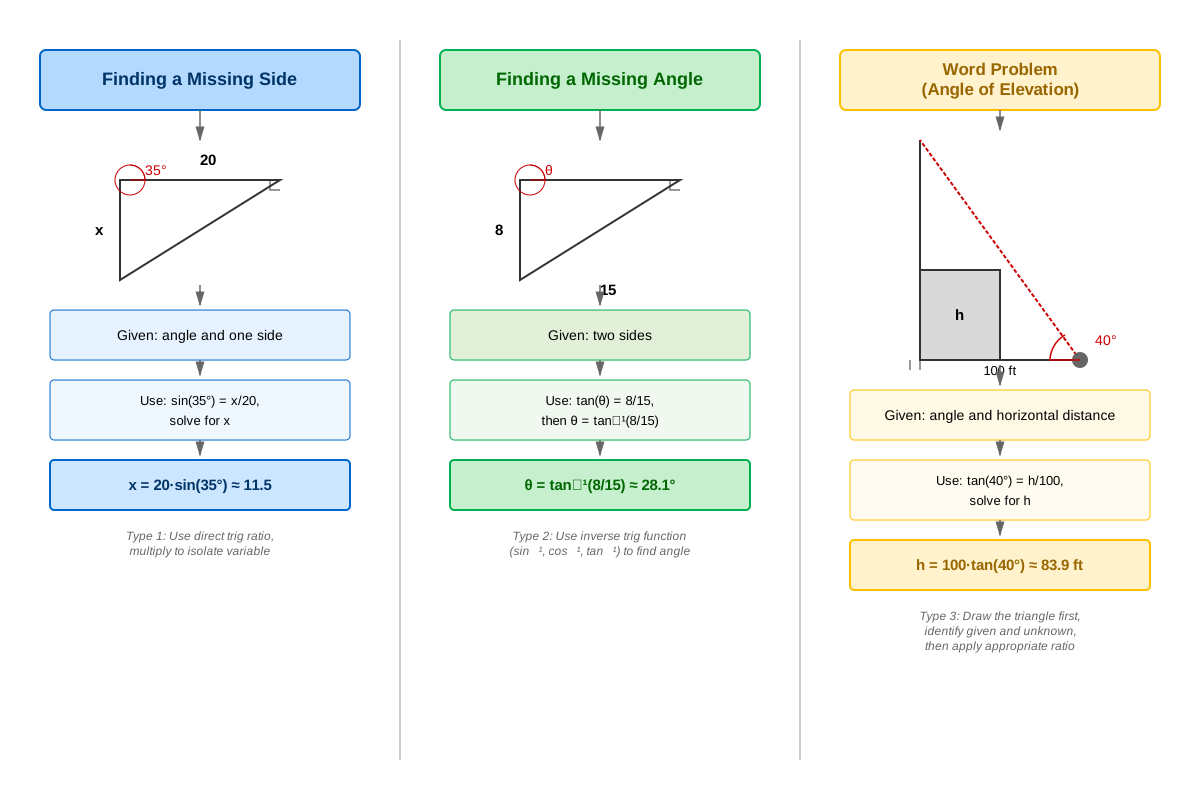
Correction: These ratios work bidirectionally. When you know an angle and one side, you can find another side by setting up the appropriate ratio equation and solving algebraically (e.g., if sin(30°) = x/10, then x = 10 × sin(30°) = 5).
Misconception: The adjacent side is always the horizontal side of the triangle.
Correction: The adjacent side is determined by the reference angle, not the triangle's orientation. If the triangle is rotated or the reference angle is at the top, the adjacent side might be vertical. Always identify sides relative to the specific angle being considered.
Misconception: You can use SOHCAHTOA on any triangle.
Correction: SOHCAHTOA only applies to right triangles. For non-right triangles, you must use the Law of Sines or Law of Cosines. If a problem presents a non-right triangle, look for ways to divide it into right triangles or use alternative methods.
Misconception: tan(θ) = sin(θ) + cos(θ).
Correction: The tangent function equals sin(θ)/cos(θ), not their sum. This is a fundamental identity that connects the three primary ratios. Confusing addition with division leads to incorrect calculations.
Misconception: When the calculator shows an error for inverse tangent, the problem has no solution.
Correction: Calculator errors typically result from mode issues (radian vs. degree) or attempting impossible operations. For inverse tangent, any real number input produces a valid angle output. Check calculator settings first.
Misconception: Angles of elevation and depression are different angles.
Correction: When two points are connected by a line of sight, the angle of elevation from the lower point equals the angle of depression from the higher point due to alternate interior angles formed by parallel horizontal lines.
Worked Examples
Example 1: Finding a Side Length
Problem: A ladder leans against a wall, forming a 65° angle with the ground. If the ladder is 20 feet long, how high up the wall does the ladder reach?
Solution:
Step 1: Draw and label the triangle. The ladder forms the hypotenuse (20 feet), the wall height is the opposite side (unknown), and the ground distance is the adjacent side (not needed for this problem).
Step 2: Identify the reference angle. The 65° angle is at the base where the ladder meets the ground.
Step 3: Determine which sides are involved. We know the hypotenuse (20 feet) and need the opposite side (wall height). This indicates we should use sine.
Step 4: Set up the equation using SOH (Sine = Opposite/Hypotenuse):
sin(65°) = opposite/20Step 5: Solve for the opposite side:
opposite = 20 × sin(65°)
opposite = 20 × 0.9063
opposite ≈ 18.13 feetAnswer: The ladder reaches approximately 18.13 feet up the wall.
Connection to Learning Objectives: This problem demonstrates identifying when SOHCAHTOA is tested (right triangle with angle and hypotenuse given), explaining the strategy (selecting sine because we have hypotenuse and need opposite), and applying it accurately to find the solution.
Example 2: Finding an Angle Measure
Problem: A surveyor measures the distance from a point on the ground to the base of a cell tower as 150 feet. Using surveying equipment, she determines the tower is 200 feet tall. What is the angle of elevation from her position to the top of the tower?
Solution:
Step 1: Visualize and sketch the scenario. The tower height (200 feet) is the opposite side, the ground distance (150 feet) is the adjacent side, and the angle of elevation is what we're finding.
Step 2: Identify known information. We have the opposite side (200 feet) and the adjacent side (150 feet), but we don't have the hypotenuse. This suggests using tangent.
Step 3: Set up the equation using TOA (Tangent = Opposite/Adjacent):
tan(θ) = 200/150
tan(θ) = 1.333...
Step 4: Use the inverse tangent function to find the angle:
θ = tan⁻¹(1.333...)
θ = tan⁻¹(4/3)
θ ≈ 53.13°Answer: The angle of elevation is approximately 53.13° or 53°.
Connection to Learning Objectives: This example shows how to identify SOHCAHTOA in a word problem context, select the appropriate ratio based on available information, and apply inverse functions to find angle measures—a common ACT question type.
Exam Strategy
When approaching ACT trigonometry questions, follow this systematic process:
Step 1: Identify the triangle type. Confirm the problem involves a right triangle by looking for explicit right angle markers, phrases like "perpendicular," "vertical," or contextual clues like walls meeting floors or ladders against walls.
Step 2: Draw and label a diagram if one isn't provided. Even crude sketches help organize information and prevent errors in identifying opposite, adjacent, and hypotenuse sides.
Step 3: Mark the reference angle. Circle or highlight which angle the problem asks about or provides information for, as this determines which sides are opposite and adjacent.
Step 4: List known and unknown information directly on your diagram. Write side lengths next to the corresponding sides and angle measures near the appropriate angles.
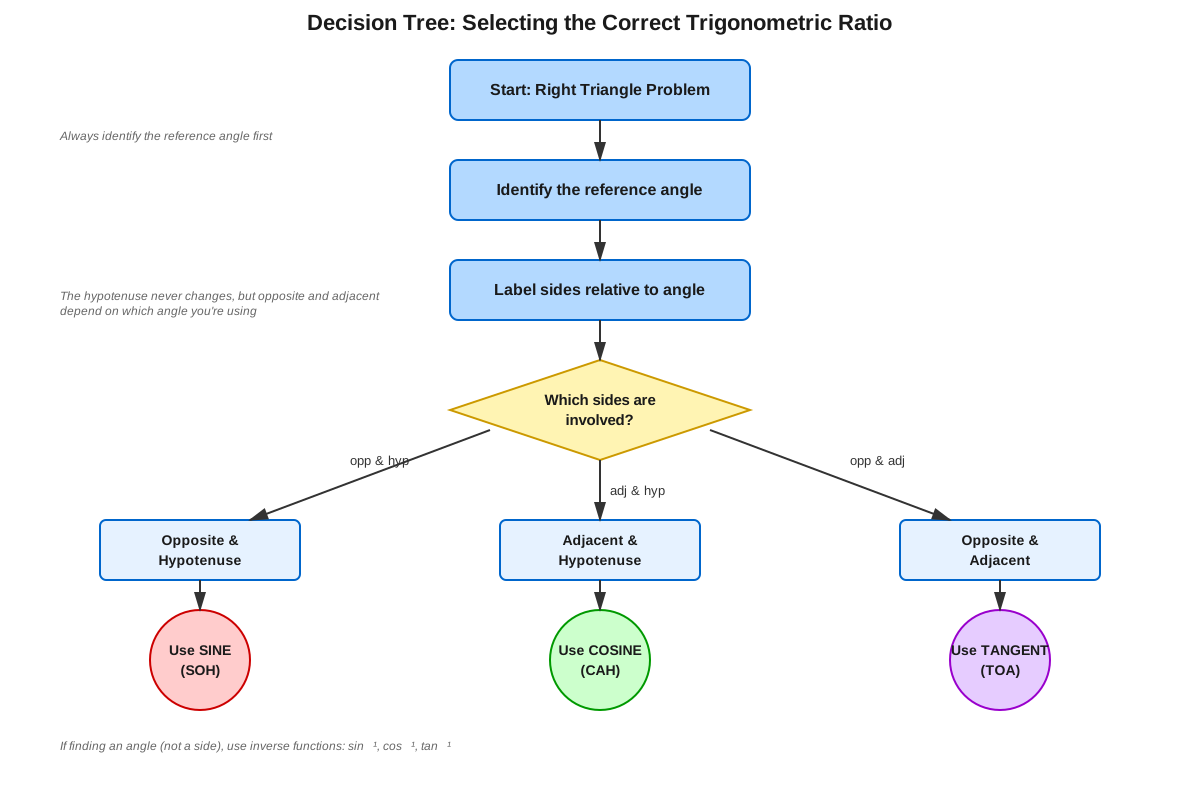
Step 5: Select the appropriate ratio by asking: "Which two sides do I have information about?" or "Which two sides does the problem involve?" Match this to SOH, CAH, or TOA.
Exam Tip: If you have or need the hypotenuse, you'll use sine or cosine. If the hypotenuse isn't involved, use tangent.
Trigger words and phrases that signal SOHCAHTOA questions:
- "Angle of elevation" or "angle of depression" (usually tangent)
- "Height of" or "how tall" (often opposite side)
- "Distance from" or "how far" (context determines if adjacent or hypotenuse)
- "Ladder against a wall" (classic setup)
- "Ramp" or "incline" (hypotenuse with angle given)
Process of elimination strategies:
- Eliminate answers that exceed the hypotenuse length when finding a side
- Eliminate angle measures greater than 90° for acute angles in right triangles
- Eliminate answers that violate the triangle inequality (sum of two sides must exceed the third)
- Check if answer choices are in degrees or radians; ACT typically uses degrees
Time allocation: Straightforward SOHCAHTOA problems should take 30-45 seconds once you've identified the setup. If you're spending more than 90 seconds, mark the question and return to it later. Complex multi-step problems involving SOHCAHTOA plus other concepts might warrant 2-3 minutes.
Memory Techniques
Primary Mnemonic: SOHCAHTOA itself is the most important memory device. Practice saying it aloud until it becomes automatic: "Soh-cah-toh-ah."
Alternative Mnemonics:
- "Some Old Hippie Caught Another Hippie Tripping On Acid"
- "Some Officers Have Curly Auburn Hair Till Old Age"
- Create your own personal mnemonic using words meaningful to you
Visual Memory Strategy: Picture a right triangle with a smiling face at one acute angle. The side the face "looks at" is opposite, the side the face "stands on" is adjacent, and the hypotenuse is always the slide (longest side) going down from the right angle.
Hand Trick: Hold your right hand up with fingers together and thumb out at 90°. Your thumb represents the opposite side, your fingers represent the adjacent side, and the line from thumb tip to fingertips represents the hypotenuse. Rotate your hand to change reference angles.
Reciprocal Relationships: Remember "flip" for reciprocals:
- Cosecant is "flipped sine" (hypotenuse/opposite)
- Secant is "flipped cosine" (hypotenuse/adjacent)
- Cotangent is "flipped tangent" (adjacent/opposite)
Special Angles Memory: For 30-60-90 triangles, remember "1-2-3" but with square roots: sides are 1, √3, 2. For 45-45-90 triangles, remember "1-1-√2" for the sides.
Summary
SOHCAHTOA represents the foundational framework for solving right triangle problems on the ACT Math section. The mnemonic encodes three essential ratios: sine equals opposite over hypotenuse, cosine equals adjacent over hypotenuse, and tangent equals opposite over adjacent. Success with these concepts requires first correctly identifying the three sides of a right triangle relative to a reference angle—the hypotenuse (always opposite the right angle), the opposite side (across from the reference angle), and the adjacent side (forming the reference angle). Once sides are identified, selecting the appropriate ratio depends on which two sides are known or needed. When finding angles from known sides, inverse trigonometric functions (sin⁻¹, cos⁻¹, tan⁻¹) provide the solution. ACT questions typically present SOHCAHTOA in straightforward calculation problems, word problems requiring diagram translation, or multi-step problems combining trigonometry with other mathematical concepts. Mastery requires both conceptual understanding of why these ratios work and procedural fluency in applying them quickly and accurately under test conditions.
Key Takeaways
- SOHCAHTOA encodes three ratios: sin = opp/hyp, cos = adj/hyp, tan = opp/adj, which apply exclusively to right triangles
- The hypotenuse never changes, but opposite and adjacent sides are defined relative to the specific reference angle being considered
- Choose sine or cosine when the hypotenuse is involved; choose tangent when working only with the two legs
- Inverse functions (sin⁻¹, cos⁻¹, tan⁻¹) find angle measures when two sides are known
- Always draw and label diagrams for word problems to visualize the triangle setup and avoid identification errors
- Angles of elevation and depression are measured from horizontal lines and are equal when viewing the same line of sight from different positions
- Calculator proficiency is essential—ensure degree mode is active and practice accessing inverse functions quickly
Related Topics
Unit Circle and Radian Measure: After mastering SOHCAHTOA with right triangles, the unit circle extends these concepts to all angle measures and introduces radian measurement, providing a more comprehensive understanding of trigonometric functions.
Law of Sines and Law of Cosines: These formulas extend trigonometric problem-solving to non-right triangles, building directly on SOHCAHTOA principles but applying them to more complex geometric situations.
Trigonometric Identities: Fundamental identities like the Pythagorean identity (sin²θ + cos²θ = 1) derive from SOHCAHTOA and the Pythagorean Theorem, enabling simplification of complex trigonometric expressions.
Coordinate Geometry and Slope: The tangent function directly relates to slope calculations, as the slope of a line equals the tangent of its angle of inclination, connecting trigonometry to linear equations.
Vectors and Components: Breaking vectors into horizontal and vertical components uses cosine and sine respectively, applying SOHCAHTOA to physics and advanced mathematics problems.
Practice CTA
Now that you've mastered the core concepts of SOHCAHTOA, it's time to solidify your understanding through active practice. Work through the practice questions to test your ability to identify triangle components, select appropriate ratios, and solve problems efficiently. Use the flashcards to drill the fundamental relationships until they become automatic. Remember, trigonometry questions on the ACT are highly predictable—consistent practice with these core concepts will translate directly into points on test day. You've got this!
Sign up free to keep reading
Create a free AnvayaPrep account to finish this ACT guide on SOHCAHTOA — plus flashcards and practice questions.