Overview
Analogy questions represent one of the most sophisticated and frequently tested elements of the ACT Reading section's Craft and Structure domain. These questions require students to recognize when an author uses comparison to illuminate complex ideas by relating them to more familiar concepts. An ACT analogy question asks test-takers to identify, interpret, or evaluate how one thing is being compared to another to clarify meaning, strengthen an argument, or make abstract concepts more concrete.
Understanding analogy is essential for ACT success because these questions appear consistently across all passage types—prose fiction, social science, humanities, and natural science. The ACT frequently embeds analogy questions within passages where authors explain difficult concepts through comparison, and students must demonstrate both literal comprehension and the ability to understand figurative relationships. Mastering analogy questions typically accounts for 2-4 questions per test, making this a high-yield topic that can significantly impact overall Reading scores.
Analogy connects deeply to other Reading concepts including author's purpose, rhetorical strategy, and textual evidence interpretation. When students understand how analogies function as explanatory tools, they simultaneously strengthen their ability to analyze tone, identify main ideas, and evaluate the effectiveness of an author's communication strategies. This topic serves as a bridge between basic comprehension and advanced critical analysis skills.
Learning Objectives
- [ ] Identify when Analogy is being tested in ACT Reading questions
- [ ] Explain the core rule or strategy behind Analogy interpretation
- [ ] Apply Analogy analysis to ACT-style questions accurately
- [ ] Distinguish between effective and ineffective analogies in passages
- [ ] Evaluate the purpose and function of specific analogies within argumentative and explanatory texts
- [ ] Recognize the relationship between compared elements in complex analogies
- [ ] Determine how analogies support or clarify an author's main argument
Prerequisites
- Basic figurative language comprehension: Understanding similes and metaphors provides the foundation for recognizing comparative relationships in analogies
- Inference skills: Analogies often require students to understand implicit connections between concepts that aren't explicitly stated
- Vocabulary in context: Recognizing how words function within comparative structures helps identify the precise relationship being established
- Main idea identification: Understanding what an author is trying to explain helps determine why a particular analogy was chosen
Why This Topic Matters
Analogies serve as one of the most powerful tools writers use to make complex, abstract, or unfamiliar concepts accessible to readers. In academic writing, scientific explanation, and literary analysis—all genres tested on the ACT—authors regularly employ analogies to bridge the gap between what readers already understand and what they need to learn. When a physicist compares electrons orbiting a nucleus to planets orbiting the sun, or when a historian compares a political movement to a river changing course, they're using analogy to transform the incomprehensible into the comprehensible.
On the ACT Reading test, analogy questions appear with remarkable consistency. Statistical analysis of released ACT tests shows that approximately 15-20% of Craft and Structure questions involve analogy recognition or interpretation. These questions typically appear 2-4 times per test, distributed across different passage types. Natural science passages frequently use analogies to explain scientific processes, while humanities passages often employ analogies to clarify philosophical or artistic concepts.
Analogy questions manifest in several distinct formats on the ACT. The most common type asks students to identify what is being compared to what ("The author compares X to Y in order to..."). Another frequent format requires students to explain the purpose or function of a specific analogy ("The comparison in lines 45-48 primarily serves to..."). A third type asks students to evaluate the effectiveness or appropriateness of an analogy. Occasionally, the ACT presents questions that require students to extend an analogy or identify which additional comparison would be most consistent with the author's reasoning pattern.
Core Concepts
Definition and Structure of Analogy
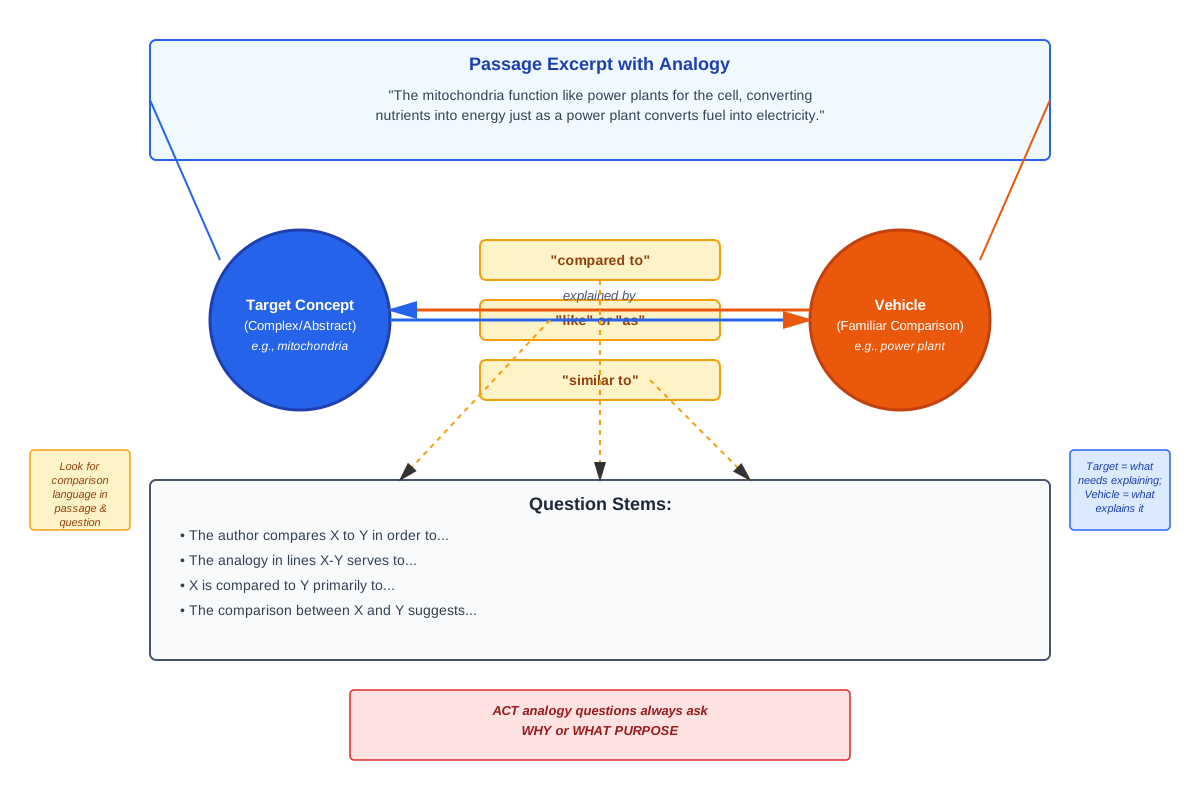
An analogy is a comparison between two things that are fundamentally different but share significant similarities in particular aspects. Unlike simple comparisons that note surface-level resemblances, analogies establish deeper structural or functional parallels. The basic structure involves a source domain (the familiar concept used for comparison) and a target domain (the unfamiliar or complex concept being explained). The effectiveness of an analogy depends on the reader's familiarity with the source domain and the accuracy of the parallel relationships.
In ACT passages, analogies typically follow predictable patterns. The author introduces a complex concept (target), then presents a more familiar concept (source) with the explicit or implicit signal that these share important characteristics. The comparison may be brief—a single sentence—or extended across multiple paragraphs. Understanding this structure helps students quickly identify when analogy is being employed and what function it serves.
Types of Analogies on the ACT
The ACT Reading section features several distinct analogy types, each serving different rhetorical purposes:
Explanatory analogies clarify difficult concepts by relating them to everyday experiences. For example, a passage about computer memory might compare RAM to a desk workspace and hard drive storage to filing cabinets. These analogies prioritize accessibility over perfect accuracy.
Structural analogies highlight parallel relationships or organizational patterns. A passage might compare the human circulatory system to a city's transportation network, emphasizing how both systems distribute essential resources through branching pathways.
Functional analogies focus on how things work or what purposes they serve. An author might compare a cell membrane to a security checkpoint, emphasizing the selective filtering function both perform.
Proportional analogies establish relationships between relationships, following the pattern "A is to B as C is to D." While less common in ACT passages than in vocabulary tests, these appear when authors draw parallels between different systems or processes.
Identifying Analogy Questions
ACT analogy questions contain specific trigger words and phrases that signal what's being tested. Common question stems include:
- "The author compares [X] to [Y] in order to..."
- "The comparison in lines [X-Y] primarily serves to..."
- "Which of the following best describes the analogy..."
- "The author's use of [specific comparison] suggests..."
- "The passage indicates that [X] is similar to [Y] in that both..."
These questions may also use words like "likens," "parallels," "resembles," "similar to," or "like" to signal that analogy interpretation is required. Recognizing these linguistic markers helps students quickly categorize questions and activate appropriate analytical strategies.
Analyzing Analogy Purpose
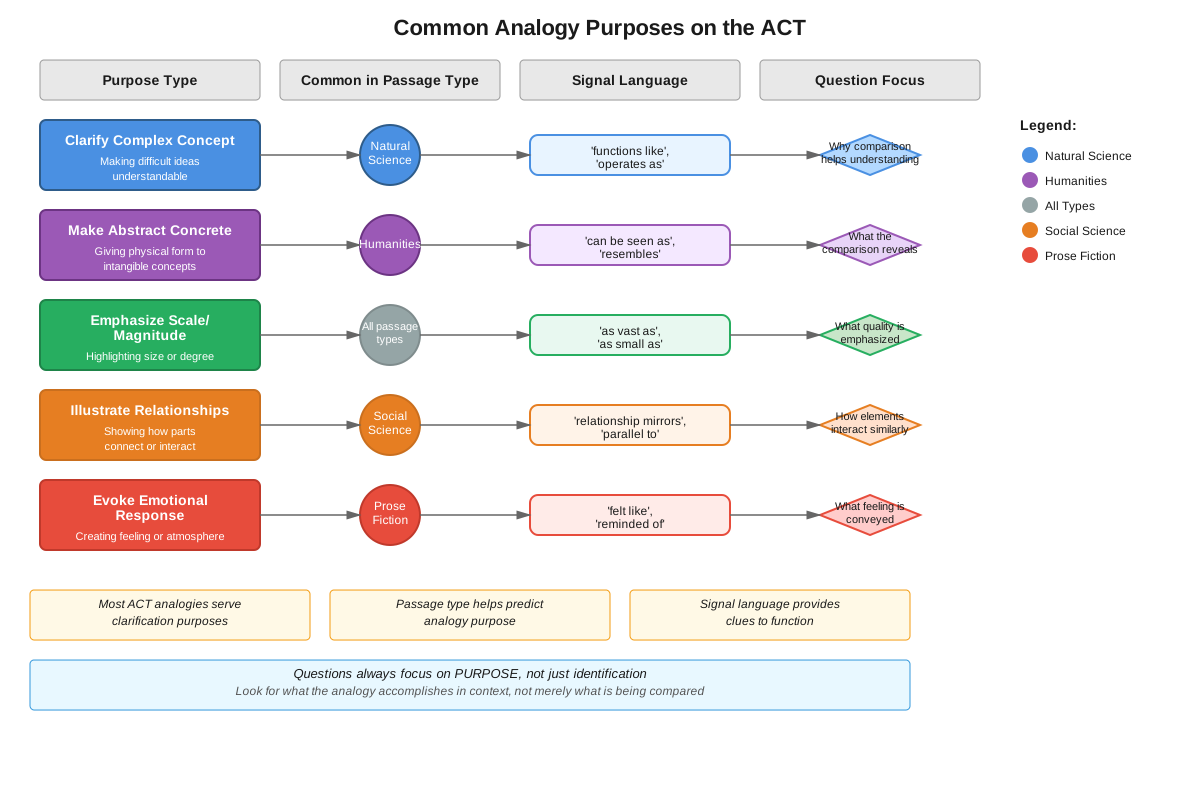
Every analogy serves one or more specific purposes within a passage. The ACT frequently tests whether students understand why an author chose a particular comparison. Common purposes include:
| Purpose | Description | Example Context |
|---|---|---|
| Clarification | Making abstract concepts concrete | Comparing quantum superposition to a coin spinning in the air |
| Persuasion | Making an argument more compelling | Comparing environmental protection to maintaining a home |
| Emphasis | Highlighting particular characteristics | Comparing a character's determination to a river carving through rock |
| Accessibility | Bridging knowledge gaps | Comparing DNA replication to photocopying documents |
| Memorability | Making information stick | Comparing historical periods to seasons of change |
Understanding purpose requires students to consider both what is being compared and the broader context of the passage. An analogy in an argumentative passage likely serves persuasive purposes, while the same comparison in an explanatory passage might prioritize clarification.
Evaluating Analogy Effectiveness
Advanced ACT questions sometimes ask students to evaluate how well an analogy works. Effective analogies share several characteristics:
- Appropriate scope: The comparison illuminates relevant aspects without suggesting misleading parallels
- Audience awareness: The source domain is genuinely familiar to intended readers
- Structural accuracy: The parallel relationships hold up under examination
- Purpose alignment: The analogy serves the author's broader communicative goals
Students must recognize that no analogy is perfect—all comparisons eventually break down. The question is whether the analogy successfully accomplishes its intended purpose within the passage context.
Common Analogy Signals in Text
Authors use various linguistic devices to introduce and develop analogies. Recognizing these signal phrases helps students identify analogies quickly:
- Direct comparison markers: "like," "as," "similar to," "resembles," "parallels"
- Explicit analogy statements: "can be compared to," "is analogous to," "functions like"
- Metaphorical language: "serves as," "acts as," "represents"
- Hypothetical scenarios: "imagine," "consider," "think of"
- Explanatory transitions: "in other words," "to put it another way," "similarly"
When these signals appear in passages, students should immediately consider whether an analogy question might follow and mentally note the comparison being established.
Concept Relationships
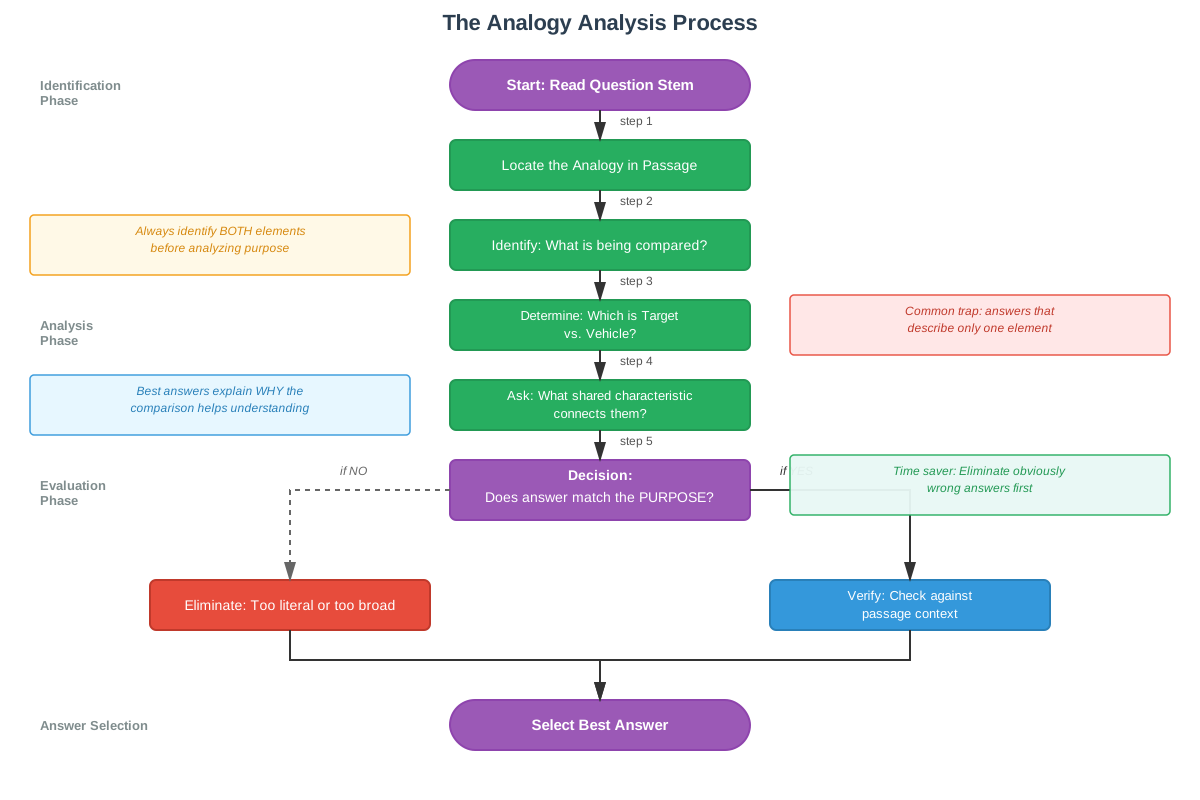
The concepts within analogy analysis form an interconnected system. Identifying analogy questions (through trigger words) → enables → recognizing the comparison structure (source and target domains) → which allows → analyzing the purpose (why this comparison was chosen) → leading to → evaluating effectiveness (how well it works).
This topic connects directly to prerequisite knowledge of figurative language, as analogies represent extended, purposeful comparisons that build on simile and metaphor foundations. Understanding main ideas proves essential because analogy purpose can only be determined within the context of the author's broader argument or explanation.
Analogy analysis also relates forward to more advanced Reading skills. Mastering analogies strengthens the ability to analyze rhetorical strategies, evaluate argumentative techniques, and understand how authors structure complex explanations. Students who excel at analogy questions typically perform well on author's purpose and craft questions because they understand how specific textual elements serve larger communicative goals.
The relationship map flows: Figurative Language Foundation → Analogy Recognition → Purpose Analysis → Effectiveness Evaluation → Broader Rhetorical Strategy Understanding
High-Yield Facts
⭐ Analogy questions appear 2-4 times per ACT Reading test, making them high-yield for score improvement
⭐ The source domain (familiar concept) always explains the target domain (complex concept), never the reverse
⭐ Question stems containing "in order to," "primarily serves to," or "suggests" signal that purpose analysis is required
⭐ Effective analogies clarify specific aspects without implying complete equivalence between compared items
⭐ Natural science passages use analogies more frequently than any other passage type on the ACT
- Analogies may be explicit (directly stated with comparison words) or implicit (suggested through parallel descriptions)
- The best answer to an analogy purpose question will be supported by specific textual evidence in the surrounding lines
- Extended analogies that span multiple sentences typically serve more complex purposes than single-sentence comparisons
- Authors sometimes acknowledge analogy limitations with phrases like "in some ways" or "to a certain extent"
- Incorrect answer choices often confuse the source and target domains or misidentify the specific aspect being compared
- Proportional analogies (A:B::C:D) rarely appear in passages but may appear in answer choices requiring parallel reasoning
- Analogy effectiveness depends on audience knowledge—what works for general readers may not work for experts
- Multiple analogies in a single passage usually build on each other to develop a complex explanation progressively
- The ACT never requires outside knowledge to understand analogies; all necessary information appears in the passage
- Recognizing when an analogy breaks down (where the comparison no longer holds) demonstrates sophisticated reading comprehension
Quick check — test yourself on Analogy so far.
Try Flashcards →Common Misconceptions
Misconception: Analogies must be scientifically or literally accurate in all respects → Correction: Analogies are explanatory tools that illuminate specific aspects of a concept; they're not meant to be perfect equivalents. An effective analogy clarifies the particular characteristic the author wants to emphasize, even if the comparison breaks down in other ways.
Misconception: The longer or more detailed an analogy, the more important it is → Correction: Analogy importance relates to its function within the passage's argument or explanation, not its length. A brief one-sentence comparison can be more crucial to understanding the main idea than an extended analogy that provides supplementary illustration.
Misconception: Analogy questions always ask what is being compared to what → Correction: While identification questions exist, the ACT more frequently tests understanding of purpose (why the comparison was made) or function (what the analogy accomplishes). Students must read question stems carefully to determine what's actually being asked.
Misconception: If two things are mentioned near each other, they're being compared → Correction: Proximity doesn't establish analogy. True analogies involve explicit or implicit comparison signals and establish parallel relationships. Simply mentioning two concepts in adjacent sentences doesn't create an analogy unless the author indicates they share significant characteristics.
Misconception: The source domain is always mentioned first in the passage → Correction: Authors may introduce the complex concept (target) before presenting the familiar comparison (source), or they may interweave the two throughout an explanation. The order of presentation varies based on rhetorical strategy and doesn't affect the analogy's structure.
Misconception: All comparisons in a passage are analogies → Correction: Not every comparison constitutes an analogy. Simple contrasts, literal similarities, or examples don't function as analogies unless they establish deeper structural or functional parallels between fundamentally different things. Analogies specifically use familiar concepts to illuminate unfamiliar ones.
Worked Examples
Example 1: Natural Science Passage
Passage Excerpt: "Understanding how neurons communicate requires grasping the concept of neurotransmitters. Think of neurotransmitters as molecular messengers, much like postal workers delivering letters between houses. Just as a postal worker carries a letter from one address to another, a neurotransmitter molecule carries a chemical signal from one neuron across the synaptic gap to a neighboring neuron. The receiving neuron has specialized receptors—like mailboxes—designed to accept specific neurotransmitters. When the right neurotransmitter 'key' fits into the receptor 'lock,' the message is delivered and the receiving neuron responds."
Question: The author's comparison of neurotransmitters to postal workers primarily serves to:
A) Demonstrate that neural communication is a slow, inefficient process
B) Clarify how chemical signals are transmitted between neurons
C) Suggest that neurons function independently like separate households
D) Emphasize the complexity of receptor-neurotransmitter interactions
Analysis:
Step 1: Identify that this is an analogy question through the phrase "comparison of X to Y primarily serves to," which signals purpose analysis.
Step 2: Determine the source and target domains. Target (complex concept) = neurotransmitter function; Source (familiar concept) = postal delivery system.
Step 3: Identify what specific aspect is being compared. The analogy focuses on the transmission process—how something moves from one location to another and is received at a specific destination.
Step 4: Consider the passage context. This appears in an explanatory passage about neural communication, suggesting the purpose is clarification rather than persuasion or criticism.
Step 5: Evaluate each answer choice:
- Choice A introduces a negative evaluation (slow, inefficient) not supported by the analogy, which emphasizes successful delivery, not speed
- Choice B accurately identifies the clarification purpose and the specific aspect being illuminated (transmission process)
- Choice C focuses on independence/separation, which isn't the point of the comparison
- Choice D mentions complexity, but the analogy actually simplifies the process to make it more understandable
Answer: B. The analogy's primary purpose is to clarify the transmission mechanism using a familiar delivery system that readers understand.
Example 2: Humanities Passage
Passage Excerpt: "Baroque architecture can be understood as a visual symphony. Just as a symphony builds emotional intensity through layered instrumentation, dynamic contrasts, and dramatic crescendos, Baroque buildings create emotional impact through ornate decoration, interplay of light and shadow, and soaring vertical elements that draw the eye upward. The architect, like a composer, orchestrates multiple elements—columns, sculptures, frescoes, gilding—into a unified composition designed to overwhelm the senses and evoke powerful feelings. Both art forms reject restraint in favor of abundance, using complexity and grandeur to move their audiences."
Question: According to the passage, the comparison between Baroque architecture and symphonic music emphasizes which shared characteristic?
A) The technical skill required to create either art form
B) The historical period during which both developed
C) The use of multiple elements to create emotional impact
D) The rejection of earlier, simpler artistic traditions
Analysis:
Step 1: Recognize this as an analogy question asking about shared characteristics between compared items.
Step 2: Identify the comparison structure. Target = Baroque architecture; Source = symphonic music.
Step 3: Locate specific parallels mentioned in the passage:
- "builds emotional intensity" / "create emotional impact"
- "layered instrumentation" / "multiple elements"
- "dramatic crescendos" / "soaring vertical elements"
- "orchestrates multiple elements" / "unified composition"
- "overwhelm the senses and evoke powerful feelings" / "move their audiences"
Step 4: Determine the central parallel. While several aspects are compared, the passage repeatedly emphasizes how both art forms use multiple components to generate emotional responses.
Step 5: Evaluate answer choices:
- Choice A (technical skill) isn't mentioned in the comparison
- Choice B (historical period) isn't addressed in this excerpt
- Choice C directly matches the repeated emphasis on using multiple elements for emotional impact
- Choice D (rejection of earlier traditions) appears only in the final sentence and isn't the primary focus
Answer: C. The analogy consistently emphasizes how both art forms combine multiple elements to create powerful emotional effects on their audiences.
Exam Strategy
Systematic Approach to Analogy Questions
When encountering an analogy question on the ACT, follow this proven process:
- Identify the question type by scanning for trigger words ("compares," "comparison," "similar to," "like," "serves to")
- Locate the relevant passage section using line references or content clues
- Determine source and target domains—which concept is familiar (source) and which is being explained (target)
- Read surrounding context (2-3 sentences before and after) to understand the analogy's purpose
- Predict the answer before looking at choices, focusing on what the comparison accomplishes
- Eliminate wrong answers systematically, removing choices that misidentify purpose, reverse source/target, or lack textual support
Trigger Words and Phrases
Develop automatic recognition of these high-frequency analogy signals in questions:
In questions: "compares," "comparison," "likens," "similar to," "resembles," "parallels," "analogous to," "serves to," "in order to," "primarily functions to," "suggests that"
In passages: "like," "as," "similar to," "can be compared to," "imagine," "think of," "in other words," "to put it another way," "functions as," "serves as"
When these appear, immediately activate analogy analysis mode and prepare to identify comparison structure and purpose.
Process of Elimination Strategies
Wrong answers to analogy questions typically fall into predictable categories:
- Reversal errors: Confusing which concept explains which (treating the target as if it were the source)
- Scope errors: Focusing on minor details rather than the main point of comparison
- Unsupported inferences: Introducing ideas not present in the passage or analogy
- Purpose misidentification: Confusing clarification with persuasion, or emphasis with criticism
- Overgeneralization: Suggesting the analogy implies complete equivalence rather than specific parallels
Systematically check each answer choice against these common error types. The correct answer will always have direct textual support and accurately identify the analogy's primary function.
Time Management
Analogy questions typically require 45-60 seconds to answer accurately—slightly longer than detail questions but shorter than inference questions. Budget time accordingly:
- 15 seconds: Read and categorize the question
- 20 seconds: Locate and reread the relevant passage section with context
- 15 seconds: Predict the answer based on purpose and structure
- 10 seconds: Eliminate wrong answers and confirm the best choice
If an analogy question requires more than 90 seconds, mark it for review and move forward. These questions reward careful analysis but shouldn't consume disproportionate time.
Memory Techniques
The SOURCE-TARGET Mnemonic
Remember analogy structure with SOURCE-TARGET:
- Simple concept used
- Obvious to readers
- Used to explain
- Relatable comparison
- Clarifies the
- Explanation
- Tough concept
- Author wants to explain
- Requires clarification
- Gets illuminated by
- Example from familiar domain
- That readers understand
Purpose Categories: The Three C's
Most ACT analogies serve one of three primary purposes—remember CLARIFY, CONVINCE, CHARACTERIZE:
- CLARIFY: Explain complex concepts (most common in science passages)
- CONVINCE: Strengthen arguments through familiar comparisons (common in social science)
- CHARACTERIZE: Reveal qualities of people, places, or things (common in prose fiction and humanities)
Visual Memory Strategy
When reading passages, mentally draw arrows connecting compared elements:
Complex Concept (target) ← explained by ← Familiar Concept (source)This visualization reinforces the directional relationship and helps prevent reversal errors on questions.
The PACES Acronym for Analysis
When analyzing any analogy, remember PACES:
- Purpose: Why did the author use this comparison?
- Aspect: What specific characteristic is being compared?
- Context: How does this fit the passage's main idea?
- Effectiveness: Does the comparison accomplish its goal?
- Support: What textual evidence confirms this interpretation?
Summary
Analogy questions test students' ability to recognize, interpret, and evaluate comparative relationships that authors use to clarify complex concepts. These questions appear consistently on the ACT Reading test, typically 2-4 times per exam, making them high-yield for score improvement. Successful analogy analysis requires identifying the source domain (familiar concept) and target domain (complex concept being explained), determining the specific aspect being compared, and understanding the purpose the comparison serves within the passage. The ACT most frequently tests whether students understand why an author chose a particular analogy and what function it serves—clarification, persuasion, emphasis, or characterization. Effective test-takers recognize analogy trigger words in questions, locate relevant passage sections efficiently, consider surrounding context, and systematically eliminate wrong answers that reverse domains, misidentify purpose, or lack textual support. Mastering analogy questions strengthens overall reading comprehension by developing the ability to analyze rhetorical strategies and understand how authors structure complex explanations for different audiences.
Key Takeaways
- Analogies use familiar concepts (source domain) to explain unfamiliar concepts (target domain), never the reverse
- Purpose analysis is more frequently tested than simple identification—focus on why the comparison was made
- Natural science passages contain the highest frequency of analogies, typically using everyday objects to explain scientific processes
- Effective analogies clarify specific aspects without implying complete equivalence between compared items
- Question stems containing "serves to," "in order to," or "primarily functions to" signal purpose questions requiring analysis of the analogy's role
- Wrong answers often reverse source and target, misidentify purpose, or introduce unsupported ideas not present in the passage
- Context matters critically—read 2-3 sentences before and after the analogy to understand its function within the author's broader explanation or argument
Related Topics
Rhetorical Strategies: Understanding analogy provides foundation for analyzing other rhetorical devices authors use to persuade, explain, and engage readers. Mastering analogy enables progression to more complex analysis of how multiple strategies work together.
Author's Purpose: Analogy analysis directly connects to determining why authors make specific choices. Students who understand analogy purpose can more easily identify overall passage purpose and tone.
Textual Evidence: Analogy questions require citing specific support for interpretations. This skill transfers to all evidence-based questions on the ACT Reading section.
Inference and Interpretation: Advanced analogy questions require inferring unstated connections between compared elements, strengthening general inference skills applicable across question types.
Comparative Relationships: Understanding how analogies establish parallels prepares students for questions about contrasts, cause-effect relationships, and other comparative structures in passages.
Practice CTA
Now that you've mastered the core concepts of analogy recognition and analysis, it's time to apply these strategies to authentic ACT-style questions. Complete the practice questions to reinforce your understanding of source and target domains, purpose identification, and systematic answer elimination. Use the flashcards to memorize trigger words and common analogy purposes until recognition becomes automatic. Remember: analogy questions are high-yield opportunities to demonstrate sophisticated reading comprehension—with focused practice, these questions can become consistent score boosters. Challenge yourself to explain not just which answer is correct, but why each wrong answer fails. This deeper analysis will cement your mastery and prepare you for test day success.
Sign up free to keep reading
Create a free AnvayaPrep account to finish this ACT guide on Analogy — plus flashcards and practice questions.