Overview
The compare and contrast structure is one of the most frequently tested organizational patterns on the ACT Reading test. This structural approach appears when authors present two or more subjects, ideas, theories, perspectives, or time periods and systematically examine their similarities and differences. Recognizing this pattern is crucial because approximately 15-20% of ACT Reading questions directly test a student's ability to identify relationships between ideas, understand how authors organize information, and track multiple perspectives throughout a passage.
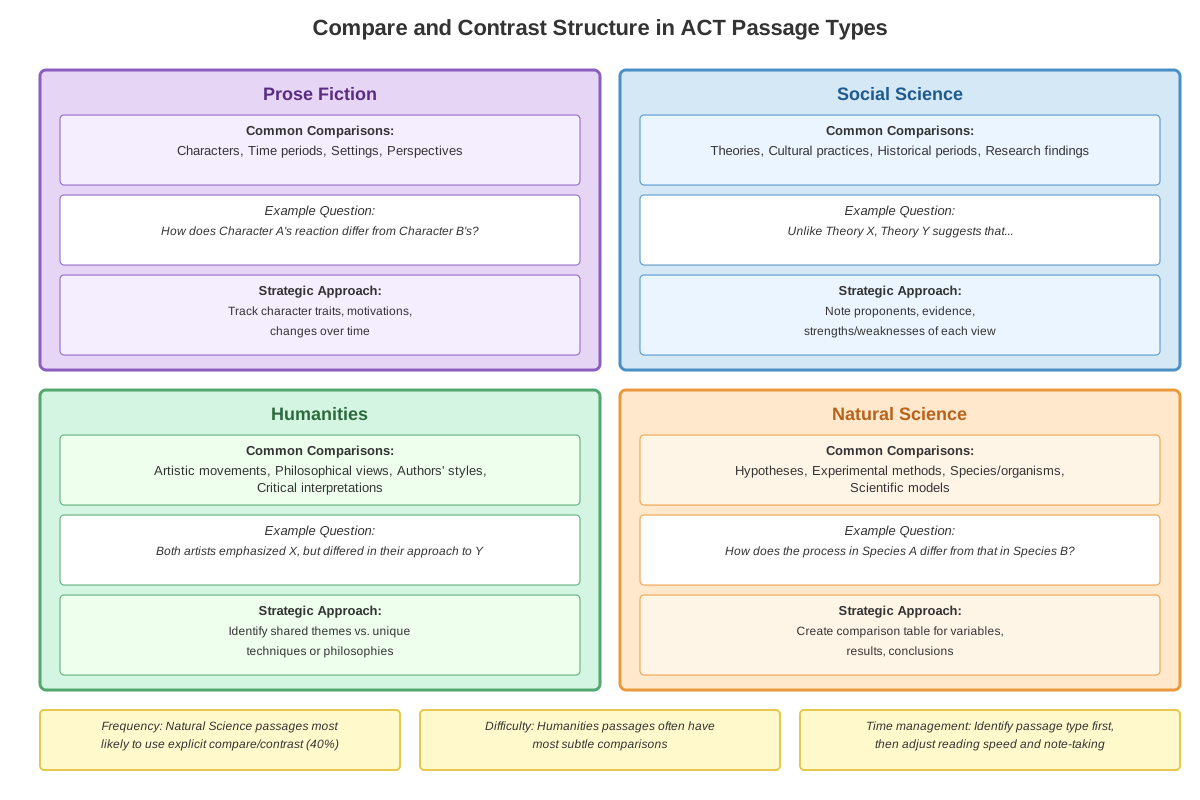
Understanding compare and contrast structure goes beyond simply spotting words like "however" or "similarly." It requires recognizing how authors build arguments by juxtaposing elements, how they signal shifts between subjects, and how they use structural patterns to emphasize certain points over others. The ACT frequently uses this structure in Prose Fiction passages (comparing characters or time periods), Social Science passages (contrasting theories or cultural practices), Humanities passages (comparing artistic movements or philosophical viewpoints), and Natural Science passages (contrasting scientific hypotheses or experimental approaches).
Mastery of ACT compare and contrast structure connects directly to other critical reading skills tested on the exam, including identifying main ideas, understanding author's purpose, making inferences, and analyzing rhetorical strategies. When students can quickly identify that a passage uses compare and contrast organization, they can predict question types, locate information more efficiently, and avoid common traps in answer choices that confuse which subject is being discussed or misrepresent the relationship between elements.
Learning Objectives
- [ ] Identify when Compare and contrast structure is being tested in ACT Reading passages
- [ ] Explain the core rule or strategy behind Compare and contrast structure
- [ ] Apply Compare and contrast structure to ACT-style questions accurately
- [ ] Distinguish between different types of compare and contrast organizational patterns (block vs. point-by-point)
- [ ] Recognize transition words and phrases that signal comparison and contrast relationships
- [ ] Analyze how authors use compare and contrast structure to develop arguments and emphasize key points
- [ ] Predict question types based on the presence of compare and contrast structure in passages
Prerequisites
- Basic reading comprehension skills: Understanding literal meaning is essential before analyzing organizational structure
- Familiarity with main idea identification: Compare and contrast structures often serve to support or develop the passage's central thesis
- Knowledge of transition words: Recognizing basic connective language helps identify structural shifts
- Understanding of paragraph function: Knowing how paragraphs work together helps track which subject is being discussed at any given point
Why This Topic Matters
Compare and contrast structure appears in approximately 3-5 questions per ACT Reading test, making it one of the highest-yield structural concepts to master. Questions testing this skill often appear as "Craft and Structure" questions, which account for roughly 25-30% of all Reading questions. These questions typically ask students to identify similarities or differences between subjects, determine how the author organizes information, or understand why the author chose to present ideas in a particular sequence.
In real-world contexts, the ability to compare and contrast is fundamental to critical thinking across all disciplines. Scientists compare experimental results, historians contrast different interpretations of events, literary critics examine how authors differ in their approaches, and social scientists analyze cultural variations. The ACT tests this skill because it reflects authentic academic reading demands that students will encounter in college coursework.
On the exam, compare and contrast structure most commonly appears in passages that present two theories (Natural Science), two time periods or characters (Prose Fiction), two cultural perspectives (Social Science), or two artistic movements or critical interpretations (Humanities). Questions may ask about the relationship between subjects, how the author organizes the discussion, what distinguishes one element from another, or how specific details relate to the comparative framework.
Core Concepts
Defining Compare and Contrast Structure
Compare and contrast structure is an organizational pattern in which an author systematically presents two or more subjects and examines their similarities (comparison) and/or differences (contrast). This structure serves multiple rhetorical purposes: highlighting unique features, showing evolution over time, evaluating relative merits, or demonstrating relationships between concepts. On the ACT, recognizing this structure helps students anticipate content, locate specific information, and understand the author's analytical framework.
The structure can focus primarily on similarities (pure comparison), primarily on differences (pure contrast), or both. Most ACT passages that employ this structure include both elements, though one typically dominates. Authors choose this organizational pattern when their purpose involves analysis, evaluation, or explanation of relationships rather than simple description or narration.
Two Primary Organizational Patterns
Compare and contrast passages follow two main organizational approaches, and recognizing which pattern an author uses dramatically improves reading efficiency:
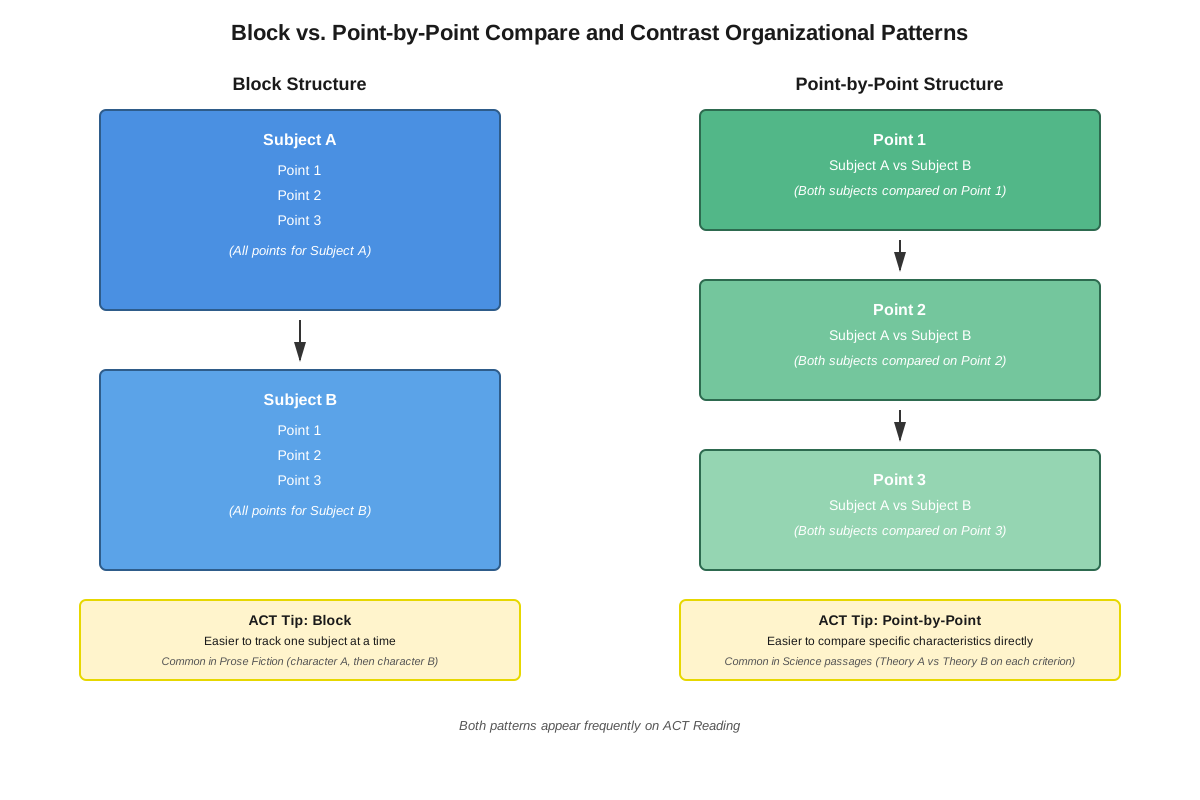
Block (Subject-by-Subject) Pattern: The author discusses all aspects of Subject A, then shifts to discuss all aspects of Subject B. This pattern is common in shorter passages or when the subjects are complex enough that switching back and forth would confuse readers.
Example structure:
- Introduction of both subjects
- Complete discussion of Subject A (multiple paragraphs)
- Transition paragraph or sentence
- Complete discussion of Subject B (multiple paragraphs)
- Conclusion synthesizing the comparison
Point-by-Point (Alternating) Pattern: The author identifies several points of comparison and discusses both subjects in relation to each point before moving to the next point. This pattern emphasizes direct comparison and is common in longer, more analytical passages.
Example structure:
- Introduction of both subjects
- Point 1: Subject A and Subject B compared
- Point 2: Subject A and Subject B compared
- Point 3: Subject A and Subject B compared
- Conclusion synthesizing the comparison
| Pattern Type | Structure | Best For | ACT Frequency |
|---|---|---|---|
| Block | All of A, then all of B | Complex subjects, shorter passages | Moderate |
| Point-by-Point | A vs. B on Point 1, A vs. B on Point 2, etc. | Direct comparison, analytical passages | High |
| Mixed | Combination of both patterns | Sophisticated arguments | Moderate |
Signal Words and Transition Phrases
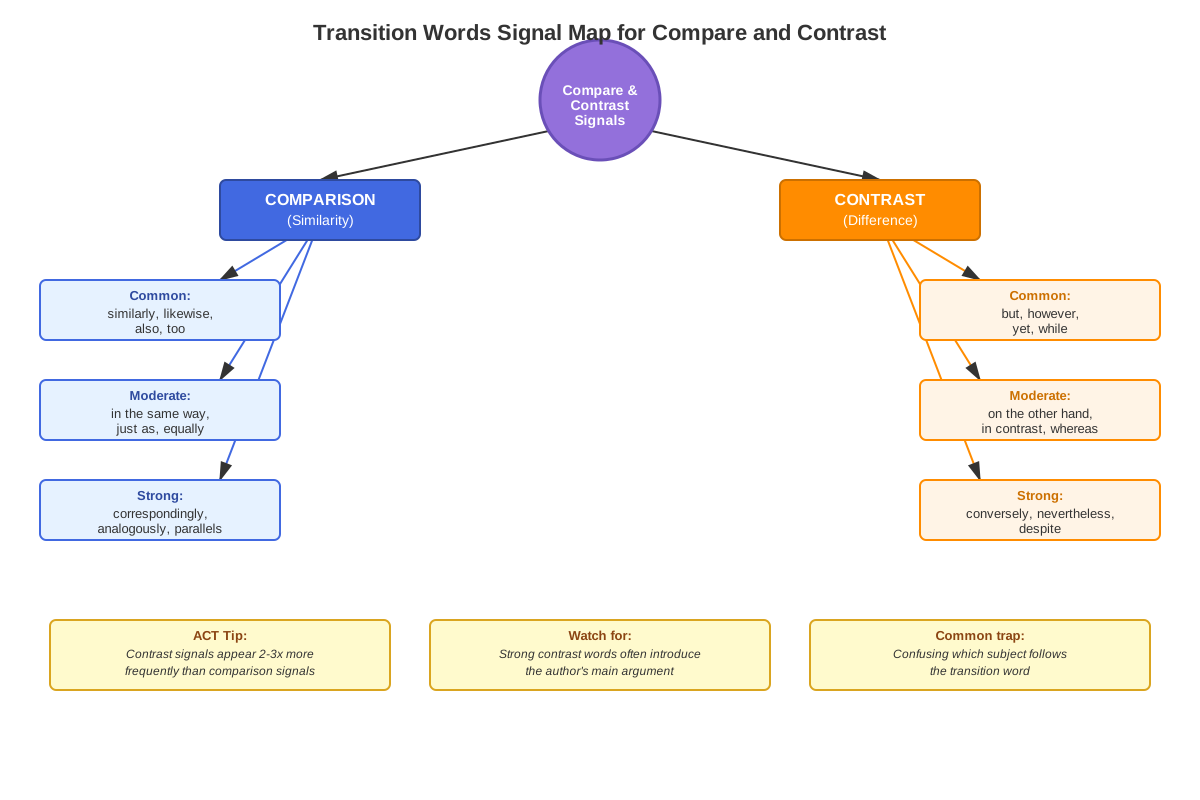
Recognizing transition words that indicate comparison or contrast is essential for tracking the structure as you read. These linguistic markers help identify when the author shifts between subjects or moves from similarity to difference.
Comparison signals (indicating similarity):
- Similarly, likewise, in the same way, also, too
- Both, equally, just as, comparable to
- Correspondingly, in like manner, analogously
Contrast signals (indicating difference):
- However, but, yet, although, though
- In contrast, on the other hand, conversely
- While, whereas, unlike, nevertheless
- Despite, in spite of, regardless
- Alternatively, instead, rather than
Structural transition phrases specific to compare/contrast:
- "Turning now to..." (signals shift from Subject A to Subject B)
- "By comparison..." (signals explicit comparison)
- "In contrast to the previous..." (signals shift and contrast)
- "Both X and Y..." (signals comparison coming)
- "Where X does..., Y instead..." (signals contrast)
Identifying Compare and Contrast Questions
ACT questions testing compare and contrast structure typically fall into several categories:
- Direct comparison questions: "How does Character A's response differ from Character B's response?"
- Organizational structure questions: "The passage is best described as comparing two..."
- Similarity/difference questions: "What do Theory X and Theory Y have in common?"
- Relationship questions: "The author discusses the second approach primarily to..."
- Detail location questions: "According to the passage, unlike Method A, Method B..."
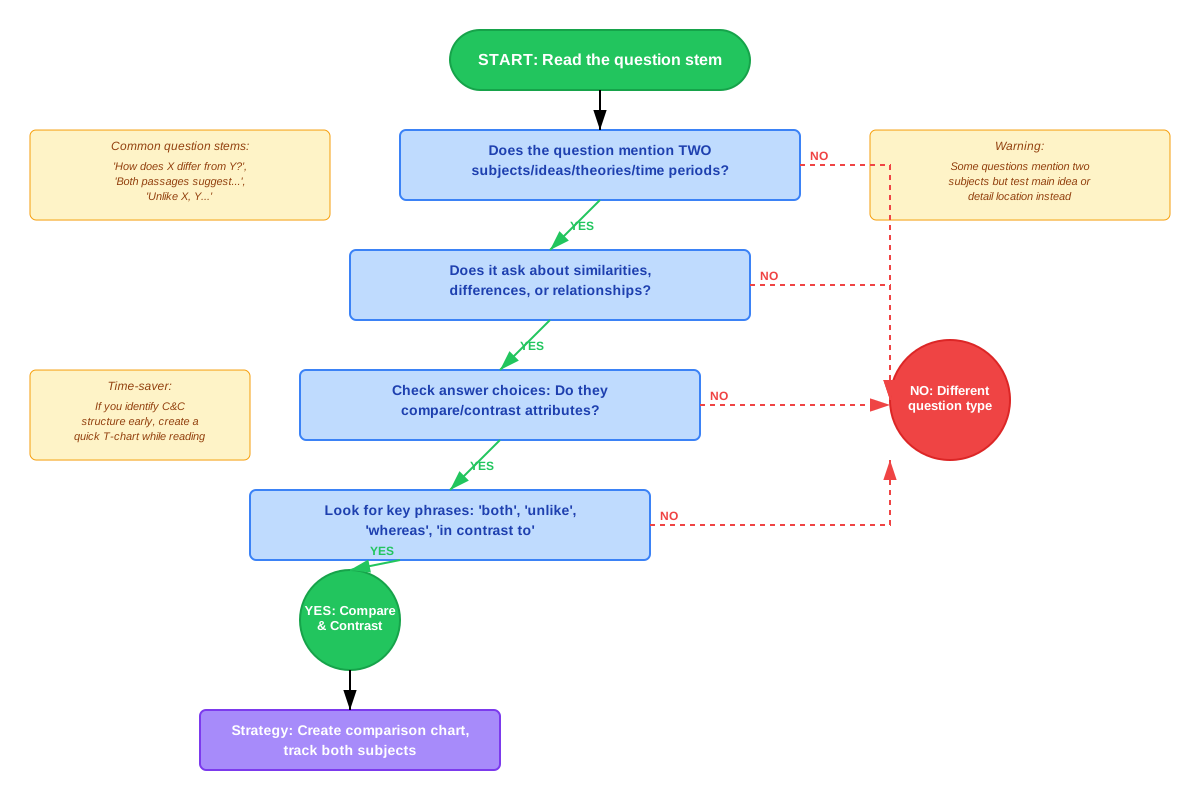
These questions often include phrases like "both," "unlike," "in contrast to," "similar to," "differ," "share," or "distinguish." When you see these phrases, you're dealing with a compare and contrast question that requires tracking the structural organization of the passage.
Reading Strategy for Compare and Contrast Passages
When you identify a passage using compare and contrast structure, employ this strategic approach:
- Identify the subjects being compared in the first paragraph or two
- Determine the organizational pattern (block or point-by-point)
- Create a mental or physical chart tracking similarities and differences
- Mark transitions between subjects with brackets or annotations
- Note the author's emphasis: Does the passage focus more on similarities or differences?
- Identify the purpose: Why is the author comparing these subjects?
This active reading approach transforms passive comprehension into strategic navigation, allowing you to answer questions more quickly and accurately.
Concept Relationships
The compare and contrast structure concept connects to multiple other ACT Reading skills in a hierarchical and complementary way. At the foundation, basic comprehension enables students to understand what is being compared. This leads upward to structural analysis, where students recognize the organizational pattern. From there, students can perform detail location, finding specific information about each subject, which enables inference-making about relationships not explicitly stated.
Compare and contrast structure directly supports main idea identification because the comparative framework often IS the main idea (e.g., "These two theories differ primarily in their assumptions about human nature"). It also connects to author's purpose analysis, as the choice to compare subjects reveals analytical intent rather than merely descriptive purpose.
The relationship map flows as follows:
Basic Comprehension → Recognition of Multiple Subjects → Identification of Compare/Contrast Structure → Tracking Organizational Pattern → Detail Location for Each Subject → Analysis of Relationships → Inference About Similarities/Differences → Understanding Author's Purpose → Synthesis of Main Idea
Additionally, compare and contrast structure intersects with rhetorical strategy analysis, as authors use this structure as a persuasive tool, often favoring one subject over another through the comparison itself.
High-Yield Facts
⭐ Compare and contrast structure appears in 3-5 questions per ACT Reading test, making it one of the highest-yield structural patterns to master.
⭐ The two primary organizational patterns are block (subject-by-subject) and point-by-point (alternating), with point-by-point being more common on the ACT.
⭐ Transition words like "however," "similarly," "in contrast," and "likewise" are the most reliable signals of compare and contrast structure.
⭐ Questions testing this structure often include the words "both," "unlike," "differ," "similar," or "in contrast to" in the question stem.
⭐ When a passage compares two subjects, approximately 60-70% of detail questions will require knowing which subject is being discussed in a specific paragraph or sentence.
- Compare and contrast passages typically introduce both subjects in the first 1-2 paragraphs, establishing the comparative framework early.
- Authors using block organization often include an explicit transition paragraph or sentence when shifting from Subject A to Subject B.
- The ACT frequently tests whether students can distinguish which details apply to which subject, making annotation crucial.
- Compare and contrast structure is most common in Natural Science passages (comparing theories or methods) and Social Science passages (comparing cultural practices or historical periods).
- Questions may ask about the organizational structure itself: "The passage is best described as..." with answers referencing comparative organization.
- Mixed patterns (combining block and point-by-point) appear in approximately 20% of compare and contrast passages, usually in longer or more complex texts.
- The subject discussed first in a passage is not necessarily the one the author favors; careful attention to evaluative language is required.
- Approximately 40% of compare and contrast questions on the ACT are "EXCEPT" or "NOT" questions, requiring comprehensive tracking of both subjects.
Quick check — test yourself on Compare and contrast structure so far.
Try Flashcards →Common Misconceptions
Misconception: Compare and contrast structure only appears when the passage explicitly uses words like "compare" or "contrast."
Correction: Many passages use this structure implicitly, presenting two subjects in parallel without explicitly stating they're being compared. The structure exists in the organization itself, not just in signal words.
Misconception: If a passage discusses two subjects, it must be using compare and contrast structure.
Correction: Some passages discuss multiple subjects sequentially without comparing them (e.g., describing two unrelated historical events). True compare and contrast structure involves analyzing relationships, similarities, or differences between subjects, not merely mentioning multiple topics.
Misconception: In block organization, the author always discusses Subject A completely before mentioning Subject B at all.
Correction: Block organization means discussing all major points about Subject A before all major points about Subject B, but the introduction typically mentions both subjects, and the conclusion often synthesizes them. Brief references to Subject B may appear in the Subject A section for context.
Misconception: Comparison means finding similarities, and contrast means finding differences, so passages do one or the other.
Correction: Most ACT passages using this structure include both similarities AND differences. The term "compare and contrast structure" encompasses both operations, and questions may test either or both aspects.
Misconception: The subject discussed first or given more space is always the one the author prefers or considers more important.
Correction: Authors may discuss a subject first for chronological reasons, to establish context, or to set up a contrasting example. Length and position don't necessarily indicate preference; evaluative language and explicit statements reveal the author's stance.
Misconception: All details about each subject will be parallel (if the author mentions X's color, they'll mention Y's color).
Correction: While point-by-point organization creates parallel structure, authors often discuss different aspects of each subject based on what's relevant or distinctive. Not every detail about Subject A will have a corresponding detail about Subject B.
Worked Examples
Example 1: Natural Science Passage (Point-by-Point Structure)
Passage Excerpt:
"Two competing theories attempt to explain the extinction of megafauna at the end of the Pleistocene epoch. The overkill hypothesis attributes these extinctions primarily to human hunting pressure. Proponents note that extinctions coincided with human arrival in various regions and that archaeological evidence shows humans hunted these large animals. The climate change hypothesis, conversely, attributes extinctions to rapid environmental shifts at the epoch's end. Supporters point to evidence of dramatic temperature fluctuations and habitat loss during this period.
Regarding temporal patterns, the overkill hypothesis struggles to explain why some extinctions occurred thousands of years after human arrival in certain regions. The climate change hypothesis, however, faces difficulty explaining why megafauna that survived previous glacial cycles failed to survive this particular climate shift.
Both theories acknowledge that multiple factors likely contributed to extinctions, though they differ in emphasis. The overkill hypothesis treats climate change as a secondary stressor that made populations more vulnerable to hunting. The climate change hypothesis views human hunting as an additional pressure on already stressed populations."
Question: According to the passage, how do the two hypotheses differ in their treatment of multiple causal factors?
Step 1 - Identify the structure: This passage uses point-by-point organization, discussing both hypotheses in relation to each analytical point (basic claims, temporal patterns, acknowledgment of multiple factors).
Step 2 - Locate the relevant section: The question asks about "multiple causal factors," which is addressed in the final paragraph.
Step 3 - Track each subject:
- Overkill hypothesis: treats climate change as secondary, hunting as primary
- Climate change hypothesis: treats climate change as primary, hunting as secondary
Step 4 - Identify the relationship: Both acknowledge multiple factors, but they differ in which factor they emphasize as primary versus secondary.
Answer: The overkill hypothesis treats climate change as a secondary factor that increased vulnerability to hunting (the primary cause), while the climate change hypothesis treats hunting as an additional pressure on populations already stressed by climate change (the primary cause). Both acknowledge multiple factors but reverse their emphasis.
Connection to Learning Objectives: This example demonstrates identifying compare and contrast structure (point-by-point pattern), applying the strategy of tracking each subject separately, and accurately answering a question about the relationship between the compared subjects.
Example 2: Prose Fiction Passage (Block Structure)
Passage Excerpt:
"In her youth, Margaret approached every challenge with methodical precision. She would list potential obstacles, devise contingency plans, and execute her strategies with unwavering discipline. Her college applications were submitted weeks before deadlines, each essay revised seven times. Her first job interview involved three days of preparation, including rehearsed answers to fifty potential questions. Friends admired her reliability but sometimes found her rigidity exhausting. Spontaneity made her anxious; she needed frameworks and structures to feel secure.
Twenty years later, Margaret barely recognized her former self. Now she made decisions based on intuition rather than exhaustive analysis. When her company offered a position in Singapore, she accepted within hours, without the pro-con lists that once governed her choices. She had learned that excessive planning often meant missed opportunities, that some of life's best moments emerged from uncertainty. Her friends noticed the change, commenting that she seemed more relaxed, more present, though occasionally they missed the old Margaret who always had a plan."
Question: The passage suggests that the primary difference between young Margaret and older Margaret lies in their:
Step 1 - Identify the structure: This passage uses block organization, fully describing young Margaret (paragraph 1) before describing older Margaret (paragraph 2).
Step 2 - Identify the transition: "Twenty years later" signals the shift from Subject A (young Margaret) to Subject B (older Margaret).
Step 3 - Extract key characteristics:
- Young Margaret: methodical, planned extensively, anxious about spontaneity, relied on structure
- Older Margaret: intuitive, spontaneous, comfortable with uncertainty, less analytical
Step 4 - Identify the primary difference: The core distinction is between planned/analytical approach versus intuitive/spontaneous approach to decision-making.
Answer: The primary difference lies in their approach to decision-making: young Margaret relied on extensive planning and analysis, while older Margaret trusts intuition and embraces spontaneity.
Connection to Learning Objectives: This example demonstrates recognizing block structure, identifying the transition between subjects, and synthesizing information about each subject to determine the primary relationship between them.
Exam Strategy
When approaching ACT Reading questions involving compare and contrast structure, employ these strategic techniques:
Pre-Reading Strategy: Scan the first paragraph and any subheadings to identify whether multiple subjects are being discussed. If you spot two theories, two time periods, two characters, or two perspectives introduced early, prepare to track compare and contrast structure.
Active Reading Annotations: Use simple symbols to track subjects:
- Underline or bracket Subject A information
- Circle or use a different bracket style for Subject B information
- Mark transition points with arrows or vertical lines
- Note "S" for similarity and "D" for difference in margins
Trigger Words to Watch For: Questions testing this structure almost always include specific language:
- "Both X and Y..." (similarity question)
- "Unlike X, Y..." (difference question)
- "In contrast to..." (difference question)
- "How does X differ from Y..." (difference question)
- "What do X and Y share..." (similarity question)
- "The passage is best described as comparing..." (structure question)
Process of Elimination Tips:
- Eliminate answers that confuse which subject has which characteristic (the most common trap)
- Eliminate answers that claim absolute similarity or difference when the passage shows nuance
- Eliminate answers that mention details from only one subject when the question asks about both
- For "EXCEPT" questions, track which details apply to which subject systematically
Time Allocation: Compare and contrast questions typically require 45-60 seconds each because they demand locating information about multiple subjects. Don't rush these questions; accuracy matters more than speed, and these questions are highly predictable once you master the pattern.
Question Prediction: When you identify compare and contrast structure, predict these question types will appear:
- At least one question about similarities or differences
- Possibly one question about organizational structure
- Multiple detail questions requiring you to distinguish which subject is being discussed
Memory Techniques
BLOCK Acronym for block organization:
- Big picture of first subject
- Lots of details about first subject
- On to second subject (transition)
- Complete discussion of second subject
- Knit together in conclusion
POINT Acronym for point-by-point organization:
- Present both subjects initially
- One point at a time
- Interweave subjects throughout
- Next point continues pattern
- Tie together at end
Visualization Strategy: Picture a Venn diagram as you read. When the passage discusses similarities, visualize the overlapping center. When it discusses differences, visualize the separate circles. This mental image helps organize information spatially.
The "Two-Column" Mental Technique: Imagine a T-chart with Subject A on the left and Subject B on the right. As you read, mentally file each detail into the appropriate column. This prevents confusion about which subject has which characteristics.
Transition Word Mnemonic - "SHOW":
- Similarly, Same (comparison words)
- However, Hinder (contrast words starting with H)
- On the other hand, Opposite (contrast phrases)
- While, Whereas (contrast words starting with W)
Summary
Compare and contrast structure is a high-yield organizational pattern on the ACT Reading test that appears when authors systematically examine similarities and differences between two or more subjects. Mastering this structure requires recognizing two primary organizational patterns—block (subject-by-subject) and point-by-point (alternating)—and tracking which details apply to which subject throughout the passage. Success depends on identifying transition words that signal comparison ("similarly," "likewise") or contrast ("however," "unlike"), actively annotating to distinguish subjects, and understanding that questions will test both the relationships between subjects and the organizational structure itself. The most common trap is confusing which characteristics belong to which subject, making careful tracking essential. Students who recognize this structure quickly can predict question types, locate information efficiently, and avoid common errors, making compare and contrast structure one of the most strategic concepts to master for ACT Reading success.
Key Takeaways
- Compare and contrast structure appears in 3-5 questions per ACT Reading test and is one of the highest-yield patterns to master
- The two primary organizational patterns are block (all of A, then all of B) and point-by-point (A and B discussed together for each point)
- Transition words like "however," "similarly," "in contrast," and "unlike" are reliable signals of this structure
- Active annotation distinguishing Subject A from Subject B prevents the most common error: confusing which details apply to which subject
- Questions testing this structure typically include words like "both," "unlike," "differ," "similar," or "in contrast to"
- Understanding the organizational pattern helps predict question types and locate information more efficiently
- Both similarities AND differences usually appear in ACT passages using this structure, even though one may be emphasized
Related Topics
Main Idea and Author's Purpose: Compare and contrast structure often serves as the vehicle for expressing the passage's main idea, particularly when the author's purpose is analytical rather than descriptive. Mastering structural analysis enhances main idea identification.
Rhetorical Strategy and Persuasion: Authors use compare and contrast structure as a rhetorical tool to persuade readers, often subtly favoring one subject over another through the comparison itself. Understanding this connection deepens analytical reading skills.
Detail Location and Reference Questions: The ability to track which subject is being discussed at any point in a passage is fundamental to answering detail questions accurately, making compare and contrast structure essential for this question type.
Inference Questions: Many inference questions on the ACT require synthesizing information about both subjects in a comparison, understanding unstated similarities or differences, or predicting how one subject might respond based on what's stated about the other.
Practice CTA
Now that you've mastered the fundamentals of compare and contrast structure, it's time to put your knowledge into action! Complete the practice questions to test your ability to identify this structure, track multiple subjects, and answer ACT-style questions accurately. The flashcards will help reinforce key transition words and organizational patterns. Remember: recognizing this structure quickly and tracking subjects carefully are skills that improve dramatically with practice. Each practice question you complete strengthens your pattern recognition and builds the confidence you need to excel on test day. You've got this!
Sign up free to keep reading
Create a free AnvayaPrep account to finish this ACT guide on Compare and contrast structure — plus flashcards and practice questions.