Overview
Passage organization refers to the structural framework authors use to arrange ideas, arguments, and information within a text. On the ACT Reading test, understanding how passages are organized is crucial for quickly locating information, predicting where certain details will appear, and comprehending the author's overall purpose. Questions testing ACT passage organization ask students to identify the function of paragraphs, recognize structural patterns, understand how ideas connect across sections, and determine why an author chose a particular arrangement of information.
Mastering passage organization provides a significant strategic advantage on the ACT Reading section. Rather than reading passages as undifferentiated blocks of text, skilled test-takers recognize common organizational patterns—such as chronological sequences, cause-and-effect relationships, compare-contrast structures, and problem-solution frameworks. This recognition enables faster comprehension, more efficient navigation when answering questions, and better retention of passage content. Students who understand organizational structures can often predict what type of information will appear next, allowing them to read more actively and purposefully.
Passage organization connects intimately with other critical reading skills tested on the ACT. It supports main idea identification by revealing how supporting details build toward central claims. It enhances inference abilities by showing logical relationships between ideas. It aids vocabulary-in-context questions by providing structural clues about word meaning. Most importantly, organizational awareness transforms passive reading into strategic analysis, enabling students to approach each passage with a clear mental framework that accelerates comprehension and improves accuracy across all question types.
Learning Objectives
- [ ] Identify when passage organization is being tested in ACT Reading questions
- [ ] Explain the core rule or strategy behind passage organization analysis
- [ ] Apply passage organization concepts to ACT-style questions accurately
- [ ] Recognize and name at least six common organizational patterns used in ACT passages
- [ ] Determine the function of individual paragraphs within a passage's overall structure
- [ ] Predict where specific types of information will appear based on organizational cues
- [ ] Distinguish between organizational questions and other question types on the ACT
Prerequisites
- Basic paragraph structure understanding: Recognizing topic sentences, supporting details, and concluding statements helps identify how individual paragraphs function within larger organizational schemes
- Main idea identification skills: Understanding a passage's central purpose provides the foundation for recognizing how organizational structure supports that purpose
- Transition word recognition: Familiarity with words like "however," "furthermore," "consequently," and "in contrast" signals organizational relationships between ideas
- Active reading strategies: The ability to annotate, summarize, and engage with text while reading enables students to track organizational patterns as they emerge
Why This Topic Matters
Understanding passage organization provides practical benefits far beyond standardized testing. In academic settings, recognizing organizational patterns helps students take better notes, write more coherent essays, and comprehend complex textbook material more efficiently. Professional contexts require the ability to quickly extract key information from reports, proposals, and technical documents—skills directly enhanced by organizational awareness. Critical thinking in everyday life improves when individuals can identify how arguments are structured, where evidence appears, and how conclusions connect to premises.
On the ACT Reading test specifically, passage organization questions appear with high frequency, typically comprising 15-20% of all reading questions across the four passages. These questions manifest in several distinct formats: asking about the function of a specific paragraph, requesting identification of the passage's overall organizational pattern, inquiring why the author placed certain information in a particular location, or testing whether students understand how one section relates to another. The ACT consistently includes at least one explicit organizational question per passage, and organizational understanding implicitly supports answering many other question types.
Passage organization questions commonly appear in all four ACT Reading passage types: Literary Narrative/Prose Fiction, Social Science, Humanities, and Natural Science. Science passages frequently employ cause-and-effect or problem-solution structures. Humanities passages often use chronological organization when discussing historical developments or compare-contrast when analyzing artistic movements. Social Science passages may combine multiple organizational patterns, such as presenting a problem chronologically while comparing different proposed solutions. Literary narratives typically follow chronological or flashback structures, with organizational questions focusing on why the author chose particular sequencing of events.
Core Concepts
Common Organizational Patterns
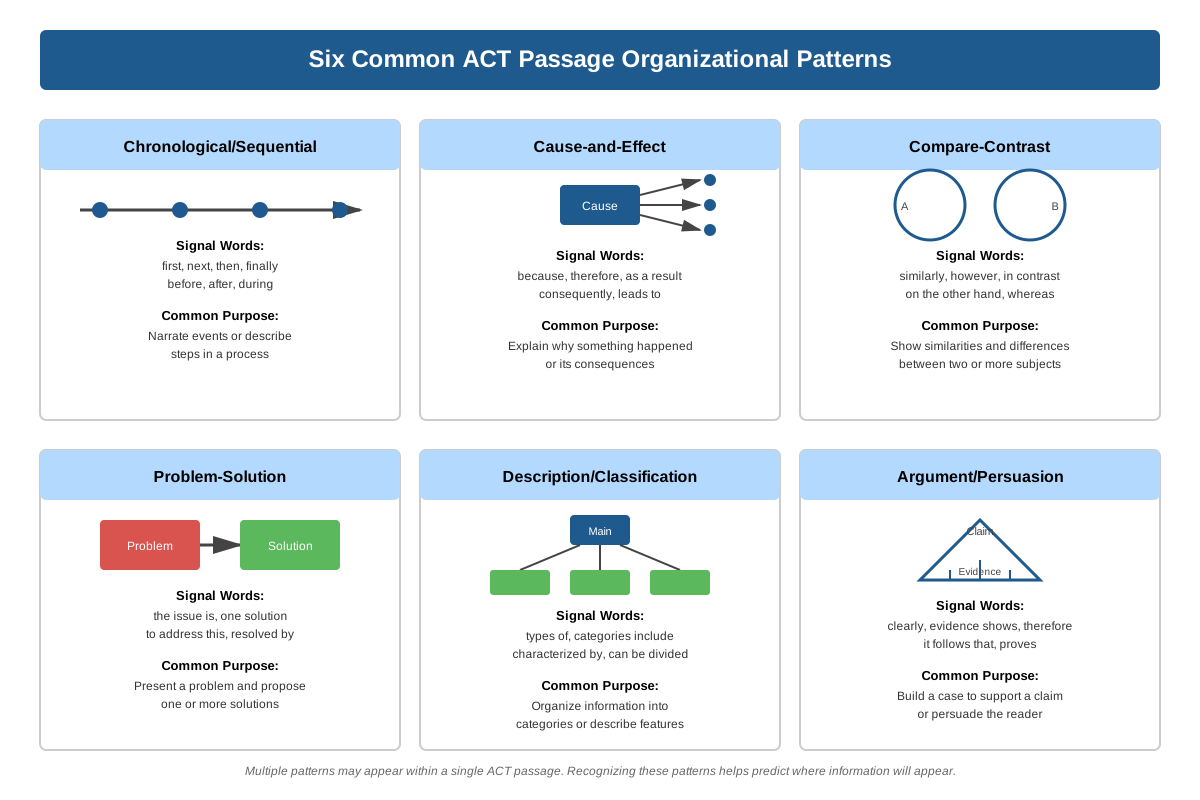
The ACT Reading section features six primary organizational patterns that appear repeatedly across passages. Recognizing these patterns quickly enables strategic reading and efficient question answering.
Chronological/Sequential Organization presents information in time order, moving from earlier to later events or from first to last steps in a process. This pattern appears frequently in historical passages, biographical narratives, and scientific descriptions of processes. Signal words include "first," "then," "next," "subsequently," "finally," "before," and "after." When encountering chronological organization, students should track the timeline mentally or through brief annotations, noting major time markers that help locate specific information quickly.
Cause-and-Effect Organization explains how one event, condition, or phenomenon leads to another. This pattern dominates scientific passages explaining natural processes and social science passages analyzing historical or sociological developments. Signal words include "because," "therefore," "consequently," "as a result," "leads to," "causes," and "due to." Cause-and-effect passages may present multiple causes for a single effect, a single cause with multiple effects, or causal chains where one effect becomes the cause of subsequent effects.
Compare-and-Contrast Organization examines similarities and differences between two or more subjects. This pattern appears when passages discuss competing theories, different artistic styles, contrasting historical periods, or alternative solutions to problems. Signal words include "similarly," "likewise," "in contrast," "however," "on the other hand," "whereas," and "unlike." These passages typically follow either a block structure (discussing all aspects of Subject A, then all aspects of Subject B) or a point-by-point structure (alternating between subjects for each characteristic discussed).
Problem-Solution Organization identifies a challenge, issue, or question, then presents one or more responses or answers. This pattern frequently appears in social science passages discussing policy issues and scientific passages describing research addressing specific questions. The problem typically appears in early paragraphs, with solutions occupying the middle and later sections. Signal words include "problem," "challenge," "issue," "solution," "answer," "resolve," and "address."
Classification/Category Organization divides a broad topic into distinct types, categories, or classifications. This pattern appears when passages discuss different species, artistic movements, historical periods, or theoretical approaches. Each category receives dedicated discussion, often in separate paragraphs. Signal words include "types," "kinds," "categories," "classified," "divided into," and "consists of."
Descriptive/Spatial Organization presents information based on physical location, moving systematically through space (top to bottom, left to right, near to far, inside to outside). This pattern appears less frequently but emerges in passages describing physical locations, architectural structures, or geographical regions. Signal words include "above," "below," "adjacent to," "nearby," "surrounding," and "within."
Paragraph Function Within Overall Structure
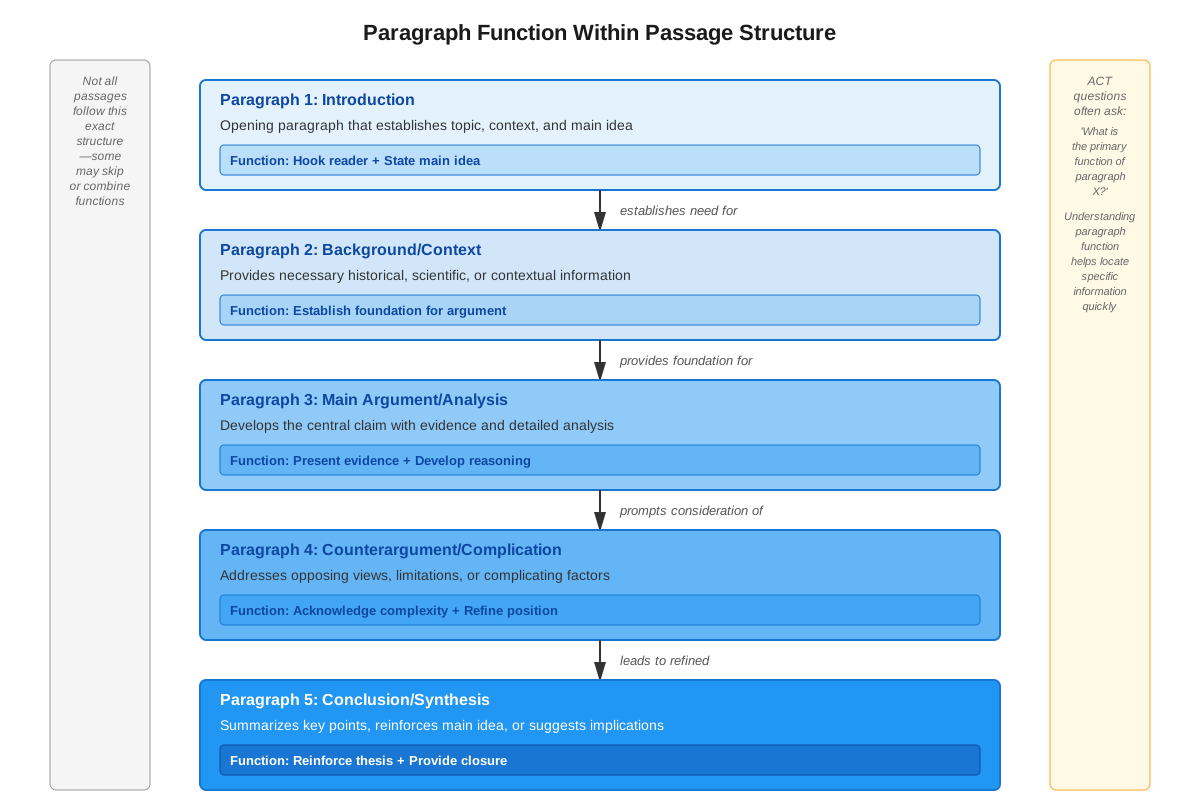
Individual paragraphs serve specific structural functions within the passage's overall organization. Recognizing these functions helps students understand why information appears where it does and predict what type of content will follow.
Introductory paragraphs establish the passage's topic, provide necessary background information, and often present the main idea or thesis. In ACT passages, the first paragraph typically orients readers to the subject matter and may preview the organizational structure to come. Questions about introductory paragraphs often ask about their purpose or relationship to the rest of the passage.
Supporting/Development paragraphs form the passage's body, providing evidence, examples, explanations, and details that develop the main idea. Each supporting paragraph typically focuses on one aspect of the overall topic, with a clear topic sentence indicating its specific focus. The number and arrangement of supporting paragraphs reflect the passage's organizational pattern—chronological passages present supporting paragraphs in time order, while compare-contrast passages alternate between subjects or present them in blocks.
Transitional paragraphs bridge major sections of longer passages, connecting one main idea to another or shifting between different aspects of the topic. These paragraphs are typically shorter and contain explicit transition language. On the ACT, recognizing transitional paragraphs helps students understand the passage's larger structure and navigate between sections efficiently.
Concluding paragraphs synthesize information, restate main ideas in light of supporting evidence, or discuss implications and significance. ACT passages don't always include formal conclusions, but when present, they often contain the author's final perspective or broader context for the topic discussed.
Organizational Markers and Transition Words
Transition words and organizational markers function as signposts revealing the passage's structure. These words explicitly signal relationships between ideas and indicate which organizational pattern the author employs.
| Organizational Pattern | Common Transition Words |
|---|---|
| Chronological/Sequential | first, second, then, next, subsequently, finally, before, after, during, meanwhile |
| Cause-and-Effect | because, since, therefore, thus, consequently, as a result, leads to, causes, due to |
| Compare-and-Contrast | similarly, likewise, also, however, in contrast, on the other hand, whereas, unlike, while |
| Problem-Solution | problem, issue, challenge, difficulty, solution, answer, resolve, address, overcome |
| Classification | types, kinds, categories, classified, divided, consists of, includes, comprises |
| Addition/Emphasis | furthermore, moreover, additionally, in addition, also, indeed, in fact |
Skilled readers actively notice these markers while reading, using them to anticipate what type of information will follow and to understand how the current sentence or paragraph relates to surrounding content.
Recognizing Organizational Questions
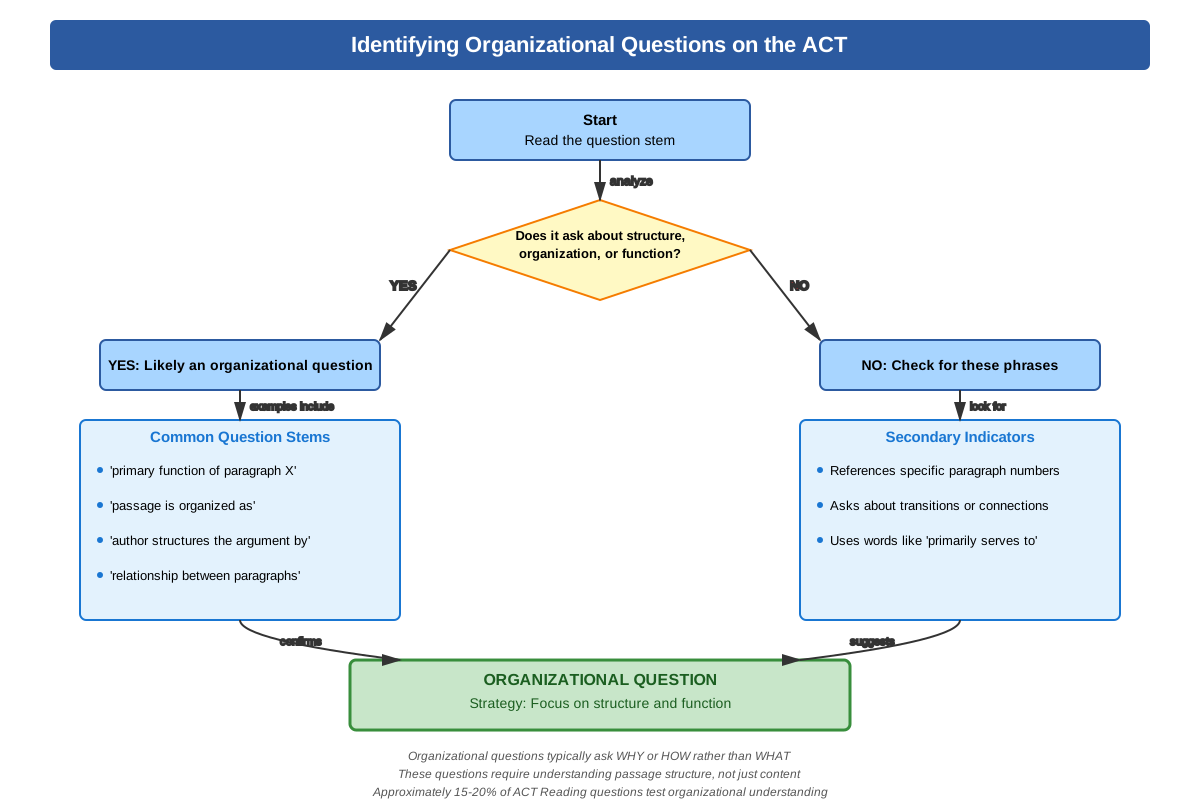
ACT organizational questions use specific question stems that signal they're testing structural understanding rather than content recall or inference. Common phrasings include:
- "The main purpose of the third paragraph is to..."
- "The author organizes the passage by..."
- "The function of lines 45-52 is to..."
- "The author most likely includes the information in paragraph 4 in order to..."
- "Which of the following best describes the structure of the passage?"
- "The passage is best described as..."
- "The author develops the main idea primarily through..."
These questions require students to step back from specific details and consider the passage's architecture—how pieces fit together rather than what those pieces say. Correct answers to organizational questions use structural language ("introduces," "contrasts," "provides an example of," "explains the causes of," "describes the solution to") rather than content-specific terminology.
Concept Relationships
The concepts within passage organization form an interconnected system where each element supports and reinforces the others. Organizational patterns serve as the overarching framework, determining how the entire passage is structured. Within this framework, individual paragraph functions fulfill specific roles—introductory paragraphs establish the pattern, supporting paragraphs develop it, transitional paragraphs connect its major sections, and concluding paragraphs complete it. Transition words and organizational markers make these patterns and functions explicit, providing textual evidence that confirms the structure.
This relationship flows as follows: Organizational Pattern → determines → Paragraph Functions → signaled by → Transition Words → enable → Question Recognition → guides → Strategic Reading
Understanding organizational patterns connects directly to prerequisite knowledge of main idea identification. The main idea represents what the passage says, while organizational structure represents how the passage says it. These two elements work together—recognizing that a passage follows a problem-solution pattern, for example, helps identify that the main idea likely involves presenting a challenge and its resolution.
Organizational awareness also enhances inference skills, another critical ACT Reading competency. When students understand where they are within a passage's structure, they can make better predictions about what information will appear next and how it will relate to what came before. This predictive ability strengthens comprehension and speeds reading.
Finally, passage organization connects to detail-location skills. Students who recognize organizational patterns can quickly navigate to specific information—knowing that a chronologically organized passage discusses events from 1920-1940 in the middle paragraphs allows immediate location of information about 1935 without re-reading the entire passage.
High-Yield Facts
⭐ Approximately 15-20% of ACT Reading questions directly test passage organization, with at least one organizational question appearing per passage.
⭐ The six most common organizational patterns on the ACT are: chronological, cause-and-effect, compare-contrast, problem-solution, classification, and descriptive/spatial.
⭐ Transition words explicitly signal organizational relationships and provide the strongest textual evidence for identifying passage structure.
⭐ Organizational questions use specific stems asking about "function," "purpose," "structure," or "organization" rather than content details.
⭐ The first paragraph typically establishes the organizational pattern that will govern the entire passage.
- Science passages most frequently employ cause-and-effect and problem-solution organizational patterns.
- Compare-contrast passages follow either block organization (all of Subject A, then all of Subject B) or point-by-point organization (alternating subjects for each characteristic).
- Recognizing organizational patterns enables prediction of where specific information will appear, reducing time spent searching for details.
- Correct answers to organizational questions use structural language ("introduces," "contrasts," "exemplifies") rather than content-specific terms.
- Transitional paragraphs, typically shorter than supporting paragraphs, bridge major sections and signal shifts in focus or perspective.
- Multiple organizational patterns can coexist within a single passage, with one serving as the primary structure and others appearing in subsections.
- The conclusion of a passage, when present, often reveals the author's ultimate purpose and helps confirm the organizational pattern.
- Chronological organization may be disrupted by flashbacks or flash-forwards, requiring careful attention to time markers.
- Problem-solution passages may present multiple solutions, requiring students to track which solution receives the author's endorsement.
- Classification passages assign each category roughly equal treatment, with separate paragraphs or sections devoted to each type.
Quick check — test yourself on Passage organization so far.
Try Flashcards →Common Misconceptions
Misconception: Passage organization only matters for questions explicitly asking about structure. → Correction: Understanding organizational patterns improves performance on all question types by enabling faster navigation, better comprehension, and more accurate prediction of where information appears. Detail questions become easier when you know which paragraph discusses which aspect of the topic.
Misconception: All passages follow a single, consistent organizational pattern throughout. → Correction: Many ACT passages combine multiple organizational patterns, using one as the primary structure while incorporating others in subsections. A passage might follow overall chronological organization while using cause-and-effect within individual paragraphs to explain why events occurred.
Misconception: The first sentence of each paragraph always serves as the topic sentence revealing that paragraph's function. → Correction: While topic sentences frequently appear first, they can also appear at the end of paragraphs or be implied rather than explicitly stated. Students must read entire paragraphs to determine their function accurately.
Misconception: Transition words always appear at the beginning of sentences or paragraphs. → Correction: Transition words can appear anywhere within sentences, and organizational relationships may be signaled through content and context rather than explicit transition words. Students should look for both explicit markers and implicit structural cues.
Misconception: Organizational questions are the easiest question type because they don't require understanding passage content. → Correction: Organizational questions require sophisticated analytical skills, demanding that students synthesize information across multiple paragraphs and understand abstract structural relationships. These questions often challenge students who focus exclusively on details without considering how those details connect.
Misconception: Memorizing organizational patterns guarantees correct answers on structure questions. → Correction: While recognizing patterns helps, students must also understand how specific passages implement those patterns and why authors chose particular organizational strategies. Correct answers require both pattern recognition and careful analysis of the specific passage's structure.
Worked Examples
Example 1: Identifying Organizational Pattern
Passage Excerpt (abbreviated):
Paragraph 1: The Industrial Revolution transformed European society beginning in the late 18th century, introducing mechanized production and urbanization on an unprecedented scale.
Paragraph 2: The revolution began in Britain around 1760, where innovations in textile manufacturing, particularly the spinning jenny and power loom, increased production efficiency dramatically.
Paragraph 3: By 1800, these innovations had spread to other industries, with steam power revolutionizing transportation through railways and steamships.
Paragraph 4: The early 19th century saw industrialization expand across Western Europe and North America, fundamentally altering economic structures and social relationships.
Paragraph 5: By the late 19th century, the Second Industrial Revolution introduced electricity, chemical processes, and mass production techniques, completing the transformation from agrarian to industrial economies.
Question: The passage is organized primarily by:
A) Comparing different countries' industrialization experiences
B) Presenting the chronological development of industrialization
C) Analyzing causes and effects of industrial change
D) Classifying different types of industrial innovations
Solution Process:
Step 1: Identify organizational markers in the passage. Notice time references: "late 18th century," "around 1760," "By 1800," "early 19th century," "late 19th century." These explicit temporal markers signal chronological organization.
Step 2: Examine paragraph functions. Each paragraph advances the timeline: Paragraph 1 introduces the topic and time period, Paragraph 2 discusses the beginning (1760), Paragraph 3 moves to 1800, Paragraph 4 covers the early 1800s, and Paragraph 5 concludes with the late 1800s. This sequential progression confirms chronological structure.
Step 3: Evaluate answer choices against the evidence. Choice A (comparing countries) is incorrect because the passage mentions multiple countries but doesn't systematically compare them. Choice C (cause-and-effect) is tempting because the passage discusses changes, but the primary organizing principle is time, not causation. Choice D (classification) is incorrect because the passage doesn't divide industrialization into distinct categories. Choice B correctly identifies the chronological organization evidenced by consistent time markers and sequential progression.
Answer: B
Connection to Learning Objectives: This example demonstrates how to identify organizational patterns through transition words (time markers) and paragraph function analysis, directly addressing the objective of recognizing when passage organization is being tested and applying organizational concepts accurately.
Example 2: Determining Paragraph Function
Passage Context: A passage discusses the problem of declining bee populations and various proposed solutions.
Paragraph 1: Introduces the decline in bee populations and its significance for agriculture.
Paragraph 2: Explains potential causes including pesticides, habitat loss, and disease.
Paragraph 3: Describes one proposed solution—restricting certain pesticide use—and its potential benefits and limitations.
Paragraph 4: Presents an alternative solution—creating pollinator-friendly habitats—with supporting evidence.
Paragraph 5: Discusses a third approach combining multiple strategies and argues for its superiority.
Question: The main function of the second paragraph is to:
F) Present the author's preferred solution to bee population decline
G) Provide background information explaining why bee populations are declining
H) Compare different theories about bee behavior
J) Argue against common misconceptions about bees
Solution Process:
Step 1: Identify the passage's overall organizational pattern. The structure follows problem-solution organization: Paragraph 1 establishes the problem, Paragraph 2 provides context, and Paragraphs 3-5 present solutions.
Step 2: Determine where Paragraph 2 fits within this structure. It appears after the problem introduction but before solution presentation, suggesting it provides necessary background or context for understanding the solutions.
Step 3: Analyze Paragraph 2's specific content. It "explains potential causes" of the problem, providing information about why the decline is occurring. This background information helps readers understand what solutions need to address.
Step 4: Evaluate answer choices. Choice F is incorrect because Paragraph 2 discusses causes, not solutions. Choice H is incorrect because the paragraph addresses causes of decline, not theories about behavior. Choice J is incorrect because the paragraph explains actual causes rather than correcting misconceptions. Choice G correctly identifies that Paragraph 2 provides background information explaining the problem's causes.
Answer: G
Connection to Learning Objectives: This example illustrates how understanding overall organizational patterns (problem-solution) helps determine individual paragraph functions, demonstrating the strategy of using structural awareness to answer organizational questions accurately.
Exam Strategy
When approaching ACT Reading passages, implement a strategic reading process that prioritizes organizational awareness from the first sentence. As you begin reading, actively look for clues about the passage's organizational pattern in the opening paragraph. Ask yourself: "Is this introducing a problem? Comparing two things? Describing a sequence of events?" This initial pattern recognition creates a mental framework that guides comprehension throughout the passage.
Trigger words and phrases that signal organizational questions include: "function," "purpose," "structure," "organized," "develops the main idea," "includes this information in order to," and "best describes the passage." When you encounter these phrases, immediately recognize that the question tests structural understanding rather than content recall. Your approach should shift from asking "What does the passage say?" to "How is the passage constructed?"
For organizational questions specifically, employ this systematic approach:
- Reread the relevant section (paragraph or lines referenced) while considering its relationship to surrounding content
- Identify the section's main point in your own words
- Determine how this point relates to the passage's overall purpose—does it introduce, support, contrast, exemplify, or conclude?
- Eliminate answers that describe content rather than function
- Select the answer using structural language that matches the section's role
Process-of-elimination strategies prove particularly effective for organizational questions. Immediately eliminate answers that:
- Describe specific content details rather than structural function
- Reference information not actually present in the specified section
- Misidentify the organizational pattern (claiming comparison when the passage shows causation)
- Use extreme language ("proves," "definitively establishes") when the section serves a more modest structural role
Time allocation for organizational questions should be moderate—approximately 45-60 seconds per question. These questions require more analysis than simple detail questions but less than complex inference questions. If you've actively tracked organizational structure while reading, you should be able to answer organizational questions relatively quickly by confirming your understanding rather than discovering the structure for the first time.
Exam Tip: Annotate organizational markers while reading. Brief notes like "cause," "effect," "solution 1," "solution 2," or "contrast" beside paragraphs create a structural map that makes organizational questions significantly faster to answer.
Common wrong answer patterns in organizational questions include:
- Content substitution: Describing what the section says rather than what it does
- Scope errors: Claiming a paragraph serves the entire passage's purpose when it only supports one aspect
- Pattern confusion: Misidentifying the organizational pattern (confusing chronological with cause-and-effect because events occur in sequence)
- Function misattribution: Claiming a paragraph introduces when it actually concludes, or vice versa
Memory Techniques
CCCCPD Mnemonic for the six primary organizational patterns:
- Chronological
- Cause-and-effect
- Compare-contrast
- Classification
- Problem-solution
- Descriptive/spatial
Visualization Strategy: Picture each organizational pattern as a distinct shape. Chronological organization resembles a timeline arrow moving left to right. Cause-and-effect looks like dominoes falling in sequence. Compare-contrast appears as a Venn diagram with overlapping circles. Problem-solution takes the shape of a lock and key. Classification resembles a tree with branches. Descriptive/spatial forms a map. When reading a passage, visualize which shape matches its structure.
FITS Acronym for analyzing paragraph function:
- Focus: What is this paragraph's specific topic?
- Intent: What is the author trying to accomplish?
- Transition: How does this connect to surrounding paragraphs?
- Structure: What role does this play in the overall organization?
Transition Word Categories memory technique: Group transition words by their function using the acronym CACTEA:
- Contrast: however, but, yet, although, whereas
- Addition: furthermore, moreover, additionally, also
- Causation: because, therefore, thus, consequently
- Time: first, then, next, finally, subsequently
- Example: for instance, such as, specifically, namely
- Agreement: similarly, likewise, equally, correspondingly
The "Skeleton" Technique: After reading each passage, mentally construct its "skeleton"—a bare-bones outline showing how paragraphs connect. For example: "Intro (problem) → Background (causes) → Solution 1 → Solution 2 → Conclusion (best solution)." This skeleton provides a structural map for quickly locating information and answering organizational questions.
Summary
Passage organization represents a high-yield ACT Reading skill that provides strategic advantages across all question types while being directly tested in 15-20% of questions. The six primary organizational patterns—chronological, cause-and-effect, compare-contrast, problem-solution, classification, and descriptive/spatial—serve as frameworks authors use to arrange ideas logically. Recognizing these patterns quickly enables prediction of where information will appear, faster navigation through passages, and more accurate comprehension. Individual paragraphs serve specific structural functions (introducing, supporting, transitioning, or concluding) within the overall organizational framework, with transition words providing explicit signals of these relationships. Organizational questions use distinctive stems asking about "function," "purpose," or "structure" and require students to analyze how passages are constructed rather than simply what they say. Mastering organizational awareness transforms reading from passive absorption to active structural analysis, significantly improving both speed and accuracy on the ACT Reading section.
Key Takeaways
- Passage organization questions comprise 15-20% of ACT Reading questions and appear at least once per passage, making this a high-frequency, high-value skill
- The six primary organizational patterns (chronological, cause-and-effect, compare-contrast, problem-solution, classification, descriptive/spatial) account for the vast majority of ACT passage structures
- Transition words serve as explicit structural markers that reveal organizational patterns and relationships between ideas
- Organizational questions ask about function and structure using distinctive stems, requiring analysis of how passages are built rather than what they say
- Understanding organizational patterns enables strategic reading, faster navigation, and better prediction of where specific information will appear
- Individual paragraphs serve specific structural functions within the overall organizational framework, and identifying these functions is essential for answering organizational questions accurately
- Correct answers to organizational questions use structural language ("introduces," "contrasts," "exemplifies") rather than content-specific terminology
Related Topics
Main Idea and Purpose: Understanding passage organization directly supports identifying main ideas, as the organizational structure reveals how supporting details build toward central claims. Mastering organizational patterns helps distinguish between the passage's overall purpose and the functions of individual sections.
Author's Craft and Rhetorical Strategies: Organizational choices represent key rhetorical decisions authors make to achieve their purposes. Advanced analysis of why authors choose specific organizational patterns connects organizational awareness to deeper understanding of authorial intent and persuasive techniques.
Detail Location and Evidence-Based Questions: Organizational awareness dramatically improves efficiency in locating specific details, as students can predict which sections contain particular types of information based on the passage's structure.
Inference and Implicit Meaning: Understanding how ideas connect structurally enhances inference abilities, as organizational patterns reveal logical relationships between explicitly stated information and implicit conclusions.
Comparative Reading (Paired Passages): When the ACT presents paired passages, organizational analysis becomes even more critical, as students must understand not only how each passage is structured individually but also how the two passages relate to each other organizationally.
Practice CTA
Now that you've mastered the core concepts of passage organization, it's time to apply this knowledge to authentic ACT-style questions. The practice questions and flashcards will reinforce your ability to quickly identify organizational patterns, determine paragraph functions, and answer structural questions with confidence. Remember: organizational awareness isn't just about answering organizational questions—it's a strategic skill that improves your performance across all Reading question types by enabling faster, more purposeful reading. Approach each practice passage by first identifying its organizational pattern, then use that structural framework to guide your comprehension and question-answering process. With consistent practice, recognizing passage organization will become automatic, giving you a significant competitive advantage on test day!
Sign up free to keep reading
Create a free AnvayaPrep account to finish this ACT guide on Passage organization — plus flashcards and practice questions.