Overview
Syntax refers to the arrangement of words and phrases to create well-formed sentences, and on the ACT Reading test, it represents one of the most sophisticated analytical skills students must master. Understanding ACT syntax goes beyond simple grammar recognition—it requires students to analyze how authors construct sentences to create meaning, establish tone, convey emphasis, and guide reader interpretation. The ACT Reading section frequently tests syntax through questions that ask students to identify the effect of sentence structure, understand how word order influences meaning, or recognize why an author chose a particular construction over alternatives.
The importance of syntax on the ACT cannot be overstated. Questions about sentence structure, word choice placement, and grammatical construction appear across all four passage types (Literary Narrative/Prose Fiction, Social Science, Humanities, and Natural Science). These questions often appear deceptively simple but require nuanced understanding of how language works at the structural level. Students who master syntax gain a significant advantage because they can quickly identify what the test is asking and apply systematic strategies to eliminate wrong answers.
Syntax questions connect deeply to other Reading concepts tested on the ACT, particularly author's craft, rhetorical strategy, and close reading skills. Understanding syntax enables students to better analyze tone and style questions, comprehend complex sentence structures in challenging passages, and recognize how authors manipulate language for specific effects. This topic serves as a bridge between basic comprehension and advanced analytical skills, making it essential for students aiming for scores in the upper ranges (28-36).
Learning Objectives
- [ ] Identify when Syntax is being tested in ACT Reading questions
- [ ] Explain the core rule or strategy behind Syntax analysis
- [ ] Apply Syntax knowledge to ACT-style questions accurately
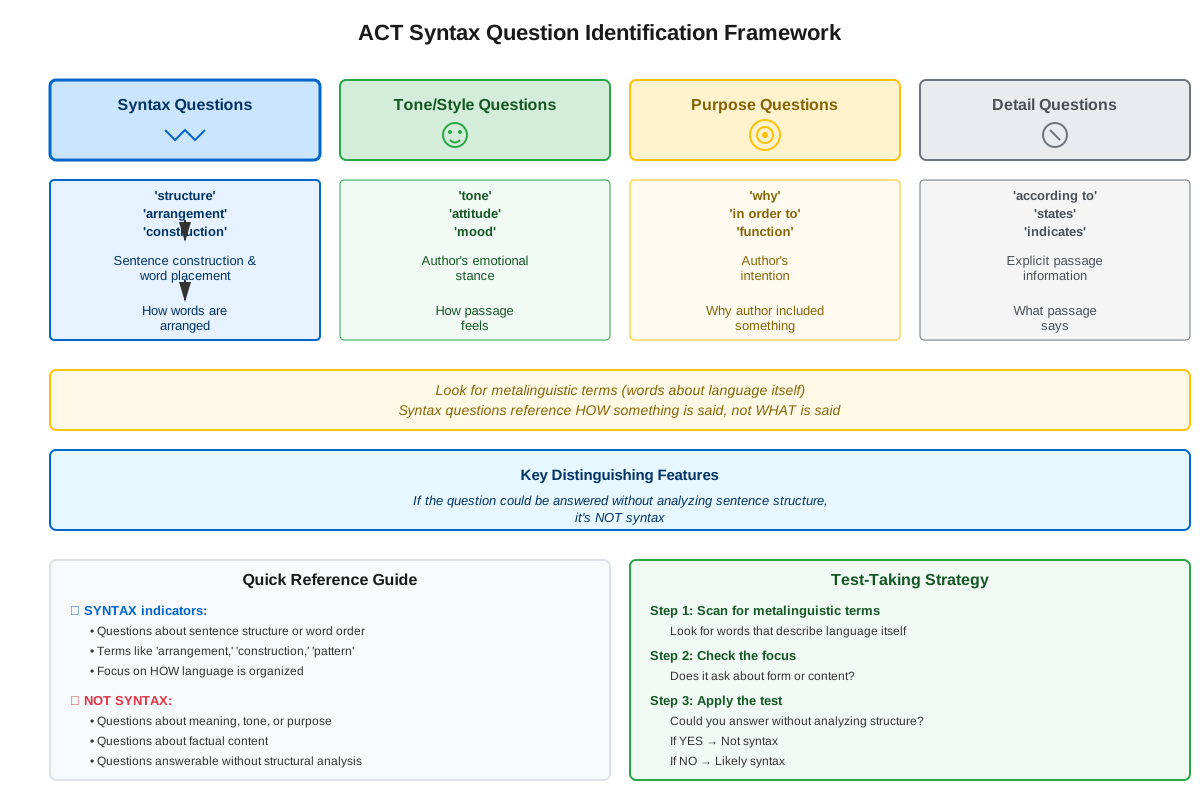
- [ ] Distinguish between syntax questions and other question types (tone, purpose, detail)
- [ ] Analyze how sentence structure affects meaning and emphasis in passages
- [ ] Evaluate why an author chose specific syntactical constructions over alternatives
- [ ] Recognize common syntax patterns that appear in ACT passages and questions
Prerequisites
- Basic sentence structure knowledge: Understanding subjects, verbs, objects, and modifiers is essential because syntax questions build on these foundational grammatical concepts
- Reading comprehension skills: Students must be able to understand passage content at a literal level before analyzing how that content is structured syntactically
- Vocabulary knowledge: Recognizing the meaning of individual words is necessary to understand how their arrangement creates specific effects
- Familiarity with ACT question formats: Knowing how ACT questions are structured helps students quickly identify syntax-specific questions
Why This Topic Matters
Syntax matters in real-world contexts because it determines how effectively we communicate ideas. Professional writers, journalists, lawyers, and academics all manipulate syntax deliberately to achieve specific rhetorical goals—creating emphasis, establishing relationships between ideas, controlling pacing, and guiding reader attention. Understanding syntax enables students to become more sophisticated readers and more effective writers in academic and professional contexts.
On the ACT Reading test, syntax-related questions appear with high frequency, typically 2-4 questions per test across the four passages. These questions often carry significant weight because they test higher-order thinking skills rather than simple recall. The College Board research indicates that syntax questions correlate strongly with overall Reading scores—students who answer these questions correctly tend to score in the 75th percentile or higher.
Common manifestations of syntax testing on the ACT include questions asking about the effect of a particular sentence structure, why an author used a specific grammatical construction, how punctuation affects meaning, what would be lost if a sentence were restructured, or how word order creates emphasis. These questions may reference specific line numbers or ask about patterns throughout a passage. They often include answer choices that are grammatically correct but miss the specific syntactical effect being tested, making them particularly challenging for students who rely solely on "what sounds right."
Core Concepts
What Syntax Means on the ACT
Syntax on the ACT Reading test refers specifically to how the arrangement and structure of words, phrases, and clauses create meaning and effect in passages. Unlike the ACT English test, which focuses on grammatical correctness, the Reading test examines syntax as a rhetorical and analytical tool. Students must understand not just whether a sentence is correct, but why an author constructed it in a particular way and what effect that construction achieves.
The ACT tests syntax through several distinct lenses: sentence length and variety, word order and inversion, parallel structure, subordination and coordination, sentence fragments and run-ons used for effect, and punctuation as a syntactical tool. Each of these elements can be manipulated by authors to achieve specific purposes, and the ACT expects students to recognize and analyze these manipulations.
Sentence Structure and Effect
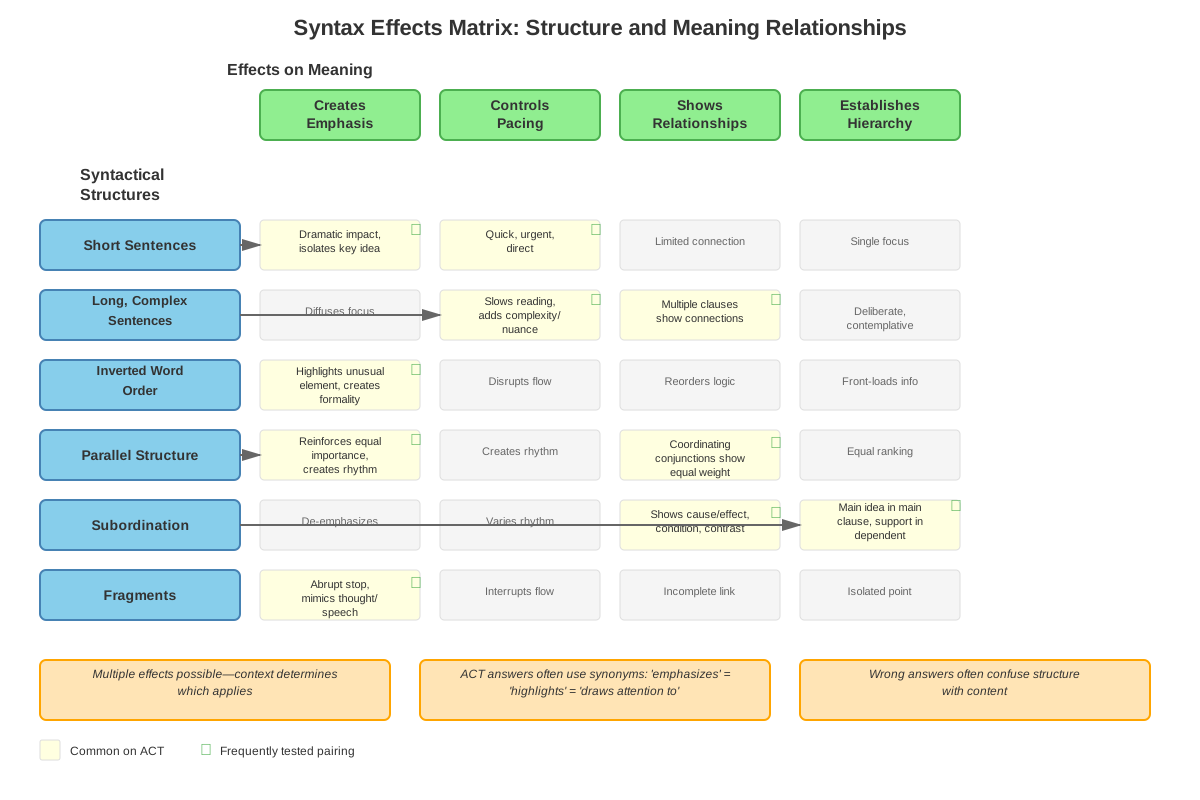
Authors use different sentence structures to create specific effects on readers. Simple sentences (one independent clause) create directness, emphasis, and clarity. They often appear at crucial moments in passages to highlight important ideas. Compound sentences (two or more independent clauses joined by coordinating conjunctions) suggest equality between ideas and create balance. Complex sentences (one independent clause and one or more dependent clauses) establish relationships of subordination, showing which ideas are primary and which are supporting.
Compound-complex sentences combine multiple independent and dependent clauses to convey sophisticated relationships between ideas. On the ACT, questions may ask why an author chose one structure over another, or what effect a particular structure creates. Understanding these effects enables students to eliminate answer choices that describe grammatical features without addressing rhetorical purpose.
Word Order and Emphasis
Standard English word order follows subject-verb-object patterns, but authors frequently deviate from this pattern to create emphasis or achieve stylistic effects. Inversion (placing elements in non-standard order) draws attention to specific words or phrases. For example, "Never had she seen such beauty" emphasizes "never" more than "She had never seen such beauty."
Fronting (placing normally later elements at the beginning of sentences) creates emphasis and often appears in literary passages. "Into the darkness he ventured" emphasizes the destination more than "He ventured into the darkness." The ACT frequently tests whether students recognize why authors use these inversions and what emphasis they create.
Parallel Structure and Rhythm
Parallel structure involves using the same grammatical form for elements in a series or for related ideas. This creates rhythm, emphasizes relationships between ideas, and makes prose more memorable. Authors use parallelism deliberately to suggest equivalence or to create rhetorical power. For example, "She came, she saw, she conquered" uses parallel structure to create momentum and emphasis.
The ACT may ask students to identify the effect of parallel structure or recognize when an author breaks parallelism deliberately for emphasis. Understanding parallelism also helps students recognize when answer choices describe features that aren't actually present in the passage.
Subordination and Coordination
Subordination uses dependent clauses to show that some ideas are less important than others or to establish causal, temporal, or conditional relationships. Words like "because," "although," "when," and "if" signal subordination. Coordination uses coordinating conjunctions (and, but, or, nor, for, yet, so) to join elements of equal importance.
The choice between subordination and coordination affects how readers understand relationships between ideas. "She studied hard, and she passed the test" suggests two equal facts. "Because she studied hard, she passed the test" establishes a causal relationship with emphasis on the result. ACT questions may ask students to identify these relationships or explain why an author chose one construction over another.
Sentence Length Variation
Authors manipulate sentence length deliberately to control pacing, create emphasis, and maintain reader engagement. Short sentences create emphasis, urgency, or dramatic effect. They often appear after longer sentences to highlight crucial information. Long sentences can create flowing, contemplative effects, convey complex relationships between ideas, or build toward climactic moments.
The ACT tests whether students recognize these effects and understand why authors vary sentence length. Questions might ask about the effect of a particularly short or long sentence, or why an author uses varied sentence lengths in a particular paragraph.
Punctuation as Syntax
While punctuation is primarily tested on the ACT English section, the Reading section examines how punctuation affects meaning and emphasis. Dashes create emphasis or interruption. Colons introduce explanations or lists and create anticipation. Semicolons join closely related ideas and suggest sophisticated relationships. Parentheses provide additional information while de-emphasizing it.
Understanding how punctuation functions syntactically helps students answer questions about author's craft and rhetorical strategy. The ACT may ask what effect a particular punctuation choice creates or what would change if different punctuation were used.
Concept Relationships
The concepts within syntax are deeply interconnected. Sentence structure choices (simple, compound, complex) directly affect emphasis and meaning, which connects to word order decisions. When authors use inversion or fronting, they're manipulating both word order and sentence structure to achieve emphasis. Parallel structure often appears within longer sentences, combining sentence length variation with coordination to create rhetorical effects.
Subordination and coordination decisions affect sentence structure (creating complex or compound sentences) while also influencing how readers understand relationships between ideas. These choices interact with punctuation decisions—authors might use semicolons to coordinate ideas, dashes to subordinate information while maintaining emphasis, or colons to create anticipation before important information.
The relationship map flows as follows: Basic sentence structure → determines → Complexity level → influences → Word order choices → creates → Emphasis patterns → combines with → Parallel structure → produces → Rhetorical effects → enhanced by → Punctuation choices → results in → Overall syntactical impact.
These syntax concepts connect to prerequisite knowledge of basic grammar (subjects, verbs, clauses) and enable progression to more advanced topics like rhetorical analysis, author's craft, and comparative reading. Mastering syntax also improves performance on tone and style questions because syntactical choices directly affect these elements.
High-Yield Facts
- ⭐ Syntax questions on the ACT ask about the effect or purpose of sentence structure, not grammatical correctness
- ⭐ Short sentences following long sentences typically create emphasis on the short sentence's content
- ⭐ Inverted word order (non-standard arrangement) draws attention to the fronted element
- ⭐ Parallel structure suggests equivalence or relationship between ideas and creates rhythm
- ⭐ The ACT frequently asks "what would be lost" if a sentence were restructured, testing understanding of syntactical effects
- Subordinate clauses (beginning with words like "because," "although," "when") establish relationships between ideas
- Dashes in passages typically signal emphasis or interruption, not just additional information
- Compound sentences (joined by coordinating conjunctions) suggest equal importance of ideas
- Complex sentences establish hierarchies of importance through subordination
- Sentence fragments in passages are usually deliberate stylistic choices, not errors
- Colons create anticipation and introduce explanations or examples
- Varied sentence length controls pacing and maintains reader engagement
- Coordination (using "and," "but," "or") differs from subordination in suggesting equality rather than hierarchy
- The position of modifiers affects what they emphasize and how readers interpret meaning
Quick check — test yourself on Syntax so far.
Try Flashcards →Common Misconceptions
Misconception: Syntax questions are the same as grammar questions on the ACT English test.
Correction: Syntax questions on the Reading test focus on rhetorical effect and author's purpose, not grammatical correctness. A sentence can be grammatically perfect but the question asks why the author structured it that way or what effect it creates.
Misconception: Longer sentences are always more complex and sophisticated than shorter sentences.
Correction: Sentence length and complexity are different concepts. Short sentences can be highly sophisticated when used for emphasis or dramatic effect. The ACT tests understanding of why authors choose specific lengths, not which length is "better."
Misconception: Parallel structure means all sentences should have the same structure.
Correction: Parallel structure refers to using the same grammatical form for elements in a series or related ideas within sentences, not making all sentences identical. Authors use parallelism selectively for specific rhetorical effects.
Misconception: Inverted word order is always wrong or awkward.
Correction: Inversion is a deliberate stylistic choice that creates emphasis and appears frequently in literary passages. The ACT expects students to recognize when inversion is used purposefully and what effect it achieves.
Misconception: The correct answer to syntax questions is always the most complicated explanation.
Correction: Correct answers precisely describe the specific syntactical effect present in the passage. Sometimes the effect is straightforward (emphasis, contrast, explanation), and the correct answer will be correspondingly direct.
Misconception: Syntax only matters in Literary Narrative passages.
Correction: All four passage types (Literary Narrative, Social Science, Humanities, Natural Science) include syntax questions. Scientific and social science passages use syntactical variation for emphasis and clarity just as literary passages do.
Worked Examples
Example 1: Sentence Structure and Emphasis
Passage excerpt: "The experiment had failed. Three years of research, countless hours in the laboratory, thousands of dollars in funding—all for nothing. The scientist stared at the results, unable to comprehend what had gone wrong."
Question: The author's use of a short sentence at the beginning of the paragraph ("The experiment had failed.") primarily serves to:
A) Provide a transition from the previous paragraph
B) Create immediate emphasis on the experiment's outcome
C) Demonstrate the scientist's limited vocabulary
D) Establish a chronological sequence of events
Analysis: This question tests understanding of how sentence length creates emphasis. Let's work through each answer:
Step 1: Identify what's being tested. The question specifically asks about the "use of a short sentence," indicating this is a syntax question about sentence length and effect.
Step 2: Analyze the syntactical feature. The short sentence appears at the beginning, followed by a longer sentence with multiple clauses, then another moderate-length sentence. This pattern (short-long-moderate) is a classic emphasis technique.
Step 3: Evaluate each answer:
- Choice A discusses transition, but there's no information about the previous paragraph, and the question focuses on the short sentence's effect, not its transitional function
- Choice B directly addresses the syntactical effect: the short sentence creates emphasis on the failure
- Choice C makes an unsupported claim about vocabulary and misses the syntactical point entirely
- Choice D discusses chronology, but the sentence announces an outcome, not a sequence
Step 4: Confirm the answer. Choice B correctly identifies that the short sentence creates emphasis. The brevity makes the failure stand out, especially before the longer sentence that elaborates on what was lost.
Correct Answer: B
Connection to learning objectives: This example demonstrates identifying when syntax is being tested (the question explicitly mentions sentence structure), explaining the core strategy (short sentences create emphasis), and applying this knowledge to select the correct answer.
Example 2: Word Order and Inversion
Passage excerpt: "Never before had the community faced such a challenge. Into their quiet town had come forces that threatened everything they valued. What they would do, how they would respond—these questions haunted every conversation."
Question: The author's use of inverted word order in the first two sentences primarily serves to:
F) Correct grammatical errors in the passage
G) Emphasize the unprecedented nature of the situation
H) Confuse readers about the chronological sequence
J) Demonstrate the author's knowledge of complex grammar
Analysis: This question tests understanding of inversion (non-standard word order) and its rhetorical effects.
Step 1: Identify the syntactical feature. Standard word order would be "The community had never before faced such a challenge" and "Forces that threatened everything they valued had come into their quiet town." The author inverts these, placing "Never before" and "Into their quiet town" at the beginning.
Step 2: Determine the effect of inversion. Fronting these elements draws attention to them—the unprecedented nature ("Never before") and the invasion of their space ("Into their quiet town").
Step 3: Evaluate answers:
- Choice F misunderstands the question entirely; inversion isn't an error but a deliberate choice
- Choice G correctly identifies that the inversion emphasizes how unprecedented and threatening the situation is
- Choice H suggests confusion, but the inversion actually clarifies emphasis rather than confusing chronology
- Choice J focuses on the author's knowledge rather than the rhetorical effect on readers
Step 4: Confirm by checking the passage context. The paragraph discusses a serious challenge, and the inverted structures emphasize the severity and unprecedented nature of the threat.
Correct Answer: G
Connection to learning objectives: This example shows how to identify syntax testing (the question mentions "inverted word order"), apply understanding of how word order affects emphasis, and eliminate answers that miss the rhetorical purpose.
Exam Strategy
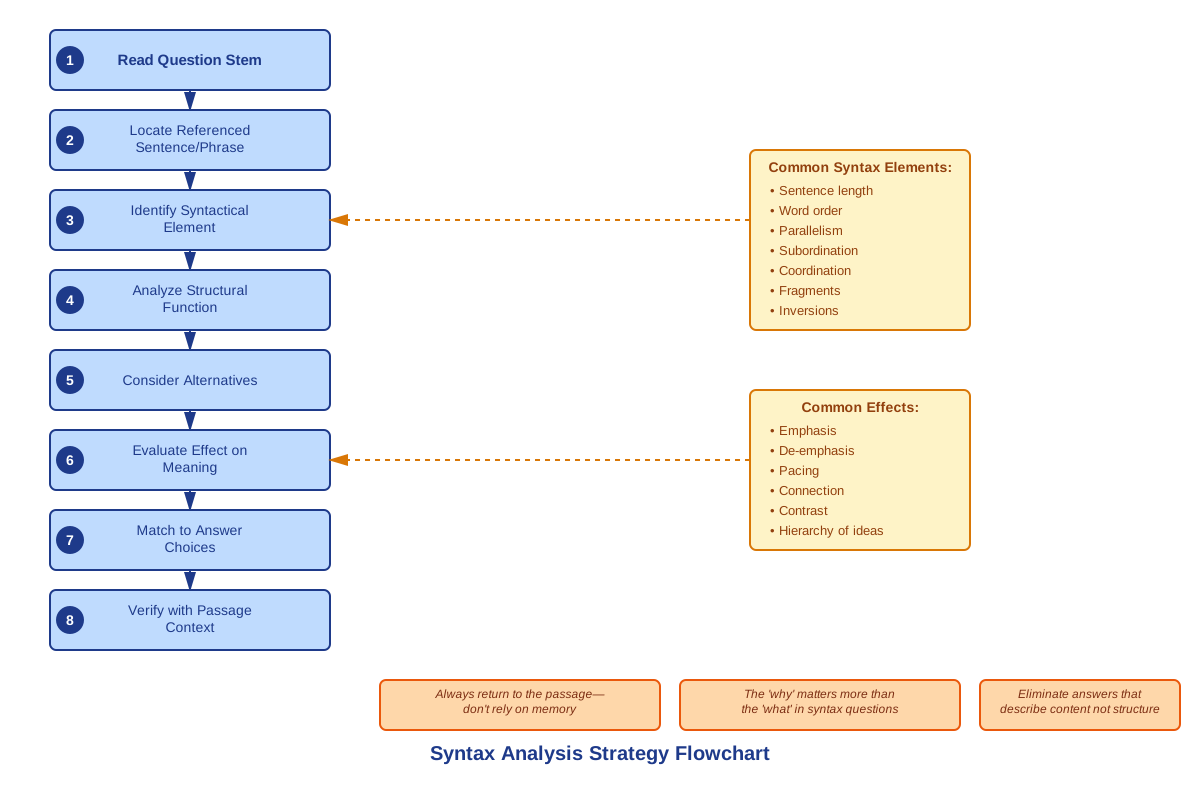
When approaching syntax questions on the ACT Reading test, follow this systematic process:
Trigger words and phrases to watch for: Look for questions containing "sentence structure," "word order," "arrangement," "construction," "effect of," "purpose of," "why the author," "what would be lost if," or references to specific punctuation marks. These signal syntax questions rather than comprehension or detail questions.
Step-by-step approach:
- Identify the specific syntactical feature mentioned in the question (sentence length, word order, parallel structure, punctuation, etc.)
- Locate and read the referenced sentence(s) plus surrounding context
- Analyze the effect the syntactical feature creates (emphasis, contrast, rhythm, relationship between ideas, pacing, etc.)
- Predict an answer before looking at choices
- Eliminate answers that describe features not present, focus on grammar rather than effect, or misidentify the rhetorical purpose
- Confirm your choice by checking that it specifically addresses the syntactical feature mentioned in the question
Process of elimination tips specific to syntax:
- Eliminate answers that discuss grammatical correctness or errors (Reading tests effect, not correctness)
- Eliminate answers that describe effects not supported by the passage context
- Eliminate answers that identify a syntactical feature different from what the question asks about
- Eliminate answers that are too vague ("makes the writing more interesting") rather than specific about the effect
- Be suspicious of answers suggesting the author made a mistake or that the structure confuses readers
Time allocation: Syntax questions typically require 45-60 seconds each. They demand careful reading of the specific sentences referenced but don't require searching through the entire passage. If you're spending more than 75 seconds, make your best educated guess and move on.
Exam Tip: The correct answer to a syntax question will always connect the structural feature to a specific effect or purpose. If an answer choice just describes what's there without explaining why or what effect it creates, it's likely wrong.
Memory Techniques
SWEEP - Remember what syntax questions test:
- Sentence structure and length
- Word order and arrangement
- Emphasis and effect
- Equality vs. hierarchy (coordination vs. subordination)
- Punctuation as meaning-maker
"Short = Shout" - Short sentences following longer ones create emphasis, as if the author is "shouting" that point to readers.
"Front = Focus" - When authors front (move to the beginning) elements that normally come later, they're focusing reader attention on those elements.
The Three P's of Parallel Structure:
- Pattern (same grammatical form)
- Purpose (shows relationship/equivalence)
- Power (creates rhythm and memorability)
Punctuation Power Hierarchy (from most to least emphatic):
- Dash — (emphasis, interruption)
- Colon : (anticipation, introduction)
- Semicolon ; (sophisticated connection)
- Comma , (separation, listing)
- Parentheses ( ) (de-emphasis, aside)
Visualization strategy: Picture sentence structure as architecture. Simple sentences are single-story buildings (direct, clear). Compound sentences are connected buildings (equal structures joined). Complex sentences are buildings with additions (main structure with supporting elements). This helps visualize how ideas relate structurally.
Summary
Syntax on the ACT Reading test examines how authors arrange words, phrases, and sentences to create specific effects and convey meaning. Unlike grammar questions that test correctness, syntax questions analyze rhetorical purpose and effect. Students must recognize when syntax is being tested by identifying trigger words like "sentence structure," "word order," or "arrangement," then analyze how the specific syntactical feature creates emphasis, establishes relationships between ideas, controls pacing, or achieves other rhetorical goals. Key concepts include understanding how sentence length variation creates emphasis, how word order inversion draws attention to fronted elements, how parallel structure suggests equivalence and creates rhythm, how subordination and coordination establish different relationships between ideas, and how punctuation functions as a syntactical tool. Success on syntax questions requires moving beyond "what sounds right" to analyze why authors make specific structural choices and what effects those choices create for readers. The systematic approach involves identifying the syntactical feature, analyzing its effect, predicting an answer, and eliminating choices that focus on grammar rather than rhetoric or that misidentify the specific effect created.
Key Takeaways
- Syntax questions test rhetorical effect and author's purpose, not grammatical correctness
- Short sentences create emphasis, especially when following longer sentences
- Inverted word order (fronting) draws attention to the element placed at the beginning
- Parallel structure suggests equivalence between ideas and creates memorable rhythm
- Subordination (complex sentences) establishes hierarchy; coordination (compound sentences) suggests equality
- Always connect syntactical features to their specific effects in context
- Eliminate answer choices that describe grammar rather than rhetorical purpose
Related Topics
Rhetorical Strategy and Author's Craft: Syntax is a fundamental tool authors use to achieve rhetorical goals. Mastering syntax enables deeper analysis of how authors persuade, inform, or move readers through structural choices.
Tone and Style Analysis: Syntactical choices directly affect tone (formal vs. informal, urgent vs. contemplative) and style (sparse vs. elaborate, direct vs. complex). Understanding syntax improves performance on tone questions.
Close Reading and Textual Analysis: Syntax analysis requires careful attention to specific word choices and arrangements, strengthening overall close reading skills essential for high ACT Reading scores.
Comparative Reading: When comparing paired passages, syntactical differences often reveal important distinctions in author's approach, purpose, or audience, making syntax knowledge valuable for comparative questions.
Practice CTA
Now that you've mastered the core concepts of syntax and learned strategies for tackling these high-yield ACT questions, it's time to put your knowledge into action. Complete the practice questions to reinforce your understanding of how sentence structure, word order, and punctuation create meaning and effect. Use the flashcards to memorize key concepts and trigger words that signal syntax questions. Remember: syntax questions correlate strongly with top-tier ACT Reading scores, so investing time in practice now will pay significant dividends on test day. You've built the foundation—now strengthen it through deliberate practice!
Sign up free to keep reading
Create a free AnvayaPrep account to finish this ACT guide on Syntax — plus flashcards and practice questions.