Overview
Application questions represent one of the most sophisticated question types on the ACT Reading test, requiring students to move beyond simple comprehension and analysis to demonstrate higher-order thinking skills. These questions ask test-takers to take information, concepts, or principles presented in a passage and apply them to new situations, contexts, or scenarios that were not explicitly discussed in the original text. Unlike detail questions that ask "what did the passage say?" or inference questions that ask "what can we conclude?", ACT application questions challenge students to extend the author's ideas, predict outcomes based on established patterns, or determine how concepts would function in different circumstances.
Application questions are essential for the ACT because they assess genuine reading comprehension at the Integration of Knowledge and Ideas level—the highest cognitive tier tested on the exam. These questions evaluate whether students can synthesize information from multiple parts of a passage, understand underlying principles well enough to transfer them to novel situations, and think critically about how ideas operate beyond their original context. Mastering application questions separates high-scoring students from average performers because these questions cannot be answered through simple text-matching or surface-level reading.
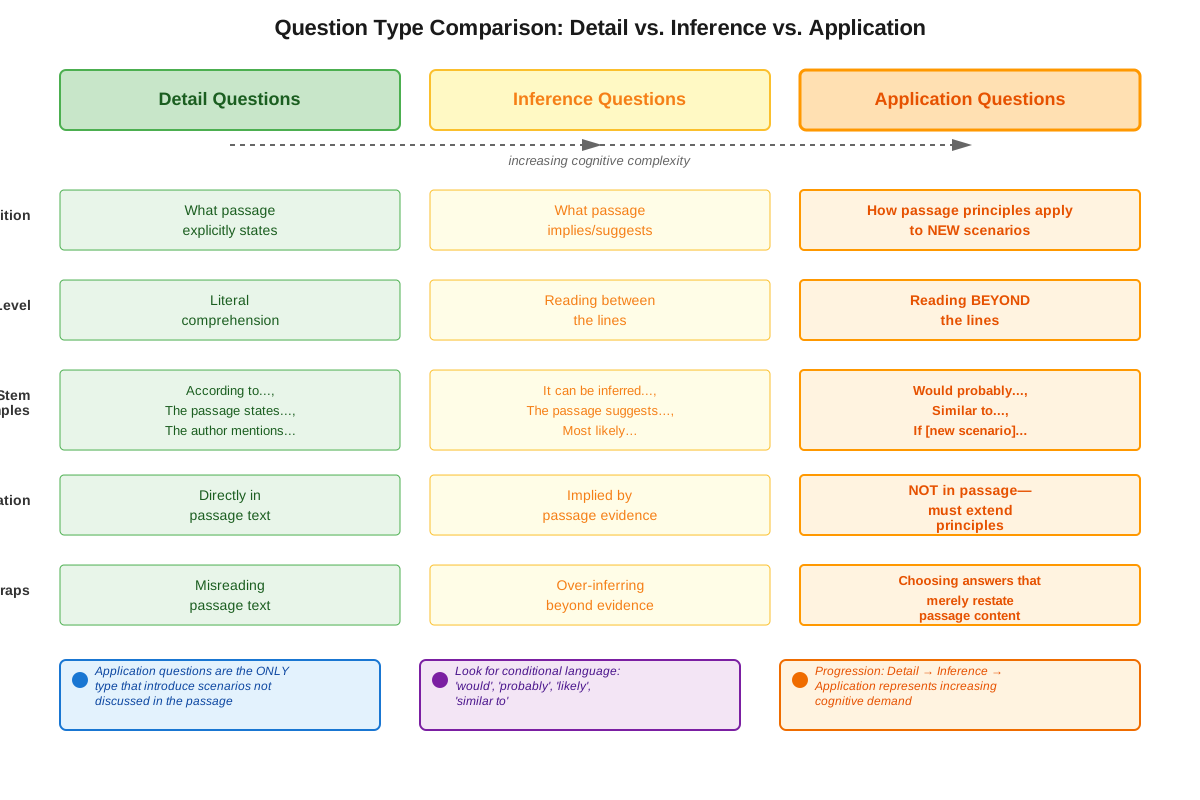
Within the broader ACT Reading framework, application questions build directly upon foundational skills like identifying main ideas, understanding author's purpose, and making inferences. While detail questions test literal comprehension and inference questions test reading between the lines, application questions test reading beyond the lines—taking what's stated or implied and projecting it forward into new territory. This makes application questions the natural culmination of the Integration of Knowledge and Ideas unit, as they require students to integrate textual evidence with logical reasoning to solve problems the passage never explicitly addresses.
Learning Objectives
- [ ] Identify when Application questions is being tested
- [ ] Explain the core rule or strategy behind Application questions
- [ ] Apply Application questions to ACT-style questions accurately
- [ ] Distinguish application questions from inference and detail questions based on question stems
- [ ] Evaluate answer choices by determining which scenarios align with passage principles
- [ ] Synthesize information from multiple passage sections to solve application problems
Prerequisites
- Main idea identification: Application questions require understanding the passage's central themes and arguments, as new scenarios must align with these overarching concepts
- Inference skills: Students must be comfortable drawing logical conclusions from textual evidence, as application builds upon inference by extending conclusions further
- Author's purpose and tone recognition: Applying passage concepts requires understanding the author's perspective and approach, which guides how ideas would extend to new situations
- Textual evidence location: Efficiently finding relevant passage sections is crucial for identifying the principles that need to be applied
Why This Topic Matters
Application questions represent approximately 15-20% of ACT Reading questions, appearing 6-8 times across the four passages in a typical test. This frequency, combined with their medium-to-high difficulty level, makes them significant point-earning opportunities for well-prepared students. Unlike some question types that appear more frequently in certain passage genres, application questions appear consistently across Prose Fiction, Social Science, Humanities, and Natural Science passages, making them universally important regardless of which passages a student finds most challenging.
In real-world contexts, application skills mirror the critical thinking demanded in college coursework and professional settings. When students read a scientific study and must determine whether its findings would apply to a different population, or when they analyze a historical event and predict how similar circumstances might unfold today, they're using the same cognitive processes tested by ACT application questions. These questions assess genuine intellectual flexibility—the ability to understand principles deeply enough to recognize them in new forms.
On the ACT, application questions typically appear in several distinct formats: hypothetical scenario questions ("Based on the passage, how would the author most likely respond to...?"), principle extension questions ("Which of the following situations best exemplifies the concept described in lines 45-50?"), and predictive questions ("If the conditions described in paragraph 3 were to change, the author would most likely suggest that..."). These questions often appear toward the middle or end of a passage's question set, after foundational comprehension has been established, and they frequently reference specific line numbers or paragraphs to guide students toward the relevant source material.
Core Concepts
Defining Application Questions
Application questions ask students to take information, principles, concepts, or patterns from the passage and determine how they would function in a new context not explicitly discussed in the text. The defining characteristic is the presence of a novel element—a hypothetical situation, a different scenario, or a changed condition—that requires students to extrapolate from what they've read. These questions test whether students understand ideas at a deep enough level to recognize them when they appear in different forms or to predict how they would operate under different circumstances.
The key distinction between application questions and other question types lies in the cognitive demand. Detail questions ask students to locate and recognize information as it appears in the passage. Inference questions ask students to draw logical conclusions from stated information. Application questions ask students to transfer understanding to entirely new situations, requiring both comprehension and creative extension of ideas.
Common Question Stem Patterns
Recognizing application questions begins with identifying characteristic question stems. These stems typically contain several telltale markers:
Hypothetical language: Phrases like "would most likely," "would probably," "if...then," or "suppose that" signal that the question involves a scenario not directly addressed in the passage.
New scenario introduction: Questions that present a situation, example, or context not mentioned in the passage and ask how passage concepts relate to it.
Comparative or analogical language: Stems asking which situation "best exemplifies," "most closely resembles," or "is most similar to" a passage concept.
Predictive language: Questions asking what "would happen if," "would result from," or "would follow from" certain changes or conditions.
| Question Type | Example Stem | Key Indicator |
|---|---|---|
| Hypothetical Response | "Based on the passage, how would the author most likely respond to the suggestion that...?" | "would most likely" + new suggestion |
| Principle Application | "Which of the following situations best exemplifies the concept described in lines 23-27?" | "best exemplifies" + new situations |
| Predictive Scenario | "If the conditions in paragraph 4 were reversed, the passage suggests that..." | "if...were" + changed conditions |
| Analogical Extension | "The relationship between X and Y in the passage is most similar to..." | "most similar to" + comparison options |
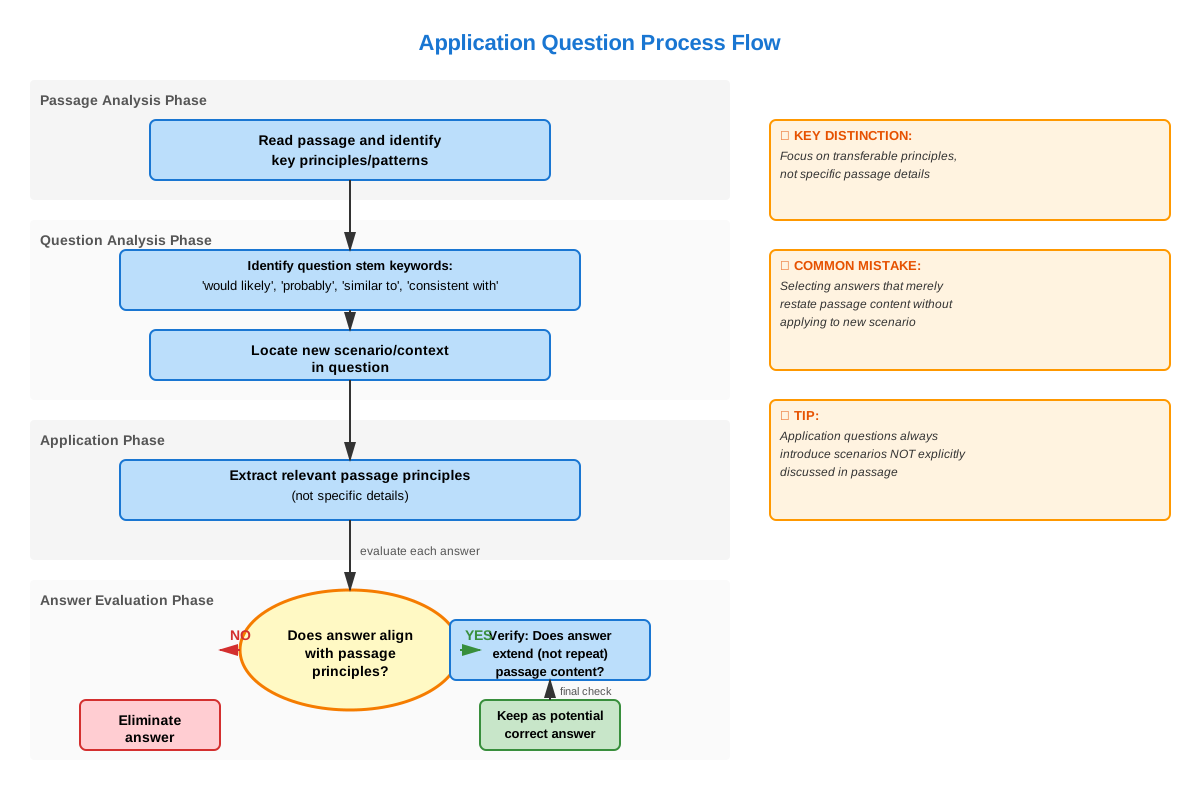
The Application Process: A Step-by-Step Approach
Successfully answering application questions requires a systematic approach:
- Identify the source principle: Locate the specific passage section referenced in the question. Read it carefully to understand not just what it says, but the underlying principle, pattern, or concept it represents.
- Abstract the principle: Move from the specific example in the passage to the general rule or pattern it illustrates. Ask: "What's the underlying concept here? What makes this work the way it does?"
- Analyze the new scenario: Carefully read the hypothetical situation or new context presented in the question or answer choices. Identify its key features and how they relate to the abstracted principle.
- Match principle to scenario: Determine which answer choice scenario best aligns with the passage principle. The correct answer will maintain the same relationships, patterns, or logical structure as the passage concept, even though the specific content differs.
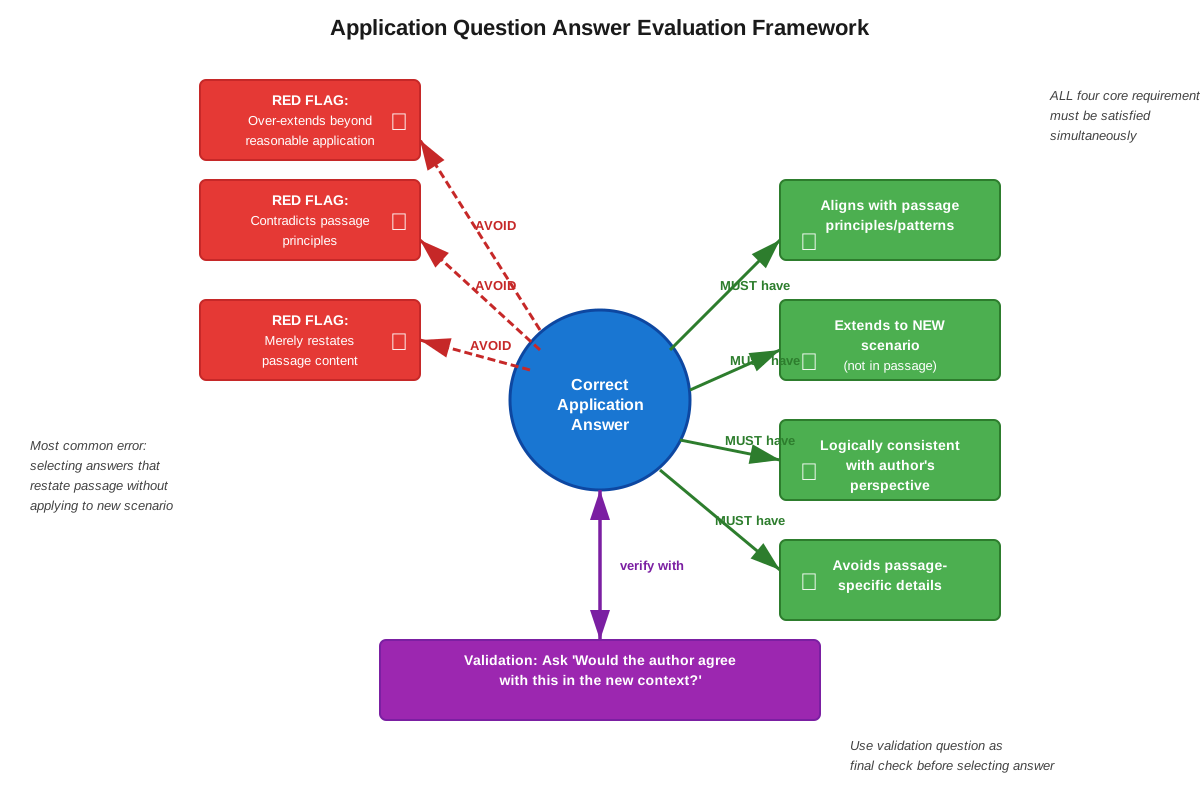
- Eliminate mismatches: Wrong answers often present scenarios that contradict passage principles, reverse relationships, or introduce elements inconsistent with the author's perspective.
Types of Principles to Apply
ACT passages present various types of principles that students must apply:
Causal relationships: If the passage establishes that X causes Y under certain conditions, application questions might ask what would happen if those conditions changed or if a similar X appeared in a different context.
Comparative patterns: When passages compare two or more things, application questions might present new items and ask which comparison from the passage they most resemble.
Processes or sequences: If a passage describes how something works or develops, application questions might ask how a similar process would unfold in a different situation.
Philosophical or theoretical positions: When passages present an author's viewpoint or theory, application questions might present new scenarios and ask how the author would interpret them based on their established perspective.
Characteristic behaviors or properties: If a passage describes how something typically behaves or what properties it possesses, application questions might ask students to identify similar behaviors or properties in new examples.
The Role of Textual Evidence
While application questions require extending beyond the text, they must still be grounded in textual evidence. The correct answer to an application question is never based on outside knowledge or personal opinion—it must be the logical extension of what the passage actually states or strongly implies. Students should be able to point to specific passage sections that support their answer choice, explaining how the principle in those sections applies to the new scenario.
This evidence-based approach distinguishes legitimate application from speculation. The question "Based on the passage, how would the author respond to X?" requires identifying the author's established views, values, or reasoning patterns from the passage and projecting them onto scenario X. It does not ask how the student personally would respond or how someone might generally respond.
Concept Relationships
Application questions sit at the apex of the ACT Reading comprehension hierarchy, building upon and integrating multiple foundational skills. The relationship flows as follows:
Detail Questions → Inference Questions → Application Questions
Detail questions establish what the passage explicitly states. Inference questions use those details to draw logical conclusions about unstated information. Application questions take both explicit details and inferred conclusions and project them into new contexts.
Within the Integration of Knowledge and Ideas unit, application questions connect closely to synthesis questions (combining information from multiple passage sections) and author's purpose questions (understanding the author's perspective well enough to predict their responses). The ability to identify an author's purpose directly enables answering application questions about how the author would respond to new scenarios.
Application questions also relate to the broader skill of analogical reasoning—recognizing that two different situations share underlying structural similarities. When a passage discusses how a specific ecosystem maintains balance and an application question asks about a different ecosystem, students must recognize the parallel structure despite different surface details.
The relationship map looks like this:
Literal Comprehension → Inference → Principle Abstraction → Application to New Context → Answer Selection Based on Parallel Structure
High-Yield Facts
⭐ Application questions ask students to extend passage concepts to new scenarios not explicitly discussed in the text
⭐ Question stems containing "would most likely," "if...then," "best exemplifies," or "suppose that" typically signal application questions
⭐ The correct answer maintains the same relationships, patterns, or logical structure as the passage principle, even with different specific content
⭐ Application questions appear 6-8 times per ACT Reading test, representing 15-20% of all questions
⭐ All application answers must be grounded in textual evidence—they extend the passage but never contradict it
- Application questions typically reference specific line numbers or paragraphs to guide students to relevant source material
- Wrong answers often reverse relationships, contradict passage principles, or introduce elements inconsistent with the author's perspective
- Application questions appear across all four passage types: Prose Fiction, Social Science, Humanities, and Natural Science
- These questions often appear in the middle or later portions of a passage's question set, after foundational comprehension is established
- The key skill is abstracting from specific examples to general principles, then recognizing those principles in new forms
Quick check — test yourself on Application questions so far.
Try Flashcards →Common Misconceptions
Misconception: Application questions can be answered using outside knowledge or personal experience → Correction: Application questions must be answered based solely on passage content. While they ask about new scenarios, the principles used to evaluate those scenarios must come directly from the passage. Outside knowledge may help understand the scenario, but the answer must align with what the passage establishes.
Misconception: Application questions are just harder inference questions → Correction: While both require reasoning beyond explicit statements, inference questions draw conclusions about information within the passage's scope, while application questions extend passage principles to entirely new contexts. Inference fills gaps; application transfers concepts.
Misconception: The correct answer will use similar vocabulary or examples to the passage → Correction: Application questions deliberately present new scenarios with different vocabulary and examples. The correct answer maintains conceptual or structural similarity, not surface-level similarity. Students must focus on underlying principles, not matching words.
Misconception: If a scenario seems plausible or realistic, it's the correct answer → Correction: Real-world plausibility doesn't determine correctness—alignment with passage principles does. An answer might describe something that could happen in reality but still be wrong if it contradicts what the passage establishes.
Misconception: Application questions are always about predicting the future or hypothetical situations → Correction: While many application questions involve hypotheticals, others ask students to identify which real-world example best exemplifies a passage concept or which existing situation most resembles a passage scenario. The key is applying passage principles to something not discussed in the text, whether hypothetical or real.
Worked Examples
Example 1: Natural Science Passage Application
Passage Context: A passage discusses how certain desert plants have evolved specialized root systems that can detect and grow toward underground water sources through a process called hydrotropism. The passage explains that root tips contain sensors that detect moisture gradients and direct growth accordingly, allowing plants to survive in arid environments where water sources are scarce and unpredictable.
Question: Based on the passage, which of the following scenarios best exemplifies the principle of hydrotropism described in lines 34-42?
A) A houseplant's leaves turning toward a sunny window to maximize photosynthesis
B) A tree's roots growing around a buried rock and continuing downward
C) A vine's tendrils wrapping around a nearby fence post for structural support
D) A seedling's roots changing direction to grow toward a leaking underground pipe
Step 1 - Identify the source principle: Lines 34-42 describe hydrotropism as roots detecting moisture gradients and directing growth toward water sources. The key elements are: (1) roots, (2) detecting water/moisture, (3) changing growth direction in response.
Step 2 - Abstract the principle: The underlying concept is that plant structures can sense environmental resources (specifically water) and actively grow toward those resources, even changing direction to do so.
Step 3 - Analyze each scenario:
- Choice A involves leaves and light (phototropism), not roots and water
- Choice B involves roots but shows obstacle avoidance, not resource-seeking
- Choice C involves above-ground structures and physical support, not water detection
- Choice D involves roots detecting water (leaking pipe) and changing direction toward it
Step 4 - Match principle to scenario: Choice D perfectly parallels the passage principle: roots (same structure), detecting moisture (same stimulus), changing growth direction (same response), toward a water source (same goal).
Answer: D
This question tests whether students can recognize the same principle (directional growth toward detected water) in a different context (urban pipe vs. desert aquifer).
Example 2: Humanities Passage Application
Passage Context: A passage discusses an art critic's theory that successful abstract expressionist paintings create emotional impact through the tension between chaotic, spontaneous brushwork and underlying structural organization. The critic argues that purely random compositions feel empty, while overly controlled compositions feel sterile—the power comes from the dynamic balance between freedom and structure.
Question: Based on the critic's perspective in the passage, he would most likely argue that which of the following represents the same principle he identifies in abstract expressionist painting?
A) A classical symphony that strictly follows traditional compositional rules
B) A jazz improvisation that maintains a consistent rhythmic foundation while allowing melodic freedom
C) A photograph that captures a completely unplanned, candid moment
D) A sculpture created by randomly assembling found objects without any organizing principle
Step 1 - Identify the source principle: The critic values the tension between chaos/spontaneity and structure/organization. Neither extreme alone succeeds—the combination creates impact.
Step 2 - Abstract the principle: The underlying concept is that artistic power emerges from balancing opposing forces—freedom and constraint, spontaneity and structure. Too much of either element alone fails; the dynamic tension between them succeeds.
Step 3 - Analyze each scenario:
- Choice A represents pure structure without spontaneity (one extreme the critic rejects)
- Choice B combines structural foundation (consistent rhythm) with spontaneous freedom (melodic improvisation)—balancing both elements
- Choice C represents pure spontaneity without structure (the other extreme the critic rejects)
- Choice D represents pure randomness without organization (explicitly what the critic calls "empty")
Step 4 - Match principle to scenario: Choice B is the only option that maintains the balance between opposing forces that the critic identifies as essential. It has the structural element (rhythmic foundation) and the spontaneous element (improvisation) working together.
Answer: B
This question tests whether students can recognize the same structural principle (productive tension between opposing forces) in a completely different art form, demonstrating true understanding of the underlying concept rather than surface-level details.
Exam Strategy
Approaching Application Questions Systematically
When encountering an application question, follow this strategic sequence:
First, identify that you're dealing with an application question by spotting trigger words like "would," "if," "best exemplifies," or "most similar to," combined with new scenarios not discussed in the passage.
Second, locate and reread the referenced passage section carefully. Don't rely on memory—application questions require precise understanding of the source principle. If the question references specific lines, read 2-3 sentences before and after for full context.
Third, before looking at answer choices, articulate the principle in your own words. Ask yourself: "What's the underlying rule, pattern, or concept here?" This abstraction step prevents getting distracted by surface details.
Fourth, evaluate each answer choice by asking: "Does this scenario maintain the same relationships and patterns as the passage principle?" Focus on structural similarity, not vocabulary matching.
Trigger Words and Phrases
Watch for these high-frequency application question indicators:
- "would most likely"
- "would probably"
- "if...then"
- "suppose that"
- "best exemplifies"
- "most closely resembles"
- "is most similar to"
- "based on the passage, how would [person] respond to"
- "which of the following situations"
- "the relationship between X and Y is most like"
Exam Tip: When you see "based on the passage" combined with a scenario not mentioned in the passage, you're almost certainly dealing with an application question.
Process of Elimination Strategies
Wrong answers in application questions typically fall into predictable categories:
Reversal errors: The answer reverses a relationship or pattern from the passage (if the passage shows X causes Y, the wrong answer might suggest Y causes X)
Contradiction errors: The answer directly contradicts a principle the passage establishes
Scope errors: The answer introduces elements or concepts that fall outside what the passage addresses or supports
Surface similarity traps: The answer uses similar vocabulary or examples to the passage but doesn't maintain the underlying structural relationship
Extreme errors: The answer takes a passage principle to an extreme the author wouldn't support
Eliminate answers that commit any of these errors, even if they seem plausible in real-world terms.
Time Allocation
Application questions typically require 60-90 seconds—slightly more than detail questions but similar to inference questions. The additional time comes from the need to abstract principles and evaluate multiple scenarios. Don't rush this process, as application questions are high-value opportunities that reward careful reasoning. However, if you're struggling after 90 seconds, mark the question and return to it after completing easier questions.
Memory Techniques
MATCH Acronym for the application process:
- Mark the referenced passage section
- Abstract the underlying principle
- Test each answer scenario
- Compare structural relationships
- Have textual evidence to support your choice
The Bridge Visualization: Picture the passage principle as one side of a bridge and the new scenario as the other side. Your job is to build the bridge by recognizing how the same structural supports (relationships, patterns, logic) connect both sides, even though the surface details differ.
The Pattern Recognition Mantra: "Same structure, different details." Repeat this when evaluating answer choices to stay focused on underlying principles rather than surface similarities.
The "Would the Author Agree?" Test: For questions asking how an author would respond, visualize the author as a person with consistent beliefs based on what they've written. Ask: "Given what this author has clearly stated, would they logically agree with this new scenario?"
Summary
Application questions represent the highest level of reading comprehension tested on the ACT, requiring students to extend passage principles to new contexts not explicitly discussed in the text. These questions appear 6-8 times per test across all passage types and are identifiable through characteristic question stems containing hypothetical language ("would most likely"), comparative language ("best exemplifies"), or new scenario introductions. Success requires a systematic approach: locate the referenced passage section, abstract the underlying principle or pattern, analyze the new scenario presented in the question or answer choices, and identify which option maintains the same structural relationships as the passage principle. The correct answer must be grounded in textual evidence while extending that evidence to new territory. Wrong answers typically reverse relationships, contradict passage principles, or introduce unsupported elements. Mastering application questions requires moving beyond surface-level reading to understand concepts deeply enough to recognize them in different forms—a skill that separates high-scoring students from average performers.
Key Takeaways
- Application questions ask students to transfer passage principles to new scenarios, testing understanding at the deepest level
- Identify these questions through trigger words like "would most likely," "best exemplifies," "if...then," and the presence of scenarios not discussed in the passage
- The systematic approach is: locate source material → abstract the principle → analyze new scenarios → match structural relationships
- Correct answers maintain the same patterns and relationships as passage principles, even with completely different surface details
- All answers must be grounded in textual evidence—application extends the passage but never contradicts it
- Focus on underlying structure and relationships, not vocabulary matching or surface similarities
- These questions appear consistently across all passage types and represent significant scoring opportunities for prepared students
Related Topics
Inference Questions: Application questions build directly on inference skills, as both require reasoning beyond explicit statements. Mastering inference provides the foundation for successful application.
Synthesis Questions: These questions ask students to combine information from multiple passage sections, a skill closely related to the integration required for application questions.
Author's Purpose and Perspective: Understanding an author's viewpoint enables answering application questions about how the author would respond to new scenarios.
Comparative Reading: Some ACT Reading tests include paired passages requiring comparison, which develops the analogical reasoning skills essential for application questions.
Argument Analysis: Recognizing how authors construct and support arguments helps students identify the principles and patterns they'll need to apply to new contexts.
Practice CTA
Now that you've mastered the strategies for tackling application questions, it's time to put your knowledge into action! Work through the practice questions to reinforce these concepts and build your confidence. Each practice question is designed to mirror actual ACT application questions, giving you valuable experience with the question types and reasoning patterns you'll encounter on test day. Remember: application questions are high-value opportunities that reward systematic thinking and careful analysis. The more you practice abstracting principles and recognizing them in new contexts, the more automatic this process becomes. You've got this—start practicing and watch your scores improve!
Sign up free to keep reading
Create a free AnvayaPrep account to finish this ACT guide on Application questions — plus flashcards and practice questions.