Overview
Comparing viewpoints is a critical skill tested in the ACT Reading section, particularly within passages that present multiple perspectives on a single topic. This skill requires students to identify, analyze, and contrast the positions, arguments, and reasoning of different authors or speakers. On the ACT, ACT comparing viewpoints questions typically appear in paired passages or within single passages that discuss contrasting opinions, making this one of the most challenging yet frequently tested concepts in the Integration of Knowledge and Ideas category.
The ability to compare viewpoints extends beyond simple identification of differences. Students must understand the nuances of each perspective, recognize the evidence each author uses to support their claims, and determine where viewpoints align or diverge. This skill is essential because approximately 15-20% of ACT Reading questions involve some form of comparison or synthesis across different parts of a passage or between paired passages. Questions testing this concept often carry significant weight in determining overall Reading scores, as they assess higher-order thinking skills rather than simple recall.
Understanding how to compare viewpoints connects directly to other fundamental Reading concepts such as identifying main ideas, analyzing author's purpose, and evaluating evidence. This skill serves as a bridge between basic comprehension and advanced critical analysis, requiring students to hold multiple perspectives in mind simultaneously while making precise distinctions between them. Mastery of viewpoint comparison also enhances performance on questions about tone, rhetorical strategy, and argumentative structure throughout the Reading section.
Learning Objectives
- [ ] Identify when Comparing viewpoints is being tested in ACT Reading questions
- [ ] Explain the core rule or strategy behind Comparing viewpoints analysis
- [ ] Apply Comparing viewpoints techniques to ACT-style questions accurately
- [ ] Distinguish between areas of agreement and disagreement between multiple authors or perspectives
- [ ] Analyze the specific evidence each author uses to support their distinct viewpoint
- [ ] Evaluate the relative strength and scope of different viewpoints presented in passages
- [ ] Synthesize information from multiple sources to answer complex comparison questions
Prerequisites
- Main idea identification: Understanding the central claim of each passage or section is essential before comparing how different viewpoints relate to that claim
- Author's purpose and tone: Recognizing why an author presents information and their attitude toward the subject provides context for viewpoint comparison
- Evidence evaluation: The ability to identify supporting details and examples helps distinguish how different authors substantiate their positions
- Passage structure awareness: Understanding how passages are organized enables efficient location of contrasting viewpoints within the text
Why This Topic Matters
In real-world contexts, the ability to compare viewpoints is fundamental to informed decision-making, academic research, and civic engagement. Whether evaluating competing scientific theories, analyzing political debates, or considering different interpretations of historical events, this skill enables critical thinking across disciplines. Students who master viewpoint comparison develop the analytical capacity to navigate complex information landscapes and form well-reasoned conclusions.
On the ACT Reading section, comparing viewpoints appears with remarkable consistency. Approximately 3-5 questions per test directly assess this skill, typically in the form of paired passages (Passage A and Passage B) or within single passages that present contrasting perspectives. These questions often appear in Natural Science and Social Science passages, though they can emerge in any passage type. The ACT specifically includes one paired passage set in every Reading section, guaranteeing that viewpoint comparison will be tested. Questions may ask students to identify points of agreement, recognize differences in emphasis, compare the use of evidence, or determine how one author would respond to the other's claims.
Common manifestations of this topic include passages featuring scientific debates (competing theories about a phenomenon), historical interpretations (different perspectives on an event's significance), social issues (contrasting views on policy or cultural practices), and literary criticism (varying interpretations of a text or author's work). The ACT favors passages where viewpoints differ in meaningful but nuanced ways rather than presenting simple opposites, requiring careful attention to specific details and claims.
Core Concepts
Understanding Viewpoint Structure
A viewpoint represents an author's position, perspective, or interpretation regarding a specific topic or question. Each viewpoint consists of three essential components: the central claim or thesis, the supporting evidence or reasoning, and the underlying assumptions or values that inform the perspective. When comparing viewpoints on the ACT, students must identify all three components for each perspective before making meaningful comparisons.
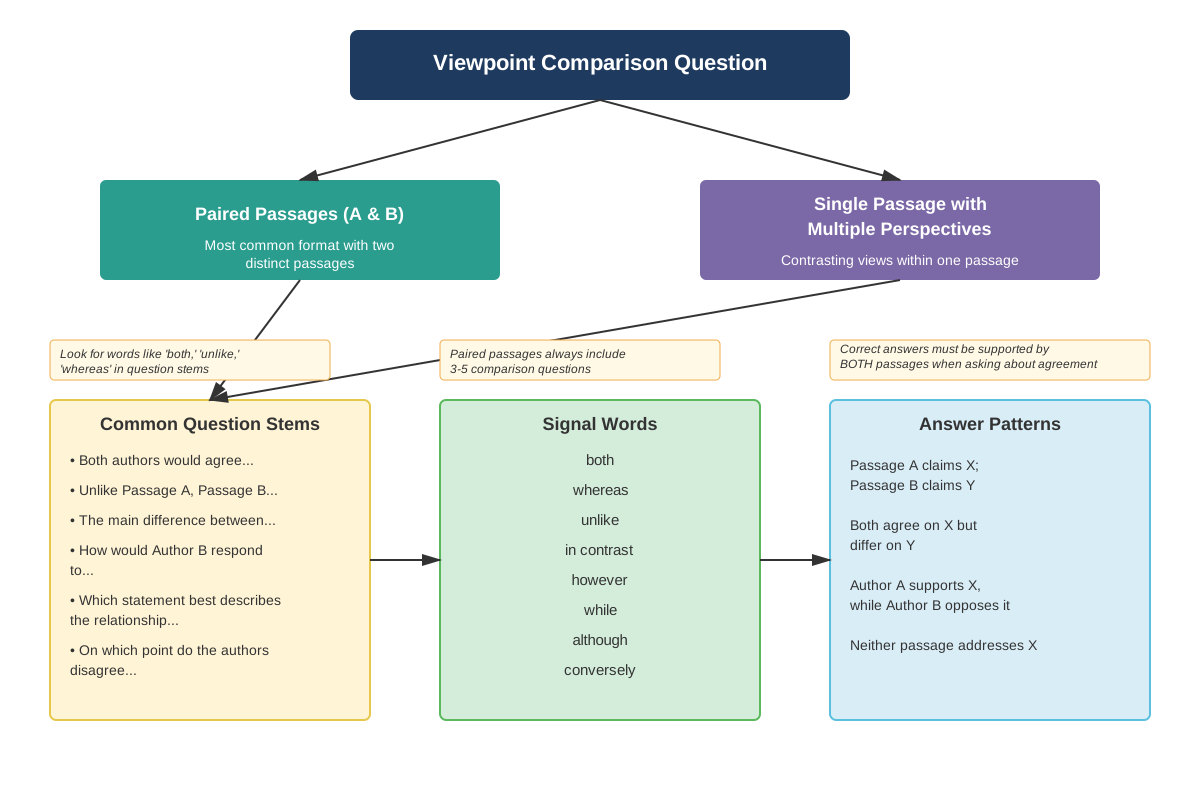
The structure of viewpoint-based passages typically follows predictable patterns. In paired passages, Passage A presents one complete perspective while Passage B offers a contrasting or complementary view. Within single passages, authors may present multiple viewpoints sequentially, often using transition words like "however," "in contrast," or "alternatively" to signal shifts. Some passages adopt a more integrated approach, weaving different perspectives throughout while maintaining clear attribution to specific sources or schools of thought.
Types of Viewpoint Relationships
Viewpoints can relate to each other in several distinct ways, and recognizing these relationships is crucial for answering comparison questions accurately:
| Relationship Type | Description | Common Indicators |
|---|---|---|
| Direct Opposition | Viewpoints make contradictory claims about the same issue | "contradicts," "disputes," "rejects" |
| Partial Agreement | Viewpoints share some common ground but differ on specific aspects | "agrees that... but," "while accepting... argues" |
| Different Emphasis | Viewpoints accept similar facts but stress different implications | "focuses on," "prioritizes," "emphasizes" |
| Complementary | Viewpoints address different aspects of the same topic without conflict | "additionally," "from another perspective" |
| Scope Variation | Viewpoints differ in how broadly or narrowly they apply claims | "in all cases" vs. "in specific circumstances" |
Identifying Comparison Questions
ACT questions testing viewpoint comparison use specific language patterns that signal the skill being assessed. Recognition of these patterns enables efficient question identification and appropriate strategy deployment. Key question stems include:
- "Both passages suggest that..."
- "Unlike the author of Passage A, the author of Passage B..."
- "Compared to Passage A, Passage B places greater emphasis on..."
- "The authors of both passages would most likely agree that..."
- "How would the author of Passage B most likely respond to the claim in lines X-Y of Passage A?"
- "Which statement best describes a difference between the two passages?"
These questions require students to move beyond understanding individual passages to synthesizing information across sources. The correct answer must be supported by specific evidence from both passages or perspectives being compared.
Mapping Viewpoints Systematically
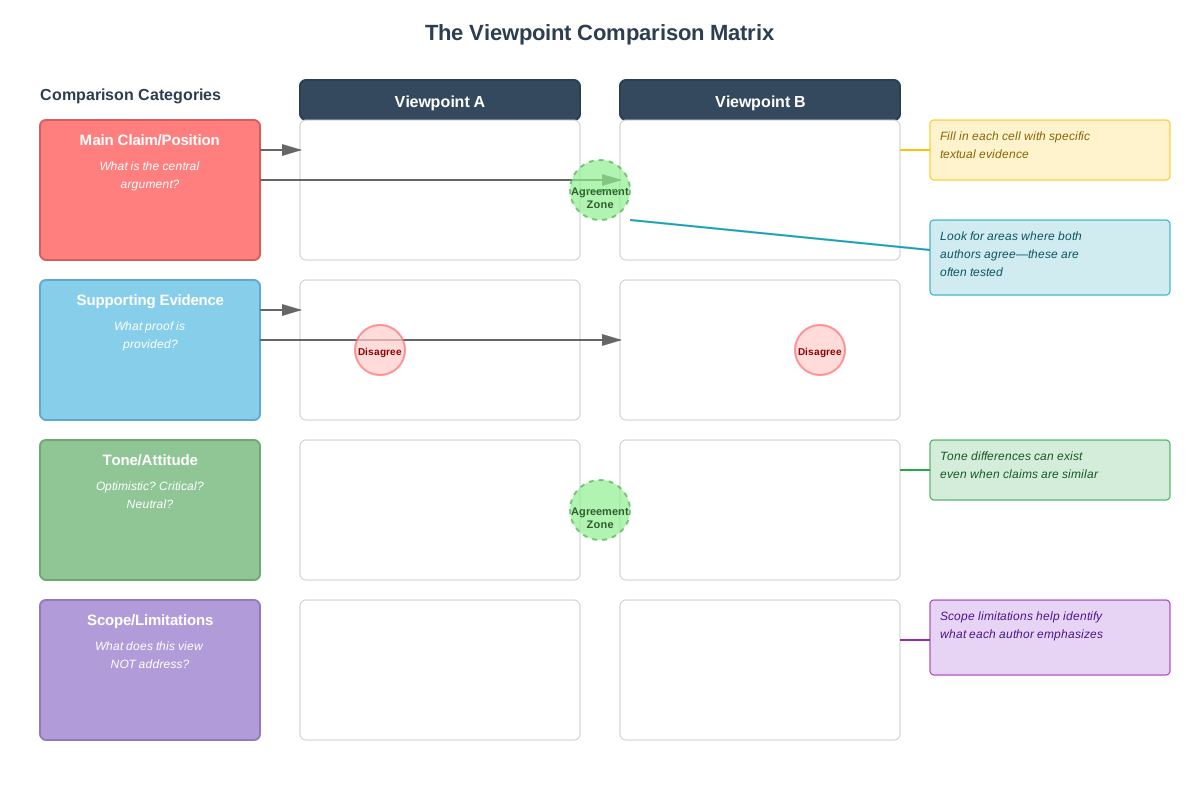
Effective viewpoint comparison requires systematic organization of information. Students should create mental or written maps that track:
- Main claim of each viewpoint: What is the central argument or position?
- Key supporting points: What are the 2-3 most important reasons or pieces of evidence?
- Tone and certainty level: Does the author present claims as definitive or tentative?
- Scope and limitations: Does the viewpoint apply universally or to specific contexts?
- Areas of overlap: Where do viewpoints share common ground?
- Points of divergence: Where do viewpoints clearly differ?
This systematic approach prevents confusion and enables accurate answering of complex comparison questions that require precise understanding of multiple perspectives.
Evidence Comparison Strategies
Different authors support their viewpoints with different types of evidence, and the ACT frequently tests students' ability to recognize these differences. Evidence types include:
- Empirical data: Statistics, experimental results, observational findings
- Expert testimony: Quotes or citations from authorities in the field
- Historical examples: Past events used to support current claims
- Logical reasoning: Deductive or inductive arguments
- Analogies: Comparisons to similar situations or phenomena
- Hypothetical scenarios: "What if" situations used to illustrate points
When comparing viewpoints, note not only what evidence each author uses but also how they interpret that evidence. Two authors might cite the same study but draw different conclusions, or they might use entirely different types of evidence to support similar claims.
Handling Agreement and Disagreement
The most sophisticated ACT comparison questions require students to identify nuanced areas of agreement within broader disagreement, or vice versa. Authors who disagree on a major conclusion might agree on underlying facts, methodological approaches, or the importance of the question being addressed. Conversely, authors who reach similar conclusions might disagree about the reasoning or evidence that supports those conclusions.
When evaluating agreement, look for:
- Shared factual claims that both authors accept
- Common values or priorities that inform both perspectives
- Mutual acknowledgment of complexity or uncertainty
- Similar concerns about implications or applications
When evaluating disagreement, distinguish between:
- Factual disputes (disagreement about what is true)
- Interpretive disputes (disagreement about what facts mean)
- Value disputes (disagreement about what matters most)
- Methodological disputes (disagreement about how to approach the question)
Concept Relationships
The skill of comparing viewpoints builds directly upon foundational reading comprehension abilities. Main idea identification serves as the prerequisite for viewpoint comparison—students must first understand what each author argues before comparing those arguments. This relationship flows as: Individual Passage Comprehension → Main Idea Extraction → Viewpoint Identification → Viewpoint Comparison.
Evidence evaluation connects intimately with viewpoint comparison because understanding how authors support their claims reveals the strength and nature of their perspectives. The relationship operates bidirectionally: analyzing evidence helps clarify viewpoints, while understanding viewpoints helps identify which evidence matters most. This creates a reinforcing cycle: Evidence Analysis ↔ Viewpoint Understanding → Effective Comparison.
Within the topic itself, concepts build hierarchically. Identifying comparison questions must occur first, triggering the appropriate analytical approach. This leads to mapping viewpoints systematically, which enables understanding viewpoint relationships. Finally, evidence comparison strategies and handling agreement and disagreement represent advanced applications that synthesize all previous concepts. The progression follows: Question Recognition → Systematic Mapping → Relationship Classification → Evidence Analysis → Nuanced Agreement/Disagreement Evaluation.
The skill of comparing viewpoints also connects forward to other advanced Reading concepts. Success with viewpoint comparison enhances performance on questions about rhetorical strategy (understanding why authors present information in specific ways) and synthesis questions (combining information from multiple sources to reach new conclusions). These connections make viewpoint comparison a central skill that both depends on and supports multiple other Reading competencies.
High-Yield Facts
⭐ Approximately 3-5 questions per ACT Reading test directly assess viewpoint comparison, making it one of the most frequently tested advanced skills
⭐ Every ACT Reading section includes exactly one paired passage set, guaranteeing that viewpoint comparison will be tested
⭐ The most common wrong answers on comparison questions are statements that accurately describe only one viewpoint but not both
⭐ Authors can disagree on conclusions while agreeing on underlying facts, or agree on conclusions while disagreeing on reasoning
⭐ Comparison questions often use the phrase "both passages" or "unlike Passage A" as explicit signals
- Viewpoint comparison questions typically appear after questions about individual passages in paired passage sets
- The ACT favors nuanced disagreements over simple oppositions, requiring careful attention to specific claims
- Evidence type differences (empirical vs. anecdotal, for example) often distinguish viewpoints even when conclusions seem similar
- Tone and certainty level can reveal important differences between viewpoints that make similar claims
- Questions asking how one author would respond to another require understanding both the specific claim and the responding author's overall perspective
- Scope differences (universal vs. limited application) frequently distinguish viewpoints on the ACT
- The correct answer to a comparison question must be explicitly supported by both passages, not inferred from only one
- Authors who use different evidence types to support the same conclusion represent a common ACT comparison scenario
- Partial agreement questions are often more difficult than complete disagreement questions because they require precise understanding of where agreement ends
- Time pressure makes systematic viewpoint mapping essential—attempting to hold all details in memory leads to confusion and errors
Quick check — test yourself on Comparing viewpoints so far.
Try Flashcards →Common Misconceptions
Misconception: If two authors discuss the same topic, they must disagree about it → Correction: Authors can present complementary viewpoints that address different aspects of a topic without contradicting each other. The ACT includes passages where both authors agree on fundamental points but emphasize different implications or applications.
Misconception: The author who uses more evidence or longer arguments has the "stronger" viewpoint that the ACT favors → Correction: The ACT tests comprehension and comparison skills, not evaluation of which viewpoint is "better." Questions ask what each author claims or how viewpoints relate, not which one is more convincing. Both viewpoints receive equal treatment in correct answers.
Misconception: If Passage A mentions a concept that Passage B doesn't discuss, the authors disagree about that concept → Correction: Absence of discussion does not equal disagreement. Authors may simply focus on different aspects of a topic. Only explicit contradictions or statements that logically conflict represent disagreement.
Misconception: Comparison questions can be answered by reading only the lines referenced in the question → Correction: While specific line references provide important evidence, comparison questions require understanding each author's overall perspective. The referenced lines must be interpreted within the context of each complete viewpoint.
Misconception: Authors who reach the same conclusion must have used the same reasoning and evidence → Correction: The ACT frequently presents passages where authors agree on conclusions but support them differently. These questions test whether students recognize that similar endpoints can result from different paths of reasoning.
Misconception: "Both passages suggest" questions always have answers that appear explicitly in both passages → Correction: These questions often require inference from each passage separately. The correct answer might not be stated directly in either passage but must be supported by evidence from both.
Misconception: In paired passages, Passage B always responds directly to Passage A → Correction: Paired passages may be written independently without either author aware of the other's work. They address the same topic from different perspectives but don't necessarily engage with each other's specific arguments.
Worked Examples
Example 1: Identifying Agreement Within Disagreement
Passage A argues that social media has fundamentally damaged interpersonal communication by replacing face-to-face interaction with superficial online exchanges. The author cites studies showing decreased empathy among heavy social media users and argues that meaningful relationships require in-person contact.
Passage B contends that social media has enhanced communication by enabling people to maintain relationships across distances and connect with others who share niche interests. The author acknowledges that online interaction differs from in-person communication but argues this difference represents expansion rather than replacement.
Question: The authors of both passages would most likely agree that:
A) Social media should be avoided to preserve relationship quality
B) Online and in-person communication have different characteristics
C) Social media users demonstrate less empathy than non-users
D) Technology has had no significant impact on how people communicate
Solution Process:
- Identify what each passage explicitly states or implies:
- Passage A: Social media replaces face-to-face interaction (negative view); online exchanges are superficial; meaningful relationships require in-person contact
- Passage B: Social media enables distant relationships (positive view); online interaction differs from in-person; difference represents expansion
- Eliminate answers supported by only one passage:
- Choice A: Only Passage A suggests avoiding social media (eliminate)
- Choice C: Only Passage A mentions the empathy studies (eliminate)
- Choice D: Both passages agree technology has had significant impact (eliminate)
- Verify the remaining answer against both passages:
- Choice B: Passage A states online exchanges are "superficial" (different from meaningful in-person communication); Passage B explicitly states online interaction "differs from in-person communication"
- Both passages acknowledge a difference, though they interpret its significance differently
Answer: B
Connection to Learning Objectives: This example demonstrates how to identify areas of agreement within broader disagreement (Objective 4) and apply systematic comparison strategies to ACT-style questions (Objective 3). The key insight is that authors can agree on factual observations while disagreeing on interpretations or implications.
Example 2: Comparing Evidence and Emphasis
Passage A discusses climate change by focusing on economic impacts, citing projected costs of coastal flooding, agricultural disruption, and infrastructure damage. The author emphasizes that addressing climate change makes financial sense because prevention costs less than adaptation.
Passage B discusses climate change by focusing on biodiversity loss, describing species extinctions, ecosystem collapse, and irreversible damage to natural habitats. The author emphasizes moral obligations to preserve the natural world for future generations.
Question: Compared to Passage A, Passage B places greater emphasis on:
A) The urgency of addressing climate change
B) Scientific evidence supporting climate change
C) Non-economic reasons for environmental action
D) The costs of failing to address climate change
Solution Process:
- Map the emphasis of each passage:
- Passage A emphasis: Economic considerations, financial costs and benefits, practical decision-making
- Passage B emphasis: Ecological considerations, moral obligations, intrinsic value of nature
- Evaluate each answer choice:
- Choice A: Both passages convey urgency; no clear difference in emphasis (eliminate)
- Choice B: Neither passage focuses primarily on scientific evidence; both assume climate change is real (eliminate)
- Choice C: Passage B emphasizes moral obligations and biodiversity (non-economic), while Passage A emphasizes financial considerations (economic) ✓
- Choice D: Both discuss costs of inaction, just different types of costs (eliminate)
- Verify the distinction is clear and supported:
- Passage A: "financial sense," "prevention costs less," "economic impacts" = economic framing
- Passage B: "moral obligations," "preserve the natural world," "intrinsic value" = non-economic framing
Answer: C
Connection to Learning Objectives: This example illustrates how to distinguish between different types of emphasis (Objective 4) and analyze the specific evidence each author uses (Objective 5). The passages don't disagree about climate change itself but frame the issue through different value systems, demonstrating that viewpoint differences can be subtle and multidimensional.
Exam Strategy
Approaching Comparison Questions Systematically
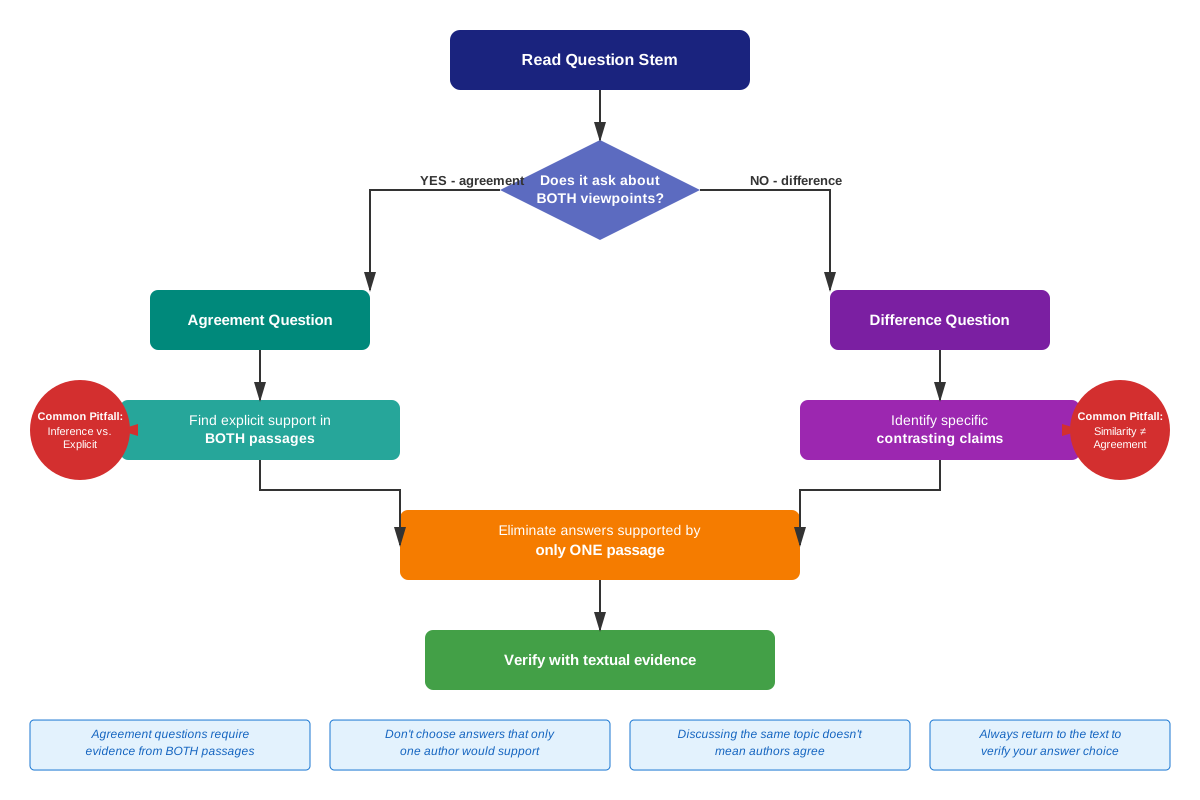
When encountering viewpoint comparison questions on the ACT, follow this strategic sequence:
- Identify the question type immediately: Look for trigger phrases like "both passages," "unlike," "compared to," or "would most likely agree"
- Locate relevant sections: Use line references or content clues to find where each passage addresses the topic
- Summarize each viewpoint separately: Before comparing, ensure clear understanding of what each author claims
- Predict the answer: Based on your understanding, anticipate what the correct answer should address
- Eliminate systematically: Remove answers that describe only one viewpoint or misrepresent either perspective
- Verify with text evidence: Confirm the remaining answer is supported by specific details from both passages
Trigger Words and Phrases
Develop automatic recognition of language that signals comparison questions:
Agreement indicators: "both passages suggest," "the authors would agree," "shared by both," "common to both"
Disagreement indicators: "unlike," "in contrast to," "whereas," "differs from," "would dispute"
Emphasis indicators: "places greater emphasis," "focuses primarily on," "is more concerned with," "gives more attention to"
Response indicators: "would most likely respond," "would probably argue," "would view," "would interpret"
Process of Elimination Strategies
Comparison questions have predictable wrong answer patterns:
One-sided answers: The most common trap—statements that accurately describe Passage A but not Passage B, or vice versa. Always verify that your answer applies to both passages.
Overgeneralization: Answers that claim complete agreement or total opposition when the relationship is more nuanced. Watch for absolute language like "entirely," "completely," or "in all respects."
Scope errors: Answers that extend claims beyond what the passages actually state. If Passage A discusses "some scientists" and an answer says "all scientists," eliminate it.
Evidence confusion: Answers that attribute evidence from one passage to the other author. Track which passage contains which information.
Tone mismatches: Answers that misrepresent the certainty level or attitude of either author. If an author presents a claim tentatively, an answer stating they "definitively prove" something is wrong.
Time Allocation
Paired passages with comparison questions require strategic time management:
- Read Passage A completely first (3-4 minutes): Understand the first viewpoint thoroughly before encountering the second
- Answer Passage A-specific questions (2-3 minutes): Build confidence and reinforce comprehension
- Read Passage B completely (3-4 minutes): Note similarities and differences as you read
- Answer Passage B-specific questions (2-3 minutes): Solidify understanding of the second viewpoint
- Tackle comparison questions (1-2 minutes each): With both viewpoints clear, these become more manageable
Resist the temptation to skip between passages while reading. This fragments comprehension and makes comparison more difficult. Complete understanding of each viewpoint separately enables efficient comparison.
Exam Tip: When stuck between two answers on a comparison question, return to the passages and find the specific sentence that supports each answer choice. The correct answer will have clear textual support from both passages, while the wrong answer will lack support from at least one passage or require unsupported inference.
Memory Techniques
The COMPARE Acronym
Use COMPARE to remember the systematic approach to viewpoint questions:
- Claims: Identify the main claim of each viewpoint
- Overlap: Note areas of agreement or shared assumptions
- Main differences: Pinpoint where viewpoints diverge
- Proof: Examine what evidence each author uses
- Attitude: Consider tone and certainty level
- Relationship: Classify the relationship type (opposition, complement, etc.)
- Eliminate: Remove answers that fail to match both viewpoints
Visualization Strategy: The Venn Diagram
When reading paired passages, mentally construct a Venn diagram:
- Left circle: Contains claims, evidence, and emphasis unique to Passage A
- Right circle: Contains claims, evidence, and emphasis unique to Passage B
- Overlap: Contains shared assumptions, agreed-upon facts, or common concerns
This visualization helps organize information and makes comparison questions more intuitive. Agreement questions draw from the overlap; difference questions draw from the non-overlapping sections.
The "Both Must Be True" Rule
For questions asking what both passages suggest or what both authors would agree with, create a mental filter: "Both must be true." As you evaluate each answer choice, explicitly verify it against both passages. If you can't confirm it for both, eliminate immediately. This simple rule prevents the most common error on comparison questions.
Evidence Type Mnemonic: HEAL
Remember common evidence types with HEAL:
- Historical examples
- Empirical data (statistics, studies)
- Analogies and comparisons
- Logical reasoning
When comparing viewpoints, quickly categorize each author's evidence using HEAL. This makes it easier to answer questions about how authors support their claims differently.
Summary
Comparing viewpoints represents a high-yield ACT Reading skill that assesses students' ability to identify, analyze, and contrast multiple perspectives on a single topic. Success requires systematic mapping of each viewpoint's main claims, supporting evidence, and underlying assumptions before making precise comparisons. The ACT tests this skill through paired passages and single passages containing multiple perspectives, with approximately 3-5 questions per test directly assessing viewpoint comparison. Students must distinguish between different types of relationships—direct opposition, partial agreement, different emphasis, complementary perspectives, and scope variation—and recognize that authors can agree on facts while disagreeing on interpretations, or reach similar conclusions through different reasoning. Effective strategy involves identifying comparison questions through trigger phrases, understanding each viewpoint completely before comparing, eliminating one-sided answers, and verifying that correct answers are supported by specific evidence from all perspectives being compared. Mastery of viewpoint comparison enhances performance across the Reading section by developing the analytical skills necessary for synthesis, evaluation, and critical thinking.
Key Takeaways
- Every ACT Reading section includes paired passages, guaranteeing that viewpoint comparison will be tested with multiple questions worth significant points
- The most common error on comparison questions is selecting answers that accurately describe only one viewpoint rather than both
- Authors can disagree on conclusions while agreeing on facts, or agree on conclusions while disagreeing on reasoning—nuanced understanding is essential
- Systematic mapping of each viewpoint's claims, evidence, and emphasis before attempting comparison questions dramatically improves accuracy
- Comparison questions use predictable trigger phrases ("both passages," "unlike," "compared to") that should immediately activate specific strategic approaches
- Understanding the type of relationship between viewpoints (opposition, partial agreement, different emphasis, etc.) helps predict correct answers
- Time invested in thoroughly understanding each individual viewpoint before tackling comparison questions yields higher accuracy and faster question completion
Related Topics
Synthesis Questions: Building on viewpoint comparison, synthesis questions require combining information from multiple sources to reach new conclusions or evaluate complex scenarios. Mastering viewpoint comparison provides the foundation for these advanced integration tasks.
Rhetorical Strategy Analysis: Understanding why authors present information in specific ways connects to viewpoint comparison by revealing how authors construct arguments to support their perspectives. This topic explores the techniques authors use to make their viewpoints persuasive.
Evidence Evaluation: This related skill involves assessing the quality, relevance, and sufficiency of evidence authors use to support claims. Strong evidence evaluation abilities enhance viewpoint comparison by enabling more sophisticated analysis of how different authors substantiate their positions.
Author's Purpose and Tone: Recognizing what authors aim to accomplish and their attitudes toward subjects provides crucial context for viewpoint comparison. This topic explores how purpose and tone shape the presentation of viewpoints.
Practice CTA
Now that you've mastered the strategies for comparing viewpoints, it's time to apply these skills to authentic ACT-style practice questions. The practice questions and flashcards will reinforce your ability to identify comparison questions, map viewpoints systematically, and select answers supported by multiple perspectives. Remember that viewpoint comparison is one of the highest-yield skills on the ACT Reading section—every question you practice brings you closer to automatic, confident performance on test day. Approach each practice question as an opportunity to refine your systematic approach and build the pattern recognition that separates good scores from great ones.
Sign up free to keep reading
Create a free AnvayaPrep account to finish this ACT guide on Comparing viewpoints — plus flashcards and practice questions.