Overview
The ACT Reading section has evolved significantly in recent years, incorporating data in reading passages as a critical component that tests students' ability to synthesize information across multiple formats. This integration challenges test-takers to move beyond traditional text comprehension and engage with visual representations of information including graphs, charts, tables, and diagrams embedded within or accompanying prose passages. Understanding how to efficiently extract, interpret, and connect data to textual arguments represents a high-yield skill that distinguishes top-scoring students from average performers.
ACT data in reading passages typically appears in the Natural Sciences and Social Studies passage types, though it can occasionally surface in Humanities selections. These questions assess whether students can identify trends, compare quantitative information, draw evidence-based conclusions, and recognize how visual data supports or contradicts claims made in the accompanying text. The ACT explicitly tests the Integration of Knowledge and Ideas standard through these hybrid passages, requiring students to demonstrate sophisticated analytical skills that mirror real-world academic and professional reading demands.
Mastering this topic connects directly to broader Reading competencies including main idea identification, detail recognition, and inference-making. However, data-focused questions add an additional layer of complexity by requiring students to toggle between different information formats rapidly and accurately. Students who develop systematic approaches to these questions gain significant advantages, as data interpretation questions often appear in predictable patterns and reward methodical analysis over rushed reading.
Learning Objectives
- [ ] Identify when Data in reading passages is being tested
- [ ] Explain the core rule or strategy behind Data in reading passages
- [ ] Apply Data in reading passages to ACT-style questions accurately
- [ ] Distinguish between data that supports, contradicts, or extends textual claims
- [ ] Synthesize information from multiple data sources within a single passage
- [ ] Recognize common data presentation formats and their interpretive conventions
- [ ] Evaluate the relationship between quantitative evidence and qualitative arguments
Prerequisites
- Basic graph literacy: Understanding axes, scales, legends, and common chart types (bar, line, pie) is essential because ACT passages assume students can decode standard visual formats without instruction
- Reading comprehension fundamentals: The ability to identify main ideas, supporting details, and author's purpose in prose passages provides the foundation for connecting textual and visual information
- Scientific method awareness: Familiarity with hypothesis, evidence, and conclusion structures helps students recognize how data functions as support for claims in Natural Sciences passages
- Comparative analysis skills: Experience comparing and contrasting information prepares students to evaluate relationships between multiple data sets or between data and text
Why This Topic Matters
In academic and professional contexts, the ability to interpret data within written arguments represents a fundamental literacy skill. Scientific journals, policy reports, business analyses, and news articles routinely combine prose explanations with visual data representations. Students who master this integration develop critical thinking capabilities that extend far beyond standardized testing into college coursework and career success.
On the ACT specifically, data-integrated passages appear with increasing frequency. Recent test administrations include at least one passage with substantial visual elements, and typically 2-4 questions per test explicitly require data interpretation. These questions carry the same point value as traditional comprehension questions but often prove more challenging for unprepared students, creating opportunities for score differentiation. The Natural Sciences passage almost always includes at least one figure, table, or graph, while Social Studies passages frequently incorporate demographic data, economic indicators, or research findings in visual format.
Common manifestations include: experimental results presented in tables alongside methodology descriptions; historical trends shown through line graphs within narrative accounts; comparative data displayed in bar charts supporting argumentative claims; demographic information in pie charts or tables within social science discussions; and process diagrams illustrating concepts explained in the text. Questions may ask students to identify specific data points, recognize trends, compare values across conditions, determine which textual claim the data supports, or identify discrepancies between visual and written information.
Core Concepts
Understanding Data Integration in ACT Passages
Data in reading passages refers to the incorporation of quantitative or visual information—including graphs, charts, tables, diagrams, and figures—within or alongside traditional prose text. The ACT uses this integration to assess whether students can process information across multiple representational formats and synthesize evidence from diverse sources. Unlike standalone data interpretation questions found in the Science section, Reading data questions always require students to connect visual information to textual arguments, claims, or explanations.
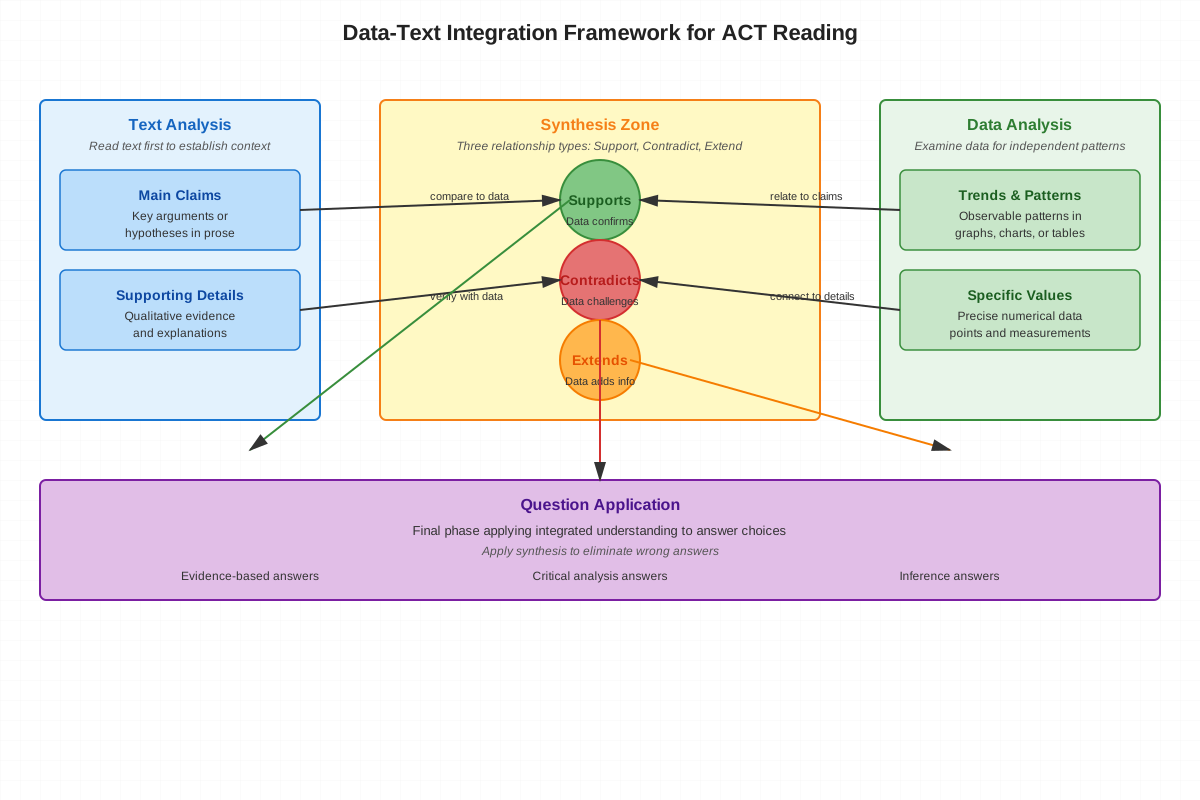
The fundamental principle underlying these questions is cross-format synthesis: the ability to move fluidly between reading prose and interpreting visual data while maintaining comprehension of how these elements work together to convey meaning. Students must recognize that data never appears randomly in ACT passages; it always serves a specific rhetorical purpose—supporting a claim, illustrating a concept, providing evidence for an argument, or demonstrating a trend discussed in the text.
Types of Visual Data on the ACT
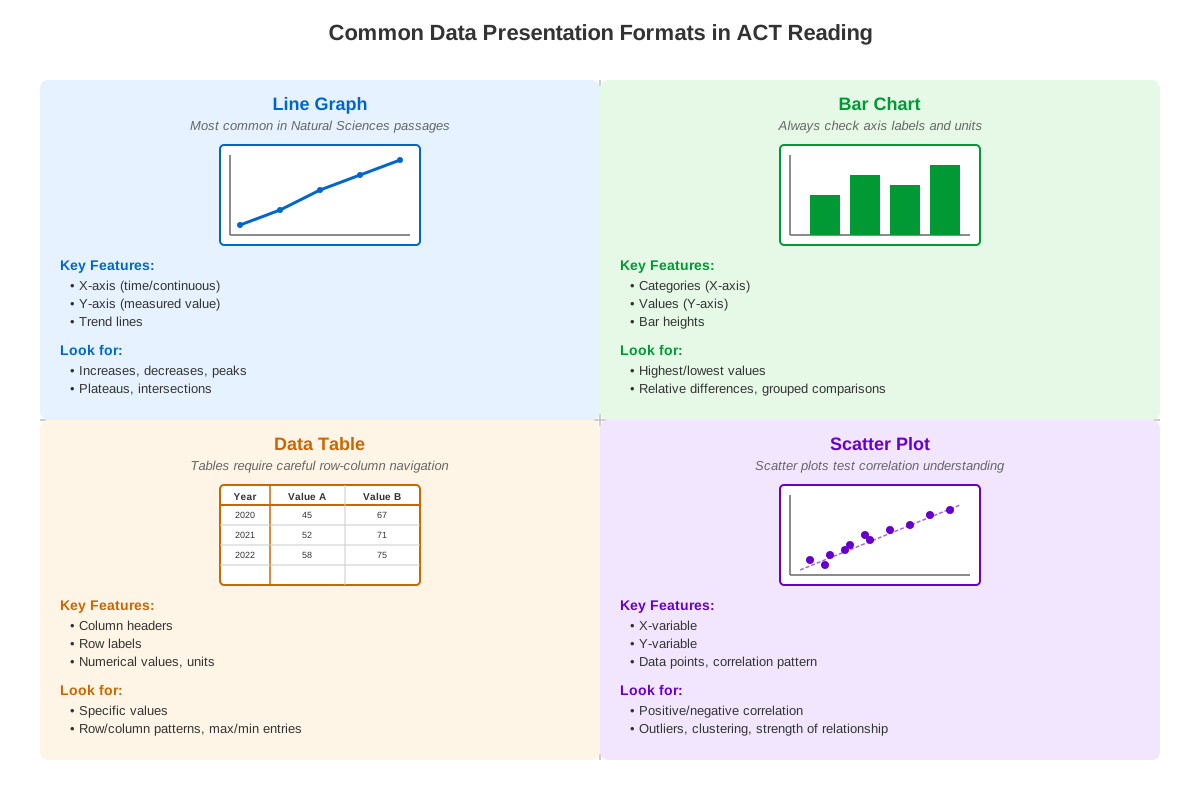
The ACT employs several standard data presentation formats, each with distinct interpretive conventions:
| Data Type | Common Features | Typical Use in Passages | Key Reading Strategy |
|---|---|---|---|
| Line Graphs | X and Y axes, trend lines, multiple series | Showing change over time, comparing trends | Focus on slope direction and intersection points |
| Bar Charts | Categorical comparisons, vertical or horizontal bars | Comparing quantities across groups | Identify highest/lowest values and relative differences |
| Tables | Rows and columns with numerical or categorical data | Presenting detailed experimental results | Scan systematically by row or column |
| Pie Charts | Percentage breakdowns of a whole | Showing proportional relationships | Look for largest/smallest segments and combined values |
| Diagrams | Labeled illustrations of processes or structures | Explaining scientific concepts or procedures | Follow directional arrows and read all labels |
The Text-Data Relationship Framework
Understanding how data relates to accompanying text is crucial for answering questions correctly. This relationship typically falls into one of four categories:
1. Supporting Evidence: The data provides quantitative proof for claims made in the text. For example, a passage arguing that renewable energy adoption has increased might include a line graph showing rising solar panel installations over a decade. Questions might ask: "Which statement from the passage is best supported by the data in Figure 1?"
2. Illustrative Example: The data demonstrates a specific instance or application of a concept explained in the text. A passage describing photosynthesis rates might include a table showing chlorophyll production under different light conditions. Questions might ask: "According to the table, which condition produced the highest chlorophyll levels?"
3. Comparative Analysis: The data allows readers to compare multiple conditions, groups, or time periods discussed in the text. A social studies passage about urbanization might include a bar chart comparing city populations across decades. Questions might ask: "Based on the chart, which city experienced the greatest population increase?"
4. Contradictory or Complicating Information: Less commonly, data might present information that challenges or nuances textual claims, requiring students to recognize discrepancies. Questions might ask: "How does the data in Table 2 complicate the author's argument in lines 45-48?"
Reading Data Efficiently
Efficient data interpretation on the ACT requires a systematic approach:
- Identify all components: Before reading the data itself, note the title, axis labels, units of measurement, legend entries, and any footnotes or annotations
- Determine the data's purpose: Quickly skim the surrounding text to understand why the data appears and what question it addresses
- Scan for extremes and patterns: Identify highest and lowest values, overall trends (increasing/decreasing), and notable outliers or anomalies
- Connect to specific textual references: Look for explicit mentions of the figure/table in the passage and read those sentences carefully
- Answer only what's asked: Avoid over-interpreting data or making inferences beyond what the question requires
Common Question Types
ACT data questions follow predictable patterns:
Direct Lookup Questions: These ask students to locate specific information in the data. Example: "According to Table 1, what was the temperature in Trial 3?" Strategy: Locate the relevant row/column intersection and read carefully.
Trend Identification Questions: These require recognizing patterns across data points. Example: "The graph indicates that as altitude increases, air pressure:" Strategy: Follow the line or bar progression and describe the overall direction.
Comparison Questions: These ask students to evaluate relative values or changes. Example: "Which group showed the greatest increase between 2010 and 2020?" Strategy: Calculate or estimate differences for each option.
Text-Data Connection Questions: These assess whether students can link visual information to prose arguments. Example: "Which statement from the passage is best supported by Figure 2?" Strategy: Evaluate each textual claim against the data evidence.
Synthesis Questions: These require combining information from multiple sources. Example: "Based on both the passage and the table, which conclusion is most reasonable?" Strategy: Verify that the answer aligns with both text and data.
Concept Relationships
The ability to interpret data in reading passages builds directly upon fundamental reading comprehension skills, particularly detail recognition and evidence-based reasoning. Students must first understand the textual argument before they can evaluate how data supports or illustrates that argument. This creates a hierarchical relationship: text comprehension → data interpretation → synthesis.
Within the topic itself, understanding visual data formats (graphs, tables, charts) enables efficient information extraction, which in turn allows students to identify text-data relationships (supporting, illustrating, comparing, contradicting). This progression can be mapped as: format recognition → information extraction → relationship identification → question answering.
The connection to broader Integration of Knowledge and Ideas skills is direct: data interpretation represents one specific application of synthesizing information from multiple sources. This skill connects laterally to paired passage questions (where students compare two texts) and to inference questions (where students draw conclusions from evidence). The relationship map looks like:
Basic Comprehension → Detail Recognition → Evidence Evaluation → Data Interpretation → Cross-Format Synthesis → Integration of Knowledge and Ideas
Understanding this topic also prepares students for the ACT Science section, where data interpretation occurs without accompanying prose passages. The Reading section's data questions serve as a bridge between pure text analysis and pure data analysis, requiring both skill sets simultaneously.
High-Yield Facts
⭐ Data-integrated passages appear in at least one Reading passage per ACT test, most commonly in Natural Sciences
⭐ Questions about data always require connecting visual information to textual claims or arguments
⭐ The correct answer to data questions must be directly supported by the visual information—no outside knowledge required
⭐ Axis labels, units, and legends contain critical information that determines correct interpretation
⭐ When data and text appear to conflict, reread both carefully—the ACT rarely includes actual contradictions
- Line graphs on the ACT typically show change over time or relationships between continuous variables
- Tables often present experimental results with multiple trials or conditions in rows and measured variables in columns
- Bar charts facilitate quick visual comparison of discrete categories or groups
- Pie charts always represent parts of a whole and should total 100% (or close to it, accounting for rounding)
- Diagrams include labels and arrows that must be read as carefully as prose text
- Data questions typically appear in the same order as the information appears in the passage
- Extreme values (highest, lowest, greatest change) are frequently tested
- The ACT never requires complex calculations—simple addition, subtraction, or comparison suffices
- When a question asks what data "suggests" or "indicates," the answer must be directly observable in the visual
- Multiple data sources in one passage (e.g., Table 1 and Figure 2) may require synthesis across both
Quick check — test yourself on Data in reading passages so far.
Try Flashcards →Common Misconceptions
Misconception: Data questions require advanced mathematical or scientific knowledge beyond what's presented in the passage. → Correction: All information needed to answer data questions appears in the passage and visual elements. The ACT tests reading comprehension and data interpretation, not content expertise. Students should rely solely on provided information.
Misconception: Reading the entire passage before looking at data is always the most efficient approach. → Correction: For data-heavy passages, quickly previewing figures and tables before reading can provide context and improve comprehension. The optimal strategy varies by passage type and individual preference, but flexibility is key.
Misconception: If data appears to contradict the text, one must be incorrect. → Correction: Apparent contradictions usually result from misreading either the text or the data. Careful rereading typically reveals that they present complementary information from different perspectives or address different aspects of the topic.
Misconception: Complex-looking graphs with multiple lines or variables are always harder than simple tables. → Correction: Visual complexity doesn't correlate with question difficulty. Simple tables can pose challenging questions requiring careful comparison, while complex graphs might only require identifying a single obvious trend.
Misconception: Data interpretation questions take significantly longer than text-only questions. → Correction: With systematic approaches, data questions often take the same time or less than inference questions. The key is developing efficient scanning strategies rather than reading every data point.
Misconception: The passage text always explicitly explains how to interpret accompanying data. → Correction: While passages provide context, students must independently apply data literacy skills. The ACT assumes students can read standard graph formats without detailed instructions.
Misconception: Estimating values from graphs is risky and should be avoided. → Correction: The ACT designs graphs so that relevant values can be read or reasonably estimated. Answer choices are typically spaced far enough apart that precise measurement isn't necessary.
Worked Examples
Example 1: Natural Sciences Passage with Line Graph
Passage Excerpt: "Researchers investigated how temperature affects enzyme activity in yeast cells. They measured the rate of carbon dioxide production (indicating fermentation activity) at five different temperatures. The results, shown in Figure 1, demonstrate that enzyme activity increases with temperature up to an optimal point, beyond which activity declines rapidly."
Figure 1: [Line graph showing Temperature (°C) on x-axis from 0-60 in increments of 10, and CO₂ Production Rate (mL/min) on y-axis from 0-10. The line rises from approximately 2 at 0°C to a peak of 9 at 40°C, then drops to 3 at 50°C and 1 at 60°C.]
Question: According to Figure 1, at which temperature was CO₂ production rate highest?
A. 30°C
B. 40°C
C. 50°C
D. 60°C
Solution Process:
Step 1: Identify what the question asks—the temperature corresponding to the highest CO₂ production rate.
Step 2: Locate the y-axis label to confirm we're looking at "CO₂ Production Rate (mL/min)."
Step 3: Scan the line graph for the highest point. The peak occurs at 40°C with a value of approximately 9 mL/min.
Step 4: Verify by checking that all other temperatures show lower values: 30°C shows approximately 7 mL/min, 50°C shows approximately 3 mL/min, and 60°C shows approximately 1 mL/min.
Step 5: Select answer B (40°C).
Connection to Learning Objectives: This question tests the ability to identify when data is being tested (recognizing a direct lookup question), apply the core strategy (systematically scanning for extreme values), and accurately answer ACT-style questions (selecting the temperature at the graph's peak).
Example 2: Social Studies Passage with Table
Passage Excerpt: "Urban migration patterns in the mid-20th century varied significantly by region. While northeastern cities experienced modest growth, western cities saw explosive population increases. Table 1 presents population data for four major cities across three decades, illustrating these divergent trends."
Table 1: Population (in thousands)
| City | 1940 | 1960 | 1980 |
|---|---|---|---|
| Boston | 770 | 697 | 563 |
| Phoenix | 65 | 439 | 790 |
| Detroit | 1,623 | 1,670 | 1,203 |
| Los Angeles | 1,504 | 2,479 | 2,967 |
Question: Based on Table 1, which statement best describes population changes between 1940 and 1980?
F. All four cities experienced population growth.
G. Phoenix showed the greatest percentage increase.
H. Detroit maintained steady growth throughout the period.
J. Boston's population exceeded Los Angeles's in 1980.
Solution Process:
Step 1: Recognize this as a synthesis question requiring comparison across multiple data points and evaluation of statements against evidence.
Step 2: Evaluate option F: Check if all cities grew. Boston decreased from 770 to 563, so F is incorrect.
Step 3: Evaluate option G: Phoenix increased from 65 to 790 (approximately 12-fold increase or 1,115% growth). Los Angeles increased from 1,504 to 2,967 (approximately 97% growth). Detroit decreased overall. Boston decreased. Phoenix indeed showed the greatest percentage increase, making G potentially correct.
Step 4: Evaluate option H: Detroit grew from 1,623 to 1,670 (1940-1960) but then declined to 1,203 (1960-1980). This is not "steady growth," so H is incorrect.
Step 5: Evaluate option J: In 1980, Boston had 563 thousand while Los Angeles had 2,967 thousand. Los Angeles exceeded Boston, so J is incorrect.
Step 6: Confirm G is correct by verifying the calculation: Phoenix's growth (from 65 to 790) represents a larger percentage increase than any other city.
Connection to Learning Objectives: This example demonstrates applying data interpretation to ACT-style questions by systematically evaluating each answer choice against table data, identifying the relationship between textual claims about "divergent trends" and the quantitative evidence, and distinguishing between absolute and percentage changes.
Exam Strategy
When approaching ACT data in reading passages, implement this systematic process:
Before Reading: Quickly scan the passage to identify all visual elements. Note their titles and general format (graph, table, diagram). This preview takes 5-10 seconds and provides valuable context.
During Reading: When the passage references a figure or table (e.g., "as shown in Figure 1"), immediately glance at that visual element. Don't study it in detail yet—just note what it represents and how it connects to the surrounding text. Mark these references with brackets or underlines for easy return.
When Answering Data Questions:
- Read the question stem carefully to identify exactly what information is needed
- Locate the relevant visual element
- Read all labels, axes, units, and legends before examining the data itself
- Find the specific data point, trend, or comparison the question addresses
- Eliminate answer choices that contradict the data
- Select the answer most directly supported by the visual information
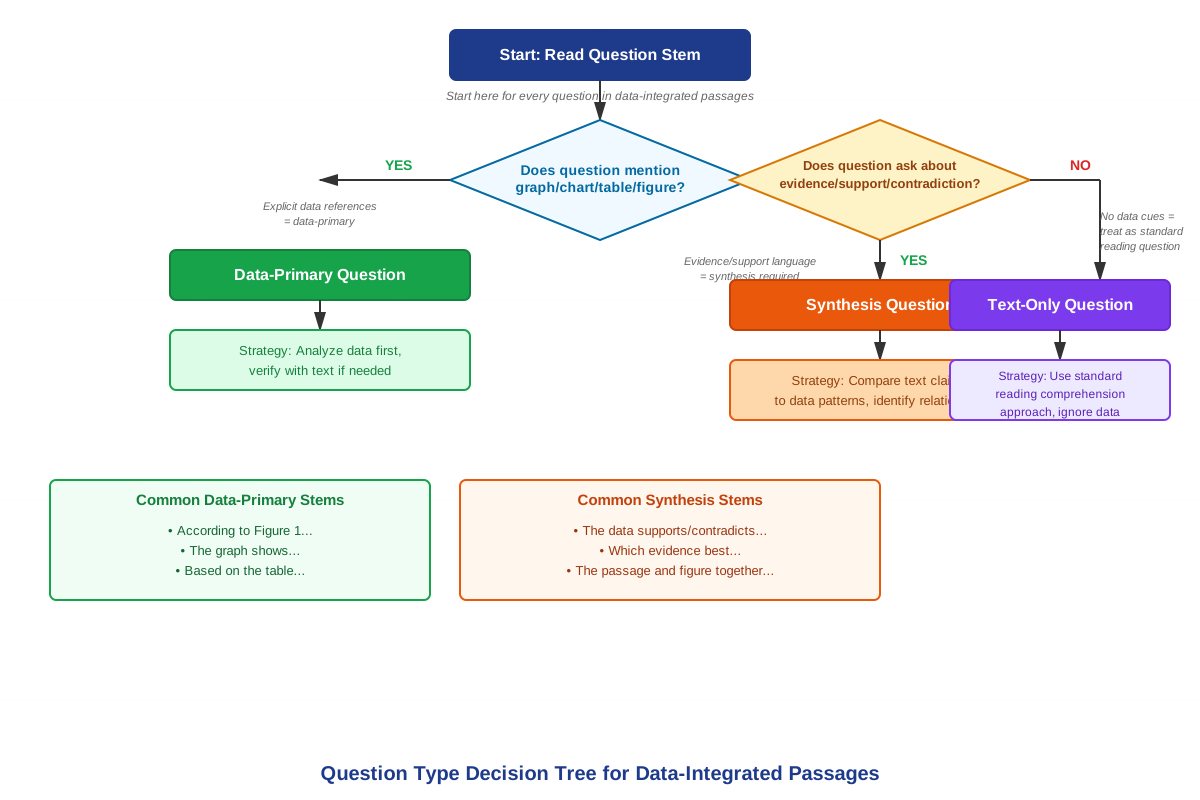
Trigger Words and Phrases: Watch for these question stems that signal data interpretation:
- "According to Figure/Table/Graph X..."
- "Based on the data presented..."
- "The chart/graph indicates that..."
- "Which statement is best supported by..."
- "As shown in the diagram..."
- "The data suggest that..."
Process of Elimination Tips:
- Eliminate answers that require information not present in the passage or data
- Eliminate answers that reverse relationships shown in the data (e.g., claiming an increase when data shows a decrease)
- Eliminate answers that confuse correlation with causation unless the passage explicitly establishes causality
- Eliminate answers that cite incorrect values or misread scales
- Eliminate answers that overgeneralize from limited data
Time Allocation: Data questions should take approximately the same time as other Reading questions (45-60 seconds each). If a data question seems to require extensive calculation or complex reasoning, reconsider your approach—the ACT rarely requires more than simple comparison or basic arithmetic. Budget 30 seconds for initial passage reading including data preview, then address questions as they appear.
Exam Tip: If a question asks which textual statement is "best supported" by data, the correct answer will have direct, unambiguous support. If you're making logical leaps or assumptions, you've likely chosen an incorrect answer.
Memory Techniques
LATTE Strategy for approaching data questions:
- Labels: Read all labels, axes, titles, and units first
- Ask: What is the question specifically asking for?
- Trend or Target: Identify if you're looking for a pattern or specific value
- Text connection: Link the data to relevant passage content
- Eliminate: Remove answers contradicting the data
GRAPH Acronym for reading visual data:
- General overview: What does this show?
- Range: What are the highest and lowest values?
- Axes: What do the x and y axes represent?
- Pattern: Is there an increasing, decreasing, or stable trend?
- How it connects: How does this relate to the passage argument?
Visualization Strategy: Picture data questions as a bridge connecting two islands—the text island and the data island. Your job is to walk across that bridge in both directions, carrying information from one side to the other. The question tells you which direction to walk and what to carry.
The "Three-Second Rule": Before diving into detailed data analysis, spend three seconds asking: "What is this data's purpose in the passage?" This prevents getting lost in numbers and maintains focus on the rhetorical function of the visual element.
Summary
Mastering data in reading passages requires developing the ability to synthesize information across textual and visual formats efficiently and accurately. The ACT integrates graphs, tables, charts, and diagrams into Reading passages to assess whether students can extract relevant information from multiple sources and connect quantitative evidence to prose arguments. Success depends on recognizing that data never appears randomly—it always serves a specific rhetorical purpose such as supporting claims, illustrating concepts, enabling comparisons, or providing evidence. Students must approach these questions systematically: identifying all visual components, understanding the data's relationship to the text, scanning for relevant information, and selecting answers directly supported by the evidence presented. The key distinction between high-scoring and average students lies not in mathematical ability but in methodical analysis and cross-format synthesis skills. By treating data interpretation as an extension of evidence-based reading rather than a separate mathematical task, students can efficiently and accurately answer these high-yield questions that increasingly appear on the ACT Reading section.
Key Takeaways
- Data-integrated passages appear regularly on the ACT, most commonly in Natural Sciences, with 2-4 questions per test requiring visual interpretation
- All information needed to answer data questions appears in the passage and visual elements—no outside knowledge or complex calculations required
- The four primary text-data relationships are: supporting evidence, illustrative example, comparative analysis, and contradictory/complicating information
- Systematic approaches (reading labels, identifying extremes, connecting to text) are more effective than attempting to memorize all data points
- Questions about data always require connecting visual information to textual claims, distinguishing Reading data questions from standalone Science section questions
- Efficient data interpretation involves previewing visuals during passage reading and returning to specific elements when questions reference them
- Answer choices for data questions are directly supported by observable information in graphs, tables, or charts—avoid over-interpretation or logical leaps
Related Topics
Paired Passages: Mastering data interpretation prepares students for comparing information across two related texts, as both skills require synthesizing evidence from multiple sources and identifying relationships between different presentations of information.
Natural Sciences Passage Strategies: Since data most frequently appears in science passages, developing specialized approaches to scientific argumentation, experimental design, and hypothesis-testing enhances data interpretation abilities.
ACT Science Section: The data literacy skills developed through Reading passages transfer directly to the Science section, where students interpret graphs, tables, and experimental results without accompanying prose passages.
Inference Questions: Data interpretation requires drawing evidence-based conclusions, a skill that strengthens the ability to make valid inferences from textual information alone.
Main Idea and Supporting Details: Understanding how data functions as supporting evidence for textual claims deepens comprehension of passage structure and argumentative development.
Practice CTA
Now that you've mastered the strategies for interpreting data in reading passages, it's time to apply these skills to authentic ACT-style questions. The practice questions and flashcards will reinforce your ability to quickly identify data question types, systematically extract relevant information from visual elements, and confidently connect quantitative evidence to textual arguments. Remember: data interpretation is a learnable skill that improves dramatically with focused practice. Each question you work through strengthens your pattern recognition and builds the automaticity needed to handle these questions efficiently under timed conditions. Approach the practice materials with the systematic strategies you've learned, and you'll see measurable improvement in both accuracy and speed. You've got this!
Sign up free to keep reading
Create a free AnvayaPrep account to finish this ACT guide on Data in reading passages — plus flashcards and practice questions.