Overview
Drawing conclusions is one of the most frequently tested skills on the ACT Reading section, appearing in approximately 20-25% of all questions across the four passages. This critical thinking skill requires students to synthesize information from the passage, combine explicit details with implicit meanings, and arrive at logical inferences that extend beyond what is directly stated. Unlike simple recall questions that ask students to locate specific facts, ACT drawing conclusions questions demand higher-order thinking: students must analyze relationships between ideas, understand cause-and-effect patterns, predict outcomes, and recognize the broader implications of the author's arguments or narrative events.
Mastering this skill is essential because it bridges multiple reading competencies tested on the ACT. Drawing conclusions requires strong comprehension of main ideas, careful attention to supporting details, recognition of author's purpose and tone, and the ability to distinguish between what is explicitly stated versus what is implied. Students who excel at drawing conclusions demonstrate sophisticated reading maturity—they can "read between the lines" while remaining grounded in textual evidence, avoiding the trap of making unsupported leaps or inserting their own opinions.
This topic sits at the intersection of literal comprehension and critical analysis within the Integration of Knowledge and Ideas standard. It connects directly to making inferences, understanding implicit meanings, and synthesizing information across paragraphs or entire passages. Strong conclusion-drawing skills also support success with comparative passages, where students must integrate information from two related texts to reach broader understandings. The ability to draw valid conclusions separates high-scoring students from those who struggle with the more nuanced aspects of reading comprehension.
Learning Objectives
- [ ] Identify when Drawing conclusions is being tested in ACT Reading questions
- [ ] Explain the core rule or strategy behind Drawing conclusions
- [ ] Apply Drawing conclusions to ACT-style questions accurately
- [ ] Distinguish between valid conclusions supported by textual evidence and unsupported inferences
- [ ] Recognize the difference between drawing conclusions and making assumptions
- [ ] Synthesize information from multiple paragraphs or sections to reach logical conclusions
- [ ] Evaluate answer choices to identify conclusions that go too far beyond the passage's scope
Prerequisites
- Main idea identification: Understanding the central point of a passage provides the foundation for drawing conclusions that align with the author's overall message
- Supporting detail recognition: Conclusions must be grounded in specific textual evidence, requiring the ability to locate and understand relevant details
- Inference-making skills: Drawing conclusions extends basic inference skills by requiring synthesis of multiple pieces of information
- Understanding author's purpose and tone: Valid conclusions must be consistent with the author's intent and attitude toward the subject
- Vocabulary in context: Misunderstanding key terms can lead to incorrect conclusions about relationships and meanings
Why This Topic Matters
Drawing conclusions represents a fundamental real-world reading skill that extends far beyond standardized testing. In academic settings, students must draw conclusions from research articles, historical documents, and scientific studies. In professional contexts, employees analyze reports, evaluate proposals, and synthesize information from multiple sources to make informed decisions. Critical consumers of media must draw conclusions about the reliability of sources, the implications of news events, and the validity of arguments presented in various formats.
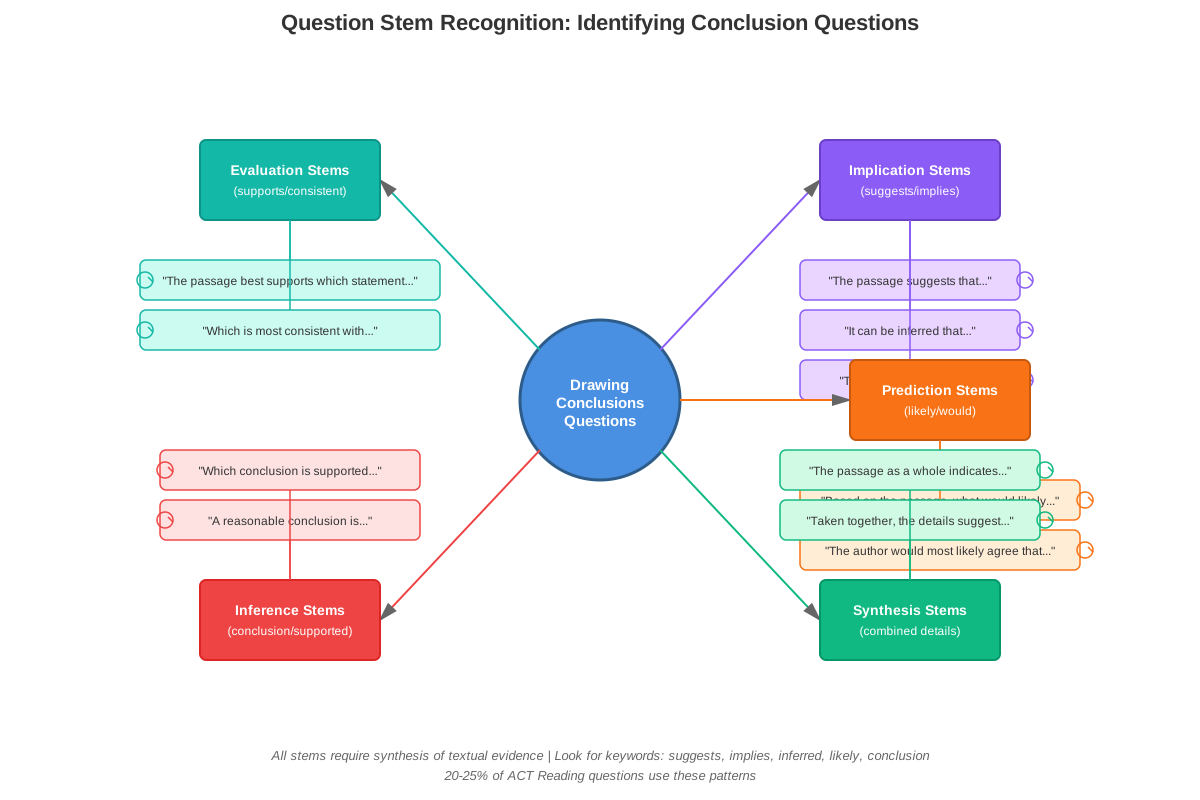
On the ACT Reading section, conclusion-drawing questions appear with remarkable consistency across all four passage types: Literary Narrative/Prose Fiction, Social Science, Humanities, and Natural Science. Approximately 4-6 questions per test explicitly require students to draw conclusions, though the skill implicitly supports many other question types. These questions typically use specific trigger phrases such as "Based on the passage, it can reasonably be concluded that...", "The passage suggests that...", "It can most reasonably be inferred that...", or "The author would most likely agree that...". The ACT particularly favors questions that require synthesizing information from different parts of the passage rather than drawing conclusions from a single sentence or paragraph.
Common manifestations include questions asking students to predict what might happen next in a narrative, determine the likely outcome of a described process, understand the broader implications of a scientific finding, recognize what an author would think about a related scenario not explicitly discussed, or identify the logical consequences of historical events or social phenomena described in the passage. The test-makers deliberately craft wrong answer choices that either go too far beyond what the passage supports, contradict subtle details, or represent common but unsupported assumptions.
Core Concepts
What Drawing Conclusions Means
Drawing conclusions involves using the information explicitly provided in a passage to arrive at logical judgments, predictions, or understandings that are not directly stated but are strongly supported by the text. This process requires combining multiple pieces of evidence, recognizing patterns and relationships, and extending the author's ideas to their logical endpoints. Unlike wild speculation or personal opinion, valid conclusions remain firmly anchored in textual evidence while reaching beyond the literal words on the page.
The key distinction lies in the relationship between evidence and conclusion: the passage must provide sufficient support that makes the conclusion reasonable and probable, even if not explicitly confirmed. Strong conclusion-drawing involves a two-step process: first, identifying all relevant information from the passage, and second, determining what logically follows from that information without making unsupported leaps.
Types of Conclusions on the ACT
The ACT tests several distinct types of conclusion-drawing skills, each requiring slightly different approaches:
Predictive Conclusions: These questions ask what would likely happen next, how a character would respond to a new situation, or what outcome would follow from a described process. Students must understand cause-and-effect relationships and character motivations or scientific principles well enough to extend them beyond the passage's explicit content.
Comparative Conclusions: These require students to determine how the author or a character would view something not directly discussed in the passage, based on their stated views about related topics. Success requires recognizing patterns in the author's reasoning or a character's values.
Synthesis Conclusions: These questions demand combining information from multiple paragraphs or sections to reach an understanding that no single passage section explicitly states. Students must see how different pieces of evidence work together to support a broader point.
Implication Conclusions: These ask students to recognize the broader significance or consequences of information presented in the passage. What does a scientific finding suggest about related phenomena? What do a character's actions reveal about their personality or situation?
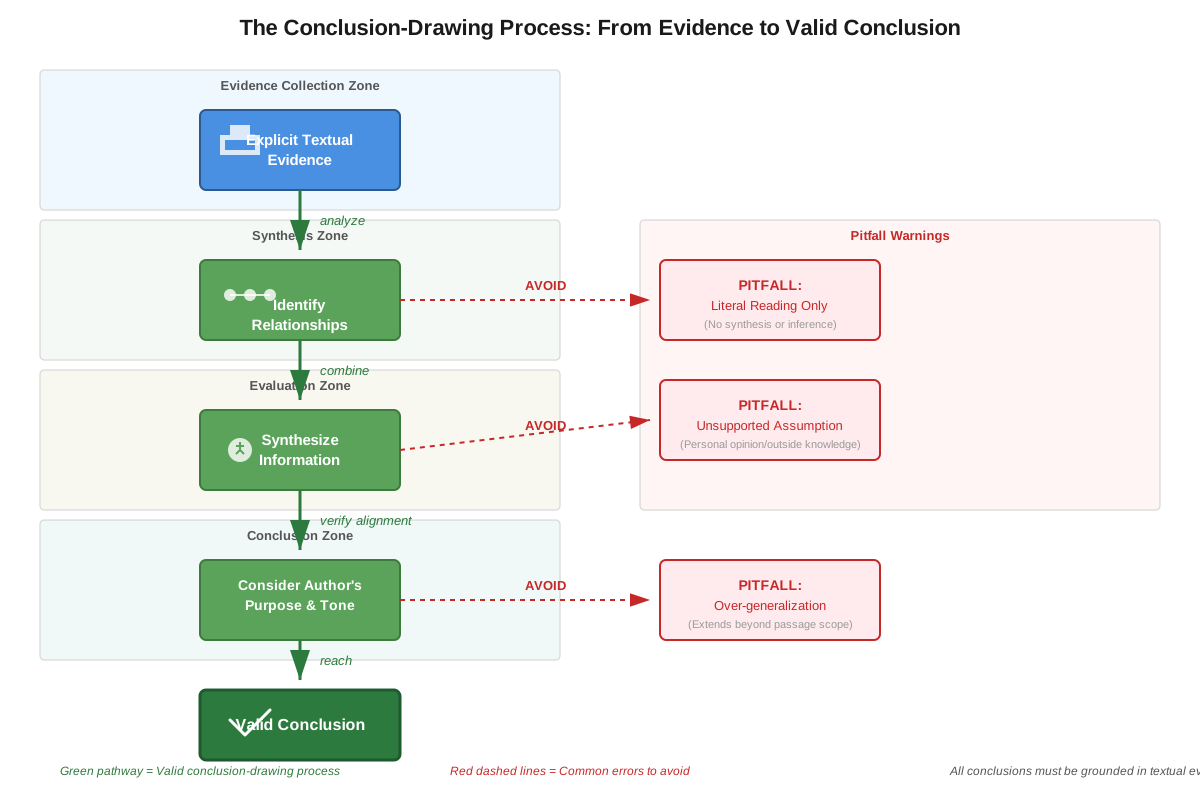
The Evidence-Based Reasoning Process
Drawing valid conclusions on the ACT requires systematic thinking:
- Identify the question's scope: Determine exactly what the question asks you to conclude and what part of the passage is relevant
- Locate all pertinent evidence: Find every detail, example, or statement that relates to the question
- Analyze relationships: Determine how the pieces of evidence connect—do they show cause and effect, comparison and contrast, or progression over time?
- Formulate a tentative conclusion: Based on the evidence, what seems most reasonable?
- Test against the passage: Does your conclusion align with the author's tone, purpose, and explicit statements? Does it contradict anything in the passage?
- Evaluate answer choices: Which option best matches your evidence-based conclusion without going too far or being too narrow?
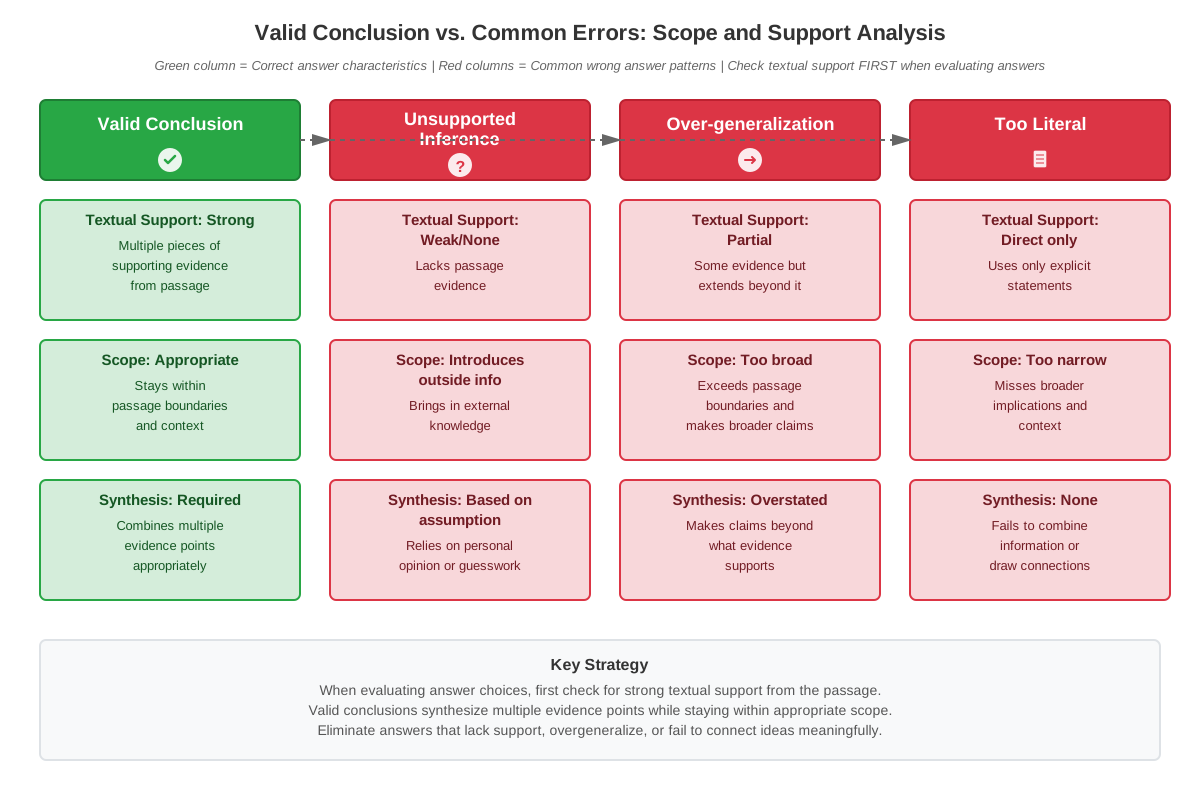
Scope and Support: The Two Critical Factors
Every valid conclusion must satisfy two requirements: appropriate scope and sufficient support. Scope refers to how broad or narrow the conclusion is—conclusions that are too sweeping make claims beyond what the passage can justify, while conclusions that are too narrow miss the point by focusing on minor details rather than the logical implications of the evidence.
Support refers to the quantity and quality of textual evidence backing the conclusion. A well-supported conclusion rests on multiple pieces of evidence or particularly strong single pieces of evidence. Weakly supported conclusions might sound plausible but lack clear grounding in the passage's actual content.
| Valid Conclusion | Too Broad (Insufficient Scope) | Too Narrow (Missing the Point) |
|---|---|---|
| The author suggests that urban planning significantly influences community health | The author proves that urban planning is the most important factor in all aspects of human wellbeing | The author mentions that one city added bike lanes |
| The character's reluctance to speak suggests she feels uncomfortable in formal settings | The character never speaks in any situation | The character didn't speak at the dinner party |
| The experiment's results indicate that temperature affects the reaction rate | The experiment proves that temperature is the only factor that matters in chemistry | The experiment showed that heating the solution to 50°C increased the reaction rate |
Red Flags: When Conclusions Go Wrong
Several warning signs indicate an answer choice represents an invalid conclusion:
Extreme language: Words like "always," "never," "only," "all," "none," "impossible," or "must" often signal conclusions that go too far. The ACT typically rewards more measured conclusions using words like "suggests," "indicates," "likely," "probably," or "tends to."
Information not in the passage: Conclusions that require outside knowledge or introduce entirely new concepts not discussed in the passage are almost always incorrect, even if they sound reasonable.
Contradictions: Any conclusion that contradicts explicit information in the passage is wrong, even if it contradicts only a minor detail.
Emotional reasoning: Conclusions based on what "should" be true or what the student personally believes rather than what the passage actually supports.
Concept Relationships
Drawing conclusions serves as the culmination of multiple reading skills working in concert. The process begins with main idea identification, which provides the framework within which conclusions must fit—valid conclusions align with and extend the passage's central message. Supporting detail recognition supplies the raw material (evidence) from which conclusions are constructed. Without accurately understanding the details, students cannot draw valid conclusions.
Inference-making represents the immediate prerequisite skill; drawing conclusions essentially involves making more complex, synthesis-level inferences that combine multiple simpler inferences. Where a basic inference might determine that a character feels sad based on descriptive details, drawing a conclusion might involve determining how that sadness will influence the character's future decisions based on patterns established throughout the passage.
Author's purpose and tone analysis constrains and guides conclusion-drawing. A conclusion that contradicts the author's established tone (drawing a cynical conclusion from an optimistic passage, for example) signals an error in reasoning. Understanding why the author wrote the passage and their attitude toward the subject helps students predict what conclusions the author would endorse.
The relationship map flows as follows: Vocabulary comprehension → Detail recognition → Main idea understanding → Basic inference → Drawing conclusions → Synthesis across passages (for comparative reading questions). Each skill builds upon and requires the previous ones, with drawing conclusions representing an advanced integration of all earlier skills.
High-Yield Facts
⭐ Drawing conclusions questions typically use trigger phrases: "Based on the passage, it can reasonably be concluded/inferred that...", "The passage suggests...", "The author would most likely agree...", or "It is reasonable to conclude..."
⭐ Valid conclusions must be supported by specific textual evidence, not outside knowledge, personal opinion, or general assumptions about the topic
⭐ The correct answer to a conclusion question is never explicitly stated in the passage—if you can point to a sentence that directly says the answer, it's a detail question, not a conclusion question
⭐ Extreme or absolute language in answer choices (always, never, only, all, none, must, impossible) usually indicates incorrect conclusions that go too far
⭐ The best conclusions synthesize information from multiple parts of the passage rather than relying on a single sentence or paragraph
- Incorrect answer choices often include information that is true according to the passage but doesn't answer the specific question asked
- Drawing conclusions requires staying within the passage's scope—conclusions that introduce entirely new topics or concepts are almost always wrong
- Time period and context matter: conclusions must be consistent with the setting and circumstances described in the passage
- Character-based conclusions must align with established personality traits, motivations, and behavior patterns shown throughout the passage
- Scientific or technical passages require conclusions that follow logically from the processes, principles, or findings described
⭐ The correct conclusion is the one that is most strongly supported, even if other answer choices are possibly true—look for the best-supported option, not just a plausible one
- Conclusions about author's views must be consistent with the tone, word choice, and explicit statements throughout the entire passage, not just one section
- When stuck between two answers, the more conservative, measured conclusion is usually correct over the more dramatic or sweeping one
- Comparative conclusions (what would the author think about X based on their views about Y) require identifying parallel situations or principles
- Predictive conclusions about what happens next must be based on established patterns, not on what typically happens in real life
Quick check — test yourself on Drawing conclusions so far.
Try Flashcards →Common Misconceptions
Misconception: Drawing conclusions means making educated guesses based on general knowledge about the topic.
Correction: Valid conclusions must be firmly grounded in specific evidence from the passage itself. Outside knowledge should never be the basis for selecting an answer, even if that outside knowledge is accurate. The ACT tests reading comprehension, not subject-matter expertise.
Misconception: If an answer choice contains true information from the passage, it must be correct.
Correction: An answer choice can accurately reflect passage content but still be wrong if it doesn't answer the specific question asked. Many incorrect answers are "true but irrelevant"—they contain factual information from the passage but don't represent the conclusion the question asks about.
Misconception: The correct answer will always be something that could definitely be true based on the passage.
Correction: The correct answer must be what is most strongly supported or most reasonable based on the passage. Multiple answer choices might be "possible," but only one will have the strongest textual support. Students must evaluate the degree of support, not just possibility.
Misconception: Drawing conclusions means finding hidden meanings that aren't really in the passage.
Correction: Valid conclusions extend the passage's explicit content logically but remain tethered to textual evidence. This isn't about finding secret messages or reading things into the passage that aren't there—it's about recognizing what logically follows from what is there.
Misconception: Longer, more complex answer choices are more likely to be correct because they sound more sophisticated.
Correction: The ACT often uses complex, impressive-sounding language in wrong answers to distract students. Correct conclusions can be stated simply and clearly. Evaluate answers based on textual support, not linguistic complexity.
Misconception: If you can imagine a scenario where an answer choice might be true, it's a valid conclusion.
Correction: Personal imagination or hypothetical scenarios don't matter. Only what the passage actually supports matters. Students must distinguish between "I can imagine this being true" and "the passage provides evidence that makes this the most reasonable conclusion."
Misconception: Conclusion questions are just opinion questions where any reasonable answer could be correct.
Correction: Despite requiring inference, conclusion questions have definitively correct answers based on textual evidence. These aren't subjective opinion questions—there are clear right and wrong answers based on what the passage supports.
Worked Examples
Example 1: Literary Narrative Conclusion
Passage excerpt: "Marcus had spent three years preparing for this moment, studying every manual, practicing every scenario, yet as he stood before the control panel, his hands trembled. The blinking lights seemed to mock his preparation. He thought of his instructor's words: 'Knowledge means nothing without the courage to apply it.' Taking a deep breath, Marcus reached for the main switch. His hand steadied as it moved forward."
Question: Based on the passage, it can reasonably be concluded that Marcus:
A) Had never operated a control panel before
B) Overcame his initial nervousness to take action
C) Was the most qualified person for this task
D) Would definitely succeed in his mission
Analysis:
Let's work through this systematically using the evidence-based reasoning process.
Step 1 - Identify relevant evidence:
- "three years preparing" and "studying every manual, practicing every scenario" = extensive preparation
- "his hands trembled" and "blinking lights seemed to mock his preparation" = initial fear/nervousness
- "Taking a deep breath" = calming himself
- "His hand steadied as it moved forward" = overcoming the nervousness and taking action
Step 2 - Evaluate each answer choice:
Choice A is too extreme. While Marcus is nervous, the passage says he "practiced every scenario," which suggests he has operated controls before, just not in this high-stakes real situation. This contradicts the evidence.
Choice B aligns perfectly with the evidence. The passage shows a clear progression from trembling hands (nervousness) to steadied hands moving forward (taking action). The phrase "his hand steadied" directly indicates he overcame the initial trembling.
Choice C goes beyond what the passage supports. While Marcus is well-prepared, nothing in the passage compares him to other people or establishes he's "the most qualified." This introduces information not present in the text.
Choice D makes a prediction the passage doesn't support. The passage shows Marcus taking action but provides no information about the outcome. "Definitely succeed" is too strong and unsupported.
Correct Answer: B
This conclusion is valid because it synthesizes evidence from multiple sentences (trembling → deep breath → steadied hand) and recognizes the progression without going beyond what the passage supports. It uses measured language ("overcame," "initial nervousness") rather than extreme claims.
Example 2: Natural Science Conclusion
Passage excerpt: "The research team observed that coral reefs in areas with higher fish diversity showed greater resilience to temperature fluctuations. In contrast, reefs with limited fish species variety experienced more extensive bleaching during warm-water events. The scientists noted that diverse fish populations contributed to algae control and nutrient cycling, processes that appeared to strengthen the coral's ability to withstand stress. However, the study's three-year timeframe meant that long-term effects remained uncertain."
Question: The passage most strongly suggests that:
A) Fish diversity is the only factor that determines coral reef health
B) Coral reefs with diverse fish populations may be better equipped to handle environmental stress
C) All coral reefs will eventually experience bleaching regardless of fish diversity
D) The three-year study definitively proved that fish diversity prevents coral bleaching
Analysis:
Step 1 - Identify relevant evidence:
- Reefs with higher fish diversity = "greater resilience to temperature fluctuations"
- Reefs with limited fish variety = "more extensive bleaching"
- Diverse fish populations = "contributed to algae control and nutrient cycling"
- These processes = "appeared to strengthen the coral's ability to withstand stress"
- Important qualifier: "long-term effects remained uncertain"
Step 2 - Evaluate each answer choice:
Choice A uses the extreme word "only," which contradicts the passage's measured tone. The passage says diverse fish populations "contributed to" and "appeared to strengthen" resilience, not that fish diversity is the sole factor. This goes too far.
Choice B uses appropriately cautious language ("may be," "better equipped") that matches the passage's tone. It synthesizes the evidence about resilience, bleaching differences, and the mechanisms (algae control, nutrient cycling) without overstating the findings. The phrase "handle environmental stress" accurately captures "withstand stress" and "temperature fluctuations."
Choice C contradicts the passage, which shows that reefs with diverse fish populations demonstrated greater resilience and less extensive bleaching. This answer ignores the comparative evidence.
Choice D contradicts the passage's explicit statement that "long-term effects remained uncertain" and uses the extreme word "definitively." The passage says processes "appeared to strengthen" and "contributed to," not that they "prevent" bleaching entirely.
Correct Answer: B
This conclusion is valid because it accurately reflects the relationship shown in the passage (fish diversity correlates with better stress response) while maintaining appropriate scope (using "may be" and "better equipped" rather than absolute claims). It synthesizes multiple pieces of evidence without going beyond what the passage supports, and it respects the passage's acknowledgment of uncertainty.
Exam Strategy
Approaching Conclusion Questions Systematically
When encountering a conclusion question on the ACT, follow this strategic approach:
First, identify the question type by looking for trigger phrases: "can reasonably be concluded," "suggests," "most likely," "it is reasonable to infer," or "the author would probably agree." These phrases signal that you need to go beyond what's explicitly stated.
Second, determine the scope of the question. Does it ask about a specific character, the author's view, a scientific principle, or a broader implication? Understanding exactly what you're concluding about prevents wasting time on irrelevant passage sections.
Third, locate all relevant evidence before looking at answer choices. Students who jump immediately to the answers often get distracted by plausible-sounding but unsupported options. Spend 15-20 seconds identifying the key evidence that relates to the question.
Fourth, formulate your own conclusion based on the evidence before evaluating the choices. This prevents the test-makers' wrong answers from influencing your thinking. Ask yourself: "Based on what I've read, what seems most reasonable?"
Fifth, use aggressive elimination. Cross out any answer with extreme language, contradictions to the passage, or information not present in the text. Often you can eliminate 2-3 choices quickly, making your final decision easier.
Trigger Words and Phrases to Watch For
In questions: "Based on the passage," "it can reasonably be concluded," "the passage suggests," "most strongly supports the idea that," "most likely," "probably," "the author would most likely agree," "it is reasonable to infer"
In correct answers: "suggests," "indicates," "likely," "probably," "may," "appears to," "seems to," "tends to," "generally," "often"
In wrong answers: "always," "never," "only," "must," "cannot," "impossible," "all," "none," "every," "proves," "definitely," "certainly" (when making claims beyond the passage's scope)
Process of Elimination Tips
Eliminate answers that:
- Contain information not mentioned anywhere in the passage
- Contradict any detail in the passage, even minor ones
- Use extreme or absolute language that goes beyond the passage's measured tone
- Are true according to the passage but don't answer the specific question asked
- Require outside knowledge about the topic rather than passage-based reasoning
- Make predictions or claims the passage doesn't provide enough evidence to support
Keep answers that:
- Synthesize information from multiple parts of the passage
- Use measured, qualified language that matches the passage's tone
- Align with the author's purpose and perspective
- Represent logical extensions of explicitly stated information
- Are the most strongly supported by specific textual evidence
Time Allocation Advice
Conclusion questions typically require more time than simple detail questions but less time than complex synthesis questions. Allocate approximately 45-60 seconds per conclusion question:
- 10-15 seconds: Read and understand the question, identify what it's asking
- 15-20 seconds: Locate and review relevant evidence in the passage
- 10-15 seconds: Formulate your own conclusion
- 15-20 seconds: Evaluate answer choices and select the best option
If you're stuck between two answers, return to the passage and look for specific evidence that supports one over the other. Don't rely on which "sounds better"—base your decision on textual support. If you're spending more than 90 seconds on a conclusion question, mark it and move on, returning if time permits.
Exam Tip: The ACT rewards conservative, well-supported conclusions over dramatic or sweeping ones. When in doubt between a measured conclusion and a stronger one, choose the measured option.
Memory Techniques
The SCOPE Acronym
Use SCOPE to evaluate whether a conclusion is valid:
- Supported by specific textual evidence
- Consistent with author's tone and purpose
- On topic (doesn't introduce new concepts)
- Proportional (not too broad or too narrow)
- Evidence-based (not assumption-based)
The "Bridge" Visualization
Think of drawing conclusions as building a bridge from the passage to the answer. The passage provides the foundation (explicit information), and your conclusion is the bridge that extends logically from that foundation. The bridge must be:
- Firmly anchored in the passage (not floating in air)
- Strong enough to support the weight of evidence
- Not so long that it reaches beyond what the passage can support
The Three-Question Test
Before selecting an answer to a conclusion question, ask:
- Can I point to specific evidence? (If no, eliminate)
- Does this contradict anything in the passage? (If yes, eliminate)
- Is this the most strongly supported option? (If no, keep looking)
The "Too Far" Warning System
Remember: EXTREME = WRONG in most conclusion questions. When you see absolute language, imagine a warning light flashing. These words usually signal wrong answers:
- Always/Never
- Only/Exclusively
- All/None
- Must/Cannot
- Proves/Definitely
Summary
Drawing conclusions represents a critical ACT Reading skill that requires students to synthesize textual evidence and extend the passage's explicit content to logical implications without making unsupported leaps. Success depends on maintaining appropriate scope—avoiding conclusions that are too broad or too narrow—and ensuring sufficient textual support for every conclusion. The ACT tests this skill through questions asking students to predict outcomes, determine author's views on related topics, recognize broader implications, and synthesize information from multiple passage sections. Valid conclusions must align with the author's tone and purpose, remain consistent with all passage details, and use measured rather than extreme language. Students should approach these questions systematically: identify the question's scope, locate all relevant evidence, formulate a tentative conclusion, and then evaluate answer choices through aggressive elimination of options that contradict the passage, introduce unsupported information, or use extreme language. The key distinction lies between what is explicitly stated (detail questions) and what logically follows from what is stated (conclusion questions), with correct answers representing the most strongly supported logical extension of passage content.
Key Takeaways
- Drawing conclusions questions require synthesizing textual evidence to reach logical implications not explicitly stated in the passage
- Valid conclusions must have appropriate scope (not too broad or narrow) and strong textual support from multiple pieces of evidence
- Trigger phrases like "can reasonably be concluded," "suggests," and "most likely" signal conclusion questions
- Extreme or absolute language in answer choices (always, never, only, must) usually indicates incorrect conclusions that go too far
- The correct answer is the most strongly supported option, not just a possible or plausible one
- Conclusions must align with the author's tone, purpose, and all passage details—any contradiction signals a wrong answer
- Systematic approach: identify scope → locate evidence → formulate conclusion → eliminate aggressively → select best-supported answer
Related Topics
Making Inferences: The foundational skill for drawing conclusions, focusing on single-step logical extensions of passage content. Mastering inference-making provides the building blocks for more complex conclusion-drawing.
Author's Purpose and Tone: Understanding why the author wrote the passage and their attitude toward the subject constrains and guides valid conclusions, ensuring they align with the author's perspective.
Synthesis and Integration: Advanced skill requiring combining information from multiple passages or sources, building directly on conclusion-drawing abilities by extending them across texts.
Evaluating Arguments: Analyzing the strength of reasoning and evidence in persuasive passages, which requires drawing conclusions about the validity and implications of the author's claims.
Comparative Reading: Applying conclusion-drawing skills across two related passages to reach integrated understandings, representing the highest level of reading synthesis on the ACT.
Practice CTA
Now that you've mastered the strategies and concepts for drawing conclusions, it's time to put your knowledge into action! Complete the practice questions to reinforce these skills and build your confidence. Each question provides an opportunity to apply the systematic approach you've learned: identify the scope, locate evidence, formulate your conclusion, and eliminate aggressively. Remember, drawing conclusions is a skill that improves with deliberate practice—the more you work through ACT-style questions, the more automatic this reasoning process becomes. Review the flashcards to cement the key concepts, trigger phrases, and elimination strategies in your memory. You're building the critical thinking skills that will serve you not just on test day, but throughout your academic career. Keep practicing, stay focused on textual evidence, and trust the systematic process!
Sign up free to keep reading
Create a free AnvayaPrep account to finish this ACT guide on Drawing conclusions — plus flashcards and practice questions.