Overview
The ability to distinguish between fact versus opinion is a foundational critical reading skill that appears consistently throughout the ACT Reading section. This skill requires students to analyze statements within passages and determine whether they represent verifiable, objective information (facts) or subjective judgments, beliefs, and interpretations (opinions). While this distinction may seem straightforward at first glance, the ACT deliberately crafts passages and questions that blur these boundaries, testing whether students can identify subtle opinion markers embedded within seemingly factual prose.
Understanding ACT fact versus opinion questions is essential because these questions assess reading comprehension at a deeper analytical level than simple recall. The ACT Reading test evaluates not just what students read, but how critically they evaluate the information presented. Questions testing this skill often appear in passages across all four content areas—prose fiction, social science, humanities, and natural science—making it one of the most universally applicable concepts in the entire Reading section. Students who master this distinction gain a significant advantage in identifying author bias, evaluating argument strength, and understanding rhetorical purpose.
This topic connects directly to broader Integration of Knowledge and Ideas skills, including analyzing author's purpose, identifying tone and perspective, and evaluating claims and evidence. The ability to separate factual statements from opinion-based assertions forms the foundation for more complex analytical tasks, such as determining whether an author's argument is well-supported or recognizing when a passage shifts from objective reporting to subjective commentary. Mastery of fact versus opinion recognition enables students to approach ACT Reading passages with the critical lens necessary for achieving top scores.
Learning Objectives
- [ ] Identify when Fact versus opinion is being tested in ACT Reading questions
- [ ] Explain the core rule or strategy behind distinguishing Fact versus opinion
- [ ] Apply Fact versus opinion analysis to ACT-style questions accurately
- [ ] Recognize subtle opinion markers and qualifying language within complex sentences
- [ ] Distinguish between expert consensus (treated as fact) and individual interpretation (opinion)
- [ ] Evaluate mixed statements that contain both factual and opinion-based elements
- [ ] Identify how context and source attribution affect whether information is presented as fact or opinion
Prerequisites
- Basic reading comprehension: Understanding literal meaning of sentences and paragraphs is necessary before analyzing whether statements are factual or opinion-based
- Vocabulary knowledge: Recognizing opinion-indicating words (believe, feel, should, best) versus neutral reporting verbs (is, shows, demonstrates) requires solid vocabulary
- Understanding of main idea and supporting details: Distinguishing facts from opinions often requires understanding how authors use each type of statement to build arguments
- Awareness of author's purpose: Recognizing whether an author intends to inform, persuade, or entertain helps predict whether passages will contain more facts or opinions
Why This Topic Matters
In real-world contexts, the ability to distinguish fact from opinion is crucial for media literacy, academic research, and informed citizenship. Every day, readers encounter news articles, social media posts, advertisements, and political speeches that blend factual information with subjective interpretation. Those who can separate verifiable claims from personal judgments are better equipped to evaluate sources, resist manipulation, and form well-reasoned conclusions. This skill extends beyond test-taking into college coursework, where students must evaluate scholarly sources and distinguish between research findings and author interpretations.
On the ACT Reading section, fact versus opinion questions appear with high frequency, typically comprising 2-4 questions per test. These questions appear in multiple formats: direct questions asking students to identify factual statements, questions about author bias or perspective that require recognizing opinion markers, and inference questions where the correct answer depends on distinguishing what the passage states as fact versus what it presents as interpretation. According to ACT data, approximately 15-20% of Integration of Knowledge and Ideas questions directly or indirectly test this skill.
Common manifestations in ACT passages include: scientific passages presenting research findings (facts) alongside researcher interpretations (opinions); historical passages mixing documented events (facts) with historian analysis (opinions); literary criticism passages distinguishing between plot elements (facts about the text) and critical judgments (opinions about quality or meaning); and social science passages presenting statistical data (facts) alongside policy recommendations (opinions). The ACT particularly favors passages where facts and opinions are interwoven, requiring careful analysis rather than surface-level recognition.
Core Concepts
Defining Facts
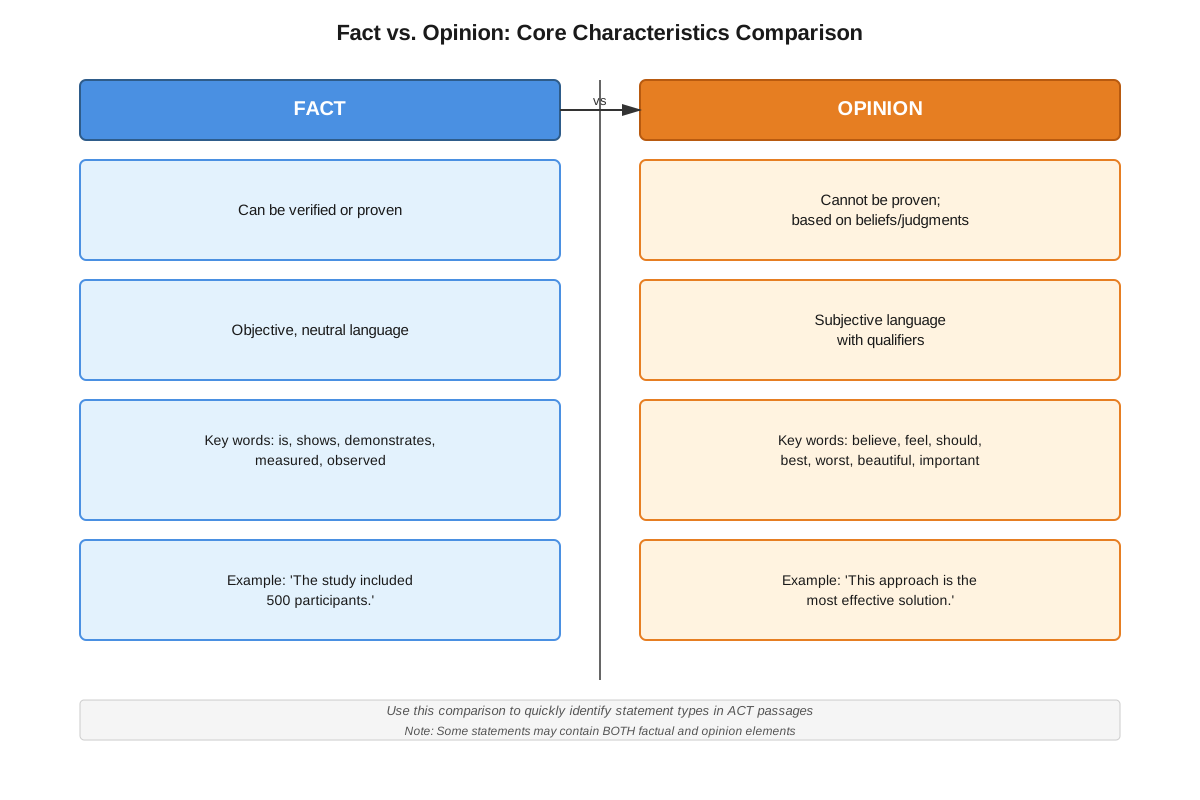
A fact is a statement that can be verified, proven, or disproven through objective evidence, observation, or documentation. Facts exist independently of personal beliefs or feelings. On the ACT, factual statements typically include: specific dates, names, and places; measurable quantities and statistics; documented historical events; scientific observations and experimental results; and direct quotations from sources. The key characteristic of a fact is its verifiability—in principle, someone could check whether the statement is accurate by consulting reliable sources or conducting observations.
Facts in ACT passages often appear with neutral, objective language. They use verbs like "is," "was," "occurred," "measured," "found," "demonstrated," and "showed." For example: "The experiment yielded 47 grams of product" is factual because the quantity can be verified. "Shakespeare wrote Hamlet in approximately 1600" is factual because historical records support this claim. Even if a fact turns out to be incorrect, it remains a factual statement (as opposed to an opinion) because it makes a verifiable claim about reality.
Defining Opinions
An opinion is a statement expressing a belief, judgment, evaluation, interpretation, or prediction that cannot be objectively proven true or false. Opinions reflect subjective perspectives and may vary from person to person. On the ACT, opinion statements typically include: value judgments about quality (best, worst, beautiful, ugly); recommendations or advice (should, ought to, must); predictions about the future; interpretations of meaning or significance; and expressions of personal preference or belief.
Opinion markers are linguistic clues that signal subjective statements. Common opinion indicators include:
- Judgment words: best, worst, greatest, most important, beautiful, terrible
- Modal verbs: should, ought to, must, might, could, may
- Belief verbs: believe, think, feel, suppose, assume, suspect
- Evaluative adjectives: wonderful, horrible, fascinating, boring, impressive
- Comparative/superlative forms used evaluatively: better, more significant, most influential
- Qualifying phrases: in my view, arguably, perhaps, possibly, likely
The Gray Area: Expert Consensus and Qualified Facts
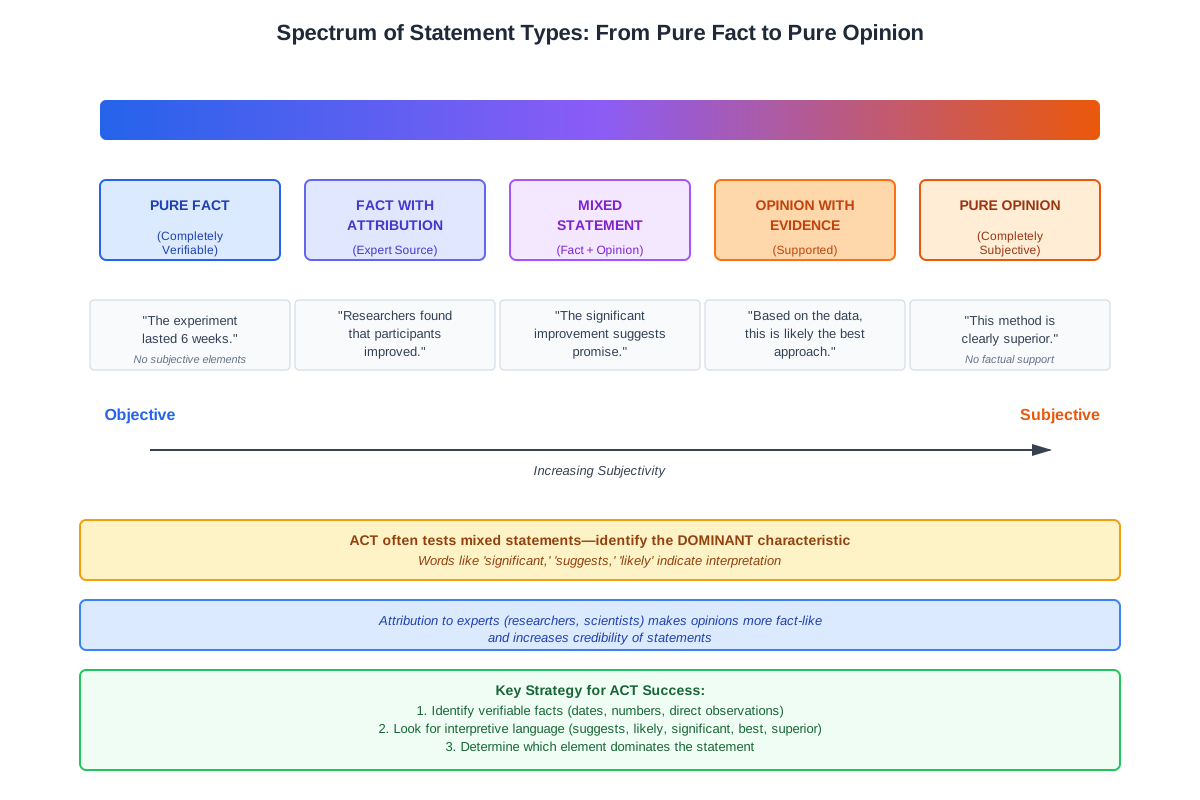
The ACT frequently tests students' ability to navigate statements that fall between clear facts and obvious opinions. Expert consensus represents a particularly important gray area. When the scientific or scholarly community widely agrees on an interpretation, the ACT typically treats this as factual information, even though it represents collective judgment. For example, "Climate change is caused primarily by human activity" reflects scientific consensus and would be treated as fact in an ACT passage, even though it represents interpretation of data.
Similarly, qualified facts use hedging language while still making verifiable claims. Statements like "The population increased by approximately 15%" or "Most historians agree that the treaty was signed in 1783" contain qualifying words (approximately, most) but still make claims that can be verified through evidence. The ACT distinguishes these from pure opinions because they reference objective evidence or expert agreement rather than personal preference.
Context and Attribution
How information is presented significantly affects whether it functions as fact or opinion within a passage. Attribution—identifying who makes a claim—is crucial. Compare these statements:
- "The novel is a masterpiece" (opinion—unattributed value judgment)
- "Critics consider the novel a masterpiece" (fact—verifiable claim about what critics say)
- "The author believes the novel is a masterpiece" (fact—verifiable claim about the author's belief)
The second and third statements are factual because they make verifiable claims about what others think, even though the underlying judgment is opinion-based. This distinction frequently appears in ACT questions.
Mixed Statements
Many ACT passages contain mixed statements that combine factual and opinion elements within a single sentence. For example: "The 1969 moon landing, one of humanity's greatest achievements, occurred on July 20." This sentence contains a verifiable fact (the date) and an opinion (greatest achievements). ACT questions may ask students to identify which portion is factual or which is opinion-based, requiring careful parsing of complex sentences.
| Feature | Fact | Opinion |
|---|---|---|
| Verifiability | Can be proven or disproven | Cannot be objectively proven |
| Language | Neutral, objective verbs and nouns | Judgment words, evaluative adjectives |
| Variability | Same for all observers | May differ between individuals |
| Evidence | Based on observable data | Based on interpretation or values |
| Time reference | Often past or present | Often includes future predictions |
| Typical verbs | is, was, measured, found, occurred | believe, should, seems, appears (when evaluative) |
Concept Relationships
The ability to distinguish fact from opinion serves as a foundational skill that connects to multiple higher-order reading comprehension concepts. Fact versus opinion directly enables author's purpose analysis—recognizing whether a passage primarily presents facts suggests an informative purpose, while heavy use of opinion indicates persuasive or evaluative intent. This relationship flows in both directions: understanding author's purpose helps predict whether statements are likely factual or opinion-based.
The concept also connects intimately with tone and perspective identification. An author's tone (objective, critical, enthusiastic, skeptical) is revealed partly through the balance of facts and opinions. Objective tone correlates with predominantly factual presentation, while subjective tones emerge through opinion-laden language. Similarly, identifying bias requires recognizing when an author presents opinions as if they were facts or selectively includes facts that support a particular viewpoint.
Evidence evaluation builds directly on fact versus opinion distinction. Strong arguments support opinions with facts; weak arguments present opinions without factual support or treat opinions as if they were facts. The relationship map flows: Fact versus Opinion → Evidence Evaluation → Argument Strength Assessment → Critical Reading Mastery.
Within the Integration of Knowledge and Ideas domain, fact versus opinion connects to analyzing multiple texts (comparing how different authors present facts versus interpretations about the same topic) and understanding claims and counterclaims (distinguishing factual premises from opinion-based conclusions in arguments).
High-Yield Facts
⭐ Facts can be verified through evidence, observation, or documentation; opinions express judgments, beliefs, or interpretations that cannot be objectively proven
⭐ Opinion markers include judgment words (best, worst), modal verbs (should, must), belief verbs (think, believe), and evaluative adjectives (beautiful, terrible)
⭐ Statements about what someone believes or thinks are factual claims about their beliefs, even if the belief itself is opinion-based
⭐ Expert consensus in scientific or scholarly fields is typically treated as factual information on the ACT, even when it represents interpretation
⭐ Mixed statements containing both factual and opinion elements require parsing to identify which portion is which
- Neutral reporting verbs (is, was, occurred, measured, found) typically signal factual statements
- Predictions about the future are always opinions because they cannot be verified in the present
- Comparative and superlative forms used evaluatively (best, most important, greatest) signal opinions
- Qualifying language (approximately, most, generally) does not automatically make a statement opinion-based if it still references verifiable evidence
- Historical events, dates, names, and documented occurrences are factual even if details are disputed
- Value judgments about quality, importance, or significance are opinions regardless of how widely held
- Direct quotations are facts (someone verifiably said those words), but the content of quotations may be opinion
- Statistical data and measurements are factual; interpretations of what the data means are opinions
- Recommendations and advice (should, ought to, must) are always opinions because they express what someone believes should happen
- Context and attribution determine whether a statement functions as fact or opinion within a passage
Quick check — test yourself on Fact versus opinion so far.
Try Flashcards →Common Misconceptions
Misconception: If a statement is true, it's a fact; if it's false, it's an opinion. → Correction: The fact versus opinion distinction is about verifiability, not truth. A false statement can still be a factual claim (it's just an incorrect fact), and a widely accepted opinion remains an opinion even if most people agree with it. The question is whether the statement can be objectively verified, not whether it's accurate.
Misconception: Any statement with qualifying language like "approximately" or "most" is an opinion. → Correction: Qualifying language indicates precision or scope but doesn't automatically make a statement opinion-based. "The population increased by approximately 15%" is still factual because it makes a verifiable claim about population change. The qualifier simply acknowledges measurement limitations.
Misconception: Expert statements are always facts because experts know what they're talking about. → Correction: Experts can express both facts and opinions. When an expert reports research findings or documented information, that's factual. When an expert interprets data, makes recommendations, or offers judgments, that's opinion—albeit expert opinion. The ACT tests whether students can distinguish expert reporting from expert interpretation.
Misconception: Statements in scientific or historical passages are always facts because those are factual subjects. → Correction: Scientific and historical passages regularly mix facts (data, events, observations) with opinions (interpretations, significance judgments, theoretical explanations). Scientists and historians constantly interpret factual information, and the ACT tests whether students can distinguish the data from the interpretation.
Misconception: If a statement appears in a published source or textbook, it must be fact. → Correction: Published sources contain both facts and opinions. Academic writing, journalism, and literature all blend factual reporting with interpretive analysis. The ACT specifically tests whether students can distinguish these elements regardless of source authority.
Misconception: Statements about feelings or beliefs are always opinions. → Correction: This requires careful distinction. "I believe the policy is effective" is an opinion (a judgment about effectiveness). However, "The senator believes the policy is effective" is a fact—a verifiable claim about what the senator believes. The ACT frequently tests this distinction between expressing an opinion and reporting someone else's opinion.
Worked Examples
Example 1: Science Passage Analysis
Passage excerpt: "The study measured cortisol levels in 200 participants over six months. Researchers found that cortisol increased by an average of 23% in the high-stress group. This alarming trend suggests that chronic stress poses a serious threat to public health. The data clearly demonstrate that stress management should be a top priority for healthcare providers."
Question: Which of the following statements from the passage is presented as a fact rather than an opinion?
A) Chronic stress poses a serious threat to public health
B) Stress management should be a top priority for healthcare providers
C) The trend in cortisol levels is alarming
D) Cortisol increased by an average of 23% in the high-stress group
Analysis:
Let's examine each statement systematically:
Statement A contains "poses a serious threat"—this is a judgment about significance and severity. While supported by data, the characterization as "serious threat" represents interpretation rather than raw data. This is opinion.
Statement B uses "should be," which is a recommendation. Recommendations about what ought to happen are always opinions because they express values and priorities rather than verifiable facts. This is opinion.
Statement C describes the trend as "alarming"—a clear evaluative judgment. Different people might view the same trend differently (concerning, expected, manageable). The emotional characterization makes this opinion.
Statement D reports a specific measurement: 23% average increase. This can be verified by examining the study data. The statement uses neutral language ("increased by") and provides a specific, measurable quantity. This is fact.
Answer: D
Connection to learning objectives: This example demonstrates how to identify fact versus opinion in scientific contexts (Objective 1), apply the core strategy of looking for verifiable claims versus judgments (Objective 2), and recognize opinion markers like "should," "alarming," and "serious threat" (Objective 4).
Example 2: Humanities Passage Analysis
Passage excerpt: "Georgia O'Keeffe painted 'Red Canna' in 1924. The painting measures 36 by 30 inches and depicts a close-up view of a flower. Art historians consider O'Keeffe one of the most important American modernists. The painting's bold colors and abstract forms make it a masterpiece of 20th-century art. O'Keeffe herself believed that her flower paintings were misinterpreted by critics who saw them as symbolic rather than purely visual."
Question: Which statement represents a verifiable fact rather than an opinion or interpretation?
A) O'Keeffe is one of the most important American modernists
B) The painting's bold colors and abstract forms make it a masterpiece
C) O'Keeffe believed her flower paintings were misinterpreted by critics
D) The painting is a masterpiece of 20th-century art
Analysis:
Statement A contains "most important," which is a value judgment. Even though it's attributed to art historians (expert consensus), the statement expresses a judgment about importance and significance. However, note the attribution—this is a factual claim about what art historians think, making this a borderline case. Let's continue examining.
Statement B uses "make it a masterpiece"—"masterpiece" is a quality judgment. The statement presents this as if it's a logical conclusion from the colors and forms, but quality assessments are opinions. This is clearly opinion.
Statement C reports what O'Keeffe believed. This is a verifiable claim about her stated beliefs. We can check historical records, interviews, or her writings to verify whether she expressed this belief. The statement doesn't claim her belief was correct—it simply reports that she held it. This is fact.
Statement D directly calls the painting "a masterpiece," which is a quality judgment. Regardless of how many people agree, assessments of artistic quality are opinions. This is opinion.
Answer: C
Key insight: This example illustrates the crucial distinction between expressing an opinion ("The painting is a masterpiece") and reporting someone's belief as fact ("O'Keeffe believed X"). Statement A is tricky because it attributes the judgment to experts, but Statement C is more clearly factual because it simply reports a belief without endorsing it.
Connection to learning objectives: This demonstrates how attribution affects whether statements function as fact or opinion (Objective 6), how to parse mixed statements (Objective 5), and how to apply fact versus opinion analysis to humanities content (Objective 3).
Exam Strategy
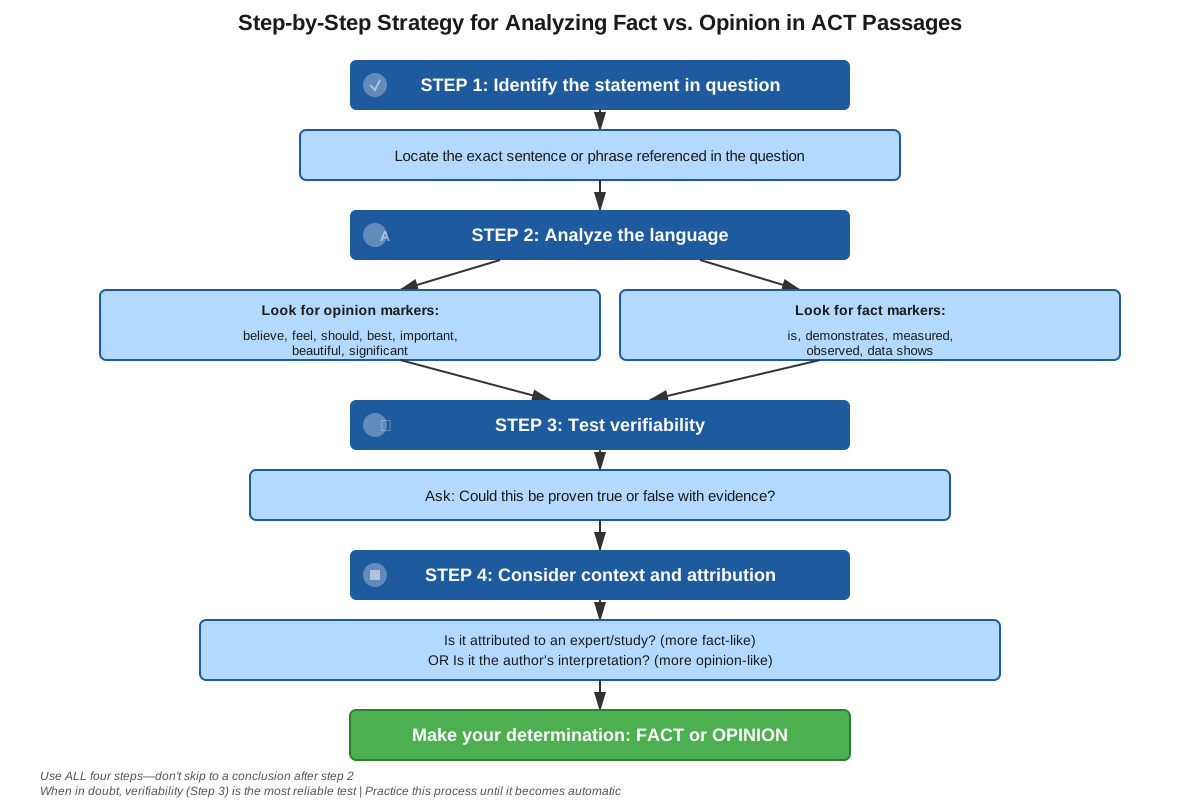
When approaching ACT Reading questions testing fact versus opinion, employ a systematic three-step process: identify, analyze, verify.
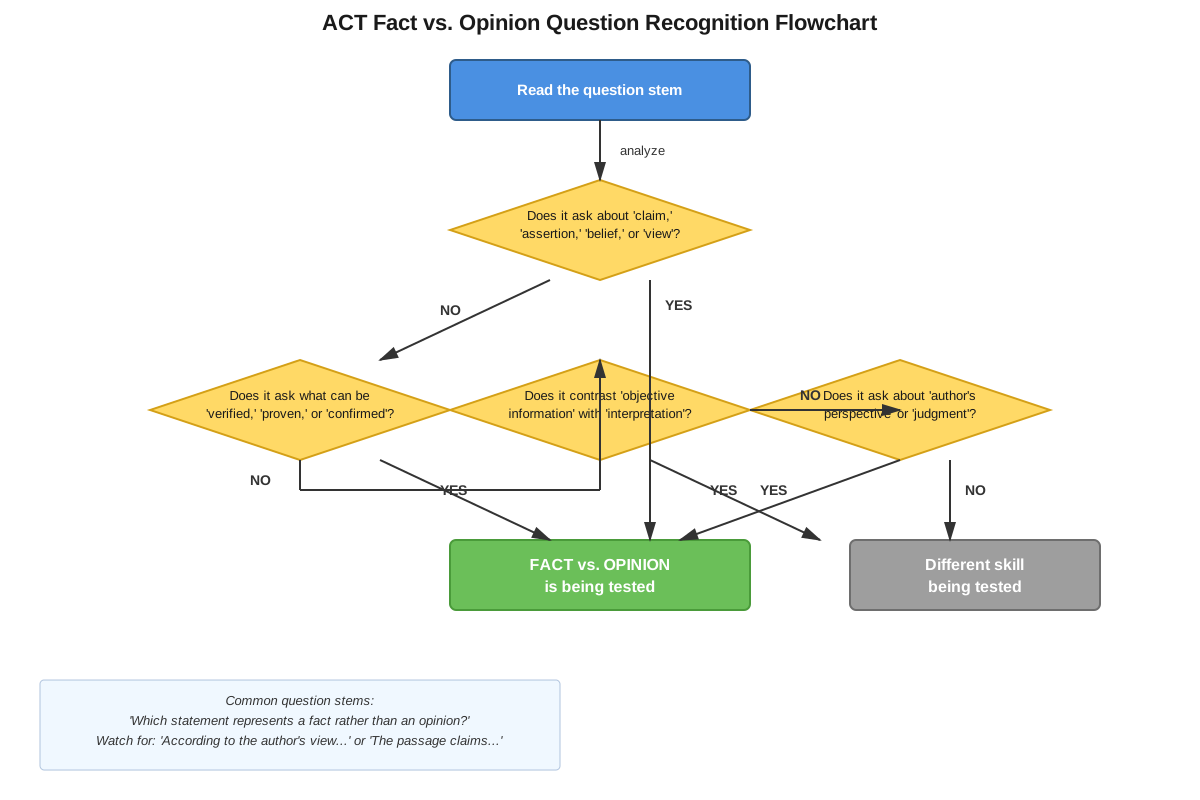
Step 1: Identify the question type. Trigger phrases include: "Which statement is presented as fact?", "Which represents the author's opinion?", "Which can be verified?", "Which expresses a judgment?", "According to the passage, which is factual?" When you see these phrases, immediately activate your fact versus opinion analysis framework.
Step 2: Analyze the language of each answer choice. Scan for opinion markers: judgment words (best, worst, important, significant), modal verbs (should, must, ought), belief verbs (think, believe, feel), evaluative adjectives (beautiful, terrible, impressive), and comparative/superlative forms used evaluatively. Statements containing these markers are likely opinions. Conversely, look for neutral reporting language, specific measurements, dates, names, and documented events—these signal facts.
Step 3: Verify by asking: "Could this be proven or disproven by checking evidence?" If yes, it's fact. If it depends on personal values or interpretation, it's opinion. For borderline cases, consider attribution—is this reporting what someone thinks (fact about their belief) or directly asserting a judgment (opinion)?
Exam Tip: When answer choices seem equally factual or opinion-based, return to the passage and examine the context. How does the author present the information? Is it attributed to a source? Does surrounding text support it with evidence or present it as interpretation?
Process of elimination strategy:
- Eliminate answers with obvious opinion markers first (should, best, most important)
- Eliminate answers that make predictions about the future (always opinions)
- Among remaining choices, eliminate those requiring value judgments
- Select the answer with the most neutral, verifiable language
Time allocation: Fact versus opinion questions should take 30-45 seconds once you've read the passage. These questions test analytical skill rather than passage comprehension, so if you understand the distinction, you can answer quickly. Don't overthink—trust your identification of opinion markers and verifiable claims.
Common trap answers: The ACT frequently includes answers that are true statements but still opinions (truth doesn't equal fact in this context), statements that mix facts and opinions (requiring you to identify which portion the question asks about), and expert opinions presented with authoritative language (still opinions despite expert source).
Memory Techniques
PROVE Mnemonic for identifying facts:
- Provable through evidence
- Reportable with neutral language
- Objective (same for all observers)
- Verifiable by checking sources
- Evidence-based
JUDGE Mnemonic for identifying opinions:
- Judgment words (best, worst, important)
- Unverifiable by objective means
- Depends on personal values
- Generally uses evaluative language
- Expresses beliefs or recommendations
Visualization strategy: Picture a courtroom. Facts are evidence that could be presented to a jury—documents, measurements, photographs, testimony about observable events. Opinions are arguments lawyers make about what the evidence means or what should be done. If it could go in the evidence pile, it's fact. If it belongs in the closing argument, it's opinion.
The "Should Test": If a statement contains or implies "should," "ought to," or "must" regarding what people should do or what should happen, it's opinion. Recommendations are always opinions.
The "Says Who?" Test: Ask "Says who?" about each statement. If the answer is "objective evidence" or "documented records," it's fact. If the answer is "the author" or "based on interpretation," it's opinion.
Attribution Acronym - REPORT: When someone's belief is Reported, Even Personal Opinions become Reportable Truth (facts about beliefs).
Summary
Distinguishing fact from opinion is a critical analytical skill that appears throughout the ACT Reading section, requiring students to separate verifiable, objective statements from subjective judgments and interpretations. Facts are statements that can be proven or disproven through evidence, observation, or documentation, typically using neutral language and specific details. Opinions express beliefs, judgments, evaluations, or recommendations that cannot be objectively verified, often signaled by judgment words, modal verbs, and evaluative language. The ACT tests this skill through direct questions about which statements are factual, questions requiring recognition of author bias or perspective, and inference questions where correct answers depend on distinguishing facts from interpretations. Success requires recognizing opinion markers, understanding how attribution affects whether statements function as facts or opinions, parsing mixed statements that contain both elements, and distinguishing expert consensus from individual interpretation. Students must remember that truth doesn't equal fact in this context—the distinction is about verifiability, not accuracy—and that statements reporting someone's beliefs are factual claims about those beliefs, even when the beliefs themselves are opinions.
Key Takeaways
- Fact versus opinion is about verifiability, not truth: facts can be proven or disproven through evidence, while opinions express judgments that cannot be objectively verified
- Opinion markers include judgment words (best, worst), modal verbs (should, must), belief verbs (think, believe), and evaluative adjectives—scan for these to identify opinions quickly
- Statements reporting what someone believes are facts about their beliefs, even if the belief itself is opinion-based—attribution is crucial
- Expert consensus is typically treated as factual on the ACT, but expert recommendations and interpretations remain opinions
- Mixed statements require careful parsing to identify which portions are factual and which are opinion-based
- Use the PROVE mnemonic for facts (Provable, Reportable, Objective, Verifiable, Evidence-based) and JUDGE for opinions (Judgment words, Unverifiable, Depends on values, Generally evaluative, Expresses beliefs)
- Apply systematic analysis: identify question type, scan for opinion markers, verify by asking whether the statement could be proven through evidence
Related Topics
Author's Purpose and Tone: Mastering fact versus opinion enables deeper analysis of why authors write and how they convey attitudes. Authors who primarily present facts aim to inform; those who emphasize opinions aim to persuade or evaluate. Understanding this relationship strengthens both skills.
Evidence and Support: Recognizing facts versus opinions is essential for evaluating argument quality. Strong arguments support opinions with facts; weak arguments present opinions without factual support or treat opinions as facts. This topic builds directly on fact versus opinion mastery.
Bias and Perspective: Identifying bias requires recognizing when authors present opinions as facts, selectively include facts supporting their viewpoint, or use opinion-laden language while claiming objectivity. Fact versus opinion distinction is foundational to bias analysis.
Comparing Multiple Texts: When the ACT presents paired passages, questions often ask students to compare how different authors present facts versus interpretations about the same topic. Mastery of fact versus opinion enables sophisticated comparative analysis.
Rhetorical Strategies: Understanding how authors blend facts and opinions to achieve persuasive effects connects fact versus opinion analysis to broader rhetorical awareness, preparing students for more advanced reading comprehension tasks.
Practice CTA
Now that you've mastered the core concepts of distinguishing fact from opinion, it's time to apply this knowledge! Complete the practice questions to test your ability to identify opinion markers, parse mixed statements, and analyze how attribution affects whether information functions as fact or opinion. The flashcards will help you memorize key opinion markers and reinforce the distinction between verifiable facts and subjective judgments. Remember: this skill appears on every ACT Reading test, so consistent practice will directly improve your score. Approach each practice question systematically using the strategies you've learned, and you'll develop the automatic recognition skills needed for test-day success!
Sign up free to keep reading
Create a free AnvayaPrep account to finish this ACT guide on Fact versus opinion — plus flashcards and practice questions.