Overview
Interpreting arguments is a critical skill tested on the ACT Reading section that requires students to analyze how authors construct, support, and present their claims within passages. This skill goes beyond simple comprehension—it demands that test-takers identify the logical structure of an author's reasoning, evaluate the strength of evidence provided, and understand how different components of an argument work together to support a central claim. On the ACT, ACT interpreting arguments questions typically ask students to recognize the relationship between claims and evidence, identify assumptions underlying an argument, or determine how specific details function within the broader argumentative framework.
The ability to interpret arguments effectively is essential for ACT success because approximately 15-20% of Reading questions directly assess this skill, making it one of the highest-yield areas for focused study. These questions appear across all passage types—prose fiction, social science, humanities, and natural science—though they are particularly prevalent in persuasive and expository texts. Students who master argument interpretation gain a significant advantage not only in answering direct questions about argumentative structure but also in understanding passages more deeply, which improves performance on inference and main idea questions as well.
Within the broader framework of ACT Reading skills, interpreting arguments sits at the intersection of literal comprehension and critical analysis. It builds upon foundational skills like identifying main ideas and supporting details while serving as a gateway to more advanced analytical tasks such as evaluating rhetorical strategies and synthesizing information across multiple sources. This topic is particularly important within the Integration of Knowledge and Ideas category, where students must demonstrate their ability to analyze how authors develop and support their positions through logical reasoning and evidence.
Learning Objectives
- [ ] Identify when Interpreting arguments is being tested in ACT Reading questions
- [ ] Explain the core rule or strategy behind Interpreting arguments on the ACT
- [ ] Apply Interpreting arguments to ACT-style questions accurately
- [ ] Distinguish between claims, evidence, and reasoning within a passage
- [ ] Evaluate the logical relationship between different components of an argument
- [ ] Recognize common argumentative structures and patterns in ACT passages
- [ ] Identify unstated assumptions that underlie an author's reasoning
Prerequisites
- Main idea identification: Understanding the central claim is essential before analyzing how it is supported
- Supporting detail recognition: Arguments are built from specific evidence, so locating relevant details is foundational
- Vocabulary in context: Precise understanding of word choice helps identify subtle shifts in argumentative tone and strength
- Author's purpose and tone: Recognizing whether an author is persuading, informing, or entertaining provides context for argument analysis
- Basic logical reasoning: Understanding cause-effect relationships and if-then structures aids in tracking argumentative flow
Why This Topic Matters
In real-world contexts, the ability to interpret arguments is fundamental to informed citizenship, professional success, and personal decision-making. Every day, individuals encounter persuasive messages in news articles, advertisements, political speeches, and workplace communications. The skills tested in ACT argument interpretation questions—identifying claims, evaluating evidence, and recognizing logical relationships—are the same skills needed to critically assess information sources, make sound judgments, and construct compelling arguments in academic and professional settings.
On the ACT Reading section, argument interpretation questions appear with remarkable consistency. Research on ACT question distribution shows that 3-5 questions per test directly assess this skill, with additional questions incorporating argument analysis as a secondary component. These questions most commonly appear in social science and humanities passages, where authors present thesis-driven arguments about historical events, cultural phenomena, or scientific debates. Natural science passages also frequently include argumentative elements when authors discuss competing theories or interpret experimental results.
The ACT tests argument interpretation through several distinct question formats. Some questions ask students to identify the function of a specific paragraph or detail within the author's overall argument ("The author includes the example in lines 45-48 primarily to..."). Others require students to recognize the logical relationship between ideas ("Which of the following best describes how the third paragraph relates to the second paragraph?"). Still others ask test-takers to identify what the author assumes or takes for granted in making a particular claim. Recognizing these question types and understanding the underlying skill being assessed is crucial for efficient, accurate test-taking.
Core Concepts
Understanding Arguments: Claims, Evidence, and Reasoning
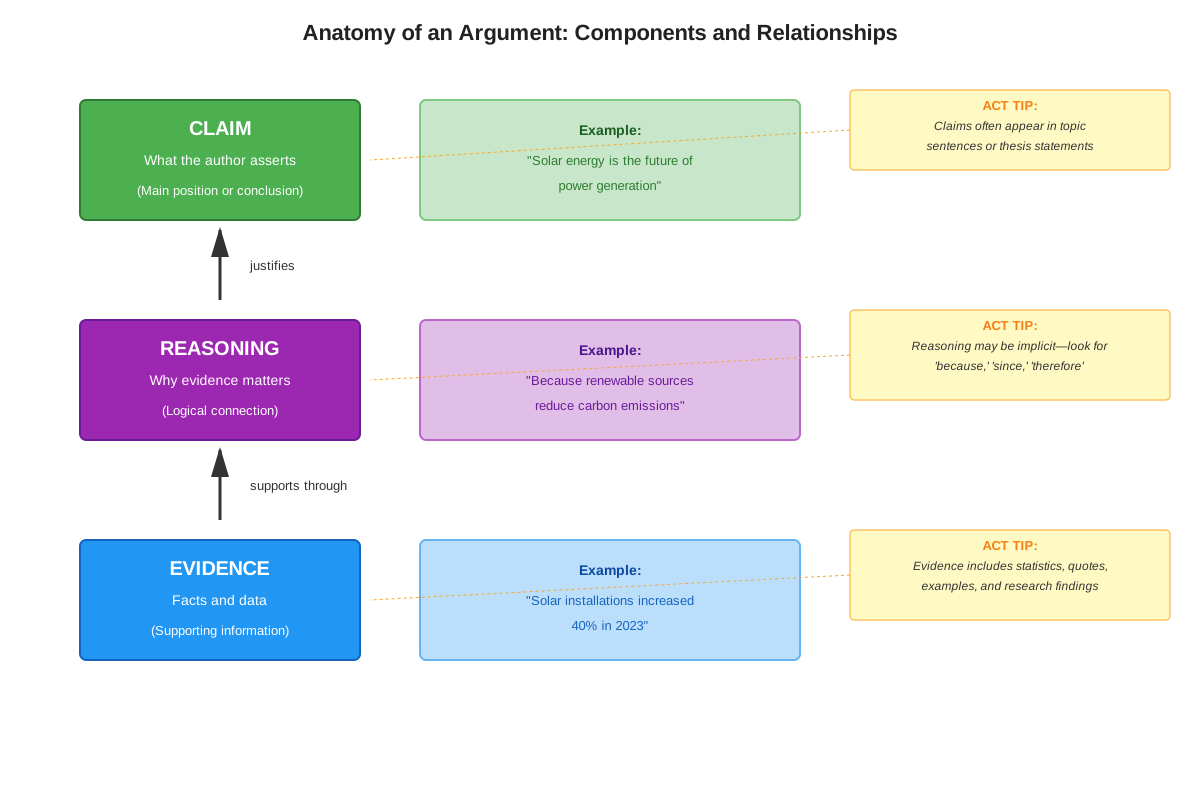
An argument in the context of ACT Reading is any passage or portion of a passage where an author makes a claim and provides support for that claim. The three fundamental components of any argument are the claim (the position or assertion the author wants readers to accept), the evidence (the facts, examples, statistics, or expert testimony used to support the claim), and the reasoning (the logical connections that link evidence to claims).
The claim represents the author's position on a debatable issue. Claims can be explicit (directly stated) or implicit (strongly suggested but not directly stated). On the ACT, students must be able to distinguish between the main claim (thesis) and subordinate claims (supporting points). For example, an author might argue that "Urban gardens improve community health" (main claim) while also asserting that "gardens provide fresh produce" and "gardens create social connections" (subordinate claims that support the main claim).
Evidence consists of the specific information authors use to make their claims credible and convincing. Evidence types include:
- Statistical data: Numbers, percentages, and quantitative research findings
- Examples: Specific instances or case studies that illustrate a point
- Expert testimony: Quotations or paraphrases from authorities in a field
- Anecdotes: Personal stories or narratives that support a claim
- Analogies: Comparisons that help readers understand unfamiliar concepts
Reasoning is the logical glue that connects evidence to claims. It answers the question "Why does this evidence support this claim?" Strong reasoning makes the connection between evidence and claim explicit and logical, while weak reasoning may contain logical fallacies or unstated assumptions.
Identifying Argumentative Structure
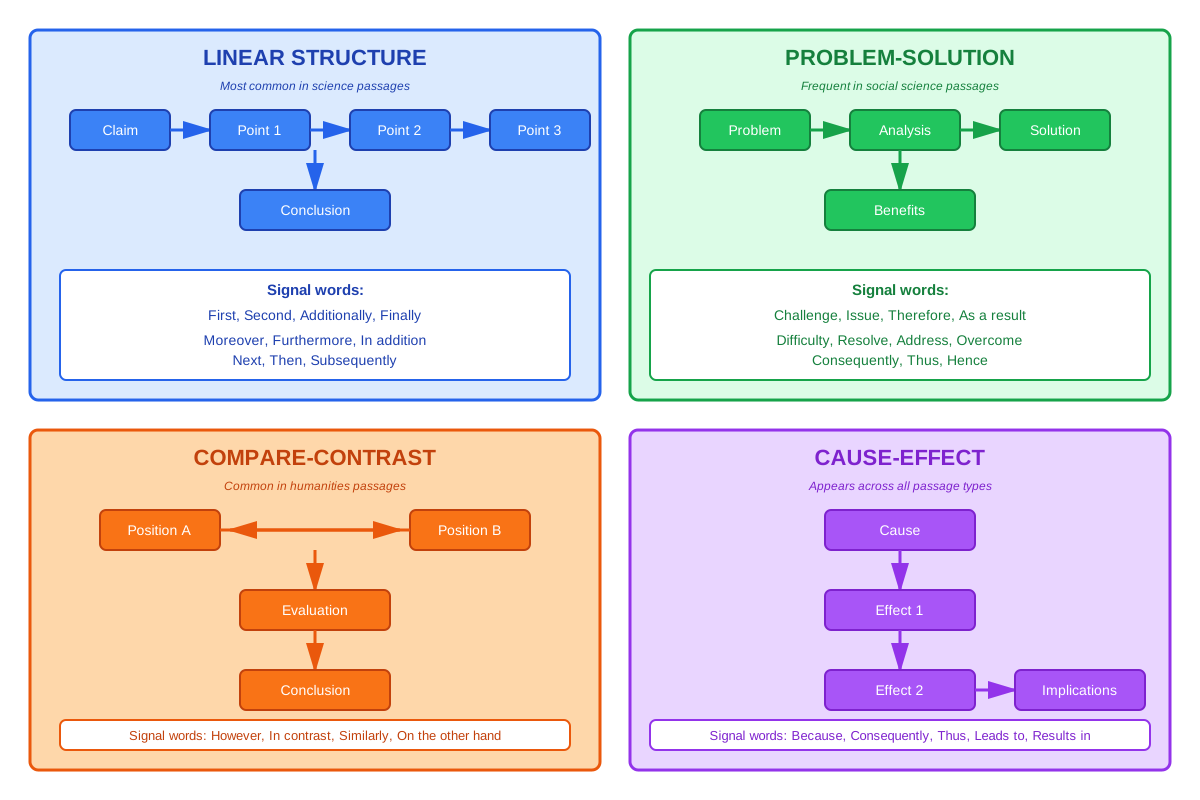
ACT passages employ several common argumentative structures that students should recognize:
Thesis-Support Structure: The author presents a main claim early in the passage, then devotes subsequent paragraphs to providing evidence and reasoning that support this claim. This is the most common structure in ACT passages.
Problem-Solution Structure: The author identifies a problem or challenge, then proposes and defends a solution. Questions often ask about the relationship between the problem description and the proposed solution.
Compare-Contrast Structure: The author presents two or more perspectives, theories, or approaches, analyzing their similarities and differences. Questions may ask how the author uses one perspective to illuminate another.
Cause-Effect Structure: The author traces causal relationships, showing how certain conditions or events lead to particular outcomes. Students must track these causal chains accurately.
Chronological-Argumentative Structure: The author presents information in time order while simultaneously building an argument about the significance or meaning of events.
Recognizing the Function of Details
A crucial skill in interpreting arguments is understanding why an author includes specific information. Every detail in an ACT passage serves a purpose within the author's argumentative framework. Common functions include:
| Function | Description | Example Signal Words |
|---|---|---|
| Supporting evidence | Provides proof for a claim | "For example," "Research shows," "Studies indicate" |
| Counterargument | Presents an opposing view | "Critics argue," "Some believe," "However" |
| Refutation | Responds to and dismisses counterarguments | "Yet," "Nevertheless," "This view overlooks" |
| Qualification | Limits or nuances a claim | "In most cases," "Generally," "With some exceptions" |
| Illustration | Makes an abstract concept concrete | "To illustrate," "Consider," "Imagine" |
| Background | Provides context necessary for understanding | "Historically," "Traditionally," "In the past" |
Identifying Assumptions
An assumption is an unstated belief or premise that must be true for an argument to work. ACT questions frequently ask students to identify what an author assumes or takes for granted. To find assumptions, students should ask: "What must be true for this evidence to support this claim?"
For example, if an author argues "City X should invest in public transportation because traffic congestion costs the economy $50 million annually," the author assumes:
- Improved public transportation would reduce traffic congestion
- The investment would cost less than $50 million or provide benefits exceeding its cost
- Economic considerations should drive public policy decisions
Evaluating Logical Relationships
ACT questions often ask about the relationship between different parts of a passage. Common logical relationships include:
- Elaboration: One section provides more detail about a concept introduced earlier
- Contrast: One section presents information that differs from or contradicts earlier information
- Causation: One section describes causes while another describes effects
- Exemplification: One section provides specific examples of a general principle stated elsewhere
- Progression: Ideas build upon each other in a logical sequence
Concept Relationships
The concepts within argument interpretation form an interconnected system where each element depends on and reinforces the others. Understanding claims is impossible without recognizing the evidence that supports them, and both claims and evidence are meaningless without understanding the reasoning that connects them. This foundational triad (claim-evidence-reasoning) underlies all other aspects of argument interpretation.
Argumentative structure emerges from the arrangement of claims, evidence, and reasoning throughout a passage. Recognizing structure helps students predict where to find key information and understand how different sections relate to each other. For instance, identifying a thesis-support structure tells students that early paragraphs likely contain the main claim, while later paragraphs provide supporting evidence—this knowledge guides efficient reading and question-answering.
The skill of identifying the function of details directly applies the claim-evidence-reasoning framework to specific textual elements. When students ask "Why did the author include this?" they are essentially asking "Is this a claim, evidence, reasoning, or something else (like background or counterargument)?" This functional analysis depends on understanding both the individual components of arguments and their structural arrangement.
Assumptions represent the invisible foundation of arguments—the unstated premises that connect evidence to claims. Identifying assumptions requires strong understanding of reasoning, because assumptions are essentially reasoning that the author has left implicit rather than making explicit.
Evaluating logical relationships synthesizes all other skills. To determine how paragraph 3 relates to paragraph 2, students must identify the claims in each paragraph, recognize the evidence and reasoning, understand the overall structure, and sometimes identify assumptions. This is why logical relationship questions are often among the most challenging on the ACT.
The relationship map flows as follows:
Claims ← supported by → Evidence ← connected through → Reasoning ← sometimes requires → Assumptions → all arranged within → Argumentative Structure → which determines → Function of Details → all of which enable → Evaluating Logical Relationships
These skills also connect to prerequisite knowledge. Main idea identification is essentially claim identification at the passage level. Supporting detail recognition is the foundation for identifying evidence. Author's purpose provides context for understanding why certain argumentative structures are chosen.
High-Yield Facts
⭐ Approximately 15-20% of ACT Reading questions directly test argument interpretation skills, making it one of the highest-yield topics for focused study.
⭐ The three essential components of any argument are claim (what the author asserts), evidence (what supports the claim), and reasoning (how evidence connects to the claim).
⭐ Function questions ("The author includes X primarily to...") are the most common type of argument interpretation question on the ACT.
⭐ Counterarguments are opposing views that authors present in order to refute them, not positions the author supports.
⭐ Assumptions are unstated premises that must be true for an argument to work; they bridge gaps between evidence and claims.
- Thesis-support structure is the most common argumentative pattern in ACT passages, with the main claim typically appearing in the first or second paragraph.
- Signal words like "however," "nevertheless," and "yet" often indicate counterarguments or refutations.
- When a question asks how one paragraph relates to another, the answer typically involves one of five relationships: elaboration, contrast, causation, exemplification, or progression.
- Evidence can be weakened by being irrelevant, insufficient, or unreliable—ACT questions sometimes ask students to recognize these weaknesses.
- Authors often qualify their claims with words like "generally," "often," or "in most cases" to make arguments more defensible.
- The conclusion of an ACT passage often restates the main claim while adding implications or broader significance.
- Analogies and metaphors in argumentative passages function as evidence by making abstract concepts more concrete and understandable.
- When authors present multiple perspectives, they typically favor one—identifying which perspective the author supports is crucial for understanding the argument.
Quick check — test yourself on Interpreting arguments so far.
Try Flashcards →Common Misconceptions
Misconception: Every detail in a passage is evidence supporting the main claim.
Correction: Details serve many functions beyond supporting the main claim, including providing background context, presenting counterarguments, qualifying claims, or illustrating abstract concepts. Students must analyze each detail's specific function within the argumentative structure.
Misconception: If an author mentions an idea, they support that idea.
Correction: Authors frequently present ideas they disagree with, particularly when introducing counterarguments they plan to refute. Signal words like "critics argue" or "some believe" often indicate positions the author will challenge rather than endorse.
Misconception: The main claim always appears in the first paragraph.
Correction: While the thesis often appears early, some passages use a delayed thesis structure where the author provides background or context before stating the main claim. Students should read flexibly and identify the thesis wherever it appears.
Misconception: Longer examples provide stronger evidence than shorter ones.
Correction: The strength of evidence depends on its relevance, reliability, and sufficiency, not its length. A brief statistical citation may provide stronger support than a lengthy anecdote, depending on the claim being made.
Misconception: Assumptions are flaws in arguments.
Correction: All arguments rest on assumptions—unstated premises that connect evidence to claims. Assumptions are only problematic when they are unreasonable or unlikely to be true. Identifying assumptions is about understanding how arguments work, not necessarily criticizing them.
Misconception: Argument interpretation questions always use the word "argument" in the question stem.
Correction: ACT questions test argument interpretation through various phrasings, including "The author includes X primarily to...", "How does paragraph 3 relate to paragraph 2?", "The passage suggests the author assumes...", and "Which of the following best describes the function of...". Students must recognize these varied question types as testing the same underlying skill.
Worked Examples
Example 1: Identifying Function of Details
Passage Excerpt:
"Urban gardens have transformed neighborhoods across America. In Detroit, where vacant lots once symbolized urban decay, community gardens now produce over 400,000 pounds of fresh produce annually. These gardens do more than feed residents—they create social bonds. Neighbors who once passed without speaking now collaborate on planting schedules and share harvests. Critics argue that gardens are merely temporary solutions that distract from addressing root causes of urban poverty. However, this view overlooks the documented health benefits: a 2019 study found that residents living within two blocks of community gardens consumed 40% more vegetables than those in comparable neighborhoods without gardens. Moreover, property values near gardens increased by an average of 9.4% over five years, suggesting that gardens contribute to long-term neighborhood stability rather than serving as temporary fixes."
Question: The author includes the information about property values (lines 11-13) primarily to:
A) Provide statistical evidence supporting the main claim
B) Introduce a new argument unrelated to health benefits
C) Refute the criticism that gardens are temporary solutions
D) Illustrate how gardens create social bonds
Solution Process:
Step 1: Identify the main claim. The passage argues that urban gardens transform neighborhoods through multiple benefits (food production, social bonds, health improvements, economic value).
Step 2: Locate the detail in question. The property value information appears after the author presents and responds to a counterargument.
Step 3: Analyze the context. The sentence begins with "Moreover," a signal word indicating additional support. It follows a refutation of critics who claim gardens are "temporary solutions."
Step 4: Determine the function. The property value data provides evidence that gardens create lasting economic benefits, directly countering the "temporary solution" criticism.
Step 5: Evaluate answer choices:
- A is partially correct but too general—it doesn't capture the specific function within the argument structure
- B is incorrect—the information relates directly to the preceding counterargument
- C is correct—the property value data specifically refutes the "temporary solution" criticism by showing long-term economic impact
- D is incorrect—this information relates to economic benefits, not social bonds
Answer: C
Connection to Learning Objectives: This example demonstrates how to identify when argument interpretation is being tested (the question asks about function/purpose), apply the core strategy (analyze context and argumentative structure), and accurately answer ACT-style questions.
Example 2: Identifying Assumptions
Passage Excerpt:
"The city council should approve funding for the new science museum. Last year, the children's museum attracted 150,000 visitors, generating $2.3 million in revenue for local businesses. A science museum would likely draw similar crowds, providing comparable economic benefits while also improving science education for regional students."
Question: The author's argument assumes that:
A) The children's museum was more popular than expected
B) Science museums and children's museums attract similar audiences
C) Local businesses need additional revenue sources
D) Science education in the region is currently inadequate
Solution Process:
Step 1: Identify the claim. The author argues the city should fund a new science museum.
Step 2: Identify the evidence. The children's museum attracted 150,000 visitors and generated $2.3 million for local businesses.
Step 3: Identify the reasoning. The author claims a science museum "would likely draw similar crowds" and provide "comparable economic benefits."
Step 4: Find the gap. The author jumps from "children's museum succeeded" to "science museum will succeed similarly." What must be true for this reasoning to work?
Step 5: Evaluate answer choices:
- A addresses whether expectations were met, but this isn't necessary for the argument to work
- B is correct—for the comparison to be valid, the two types of museums must attract similar audiences
- C might be true but isn't necessary for the argument—the argument works even if businesses don't "need" additional revenue
- D relates to the education benefit mentioned but isn't necessary for the economic argument to work
Answer: B
Connection to Learning Objectives: This example shows how to identify assumptions by finding logical gaps between evidence and claims, demonstrating mastery of core argument interpretation strategies.
Exam Strategy
Recognizing Argument Interpretation Questions
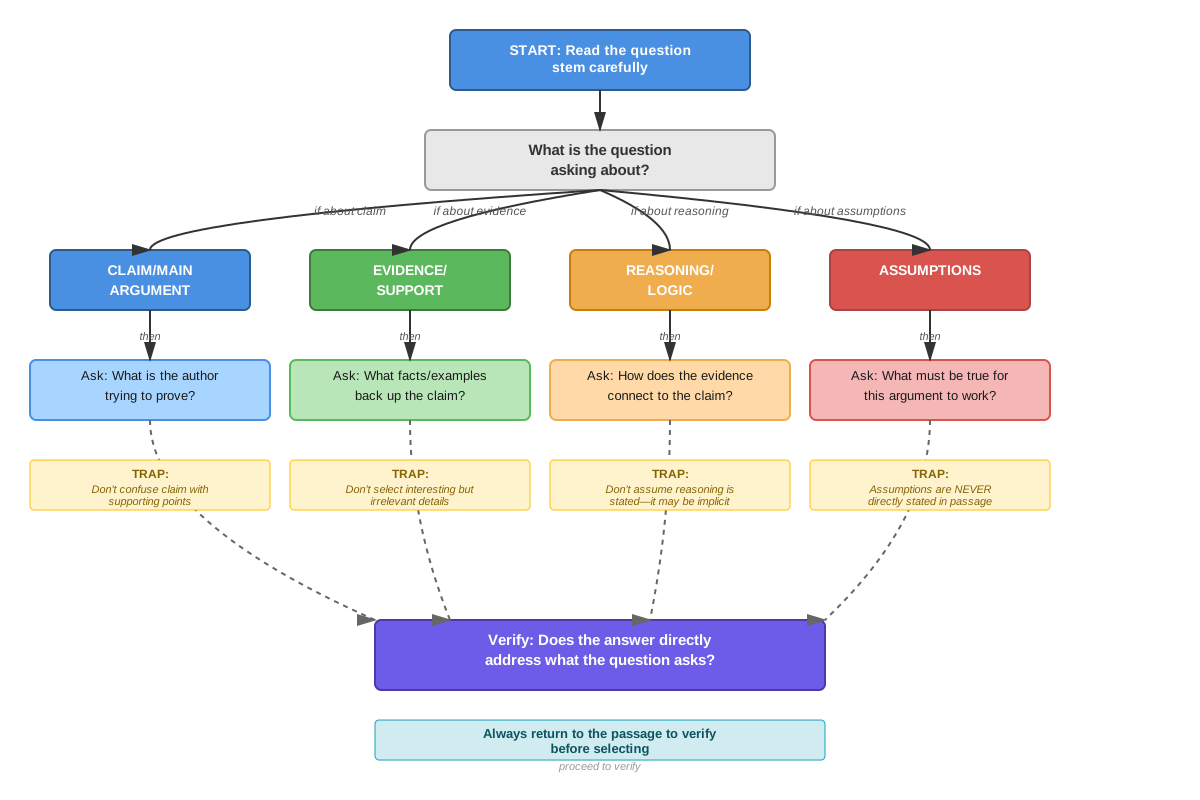
ACT argument interpretation questions use specific trigger phrases that signal what skill is being tested:
- "The author includes X primarily to..." → Function of detail question
- "How does paragraph X relate to paragraph Y?" → Logical relationship question
- "The author assumes/takes for granted that..." → Assumption identification question
- "Which of the following best describes the function of..." → Function question
- "The author uses X as an example of..." → Function/purpose question
- "The passage suggests the author believes..." → Claim identification question
Exam Tip: When you see these trigger phrases, immediately shift into argument analysis mode. Ask yourself: What is the author's main claim? What evidence supports it? How do the parts connect?
Systematic Approach to Argument Questions
Step 1: Locate and understand the main claim
Before answering any argument interpretation question, ensure you understand the author's thesis. This provides context for analyzing how individual details function.
Step 2: Identify the specific element in question
Find the referenced detail, paragraph, or section in the passage. Read it carefully along with surrounding context.
Step 3: Analyze the argumentative context
Ask: What comes before this element? What comes after? How does it fit into the overall argument structure?
Step 4: Determine the function or relationship
Use your understanding of argumentative components (claim, evidence, reasoning, counterargument, etc.) to categorize the element's role.
Step 5: Predict an answer before looking at choices
Formulate your own answer in simple terms ("This provides an example of the main claim" or "This refutes the counterargument").
Step 6: Match your prediction to answer choices
Select the choice that best matches your prediction. Eliminate choices that misidentify the function or relationship.
Process of Elimination Strategies
Eliminate answers that misidentify the argumentative component: If a detail is clearly evidence, eliminate choices that describe it as a claim or counterargument.
Eliminate answers that are too broad or too narrow: The correct answer should precisely match the scope of the detail's function. "Supports the main claim" might be too broad if the detail specifically "provides an example of one benefit mentioned in the main claim."
Eliminate answers that contradict the author's position: If the author clearly supports an idea, eliminate choices suggesting the author opposes it.
Watch for "primarily" and "mainly": These words indicate that while multiple answers might be partially true, only one captures the primary function.
Time Management
Argument interpretation questions typically require 45-60 seconds each—slightly longer than detail questions but shorter than inference questions. Budget your time accordingly:
- 15 seconds: Locate the relevant passage section
- 20 seconds: Analyze the argumentative context and function
- 15 seconds: Predict an answer
- 10 seconds: Evaluate and select from answer choices
If a question requires more than 90 seconds, mark it and return after completing easier questions. Don't let one challenging argument question consume time needed for other questions.
Memory Techniques
The CERA Framework
Remember the four essential components of arguments with CERA:
- Claim: What the author asserts
- Evidence: What supports the claim
- Reasoning: How evidence connects to claim
- Assumptions: What must be true for the argument to work
Function Categories: The SCRIBE Method
Remember common functions of details with SCRIBE:
- Support: Provides evidence for a claim
- Contrast: Presents opposing or different information
- Refute: Responds to and dismisses counterarguments
- Illustrate: Makes abstract concepts concrete
- Background: Provides necessary context
- Elaborate: Adds detail to a previously stated idea
Signal Word Categories
Support signals: "For example," "Research shows," "Studies indicate," "Evidence suggests"
Contrast signals: "However," "Nevertheless," "Yet," "On the other hand," "In contrast"
Causation signals: "Therefore," "Thus," "Consequently," "As a result," "Because"
Addition signals: "Moreover," "Furthermore," "Additionally," "Also"
Visualize these signal words as road signs that tell you where the argument is heading. "However" means "turn ahead"—the argument is changing direction. "Moreover" means "continue straight"—the argument is building in the same direction.
The Assumption Bridge Visualization
Visualize assumptions as invisible bridges connecting evidence islands to claim islands. When you see evidence on one side and a claim on the other, ask: "What bridge must exist for me to get from this evidence to that claim?" The bridge is the assumption.
Summary
Interpreting arguments on the ACT Reading section requires students to analyze how authors construct and support their claims through evidence and reasoning. This skill encompasses identifying the components of arguments (claims, evidence, reasoning, and assumptions), recognizing common argumentative structures (thesis-support, problem-solution, compare-contrast, cause-effect), determining the function of specific details within the argumentative framework, and evaluating logical relationships between different parts of passages. Success on argument interpretation questions depends on systematic analysis: identifying the main claim, locating relevant details in context, analyzing how those details function within the argument structure, and matching this analysis to answer choices. Students must recognize that details serve various purposes—supporting claims, presenting counterarguments, refuting opposing views, providing background, or illustrating concepts—and that understanding these functions is essential for answering the 15-20% of ACT Reading questions that test this high-yield skill. Mastery requires moving beyond surface-level comprehension to analyze the logical architecture of passages, identifying both what authors say explicitly and what they assume implicitly.
Key Takeaways
- Interpreting arguments is tested in approximately 15-20% of ACT Reading questions, making it one of the highest-yield skills for focused preparation
- Every argument consists of three core components: claims (assertions), evidence (support), and reasoning (logical connections), with assumptions serving as unstated premises
- Function questions ("The author includes X primarily to...") are the most common argument interpretation question type and require analyzing how details fit within the overall argumentative structure
- Details serve multiple purposes beyond supporting the main claim, including presenting counterarguments, providing background, refuting opposing views, and illustrating abstract concepts
- Systematic analysis—identifying the main claim, locating details in context, determining function, and predicting answers—leads to accurate, efficient question-answering
- Signal words like "however," "moreover," and "for example" provide crucial clues about argumentative structure and the relationships between ideas
- Recognizing common argumentative structures (thesis-support, problem-solution, compare-contrast, cause-effect) helps predict where key information appears and how sections relate to each other
Related Topics
Analyzing Rhetorical Strategies: Building on argument interpretation, this advanced skill examines how authors use specific techniques (appeals to emotion, credibility, logic) to make arguments more persuasive. Mastering argument interpretation provides the foundation for understanding why authors make particular rhetorical choices.
Synthesizing Information Across Texts: Some ACT Reading sections include paired passages requiring students to compare and contrast arguments from different authors. Strong argument interpretation skills enable efficient analysis of how different authors approach similar topics.
Evaluating Evidence Quality: An advanced extension of argument interpretation involves assessing whether evidence is relevant, sufficient, and reliable. This skill builds directly on the ability to identify evidence and understand its function.
Identifying Logical Fallacies: While the ACT rarely asks students to name specific fallacies, recognizing flawed reasoning helps students identify weak arguments and understand why certain answer choices are incorrect.
Author's Purpose and Tone Analysis: Understanding why authors write (to persuade, inform, entertain) and how they feel about their subjects provides essential context for interpreting arguments. These skills work together to enable comprehensive passage analysis.
Practice CTA
Now that you've mastered the core concepts of interpreting arguments, it's time to apply these skills to ACT-style practice questions. The practice questions and flashcards accompanying this guide will help you recognize argument interpretation questions quickly, apply systematic analysis strategies, and build the confidence needed for test day success. Remember: argument interpretation is a high-yield skill that appears consistently on every ACT Reading section. The time you invest in deliberate practice now will translate directly into points on test day. Challenge yourself to work through the practice materials, focusing not just on getting correct answers but on understanding why each answer is correct and how it connects to the strategies you've learned. You've got this!
Sign up free to keep reading
Create a free AnvayaPrep account to finish this ACT guide on Interpreting arguments — plus flashcards and practice questions.