Overview
Interpreting charts in reading is a critical skill tested on the ACT Reading section, particularly within the Integration of Knowledge and Ideas category. This skill requires students to analyze visual data presentations—including graphs, tables, charts, and diagrams—that accompany reading passages and extract meaningful information to answer questions correctly. Unlike traditional reading comprehension that focuses solely on text analysis, ACT interpreting charts in reading demands that test-takers synthesize information from both written passages and visual representations, making it a unique and increasingly important component of the exam.
The ACT has progressively incorporated more data-driven questions into its Reading section, reflecting real-world academic and professional demands where individuals must regularly interpret visual information alongside textual content. Questions testing chart interpretation typically appear in science-related passages (natural sciences) or social studies passages that include research findings, statistical data, or comparative information. These questions assess whether students can identify trends, compare data points, draw conclusions from visual information, and connect chart data to claims made in the accompanying text.
Mastering chart interpretation connects directly to broader Reading skills such as identifying main ideas, understanding author's purpose, and making inferences. When a passage includes visual elements, the chart often serves to support, illustrate, or provide evidence for arguments presented in the text. Students who excel at interpreting charts demonstrate advanced critical thinking by recognizing how visual and textual information work together to convey complex ideas—a skill that extends beyond the ACT into college coursework and professional environments where data literacy is essential.
Learning Objectives
- [ ] Identify when Interpreting charts in reading is being tested
- [ ] Explain the core rule or strategy behind Interpreting charts in reading
- [ ] Apply Interpreting charts in reading to ACT-style questions accurately
- [ ] Distinguish between information presented in charts versus information in the accompanying text
- [ ] Synthesize data from multiple sources (chart and passage) to answer complex questions
- [ ] Recognize common chart types and their specific interpretive requirements
- [ ] Evaluate whether conclusions drawn from chart data are supported or contradicted by passage content
Prerequisites
- Basic graph literacy: Understanding axes, labels, legends, and scales is essential because ACT charts assume students can decode standard visual conventions without explanation
- Reading comprehension fundamentals: The ability to identify main ideas and supporting details in text enables students to connect chart data to passage arguments
- Comparative analysis skills: Recognizing similarities and differences between data points or categories forms the foundation for answering chart-based questions
- Inference-making ability: Drawing logical conclusions from presented information applies equally to charts and text, making this a transferable skill
Why This Topic Matters
Chart interpretation represents a convergence of quantitative reasoning and reading comprehension, reflecting the interdisciplinary nature of modern academic work. In college courses across disciplines—from psychology research reports to economic analyses to scientific studies—students encounter visual data representations that require careful analysis. Professionals in virtually every field must interpret charts, graphs, and tables to make informed decisions, communicate findings, and understand research in their areas.
On the ACT specifically, chart interpretation questions appear with increasing frequency, typically comprising 2-4 questions per Reading test. These questions most commonly appear in natural science passages (approximately 60% of chart-based questions) and social science passages (approximately 30%), with occasional appearances in humanities passages that discuss research or historical data. The ACT includes charts to test higher-order thinking skills beyond basic comprehension, as these questions require students to integrate multiple information sources simultaneously.
Chart interpretation questions typically manifest in several formats: direct data retrieval ("According to the chart, which year showed the highest..."), comparative analysis ("The chart indicates that Group A differed from Group B in that..."), synthesis questions ("Which statement is supported by both the passage and the chart?"), and contradiction identification ("The chart data contradicts the passage's claim that..."). Recognizing these question patterns helps students approach chart-based items strategically and efficiently.
Core Concepts
Understanding Chart Components
Every chart contains specific structural elements that students must identify and understand before attempting interpretation. The title provides the overall subject and scope of the data presented, often indicating what variables are being compared or measured. Axes (in graphs) or column/row headers (in tables) identify the variables being represented—the x-axis typically shows the independent variable while the y-axis displays the dependent variable. The legend or key explains symbols, colors, or patterns used to differentiate between data categories. Scale and units indicate the measurement system and increments, which are crucial for accurate data reading. Finally, data points, bars, lines, or cells contain the actual information being presented.
Students must systematically examine each component before reading questions. A common error involves jumping directly to data points without understanding what those points represent, leading to misinterpretation. For example, a chart showing "Population Growth (in thousands)" requires multiplying displayed numbers by 1,000 to obtain actual population figures—missing this detail results in incorrect answers.
Types of Charts on the ACT
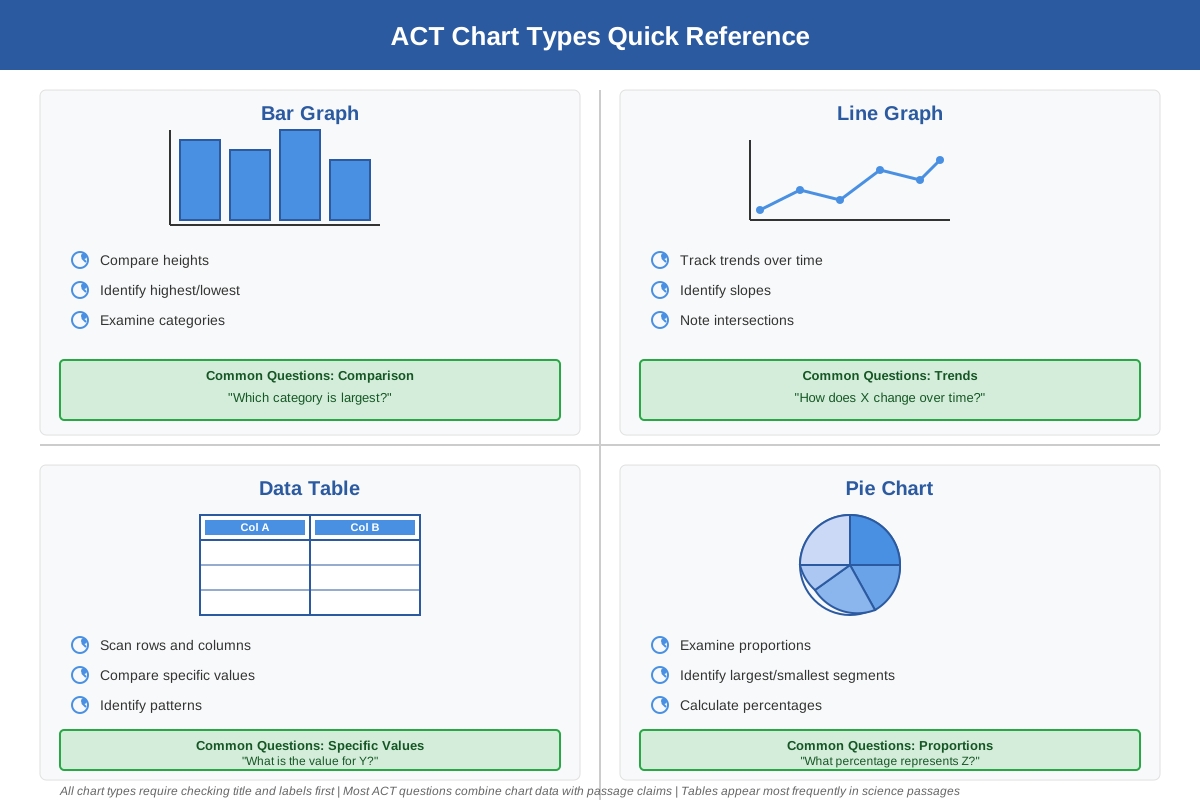
The ACT employs several standard chart formats, each with specific interpretive requirements. Line graphs display trends over time or continuous variables, requiring students to identify increases, decreases, peaks, valleys, and rates of change. Bar charts compare discrete categories, making them ideal for showing differences between groups or conditions. Tables present precise numerical data in rows and columns, often containing more detailed information than graphs but requiring careful navigation to locate specific values. Pie charts show proportional relationships and percentages of a whole, though these appear less frequently on the ACT. Scatter plots display correlations between two variables, asking students to identify positive, negative, or no correlation patterns.
Each chart type emphasizes different analytical skills. Line graphs test trend identification and prediction abilities. Bar charts assess comparative reasoning. Tables demand precise data location and calculation skills. Understanding which chart type appears in a question helps students apply the appropriate interpretive strategy.
Reading Charts Systematically
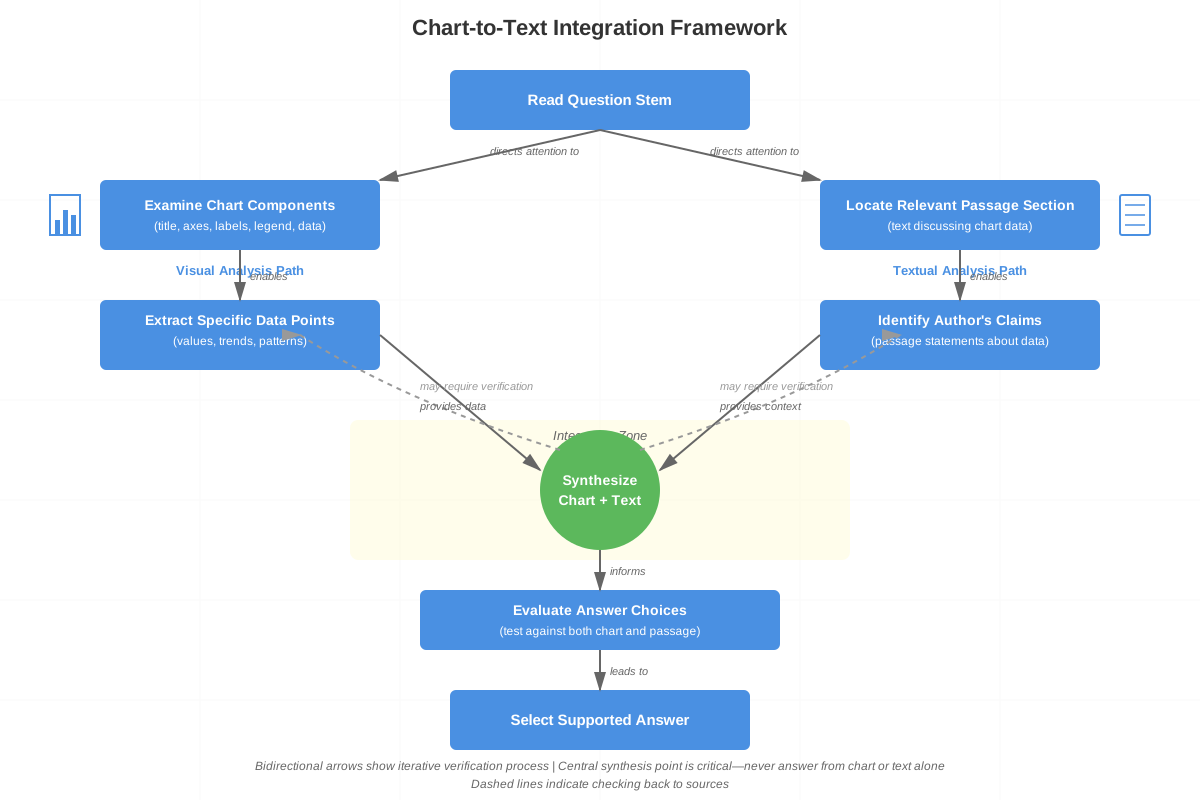
Effective chart interpretation follows a structured process. Step 1: Read the chart title and identify the general topic and purpose. Step 2: Examine axes, labels, and legends to understand what variables are represented and how they're measured. Step 3: Note the scale and units to ensure accurate data reading. Step 4: Identify overall patterns, trends, or notable features (highest/lowest values, significant changes, outliers). Step 5: Read the question carefully to determine what specific information is needed. Step 6: Locate the relevant data in the chart. Step 7: Verify that the answer addresses exactly what the question asks.
This systematic approach prevents common errors such as misreading scales, confusing variables, or selecting answers that contain accurate data but don't answer the specific question asked. Time invested in understanding chart structure before examining data points yields more accurate and efficient question answering.
Integrating Chart and Passage Information
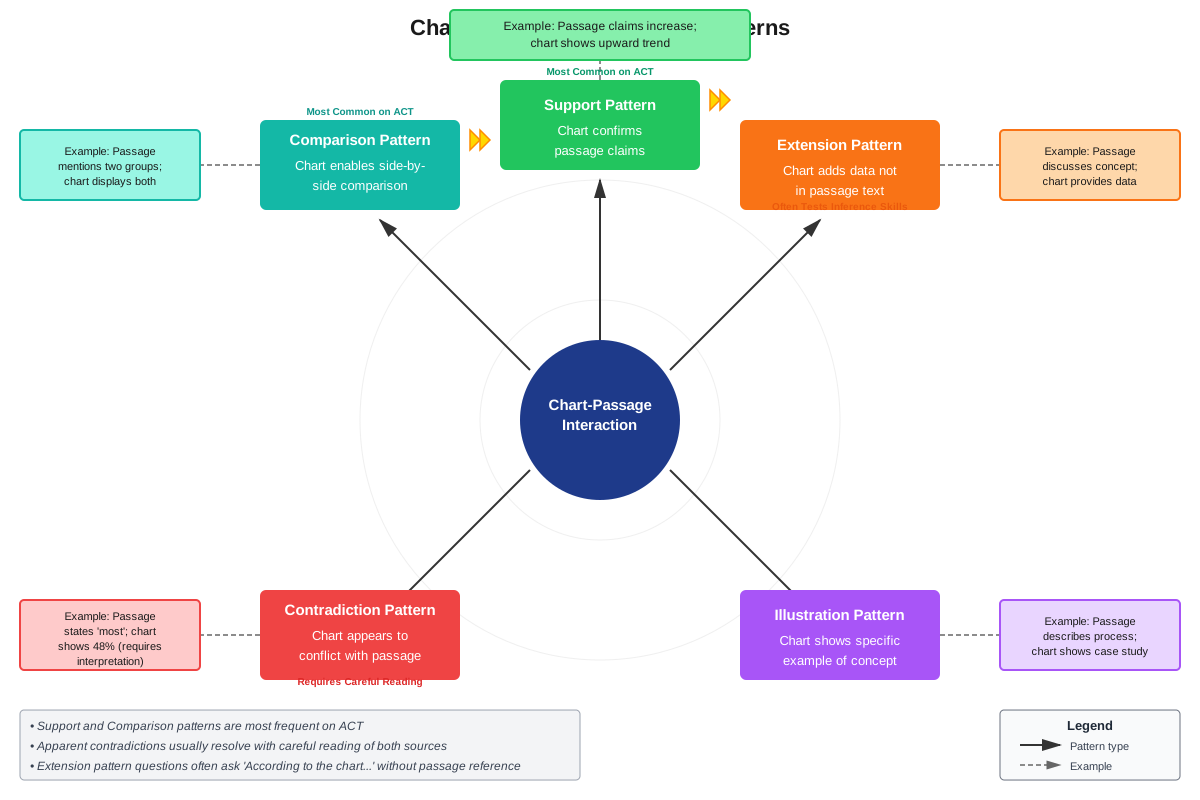
The most challenging ACT chart questions require synthesizing information from both visual and textual sources. Students must determine whether chart data supports, contradicts, or extends claims made in the passage. Supporting relationships occur when chart data provides evidence for passage arguments. Contradictory relationships exist when data conflicts with textual claims, often testing whether students notice discrepancies. Extension relationships happen when charts provide additional information not explicitly stated in the passage but consistent with its themes.
To effectively integrate sources, students should: identify the passage's main claims about the topic addressed in the chart; locate specific data points that relate to those claims; determine the relationship between textual and visual information; and select answers that accurately reflect this relationship. Questions often use phrases like "According to both the passage and the chart..." or "The chart data contradicts the author's claim that..." to signal integration requirements.
Common Data Relationships and Patterns
ACT chart questions frequently test recognition of specific data relationships. Positive correlation occurs when both variables increase together. Negative correlation exists when one variable increases as the other decreases. No correlation means variables change independently. Causation versus correlation is a critical distinction—charts show relationships but don't necessarily prove that one variable causes changes in another.
Other important patterns include maximum and minimum values (highest and lowest data points), ranges (difference between maximum and minimum), trends (general direction of change over time), rates of change (how quickly values increase or decrease), and outliers (data points that deviate significantly from patterns). Questions may ask students to identify these patterns explicitly or use them to draw conclusions.
Concept Relationships
Chart interpretation skills build upon fundamental reading comprehension abilities, particularly the capacity to identify main ideas and supporting details. When a passage includes a chart, the visual element typically functions as a supporting detail that illustrates, proves, or extends textual claims. This relationship means students must first understand the passage's argument before effectively interpreting how chart data relates to that argument.
The interpretive process flows as follows: Basic graph literacy → Chart component identification → Data location and reading → Pattern recognition → Integration with passage content → Answer selection. Each step depends on successful completion of previous steps. Students who struggle with basic graph literacy cannot effectively identify chart components, which prevents accurate data reading, and so forth.
Chart interpretation also connects to inference-making skills tested throughout the Reading section. Just as students must draw logical conclusions from textual evidence, they must infer meanings from data patterns. For example, a line graph showing declining values might support an inference about decreasing popularity, reduced effectiveness, or diminishing resources, depending on what the chart measures. This parallel structure means students can transfer inference strategies from text-based questions to chart-based questions.
High-Yield Facts
⭐ Charts on the ACT Reading section most frequently appear in natural science and social science passages, comprising 2-4 questions per test
⭐ The most common chart question types are direct data retrieval, comparative analysis, and synthesis of chart and passage information
⭐ Always read the chart title, axes labels, and legend before examining data points to avoid misinterpretation
⭐ Questions asking "According to the chart" require answers based solely on visual data, not passage content
⭐ Questions asking "According to both the passage and the chart" require synthesis of information from both sources
- Line graphs on the ACT typically display trends over time or relationships between continuous variables
- Bar charts compare discrete categories and are ideal for identifying which group has the highest or lowest values
- Tables contain precise numerical data and often require locating specific values at the intersection of rows and columns
- Pay careful attention to units and scale—missing "in thousands" or "percentage" designations leads to incorrect answers
- Charts may contradict passage claims intentionally to test whether students notice discrepancies between sources
Quick check — test yourself on Interpreting charts in reading so far.
Try Flashcards →Common Misconceptions
Misconception: Charts always support and agree with passage content → Correction: Charts may contradict passage claims, and some questions specifically test whether students recognize these discrepancies. Always verify the relationship between visual and textual information rather than assuming agreement.
Misconception: The highest bar or point in a chart is always the correct answer → Correction: Questions may ask about the lowest value, the second-highest value, the greatest change, or other specific data points. Carefully read what the question asks before selecting an answer based on visual prominence.
Misconception: All information needed to answer chart questions appears in the chart itself → Correction: Many questions require integrating chart data with passage content. The phrase "According to both the passage and the chart" signals that synthesis is necessary, and answers based solely on one source will be incorrect.
Misconception: Correlation shown in charts proves causation → Correction: Charts display relationships between variables but don't establish that one variable causes changes in another. The ACT may include wrong answers that incorrectly claim causation based on correlational data.
Misconception: Quickly glancing at a chart provides sufficient understanding to answer questions → Correction: Effective chart interpretation requires systematic examination of title, axes, labels, scale, units, and legend before analyzing data. Rushing through this process leads to misreading and errors.
Misconception: Charts are optional elements that can be skipped if time is short → Correction: When a passage includes a chart, questions will specifically test chart interpretation, making these visual elements essential rather than supplementary. Skipping chart analysis guarantees missed questions.
Worked Examples
Example 1: Direct Data Retrieval and Comparison
Passage Context: A passage discusses the growth of renewable energy sources in the United States from 2010 to 2020. The accompanying bar chart shows "Renewable Energy Production by Source (in million megawatt-hours)" with bars for Solar, Wind, Hydroelectric, and Geothermal across three years: 2010, 2015, and 2020.
Chart Details:
- Solar: 2010 = 2, 2015 = 15, 2020 = 60
- Wind: 2010 = 95, 2015 = 190, 2020 = 340
- Hydroelectric: 2010 = 260, 2015 = 250, 2020 = 280
- Geothermal: 2010 = 15, 2015 = 16, 2020 = 17
Question: According to the chart, which renewable energy source showed the greatest percentage increase from 2010 to 2020?
Solution Process:
Step 1: Identify what the question asks—greatest percentage increase, not absolute increase. This distinction is crucial because the source with the largest numerical increase may not have the largest percentage increase.
Step 2: Calculate percentage increases for each source using the formula: [(New Value - Old Value) / Old Value] × 100
- Solar: [(60 - 2) / 2] × 100 = 2,900% increase
- Wind: [(340 - 95) / 95] × 100 = 258% increase
- Hydroelectric: [(280 - 260) / 260] × 100 = 7.7% increase
- Geothermal: [(17 - 15) / 15] × 100 = 13.3% increase
Step 3: Compare percentages to identify the greatest increase. Solar shows a 2,900% increase, far exceeding all other sources.
Step 4: Verify the answer makes sense. Solar started from a very small base (2 million megawatt-hours) and grew to 60, representing dramatic growth even though wind produced more total energy in 2020.
Answer: Solar energy showed the greatest percentage increase from 2010 to 2020.
Learning Objective Connection: This example demonstrates applying chart interpretation to ACT-style questions accurately by requiring careful attention to what the question asks (percentage versus absolute increase) and systematic data analysis.
Example 2: Synthesis of Chart and Passage Information
Passage Context: A social science passage argues that urban areas experienced declining air pollution levels between 2000 and 2020 due to stricter environmental regulations. The author claims that "all major pollutants decreased consistently throughout this period."
Chart Details: A line graph titled "Average Urban Air Pollutant Levels (2000-2020)" shows three lines representing Particulate Matter, Nitrogen Dioxide, and Sulfur Dioxide. Particulate Matter and Sulfur Dioxide show steady declines from 2000 to 2020. Nitrogen Dioxide declines from 2000 to 2010, then increases slightly from 2010 to 2015, before declining again from 2015 to 2020.
Question: The chart data indicates that the author's claim about pollutant trends is:
A) Fully supported, as all pollutants decreased from 2000 to 2020
B) Partially contradicted, as one pollutant increased during part of the period
C) Completely contradicted, as pollutants increased throughout the period
D) Supported only for the first decade of the period
Solution Process:
Step 1: Identify the specific passage claim being tested—"all major pollutants decreased consistently throughout this period."
Step 2: Examine the chart for each pollutant's trend. Note that "consistently" means without interruption or reversal.
Step 3: Analyze each pollutant:
- Particulate Matter: Consistent decline ✓
- Sulfur Dioxide: Consistent decline ✓
- Nitrogen Dioxide: Decline, then increase (2010-2015), then decline again ✗
Step 4: Determine the relationship between chart data and passage claim. The claim states "all major pollutants decreased consistently," but Nitrogen Dioxide increased during 2010-2015, contradicting the "consistently" aspect.
Step 5: Evaluate answer choices:
- A is incorrect because not all pollutants decreased consistently
- B accurately describes the situation—partial contradiction due to one pollutant's temporary increase
- C is incorrect because most pollutants did decrease overall
- D is incorrect because the overall trend from 2000 to 2020 shows decreases despite the temporary increase
Answer: B) Partially contradicted, as one pollutant increased during part of the period
Learning Objective Connection: This example demonstrates identifying when chart interpretation is being tested (through synthesis questions), explaining the core strategy (comparing chart data to passage claims), and applying this skill to ACT-style questions that require integration of multiple information sources.
Exam Strategy
When approaching ACT Reading questions involving charts, implement a strategic process that maximizes accuracy while managing time effectively. Before reading the passage, quickly scan to identify whether charts are present—this alerts you to expect integration questions and allocate slightly more time for this passage. During passage reading, note where the text references data, studies, or findings that might connect to chart content, but don't stop to analyze the chart in detail yet.
Trigger words and phrases that signal chart interpretation questions include: "According to the chart," "The data in the figure shows," "Based on the graph," "Which statement is supported by both the passage and the chart," "The chart contradicts the author's claim that," and "The figure indicates." These phrases tell you exactly where to find your answer—chart only, passage only, or both sources.
For process of elimination, first eliminate answers that misread chart data (wrong numbers, reversed trends, confused variables). Next, eliminate answers that address the wrong question (correct data but answering what wasn't asked). Then eliminate answers that make unsupported inferences beyond what the chart shows. Finally, verify that your remaining answer precisely matches both the chart data and the question requirements.
Time allocation for chart questions should be approximately 45-60 seconds per question—slightly longer than pure text-based questions because you must locate and verify information in two sources. If a chart question requires complex calculations or multiple data comparisons, mark it and return after completing easier questions. Never spend more than 90 seconds on a single chart question during your first pass through the passage.
Exam Tip: Always verify units and scale before selecting an answer. A chart showing "Population (in thousands)" means a data point of "50" represents 50,000 people, not 50 people. This detail frequently appears in wrong answer choices designed to trap students who don't read carefully.
Memory Techniques
TITLE Mnemonic for systematic chart analysis:
- Title - Read and understand the chart's subject
- Identify - Locate axes, labels, and legends
- Trends - Note overall patterns before details
- Locate - Find specific data the question requires
- Evaluate - Verify your answer matches the question
"Chart Before Question, Question Before Answer" reminds students to understand the chart structure before reading questions, then read questions carefully before searching for answers. This prevents the common error of finding correct data that doesn't answer what was actually asked.
The Three Rs of Chart Integration: Read the passage claim, Retrieve the relevant chart data, Relate the two sources to determine support, contradiction, or extension. This three-step process ensures systematic synthesis of information.
Visual Anchoring: When first viewing a chart, identify and mentally note the highest point, lowest point, and any obvious trends or outliers. These visual anchors help you quickly relocate information when questions ask about maximums, minimums, or unusual data points.
Summary
Interpreting charts in reading represents a crucial ACT skill that combines visual data analysis with traditional reading comprehension. Success requires systematic examination of chart components—title, axes, labels, scale, units, and legend—before analyzing data points or answering questions. The ACT tests chart interpretation primarily through direct data retrieval questions, comparative analysis questions, and synthesis questions that require integrating chart and passage information. Students must distinguish between questions asking for chart-only information versus those requiring both sources, paying careful attention to trigger phrases like "According to the chart" or "According to both the passage and the chart." Common pitfalls include misreading scales and units, confusing correlation with causation, assuming charts always support passage claims, and selecting answers with correct data that don't address the specific question asked. Effective strategy involves understanding chart structure before reading questions, using process of elimination to remove answers with misread data or unsupported inferences, and allocating appropriate time for these multi-source questions. Mastery of chart interpretation not only improves ACT Reading scores but also develops essential academic and professional skills for analyzing data-driven arguments across disciplines.
Key Takeaways
- Chart interpretation questions appear 2-4 times per ACT Reading test, most frequently in natural science and social science passages
- Always read chart titles, axes, labels, and legends systematically before examining data points to prevent misinterpretation
- Distinguish between questions requiring chart-only information versus synthesis of chart and passage content by identifying trigger phrases
- Pay careful attention to units and scale—missing "in thousands," "percentage," or other designations is a common source of errors
- Charts may support, contradict, or extend passage claims; never assume agreement without verification
- Use the TITLE mnemonic (Title, Identify, Trends, Locate, Evaluate) for systematic chart analysis
- Correlation shown in charts does not prove causation—avoid answers that incorrectly claim causal relationships based solely on data patterns
Related Topics
Data Analysis in ACT Science: While this guide focuses on chart interpretation in the Reading section, the ACT Science section extensively tests similar skills with more complex data presentations. Mastering reading charts provides a foundation for tackling scientific graphs and experimental data.
Synthesis Questions Across Passages: The skill of integrating information from multiple sources extends to paired passage questions where students must compare and contrast arguments from two different texts, building on the chart-passage integration abilities developed here.
Author's Purpose and Evidence: Understanding how charts function as evidence for passage arguments connects to broader questions about author's purpose, rhetorical strategies, and argument structure throughout the Reading section.
Quantitative Reasoning in Context: Chart interpretation bridges reading comprehension and mathematical reasoning, preparing students for college coursework that requires analyzing numerical data within written arguments across disciplines.
Practice CTA
Now that you've mastered the strategies for interpreting charts in reading, it's time to apply these skills to authentic ACT-style questions. Complete the practice questions associated with this topic to reinforce your systematic approach to chart analysis, test your ability to integrate visual and textual information, and build confidence for exam day. The flashcards will help you internalize key concepts like chart components, common question types, and trigger phrases. Remember: chart interpretation is a skill that improves dramatically with practice—each question you work through strengthens your ability to quickly and accurately analyze data presentations. You've got this!
Sign up free to keep reading
Create a free AnvayaPrep account to finish this ACT guide on Interpreting charts in reading — plus flashcards and practice questions.