Overview
The ACT Reading section regularly features a unique question format that challenges students to analyze and compare two related passages on the same topic. Paired passage comparison questions require test-takers to understand not just individual passages in isolation, but to synthesize information across both texts, identify points of agreement and disagreement, and recognize how different authors approach similar subject matter. This skill represents one of the most sophisticated reading comprehension tasks on the ACT, as it demands higher-order thinking that goes beyond simple recall or single-text analysis.
Understanding ACT paired passage comparison is essential because these questions typically appear in one of the four reading passages on every ACT exam, accounting for approximately 10-15% of all Reading questions. Unlike standard single-passage questions, paired passage items test your ability to hold multiple perspectives in mind simultaneously, compare rhetorical strategies, and evaluate how different authors use evidence to support their claims. Students who master this skill gain a significant competitive advantage, as these questions often separate high scorers from average performers.
This topic sits at the intersection of several critical reading skills: close reading comprehension, author's purpose analysis, tone and perspective identification, and evidence evaluation. Paired passage comparison builds directly on foundational reading skills while preparing students for the type of comparative analysis required in college-level coursework across disciplines. Success with paired passages demonstrates the ability to engage with complex texts critically—a skill that extends far beyond standardized testing into academic and professional contexts.
Learning Objectives
- [ ] Identify when Paired passage comparison is being tested
- [ ] Explain the core rule or strategy behind Paired passage comparison
- [ ] Apply Paired passage comparison to ACT-style questions accurately
- [ ] Distinguish between questions asking about individual passages versus both passages
- [ ] Analyze the relationship between two authors' perspectives on the same topic
- [ ] Evaluate how different rhetorical approaches affect the presentation of similar content
- [ ] Synthesize information from both passages to answer comparative questions
Prerequisites
- Single-passage comprehension skills: The foundation for understanding each passage individually before comparing them
- Main idea identification: Essential for recognizing what each author prioritizes and how their central arguments differ
- Author's tone and purpose recognition: Necessary to understand the perspective each author brings to the shared topic
- Evidence location and interpretation: Required to support comparative claims with specific textual references
- Vocabulary in context: Important for understanding nuanced differences in how authors discuss similar concepts
Why This Topic Matters
Paired passage comparison reflects real-world reading scenarios where professionals must evaluate multiple perspectives on the same issue—from comparing research studies to analyzing competing policy proposals. This skill directly translates to college coursework, where students regularly encounter assignments requiring synthesis of multiple sources with different viewpoints. The ability to hold competing ideas in mind while evaluating their relative merits represents sophisticated critical thinking that employers and educators value highly.
On the ACT Reading section, paired passages appear consistently as one of the four reading passages (typically in the Natural Sciences or Social Studies category). Students can expect 3-4 questions specifically focused on comparing the passages, plus 6-7 questions about individual passages within the pair. This means approximately 25% of one passage set—and roughly 6-7% of the entire Reading section—directly tests paired passage comparison skills. The questions range from straightforward identification of agreements and disagreements to complex synthesis questions requiring integration of both authors' perspectives.
Common question formats include: "Both authors would most likely agree that...," "Unlike Passage A, Passage B emphasizes...," "Compared to the author of Passage A, the author of Passage B is more...," and "Which statement best describes the relationship between the two passages?" These questions appear throughout the passage set, not just at the end, requiring students to maintain awareness of both passages while reading and answering questions. Students who struggle with paired passages often lose 3-5 points on the Reading section—a significant score impact that can be avoided through targeted practice.
Core Concepts
Understanding the Paired Passage Format
The paired passage comparison format on the ACT presents two shorter passages (typically 400-500 words each, totaling approximately 900 words) that address the same general topic from different angles, perspectives, or with different purposes. These passages are labeled "Passage A" and "Passage B" and appear consecutively in the test booklet. The passages share thematic connections but differ in crucial ways—they might present opposing viewpoints, complementary information, different time periods, contrasting tones, or varied rhetorical approaches to the same subject matter.
The key structural element distinguishing paired passages from single passages is the deliberate relationship between the texts. The ACT constructs these pairs to create meaningful points of comparison: one passage might be scientific and objective while the other is personal and reflective; one might advocate for a position while the other presents balanced analysis; one might focus on historical context while the other examines contemporary implications. Understanding this intentional relationship is fundamental to answering comparison questions accurately.
Types of Paired Passage Relationships
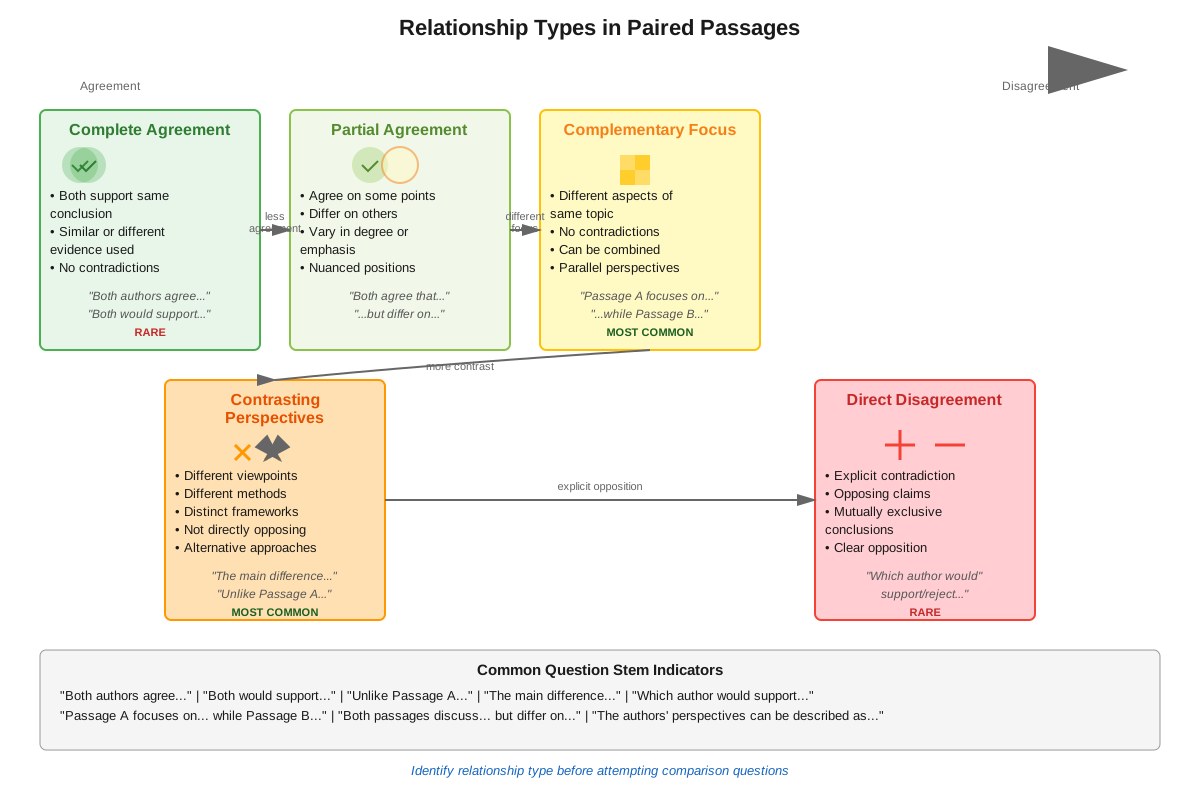
| Relationship Type | Description | Example Topics |
|---|---|---|
| Opposing Viewpoints | Authors take contradictory positions on a debatable issue | Passage A supports renewable energy; Passage B defends fossil fuels |
| Complementary Perspectives | Authors examine different aspects of the same phenomenon | Passage A discusses biological factors; Passage B explores social factors |
| Historical vs. Contemporary | One passage provides historical context; the other addresses current situations | Passage A covers 19th-century immigration; Passage B examines modern immigration |
| General vs. Specific | One passage offers broad overview; the other provides detailed case study | Passage A surveys climate change globally; Passage B details one ecosystem |
| Objective vs. Subjective | One passage maintains neutral tone; the other includes personal perspective | Passage A presents scientific data; Passage B shares personal experience |
Reading Strategy for Paired Passages
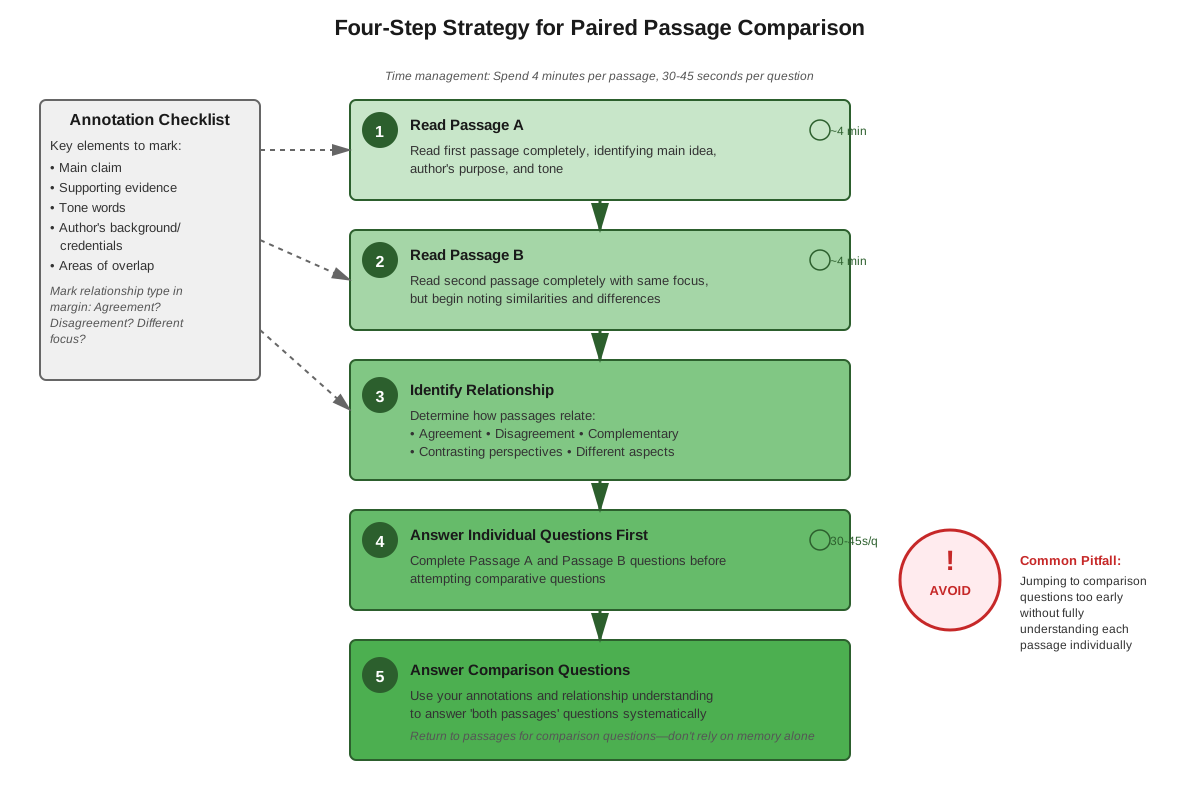
The most effective approach to paired passages involves a three-phase reading strategy:
- Read Passage A completely while noting its main idea, author's purpose, tone, and key supporting details
- Pause briefly to mentally summarize Passage A before moving to Passage B
- Read Passage B actively while consciously comparing it to Passage A, noting similarities, differences, and the relationship between the passages
This sequential approach prevents confusion and allows students to establish a clear understanding of the first passage before introducing the complexity of comparison. Some students attempt to read both passages simultaneously or skip between them, but this typically leads to confusion and missed details. The human brain processes comparative information more effectively when it has a stable reference point (Passage A) before introducing the comparison element (Passage B).
Question Types in Paired Passages
Paired passage sets contain three distinct question categories:
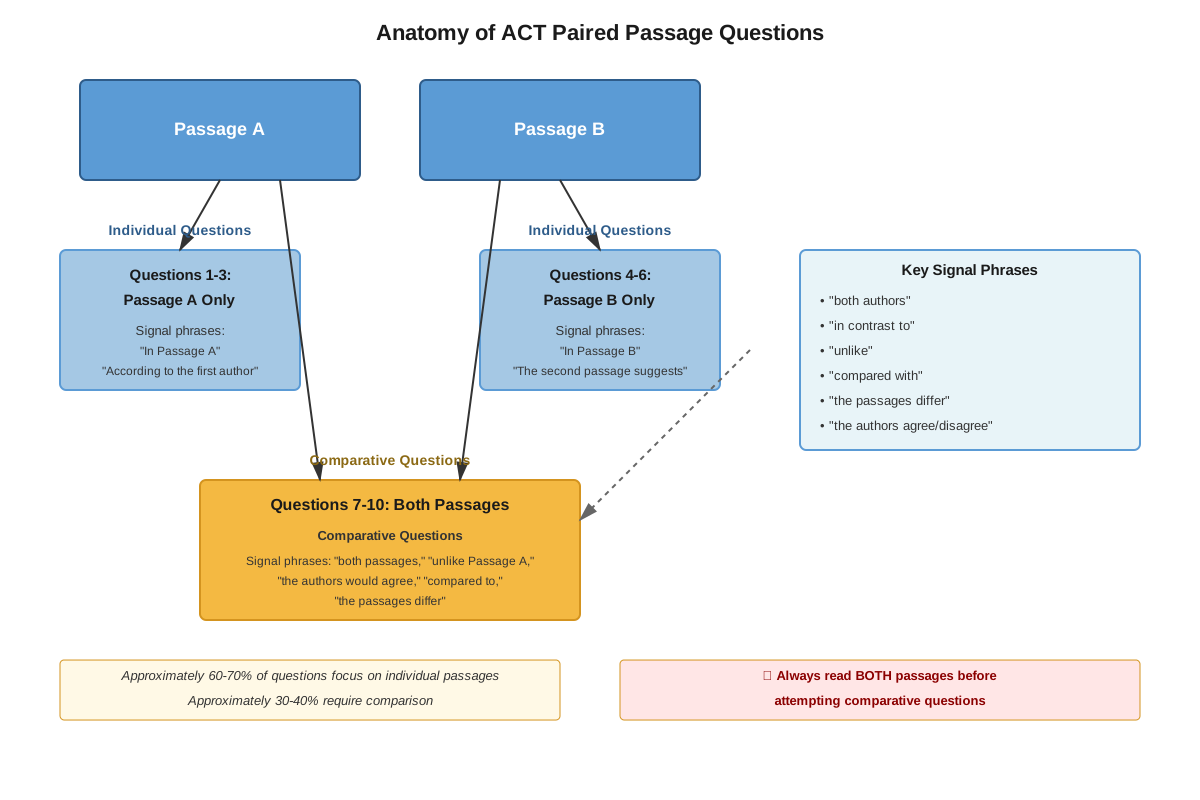
Passage A-only questions focus exclusively on the first passage and should be answered using only information from Passage A. These questions typically appear first in the question set and are marked by language like "According to Passage A..." or "In Passage A, the author suggests..."
Passage B-only questions focus exclusively on the second passage and should be answered using only information from Passage B. These questions use similar language markers: "In Passage B..." or "The author of Passage B indicates..."
Comparison questions require synthesis of both passages and represent the unique challenge of paired passage sets. These questions use distinctive language patterns:
- "Both authors would agree..."
- "Unlike Passage A, Passage B..."
- "Compared to the author of Passage A, the author of Passage B is more..."
- "Which statement best describes the relationship between the passages?"
- "The authors of both passages would most likely agree that..."
Analytical Framework for Comparison
When approaching comparison questions, students should systematically evaluate several dimensions:
Perspective and Tone: Does each author write from a personal, professional, or academic stance? Is the tone formal or informal, passionate or detached, optimistic or pessimistic? These differences often form the basis of comparison questions.
Purpose and Audience: Why did each author write their passage? Are they trying to persuade, inform, entertain, or reflect? Who is the intended audience, and how does this affect the content and style?
Evidence and Support: What types of evidence does each author use? Does one rely on statistics while the other uses anecdotes? Does one cite scientific studies while the other draws on personal experience?
Scope and Focus: What aspects of the topic does each author emphasize? Does one take a broad view while the other narrows to specific details? Does one focus on causes while the other examines effects?
Argumentation Style: How does each author build their case? Does one use logical reasoning while the other appeals to emotion? Does one acknowledge counterarguments while the other presents a one-sided view?
Common Comparison Question Patterns
The ACT uses predictable patterns in paired passage comparison questions. Recognizing these patterns helps students anticipate what to look for while reading:
Agreement questions ask what both authors would accept as true. The correct answer must be supported by evidence in both passages, even if the authors emphasize different aspects of the shared idea.
Disagreement questions identify points where the authors would take opposing positions. The correct answer highlights a genuine conflict between the passages, not merely different topics or emphases.
Relationship questions ask how the passages connect to each other structurally or thematically. Common relationships include: one passage provides context for the other, one passage offers a solution to a problem raised in the other, or one passage presents a specific example of a general principle discussed in the other.
Comparative tone or style questions require students to characterize how the authors differ in their approach to the topic. These questions often include comparative language: "more skeptical," "less formal," "more detailed," or "less optimistic."
Concept Relationships
The skill of paired passage comparison builds directly on foundational single-passage reading comprehension. Students must first master identifying main ideas, understanding author's purpose, and locating supporting evidence within individual texts before they can effectively compare two passages. This hierarchical relationship means that weakness in basic comprehension will inevitably undermine paired passage performance.
Within the paired passage framework itself, several concepts interconnect systematically. Understanding the relationship type between passages (opposing, complementary, etc.) enables more accurate prediction of comparison question content. Recognizing each author's tone and perspective facilitates analysis of how their approaches differ. Identifying the scope and focus of each passage helps students understand why certain details appear in one passage but not the other.
The progression flows as follows: Single-passage comprehension → Individual passage analysis (tone, purpose, main idea) → Relationship identification → Comparative analysis → Synthesis for comparison questions. Each stage depends on the previous one, creating a scaffolded skill set that develops through practice.
Paired passage comparison also connects forward to college-level academic skills, particularly research synthesis and argumentative writing. The ability to evaluate multiple perspectives on a topic, identify points of agreement and disagreement, and synthesize information from multiple sources represents essential preparation for college coursework across disciplines. This makes paired passage comparison one of the most academically relevant skills tested on the ACT.
Quick check — test yourself on Paired passage comparison so far.
Try Flashcards →High-Yield Facts
⭐ Paired passages always share a common topic but differ in perspective, purpose, tone, or approach—this intentional relationship forms the basis of all comparison questions.
⭐ Approximately 3-4 questions in a paired passage set will specifically test comparison skills, while the remaining 6-7 questions focus on individual passages.
⭐ Comparison questions use distinctive language markers including "both authors," "unlike Passage A," "compared to," and "relationship between the passages."
⭐ The correct answer to an agreement question must be supported by evidence in both passages, even if the evidence appears in different forms or contexts.
⭐ Reading Passage A completely before starting Passage B produces better comprehension than attempting to read both simultaneously or switching between them.
- Paired passages typically appear in the Natural Sciences or Social Studies category on the ACT Reading section.
- Wrong answers to comparison questions often include information that appears in only one passage, even if that information is accurate.
- The relationship between passages can be opposing (contradictory positions), complementary (different aspects of the same topic), or sequential (one provides context for the other).
- Tone and perspective differences between authors frequently form the basis of comparison questions, even when the factual content is similar.
- Comparison questions may appear anywhere in the question set, not just at the end, requiring continuous awareness of both passages.
- The most challenging comparison questions ask students to synthesize information that appears in different forms in each passage.
- Effective annotation while reading—marking main ideas, tone indicators, and key evidence in each passage—significantly improves comparison question accuracy.
Common Misconceptions
Misconception: Students should read all questions before reading the paired passages to know what to look for.
Correction: This strategy wastes time and creates confusion. Reading the passages first with active comprehension provides better preparation for all question types, including comparison questions. The passages are too long to hold specific question details in mind while reading.
Misconception: Comparison questions always ask about disagreements between the authors.
Correction: Comparison questions test various relationships including agreements, complementary information, different emphases, and contrasting approaches. Many comparison questions ask what both authors would agree on, requiring students to find common ground rather than conflicts.
Misconception: If information appears in only one passage, it cannot be the correct answer to any question.
Correction: This is only true for comparison questions that explicitly ask about both passages. Many questions in paired passage sets focus on individual passages, and the correct answers to these questions will naturally draw from only one passage.
Misconception: The passages will always present completely opposite viewpoints.
Correction: While some paired passages do present opposing perspectives, many present complementary information, different aspects of the same topic, or varied approaches to similar content. The relationship between passages varies and must be determined through careful reading.
Misconception: Students should answer all Passage A questions, then all Passage B questions, then comparison questions.
Correction: Questions should be answered in the order presented because the ACT strategically sequences questions to guide comprehension. Early questions often address foundational understanding needed for later, more complex questions. Skipping around disrupts this progression and increases the likelihood of errors.
Misconception: Paired passages are always shorter and easier than single passages because each individual passage is briefer.
Correction: While each passage in a pair is shorter than a full-length single passage, the cognitive demand of comparing two passages and synthesizing information across both texts makes paired passages equally or more challenging than single passages for many students.
Worked Examples
Example 1: Agreement Question
Passage A discusses how urban gardens provide fresh produce to city residents, emphasizing the nutritional benefits and improved access to vegetables in food deserts. The author cites statistics about increased vegetable consumption in neighborhoods with community gardens.
Passage B examines urban gardens from an environmental perspective, focusing on how they reduce urban heat islands, improve air quality, and provide habitat for pollinators. The author describes the ecological benefits of converting vacant lots into green spaces.
Question: Both authors would most likely agree that urban gardens:
- A) should replace traditional grocery stores in cities
- B) provide important benefits to urban communities
- C) require significant financial investment from city governments
- D) are more effective than rural farms at producing food
Analysis:
Step 1: Identify this as a comparison question requiring agreement between both authors (key phrase: "both authors would most likely agree").
Step 2: Evaluate each answer choice against both passages:
- Choice A: Neither passage suggests replacing grocery stores—eliminate
- Choice B: Passage A emphasizes nutritional benefits (a benefit to communities); Passage B emphasizes environmental benefits (also benefits to communities)—this works for both
- Choice C: Neither passage discusses financial investment requirements—eliminate
- Choice D: Neither passage compares urban gardens to rural farms—eliminate
Step 3: Verify the correct answer. Choice B is supported by both passages, though each author focuses on different types of benefits. The question asks what both would agree on, and both clearly present urban gardens as beneficial to communities.
Correct Answer: B
Key Lesson: Agreement questions require finding common ground between passages, even when the authors emphasize different aspects of a topic. The correct answer must be supported by both passages, but the support doesn't need to be identical.
Example 2: Relationship Question
Passage A provides a historical overview of the development of jazz music from its origins in New Orleans through its spread to Chicago and New York in the 1920s. The passage discusses key musicians and the social conditions that influenced jazz's evolution, maintaining an objective, informative tone.
Passage B is a personal narrative by a jazz musician describing their experience learning to improvise and the emotional connection they feel to the music. The passage includes specific anecdotes about performances and the author's relationship with their mentor.
Question: Which statement best describes the relationship between Passage A and Passage B?
- A) Passage A presents a theory that Passage B disproves through counterexamples
- B) Passage A provides historical context for the art form that Passage B explores through personal experience
- C) Passage A and Passage B present opposing viewpoints on the value of jazz music
- D) Passage A focuses on technical aspects that Passage B explains in simpler terms
Analysis:
Step 1: Identify the relationship type by comparing the passages' purposes, tones, and content:
- Passage A: Historical, objective, informative, broad scope
- Passage B: Personal, subjective, experiential, narrow scope
Step 2: Evaluate each answer choice:
- Choice A: Passage B doesn't disprove anything from Passage A—eliminate
- Choice B: Passage A does provide historical context, and Passage B does explore jazz through personal experience—this accurately describes the relationship
- Choice C: Neither passage argues about jazz's value; both assume it's valuable—eliminate
- Choice D: Passage A isn't particularly technical, and Passage B doesn't simplify technical concepts—eliminate
Step 3: Confirm the relationship. Passage A establishes the historical and cultural background of jazz, while Passage B illustrates what it means to participate in this musical tradition personally. They complement each other by addressing different dimensions of the same topic.
Correct Answer: B
Key Lesson: Relationship questions require understanding how the passages connect structurally and thematically. Look for complementary relationships where one passage provides context, background, or a different perspective that enriches understanding of the other passage.
Exam Strategy
When approaching paired passages on the ACT Reading section, implement a systematic strategy that maximizes comprehension while managing time effectively. Allocate approximately 9 minutes to read both passages and answer all 10 questions—slightly more than the standard 8-9 minutes for single passages due to the added complexity of comparison.
Reading Phase Strategy: Read Passage A completely and actively, marking the main idea, author's tone, and 2-3 key supporting details. Take 10-15 seconds after finishing Passage A to mentally summarize it in one sentence. Then read Passage B while consciously noting how it relates to Passage A. Mark similarities, differences, and the overall relationship. This sequential approach prevents confusion and establishes a clear reference point for comparison.
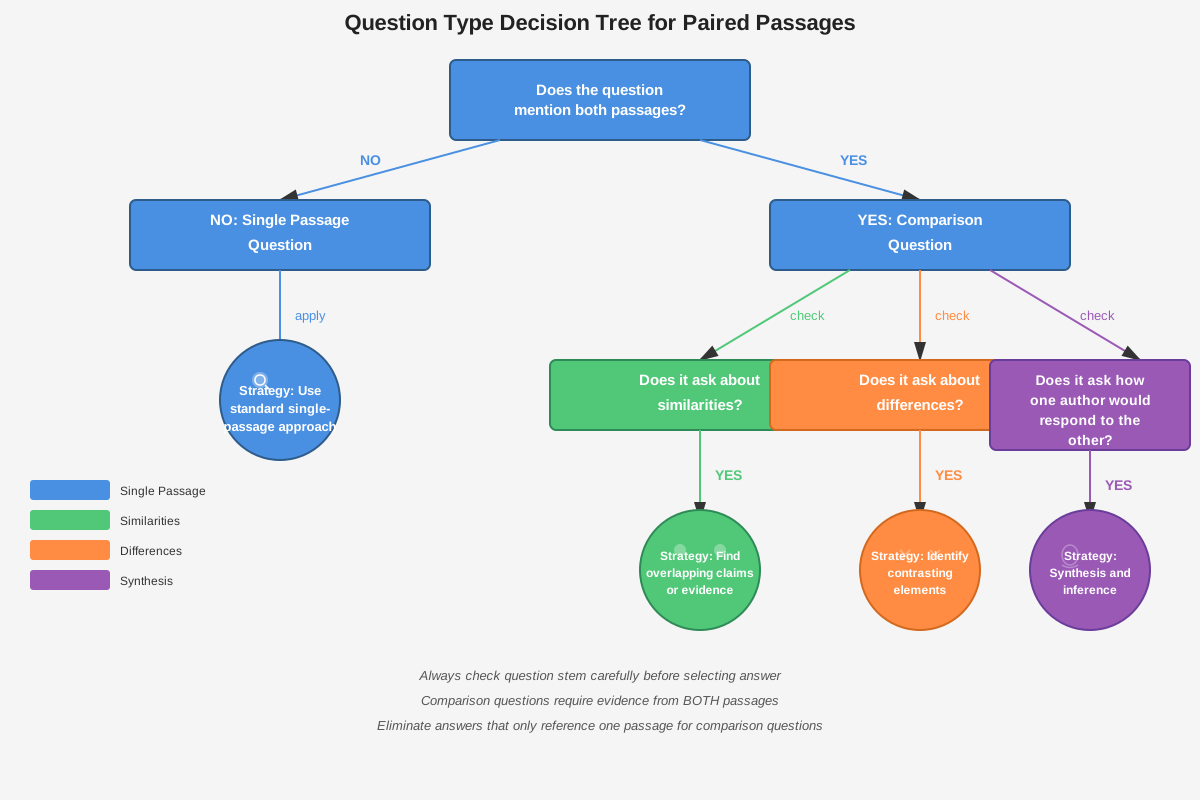
Question Identification Triggers: Immediately identify whether each question asks about Passage A only, Passage B only, or both passages by looking for these trigger phrases:
- Passage A only: "According to Passage A," "In Passage A," "The author of Passage A"
- Passage B only: "According to Passage B," "In Passage B," "The author of Passage B"
- Comparison: "Both authors," "Unlike Passage A," "Compared to," "relationship between," "authors would agree"
Process of Elimination for Comparison Questions: Wrong answers to comparison questions typically fall into predictable categories:
- One-passage answers: Information that appears in only one passage, even if accurate
- Overgeneralization: Statements that go beyond what both authors would support
- Misrepresentation: Distortions of what one or both authors actually said
- Irrelevant comparison: Comparisons on dimensions not addressed in the passages
Eliminate answers that fail the "both passages" test—if you cannot find support in both passages, the answer cannot be correct for a comparison question.
Time Management: If running short on time, prioritize individual passage questions over comparison questions, as they typically require less cognitive processing. However, don't skip comparison questions entirely—they're worth the same points as other questions and often have clear wrong answers that can be eliminated quickly.
Annotation Technique: Use different marking symbols for each passage (e.g., underline for Passage A, circle for Passage B) to quickly locate information when answering questions. Mark relationship indicators (words like "however," "similarly," "in contrast") that signal how ideas connect within and between passages.
Memory Techniques
COMPARE Acronym for analyzing paired passages:
- Common topic (What subject do both passages address?)
- Opposing or complementary (Do they disagree or complement each other?)
- Main idea of each (What is the central point of each passage?)
- Purpose of each author (Why did each author write their passage?)
- Approach and tone (How does each author present information?)
- Relationship type (What is the structural connection between passages?)
- Evidence types (What kinds of support does each author use?)
The "Both Test" Mnemonic: For agreement questions, visualize a Venn diagram with overlapping circles. The correct answer must fit in the overlap—it must pass the "both test" by appearing in both circles. If you can only place the answer in one circle, it's wrong for a comparison question.
Passage Personality Visualization: Assign each passage a "personality" based on its tone and approach. For example, Passage A might be "Professor Formal" (academic, objective, data-driven) while Passage B is "Personal Paula" (subjective, experiential, narrative). This personification helps maintain clear mental separation between the passages and makes comparison more intuitive.
The Three-Question Framework: Before answering any comparison question, ask yourself three questions:
- What does Passage A say about this?
- What does Passage B say about this?
- How do these ideas relate?
This framework prevents the common error of answering based on only one passage.
Summary
Paired passage comparison represents a sophisticated reading skill that requires students to comprehend two related passages individually while simultaneously analyzing their relationship. The ACT consistently includes one paired passage set among the four reading passages, with 3-4 questions specifically testing comparison skills. Success requires a systematic approach: reading Passage A completely before Passage B, actively noting similarities and differences while reading, and carefully identifying whether questions ask about individual passages or both passages together. The most common comparison question types ask about agreements between authors, differences in approach or emphasis, and the structural relationship between passages. Effective strategies include using the "both test" for agreement questions (the answer must be supported by both passages), recognizing trigger phrases that identify comparison questions, and understanding that paired passages typically present complementary perspectives, opposing viewpoints, or different approaches to the same topic rather than completely unrelated content. Students who master paired passage comparison gain a significant advantage on the ACT Reading section, as these questions often separate high scorers from average performers through their demand for synthesis and higher-order thinking.
Key Takeaways
- Paired passages always share a common topic but differ in perspective, purpose, tone, or approach—understanding this relationship is essential for answering comparison questions
- Read Passage A completely before starting Passage B to establish a clear reference point for comparison and prevent confusion
- Comparison questions use distinctive trigger phrases like "both authors," "unlike Passage A," and "relationship between" that immediately identify them as requiring synthesis of both passages
- The correct answer to an agreement question must be supported by evidence in both passages, even if the support appears in different forms
- Approximately 3-4 questions per paired passage set specifically test comparison skills, making this a high-value skill worth targeted practice
- Wrong answers to comparison questions frequently include accurate information from only one passage—always apply the "both test" to verify answers
- The three main comparison question types are agreement questions, difference/contrast questions, and relationship questions—each requires a specific analytical approach
Related Topics
Author's Purpose and Tone Analysis: Mastering paired passage comparison deepens understanding of how authors' purposes and tones shape their presentation of information, a skill that applies to all ACT Reading passages.
Evidence Evaluation and Synthesis: The ability to compare how different authors use evidence prepares students for research-based writing and critical analysis in college coursework.
Rhetorical Strategy Analysis: Understanding how different rhetorical approaches affect persuasiveness and clarity extends paired passage skills to more sophisticated textual analysis.
Multiple Source Integration: Success with paired passages builds the foundation for college-level research papers that require synthesizing information from multiple sources with varying perspectives.
Practice CTA
Now that you understand the strategies and concepts behind paired passage comparison, it's time to apply these skills to actual ACT-style questions. The practice questions and flashcards will reinforce your ability to identify comparison questions, analyze passage relationships, and select correct answers confidently. Remember that paired passage comparison is a high-yield skill—mastering it can directly improve your ACT Reading score by 2-3 points. Approach the practice materials systematically, using the COMPARE acronym and the "both test" to guide your analysis. With focused practice, you'll develop the confidence and skill to tackle any paired passage set the ACT presents!
Sign up free to keep reading
Create a free AnvayaPrep account to finish this ACT guide on Paired passage comparison — plus flashcards and practice questions.