Overview
The central claim in humanities represents one of the most frequently tested reading comprehension skills on the ACT Reading section. When encountering passages from humanities disciplines—including literature, philosophy, art history, music criticism, cultural studies, and memoir—students must quickly identify the author's primary argument or main point. This skill goes beyond simple topic identification; it requires understanding what the author is asserting, arguing, or attempting to prove throughout the passage.
On the ACT, humanities passages typically present an author's perspective on a cultural phenomenon, artistic movement, historical figure, or philosophical concept. The ACT central claim in humanities questions assess whether students can distinguish between supporting details, examples, and the overarching thesis that unifies the entire passage. Unlike informational texts that may simply present facts, humanities passages are inherently argumentative or interpretive, making central claim identification both more challenging and more critical for success.
Mastering this skill connects directly to other essential reading competencies tested on the ACT, including understanding author's purpose, identifying supporting evidence, recognizing organizational structure, and evaluating rhetorical choices. The central claim serves as the foundation upon which all other passage elements rest—once identified, it becomes significantly easier to answer questions about specific details, inferences, and the author's craft. This topic typically appears in 2-4 questions per humanities passage, making it one of the highest-yield areas for focused study.
Learning Objectives
- [ ] Identify when Central claim in humanities is being tested
- [ ] Explain the core rule or strategy behind Central claim in humanities
- [ ] Apply Central claim in humanities to ACT-style questions accurately
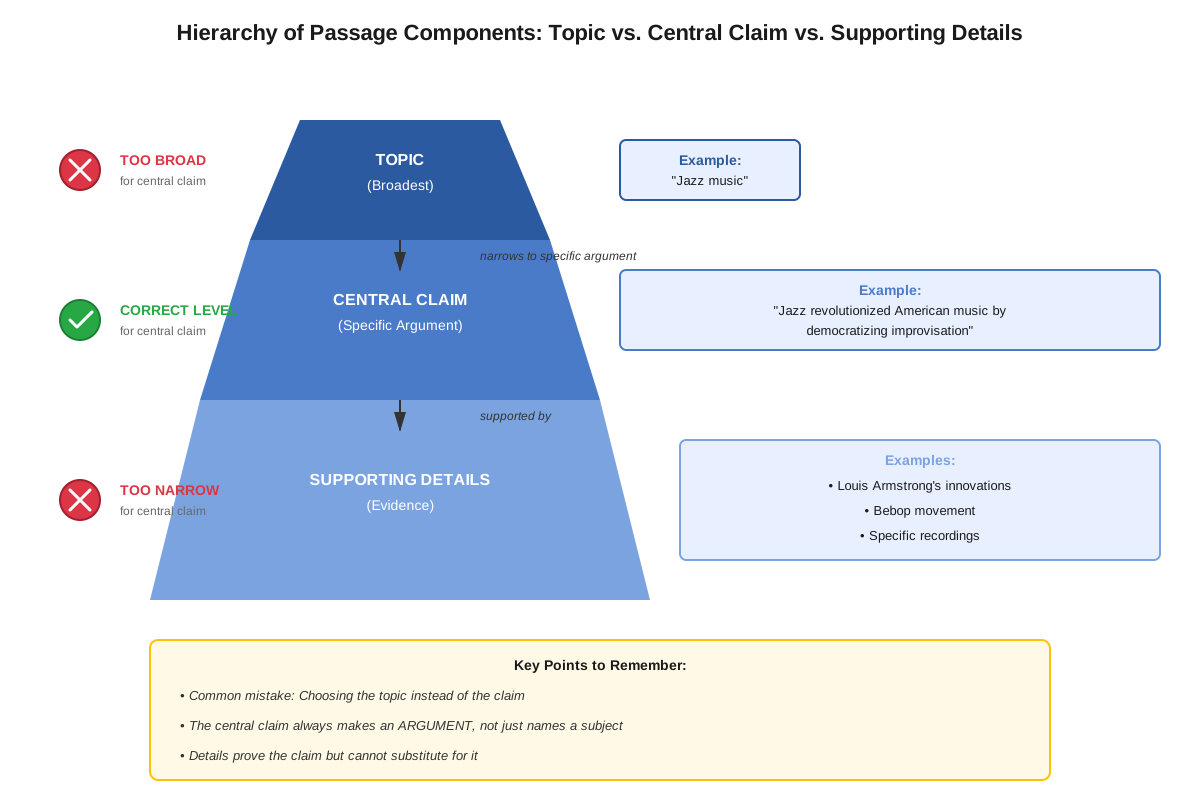
- [ ] Distinguish between a passage's topic, central claim, and supporting details within 30 seconds
- [ ] Recognize common locations where authors state or imply their central claims in humanities passages
- [ ] Evaluate answer choices to eliminate options that are too narrow, too broad, or factually inaccurate
- [ ] Synthesize information from multiple paragraphs to construct the central claim when it's not explicitly stated
Prerequisites
- Basic reading comprehension: Understanding literal meaning of sentences and paragraphs is essential because central claim identification requires processing the entire passage's content
- Paragraph structure awareness: Recognizing topic sentences and supporting details helps distinguish between main ideas and subordinate information
- Vocabulary at grade level: Humanities passages often use sophisticated language; adequate vocabulary prevents misunderstanding the author's argument
- Ability to identify passage type: Distinguishing humanities passages from natural science, social science, and literary narrative passages helps activate appropriate reading strategies
Why This Topic Matters
Understanding central claims in humanities passages has profound real-world applications beyond standardized testing. This skill mirrors the critical thinking required in college humanities courses, where students must identify thesis statements in scholarly articles, understand arguments in philosophical texts, and grasp interpretive claims in art criticism. Professionals in fields ranging from law to journalism to education regularly analyze complex arguments and must quickly identify the core assertion an author makes.
On the ACT Reading section, humanities passages appear in every test administration, comprising exactly 25% of the reading questions (one of four passages). Statistical analysis of released ACT exams reveals that 40-50% of humanities passage questions directly or indirectly test central claim comprehension. Questions may ask students to identify the main idea, determine the author's primary purpose, select the best title, or recognize which statement best summarizes the passage. Additionally, even questions focused on specific details often require understanding how those details support the central claim.
This topic commonly appears in several distinct question formats: direct main idea questions ("The main point of the passage is..."), purpose questions ("The author's primary purpose is to..."), summary questions ("Which of the following best describes the passage as a whole?"), and title questions ("The most appropriate title for this passage would be..."). Humanities passages on the ACT frequently explore topics such as biographical sketches of artists or writers, analyses of artistic movements or cultural phenomena, personal essays reflecting on cultural experiences, and examinations of philosophical or ethical questions. In each case, identifying the central claim provides the interpretive framework necessary for answering all subsequent questions accurately.
Core Concepts
Definition of Central Claim
The central claim in a humanities passage is the author's primary assertion, argument, or interpretive stance that unifies the entire text. Unlike a topic (which identifies what the passage discusses) or a theme (which identifies abstract ideas), the central claim represents what the author wants readers to believe, understand, or accept about that topic. It functions as the passage's thesis statement, though it may be explicitly stated in a single sentence or implicitly developed across multiple paragraphs.
In humanities writing, central claims typically take one of several forms: evaluative claims (asserting the significance or quality of something), interpretive claims (offering a particular understanding of cultural phenomena), causal claims (arguing why something occurred or what effects it produced), or comparative claims (establishing relationships between different subjects). For example, a passage about jazz musician Miles Davis might have the central claim that "Davis's willingness to constantly reinvent his musical style made him the most influential jazz artist of the 20th century"—this is evaluative, interpretive, and goes beyond merely stating that Davis was a jazz musician.
Characteristics of Strong Central Claims
Effective central claims in humanities passages share several identifiable characteristics. First, they are arguable—they present a position that requires evidence and reasoning rather than stating obvious facts. Second, they are specific enough to be meaningful while remaining broad enough to encompass the entire passage. Third, they are unified—all major sections of the passage relate back to supporting or developing this claim. Fourth, they often contain evaluative or interpretive language that signals the author's perspective (words like "significant," "revolutionary," "demonstrates," "reveals," or "exemplifies").
Understanding these characteristics helps students distinguish central claims from other passage elements. A sentence stating "Georgia O'Keeffe painted flowers" is too factual and narrow to be a central claim. However, "Georgia O'Keeffe's flower paintings revolutionized American modernism by transforming natural forms into abstract expressions of emotional intensity" functions as a central claim because it's arguable, specific yet comprehensive, and requires the passage to provide supporting evidence.
Common Locations for Central Claims
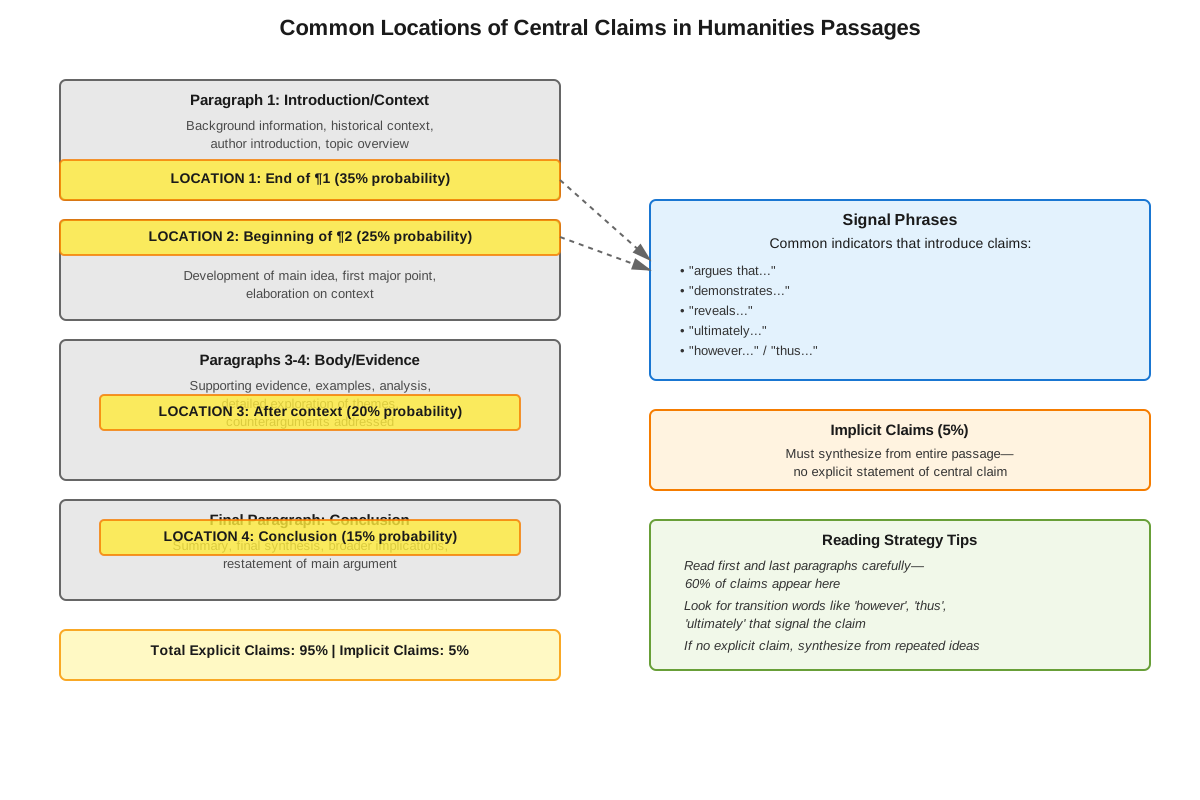
Authors typically position central claims in predictable locations within humanities passages, though ACT passages sometimes deviate from standard academic essay structure. The most common location is the end of the first paragraph or the beginning of the second paragraph, where authors introduce their main argument after providing context. This mirrors the traditional thesis statement placement in academic writing.
However, ACT humanities passages may also present central claims in other locations:
- Opening sentence: Some passages begin with a bold assertion that the rest of the passage supports
- Concluding paragraph: Authors may build toward their main point, stating it explicitly only after presenting evidence
- Implied throughout: The central claim may never appear in a single sentence but emerges from the cumulative effect of multiple paragraphs
- Restated in conclusion: Even when stated early, authors often rephrase their central claim in the final paragraph for emphasis
Distinguishing Central Claims from Supporting Details
One of the most challenging aspects of identifying central claims involves distinguishing them from supporting details, examples, and subordinate ideas. The following table illustrates key differences:
| Central Claim | Supporting Detail |
|---|---|
| Encompasses the entire passage | Relates to one section or paragraph |
| Presents the author's main argument | Provides evidence for the argument |
| Answers "What is the author trying to prove?" | Answers "How does the author prove it?" |
| Abstract or interpretive | Concrete or factual |
| Requires the whole passage to support | Can be verified in a single paragraph |
For example, in a passage arguing that "The Harlem Renaissance represented a fundamental shift in African American cultural identity," supporting details might include specific writers who participated (Langston Hughes, Zora Neale Hurston), particular works they produced, historical context about the Great Migration, or descriptions of Harlem nightclubs. Each detail is important, but none captures the passage's central claim—they merely provide the evidence that makes the claim convincing.
Implicit vs. Explicit Central Claims
ACT humanities passages vary in how directly they state their central claims. Explicit central claims appear in clear, identifiable sentences within the passage. Students can often locate these by looking for sentences that contain broad, evaluative language and seem to make an overarching point rather than discussing specific details.
Implicit central claims require more interpretive work. The author develops a main argument through accumulated evidence, examples, and analysis without ever stating it in a single sentence. To identify implicit central claims, students must:
- Identify what each paragraph contributes to the overall passage
- Recognize patterns in the author's word choice and tone
- Determine what conclusion the evidence collectively supports
- Synthesize these elements into a statement of the author's main point
For instance, a passage might describe various ways a particular novelist used symbolism, discuss critical reception of this technique, and analyze its influence on later writers—without ever explicitly stating "This novelist's innovative use of symbolism transformed modern fiction." Students must infer this central claim from the passage's overall direction and emphasis.
Central Claim vs. Author's Purpose
While closely related, central claim and author's purpose represent distinct concepts that ACT questions may test separately. The central claim identifies what the author argues or asserts, while the author's purpose identifies why the author wrote the passage or what effect they intended to achieve.
Consider these examples:
- Central claim: "Abstract Expressionism emerged from artists' responses to World War II trauma"
- Author's purpose: To explain the historical origins of an artistic movement
The central claim states the argument; the purpose describes the author's goal in making that argument (to explain, to persuade, to celebrate, to critique, etc.). Understanding this distinction prevents confusion when questions ask about purpose rather than main idea.
Concept Relationships
The central claim functions as the organizational hub of humanities passages, with all other elements radiating from and supporting it. Supporting details → provide evidence for → central claim, while examples and anecdotes → illustrate → central claim. The author's tone and word choice → reinforce → central claim by signaling the author's attitude toward the subject.
Understanding paragraph structure (a prerequisite skill) enables central claim identification because recognizing topic sentences helps students distinguish between paragraph-level main ideas and passage-level central claims. Multiple paragraph main ideas → combine to support → the overarching central claim. Similarly, vocabulary knowledge (another prerequisite) allows students to recognize the evaluative and interpretive language that often signals central claims.
Central claim identification connects forward to more advanced reading skills tested on the ACT. Once students identify the central claim, they can more effectively evaluate how the author develops their argument (organizational structure questions), why the author includes specific details (purpose of detail questions), and what the author implies beyond explicit statements (inference questions). The relationship flows: Central claim identification → enables → understanding passage structure → enables → making valid inferences → enables → evaluating author's craft.
High-Yield Facts
⭐ The central claim appears most frequently at the end of the first paragraph or beginning of the second paragraph in ACT humanities passages
⭐ Central claims are always broad enough to encompass the entire passage, not just one section or example
⭐ Questions asking for "main idea," "primary purpose," "best title," or "passage summary" all test central claim identification
⭐ Wrong answer choices for central claim questions are typically too narrow (focusing on one detail), too broad (going beyond the passage scope), or factually inaccurate
⭐ The central claim represents what the author argues or interprets, not merely what topic the passage discusses
- Central claims in humanities passages often contain evaluative language like "significant," "revolutionary," "demonstrates," or "reveals"
- When the central claim isn't explicitly stated, students should ask "What point do all these examples and details collectively support?"
- The author's tone (admiring, critical, analytical, celebratory) provides clues about the central claim's nature
- Supporting details answer "how" or "what," while the central claim answers "so what" or "why does this matter"
- Effective test-takers identify the central claim within the first 2-3 minutes of reading to create a mental framework for answering all questions
- Central claims in biographical passages typically assert something about the subject's significance, influence, or distinctive characteristics rather than simply recounting events
- Passages about artistic or cultural movements usually claim something about the movement's origins, impact, or defining features
- The conclusion often restates or reinforces the central claim, making it a valuable location to check when uncertain
- If two answer choices seem equally valid, the one that encompasses more of the passage content is typically correct
- Central claims never contradict information explicitly stated in the passage, even when they require inference
Quick check — test yourself on Central claim in humanities so far.
Try Flashcards →Common Misconceptions
Misconception: The central claim is always stated in the first paragraph.
Correction: While the first paragraph is a common location, central claims may appear in the second paragraph, conclusion, or be implied throughout the passage without explicit statement in any single sentence.
Misconception: The passage topic and central claim are the same thing.
Correction: The topic identifies what the passage discusses (e.g., "impressionist painting"), while the central claim states what the author argues about that topic (e.g., "impressionist painting revolutionized how artists represented light and perception"). The central claim is always more specific and arguable than the topic.
Misconception: The longest or most detailed paragraph contains the central claim.
Correction: Lengthy paragraphs often provide supporting evidence and examples rather than stating the main argument. The central claim is typically expressed concisely, while supporting paragraphs elaborate with details.
Misconception: If a statement appears early in the passage, it must be the central claim.
Correction: Early paragraphs often provide background information, context, or anecdotes that lead to the central claim rather than stating it directly. Students must distinguish between introductory context and the main argument.
Misconception: The central claim must use formal, academic language.
Correction: ACT humanities passages include personal essays and creative nonfiction that may state central claims in conversational or narrative language. The claim's function (unifying the passage and presenting the main argument) matters more than its stylistic register.
Misconception: Every paragraph must explicitly connect to the central claim.
Correction: While all paragraphs should ultimately support the central claim, some may provide necessary background, context, or counterarguments that connect indirectly. The overall passage trajectory matters more than each individual paragraph's obvious connection.
Misconception: Central claims are always positive or celebratory.
Correction: Authors may argue critical, analytical, or even negative central claims. A passage might claim that a cultural movement was overrated, that an artist's influence has been misunderstood, or that a philosophical approach contains fundamental flaws.
Worked Examples
Example 1: Explicit Central Claim
Passage excerpt (condensed for illustration):
When Martha Graham began choreographing in the 1920s, ballet dominated American dance with its emphasis on grace, lightness, and ethereal beauty. Graham rejected these conventions entirely. Her dancers moved with angular, percussive force, contracting and releasing their torsos in ways that revealed rather than concealed physical effort. They portrayed psychological states—grief, rage, ecstasy—through movement vocabularies that looked nothing like classical ballet.
This revolutionary approach transformed modern dance from ballet's derivative cousin into an independent art form. Graham's technique gave dancers new tools for expressing the full range of human emotion and experience. By the 1940s, her influence had spread throughout American dance companies, and today her technique remains one of the foundational training methods for modern dancers worldwide.
Question: Which of the following best states the main idea of the passage?
A) Martha Graham began choreographing in the 1920s when ballet dominated American dance.
B) Graham's dancers used angular, percussive movements rather than graceful, light ones.
C) Martha Graham's rejection of ballet conventions established modern dance as an independent art form.
D) Modern dancers today still train in Graham's technique.
Solution Process:
Step 1: Identify what the passage discusses (topic) vs. what it argues (central claim). The topic is Martha Graham and her dance technique. But what does the author argue about this topic?
Step 2: Locate potential central claim statements. The second paragraph begins with "This revolutionary approach transformed modern dance from ballet's derivative cousin into an independent art form"—this is a broad, evaluative statement that seems to encompass the passage's main point.
Step 3: Evaluate each answer choice:
- Choice A is too narrow and factual—it's background information from the first paragraph, not an argument
- Choice B describes a supporting detail (how Graham's technique looked) but doesn't capture the significance
- Choice C matches the identified central claim statement and is broad enough to encompass both paragraphs
- Choice D is a supporting detail from the conclusion, too narrow to be the main idea
Step 4: Verify that choice C encompasses the entire passage. The first paragraph describes what Graham rejected and how her approach differed (supporting the "rejection of ballet conventions" part). The second paragraph explains the impact (supporting the "established modern dance as an independent art form" part).
Answer: C
Connection to learning objectives: This example demonstrates identifying when central claim is tested (main idea question), applying the core strategy (locating broad evaluative statements and checking they encompass the whole passage), and accurately selecting the correct answer by eliminating options that are too narrow or purely factual.
Example 2: Implicit Central Claim
Passage excerpt (condensed):
In his early novels, James Baldwin wrote primarily about racial injustice in America, documenting the experiences of Black Americans facing discrimination and violence. Critics praised these works but often categorized Baldwin narrowly as a "protest writer."
Baldwin's later novels expanded beyond racial themes to explore universal questions of identity, love, and moral responsibility. Giovanni's Room, for instance, featured white characters and examined sexuality and self-acceptance. Another Country wove together multiple perspectives across racial and sexual identities.
This evolution frustrated some critics who wanted Baldwin to remain focused on racial politics. Yet Baldwin insisted that exploring the full complexity of human experience—across all identities—was itself a political act. His refusal to be limited by others' expectations demonstrated that Black writers need not confine themselves to any single subject or approach.
Question: The passage primarily serves to:
F) chronicle the publication history of James Baldwin's novels
G) argue that Baldwin's later work was superior to his early novels
H) illustrate how Baldwin's expanding thematic range challenged limiting categorizations
J) explain why critics disagreed about Baldwin's literary merit
Solution Process:
Step 1: Recognize that no single sentence explicitly states "The main point of this passage is..." This requires synthesizing an implicit central claim.
Step 2: Identify what each paragraph contributes:
- Paragraph 1: Baldwin's early work and how critics categorized him
- Paragraph 2: How his later work expanded thematically
- Paragraph 3: The significance of this evolution (challenging expectations and limitations)
Step 3: Synthesize these elements. The passage traces a progression (early narrow focus → later expansion) and emphasizes the significance of this change (challenging limiting categorizations). The implicit central claim is that Baldwin's thematic evolution was significant because it resisted narrow categorization.
Step 4: Evaluate answer choices:
- Choice F is too narrow and factual—the passage does more than chronicle publication history
- Choice G makes a value judgment (superiority) that the passage doesn't support
- Choice H captures the implicit central claim: the expansion challenged limitations
- Choice J focuses on critical disagreement, which is mentioned but isn't the main point
Answer: H
Connection to learning objectives: This example shows how to identify implicit central claims by synthesizing information across paragraphs, distinguishing between supporting details and the overarching argument, and selecting answers that capture the passage's primary purpose even when not explicitly stated.
Exam Strategy
When approaching ACT questions testing central claim identification, implement this systematic process:
Step 1: Active Reading for Central Claim (First 2-3 minutes)
As you read the passage initially, actively search for the central claim. Pay special attention to the end of the first paragraph, beginning of the second paragraph, and conclusion. Mark any sentence that seems to make a broad, evaluative statement about the passage topic. Look for trigger words like "demonstrates," "reveals," "significant," "transformed," "challenged," "established," or "represents."
Step 2: Question Recognition
Identify central claim questions through these common phrasings:
- "The main idea/point of the passage is..."
- "The passage primarily serves to..."
- "The author's primary purpose is to..."
- "Which of the following best describes the passage as a whole?"
- "The most appropriate title for this passage would be..."
- "The passage can best be described as..."
Step 3: Predict Before Looking at Choices
Before reading answer choices, mentally articulate the central claim in your own words. This prevents you from being swayed by attractive but incorrect options. Ask yourself: "If I had to explain this passage's main point in one sentence, what would I say?"
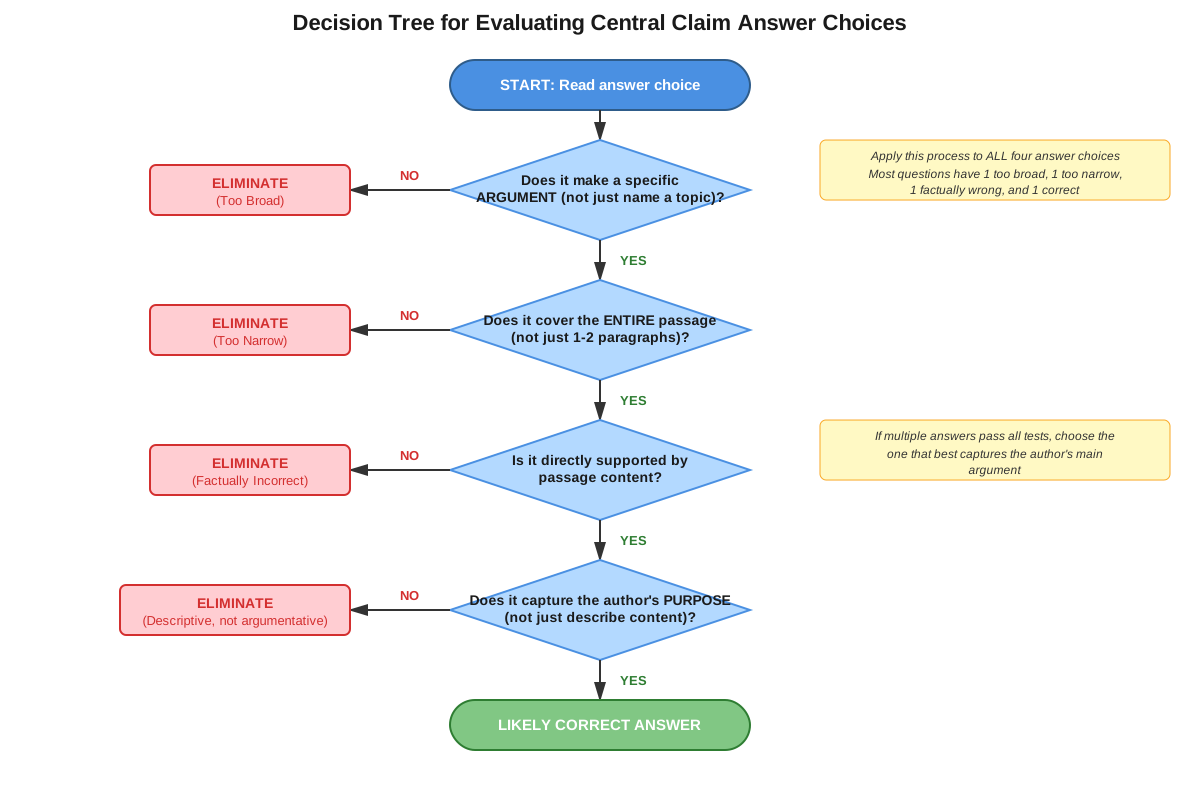
Step 4: Eliminate Using the "Too Narrow/Too Broad/Wrong" Framework
For each answer choice, ask:
- Too narrow? Does this describe only one paragraph or example rather than the whole passage?
- Too broad? Does this go beyond what the passage actually discusses?
- Factually wrong? Does this contradict information in the passage or make claims unsupported by the text?
Most incorrect answers fall into one of these three categories. The correct answer will be "just right"—broad enough to encompass the entire passage but specific enough to accurately represent what the author argues.
Step 5: Verify with Passage Structure
Before finalizing your answer, quickly check that your selected choice accounts for all major sections of the passage. If the passage has four paragraphs, does your answer encompass what all four contribute? If not, it's likely too narrow.
Time Allocation Advice: Spend no more than 45 seconds on central claim questions once you've read the passage. If you actively identified the central claim during your initial reading, these questions should be among the quickest to answer. If you're uncertain between two choices, select the one that is broader and more encompassing—central claims are never narrow.
Process of Elimination Tips Specific to This Topic:
- Eliminate any choice that focuses on a specific example, person, or detail mentioned in only one paragraph
- Eliminate choices that use absolute language ("only," "always," "never") unless the passage itself uses such language
- Eliminate choices that mention topics or ideas not discussed in the passage, even if they seem related
- When stuck between two choices, eliminate the one that sounds more like a supporting detail than an overarching argument
Memory Techniques
CLAIM Acronym for Identifying Central Claims:
- Comprehensive: Does it cover the whole passage?
- Located strategically: Check intro, early paragraphs, and conclusion
- Arguable: Is it a position that requires evidence, not just a fact?
- Interpretive: Does it express the author's perspective or analysis?
- Main point: Does everything else in the passage support this?
The "Umbrella Visualization": Picture the central claim as an umbrella that covers the entire passage. All supporting details, examples, and evidence are raindrops that fall under this umbrella. If something in the passage doesn't fit under your identified central claim umbrella, you haven't found the true central claim yet.
The "So What?" Test: After reading a potential central claim, ask "So what?" If the answer is "That's what the whole passage is about," you've found it. If the answer is "That's just one example" or "That's just background information," keep looking.
Location Memory Device: "First-Second-Last" reminds you to check the end of the first paragraph, the beginning of the second paragraph, and the last paragraph—the three most common locations for central claims.
The Goldilocks Principle: Like Goldilocks finding the "just right" porridge, the correct central claim answer is never too narrow (one detail), never too broad (beyond the passage), but just right (encompassing the whole passage accurately).
Summary
The central claim in humanities passages represents the author's primary argument or interpretive stance that unifies the entire text. Unlike topics (which identify subject matter) or supporting details (which provide evidence), the central claim states what the author wants readers to understand, believe, or accept. On the ACT Reading section, identifying central claims is essential because approximately 40-50% of humanities questions directly or indirectly test this skill through main idea, purpose, summary, and title questions. Central claims typically appear at the end of the first paragraph, beginning of the second paragraph, or in the conclusion, though they may be implicit rather than explicitly stated. Effective identification requires distinguishing between broad, arguable claims that encompass the entire passage and narrow, factual details that support those claims. Students should actively search for central claims during initial reading, looking for evaluative language and broad statements, then verify their identification by ensuring all major passage sections connect to this overarching argument. Mastering this skill provides the interpretive framework necessary for answering all other questions about the passage accurately and efficiently.
Key Takeaways
- The central claim is the author's main argument or interpretive stance, not merely the passage topic or a supporting detail
- Central claim questions appear in multiple formats: main idea, primary purpose, best title, and passage summary questions
- Check three key locations: end of first paragraph, beginning of second paragraph, and conclusion
- Use the "too narrow/too broad/wrong" elimination framework to evaluate answer choices systematically
- The correct answer must encompass the entire passage while remaining specific enough to accurately represent the author's argument
- Evaluative and interpretive language ("demonstrates," "reveals," "transformed," "significant") often signals central claims
- When the central claim is implicit, synthesize what all paragraphs collectively argue rather than looking for a single sentence
Related Topics
Supporting Evidence and Details: After mastering central claim identification, students should study how authors select and organize supporting evidence to develop their main arguments. This skill builds directly on central claim work because understanding what the author argues enables evaluation of how effectively they support that argument.
Author's Purpose and Tone: Closely related to central claims, author's purpose examines why the author wrote the passage and what effect they intended. Tone analysis explores the author's attitude toward their subject, which reinforces and clarifies the central claim.
Passage Structure and Organization: Understanding how authors organize humanities passages—through chronological progression, comparison-contrast, cause-effect, or problem-solution structures—helps predict where central claims will appear and how they'll be developed.
Inference Questions in Humanities: Once students can identify explicit central claims, they're prepared to tackle inference questions that require understanding implicit arguments and reading between the lines of humanities texts.
Practice CTA
Now that you've mastered the strategies for identifying central claims in humanities passages, it's time to put your knowledge into action! Complete the practice questions to test your ability to distinguish central claims from supporting details, eliminate incorrect answer choices, and apply the systematic approach outlined in this guide. The flashcards will help you internalize key concepts and trigger words that signal central claims. Remember: identifying the central claim quickly and accurately during your initial reading will make every other question about the passage easier to answer. You've built a strong foundation—now strengthen it through deliberate practice!
Sign up free to keep reading
Create a free AnvayaPrep account to finish this ACT guide on Central claim in humanities — plus flashcards and practice questions.