Overview
The detail location strategy is one of the most fundamental and frequently tested skills on the ACT Reading section. This strategy involves efficiently finding specific information within a passage to answer questions that ask about explicit details, facts, or statements made by the author. Unlike inference or main idea questions, detail questions require students to locate and accurately identify information that is directly stated in the text.
Mastering the ACT detail location strategy is essential because approximately 40-50% of ACT Reading questions are detail-oriented, making this the single most common question type on the exam. These questions typically begin with phrases like "According to the passage," "The author states that," or "The passage indicates that." Success with detail location questions directly impacts overall Reading scores, as they represent a significant portion of the 40 questions students must answer in 35 minutes. Students who develop systematic approaches to locating details can answer these questions quickly and accurately, freeing up valuable time for more challenging inference and synthesis questions.
The detail location strategy connects to broader reading comprehension skills within the ACT framework. It serves as the foundation for more complex tasks like making inferences, understanding author's purpose, and analyzing text structure. Before students can interpret what an author implies or suggests, they must first be able to identify what the author explicitly states. This strategy also reinforces active reading techniques, including annotation, skimming for key information, and understanding how passages are organized—all critical skills for achieving high scores across all four ACT Reading passage types (Literary Narrative, Social Science, Humanities, and Natural Science).
Learning Objectives
- [ ] Identify when Detail location strategy is being tested
- [ ] Explain the core rule or strategy behind Detail location strategy
- [ ] Apply Detail location strategy to ACT-style questions accurately
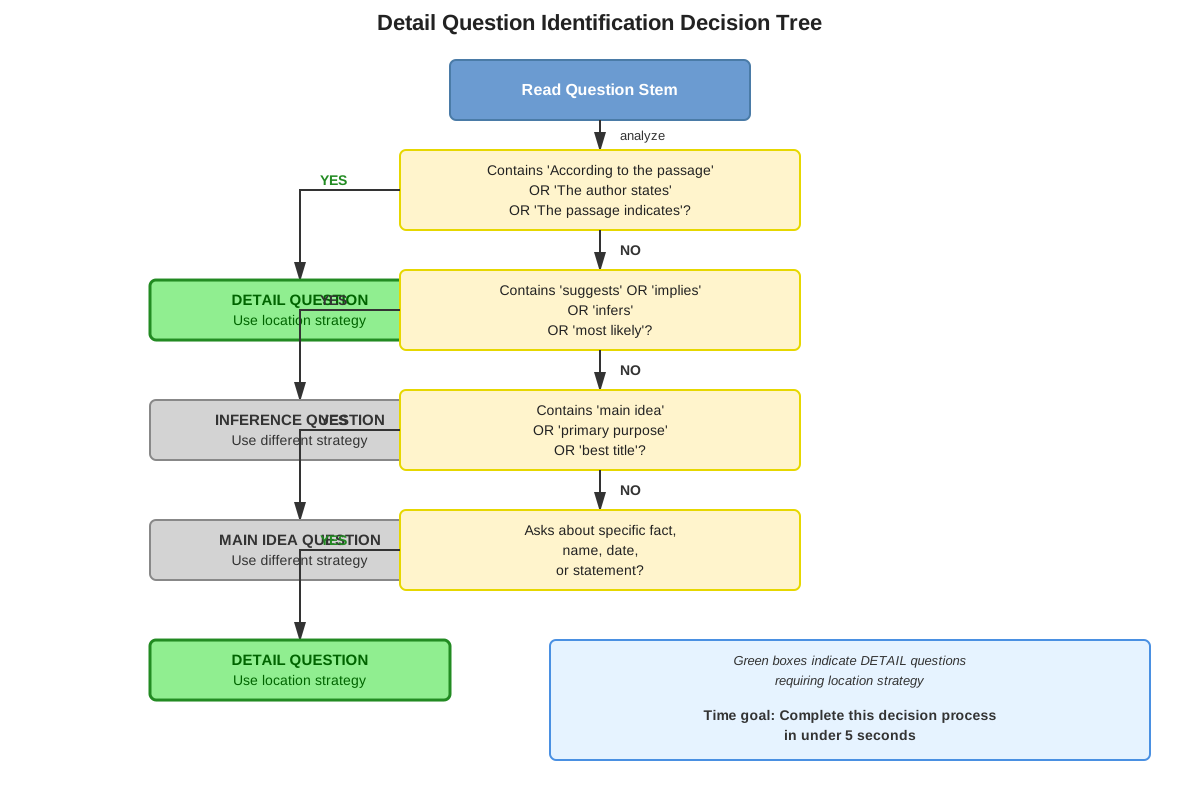
- [ ] Distinguish between detail questions and inference questions within 5 seconds
- [ ] Locate relevant passage sections using question keywords in under 30 seconds
- [ ] Eliminate incorrect answer choices that distort, exaggerate, or misrepresent passage details
- [ ] Recognize common detail question formats and their corresponding search strategies
Prerequisites
- Basic reading comprehension: Understanding literal meaning of sentences and paragraphs is necessary to identify when information matches between question and passage
- Passage navigation skills: Ability to skim and scan text efficiently enables quick location of relevant sections without re-reading entire passages
- Vocabulary knowledge: Recognizing synonyms and paraphrased language helps identify correct answers that restate passage details using different words
- Time management fundamentals: Understanding the 8-9 minute per passage guideline allows appropriate allocation of 30-45 seconds per detail question
Why This Topic Matters
Detail location questions appear more frequently than any other question type on the ACT Reading section, typically comprising 16-20 of the 40 total questions. These questions test whether students can efficiently navigate passages to find specific information—a skill that directly translates to academic success in college coursework, where students must locate supporting evidence in textbooks, research articles, and primary sources.
In real-world applications, detail location mirrors the research and information verification skills professionals use daily. Lawyers must find specific clauses in contracts, medical professionals must locate precise dosage information in pharmaceutical references, and researchers must identify exact data points in published studies. The ability to quickly and accurately locate specific information in complex texts is a fundamental literacy skill that extends far beyond standardized testing.
On the ACT, detail questions appear in predictable patterns across all four passage types. In Literary Narrative passages, detail questions often ask about character actions, dialogue, or setting descriptions. Social Science passages feature detail questions about research findings, historical events, or statistical information. Humanities passages include questions about biographical facts, artistic techniques, or cultural practices. Natural Science passages test details about scientific processes, experimental procedures, or research conclusions. Understanding these patterns helps students anticipate where to look for answers and how information will be presented.
Core Concepts
Understanding Detail Questions
Detail questions ask students to identify information that is explicitly stated in the passage. These questions do not require interpretation, inference, or analysis—only accurate location and recognition of stated facts. The correct answer will either directly quote the passage or paraphrase it using synonymous language. Detail questions are fundamentally matching exercises: students must match the information requested in the question stem to its corresponding location in the passage.
The key characteristic distinguishing detail questions from other types is the presence of trigger phrases that signal explicit information retrieval. Common question stems include:
- "According to the passage..."
- "The author states that..."
- "The passage indicates that..."
- "As described in the passage..."
- "The passage mentions which of the following..."
The Four-Step Detail Location Process
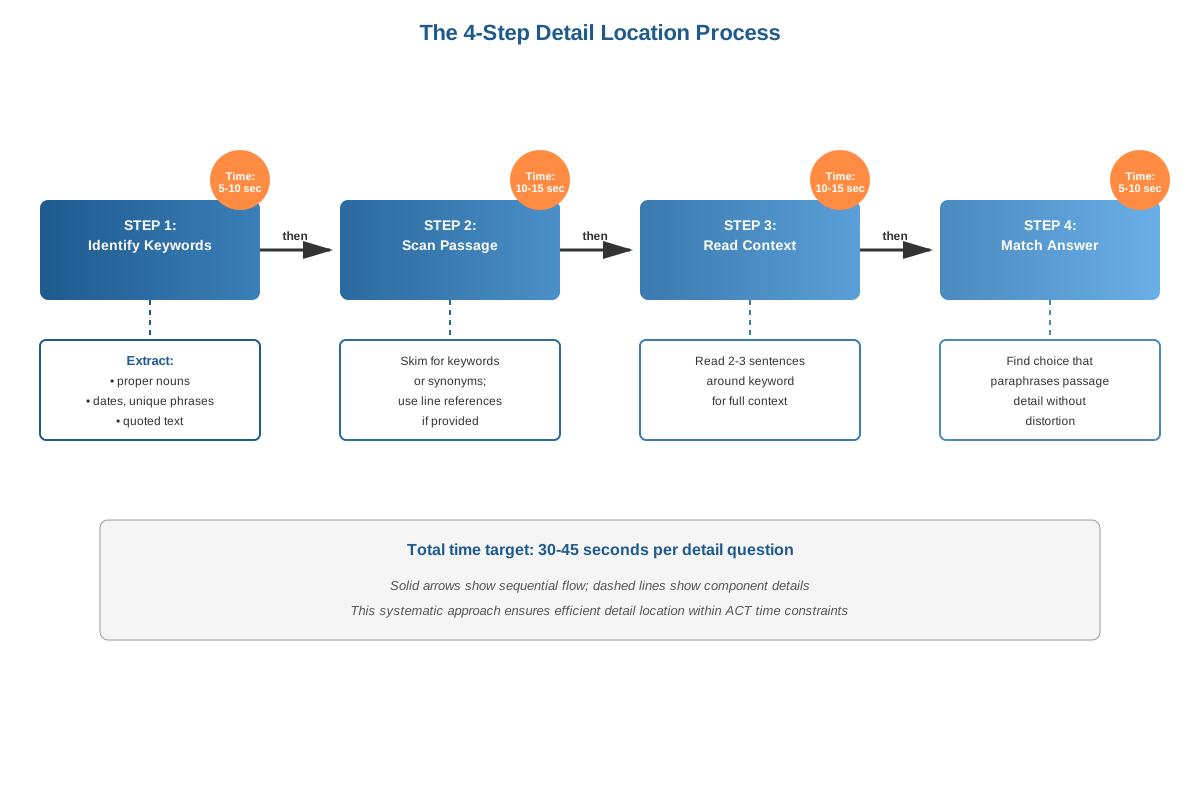
Successful detail location follows a systematic approach that maximizes accuracy while minimizing time expenditure:
Step 1: Identify the Question Type
Recognize detail question triggers in the question stem. Look for phrases that indicate explicit information retrieval rather than inference or interpretation. This recognition should occur within 3-5 seconds of reading the question.
Step 2: Extract Keywords
Identify 2-3 specific, searchable terms from the question stem. Effective keywords include:
- Proper nouns (names, places, organizations)
- Numbers and dates
- Unusual or technical terms
- Quoted phrases
- Specific concepts or objects mentioned
Avoid using common words like "the," "and," "important," or "significant" as search terms, as these appear too frequently to be useful locators.
Step 3: Scan the Passage
Use the extracted keywords to quickly scan the passage for the relevant section. Most detail questions include line references or paragraph indicators, but when they don't, systematic scanning is essential. Start with:
- Topic sentences of paragraphs
- Areas with similar vocabulary to the question
- Sections already annotated during initial reading
Step 4: Match and Verify
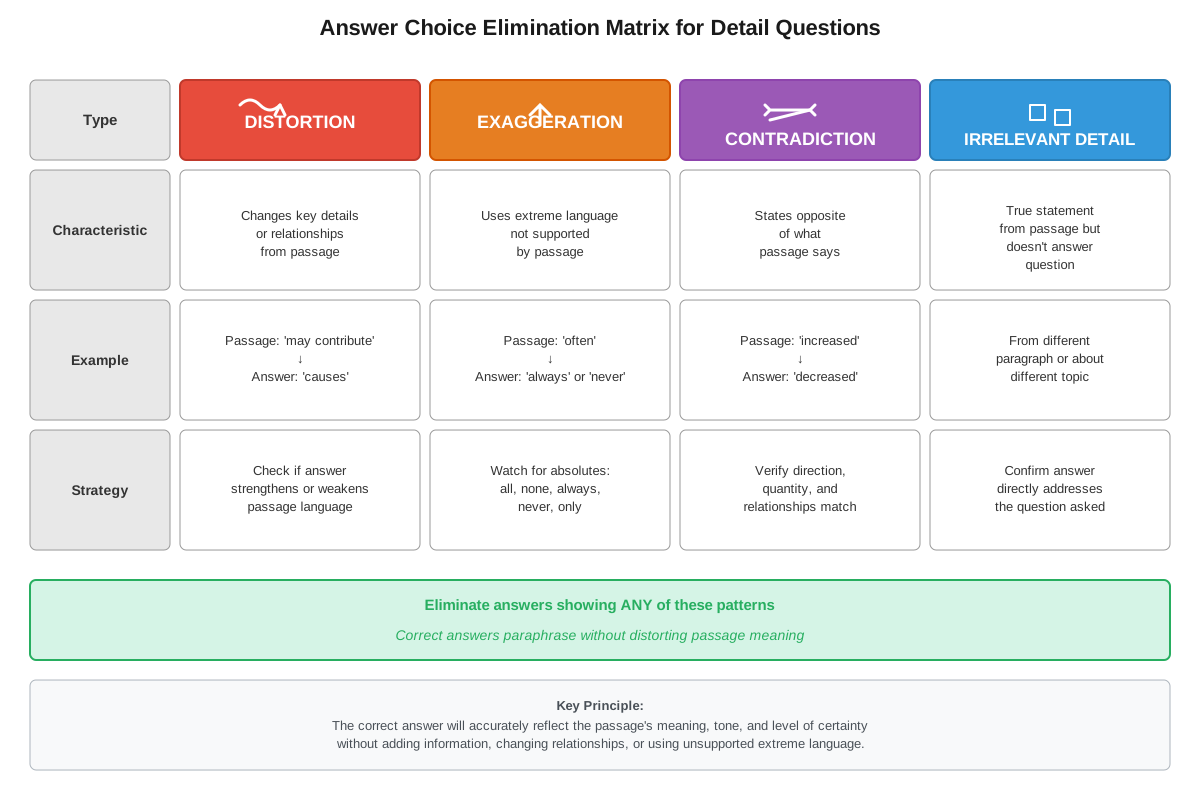
Once the relevant passage section is located, read 2-3 sentences before and after the keyword location to establish context. Compare the passage information directly to each answer choice, eliminating options that:
- Contradict the passage
- Include information not mentioned
- Distort or exaggerate the stated detail
- Mix accurate and inaccurate information
Types of Detail Questions
| Detail Question Type | Characteristics | Example Stem | Search Strategy |
|---|---|---|---|
| Direct Fact | Asks for specific information stated once | "According to the passage, the experiment was conducted in..." | Use proper nouns or unique terms to locate exact sentence |
| Multiple Detail | Requires checking several passage locations | "The passage mentions all of the following EXCEPT..." | Systematically verify each answer choice against passage |
| Sequence/Order | Asks about chronological or procedural order | "According to the passage, which event occurred first?" | Look for transition words (first, then, next, finally) |
| Quoted Language | Includes exact phrase from passage | "What does the author mean by 'adaptive radiation'?" | Search for quotation marks or italicized terms |
| Paraphrased Detail | Restates passage information using different words | "The passage suggests that the primary cause was..." | Identify concept, then find synonymous language |
Common Detail Question Traps
The ACT deliberately constructs incorrect answer choices to exploit common reading errors. Understanding these traps is crucial for avoiding them:
Distortion: Answer choices that take passage information and slightly alter it, changing the meaning. For example, if the passage states "some scientists believe," an incorrect answer might say "most scientists agree."
Out-of-Scope: Answer choices that introduce information not mentioned in the passage, even if the information seems plausible or factually accurate in the real world.
Extreme Language: Answer choices using absolute terms (always, never, only, all, none) when the passage uses qualified language (some, many, often, typically).
Wrong Section: Answer choices that accurately reflect passage information but from a different section than what the question asks about, testing whether students carefully match question scope to passage location.
Annotation Techniques for Detail Location
Effective annotation during the initial passage reading significantly improves detail location speed. Students should mark:
- Proper nouns: Circle or underline names, places, dates
- Transition words: Note sequence indicators (first, however, additionally)
- Key concepts: Mark main topics in each paragraph
- Lists or examples: Bracket series of items or supporting details
- Contrasts: Highlight opposing viewpoints or comparisons
These annotations create a visual map of the passage, allowing rapid navigation when detail questions arise.
Concept Relationships
The detail location strategy serves as the foundation for all other ACT Reading question types. Before students can make inferences (reading between the lines), they must first master reading the lines themselves—identifying what is explicitly stated. This hierarchical relationship means that weakness in detail location inevitably undermines performance on more complex question types.
Detail location connects directly to passage structure understanding. Recognizing how passages are organized (chronologically, by comparison/contrast, by cause/effect, by problem/solution) helps predict where specific types of details will appear. For example, in a cause/effect structure, details about causes typically appear before details about effects, allowing strategic scanning.
The strategy also relates to vocabulary in context questions. Both question types require locating specific passage sections and understanding the precise meaning of words or phrases in their textual environment. The scanning and context-reading skills developed through detail location practice transfer directly to vocabulary questions.
Relationship Map:
Initial Passage Reading with Annotation → Enables Quick Detail Location → Supports Accurate Inference Making → Contributes to Main Idea Understanding → Facilitates Author's Purpose Analysis
Additionally, detail location strategy connects to time management skills. Students who efficiently locate details (30-45 seconds per question) create time reserves for challenging inference and synthesis questions that require deeper analysis (60-90 seconds per question).
High-Yield Facts
⭐ Detail questions comprise 40-50% of all ACT Reading questions, making them the most common question type
⭐ Correct answers to detail questions are always supported by explicit passage statements, never requiring inference
⭐ Question stems containing "according to the passage" or "the author states" are definitive detail question indicators
⭐ The correct answer will either directly quote the passage or paraphrase it using synonymous language
⭐ Scanning for proper nouns, numbers, and unusual terms is the fastest way to locate relevant passage sections
- Detail questions typically appear in the same order as information appears in the passage, allowing sequential searching
- Answer choices that use extreme language (always, never, only) are usually incorrect unless the passage also uses extreme language
- Reading 2-3 sentences before and after the keyword location provides necessary context for accurate answer selection
- "EXCEPT" and "NOT" questions require verifying each answer choice against the passage, making them more time-consuming
- Incorrect answer choices often mix accurate passage information with subtle distortions or additions
- Line reference questions (e.g., "lines 23-25") still require reading surrounding context, not just the referenced lines
- Detail questions about dialogue or quotations require understanding who is speaking and in what context
- Chronological detail questions can be answered by identifying transition words like "first," "subsequently," "finally"
- Multiple detail questions asking "which of the following" require systematic elimination rather than searching for one correct answer
- Paraphrased correct answers test vocabulary knowledge, as students must recognize synonymous expressions
Quick check — test yourself on Detail location strategy so far.
Try Flashcards →Common Misconceptions
Misconception: Detail questions are easy and don't require strategy because they just ask what's in the passage.
Correction: While detail questions test explicit information, they require systematic location strategies and careful answer verification. The ACT deliberately creates plausible-sounding incorrect answers that distort passage details, making strategic elimination essential for consistent accuracy.
Misconception: The correct answer will use the exact same words as the passage.
Correction: Correct answers frequently paraphrase passage information using synonymous language. Students must recognize when different words express the same meaning. For example, if the passage says "rapidly increased," the correct answer might say "grew quickly."
Misconception: If an answer choice contains true information, it must be correct.
Correction: Answer choices may contain factually accurate real-world information that is not stated or supported by the passage. The ACT tests reading comprehension, not outside knowledge. Only information explicitly stated or directly supported by the passage can be correct.
Misconception: Reading the entire passage carefully eliminates the need for detail location strategies.
Correction: Even with thorough initial reading, students cannot remember every detail from a 750-900 word passage. Detail location strategies enable efficient verification of specific information without relying on memory, which is unreliable under time pressure.
Misconception: Line reference questions only require reading the referenced lines.
Correction: Context is essential for understanding any passage detail. Reading only the referenced lines often leads to misinterpretation. Students should read at least 2-3 sentences before and after any line reference to understand the full context.
Misconception: Detail questions should be answered first because they're easiest.
Correction: Question order doesn't necessarily correlate with difficulty. While detail questions test explicit information, some require extensive searching or verification. Students should answer questions in the order they appear, as ACT questions typically follow passage sequence, making sequential answering most efficient.
Misconception: If you can't find the answer quickly, you should guess and move on.
Correction: Detail questions always have answers explicitly stated in the passage. If the answer isn't immediately apparent, the search strategy needs adjustment—try different keywords, scan different passage sections, or re-read the question stem for overlooked clues. Systematic searching is more effective than guessing.
Worked Examples
Example 1: Direct Fact Detail Question
Passage Excerpt:
"The Harlem Renaissance, which flourished during the 1920s and early 1930s, represented a pivotal moment in African American cultural history. Writers like Langston Hughes and Zora Neale Hurston produced works that celebrated Black identity and challenged prevailing racial stereotypes. The movement centered primarily in the Harlem neighborhood of New York City, though its influence extended to other urban centers including Chicago and Washington, D.C. Jazz music, visual arts, and theater all experienced remarkable growth during this period, creating a multifaceted cultural explosion that reshaped American artistic expression."
Question:
According to the passage, the Harlem Renaissance was primarily centered in:
A) Chicago and Washington, D.C.
B) New York City
C) multiple urban centers equally
D) the southern United States
Solution Process:
Step 1: Identify question type - "According to the passage" signals a detail question requiring explicit information.
Step 2: Extract keywords - "Harlem Renaissance" and "centered" are the key search terms.
Step 3: Scan passage - "Harlem Renaissance" appears in the first sentence, but "centered" appears in the third sentence: "The movement centered primarily in the Harlem neighborhood of New York City."
Step 4: Match and verify - The passage explicitly states the movement "centered primarily in" New York City, though it mentions other cities had influence. The word "primarily" is crucial—it indicates the main center while acknowledging other locations.
Answer Analysis:
- A) Incorrect - These cities are mentioned as places where influence extended, not where the movement centered
- B) Correct - Directly matches "centered primarily in the Harlem neighborhood of New York City"
- C) Incorrect - Distorts the passage by ignoring "primarily," which indicates one main center
- D) Incorrect - Not mentioned in the passage; introduces out-of-scope information
Correct Answer: B
Learning Objective Connection: This example demonstrates identifying detail questions through trigger phrases and applying systematic location strategy to find explicit information.
Example 2: Multiple Detail "EXCEPT" Question
Passage Excerpt:
"Photosynthesis occurs in two main stages: the light-dependent reactions and the light-independent reactions (Calvin cycle). During the light-dependent reactions, which take place in the thylakoid membranes, chlorophyll absorbs light energy and converts it to chemical energy in the form of ATP and NADPH. Water molecules are split, releasing oxygen as a byproduct. The light-independent reactions occur in the stroma, where the ATP and NADPH produced earlier are used to convert carbon dioxide into glucose. This process does not require direct light but depends on the products of the light-dependent reactions. Temperature and carbon dioxide concentration significantly affect the rate of photosynthesis, while the process requires chlorophyll to capture light energy."
Question:
The passage states that photosynthesis involves all of the following EXCEPT:
A) the production of ATP and NADPH
B) the release of oxygen
C) the consumption of glucose
D) the conversion of carbon dioxide
Solution Process:
Step 1: Identify question type - "The passage states" with "EXCEPT" signals a multiple detail question requiring verification of each answer choice.
Step 2: Strategy adjustment - For EXCEPT questions, find the three choices that ARE mentioned and eliminate them; the remaining choice is correct.
Step 3: Systematic verification:
- A) "converts it to chemical energy in the form of ATP and NADPH" - MENTIONED, eliminate
- B) "releasing oxygen as a byproduct" - MENTIONED, eliminate
- C) Search for "glucose" - passage states glucose is PRODUCED ("convert carbon dioxide into glucose"), not consumed - NOT MENTIONED as consumed
- D) "convert carbon dioxide into glucose" - MENTIONED, eliminate
Step 4: Verify the exception - Choice C is the only option not supported by the passage. The passage describes glucose as a product, not something consumed during photosynthesis.
Answer Analysis:
- A) Incorrect - Explicitly mentioned in the passage
- B) Incorrect - Explicitly mentioned in the passage
- C) Correct - The passage states glucose is produced, not consumed; this is the exception
- D) Incorrect - Explicitly mentioned in the passage
Correct Answer: C
Learning Objective Connection: This example demonstrates applying detail location strategy to EXCEPT questions, which require systematic verification of multiple passage details and careful attention to what is NOT stated.
Exam Strategy
Question Recognition Strategy
Develop automatic recognition of detail questions by memorizing trigger phrases. When reading a question stem, the presence of "according to," "states that," "indicates that," or "mentions" should immediately activate detail location mode. This recognition should occur within 3 seconds, allowing maximum time for the actual search and verification process.
Efficient Scanning Technique
Rather than re-reading the entire passage, use a targeted scanning approach:
- Identify 2-3 specific keywords from the question
- Scan paragraph topic sentences first (where main ideas and key details often appear)
- Look for visual cues: capitalized words, numbers, quotation marks, italics
- If keywords aren't found in topic sentences, scan the full paragraphs systematically
Exam Tip: Most ACT passages are structured with one main idea per paragraph. Detail questions often test information from topic sentences or concluding sentences of paragraphs, making these high-priority scanning targets.
Process of Elimination Specific to Detail Questions
Eliminate answer choices that:
- Contradict passage statements: If the passage says "increased," eliminate answers saying "decreased"
- Use extreme language without passage support: Words like "only," "never," "always," "all" require explicit passage confirmation
- Combine accurate and inaccurate information: Some choices mix true passage details with false additions
- Reference the wrong passage section: Verify that the detail comes from the section the question asks about
Time Allocation Guidelines
Allocate 30-45 seconds per detail question:
- 5 seconds: Identify question type and extract keywords
- 15-20 seconds: Scan and locate relevant passage section
- 10-15 seconds: Read context and verify answer
- 5 seconds: Mark answer and move forward
If a detail question exceeds 60 seconds, mark your best answer and flag it for review if time permits. Spending excessive time on one detail question sacrifices time needed for other questions.
Strategic Approach to Line Reference Questions
When questions provide line references (e.g., "lines 34-37"), always read beyond the referenced lines:
- Read 2-3 sentences before the reference for context
- Read the referenced lines carefully
- Read 1-2 sentences after the reference for complete understanding
The ACT often places the actual answer information in sentences adjacent to the line reference, testing whether students understand context.
Handling "EXCEPT" and "NOT" Questions
These questions require a different approach:
- Circle or underline "EXCEPT" or "NOT" in the question stem to maintain awareness
- Verify each answer choice individually against the passage
- Mark each choice as "mentioned" or "not mentioned"
- The choice that is NOT mentioned (or that contradicts the passage) is correct
- Budget 60-75 seconds for these questions, as they require more verification time
Memory Techniques
SCAN Acronym for Detail Location
Spot the question type (detail vs. inference)
Choose keywords (2-3 specific, searchable terms)
Aim for the section (use keywords to locate passage area)
Narrow to the answer (read context and eliminate wrong choices)
The "Three-Sentence Rule" Visualization
Visualize every detail question answer as existing within a three-sentence window: one sentence before, the key sentence, and one sentence after. This mental image prevents reading too narrowly (missing context) or too broadly (wasting time).
Keyword Priority Pyramid
Remember keyword search priority using a pyramid structure:
        Proper Nouns/Numbers (TOP PRIORITY)
           Unusual/Technical Terms
              Quoted Phrases
         Common Nouns with Modifiers
Start searching with top-priority keywords and work down only if needed.
"PASS" for Answer Elimination
Passage contradiction? Eliminate.
Added information not in passage? Eliminate.
Strong/extreme language without support? Eliminate.
Section mismatch (right info, wrong part)? Eliminate.
Trigger Phrase Flashcard Method
Create mental flashcards associating trigger phrases with the detail location strategy:
- "According to" = DETAIL → SCAN for keywords
- "The author states" = DETAIL → LOCATE exact section
- "The passage indicates" = DETAIL → VERIFY with passage text
- "As described in" = DETAIL → READ context around keywords
Summary
The detail location strategy is the most essential skill for ACT Reading success, as detail questions constitute nearly half of all reading questions. This strategy involves systematically identifying detail questions through trigger phrases, extracting searchable keywords, efficiently scanning the passage to locate relevant sections, and carefully verifying answers against explicit passage statements. Unlike inference questions, detail questions never require reading between the lines—the correct answer is always directly stated or clearly paraphrased in the passage. Success requires understanding common detail question formats (direct fact, multiple detail, sequence, quoted language, and paraphrased detail), recognizing answer choice traps (distortion, out-of-scope information, extreme language, and wrong section references), and applying efficient time management (30-45 seconds per question). Students must develop automatic recognition of detail question triggers, master targeted scanning techniques using proper nouns and specific terms, and practice systematic elimination of incorrect answers. The strategy connects foundational reading comprehension to more advanced skills like inference and synthesis, making it essential for overall ACT Reading performance.
Key Takeaways
- Detail questions are the most common ACT Reading question type, comprising 40-50% of all questions and requiring systematic location strategies rather than memory
- Trigger phrases like "according to the passage," "the author states," and "the passage indicates" definitively signal detail questions
- The four-step process (identify question type, extract keywords, scan passage, match and verify) provides a reliable framework for consistent accuracy
- Correct answers either directly quote or paraphrase passage information using synonymous language; they never require inference or outside knowledge
- Reading 2-3 sentences before and after keyword locations provides essential context for accurate answer selection
- Common wrong answer traps include distortion of passage details, extreme language without support, out-of-scope information, and mixing accurate with inaccurate information
- Efficient keyword selection (prioritizing proper nouns, numbers, and unusual terms) dramatically reduces search time and improves accuracy
Related Topics
Inference Questions: After mastering detail location, students progress to inference questions, which require reading between the lines to understand implied meanings. Detail location skills provide the foundation for inference, as students must first identify relevant passage details before drawing logical conclusions from them.
Main Idea and Purpose Questions: Understanding how details support broader themes and author's purpose builds on detail location skills. Students learn to synthesize multiple details to identify overarching ideas and authorial intent.
Vocabulary in Context: This question type shares the scanning and context-reading skills developed through detail location practice. Both require locating specific passage sections and understanding precise meanings within textual environments.
Passage Structure and Organization: Recognizing how passages are organized (chronologically, by comparison, by cause/effect) enhances detail location efficiency by helping students predict where specific types of information will appear.
Evidence-Based Reading: Advanced application of detail location involves identifying which passage details best support specific claims or interpretations, a skill essential for college-level academic reading.
Practice CTA
Now that you understand the detail location strategy, it's time to apply these techniques to actual ACT-style passages and questions. The practice questions and flashcards are specifically designed to reinforce the four-step process, help you recognize detail question triggers automatically, and build your speed and accuracy. Remember: detail location is a skill that improves dramatically with deliberate practice. Each practice question you complete strengthens your pattern recognition and scanning efficiency. Approach the practice materials systematically, timing yourself to build the 30-45 second per question pace you'll need on test day. Your investment in mastering this high-yield strategy will pay dividends across every ACT Reading passage you encounter!
Sign up free to keep reading
Create a free AnvayaPrep account to finish this ACT guide on Detail location strategy — plus flashcards and practice questions.