Overview
Detail trap answers represent one of the most frequently encountered wrong answer types on the ACT Reading section. These deceptive options contain information that actually appears in the passage, making them seem correct at first glance. However, they fail to answer the specific question being asked—they might address the wrong paragraph, reference a different character's perspective, or provide accurate information that simply doesn't match what the question is targeting. Understanding how to identify and avoid these traps is crucial for achieving a high score on the ACT Reading test.
The ACT test makers deliberately craft ACT detail trap answers to exploit common reading mistakes: skimming too quickly, relying on memory rather than returning to the passage, or selecting an answer simply because it "sounds familiar." These wrong answers are strategically designed to catch students who recognize true statements from the passage but fail to verify that those statements actually answer the question at hand. Approximately 40-50% of wrong answers on ACT Reading questions fall into this category, making detail traps the single most common type of incorrect answer choice.
Mastering the identification and elimination of detail trap answers connects directly to broader ACT Reading skills, including careful question analysis, strategic passage navigation, and evidence-based answer selection. This skill builds upon fundamental reading comprehension abilities while requiring the additional layer of critical thinking necessary to distinguish between "true" and "correct." Students who develop expertise in spotting detail traps typically see score improvements of 3-5 points on the Reading section, as they avoid the most common pitfall that prevents otherwise capable readers from reaching their target scores.
Learning Objectives
By the end of this study guide, students will be able to:
- [ ] Identify when Detail trap answers is being tested
- [ ] Explain the core rule or strategy behind Detail trap answers
- [ ] Apply Detail trap answers to ACT-style questions accurately
- [ ] Distinguish between answer choices that are "true" versus "correct"
- [ ] Develop a systematic verification process to check answers against both the question and passage
- [ ] Recognize the five most common types of detail trap constructions
- [ ] Implement time-efficient strategies for avoiding detail traps under test conditions
Prerequisites
Students should have foundational knowledge in the following areas:
- Basic passage comprehension skills: Ability to understand main ideas and supporting details is necessary before learning to distinguish between relevant and irrelevant details
- Question stem analysis: Understanding what a question is actually asking forms the foundation for recognizing when an answer doesn't match the question
- Passage navigation techniques: Knowing how to locate specific information quickly enables efficient verification of answer choices
- Line reference interpretation: Many detail questions include line references, and students must know how to use these effectively
Why This Topic Matters
Detail trap answers appear on virtually every ACT Reading test, typically accounting for 8-12 questions per exam. These questions span all four passage types (Literary Narrative/Prose Fiction, Social Science, Humanities, and Natural Science) and appear most frequently in questions asking about specific details, supporting evidence, or explicit information stated in the passage. Students who cannot identify detail traps consistently lose points not because they lack reading comprehension skills, but because they fall for strategically designed distractors.
In real-world applications, the skill of distinguishing between relevant and irrelevant information—even when both are true—proves invaluable in academic research, professional communication, and critical analysis. When writing research papers, students must select evidence that directly supports their thesis rather than simply including interesting facts. In professional settings, responding accurately to specific questions requires filtering out tangential information, no matter how accurate or interesting it might be.
On the ACT specifically, detail trap questions most commonly appear as:
- "According to the passage..." questions with line references
- "The author states that..." questions requiring specific textual evidence
- "Which of the following is mentioned..." questions testing careful reading
- Questions about cause-and-effect relationships where multiple causes appear in the passage
- Questions about character motivations, actions, or beliefs in prose fiction passages
Core Concepts
What Are Detail Trap Answers?
A detail trap answer is an incorrect answer choice that contains information explicitly stated in or strongly supported by the passage, but does not correctly answer the specific question being asked. These answers "trap" test-takers by appearing familiar and accurate, triggering recognition memory without requiring the critical verification step of confirming relevance to the question.
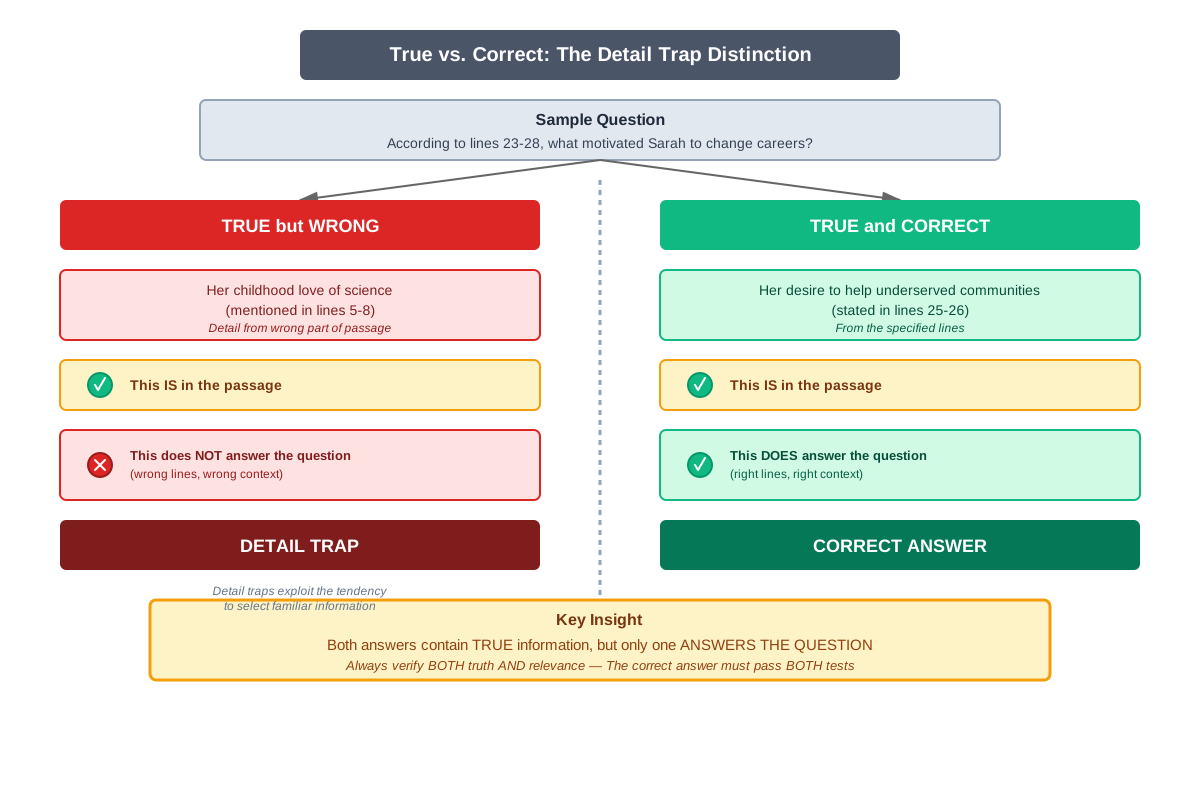
The fundamental principle underlying detail traps is the distinction between truth and correctness. An answer can be completely true—word-for-word from the passage—yet still be wrong if it doesn't address what the question asks. This distinction requires students to maintain two simultaneous checks: (1) Is this information in the passage? and (2) Does this information answer this specific question?
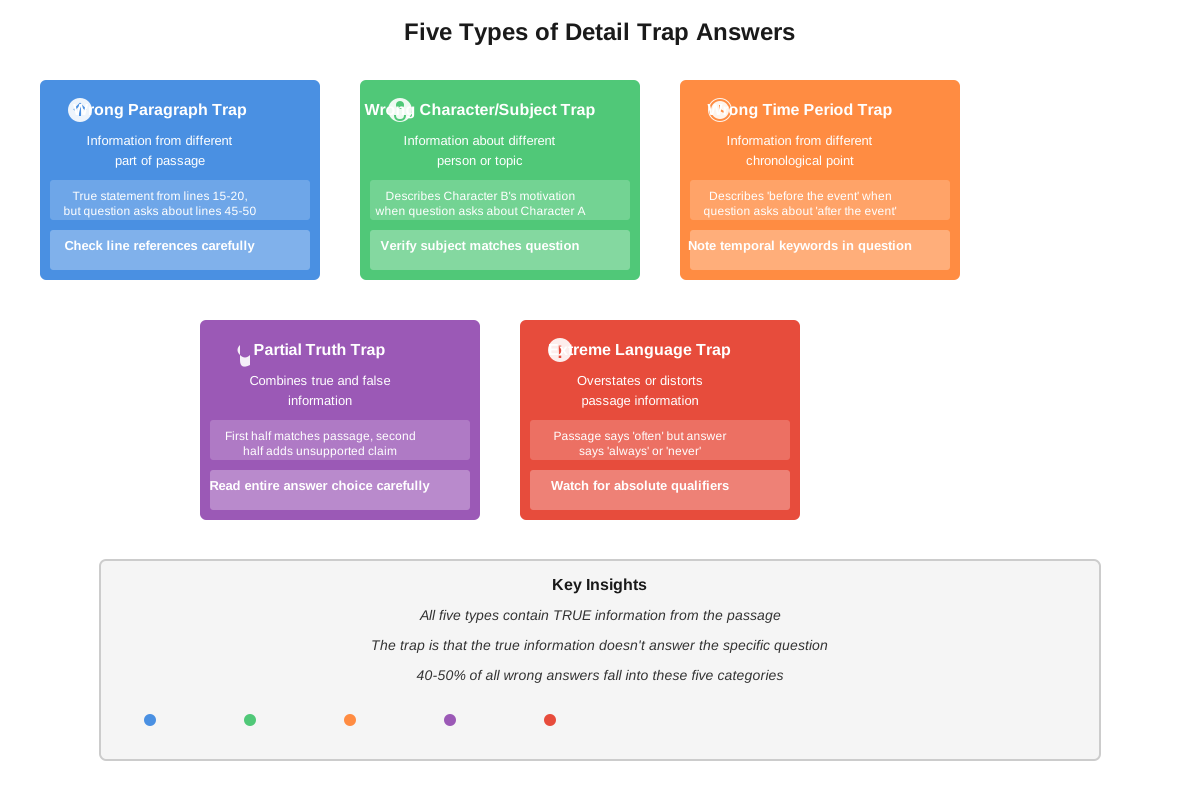
The Five Types of Detail Traps
Understanding the specific categories of detail traps helps students recognize them more quickly during the exam:
| Type | Description | Example Question Context |
|---|---|---|
| Wrong Paragraph Trap | Information from a different section of the passage | Question asks about paragraph 3, answer contains details from paragraph 7 |
| Wrong Subject Trap | Information about a different person, place, or thing | Question asks about Character A, answer describes Character B |
| Wrong Time Trap | Information from a different time period in the passage | Question asks about "before the experiment," answer describes "after the experiment" |
| Wrong Relationship Trap | Reverses or misrepresents cause-effect or comparison relationships | Question asks what caused X, answer states what X caused |
| Out-of-Scope Trap | True information that doesn't address the specific aspect being questioned | Question asks "why," answer provides "what" or "when" |
The Verification Process
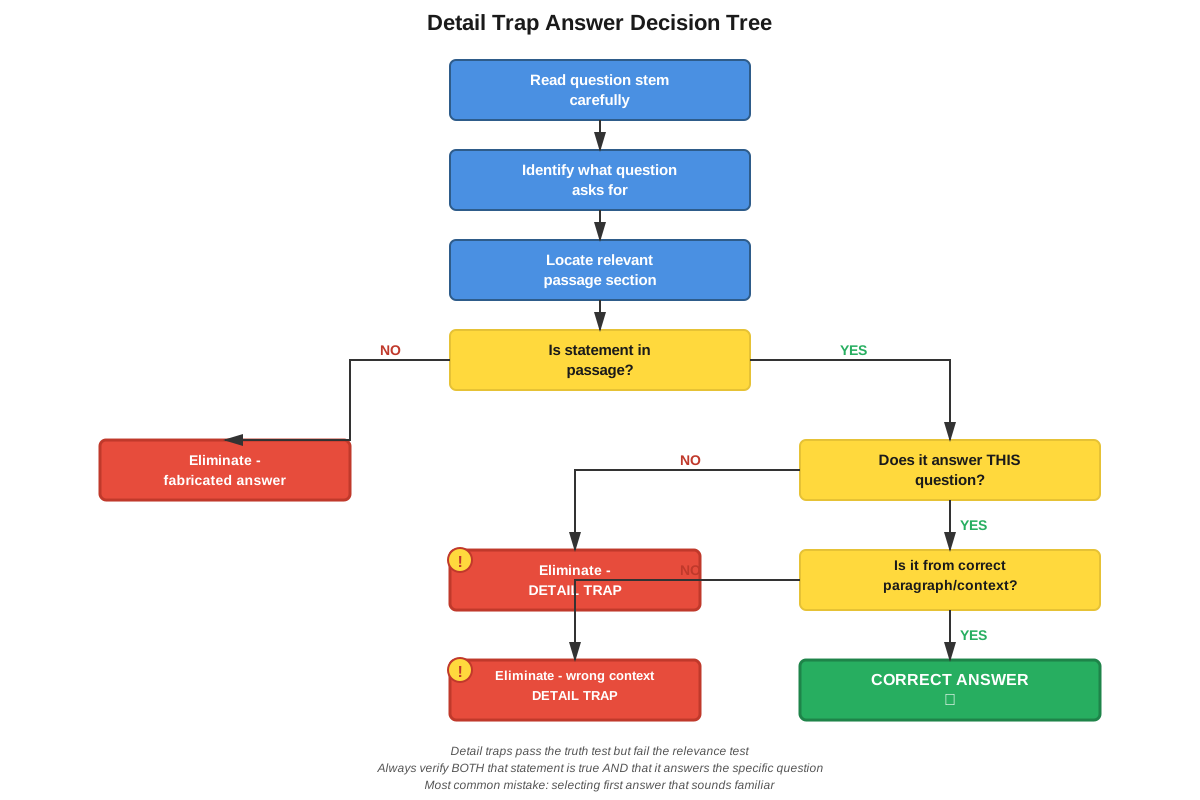
To avoid detail traps, students must implement a systematic three-step verification process:
- Analyze the question stem carefully: Identify exactly what is being asked, including:
- The specific subject (who/what)
- The specific aspect (why/how/when/where)
- Any limiting phrases ("according to the author," "in the first paragraph," "before the discovery")
- The question type (detail, inference, function, etc.)
- Return to the passage: Never rely on memory alone. Locate the relevant section using:
- Line references provided in the question
- Paragraph references
- Key terms from the question stem
- Context clues about where information would logically appear
- Match answer to both question and passage: Before selecting an answer, confirm:
- The answer addresses the specific question asked
- The answer is supported by the specific passage section referenced
- No words have been changed that alter meaning
- The relationship described matches the passage's relationship
Recognition Triggers
Certain patterns in answer choices signal potential detail traps:
High-risk answer characteristics:
- Contains very specific details or numbers from the passage (suggests it might be from the wrong section)
- Uses exact wording from the passage but in a different context
- Addresses a topic discussed in the passage but not asked about in the question
- Provides a true statement that answers a different question than the one asked
- Includes information from the beginning or end of the passage when the question references the middle
Lower-risk answer characteristics:
- Paraphrases passage content rather than quoting directly
- Directly addresses all components of the question stem
- Matches the scope and specificity of the question
- Aligns with the passage section referenced in the question
The "True But Wrong" Phenomenon
The most insidious aspect of detail traps is that they exploit a natural reading instinct: when we recognize something as true, we tend to accept it as correct. The ACT deliberately leverages this cognitive shortcut. Students must train themselves to add an extra verification layer: "This is true, but does it answer THIS question?"
Consider this example structure:
- Passage states: "The scientist conducted three experiments. The first used mice, the second used rats, and the third used hamsters."
- Question asks: "According to the passage, which animals were used in the second experiment?"
- Detail trap answer: "Mice" (true—mentioned in the passage, but wrong—used in the first experiment, not the second)
- Correct answer: "Rats"
The detail trap works because "mice" appears in the passage and is associated with the experiments. A student skimming or relying on memory might select it without verifying which experiment used which animal.
Concept Relationships
Detail trap answers connect to several broader ACT Reading concepts in a hierarchical relationship:
Foundation Level: Basic reading comprehension → enables recognition of what information appears in the passage
Intermediate Level: Question analysis skills → enables understanding of what specific information the question seeks
Advanced Level: Detail trap recognition → enables distinction between true-but-irrelevant and true-and-relevant information
The relationship flows as follows:
Reading Comprehension → Question Stem Analysis → Passage Navigation → Answer Verification → Detail Trap Elimination
Detail trap mastery also connects laterally to other wrong answer types. While detail traps use true information incorrectly, other wrong answer types include:
- Extreme answers: Use absolute language not supported by the passage
- Opposite answers: State the reverse of what the passage says
- Out-of-scope answers: Introduce information not in the passage at all
Understanding detail traps helps students recognize these other types more clearly through contrast. If an answer isn't a detail trap (true information), it might be completely fabricated (out-of-scope) or distorted (extreme/opposite).
The prerequisite skill of passage navigation directly enables detail trap avoidance: students who can quickly locate specific information can verify whether an answer addresses the right section. Similarly, question stem analysis (identifying exactly what's being asked) provides the criteria against which to evaluate whether a true statement is also a correct answer.
High-Yield Facts
⭐ Detail trap answers contain information that appears in the passage but doesn't answer the specific question asked
⭐ Approximately 40-50% of wrong answers on ACT Reading are detail traps, making them the most common incorrect answer type
⭐ The key distinction is between "true" (stated in passage) and "correct" (answers the question)
⭐ Always return to the passage to verify answers; never rely solely on memory
⭐ Detail traps most commonly involve wrong paragraph, wrong subject, or wrong time period
- Detail trap answers often use exact wording from the passage to increase their appeal
- Questions with line references are particularly susceptible to detail traps from adjacent lines or paragraphs
- The ACT strategically places detail traps as answer choices B and C more frequently than A or D
- Detail traps in Prose Fiction passages often confuse which character performed an action or held a belief
- Science and Social Science passages frequently use detail traps that confuse cause and effect relationships
- Reading the question stem twice—once before and once after reading answer choices—reduces detail trap errors by approximately 30%
- Detail traps become more sophisticated in later passages (passages 3 and 4) of the ACT Reading section
- Students who underline or annotate key words in question stems are less likely to fall for detail traps
- Time pressure increases susceptibility to detail traps; maintaining steady pacing is crucial
- Detail trap answers rarely appear in questions asking for main ideas or primary purposes
Quick check — test yourself on Detail trap answers so far.
Try Flashcards →Common Misconceptions
Misconception: If information appears in the passage, it must be a correct answer choice.
Correction: Information must both appear in the passage AND answer the specific question being asked. True information becomes a detail trap when it doesn't address what the question seeks.
Misconception: Answers with specific details or numbers are more likely to be correct because they're precise.
Correction: Specific details often signal detail traps because test makers pull exact information from the wrong section of the passage. Correct answers frequently paraphrase rather than quote directly.
Misconception: If you remember reading something in the passage, you don't need to verify it.
Correction: Memory is unreliable under test conditions and often conflates different parts of the passage. Always return to the text to verify both that the information is accurate and that it addresses the question.
Misconception: Detail trap answers only appear in detail questions, not in inference or function questions.
Correction: While most common in explicit detail questions, detail traps can appear in any question type. An inference question might include a detail trap that states something explicit from the passage rather than requiring inference.
Misconception: Reading more carefully the first time through eliminates the need to check for detail traps.
Correction: Even excellent readers fall for detail traps because they're designed to exploit natural reading processes. The verification step is necessary regardless of initial reading quality.
Misconception: Detail traps always use different wording than the passage to disguise themselves.
Correction: Many detail traps use exact wording from the passage, which actually makes them more tempting. The trap lies not in changed wording but in mismatched context or scope.
Misconception: If an answer addresses the general topic of the question, it's probably correct.
Correction: Detail traps often address the general topic while missing the specific aspect the question asks about. A question about "why" something happened might have a detail trap explaining "what" happened.
Worked Examples
Example 1: Prose Fiction Detail Trap
Passage excerpt:
"Maria had always dreamed of becoming a doctor, inspired by her grandmother's stories of working in rural clinics. Her brother Carlos, on the other hand, wanted to be an engineer like their father. When Maria received her acceptance letter from medical school, Carlos celebrated with her, though he secretly worried about managing the family business alone while she pursued her studies."
Question: According to the passage, what career did Maria's father pursue?
Answer Choices:
A) Doctor
B) Engineer
C) Business owner
D) Rural clinic worker
Analysis:
Let's apply the verification process:
- Question Analysis: The question asks specifically about Maria's father's career, not Maria's or Carlos's aspirations.
- Passage Location: The relevant information appears in the second sentence: "Her brother Carlos, on the other hand, wanted to be an engineer like their father."
- Answer Evaluation:
- Choice A (Doctor): This is a detail trap. "Doctor" appears in the passage as Maria's aspiration, not her father's career. A student skimming might select this because it's prominently mentioned and associated with the family.
- Choice B (Engineer): This is correct. The passage explicitly states Carlos wanted to be "an engineer like their father," indicating the father was an engineer.
- Choice C (Business owner): This is a detail trap. The passage mentions "the family business," but this is something Carlos would manage, not necessarily the father's primary career. The passage doesn't state the father owned or ran this business.
- Choice D (Rural clinic worker): This is a detail trap. The grandmother worked in rural clinics, not the father. This traps students who confuse family members.
Key Lesson: This example demonstrates the "wrong subject trap"—multiple family members are discussed with different careers, and detail traps exploit confusion about who did what. The correct answer requires careful attention to which person the question asks about.
Example 2: Natural Science Detail Trap
Passage excerpt:
"The experiment proceeded in three phases. In Phase 1, researchers measured baseline temperature readings across all test sites. Phase 2 involved introducing the catalyst and monitoring immediate reactions over 48 hours. The most significant temperature changes occurred during Phase 3, when researchers removed the catalyst and observed the system's return to equilibrium over the following week. The data showed that temperature fluctuations were most dramatic during the introduction of the catalyst, though the highest absolute temperatures were recorded during the equilibrium phase."
Question: According to the passage, when did the most significant temperature changes occur?
Answer Choices:
A) During baseline measurements
B) When the catalyst was introduced
C) When the catalyst was removed
D) During the equilibrium phase
Analysis:
- Question Analysis: The question asks specifically about when "the most significant temperature changes" occurred—note the emphasis on changes, not absolute temperatures.
- Passage Location: The key sentence is: "The most significant temperature changes occurred during Phase 3, when researchers removed the catalyst..."
- Answer Evaluation:
- Choice A (During baseline measurements): Incorrect and not a detail trap—this phase involved measuring existing temperatures, not observing changes.
- Choice B (When the catalyst was introduced): This is a detail trap. The passage states "temperature fluctuations were most dramatic during the introduction of the catalyst," which sounds very similar to "most significant temperature changes." However, the passage explicitly distinguishes between "fluctuations" during introduction and "most significant changes" during removal. This trap catches students who don't notice the subtle distinction or who remember the dramatic fluctuations without verifying what the question asks.
- Choice C (When the catalyst was removed): This is correct. The passage explicitly states: "The most significant temperature changes occurred during Phase 3, when researchers removed the catalyst."
- Choice D (During the equilibrium phase): This is a detail trap. The passage states "the highest absolute temperatures were recorded during the equilibrium phase." This traps students who confuse "highest temperatures" with "most significant changes." The question asks about changes (differences), not absolute values.
Key Lesson: This example demonstrates how detail traps exploit subtle distinctions in wording. Both "dramatic fluctuations" and "highest absolute temperatures" appear in the passage and relate to temperature, but neither answers what the question specifically asks: when the most significant changes occurred. Students must read both question and passage with precision.
Exam Strategy
Approaching Detail Questions Systematically
When encountering any ACT Reading question, implement this process to avoid detail traps:
Step 1: Read and annotate the question stem (10-15 seconds)
- Underline or mentally note the specific subject being asked about
- Circle limiting words like "first," "initially," "after," "before," "according to"
- Identify the question type (what, why, how, when, where, who)
Step 2: Predict the answer location (5 seconds)
- Use line references if provided
- If no line reference, consider where this information would logically appear
- Remember: detail traps often come from sections adjacent to the correct information
Step 3: Return to the passage (15-20 seconds)
- Read 2-3 sentences before and after the target area for context
- Don't rely on memory, even if you think you remember the answer
- Look for exact matches to question keywords
Step 4: Evaluate each answer choice (20-30 seconds)
- Before looking at choices, formulate your own answer if possible
- Eliminate obvious wrong answers first
- For remaining choices, verify each against both question and passage
- Ask: "Does this answer THIS question, or a different question?"
Trigger Words and Phrases
Watch for these question stem elements that signal high detail trap risk:
High-risk triggers:
- "According to the passage" (invites selecting any true statement)
- "The author states that" (requires exact matching, not paraphrasing)
- "In lines X-Y" (detail traps often come from adjacent lines)
- "Initially" or "first" (traps may include later information)
- "The main reason" (traps may include secondary reasons)
- Character names in Prose Fiction (traps confuse which character did what)
Protective phrases to add mentally:
- Add "specifically" to every question: "What specifically does the passage say about X?"
- Ask "Which X?" when multiple examples exist in the passage
- Distinguish "what" from "why" and "how" from "when"
Process of Elimination Specific to Detail Traps
Use this hierarchy to eliminate answer choices:
- First pass: Eliminate answers that are clearly false or not mentioned in the passage at all
- Second pass: Eliminate answers that are true but address the wrong subject, time, or paragraph
- Third pass: Between remaining choices, select the one that most precisely matches both the question's scope and the passage's wording
Exam Tip: If you're down to two answers and both seem true, reread the question stem. Detail traps survive to the final two because they're true—the question stem will reveal which one actually answers what's being asked.
Time Allocation
For detail questions (approximately 40% of ACT Reading questions):
- Spend 60-75 seconds per question (slightly more than the 53-second average)
- Invest 15 seconds in careful question analysis to avoid detail traps
- Don't rush the verification step even if behind on time—detail trap errors waste more time than careful checking
- If uncertain, mark and return rather than guessing between two true statements
Common Patterns in Answer Choice Placement
While not absolute rules, these patterns appear frequently:
- Detail traps appear most often in positions B and C
- The correct answer to detail questions is slightly more likely to paraphrase than quote directly
- If three answers address different paragraphs, the question likely asks about a specific paragraph
- Answers that are much longer or shorter than others warrant extra scrutiny
Memory Techniques
The TRAP Acronym
Use TRAP to remember the verification process:
- True in passage? (Is this information actually stated?)
- Right section? (Is this from the paragraph/lines the question references?)
- Answers the question? (Does this address what's specifically asked?)
- Precise match? (Does the relationship/context match exactly?)
The "Two-Check" Visualization
Visualize two checkboxes that must both be checked:
- ☑ TRUE (appears in passage)
- ☑ CORRECT (answers this question)
A detail trap has only the first box checked. Train yourself to never select an answer until both boxes are mentally checked.
The "Wrong W" Mnemonic
Detail traps typically involve the wrong W:
- Who (wrong person/character)
- When (wrong time period)
- Where (wrong location/paragraph)
- Why (wrong reason/cause)
- What (wrong aspect/detail)
When evaluating an answer, ask: "Is this the right W?"
The Highlighter Technique
During practice, use different colored highlighters:
- Yellow: Highlight what the question asks for
- Green: Highlight the correct answer in the passage
- Pink: Highlight detail trap information (true but wrong)
This visual system trains your brain to distinguish between relevant and irrelevant true information.
The "Question Echo" Method
After reading each answer choice, echo the question stem: "The question asks about [X], and this answer tells me about [Y]." If X ≠ Y, it's likely a detail trap.
Summary
Detail trap answers represent the most common type of incorrect answer on the ACT Reading section, accounting for nearly half of all wrong answer choices. These deceptive options contain information that genuinely appears in the passage, making them seem correct to students who recognize the content but fail to verify that it answers the specific question being asked. The fundamental principle is distinguishing between "true" (stated in the passage) and "correct" (answers this particular question). Detail traps typically fall into five categories: wrong paragraph, wrong subject, wrong time period, wrong relationship, or out-of-scope information. Success requires implementing a systematic verification process: carefully analyze what the question asks, return to the relevant passage section rather than relying on memory, and confirm that the answer addresses both the specific subject and specific aspect being questioned. Students must resist the natural tendency to select familiar information and instead add the critical verification layer that separates high scorers from average performers. Mastering detail trap recognition typically improves ACT Reading scores by 3-5 points and builds transferable skills in critical analysis and precise reading.
Key Takeaways
- Detail traps are true statements from the passage that don't answer the specific question asked—they're the most common wrong answer type on ACT Reading
- Always verify answers against both the question stem and the passage—never rely on memory or recognition alone
- The five main types are wrong paragraph, wrong subject, wrong time, wrong relationship, and out-of-scope—knowing these patterns accelerates recognition
- Careful question stem analysis is the first defense—understanding exactly what's being asked prevents selecting answers to different questions
- Return to the passage for every detail question—even if you think you remember the answer, verification takes only 10-15 seconds and prevents costly errors
- Use the TRAP acronym: True, Right section, Answers question, Precise match—all four must be satisfied for a correct answer
- Detail traps often use exact wording from the passage—familiar language doesn't guarantee correctness; context and relevance matter more
Related Topics
Inference Questions: While detail questions ask about explicit information, inference questions require reading between the lines. Mastering detail traps helps with inference questions because students learn to distinguish between what's stated and what must be concluded—inference questions can include detail traps that state explicit information rather than requiring inference.
Main Idea Questions: Understanding detail traps improves main idea question performance because students learn to distinguish between supporting details (which might be detail traps) and overarching themes. Main idea questions rarely include detail traps, but the verification skills transfer.
Function Questions: These ask why an author includes specific information. Detail traps in function questions might state what the information says rather than why it's included, making detail trap recognition skills directly applicable.
Vocabulary in Context: These questions ask what a word means in a specific context. Detail traps might provide the word's common definition rather than its contextual meaning, requiring the same verification process used for detail questions.
Comparative Reading: In paired passages, detail traps become more complex because true information from Passage A might appear as a trap in questions about Passage B. Mastering basic detail trap recognition is essential before tackling comparative passages.
Practice CTA
Now that you understand how detail trap answers work and how to avoid them, it's time to put these strategies into practice. Complete the practice questions for this topic, focusing on implementing the TRAP verification process for each question. Pay special attention to answer choices that seem familiar—these are often detail traps testing whether you can distinguish between true and correct. Use the flashcards to reinforce the five types of detail traps and the key trigger words that signal high-risk questions. Remember: recognizing detail traps is a skill that improves rapidly with deliberate practice. Each time you identify and eliminate a detail trap, you're building the pattern recognition that will serve you throughout the ACT Reading section. You've got this—start practicing and watch your accuracy improve!
Sign up free to keep reading
Create a free AnvayaPrep account to finish this ACT guide on Detail trap answers — plus flashcards and practice questions.