Overview
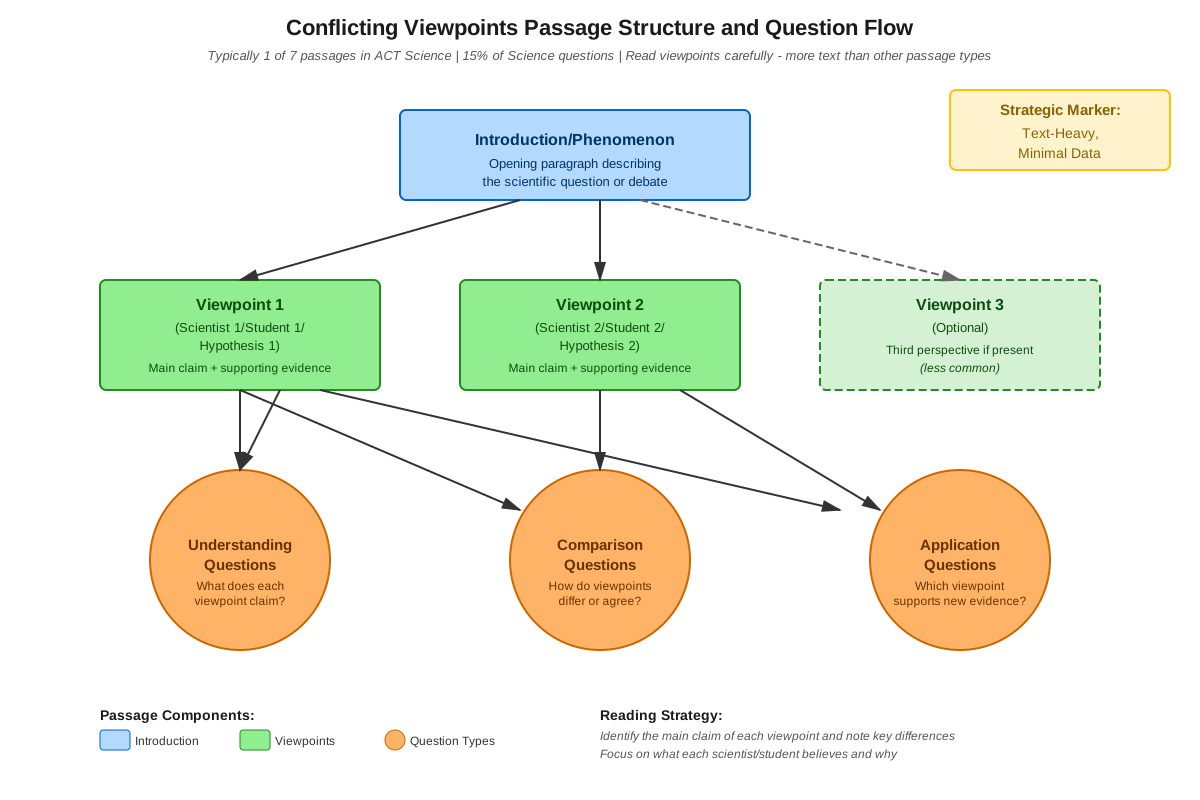
The ACT conflicting viewpoints strategy is one of the most critical skills for success on the ACT Science section. Unlike the Research Summaries and Data Representation passages that focus on experimental design and data interpretation, Conflicting Viewpoints passages present two or more competing scientific hypotheses, theories, or perspectives on a single phenomenon. These passages typically comprise one of the seven passages in the Science section and account for approximately 15% of all Science questions. Mastering this passage type requires a distinct approach that emphasizes reading comprehension, comparative analysis, and the ability to distinguish between different scientific arguments.
The fundamental challenge of Conflicting Viewpoints passages lies in their unique structure: students must quickly identify the core claims of each scientist, student, or hypothesis, understand the evidence or reasoning supporting each position, and recognize the key differences between viewpoints. Unlike other Science passages where data tables and graphs dominate, these passages are predominantly text-based, making them more similar to Reading Comprehension passages but with scientific content. Success requires not just understanding what each viewpoint claims, but also why they differ and what specific evidence or assumptions underlie each position.
Within the broader ACT Science curriculum, the ACT conflicting viewpoints strategy serves as a bridge between pure data analysis skills and critical thinking about scientific argumentation. This topic connects to fundamental scientific literacy—the ability to evaluate competing claims, identify supporting evidence, and understand that science often involves debate and multiple interpretations of phenomena. Students who excel at Conflicting Viewpoints passages demonstrate sophisticated analytical skills that extend beyond memorizing facts to genuinely understanding how scientists construct and defend arguments.
Learning Objectives
- [ ] Identify when ACT conflicting viewpoints strategy is being tested
- [ ] Explain the core rule or strategy behind ACT conflicting viewpoints strategy
- [ ] Apply ACT conflicting viewpoints strategy to ACT-style questions accurately
- [ ] Distinguish between the main claims and supporting evidence within each viewpoint
- [ ] Compare and contrast multiple scientific perspectives systematically
- [ ] Predict which viewpoint would support or oppose a given statement or new piece of evidence
- [ ] Synthesize information across viewpoints to answer questions requiring integration
Prerequisites
- Basic scientific vocabulary: Understanding common scientific terms enables faster comprehension of technical passages without getting stuck on terminology
- Reading comprehension skills: The ability to identify main ideas, supporting details, and logical structure in expository text is essential since these passages are text-heavy
- Familiarity with scientific reasoning: Recognizing how evidence supports conclusions and understanding cause-and-effect relationships helps students follow each scientist's logic
- Basic knowledge of scientific method: Understanding hypotheses, theories, and how scientists use evidence to support claims provides context for why viewpoints might differ
Why This Topic Matters
Conflicting Viewpoints passages represent a unique challenge on the ACT Science test because they assess a different skill set than the other passage types. While Research Summaries and Data Representation passages focus on interpreting graphs, tables, and experimental procedures, Conflicting Viewpoints passages evaluate students' ability to understand scientific argumentation and compare theoretical positions. This mirrors real-world scientific practice, where researchers often disagree about interpretations of data, mechanisms underlying phenomena, or predictions about future observations.
On the ACT, Conflicting Viewpoints passages typically appear once per test, containing 6-7 questions worth approximately 10-12% of the total Science score. These passages are often placed strategically within the test—sometimes early to challenge students immediately, sometimes late when fatigue sets in. The questions associated with these passages fall into predictable categories: identifying what each viewpoint claims, determining points of agreement or disagreement, predicting how each scientist would respond to new information, and occasionally synthesizing information across viewpoints.
The practical significance extends beyond test-taking. In academic and professional contexts, the ability to understand multiple perspectives on complex issues, identify the crux of disagreements, and evaluate competing claims based on evidence is invaluable. Whether reading scientific literature, evaluating health information, or making informed decisions about technology and policy, these critical thinking skills prove essential. Students who master this strategy develop analytical capabilities that serve them throughout their educational careers and beyond.
Core Concepts
Structure of Conflicting Viewpoints Passages
Conflicting Viewpoints passages follow a consistent organizational pattern that students can leverage for efficient reading. The passage begins with an introductory paragraph providing background information about the phenomenon under discussion. This introduction establishes the context and often defines key terms that both viewpoints will reference. Following the introduction, the passage presents two, three, or occasionally four distinct viewpoints, each labeled clearly (e.g., "Scientist 1," "Student 1," "Hypothesis A").
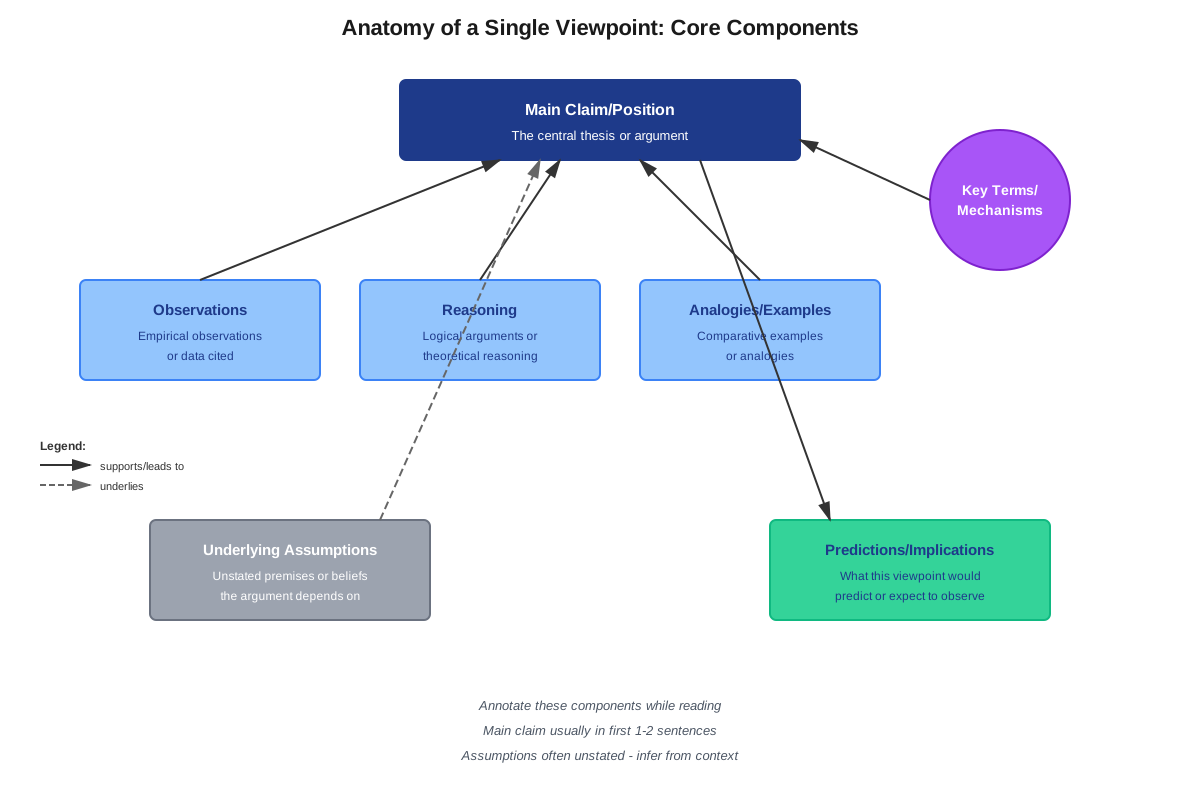
Each viewpoint section contains three essential components: the main claim or thesis, the reasoning or mechanism explaining the phenomenon, and supporting evidence or examples. The main claim typically appears in the first sentence or two of each viewpoint and states the scientist's position on the central question. The reasoning section explains why the scientist holds this position, often describing underlying mechanisms or processes. The supporting evidence may include references to observations, experimental results, logical arguments, or theoretical considerations.
Understanding this structure allows students to read strategically rather than passively absorbing information. By actively identifying these three components for each viewpoint, students create a mental framework that makes answering questions significantly easier.
The Core Strategy: Active Annotation and Comparison
The ACT conflicting viewpoints strategy centers on active reading with systematic comparison. Rather than reading each viewpoint in isolation, successful students constantly compare and contrast as they read. This involves three key steps executed simultaneously:
Step 1: Identify the Core Claim - As you begin each viewpoint, immediately identify and mentally note (or physically underline) the main thesis. Ask yourself: "What is this scientist's answer to the central question?" This claim should be expressible in a single sentence.
Step 2: Map the Supporting Structure - As you continue reading, identify what evidence or reasoning supports the claim. Look for phrases like "because," "evidence shows," "this explains," or "therefore" that signal supporting material. Note whether the support comes from observations, experiments, logical reasoning, or theoretical frameworks.
Step 3: Note Points of Difference - Actively compare each new viewpoint to previous ones. Ask: "How does this differ from what Scientist 1 said?" "Do they disagree about the cause, the effect, the mechanism, or the interpretation?" "What specific aspect of the phenomenon do they explain differently?"
This three-step process transforms passive reading into active analysis, ensuring students understand not just what each scientist says, but how the viewpoints relate to each other.
Types of Questions in Conflicting Viewpoints Passages
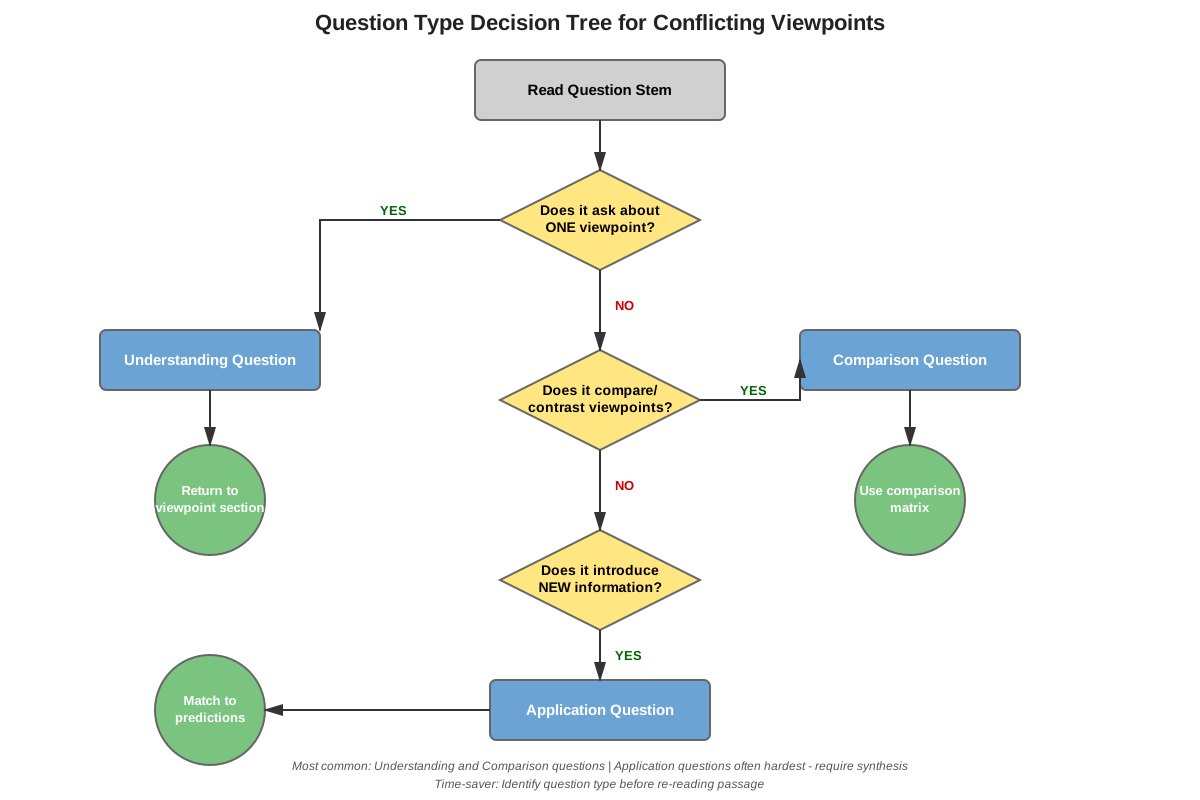
Questions associated with these passages fall into five predictable categories, each requiring specific approaches:
| Question Type | What It Asks | Strategy |
|---|---|---|
| Direct Comprehension | What does Scientist X claim/believe? | Return to that viewpoint; answer is usually explicitly stated |
| Comparison | How do the viewpoints differ/agree? | Compare specific aspects; look for contrasting statements |
| New Information | How would Scientist X respond to this new evidence? | Determine if new info supports or contradicts their claim |
| Prediction | What would Scientist X predict about...? | Extend their reasoning to the new scenario |
| Synthesis | Which statement is consistent with both/all viewpoints? | Find common ground or areas of agreement |
Direct Comprehension questions are the most straightforward, asking students to identify what a specific scientist claims or believes. These questions can usually be answered by returning to the relevant viewpoint and finding the explicit statement. The key is knowing exactly where to look—understanding the passage structure makes this efficient.
Comparison questions require students to identify similarities or differences between viewpoints. These questions might ask "On which point do Scientists 1 and 2 disagree?" or "Which aspect of the phenomenon do all three hypotheses explain differently?" Success requires having mentally noted the key differences while reading.
New Information questions present a hypothetical scenario, new piece of evidence, or additional observation and ask how it relates to one or more viewpoints. Students must determine whether the new information supports, contradicts, or is irrelevant to each viewpoint's claims. This requires understanding not just what each scientist claims, but why they claim it.
Prediction questions ask students to extend a viewpoint's reasoning to a new situation. For example: "Based on Scientist 2's hypothesis, what would happen if temperature increased?" These questions test whether students understand the underlying logic and mechanisms, not just the specific claims made in the passage.
Synthesis questions are the most challenging, requiring students to find information that applies across multiple viewpoints or to identify areas of agreement. These questions might ask "Which statement would both scientists accept?" or "What assumption do all three hypotheses share?"
Reading Efficiency Techniques
Time management is crucial for ACT Science success, and Conflicting Viewpoints passages require a different reading approach than other passage types. The optimal strategy involves spending slightly more time reading carefully upfront (approximately 2-3 minutes) to save time when answering questions.
Strategic reading order matters significantly. Always read the introduction carefully—it provides essential context and defines terms that appear throughout. Then, read each viewpoint systematically, applying the three-step active annotation process. Resist the temptation to skim; these passages require genuine comprehension, not just data extraction.
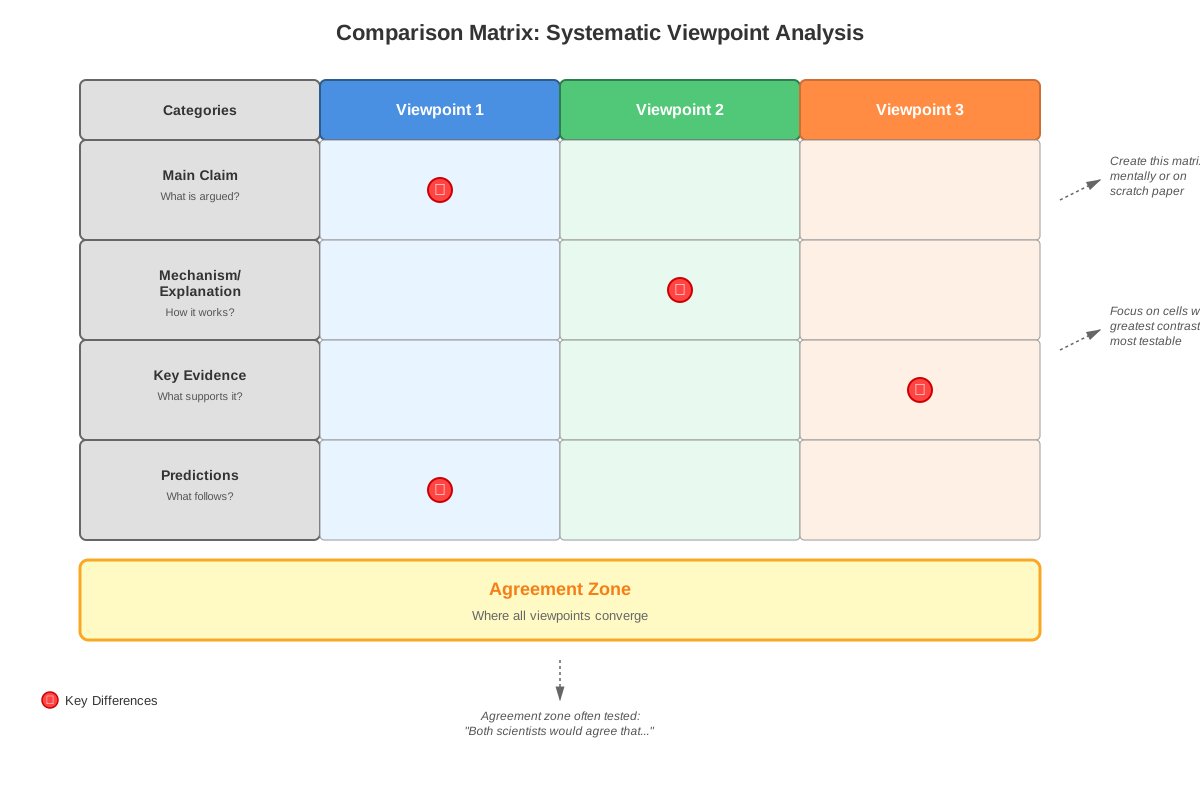
Marking the passage effectively enhances efficiency. Even though the ACT is now computer-based in many locations, students can still use scratch paper to create a quick comparison chart. A simple three-column table with "Scientist 1," "Scientist 2," and "Scientist 3" as headers, with rows for "Main Claim," "Key Evidence," and "Mechanism/Reasoning" provides an invaluable reference when answering questions.
Identifying transition words and phrases helps students navigate the logical structure. Words like "however," "in contrast," "alternatively," and "on the other hand" signal differences between viewpoints. Phrases like "because," "therefore," "this explains," and "evidence shows" indicate supporting reasoning. Recognizing these linguistic markers accelerates comprehension.
Common Patterns in Viewpoint Disagreements
Scientists in these passages typically disagree in predictable ways, and recognizing these patterns helps students anticipate questions and organize their understanding:
Disagreement about cause: The viewpoints agree on what happens but disagree about why it happens. For example, all scientists might agree that a population declined, but Scientist 1 attributes it to disease while Scientist 2 blames habitat loss.
Disagreement about mechanism: The viewpoints agree on the overall phenomenon but propose different processes or mechanisms. For instance, both scientists might agree that a chemical reaction occurs, but propose different intermediate steps.
Disagreement about interpretation: The viewpoints acknowledge the same data but interpret its significance differently. One scientist might view an observation as evidence for their theory while another considers it irrelevant or explainable by alternative means.
Disagreement about scope or conditions: The viewpoints might agree in general but disagree about when, where, or under what conditions the phenomenon occurs. For example, one hypothesis might claim a process occurs universally while another argues it only happens under specific circumstances.
Identifying which type of disagreement exists helps students predict question types and locate relevant information quickly.
Concept Relationships
The ACT conflicting viewpoints strategy integrates multiple cognitive skills into a cohesive approach. At the foundation lies reading comprehension—the ability to extract main ideas and supporting details from expository text. This connects directly to comparative analysis, where students must hold multiple viewpoints in mind simultaneously and identify their relationships. Comparative analysis then enables prediction and synthesis, the highest-level skills tested in these passages.
The relationship flows as follows: Reading Comprehension → Identification of Core Claims → Mapping of Supporting Evidence → Comparative Analysis → Application to New Scenarios → Synthesis Across Viewpoints. Each step builds on the previous one, creating a hierarchy of skills where mastery of earlier steps is essential for success with later ones.
This strategy also connects to prerequisite knowledge of scientific reasoning. Understanding how scientists construct arguments—moving from observations to hypotheses to theories—provides the framework for comprehending why viewpoints differ. The scientific method's emphasis on evidence-based reasoning underlies every Conflicting Viewpoints passage, even when not explicitly mentioned.
Furthermore, the skills developed through this strategy transfer to other ACT Science passage types. The ability to identify main ideas helps with understanding experimental purposes in Research Summaries passages. The comparative analysis skills apply when comparing different experiments or conditions. The attention to detail and systematic approach benefits all Science passage types, making Conflicting Viewpoints strategy a cornerstone of overall Science section success.
High-Yield Facts
⭐ Conflicting Viewpoints passages always appear exactly once per ACT Science test, containing 6-7 questions
⭐ The introduction paragraph contains essential context and definitions that apply to all viewpoints—never skip it
⭐ Each viewpoint's main claim typically appears in the first 1-2 sentences of that viewpoint's section
⭐ Questions asking "On which point do the scientists disagree?" require identifying the specific aspect where viewpoints differ, not just noting that they disagree
⭐ When a question presents new information, determine whether it supports, contradicts, or is neutral to each viewpoint's core claim
- Viewpoints are always clearly labeled (Scientist 1, Student A, Hypothesis 1, etc.) making navigation straightforward
- Agreement questions are less common than disagreement questions but require careful reading since scientists often agree on basic facts while disagreeing on interpretations
- The passage will never require outside scientific knowledge beyond basic vocabulary—all necessary information is provided
- Time allocation should be approximately 5-6 minutes total per Conflicting Viewpoints passage (2-3 minutes reading, 3 minutes answering questions)
- Creating a simple comparison chart on scratch paper before answering questions saves time and reduces errors
- Questions are not ordered by difficulty or by viewpoint—they may jump between scientists randomly
- "According to Scientist X" questions can always be answered by returning to that specific viewpoint section
- Synthesis questions asking what "both scientists would agree" often focus on basic facts stated in the introduction or fundamental observations
Quick check — test yourself on ACT conflicting viewpoints strategy so far.
Try Flashcards →Common Misconceptions
Misconception: Students must have prior knowledge about the scientific topic discussed in the passage to answer questions correctly.
Correction: Conflicting Viewpoints passages are entirely self-contained. All information needed to answer questions appears in the passage itself. The ACT tests reading comprehension and analytical skills, not content knowledge. Students should rely exclusively on the passage text, not outside knowledge that might actually contradict the passage's presentation.
Misconception: Reading all viewpoints before looking at questions wastes time; it's better to read questions first then search for answers.
Correction: Unlike Data Representation passages where this strategy sometimes works, Conflicting Viewpoints passages require understanding the overall structure and relationships between viewpoints. Reading questions first leads to fragmented comprehension and makes comparison questions nearly impossible to answer efficiently. The optimal approach is reading all viewpoints carefully first, then answering questions.
Misconception: If two scientists disagree, they must disagree about everything.
Correction: Scientists in these passages typically agree on many basic facts and observations while disagreeing on specific aspects like causes, mechanisms, or interpretations. Questions often test whether students can distinguish between points of agreement and disagreement. Assuming total disagreement leads to incorrect answers on synthesis and agreement questions.
Misconception: The viewpoint presented first is usually correct or more important.
Correction: The ACT presents viewpoints in neutral fashion without indicating which (if any) is "correct." All viewpoints receive equal treatment and equal numbers of questions. Students should avoid unconsciously favoring the first viewpoint they read or assuming any hierarchy of importance.
Misconception: Longer viewpoints contain more important information than shorter ones.
Correction: Length varies based on complexity of the argument, not importance. A concise viewpoint may be just as significant as a lengthy one. Questions are distributed roughly equally across viewpoints regardless of length. Students should give equal attention to all viewpoints, focusing on understanding core claims rather than passage length.
Misconception: Technical vocabulary indicates which viewpoint is more scientifically valid.
Correction: The ACT sometimes includes technical terms to test reading comprehension, but vocabulary complexity doesn't indicate correctness or importance. All viewpoints are presented as equally valid scientific positions. Students should focus on understanding the logical structure of arguments rather than being intimidated or impressed by technical language.
Worked Examples
Example 1: Identifying Core Claims and Differences
Passage Summary: Three scientists discuss why certain bird populations migrate different distances.
Scientist 1: Birds migrate distances determined primarily by food availability. Species that depend on insects migrate farther because insect populations decline more severely in winter. Birds migrate only as far as necessary to find adequate food sources, explaining why migration distances vary among species with different diets.
Scientist 2: Migration distance is determined by day length sensitivity. Birds possess internal mechanisms that respond to photoperiod changes. Species more sensitive to decreasing day length begin migration earlier and travel farther. Food availability is a secondary factor that may fine-tune migration timing but doesn't determine distance.
Scientist 3: Migration patterns are genetically programmed through evolutionary history. Birds migrate distances that proved optimal for their ancestors' survival. Current food availability and day length may trigger migration timing, but the distance traveled is inherited, not determined by current environmental conditions.
Question: On which point do Scientists 1 and 2 disagree?
Step 1 - Identify each scientist's core claim:
- Scientist 1: Food availability determines migration distance
- Scientist 2: Day length sensitivity determines migration distance
- Scientist 3: Genetic programming determines migration distance
Step 2 - Compare Scientists 1 and 2 specifically:
Both discuss what determines migration distance, but they identify different primary factors. Scientist 1 says food availability is primary; Scientist 2 says day length sensitivity is primary.
Step 3 - Eliminate wrong answers:
- They don't disagree about whether birds migrate (both accept this)
- They don't disagree about whether migration varies by species (both acknowledge this)
- They DO disagree about the primary factor determining migration distance
Answer: Scientists 1 and 2 disagree about what factor primarily determines migration distance—Scientist 1 claims food availability while Scientist 2 claims day length sensitivity.
Connection to Learning Objectives: This example demonstrates identifying when conflicting viewpoints strategy is tested (recognizing a comparison question), explaining the core strategy (systematically comparing specific claims), and applying it accurately (eliminating wrong answers and selecting the precise point of disagreement).
Example 2: Applying Viewpoints to New Information
Passage Summary: Two students debate why a lake's fish population declined.
Student 1: The decline resulted from increased water temperature. Warmer water holds less dissolved oxygen, stressing fish populations. Temperature records show a 3°C increase over the past decade, correlating with population decline. Other lakes in the region with similar temperature increases show similar declines.
Student 2: The decline resulted from introduction of an invasive predator species. The predator was first observed five years ago and has since established a large population. Native fish lack defensive behaviors against this predator. Lakes without the invasive species maintain stable fish populations despite similar temperature changes.
Question: Suppose researchers discover that fish populations in a nearby lake with similar temperature increases but no invasive species remain stable. How does this finding affect each student's hypothesis?
Step 1 - Understand what the new information states:
A lake with temperature increase (like the original lake) but no invasive species (unlike the original lake) has stable fish populations (unlike the original lake).
Step 2 - Evaluate impact on Student 1's hypothesis:
Student 1 claims temperature increase causes decline. The new lake has temperature increase but no decline. This contradicts Student 1's hypothesis—if temperature were the cause, this lake should also show decline. This weakens Student 1's position.
Step 3 - Evaluate impact on Student 2's hypothesis:
Student 2 claims the invasive species causes decline. The new lake lacks the invasive species and shows no decline, which is consistent with Student 2's claim. This supports Student 2's hypothesis—the absence of the invasive species correlates with stable populations.
Step 4 - Formulate complete answer:
The finding weakens Student 1's hypothesis by showing that temperature increase alone doesn't cause decline. The finding strengthens Student 2's hypothesis by demonstrating that lakes without the invasive species maintain stable populations despite temperature changes.
Connection to Learning Objectives: This example shows applying the strategy to predict how new evidence affects each viewpoint, requiring understanding not just what each student claims but why they claim it and what evidence would support or contradict their positions.
Exam Strategy
Approaching Conflicting Viewpoints Passages Systematically
When encountering a Conflicting Viewpoints passage, implement this proven sequence:
First 30 seconds: Identify the passage type by scanning for labeled viewpoints (Scientist 1, Hypothesis A, etc.) and noting the text-heavy format with minimal data tables or graphs. Recognize that this requires the conflicting viewpoints strategy.
Next 2-3 minutes: Read actively using the three-step process. Read the introduction completely, identifying the central phenomenon or question. For each viewpoint, identify and mentally note the core claim, supporting evidence, and reasoning. As you read subsequent viewpoints, actively compare them to previous ones, noting specific differences.
Before answering questions: Take 20-30 seconds to create a mental or written comparison chart. This brief investment pays dividends when answering questions, especially comparison and synthesis questions.
While answering questions: Return to the passage frequently. Even after careful reading, confirming answers by checking the text prevents careless errors. For "According to Scientist X" questions, always verify by finding the relevant statement in that viewpoint's section.
Trigger Words and Phrases
Certain words and phrases signal specific question types and appropriate strategies:
Comparison triggers: "differ," "disagree," "in contrast to," "unlike," "whereas" → These indicate comparison questions requiring identification of specific differences between viewpoints.
Agreement triggers: "both scientists," "all hypotheses," "consistent with," "would agree" → These indicate synthesis questions requiring identification of common ground.
New information triggers: "suppose," "if researchers discovered," "new evidence shows," "which finding would support" → These indicate application questions requiring evaluation of how new information relates to existing viewpoints.
Direct comprehension triggers: "according to," "Scientist X claims," "Hypothesis Y states" → These indicate straightforward comprehension questions answerable by returning to the specified viewpoint.
Process of Elimination Techniques
For Conflicting Viewpoints questions, elimination strategies differ from other Science passage types:
For comparison questions: Eliminate answers that describe differences not actually present in the passage or that misrepresent what a scientist claims. The correct answer must identify a genuine, specific difference explicitly stated or clearly implied in the passage.
For new information questions: Eliminate answers that reverse the relationship (claiming new evidence supports a viewpoint it actually contradicts) or that claim relevance when the new information is actually neutral to a viewpoint's core claim.
For synthesis questions: Eliminate answers that only one viewpoint would support or that contradict any viewpoint. The correct answer must be consistent with all specified viewpoints, often focusing on basic facts or observations rather than interpretations.
For prediction questions: Eliminate answers inconsistent with a viewpoint's underlying mechanism or reasoning, even if they seem superficially related to the topic. The correct answer must logically follow from the viewpoint's explanation of how or why phenomena occur.
Time Allocation
Optimal time management for Conflicting Viewpoints passages differs from other passage types:
- Reading phase: 2-3 minutes (longer than Data Representation but necessary for comprehension)
- Per question: 30-45 seconds (faster than Research Summaries once passage is understood)
- Total passage time: 5-6 minutes (similar to other passage types but with different distribution)
If running short on time, prioritize direct comprehension questions over synthesis questions, as they require less integration and can be answered more quickly by returning to specific viewpoint sections.
Memory Techniques
The CLAIM Acronym for Reading Each Viewpoint
Core thesis - What is the main claim?
Logic and reasoning - Why does the scientist believe this?
Arguments and evidence - What supports the claim?
Identify differences - How does this differ from other viewpoints?
Mark key phrases - Note important statements for reference
This acronym provides a systematic approach to reading each viewpoint section, ensuring no critical element is overlooked.
The "Three Columns" Visualization
Visualize the passage as three columns (for a three-viewpoint passage), each containing three boxes stacked vertically:
Scientist 1    |    Scientist 2    |    Scientist 3
[Main Claim]   |   [Main Claim]    |   [Main Claim]
[Evidence]     |   [Evidence]      |   [Evidence]
[Reasoning]    |   [Reasoning]     |   [Reasoning]
This mental model helps organize information spatially, making comparisons easier and reducing cognitive load when answering questions.
The "Agree-Disagree" Sorting Strategy
For each major aspect of the phenomenon discussed, mentally sort viewpoints into "agree" and "disagree" categories:
- Basic facts: Usually all agree
- Cause of phenomenon: Often disagree
- Mechanism or process: Frequently disagree
- Predictions: May agree or disagree depending on the scenario
This sorting helps anticipate questions and quickly locate relevant information when answering agreement or disagreement questions.
The "If-Then" Chain for Predictions
When facing prediction questions, construct if-then chains based on each viewpoint's reasoning:
"If Scientist 1 is correct that [core claim], then [logical consequence]"
This technique transforms abstract reasoning into concrete predictions, making it easier to evaluate answer choices and extend viewpoints to new scenarios.
Summary
The ACT conflicting viewpoints strategy is essential for success on approximately 15% of ACT Science questions. These passages present multiple scientific perspectives on a single phenomenon, requiring students to identify core claims, understand supporting evidence, and compare viewpoints systematically. The optimal approach involves active reading with continuous comparison, spending 2-3 minutes understanding the passage structure before answering questions. Success requires recognizing five question types—direct comprehension, comparison, new information, prediction, and synthesis—each demanding specific strategies. Students must distinguish between points of agreement and disagreement, understanding that scientists typically agree on basic facts while disagreeing on causes, mechanisms, or interpretations. The strategy emphasizes returning to the passage frequently to verify answers, using trigger words to identify question types, and creating mental or written comparison charts to organize information. Unlike other Science passage types that prioritize data interpretation, Conflicting Viewpoints passages test reading comprehension and analytical reasoning applied to scientific argumentation, making them unique within the Science section but manageable through systematic application of proven strategies.
Key Takeaways
- Conflicting Viewpoints passages appear exactly once per test with 6-7 questions, making them high-value targets for strategic preparation
- The core strategy involves three simultaneous steps: identifying each viewpoint's main claim, mapping supporting evidence, and noting specific differences between viewpoints
- Questions fall into five predictable categories (direct comprehension, comparison, new information, prediction, synthesis), each requiring distinct approaches
- The introduction paragraph provides essential context that applies to all viewpoints and should never be skipped
- Scientists typically agree on basic observations while disagreeing on causes, mechanisms, or interpretations—distinguishing these levels is crucial
- Active reading with comparison takes 2-3 minutes but saves time when answering questions by building comprehensive understanding
- Creating a simple comparison chart before answering questions dramatically improves accuracy and efficiency on comparison and synthesis questions
Related Topics
Research Summaries Passages: These passages present experimental designs and results, requiring interpretation of procedures and data. Mastering Conflicting Viewpoints strategy builds analytical skills that transfer to evaluating experimental logic and comparing different experiments within Research Summaries passages.
Data Representation Passages: These passages focus on interpreting graphs, tables, and charts. While different in format from Conflicting Viewpoints, the systematic approach and attention to detail developed through conflicting viewpoints strategy enhances performance on all passage types.
Scientific Argumentation and Evidence Evaluation: Understanding how scientists construct arguments, use evidence, and respond to counterarguments extends beyond the ACT to college-level science courses and critical thinking in general. The skills developed through this strategy provide foundation for advanced scientific literacy.
Reading Comprehension Strategies: Since Conflicting Viewpoints passages are text-heavy, strategies from ACT Reading—identifying main ideas, understanding paragraph structure, and making inferences—directly apply and can be refined through practice with these Science passages.
Practice CTA
Now that you understand the comprehensive strategy for Conflicting Viewpoints passages, it's time to apply these techniques to actual ACT-style questions. The practice questions and flashcards accompanying this guide provide opportunities to implement the CLAIM acronym, practice the three-step active reading process, and develop speed and accuracy with each question type. Remember that mastery comes through deliberate practice—work through each question systematically, referring back to this guide when needed, and analyze both correct and incorrect answers to understand why each answer choice succeeds or fails. Your investment in mastering this high-yield strategy will pay dividends not just on test day, but in developing critical thinking skills that serve you throughout your academic career. You've got this!
Sign up free to keep reading
Create a free AnvayaPrep account to finish this ACT guide on ACT conflicting viewpoints strategy — plus flashcards and practice questions.