Overview
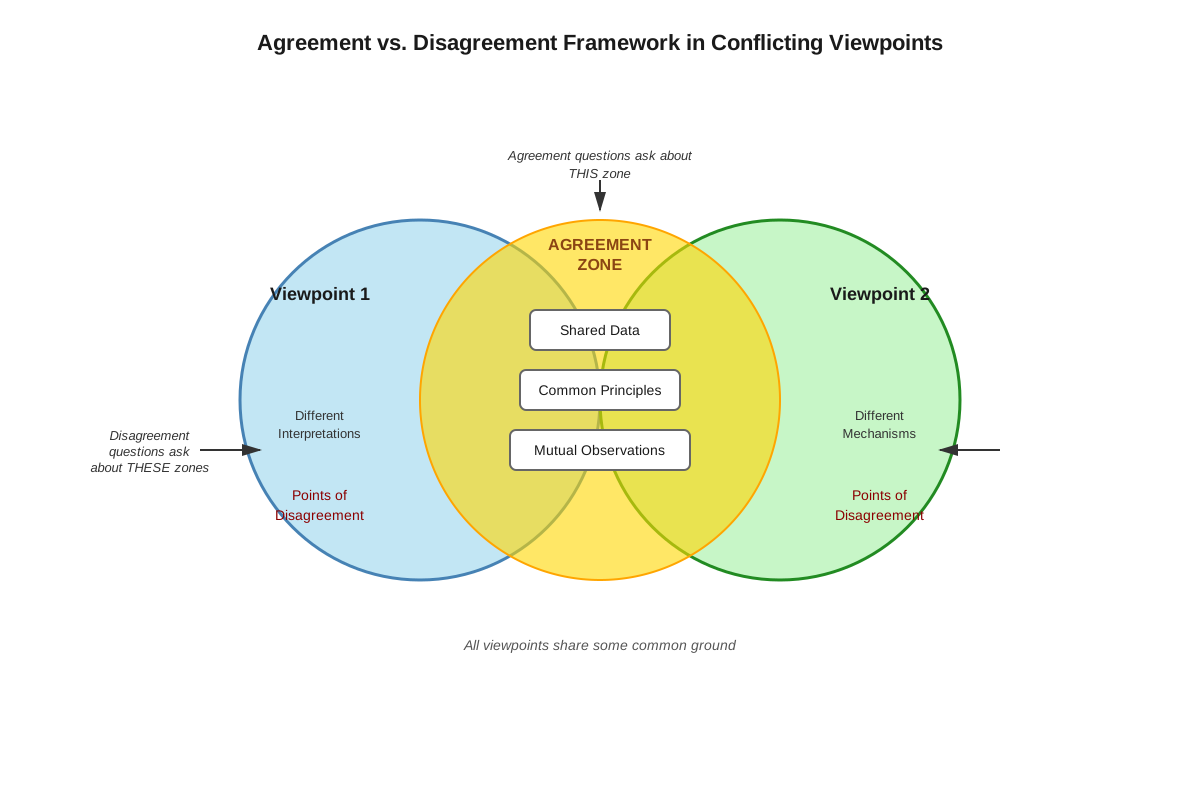
The ACT Science section frequently presents students with passages containing multiple competing hypotheses, theories, or viewpoints about a scientific phenomenon. While much attention is given to identifying differences between these perspectives, a critical—and often overlooked—skill is recognizing where these viewpoints actually agree. Agreement between viewpoints refers to the ability to identify shared assumptions, common observations, accepted data, or mutual conclusions that exist across two or more conflicting scientific perspectives presented in a passage.
Understanding ACT agreement between viewpoints is essential because approximately 15-20% of Conflicting Viewpoints passage questions explicitly test this skill. These questions assess whether students can distinguish between the contested elements of scientific debate and the foundational common ground that all parties accept. This skill mirrors authentic scientific discourse, where researchers may disagree on interpretations or mechanisms while accepting the same experimental data or basic principles. Mastering this concept prevents students from incorrectly assuming that conflicting viewpoints disagree on every aspect of a phenomenon.
Within the broader ACT Science curriculum, agreement between viewpoints serves as a complementary skill to identifying differences and evaluating the strength of competing arguments. It requires careful reading comprehension, the ability to synthesize information across multiple text sections, and critical thinking to separate shared foundations from points of contention. This topic connects directly to data interpretation skills and scientific reasoning, as students must evaluate which evidence all scientists accept versus which conclusions remain disputed.
Learning Objectives
- [ ] Identify when agreement between viewpoints is being tested in ACT Science passages
- [ ] Explain the core rule or strategy behind agreement between viewpoints
- [ ] Apply agreement between viewpoints to ACT-style questions accurately
- [ ] Distinguish between explicit agreements (directly stated) and implicit agreements (logically necessary)
- [ ] Recognize common categories of agreement (shared data, accepted principles, mutual observations)
- [ ] Eliminate answer choices that represent points of disagreement when agreement questions are asked
Prerequisites
- Basic understanding of the Conflicting Viewpoints passage structure: Students must recognize that these passages present 2-4 competing scientific perspectives about the same phenomenon, as this forms the foundation for identifying both agreements and disagreements.
- Ability to identify the main claim of each viewpoint: Recognizing what each scientist or hypothesis argues is necessary before determining what they share in common.
- Fundamental reading comprehension skills: Students need to extract information from scientific text and compare statements across multiple paragraphs or sections.
- Understanding of scientific terminology at a high school level: Basic familiarity with scientific vocabulary ensures students can focus on logical relationships rather than struggling with language.
Why This Topic Matters
In real-world scientific practice, researchers rarely disagree about everything. Scientific debates typically center on interpretation, mechanism, or causation while accepting the same observational data or fundamental principles. For example, climate scientists may debate the precise magnitude of temperature increases while agreeing that atmospheric CO₂ levels have risen. Paleontologists may disagree about what caused dinosaur extinction while accepting the fossil record showing their disappearance 66 million years ago. Recognizing these agreements is crucial for understanding how scientific knowledge progresses through debate and refinement rather than complete rejection of previous work.
On the ACT Science section, Conflicting Viewpoints passages appear once per test (out of six total passages), and these passages typically contain 6-7 questions. Approximately 1-2 questions per Conflicting Viewpoints passage directly test agreement between viewpoints, making this a high-yield topic that appears on virtually every ACT administration. These questions often prove challenging because students naturally focus on differences when reading about "conflicting" viewpoints, causing them to overlook the common ground.
Agreement questions commonly appear in several formats: "According to both Scientist 1 and Scientist 2..." or "Which of the following would both hypotheses accept?" or "On which point do the two viewpoints agree?" These questions may also appear in negative form: "Which of the following is NOT a point of agreement?" Understanding how to approach these question types efficiently can significantly improve both accuracy and timing on the Science section.
Core Concepts
Definition of Agreement Between Viewpoints
Agreement between viewpoints occurs when two or more competing scientific perspectives share common ground on specific aspects of a phenomenon, despite disagreeing on other elements. This common ground can take multiple forms: acceptance of the same observational data, reliance on the same fundamental scientific principles, acknowledgment of the same initial conditions, or mutual recognition of certain facts or measurements. The key insight is that scientific disagreement is typically focused and specific—scientists debate particular interpretations, mechanisms, or conclusions while accepting a shared foundation of evidence and principles.
On the ACT, agreements are not always explicitly stated. Sometimes both viewpoints will directly mention the same fact (explicit agreement), but more commonly, students must infer agreements from what both viewpoints assume or require to be true (implicit agreement). For example, if Scientist 1 argues that a meteor impact caused mass extinction and Scientist 2 argues that volcanic activity caused it, both implicitly agree that mass extinction occurred—they only disagree about the cause.
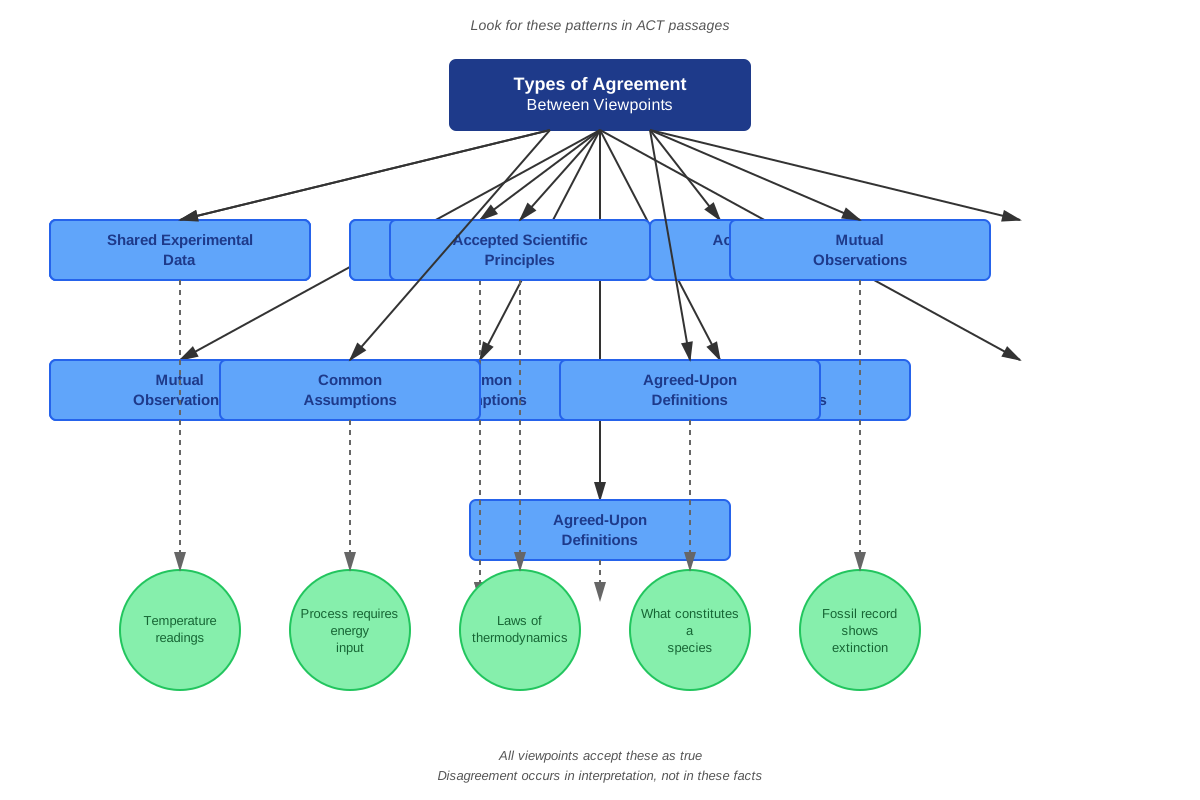
Types of Agreement
Understanding the categories of agreement helps students systematically search for common ground:
Shared Observational Data: Both viewpoints accept the same experimental results, measurements, or observations. For instance, two hypotheses about star formation might disagree on the mechanism but both accept telescope observations showing that stars form in molecular clouds. This is the most common type of agreement tested on the ACT.
Accepted Scientific Principles: Both viewpoints rely on the same fundamental laws or principles. Two theories about chemical reactions might disagree on the reaction pathway but both accept the law of conservation of mass. These agreements often remain unstated because they represent foundational knowledge.
Common Initial Conditions: Both viewpoints agree on the starting state or context of the phenomenon being studied. Competing hypotheses about lake ecosystem changes might disagree on the cause but both accept that the lake's pH decreased over a specific time period.
Mutual Acknowledgment of Phenomena: Both viewpoints recognize that certain events or patterns exist, even if they explain them differently. Two viewpoints on climate patterns might disagree on causation but both acknowledge that El Niño events occur cyclically.
Distinguishing Agreement from Disagreement
The critical skill in this topic is separating what scientists share from what they contest. Students must read each viewpoint carefully and create a mental (or written) inventory of claims. A systematic approach involves:
- Identify the central claim of each viewpoint (what they disagree about)
- List supporting evidence each viewpoint uses
- Note fundamental assumptions each viewpoint makes
- Compare lists to find overlap
Consider this example structure:
| Aspect | Scientist 1 | Scientist 2 | Agreement? |
|---|---|---|---|
| Phenomenon exists | Yes | Yes | ✓ Agreement |
| Cause of phenomenon | Factor A | Factor B | ✗ Disagreement |
| Timing of phenomenon | 10,000 years ago | 10,000 years ago | ✓ Agreement |
| Mechanism | Process X | Process Y | ✗ Disagreement |
Explicit vs. Implicit Agreements
Explicit agreements are directly stated in the passage. Both viewpoints might mention the same fact using similar or identical language. For example: "Scientist 1 notes that atmospheric pressure at sea level is 101.3 kPa" and "Scientist 2 begins with the observation that atmospheric pressure at sea level is 101.3 kPa." These are straightforward to identify but less common on the ACT.
Implicit agreements require logical inference. These are assumptions or prerequisites that must be true for each viewpoint's argument to make sense, even if never explicitly stated. For example, if Scientist 1 argues that increased predation reduced deer populations and Scientist 2 argues that disease reduced deer populations, both implicitly agree that deer populations decreased—this is a necessary premise for both arguments. Implicit agreements are more frequently tested and require stronger critical thinking skills.
Common Patterns in ACT Passages
ACT Conflicting Viewpoints passages follow predictable patterns in how they structure agreements:
Introductory paragraph agreements: The passage introduction (before individual viewpoints are presented) often contains information that all viewpoints accept. This background information establishes the shared context for the debate.
Methodological agreements: When viewpoints are based on the same experiment or dataset, they typically agree on the experimental methods and raw data, disagreeing only on interpretation.
Scope agreements: Viewpoints often agree on what they're NOT discussing. For example, two hypotheses about mammalian evolution might both focus on the Cenozoic Era, implicitly agreeing not to address earlier periods.
Concept Relationships
Agreement between viewpoints connects intimately with other Conflicting Viewpoints skills. Before identifying agreements, students must first understand each individual viewpoint's main argument and supporting evidence. The skill of identifying differences between viewpoints serves as the complementary opposite—students need both skills to fully comprehend scientific debates. Where differences represent the contested terrain of scientific discussion, agreements represent the accepted foundation.
This topic also relates to evaluating the strength of arguments because understanding what all parties accept helps identify which evidence is uncontroversial versus which claims require additional support. If all viewpoints accept a particular piece of data, that data is well-established; if only one viewpoint cites certain evidence, that evidence may be more questionable.
The relationship flow works as follows:
Reading Passage → Identify Individual Viewpoints → Extract Claims and Evidence → Compare Across Viewpoints → Categorize as Agreement or Disagreement → Answer Questions
Additionally, agreement between viewpoints connects to data interpretation skills from Research Summaries and Data Representation passages. Students must evaluate whether different viewpoints interpret the same data differently (disagreement on interpretation, agreement on data) or rely on entirely different datasets (potential disagreement on data itself).
High-Yield Facts
⭐ Agreement questions typically ask what ALL viewpoints accept, not what most viewpoints accept—every viewpoint mentioned must agree for an answer to be correct.
⭐ The introductory paragraph before individual viewpoints are presented almost always contains information that all viewpoints agree upon—this is the shared context for the debate.
⭐ Implicit agreements are more commonly tested than explicit agreements—students must infer what must be true for all arguments to make sense.
⭐ If viewpoints disagree on causation or mechanism, they typically agree on the phenomenon itself—the debate is about "why" or "how," not "whether."
⭐ Shared observational data represents the most frequent type of agreement—competing interpretations of the same evidence are common in science.
- Agreement questions often use phrases like "both viewpoints," "all scientists," "each hypothesis," or "according to all the viewpoints presented."
- When viewpoints use the same experimental setup or dataset, they agree on the methodology and raw results, even if interpretations differ.
- Fundamental scientific laws (conservation of energy, laws of motion, etc.) are typically implicit agreements unless the passage specifically addresses them.
- Time periods, locations, and numerical values mentioned in the introduction are usually points of agreement.
- If an answer choice represents a point of disagreement, it cannot be correct for an agreement question—this makes process of elimination highly effective.
- Agreements can exist at different levels: scientists might agree on broad patterns while disagreeing on specific details, or vice versa.
Quick check — test yourself on Agreement between viewpoints so far.
Try Flashcards →Common Misconceptions
Misconception: If viewpoints are labeled "conflicting," they must disagree about everything.
Correction: Conflicting viewpoints disagree on specific aspects (usually interpretation, mechanism, or causation) while agreeing on foundational facts, data, and principles. Scientific debates are focused, not total.
Misconception: Agreement means the viewpoints say exactly the same thing using the same words.
Correction: Agreements can be implicit or stated differently. If both viewpoints require the same fact to be true for their arguments to work, they agree on that fact even if neither explicitly states it.
Misconception: Information in the introduction is just background and doesn't relate to agreement questions.
Correction: The introductory paragraph typically establishes the shared context that all viewpoints accept. This is often the richest source of agreement information and should be carefully noted.
Misconception: If one viewpoint mentions a fact and another doesn't mention it, they disagree about it.
Correction: Absence of mention doesn't indicate disagreement. A viewpoint might not mention something because it's assumed, irrelevant to their argument, or simply not discussed. Disagreement requires active contradiction.
Misconception: Agreement questions are easier than disagreement questions because there's less to analyze.
Correction: Agreement questions are often more challenging because they require synthesizing information across all viewpoints and recognizing implicit assumptions. Students naturally focus on differences when reading about conflicts, making agreements less salient.
Misconception: Numerical data mentioned by multiple viewpoints always represents agreement.
Correction: Check whether the viewpoints cite the same numbers for the same measurements. Sometimes viewpoints cite different data or interpret the same numbers differently, which represents disagreement, not agreement.
Worked Examples
Example 1: Implicit Agreement in Extinction Hypotheses
Passage Summary: Two scientists debate what caused the extinction of large mammals in North America 12,000 years ago. Scientist 1 argues that climate change at the end of the Ice Age eliminated their habitat. Scientist 2 argues that overhunting by newly arrived human populations caused the extinction.
Question: Based on the viewpoints presented, which of the following would both scientists agree occurred?
A) Human populations arrived in North America before 12,000 years ago.
B) Large mammals in North America went extinct approximately 12,000 years ago.
C) Climate change was the primary driver of ecosystem changes during this period.
D) Hunting pressure increased significantly during this time period.
Solution Process:
Step 1: Identify what each viewpoint explicitly claims.
- Scientist 1: Climate change caused extinction
- Scientist 2: Overhunting caused extinction
Step 2: Identify what both viewpoints must assume to be true.
- Both viewpoints are explaining the same event: extinction of large mammals
- Both viewpoints reference the same time period: 12,000 years ago
- Both viewpoints assume the extinction actually occurred
Step 3: Evaluate each answer choice.
Choice A: Scientist 2 mentions human arrival, but Scientist 1's climate argument doesn't require humans to have arrived at any particular time. This is not a necessary agreement. Eliminate.
Choice B: Both scientists are explaining why large mammals went extinct 12,000 years ago. This is the fundamental phenomenon both accept—they only disagree on the cause. This is an implicit agreement. Keep.
Choice C: This is Scientist 1's specific claim, not something Scientist 2 accepts. Scientist 2 focuses on hunting, not climate. Eliminate.
Choice D: This is part of Scientist 2's argument but not something Scientist 1 discusses or requires. Eliminate.
Answer: B
Key Insight: This question tests implicit agreement. Neither scientist explicitly states "large mammals went extinct," but both viewpoints are explanations for this extinction. The extinction itself is the shared foundation; the cause is the point of disagreement. This pattern—agreement on phenomenon, disagreement on cause—is extremely common on the ACT.
Example 2: Shared Data in Chemical Reaction Hypotheses
Passage Summary: Two hypotheses explain why a particular chemical reaction produces different amounts of product under different conditions. The introduction states: "In experiments conducted at 25°C, Reaction A produced 45g of product when using Catalyst X and 72g of product when using Catalyst Y." Hypothesis 1 argues that Catalyst Y increases reaction rate by lowering activation energy. Hypothesis 2 argues that Catalyst Y changes the reaction pathway to a more efficient mechanism.
Question: Which of the following do both hypotheses accept?
F) Catalyst Y lowers the activation energy of the reaction.
G) Using Catalyst Y results in greater product formation than using Catalyst X.
H) The reaction pathway differs depending on which catalyst is used.
J) Temperature affects the amount of product formed.
Solution Process:
Step 1: Identify information presented before the hypotheses (shared context).
- Experiments at 25°C
- Catalyst X produced 45g
- Catalyst Y produced 72g
Step 2: Identify what each hypothesis claims.
- Hypothesis 1: Catalyst Y works by lowering activation energy
- Hypothesis 2: Catalyst Y works by changing the reaction pathway
Step 3: Evaluate each answer choice.
Choice F: This is the specific mechanism proposed by Hypothesis 1. Hypothesis 2 doesn't mention activation energy. Eliminate.
Choice G: The experimental data in the introduction shows 72g with Catalyst Y versus 45g with Catalyst X. Both hypotheses are explaining this observed difference, so both must accept that it occurred. This is explicit agreement based on shared data. Keep.
Choice H: This is the specific mechanism proposed by Hypothesis 2. Hypothesis 1 doesn't discuss reaction pathways. Eliminate.
Choice J: The passage mentions temperature (25°C) but doesn't discuss varying temperature or its effects. Neither hypothesis addresses this. Eliminate.
Answer: G
Key Insight: This question tests agreement on shared observational data. The experimental results presented in the introduction are accepted by both hypotheses—they're explaining why these results occurred. Information presented before individual viewpoints are introduced typically represents common ground. Students should always carefully read and note these introductory facts.
Exam Strategy
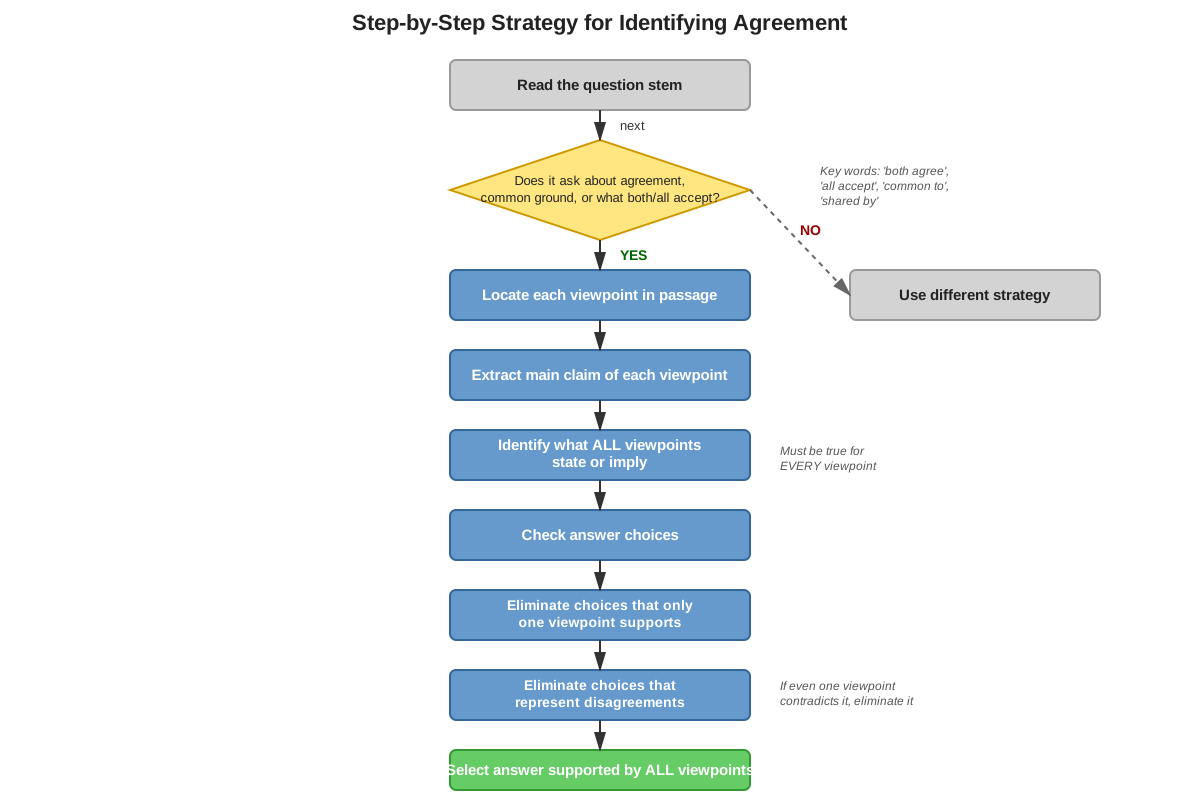
When approaching agreement questions on the ACT Science section, employ this systematic strategy:
Step 1: Identify the question type immediately. Look for trigger phrases: "both viewpoints," "all scientists agree," "according to each hypothesis," "which of the following is accepted by all," or "on which point do the viewpoints agree." These phrases signal an agreement question, which requires a different approach than disagreement questions.
Step 2: Review the introductory paragraph first. Before even looking at answer choices, reread the passage introduction (the paragraph before individual viewpoints are presented). This section almost always contains shared context and accepted facts. Underline or mentally note these facts as likely agreements.
Step 3: Use process of elimination aggressively. For each answer choice, ask: "Does EVERY viewpoint mentioned accept this?" If even one viewpoint contradicts or doesn't support an answer choice, eliminate it immediately. Agreement questions require unanimity.
Step 4: Distinguish between "not mentioned" and "contradicted." If a viewpoint doesn't mention something, that doesn't mean they disagree with it—it might be irrelevant to their argument. Only eliminate answer choices that are actively contradicted by at least one viewpoint.
Step 5: Check for implicit agreements. If all answer choices seem wrong, look for what must be true for all arguments to make sense. What phenomenon are all viewpoints explaining? What assumptions do all viewpoints require? These implicit agreements are frequently the correct answer.
Exam Tip: If you're stuck between two answer choices, ask yourself: "Is this a point of debate or a shared foundation?" Points of debate cannot be agreements. The shared foundation—what makes the debate possible—is where agreements lie.
Time allocation: Agreement questions typically take 30-45 seconds each if approached systematically. Don't spend excessive time rereading entire viewpoints; focus on the introduction and the specific claims each viewpoint makes. If a question is taking more than one minute, mark it and return after completing easier questions.
Common trap answers: The ACT frequently includes answer choices that represent the position of only one viewpoint (often the first or most prominent one). These are tempting because they're true according to the passage, but they're not agreements. Always verify that ALL viewpoints support an answer before selecting it.
Memory Techniques
SHARED Mnemonic for types of agreement:
- Scientific principles (fundamental laws all viewpoints accept)
- Hypothesis foundation (the phenomenon being explained)
- Assumptions (implicit requirements for arguments to work)
- Results (experimental data all viewpoints acknowledge)
- Evidence (observations all viewpoints cite)
- Data (measurements presented in the introduction)
Visualization Strategy: Picture the passage as a Venn diagram. Each viewpoint is a circle, and the overlapping center represents agreements. When reading, mentally sort information: "Does this go in the overlap (agreement) or in just one circle (unique to that viewpoint)?"
The Foundation Rule: Remember that scientific debates are like buildings with different structures on the same foundation. The foundation (agreements) supports everything; the structures (different viewpoints) are what vary. Always identify the foundation first.
Intro = Agreement Acronym: Introductory paragraphs Nearly Typically Reveal Obvious agreements. Train yourself to automatically associate the introduction with agreement questions.
Summary
Agreement between viewpoints is a critical ACT Science skill that tests whether students can identify common ground among competing scientific perspectives. While Conflicting Viewpoints passages emphasize disagreement in their structure, successful students recognize that scientific debates occur within a framework of shared observations, accepted data, and fundamental principles. Agreements can be explicit (directly stated by multiple viewpoints) or implicit (logically necessary for all arguments). The most common types of agreement involve shared observational data, accepted scientific principles, and mutual acknowledgment of the phenomenon being explained. The introductory paragraph before individual viewpoints are presented typically contains the richest source of agreement information. Success on agreement questions requires systematic comparison across all viewpoints, careful distinction between what is contradicted versus merely not mentioned, and aggressive use of process of elimination. This skill appears on virtually every ACT administration and represents 15-20% of Conflicting Viewpoints questions, making it a high-yield topic for focused study.
Key Takeaways
- Agreement questions require that ALL viewpoints mentioned accept the answer choice—unanimity is essential, not majority.
- The introductory paragraph before individual viewpoints are presented almost always contains information that all viewpoints agree upon.
- Implicit agreements (what must be true for all arguments to work) are tested more frequently than explicit agreements (directly stated by multiple viewpoints).
- Viewpoints typically agree on the phenomenon itself while disagreeing on the cause, mechanism, or interpretation.
- Shared observational data represents the most common type of agreement tested on the ACT.
- Process of elimination is highly effective: if even one viewpoint contradicts an answer choice, it cannot be correct for an agreement question.
- Not mentioning something is different from disagreeing with it—absence of mention doesn't indicate disagreement.
Related Topics
Identifying Differences Between Viewpoints: The complementary skill to agreement, this involves recognizing where viewpoints contradict each other on mechanisms, causes, interpretations, or predictions. Mastering agreement helps sharpen difference identification by clarifying what's actually contested.
Evaluating Strength of Arguments: Understanding what all viewpoints accept helps assess which claims are well-established versus which require additional support. Agreements represent uncontroversial foundations; unique claims need stronger justification.
Understanding Scientific Hypotheses: This foundational skill involves recognizing how scientific explanations are structured, what constitutes evidence, and how hypotheses relate to observations. Agreement between viewpoints builds on this by comparing multiple hypotheses.
Interpreting Conflicting Data: While agreement between viewpoints focuses on shared acceptance, this related skill addresses how scientists handle contradictory experimental results and competing datasets.
Practice CTA
Now that you've mastered the core concepts of agreement between viewpoints, it's time to put your knowledge into action! Complete the practice questions to test your ability to identify agreements in ACT-style Conflicting Viewpoints passages. Use the flashcards to reinforce the key distinctions between explicit and implicit agreements, and to memorize the common patterns where agreements appear. Remember: recognizing what scientists share is just as important as understanding where they differ. With focused practice, you'll quickly develop the systematic approach needed to confidently answer agreement questions on test day. You've got this!
Sign up free to keep reading
Create a free AnvayaPrep account to finish this ACT guide on Agreement between viewpoints — plus flashcards and practice questions.