Overview
The competing hypotheses question type represents one of the most challenging and high-value sections of the ACT Science test. Unlike data representation or research summaries passages, ACT competing hypotheses passages present multiple scientific viewpoints, theories, or explanations for the same phenomenon. Students must analyze, compare, and evaluate these different perspectives to answer questions correctly. This format mirrors authentic scientific discourse, where researchers propose different explanations for observations and must defend their positions using evidence and logical reasoning.
Mastering competing hypotheses is essential for ACT success because these passages typically comprise 15-20% of the Science section and often contain the most difficult questions. Students who struggle with this format frequently lose critical points that separate good scores from excellent ones. The key challenge lies not in understanding complex data or calculations, but in tracking multiple viewpoints simultaneously, identifying what makes each hypothesis unique, and recognizing which evidence supports or contradicts each position.
Within the broader ACT Science curriculum, competing hypotheses passages build upon foundational skills in data interpretation and experimental design while adding a critical thinking dimension. Success requires synthesizing information across multiple paragraphs, understanding scientific argumentation, and applying logical reasoning—skills that connect to both the Reading section's comparative passages and real-world scientific literacy. This topic serves as the bridge between basic data analysis and advanced scientific reasoning.
Learning Objectives
- [ ] Identify when Competing hypotheses is being tested
- [ ] Explain the core rule or strategy behind Competing hypotheses
- [ ] Apply Competing hypotheses to ACT-style questions accurately
- [ ] Distinguish between the key claims of each hypothesis in a passage
- [ ] Determine which evidence supports, contradicts, or is neutral to each hypothesis
- [ ] Predict how each scientist would respond to new information or scenarios
- [ ] Synthesize information across multiple hypotheses to answer comparative questions
Prerequisites
- Basic scientific vocabulary and terminology: Understanding fundamental science terms allows students to focus on argument structure rather than decoding basic concepts
- Reading comprehension skills: The ability to extract main ideas and supporting details from dense text is essential since these passages are text-heavy
- Data interpretation fundamentals: Some competing hypotheses passages include graphs or tables that provide evidence for or against different viewpoints
- Understanding of the scientific method: Recognizing how hypotheses, evidence, and conclusions relate helps students evaluate the logical structure of each argument
Why This Topic Matters
Competing hypotheses passages reflect authentic scientific practice. In real research environments, scientists regularly propose different explanations for phenomena—from the nature of dark matter to the causes of climate change to the mechanisms of disease. Learning to evaluate multiple perspectives critically is not just an exam skill but a fundamental component of scientific literacy that students will use throughout their academic and professional careers.
On the ACT Science test, competing hypotheses passages appear in exactly one passage per test (out of six or seven total passages), but this single passage typically contains 6-7 questions worth significant points. According to ACT data, these questions have the lowest average accuracy rates among all Science question types, with many students scoring 50-60% on these items compared to 70-80% on data representation questions. This difficulty gap creates an opportunity: students who master this format gain a substantial competitive advantage.
The most common presentation formats include: two or three scientists presenting different theories about a natural phenomenon (geological, astronomical, biological); researchers proposing different mechanisms for an observed effect; or competing explanations for historical events (extinction, climate shifts, evolutionary changes). Questions typically ask students to identify differences between hypotheses, determine what evidence each scientist would accept or reject, predict responses to new scenarios, or find points of agreement. Unlike other passage types that test data reading, these questions assess logical reasoning and argument analysis.
Core Concepts
Structure of Competing Hypotheses Passages
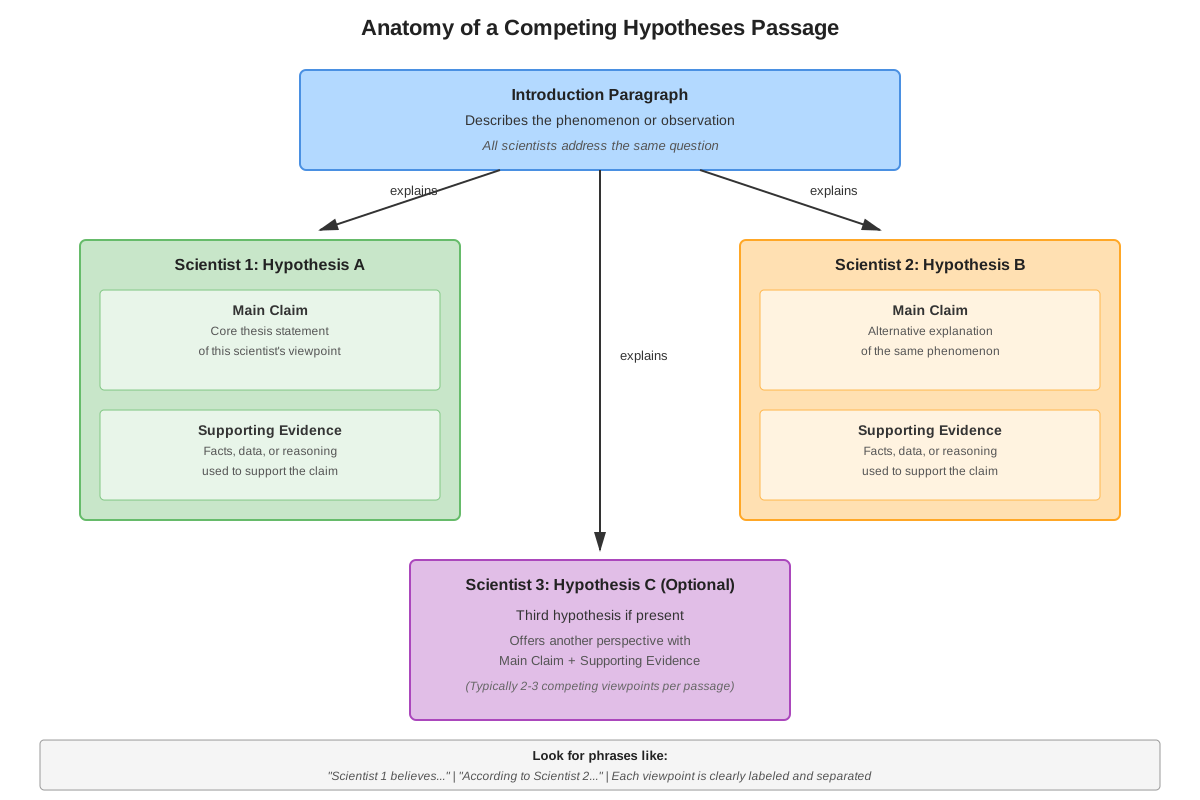
Competing hypotheses passages follow a predictable structure that students can leverage for efficient reading. The passage begins with an introductory paragraph describing a phenomenon, observation, or question that scientists are trying to explain. This introduction provides shared background information that all hypotheses accept as true—these are the established facts or observations that need explanation.
Following the introduction, the passage presents 2-3 distinct viewpoints, typically labeled as "Scientist 1," "Scientist 2," and sometimes "Scientist 3," or "Hypothesis A," "Hypothesis B," etc. Each section presents one complete argument including: the main claim or explanation, supporting evidence or reasoning, and sometimes predictions or implications. The length of each hypothesis section ranges from 3-8 sentences, making these the most text-dense passages on the ACT Science test.
The Core Strategy: Active Comparison
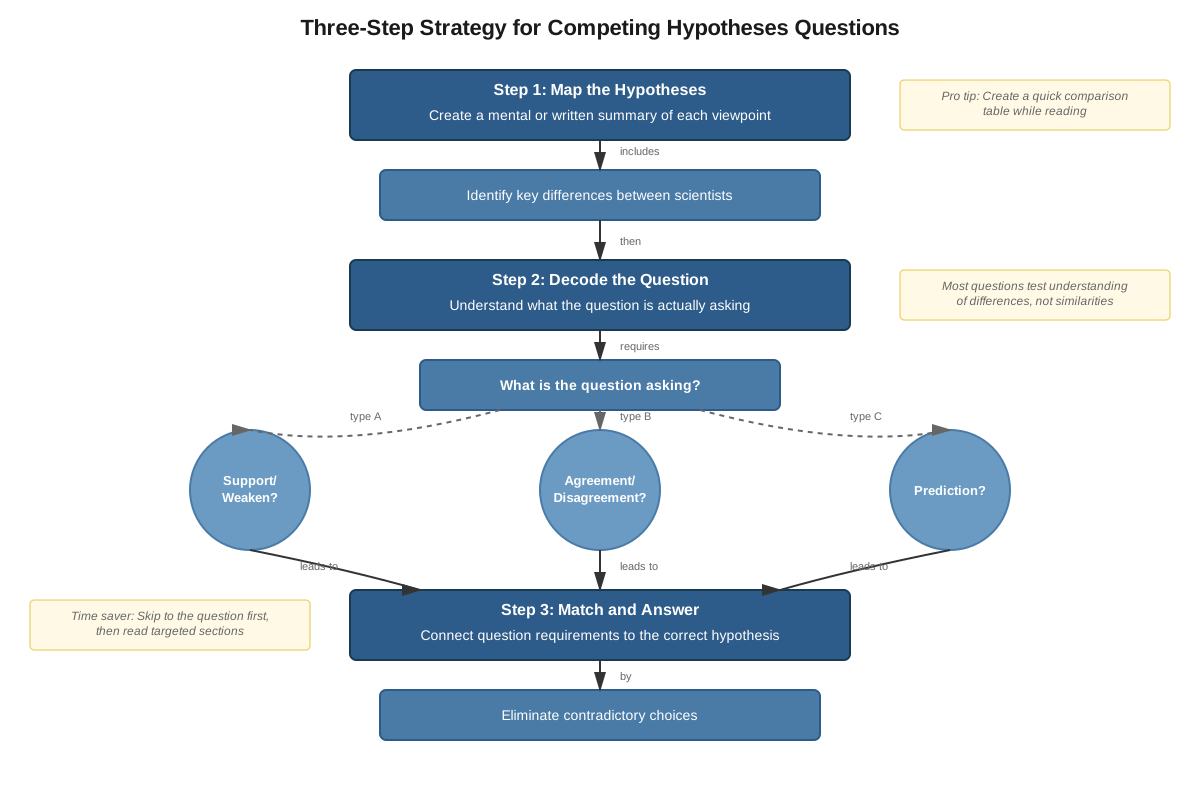
The fundamental strategy for ACT competing hypotheses success involves active comparison while reading. Rather than reading each hypothesis in isolation, students must constantly ask: "How is this different from the previous hypothesis?" This comparative approach allows efficient tracking of the key distinctions that questions will target.
The most effective reading process follows these steps:
- Read the introduction carefully to identify the phenomenon being explained and any facts all scientists agree upon
- Read Hypothesis 1 completely and identify its main claim in one sentence
- Before reading Hypothesis 2, predict what might be different
- While reading Hypothesis 2, actively note differences from Hypothesis 1
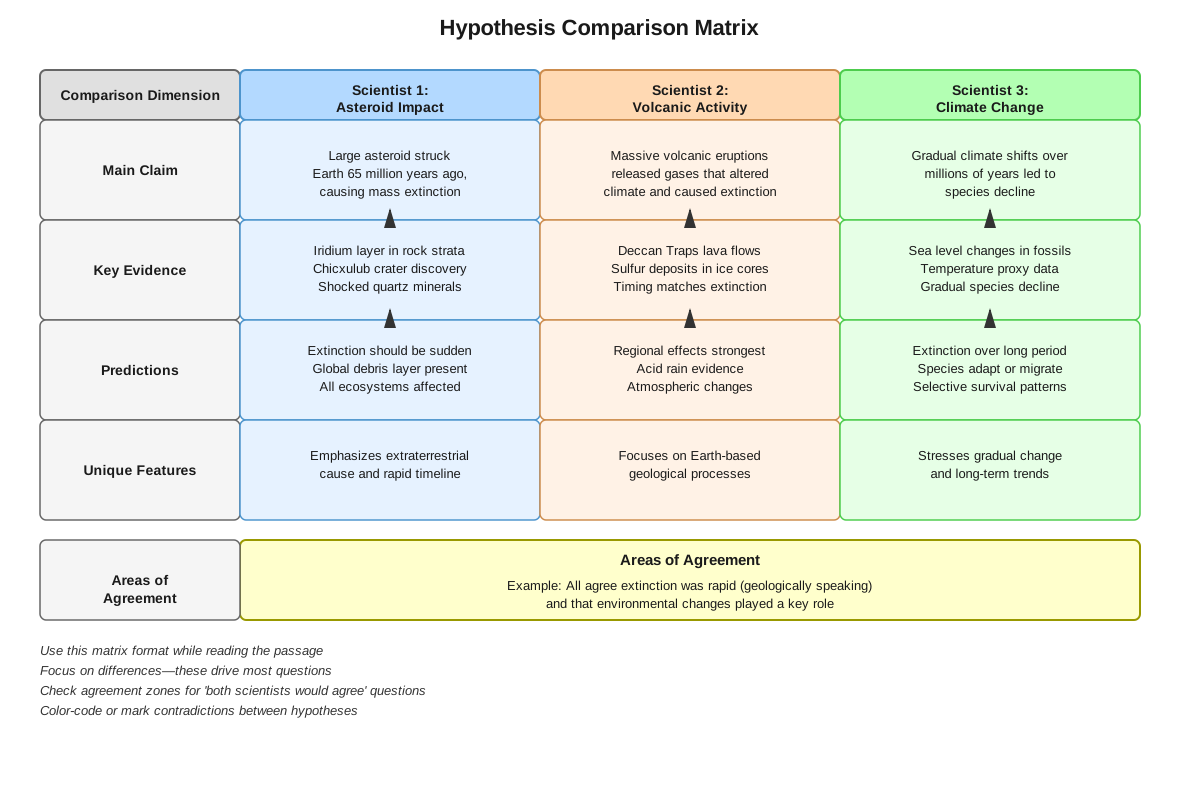
- Create a mental or written comparison chart with key differences
- For Hypothesis 3 (if present), note how it differs from both previous hypotheses
Key Elements to Track
When analyzing each hypothesis, students should identify and track these critical elements:
| Element | Description | Why It Matters |
|---|---|---|
| Main Claim | The central explanation or theory | Questions often ask what each scientist believes or would conclude |
| Mechanism | How or why the phenomenon occurs according to this hypothesis | Distinguishes hypotheses with similar conclusions but different reasoning |
| Evidence Cited | Specific observations, data, or facts used to support the claim | Questions ask what evidence supports each view |
| Predictions | What this hypothesis suggests should be true or observable | Questions may present new scenarios and ask which scientist predicted them |
| Assumptions | Underlying beliefs or conditions the hypothesis requires | Advanced questions test understanding of logical foundations |
Types of Differences Between Hypotheses
Competing hypotheses differ in predictable ways. Recognizing these difference patterns helps students quickly identify what makes each viewpoint unique:
Temporal differences: Hypotheses propose different timescales (one suggests a process took millions of years, another suggests thousands of years)
Causal differences: Hypotheses identify different causes for the same effect (one attributes climate change to solar activity, another to volcanic activity, another to atmospheric composition)
Mechanistic differences: Hypotheses agree on cause and effect but disagree on the mechanism connecting them (different explanations for how a drug produces its therapeutic effect)
Magnitude differences: Hypotheses agree on the type of process but disagree on its scale or importance (all agree temperature affects reaction rate but disagree on how much)
Directional differences: Hypotheses make opposite predictions (one predicts population increase, another predicts decrease)
Agreement vs. Disagreement
A critical but often overlooked skill involves identifying what hypotheses agree upon versus where they diverge. The introduction typically contains agreed-upon facts, but hypotheses may also share certain assumptions or accept certain evidence while disagreeing on interpretation. Questions frequently ask about points of agreement, which students often miss because they focus exclusively on differences.
To identify agreement: Look for information that appears in multiple hypotheses without contradiction, facts from the introduction that no hypothesis challenges, or explicit statements like "both scientists agree that..." or "all hypotheses accept that..."
Evidence Evaluation
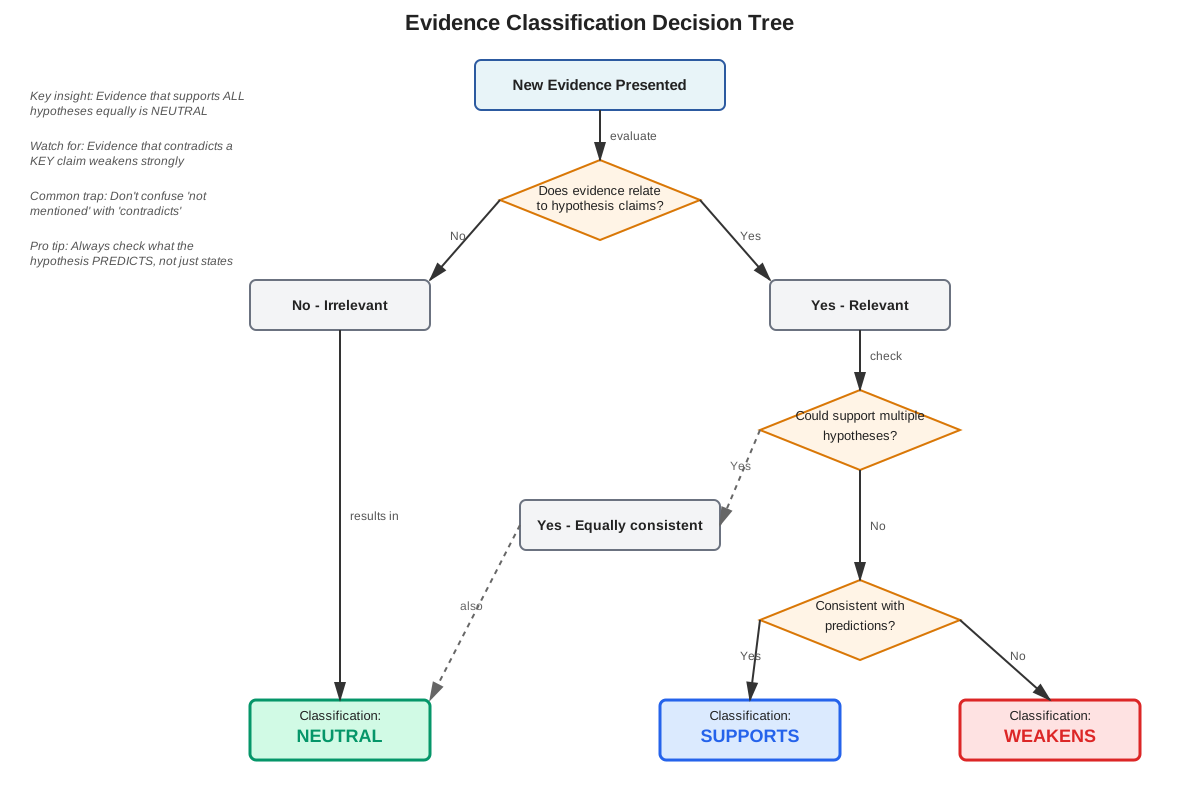
Many questions present new evidence and ask which hypothesis it supports or contradicts. The key strategy involves asking: "What does each hypothesis predict or require to be true?" Then compare the new evidence to these predictions:
- Evidence supports a hypothesis if it matches what that hypothesis predicts or requires
- Evidence contradicts a hypothesis if it shows the opposite of what that hypothesis predicts
- Evidence is neutral if it doesn't relate to the specific claims that distinguish hypotheses
Students often incorrectly assume that evidence supporting one hypothesis automatically contradicts others. This is only true if the hypotheses make mutually exclusive predictions about that specific point.
Concept Relationships
The concepts within competing hypotheses are hierarchically organized. Understanding passage structure (introduction + multiple hypothesis sections) enables the active comparison strategy. Active comparison requires tracking key elements (claims, mechanisms, evidence, predictions). Tracking these elements allows identification of difference types (temporal, causal, mechanistic, etc.). Recognizing difference types facilitates both agreement/disagreement analysis and evidence evaluation.
This topic connects to prerequisite knowledge in several ways: Basic reading comprehension skills provide the foundation for extracting main ideas from each hypothesis section. Data interpretation skills enable students to evaluate graphs or tables that may appear as evidence. Understanding the scientific method helps students recognize the logical structure of hypothesis → evidence → conclusion that each viewpoint follows.
Competing hypotheses also relates to other ACT Science topics: The research summaries passage type sometimes includes competing interpretations of experimental results, requiring similar comparison skills. Data representation passages occasionally present conflicting trends that require reconciliation. More broadly, the critical thinking skills developed through competing hypotheses practice enhance performance across all Science passage types.
Relationship map: Passage Structure Recognition → Active Comparison Strategy → Element Tracking → Difference Pattern Identification → Agreement/Disagreement Analysis + Evidence Evaluation → Accurate Question Answering
High-Yield Facts
⭐ Competing hypotheses passages always appear exactly once per ACT Science test, typically as one of the six or seven total passages
⭐ The introduction paragraph contains facts that ALL hypotheses accept as true—this shared information never distinguishes between viewpoints
⭐ Questions most frequently ask about differences between hypotheses, not similarities, so focus comparison efforts on identifying distinctions
⭐ Each hypothesis section presents a complete, self-contained argument—students don't need to read all hypotheses to understand any single one
⭐ Evidence that supports one hypothesis does NOT automatically contradict other hypotheses unless the hypotheses make mutually exclusive predictions
- The number of hypotheses ranges from 2-3, with 2-hypothesis passages being most common
- Hypothesis sections are typically equal in length, ranging from 50-120 words each
- Questions appear in no particular order relative to the passage—they don't follow the sequence of hypotheses
- "According to Scientist X" questions can be answered using only that scientist's section
- Comparative questions ("How do the scientists differ?") require reading multiple sections
- New evidence questions require understanding what each hypothesis predicts, not just what it states
- Time pressure makes competing hypotheses passages the most commonly skipped or rushed section
Quick check — test yourself on Competing hypotheses so far.
Try Flashcards →Common Misconceptions
Misconception: Students must understand the scientific content deeply to answer questions correctly → Correction: Success depends on tracking arguments and comparisons, not mastering the science. A student with no background in geology can excel on a passage about rock formation by focusing on how the hypotheses differ, not on understanding geology itself.
Misconception: Evidence supporting Hypothesis A must contradict Hypothesis B → Correction: Multiple hypotheses can be consistent with the same evidence. Evidence only contradicts a hypothesis if it directly opposes that hypothesis's specific predictions. Many pieces of evidence are neutral, supporting one view without contradicting others.
Misconception: All information in each hypothesis section is equally important → Correction: The main claim and key distinguishing features matter most. Supporting details that don't differentiate between hypotheses rarely appear in questions. Focus on what makes each hypothesis unique.
Misconception: Students should read all hypotheses before looking at questions → Correction: While reading all hypotheses is generally advisable, students can answer "According to Scientist X" questions after reading only that scientist's section. Strategic question selection can improve time management.
Misconception: Longer or more detailed hypotheses are more likely to be correct → Correction: The ACT never indicates which hypothesis is "right." All hypotheses are treated as equally valid viewpoints. Length reflects complexity of argument, not correctness. Questions test comprehension and comparison, not scientific accuracy.
Misconception: The introduction is just background and can be skimmed quickly → Correction: The introduction contains critical shared information and defines the phenomenon being explained. Misunderstanding the introduction leads to misinterpreting all hypotheses. This section deserves careful reading despite time pressure.
Worked Examples
Example 1: Identifying Key Differences
Passage Setup: The introduction states that scientists observe a crater on Earth's surface and want to explain its origin.
Scientist 1 proposes that the crater formed from a meteor impact approximately 50,000 years ago. The circular shape, raised rim, and presence of shocked quartz (a mineral that forms under extreme pressure) support this explanation. The crater's size suggests a meteor approximately 50 meters in diameter.
Scientist 2 proposes that the crater formed from volcanic activity approximately 2 million years ago. The circular shape is consistent with volcanic calderas, and the raised rim could result from lava accumulation. The presence of basaltic rock in the crater supports volcanic origin.
Question: How do the scientists' explanations differ?
Solution Process:
Step 1: Identify the main claim of each hypothesis
- Scientist 1: Meteor impact caused the crater
- Scientist 2: Volcanic activity caused the crater
Step 2: Identify the temporal difference
- Scientist 1: 50,000 years ago
- Scientist 2: 2 million years ago
Step 3: Identify the evidence each uses
- Scientist 1: Shocked quartz, circular shape, raised rim
- Scientist 2: Basaltic rock, circular shape, raised rim
Step 4: Note what they agree on
- Both accept: The crater exists, it's circular, it has a raised rim
Step 5: Identify the key differences
- Cause: Impact vs. volcanic
- Timing: 50,000 vs. 2 million years
- Unique evidence: Shocked quartz (Scientist 1) vs. basaltic rock (Scientist 2)
Answer Strategy: Questions asking "how do they differ" typically have answers focusing on the cause or mechanism. The most fundamental difference here is meteor impact versus volcanic activity. Temporal differences are secondary. Evidence differences support the main causal difference.
Example 2: Evaluating New Evidence
Using the same passage from Example 1
Question: Scientists discover that rocks at the crater site contain high concentrations of iridium, an element rare on Earth but common in meteors. This finding would most likely support which scientist's hypothesis?
Solution Process:
Step 1: Understand what the new evidence shows
- High iridium concentration
- Iridium is rare on Earth
- Iridium is common in meteors
Step 2: Determine what each hypothesis predicts about iridium
- Scientist 1 (meteor impact): Would predict iridium presence because meteors contain iridium
- Scientist 2 (volcanic activity): Would not specifically predict iridium because volcanic processes don't typically concentrate this element
Step 3: Match evidence to predictions
- The iridium finding matches Scientist 1's prediction
- The iridium finding doesn't match Scientist 2's volcanic explanation
Step 4: Consider if this evidence contradicts Scientist 2
- It doesn't directly contradict volcanic activity (volcanoes could theoretically bring up iridium from deep Earth)
- But it's more consistent with and predicted by the meteor hypothesis
Answer: This evidence supports Scientist 1's hypothesis. The key reasoning: Scientist 1's meteor impact explanation predicts iridium presence, while Scientist 2's volcanic explanation doesn't account for this element. Evidence supports a hypothesis when it matches what that hypothesis predicts or requires.
Learning Objective Connection: This example demonstrates applying competing hypotheses strategies to ACT-style questions by evaluating how new evidence relates to each hypothesis's predictions.
Exam Strategy
Approaching Competing Hypotheses Passages
Time allocation: Spend 6-7 minutes on competing hypotheses passages (slightly more than the 5-6 minutes for other passages) because the reading is more demanding. Don't rush the initial reading—investing time upfront saves time on questions.
Reading strategy: Use a three-pass approach:
- First pass: Read introduction carefully, identifying the phenomenon and agreed-upon facts
- Second pass: Read each hypothesis, noting the main claim in the margin
- Third pass: While answering questions, return to specific sections as needed
Annotation technique: For paper tests, mark key differences with symbols:
- Circle or underline the main claim of each hypothesis
- Use brackets around unique evidence
- Draw arrows connecting similar concepts across hypotheses
- Write brief margin notes: "H1: impact, 50K yrs" "H2: volcano, 2M yrs"
Trigger Words and Phrases
Watch for these question stems that signal specific strategies:
"According to Scientist X...": Read only that scientist's section; answer is explicitly stated
"How do the scientists differ...": Focus on the key distinguishing features identified during reading
"Both scientists would agree...": Look for information in the introduction or statements that appear in multiple hypotheses without contradiction
"Which hypothesis is supported by...": Determine what each hypothesis predicts, then match evidence to predictions
"Scientist X would most likely...": Extend the hypothesis's logic to a new scenario; ask "what would this scientist predict based on their explanation?"
"Which of the following is an assumption of...": Identify what must be true for this hypothesis to work
Process of Elimination Tips
For difference questions: Eliminate answers that describe similarities or that misrepresent what either hypothesis claims
For evidence questions: Eliminate answers where the evidence is neutral (doesn't relate to distinguishing features) or where the connection is backwards (claims evidence contradicts when it actually supports)
For agreement questions: Eliminate answers that only one hypothesis mentions or that represent points of disagreement
For prediction questions: Eliminate answers inconsistent with the hypothesis's mechanism or that contradict its main claim
Common Question Patterns
Approximately 40% of questions ask about differences between hypotheses. Another 30% ask what individual scientists believe or would conclude. About 20% involve evaluating new evidence. The remaining 10% ask about agreements or assumptions. Prioritize mastering difference and individual-belief questions for maximum score impact.
Memory Techniques
CLAIM mnemonic for what to identify in each hypothesis:
- Central explanation
- Logic or mechanism
- Assumptions required
- Important evidence cited
- Main predictions
The "Debate" visualization: Picture the scientists in a debate, each presenting their case. The introduction is the moderator describing the topic. Each hypothesis is one debater's argument. Questions are audience members asking the debaters to clarify, compare, or respond to new information.
The "Three-Column" mental model: Visualize a table with three columns:
- Column 1: Scientist 1's views
- Column 2: Scientist 2's views
- Column 3: Points of agreement
As you read, mentally file information into the appropriate column. This organization makes comparison questions easier.
SPEED acronym for difference types to check:
- Scale or magnitude
- Process or mechanism
- Evidence used
- Explanation or cause
- Duration or timing
The "Prediction Test": For evidence evaluation questions, ask: "If this hypothesis were true, what would we expect to see?" Then check if the new evidence matches that expectation. This converts abstract comparison into concrete prediction-matching.
Summary
Competing hypotheses passages present multiple scientific explanations for the same phenomenon, requiring students to track, compare, and evaluate different viewpoints. Success depends not on deep scientific knowledge but on systematic comparison strategies. The passage structure—introduction with shared facts followed by 2-3 distinct hypothesis sections—enables efficient reading when students actively identify key differences while reading rather than trying to memorize all details. The most critical skills include distinguishing each hypothesis's main claim and mechanism, recognizing what evidence each viewpoint uses, determining points of agreement versus disagreement, and evaluating how new evidence relates to each hypothesis's predictions. Questions predominantly test differences between hypotheses and what individual scientists believe, making comparison the core skill. Students who master the active comparison strategy, track key elements systematically, and understand that evidence supporting one view doesn't automatically contradict others will excel on these high-value passages.
Key Takeaways
- Competing hypotheses passages appear exactly once per ACT Science test and contain some of the most challenging questions
- The introduction contains facts all hypotheses accept; focus comparison efforts on the hypothesis sections where viewpoints diverge
- Active comparison while reading (constantly asking "how is this different?") is more effective than trying to memorize each hypothesis separately
- Track five key elements for each hypothesis: main claim, mechanism, evidence, predictions, and assumptions
- Evidence supports a hypothesis when it matches that hypothesis's predictions; supporting one hypothesis doesn't automatically contradict others
- Questions asking "According to Scientist X" can be answered using only that scientist's section
- The most common question types ask about differences between hypotheses (40%) and what individual scientists believe (30%)
Related Topics
Research Summaries with Conflicting Results: Some research summary passages present experiments with results that seem contradictory, requiring similar comparison and reconciliation skills developed in competing hypotheses passages.
Data Representation with Multiple Trends: Passages showing graphs with opposing trends (one variable increasing while another decreases) require evaluating competing patterns, building on comparison skills.
Scientific Argumentation and Logic: Understanding how scientists construct arguments, use evidence, and make predictions extends beyond the ACT to college science courses and research literacy.
Reading Section Comparative Passages: The ACT Reading section includes paired passages presenting different perspectives on the same topic, using similar comparison strategies to competing hypotheses in Science.
Mastering competing hypotheses provides a foundation for these related topics and develops critical thinking skills applicable across all standardized test sections and academic disciplines.
Practice CTA
Now that you understand the structure and strategy for competing hypotheses passages, it's time to apply these skills to real ACT-style questions. The practice questions and flashcards will reinforce your ability to identify key differences, evaluate evidence, and answer questions efficiently. Remember: competing hypotheses mastery comes from active practice, not passive reading. Each practice passage you complete strengthens your comparison skills and builds the confidence needed to tackle these challenging questions on test day. Start with the practice questions to see immediate improvement in your approach and accuracy!
Sign up free to keep reading
Create a free AnvayaPrep account to finish this ACT guide on Competing hypotheses — plus flashcards and practice questions.