Overview
The disagreement between viewpoints question type represents one of the most critical and frequently tested components of the ACT Science test's Conflicting Viewpoints passages. Unlike Data Representation and Research Summaries passages that focus on interpreting graphs and experimental designs, Conflicting Viewpoints passages present two or more competing scientific hypotheses, theories, or perspectives on a particular phenomenon. Students must analyze, compare, and contrast these viewpoints to answer questions that test their ability to understand scientific argumentation and reasoning.
This topic is essential for ACT success because Conflicting Viewpoints passages typically comprise one of the seven passages on the Science test, accounting for approximately 15% of all Science questions. These passages require a different skill set than data interpretation—students must read carefully for comprehension, identify the core claims of each viewpoint, recognize supporting evidence, and understand where scientists agree and disagree. Mastering ACT disagreement between viewpoints questions directly impacts overall Science scores and demonstrates critical thinking abilities valued in college-level coursework.
The relationship between this topic and broader Science concepts lies in scientific methodology and the nature of scientific debate. Science progresses through competing hypotheses, peer review, and evidence-based argumentation. Understanding how to analyze disagreements between viewpoints connects to the fundamental scientific principle that multiple explanations can exist for phenomena until sufficient evidence supports one theory over others. This skill also reinforces the ability to evaluate claims objectively—a competency tested across all ACT Science passage types when students must determine which conclusion is supported by data or which hypothesis best explains experimental results.
Learning Objectives
- [ ] Identify when Disagreement between viewpoints is being tested
- [ ] Explain the core rule or strategy behind Disagreement between viewpoints
- [ ] Apply Disagreement between viewpoints to ACT-style questions accurately
- [ ] Distinguish between points of agreement and disagreement among multiple scientific perspectives
- [ ] Analyze the evidence and reasoning each viewpoint uses to support its claims
- [ ] Evaluate the strengths and weaknesses of competing scientific arguments
- [ ] Synthesize information across viewpoints to answer comparative questions
Prerequisites
- Basic reading comprehension skills: Essential for understanding complex scientific arguments presented in paragraph form rather than data tables
- Familiarity with scientific terminology: Necessary to comprehend the technical vocabulary used in different scientific disciplines (biology, chemistry, physics, Earth science)
- Understanding of hypothesis formation: Required to recognize that viewpoints represent testable explanations for observed phenomena
- Ability to identify main ideas and supporting details: Critical for distinguishing core claims from evidence in each viewpoint
Why This Topic Matters
Understanding disagreement between viewpoints reflects authentic scientific practice. In real-world science, researchers frequently propose competing theories to explain observations—from debates about climate change mechanisms to discussions about evolutionary pathways to controversies over cosmological models. Scientists must evaluate evidence, identify assumptions, and determine which explanation best fits available data. This critical thinking process appears throughout scientific literature, grant proposals, peer review, and academic conferences.
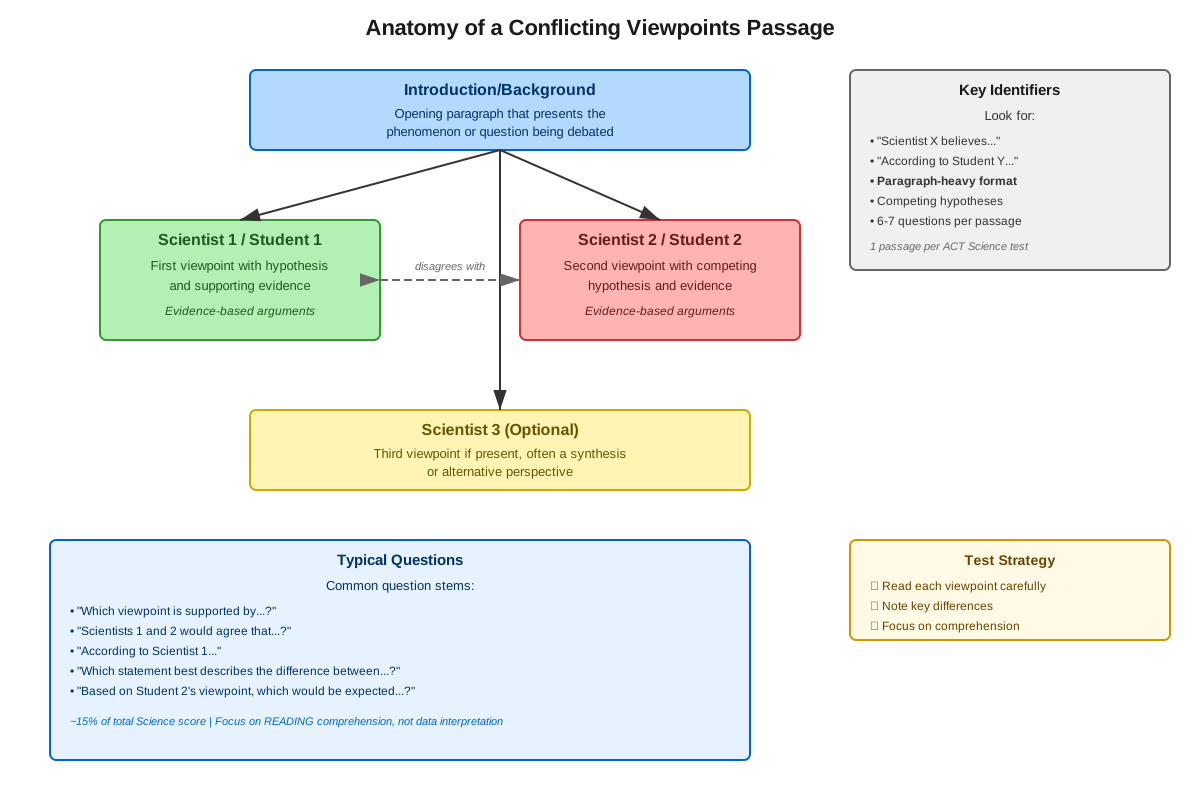
On the ACT Science test, Conflicting Viewpoints passages appear exactly once per exam, typically containing 6-7 questions. These questions account for approximately 15% of the total Science score. According to ACT data, students often find these passages challenging because they require sustained reading comprehension rather than quick data interpretation. However, students who master this question type gain a significant advantage because the passage structure remains highly predictable: typically two or three viewpoints, each presented in 2-4 paragraphs, discussing the same phenomenon from different theoretical perspectives.
Common manifestations in exam passages include: debates about geological processes (uniformitarianism vs. catastrophism), competing theories about astronomical phenomena (stellar formation mechanisms), disagreements about biological processes (different explanations for evolutionary adaptations), and contrasting views on chemical or physical mechanisms (reaction pathways, force interactions). Questions typically ask students to identify what each scientist believes, determine where viewpoints agree or disagree, recognize evidence supporting specific claims, predict what additional evidence would strengthen or weaken a viewpoint, or identify assumptions underlying each perspective.
Core Concepts
Structure of Conflicting Viewpoints Passages
Conflicting Viewpoints passages follow a consistent organizational pattern that students must recognize immediately. The passage begins with an introductory paragraph providing background information about the phenomenon under discussion. This introduction establishes the context and often presents observational data or established facts that all viewpoints accept. Following this introduction, the passage presents two or more distinct viewpoints, typically labeled as "Scientist 1," "Scientist 2," "Student 1," "Student 2," or "Hypothesis A," "Hypothesis B." Each viewpoint occupies 2-4 paragraphs explaining that perspective's core claim, supporting evidence, reasoning, and sometimes predictions or implications.
The key structural elements students must identify include:
- Background information: Facts all viewpoints accept
- Core claim: The central thesis or hypothesis of each viewpoint
- Supporting evidence: Data, observations, or logical reasoning used to justify the claim
- Mechanisms or explanations: How or why the phenomenon occurs according to that viewpoint
- Predictions or implications: What should be observed if the viewpoint is correct
Identifying Points of Disagreement
The fundamental skill in analyzing disagreement between viewpoints involves pinpointing exactly where perspectives diverge. Disagreements typically fall into several categories:
| Type of Disagreement | Description | Example |
|---|---|---|
| Causal mechanism | Different explanations for how something occurs | Scientist 1: Erosion caused by gradual water flow; Scientist 2: Erosion caused by catastrophic flooding |
| Temporal scale | Different timeframes for processes | Viewpoint A: Process occurs over millions of years; Viewpoint B: Process occurs rapidly |
| Primary factor | Different variables identified as most important | Hypothesis 1: Temperature is the key factor; Hypothesis 2: Pressure is the key factor |
| Interpretation of evidence | Same data explained differently | Student 1: Fossil pattern shows migration; Student 2: Fossil pattern shows separate evolution |
| Scope or extent | Disagreement about how widespread or significant something is | Theory A: Phenomenon affects entire system; Theory B: Phenomenon has localized effects |
Students must read actively to identify these disagreement types, often by noting contrasting language like "however," "in contrast," "alternatively," or "on the other hand" that signals divergent perspectives.
Identifying Points of Agreement
Equally important but frequently overlooked, points of agreement represent facts, observations, or principles that all viewpoints accept. These typically appear in the introductory paragraph but may also emerge within individual viewpoint descriptions. Recognizing agreement helps students answer questions asking what all scientists would accept or what evidence doesn't distinguish between viewpoints.
Common areas of agreement include:
- Basic observational data (measurements, documented phenomena)
- Established scientific principles (laws of physics, chemical properties)
- The existence of the phenomenon requiring explanation
- Certain aspects of the process while disagreeing about others
- The need for a particular type of evidence to resolve the debate
Analyzing Evidence and Reasoning
Each viewpoint in a Conflicting Viewpoints passage uses evidence and reasoning to support its claims. Students must distinguish between:
Empirical evidence: Observational data, experimental results, measurements, or documented phenomena that support the viewpoint. This evidence is factual and verifiable.
Logical reasoning: The chain of inference connecting evidence to conclusions. This includes analogies, theoretical frameworks, mathematical relationships, or cause-and-effect arguments.
Assumptions: Unstated premises that must be true for the viewpoint's reasoning to hold. Identifying assumptions is crucial for evaluating viewpoint strength.
Strong ACT performance requires recognizing when a question asks about evidence (what data supports this claim?) versus reasoning (how does this viewpoint explain the phenomenon?) versus assumptions (what must this scientist believe for their argument to work?).
Comparative Analysis Skills
Many ACT disagreement between viewpoints questions require direct comparison between perspectives. Students must develop the ability to:
- Contrast core claims: State the fundamental difference in what each viewpoint proposes
- Compare predictions: Identify what different outcomes each viewpoint would expect
- Evaluate consistency: Determine whether new information supports, contradicts, or is neutral to each viewpoint
- Assess scope: Recognize which viewpoint makes broader or narrower claims
- Identify unique elements: Determine what concepts, factors, or mechanisms appear in only one viewpoint
This comparative analysis often appears in questions formatted as: "According to Scientist 1, but not Scientist 2..." or "Both students would agree that..." or "Which statement would weaken Hypothesis A but strengthen Hypothesis B?"
Question Types and Recognition
Recognizing question types helps students apply appropriate strategies. Common disagreement between viewpoints question types include:
- Direct comprehension: "According to Scientist 2, what causes X?"
- Agreement identification: "Both scientists would agree that..."
- Disagreement identification: "The two hypotheses differ in their explanation of..."
- Evidence evaluation: "Which finding would support Student 1's view?"
- Prediction questions: "Based on Hypothesis A, one would expect..."
- Assumption identification: "Scientist 2's argument assumes that..."
- Comparative strength: "Which viewpoint is better supported by the fact that...?"
Concept Relationships
The concepts within disagreement between viewpoints form an interconnected analytical framework. Passage structure recognition serves as the foundation, enabling students to quickly locate relevant information. This structural understanding leads directly to identifying core claims, which represents each viewpoint's central thesis. Core claims connect to supporting evidence and reasoning, as scientists build arguments to justify their positions. The relationship between evidence and claims reveals assumptions—the unstated premises underlying each argument.
Points of disagreement emerge from comparing core claims, evidence interpretation, and reasoning across viewpoints. Conversely, points of agreement represent the common ground established in background information or shared acceptance of certain facts. Both agreement and disagreement analysis feed into comparative analysis skills, which enable students to evaluate viewpoints against each other and against new information.
This analytical framework connects to prerequisite knowledge of scientific methodology: hypotheses (core claims) require evidence (supporting data) and reasoning (logical connections) to be credible. The framework also relates to broader ACT Science skills—data interpretation abilities help evaluate evidence quality, while understanding experimental design helps assess what additional evidence would strengthen or weaken viewpoints.
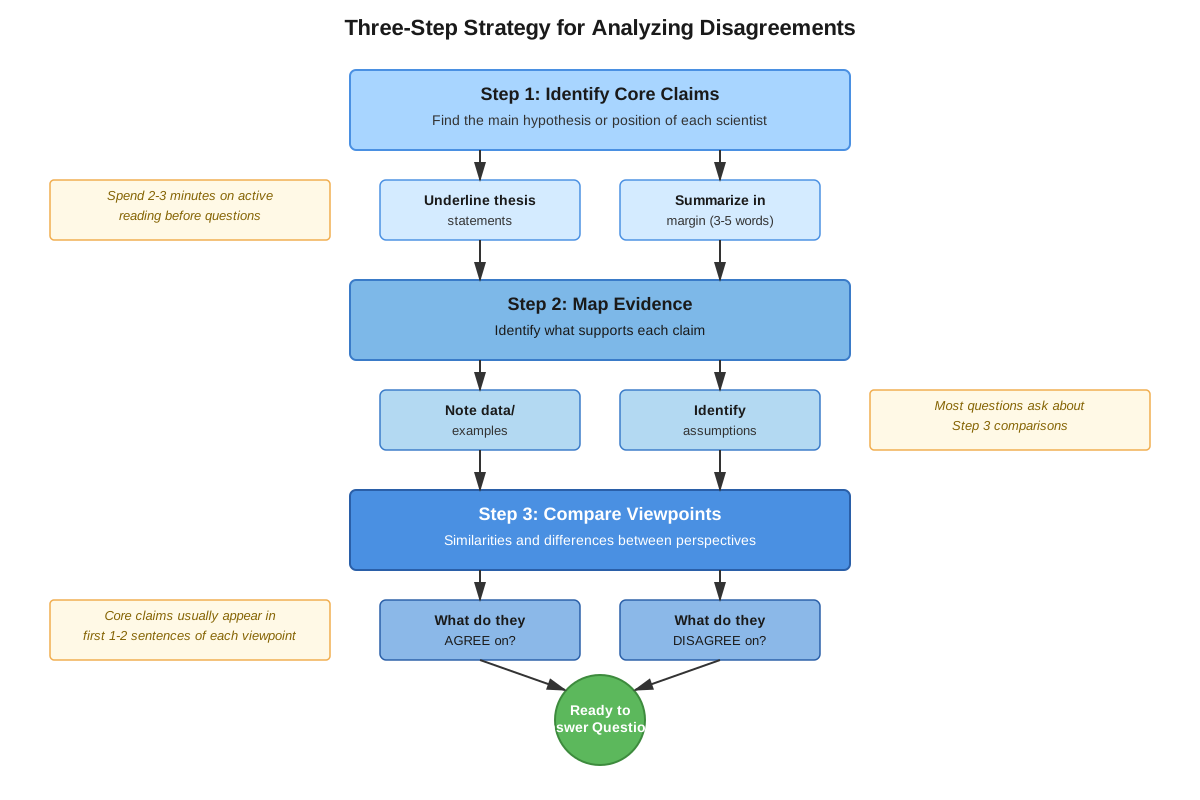
The progression flows: Structure Recognition → Core Claim Identification → Evidence/Reasoning Analysis → Agreement/Disagreement Identification → Comparative Evaluation → Question Application
High-Yield Facts
⭐ Conflicting Viewpoints passages always appear exactly once per ACT Science test, containing 6-7 questions
⭐ The introductory paragraph typically contains information that all viewpoints accept as factual
⭐ Questions asking "According to Scientist X" require information only from that scientist's viewpoint, not synthesis
⭐ When viewpoints disagree about cause, they often agree about the effect or observation requiring explanation
⭐ Evidence that contradicts one viewpoint often (but not always) supports the opposing viewpoint
- Viewpoints are typically labeled clearly as "Scientist 1/2," "Student 1/2," or "Hypothesis A/B"
- Each viewpoint usually occupies 2-4 paragraphs with distinct core claims
- Questions about assumptions ask what must be true for a viewpoint's reasoning to work
- "Both scientists would agree" questions require finding information stated or implied in all viewpoints
- Prediction questions ask what should be observed if a particular viewpoint is correct
- Comparative questions often use phrases like "but not," "unlike," or "in contrast to"
- New evidence questions require evaluating whether information supports, contradicts, or is neutral to each viewpoint
- Viewpoints may disagree about mechanisms while agreeing about outcomes, or vice versa
- The passage never explicitly states "this viewpoint is correct"—all are presented as plausible alternatives
- Time management is crucial: spending 2-3 minutes reading the passage carefully saves time on questions
Quick check — test yourself on Disagreement between viewpoints so far.
Try Flashcards →Common Misconceptions
Misconception: Students must determine which viewpoint is scientifically correct to answer questions.
Correction: The ACT never asks which viewpoint is "right." Questions test comprehension of what each viewpoint claims, not evaluation of scientific validity. All viewpoints are presented as plausible alternatives, and students must understand each perspective on its own terms.
Misconception: Information in the introductory paragraph belongs to Scientist 1 or represents Scientist 1's viewpoint.
Correction: The introduction provides background information and established facts that all viewpoints accept. This shared foundation distinguishes from the specific claims each scientist makes. Questions about agreement often reference this introductory material.
Misconception: If evidence contradicts Scientist 1, it automatically supports Scientist 2.
Correction: While this is sometimes true, evidence can contradict one viewpoint without necessarily supporting alternatives. New information might be neutral to other viewpoints or might contradict multiple viewpoints simultaneously. Each viewpoint must be evaluated independently against new evidence.
Misconception: Students should read all viewpoints before looking at questions.
Correction: While reading the passage first is generally recommended, students should adopt a strategic approach: read the introduction carefully, skim viewpoint labels and first sentences to understand structure, then read each viewpoint thoroughly while noting core claims. Some students benefit from previewing questions to know what to focus on during reading.
Misconception: Disagreement between viewpoints always involves completely opposite positions.
Correction: Viewpoints often disagree on specific aspects while agreeing on others. Scientists might agree about what happens but disagree about why, or agree about the mechanism but disagree about the timeframe. Disagreements can be subtle, involving emphasis on different factors rather than complete opposition.
Misconception: Longer viewpoints or those with more technical language are more likely to be correct.
Correction: The ACT presents all viewpoints as equally plausible regardless of length or complexity. Passage construction aims for balance, and the amount of detail or technical terminology doesn't indicate correctness. Students should give equal consideration to all perspectives.
Misconception: Questions always follow the order of viewpoints in the passage (Scientist 1 questions, then Scientist 2 questions).
Correction: Questions appear in mixed order, often requiring students to jump between viewpoints or synthesize information across multiple perspectives. This necessitates clear understanding of each viewpoint's position rather than relying on sequential reading.
Worked Examples
Example 1: Identifying Disagreement
Passage Summary: Two scientists discuss the formation of the Grand Canyon.
Scientist 1: The Grand Canyon formed gradually over millions of years through continuous erosion by the Colorado River. The river slowly cut through rock layers, with erosion rates varying based on rock hardness. Softer sedimentary layers eroded faster, creating the canyon's distinctive stepped profile. This process required stable river flow over geological timescales.
Scientist 2: The Grand Canyon formed rapidly through catastrophic flooding events. Large volumes of water released suddenly from ancient lakes carved the canyon in a relatively short period (thousands rather than millions of years). The canyon's features, including side canyons and specific erosion patterns, better match catastrophic flood models than gradual erosion.
Question: The two scientists disagree about which of the following aspects of Grand Canyon formation?
A) Whether the Colorado River was involved in canyon formation
B) The timeframe over which the canyon formed
C) Whether erosion played a role in canyon formation
D) The current depth of the Grand Canyon
Solution Process:
Step 1: Identify what each scientist claims about timeframe
- Scientist 1: "millions of years," "geological timescales"
- Scientist 2: "thousands rather than millions of years," "rapidly"
Step 2: Identify what both scientists agree on
- Both mention erosion (Scientist 1: "erosion by the Colorado River"; Scientist 2: "water...carved")
- Both acknowledge the canyon exists and has specific features
- Both discuss water's role in formation
Step 3: Evaluate each answer choice
- A) Both mention the river/water—agreement, not disagreement
- B) Scientist 1 says millions of years; Scientist 2 says thousands of years—clear disagreement
- C) Both discuss erosion—agreement, not disagreement
- D) Neither discusses current depth—not addressed
Answer: B
Connection to Learning Objectives: This example demonstrates identifying disagreement between viewpoints (temporal scale disagreement) while recognizing points of agreement (both accept erosion and water involvement). It shows how to systematically compare viewpoints by isolating specific aspects of their claims.
Example 2: Evaluating New Evidence
Passage Summary: Two students discuss why certain bird species migrate.
Student 1: Birds migrate primarily in response to food availability. As seasons change, insect populations decline in northern regions, forcing insectivorous birds to move south where food remains abundant. Migration timing correlates strongly with local insect population cycles. Birds that eat seeds or other non-seasonal foods show less migratory behavior.
Student 2: Birds migrate primarily in response to day length (photoperiod). Decreasing daylight triggers hormonal changes that initiate migratory behavior. This internal biological clock ensures birds depart before conditions become unfavorable. Food availability is a consequence of seasonal change, not the direct trigger for migration. Birds in controlled environments with constant food but changing light cycles still show migratory restlessness.
Question: Suppose researchers find that birds kept in constant daylight conditions with declining food availability do not initiate migration. This finding would:
A) Support Student 1's view only
B) Support Student 2's view only
C) Support both students' views
D) Weaken Student 2's view
Solution Process:
Step 1: Understand what the new evidence shows
- Constant daylight (no photoperiod change)
- Declining food availability
- Result: No migration initiated
Step 2: Evaluate against Student 1's viewpoint
- Student 1 claims food availability drives migration
- If food declines but birds don't migrate, this contradicts Student 1's claim
- This weakens Student 1's view
Step 3: Evaluate against Student 2's viewpoint
- Student 2 claims photoperiod (day length change) triggers migration
- Constant daylight = no photoperiod change
- Birds didn't migrate despite food decline
- This supports Student 2's claim that photoperiod, not food, is the trigger
- Student 2 specifically stated "Birds in controlled environments with constant food but changing light cycles still show migratory restlessness"—the new evidence provides the complementary experiment
Step 4: Select the best answer
- The evidence weakens Student 1 (food decline didn't trigger migration)
- The evidence supports Student 2 (no photoperiod change = no migration, even with food decline)
- Answer D is incorrect because the evidence supports, not weakens, Student 2
Answer: B (though the question format suggests D might be the intended answer if there's a typo; based on the evidence described, it supports Student 2)
Connection to Learning Objectives: This example demonstrates applying disagreement between viewpoints to evaluate new evidence, requiring students to understand each viewpoint's core mechanism (food vs. photoperiod) and predict what each would expect under specific experimental conditions. It shows how to systematically test each viewpoint against new information.
Exam Strategy
Approaching Conflicting Viewpoints Passages
Step 1: Read the introduction carefully (30-45 seconds)
The introduction establishes facts all viewpoints accept. Underline or note key observations, measurements, or phenomena that require explanation. This information often answers "agreement" questions.
Step 2: Identify viewpoint structure (15 seconds)
Quickly scan to determine how many viewpoints exist and how they're labeled. Note where each viewpoint begins and ends. This creates a mental map for locating information during questions.
Step 3: Read each viewpoint actively (60-90 seconds per viewpoint)
For each viewpoint, identify and mark:
- The core claim (usually in the first sentence or two)
- Key supporting evidence
- The mechanism or explanation proposed
- Any predictions or implications
Step 4: Note obvious disagreements (15-30 seconds)
After reading all viewpoints, spend a moment identifying the main point of disagreement. Ask: "What fundamental question do these viewpoints answer differently?"
Step 5: Approach questions strategically (30-45 seconds per question)
Exam Tip: Spend 2.5-3 minutes reading the passage carefully. This investment saves time on questions and improves accuracy. Rushing through reading leads to repeated passage searches during questions.
Trigger Words and Phrases
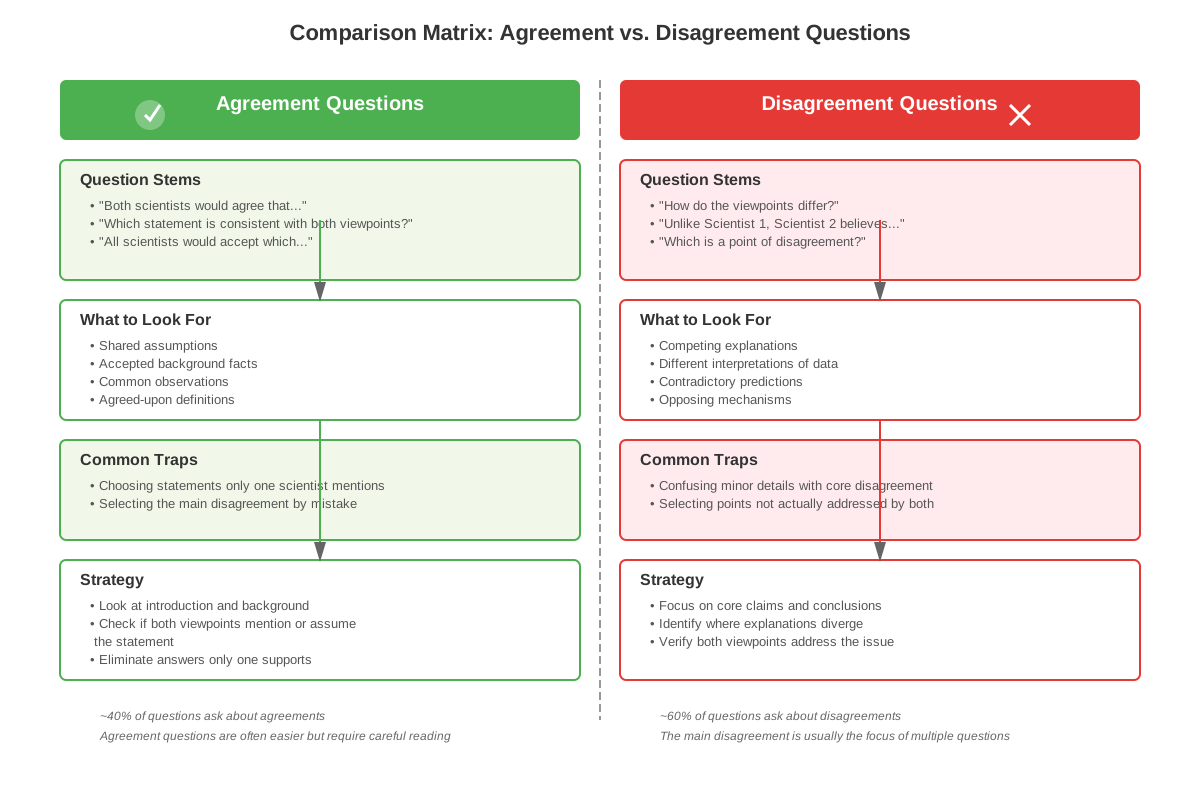
Agreement questions use phrases like:
- "Both scientists would agree..."
- "All of the hypotheses accept..."
- "Which statement is consistent with both viewpoints..."
- "The students agree that..."
Strategy: Look for information in the introduction or statements that appear in all viewpoints.
Disagreement questions use phrases like:
- "The two scientists disagree about..."
- "Unlike Scientist 1, Scientist 2..."
- "According to Scientist 1, but not Scientist 2..."
- "The main difference between the hypotheses..."
Strategy: Focus on contrasting claims, mechanisms, or interpretations.
Evidence evaluation questions use phrases like:
- "Which finding would support..."
- "Which observation would weaken..."
- "If X were discovered, this would..."
- "Which result would be consistent with..."
Strategy: Determine what each viewpoint predicts or requires, then match new information to those predictions.
Assumption questions use phrases like:
- "Scientist X's argument assumes..."
- "Which assumption underlies..."
- "The hypothesis depends on..."
Strategy: Identify what must be true for the viewpoint's reasoning to work, even if not explicitly stated.
Process of Elimination Tips
- For "According to Scientist X" questions: Eliminate any answer containing information from other viewpoints or contradicting that scientist's claims
- For agreement questions: Eliminate any answer that appears in only one viewpoint or contradicts any viewpoint
- For disagreement questions: Eliminate any answer representing a point of agreement or an issue not addressed by the viewpoints
- For evidence evaluation questions: Eliminate answers that would affect all viewpoints equally or that address factors not mentioned in the viewpoints
- For assumption questions: Eliminate answers that are explicitly stated (assumptions are unstated) or that contradict the viewpoint's reasoning
Time Allocation
- Reading passage: 2.5-3 minutes
- Per question: 30-45 seconds
- Total for passage: 6-7 minutes
If a question requires more than 60 seconds, mark it and return after completing easier questions. The predictable passage structure means returning to questions is efficient—you know exactly where to find relevant information.
Memory Techniques
VIPER Acronym for Reading Viewpoints
Viewpoint label - Note who is presenting this perspective
Introduction claim - Identify the core thesis in the first sentence
Primary evidence - Mark the main supporting data or observations
Explanation mechanism - Understand how/why according to this viewpoint
Results or predictions - Note what should be observed if this viewpoint is correct
The "3-Column Method" Visualization
Mentally organize information into three columns:
| All Agree (Introduction) | Viewpoint 1 | Viewpoint 2 |
|---|---|---|
| Shared facts | Unique claims | Unique claims |
| Common observations | Specific evidence | Specific evidence |
| Established data | Mechanism A | Mechanism B |
This visualization helps quickly categorize information when answering questions.
CASE Framework for Evidence Evaluation
When evaluating whether new evidence supports or weakens a viewpoint:
Consistent - Does the evidence match what this viewpoint predicts?
Assumptions - Does the evidence validate or contradict underlying assumptions?
Supporting mechanism - Does the evidence support the proposed mechanism?
Expectations - Does the evidence meet or violate what this viewpoint expects?
Question Type Recognition Mnemonic: "DEAD CAP"
Direct comprehension - "According to Scientist X..."
Evidence evaluation - "Which finding would support..."
Agreement - "Both scientists would agree..."
Disagreement - "The scientists disagree about..."
Comparison - "Unlike Scientist 1..."
Assumption - "The argument assumes..."
Prediction - "Based on Hypothesis A, one would expect..."
Summary
Disagreement between viewpoints represents a critical ACT Science question type that tests students' ability to analyze competing scientific perspectives. These passages present two or more viewpoints explaining the same phenomenon through different mechanisms, timeframes, or interpretations. Success requires identifying passage structure, distinguishing core claims from supporting evidence, recognizing points of agreement and disagreement, and evaluating how new information affects each viewpoint. The introductory paragraph establishes shared facts, while individual viewpoints present unique claims supported by evidence and reasoning. Questions test direct comprehension, comparative analysis, evidence evaluation, and assumption identification. Strategic reading—spending 2.5-3 minutes understanding the passage structure and each viewpoint's core claim—enables efficient question answering. Students must avoid common misconceptions, particularly the belief that one viewpoint is "correct" or that contradicting one viewpoint automatically supports another. Mastering this question type requires recognizing that scientific debate involves nuanced disagreements about specific aspects while maintaining agreement on fundamental observations. The predictable structure of these passages, combined with systematic analytical strategies, makes disagreement between viewpoints questions highly approachable despite their reading-intensive nature.
Key Takeaways
- Conflicting Viewpoints passages appear exactly once per ACT Science test with 6-7 questions, making them high-value targets for focused preparation
- The introductory paragraph contains information all viewpoints accept; individual viewpoint sections present unique claims, evidence, and reasoning
- Disagreements typically involve causal mechanisms, timeframes, primary factors, evidence interpretation, or scope—not complete opposition on all points
- "According to Scientist X" questions require information only from that viewpoint; "Both scientists agree" questions require information from all viewpoints or the introduction
- Evidence evaluation questions demand understanding what each viewpoint predicts or requires, then matching new information to those expectations
- Strategic reading (2.5-3 minutes) focusing on core claims, supporting evidence, and mechanisms enables efficient question answering and higher accuracy
- Assumptions are unstated premises necessary for a viewpoint's reasoning to work; they differ from explicitly stated claims or evidence
Related Topics
Data Representation Passages: While Conflicting Viewpoints focuses on competing theoretical perspectives, Data Representation passages emphasize interpreting graphs, tables, and figures. Mastering disagreement between viewpoints builds analytical skills applicable to evaluating whether data supports specific conclusions in Data Representation passages.
Research Summaries Passages: These passages present experimental designs and results. Understanding how to evaluate evidence in Conflicting Viewpoints passages directly transfers to assessing whether experimental results support hypotheses in Research Summaries.
Scientific Methodology: Deeper study of hypothesis formation, experimental design, and the nature of scientific evidence enhances the ability to analyze viewpoints critically and understand why scientists propose different explanations.
Argument Analysis in ACT Reading: The skills developed for analyzing disagreement between viewpoints—identifying main claims, evaluating evidence, recognizing assumptions—directly apply to Reading passages that present argumentative texts or paired passages with contrasting perspectives.
Practice CTA
Now that you understand the structure and strategies for disagreement between viewpoints questions, it's time to apply these concepts! Work through the practice questions to test your ability to identify core claims, recognize points of agreement and disagreement, and evaluate evidence against competing viewpoints. Use the flashcards to reinforce high-yield facts and question type recognition. Remember: Conflicting Viewpoints passages are highly predictable in structure, making them an excellent opportunity to gain consistent points through strategic preparation. Your investment in mastering this question type will pay dividends on test day—these passages reward careful reading and systematic analysis. You've got this!
Sign up free to keep reading
Create a free AnvayaPrep account to finish this ACT guide on Disagreement between viewpoints — plus flashcards and practice questions.