Overview
The ACT Science section frequently presents students with Conflicting Viewpoints passages where multiple scientists, students, or hypotheses offer different explanations for the same phenomenon. Within these passages, one of the most challenging and high-yield question types asks students to make predictions from viewpoints—essentially requiring test-takers to extend a scientist's reasoning beyond what is explicitly stated in the passage. This skill demands that students thoroughly understand each perspective's underlying logic, assumptions, and implications, then apply that framework to novel scenarios or conditions not directly addressed in the text.
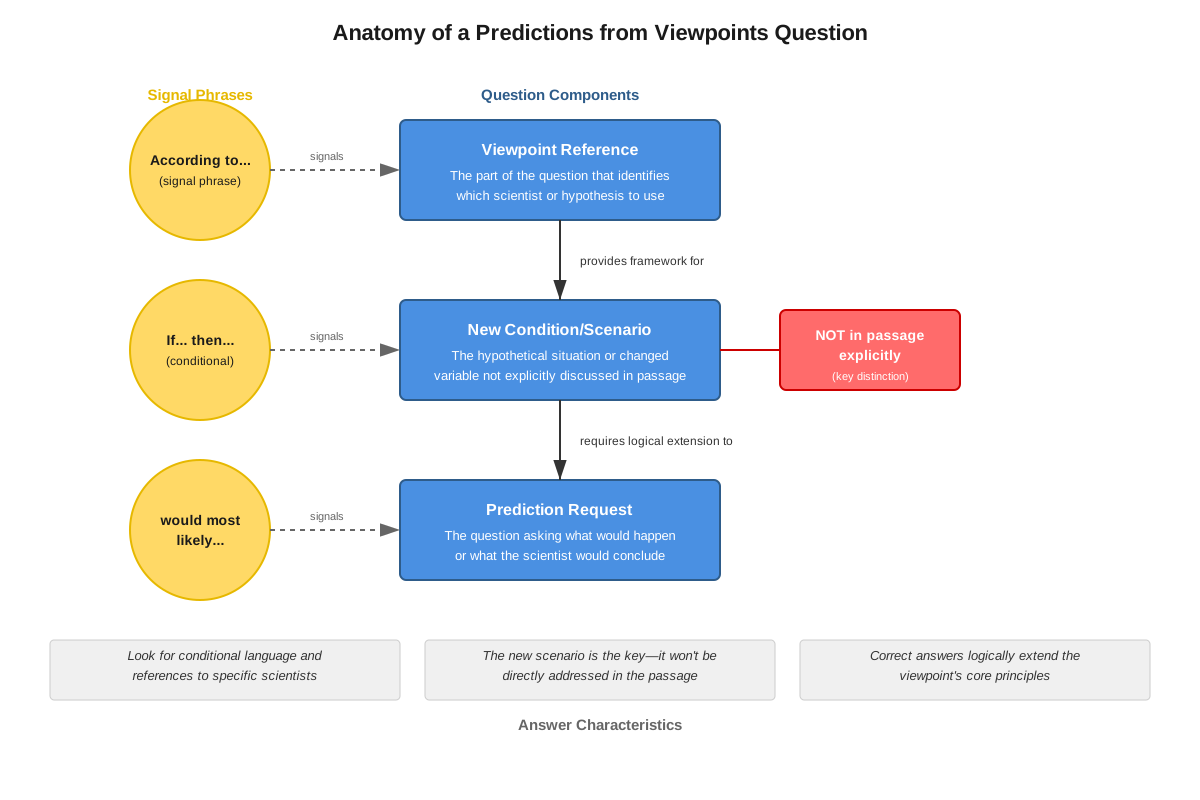
Predictions from viewpoints questions test critical thinking rather than simple recall. Students must internalize the core principles of each viewpoint, identify the logical patterns that govern each scientist's reasoning, and extrapolate how that scientist would respond to new data, changed conditions, or hypothetical situations. These questions often appear as "According to Scientist 2, if [new condition], then..." or "Based on Hypothesis A, which of the following would most likely occur if...?" This question type typically accounts for 15-20% of Conflicting Viewpoints questions, making it a high-priority skill for score optimization.
Understanding how to make accurate predictions from viewpoints connects directly to broader scientific literacy skills tested throughout the ACT Science section. This topic builds upon the ability to identify main ideas, recognize supporting evidence, and distinguish between competing explanations—all fundamental skills in scientific reasoning. Mastery of prediction questions also strengthens performance on evaluation and comparison questions, as students who can predict outcomes from a viewpoint necessarily understand that viewpoint's strengths, limitations, and logical structure.
Learning Objectives
- [ ] Identify when Predictions from viewpoints is being tested in ACT Science passages
- [ ] Explain the core rule or strategy behind Predictions from viewpoints questions
- [ ] Apply Predictions from viewpoints to ACT-style questions accurately
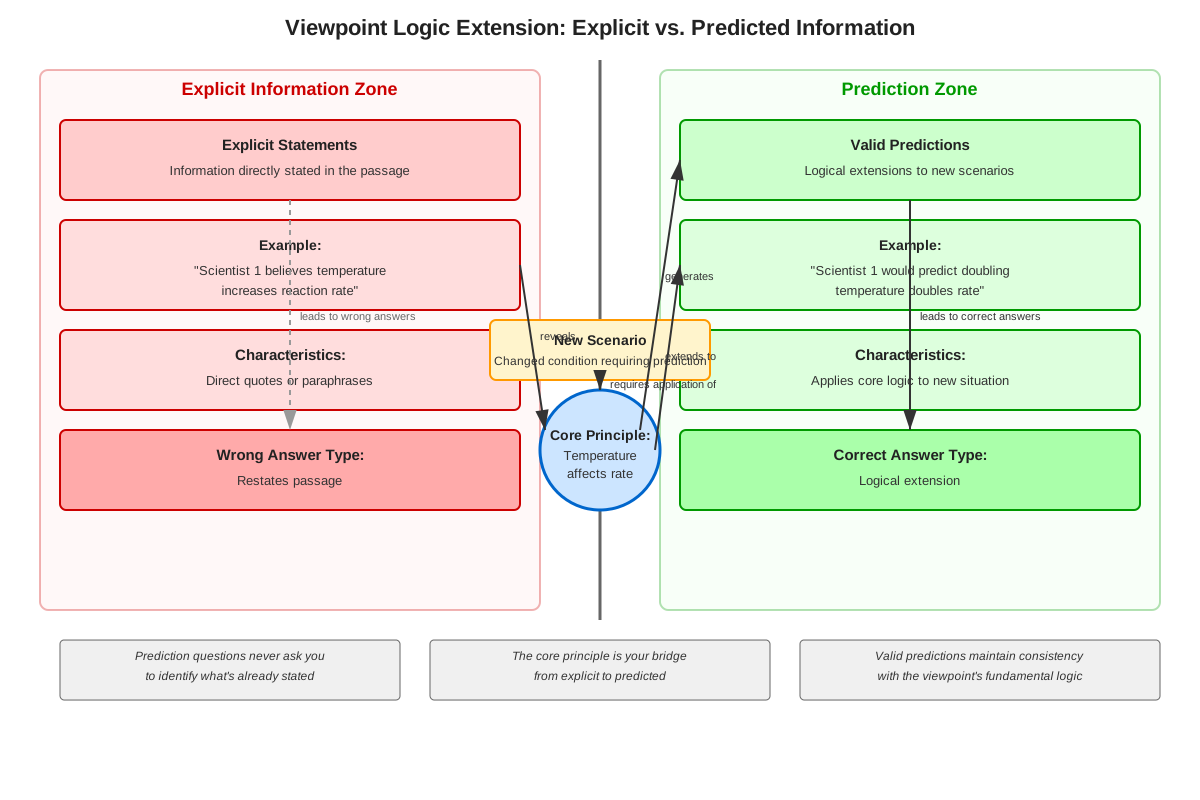
- [ ] Distinguish between explicit statements and logical extensions of a viewpoint
- [ ] Evaluate which aspects of a viewpoint are most relevant for making specific predictions
- [ ] Recognize common patterns in how viewpoints respond to changed conditions or new evidence
Prerequisites
- Understanding of Conflicting Viewpoints passage structure: Students must recognize that these passages present 2-3 distinct perspectives on a single phenomenon, as this forms the foundation for all prediction questions.
- Ability to identify main claims and supporting evidence: Predictions require understanding what each scientist believes and why, which depends on distinguishing central arguments from peripheral details.
- Basic scientific reasoning skills: Students need to understand cause-and-effect relationships, as predictions involve extending causal logic to new situations.
- Familiarity with hypothesis testing: Many viewpoints are structured as hypotheses, and predictions often involve imagining how each hypothesis would explain new experimental results.
Why This Topic Matters
In real-world scientific practice, the ability to make predictions from theoretical frameworks is fundamental to the scientific method. Scientists constantly use their models and theories to predict outcomes of experiments not yet performed, phenomena not yet observed, or conditions not yet tested. This predictive power is what makes scientific theories useful and testable. When students master ACT predictions from viewpoints, they develop the same logical reasoning skills that professional scientists use daily to design experiments, interpret unexpected results, and refine their understanding of natural phenomena.
On the ACT Science test, prediction questions appear in approximately 60-70% of Conflicting Viewpoints passages, with typically 1-2 questions per passage requiring this skill. These questions are considered medium-to-difficult because they cannot be answered through simple passage lookup; students must genuinely understand the logical structure of each viewpoint. According to ACT scoring data, prediction questions show strong discrimination between mid-range and high-scoring students, making them particularly valuable for students aiming for scores above 28.
Prediction questions commonly appear in several formats: asking how a scientist would explain a new observation, what outcome a scientist would expect under changed conditions, which data would support or contradict a viewpoint, or how a viewpoint would need to be modified to account for new information. These questions often include phrases like "According to Scientist 1, if the temperature were increased..." or "Based on Hypothesis B, which of the following would most likely occur?" Recognition of these trigger phrases helps students quickly identify when prediction skills are being tested.
Core Concepts
Understanding Viewpoint Structure
Each viewpoint in a Conflicting Viewpoints passage contains several key components that students must identify to make accurate predictions. The central claim represents the main argument or explanation that the scientist or hypothesis proposes. Supporting this claim are underlying assumptions—often unstated beliefs about how the system works—and mechanisms or processes that explain how the phenomenon occurs according to that viewpoint. Finally, each viewpoint typically includes supporting evidence or reasoning that the scientist uses to justify their position.
To make predictions, students must distinguish between what is explicitly stated and what is logically implied. For example, if Scientist 1 argues that "increased temperature causes faster molecular motion, leading to higher reaction rates," the explicit claim is about temperature and reaction rates. However, this viewpoint implicitly assumes that molecular motion is the key factor controlling reaction rates. A prediction question might ask what this scientist would say about reaction rates under high pressure—requiring students to recognize that if pressure also affects molecular motion, Scientist 1's logic would extend to predict pressure effects as well.
The Prediction Process
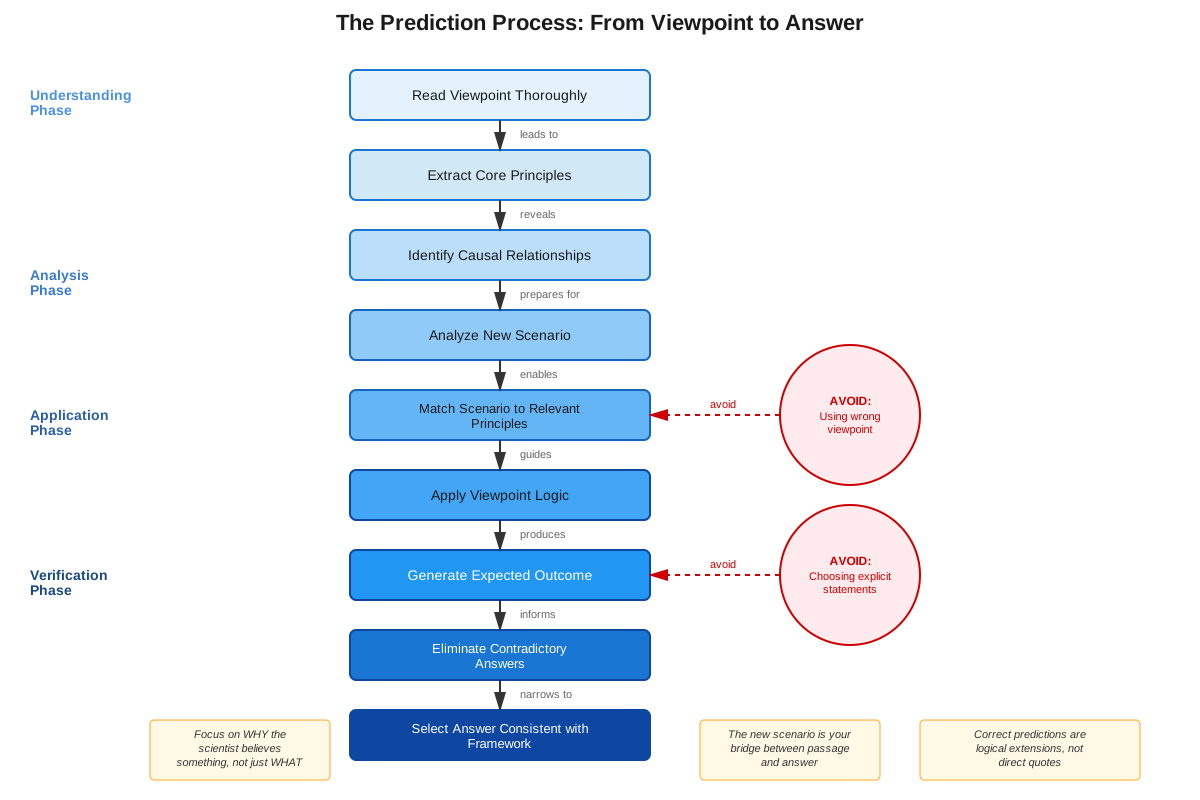
Making accurate predictions from viewpoints follows a systematic process. First, students must identify the relevant viewpoint by carefully reading which scientist, student, or hypothesis the question references. Second, students should extract the core logic of that viewpoint—the fundamental principles or mechanisms that drive the scientist's reasoning. Third, students must analyze the new condition presented in the question, identifying what has changed from the original passage scenario. Fourth, students should apply the viewpoint's logic to the new condition, reasoning through how the scientist's principles would operate under these changed circumstances. Finally, students must select the answer choice that best reflects this logical extension.
Consider this example: If Scientist 2 believes that "glacial retreat is caused primarily by decreased snowfall rather than increased temperature," and a question asks what this scientist would predict if both snowfall and temperature remained constant, students must apply Scientist 2's logic. Since this scientist attributes glacial retreat to snowfall changes, constant snowfall would predict no glacial retreat, regardless of temperature. This demonstrates how the prediction process requires understanding the causal relationships within each viewpoint.
Types of Prediction Questions
ACT predictions from viewpoints questions fall into several distinct categories. Outcome predictions ask what result a scientist would expect under specified conditions: "According to Scientist 1, if the pH were decreased, the reaction rate would most likely..." Explanation predictions ask how a scientist would interpret or explain a new observation: "Based on Hypothesis A, the observed increase in population would most likely be attributed to..." Support/contradiction predictions ask what new evidence would strengthen or weaken a viewpoint: "Which of the following findings would most support Scientist 2's hypothesis?"
Modification predictions ask how a viewpoint would need to change to accommodate new information: "If it were discovered that [new fact], Scientist 1's hypothesis would need to be revised to include..." Comparative predictions ask how different viewpoints would respond differently to the same new condition: "Unlike Scientist 1, Scientist 2 would most likely predict that..." Each question type requires the same fundamental skill—understanding the viewpoint's logic—but applies that understanding in slightly different ways.
Common Logical Patterns
Certain logical patterns appear repeatedly in viewpoints and their predictions. Causal chains present a sequence where A causes B, which causes C; predictions extend this chain to new situations. Proportional relationships suggest that as one variable increases, another increases or decreases proportionally; predictions apply this relationship to new values. Threshold effects propose that a phenomenon only occurs above or below a certain value; predictions determine whether new conditions cross that threshold.
Necessary and sufficient conditions distinguish between what must be present (necessary) and what alone can cause an effect (sufficient); predictions identify whether new conditions meet these requirements. Competing factors acknowledge multiple influences on an outcome; predictions determine which factor dominates under new conditions. Recognizing these patterns helps students quickly identify the logical structure of viewpoints and make accurate predictions.
Avoiding Over-Extension
A critical skill in making predictions is recognizing the scope and limitations of each viewpoint. Students must avoid extending a viewpoint's logic beyond what is reasonably supported by its stated principles. For example, if Scientist 1 discusses only temperature effects on reaction rates, students should not assume this scientist would make specific predictions about pressure effects unless the viewpoint's underlying mechanism clearly extends to pressure. The safest predictions stay close to the core logic explicitly or implicitly stated in the passage.
When answer choices seem to require assumptions beyond the viewpoint's scope, students should select the choice that makes the fewest additional assumptions while remaining consistent with the viewpoint's stated logic. This principle of minimal extension helps students avoid trap answers that sound plausible but require inferential leaps not supported by the passage.
Concept Relationships
The ability to make predictions from viewpoints builds directly upon the foundational skill of identifying and understanding each viewpoint's main claims. Students cannot predict what a scientist would say about a new situation without first comprehending what that scientist believes about the original situation. This understanding → prediction relationship is sequential and hierarchical.
Within the prediction process itself, several concepts interconnect. Identifying core logic enables recognizing logical patterns, which in turn facilitates applying viewpoint reasoning to new conditions. These three skills form a cycle: the better students become at recognizing patterns, the more quickly they can identify core logic in new passages, and the more accurately they can apply that logic to make predictions.
The relationship map flows as follows: Viewpoint Structure → Core Logic Extraction → Pattern Recognition → Logical Application → Accurate Prediction. Additionally, Understanding Scope and Limitations acts as a regulatory mechanism throughout this process, preventing over-extension at each step. This interconnected system means that weakness in any component undermines the entire prediction process, while strength in pattern recognition and logic extraction accelerates performance on all prediction questions.
High-Yield Facts
- ⭐ Prediction questions require extending a viewpoint's logic to new conditions, not simply recalling what the passage states explicitly
- ⭐ The correct prediction must be consistent with the viewpoint's underlying assumptions and mechanisms, even if not directly stated
- ⭐ Approximately 60-70% of Conflicting Viewpoints passages include at least one prediction question
- ⭐ Trigger phrases include "According to Scientist X, if...", "Based on Hypothesis Y, which would most likely...", and "Scientist Z would predict..."
- ⭐ The viewpoint's core mechanism or causal relationship is more important for predictions than specific data points mentioned
- Students should identify what drives each viewpoint's reasoning (temperature, pressure, time, concentration, etc.) to predict responses to changes in those variables
- Prediction questions often test whether students understand the difference between correlation and causation within a viewpoint
- When multiple answer choices seem consistent with a viewpoint, choose the one requiring the fewest additional assumptions
- Comparative prediction questions require understanding how viewpoints differ in their fundamental mechanisms, not just their conclusions
- If a viewpoint emphasizes one factor as primary, predictions should reflect that factor's dominance even when other factors are mentioned
- Predictions should maintain the same logical structure as the original viewpoint (if-then relationships, proportional changes, threshold effects)
- Wrong answers often confuse which scientist holds which view or apply one scientist's logic to another scientist's name
Quick check — test yourself on Predictions from viewpoints so far.
Try Flashcards →Common Misconceptions
Misconception: Predictions can be made by simply finding similar keywords between the question and one part of the passage. → Correction: Accurate predictions require understanding the viewpoint's underlying logic and mechanisms, then applying that reasoning to new conditions. Keyword matching often leads to trap answers that use passage vocabulary but contradict the viewpoint's actual reasoning.
Misconception: If a viewpoint doesn't explicitly mention a variable (like pressure or pH), that scientist would have no prediction about it. → Correction: Scientists can make predictions about variables not explicitly discussed if those variables relate to the viewpoint's core mechanism. For example, if a scientist's mechanism involves molecular motion, they could predict effects of any factor that influences molecular motion, even if not specifically mentioned.
Misconception: All scientists would agree on predictions about basic scientific facts, so viewpoint-specific predictions don't matter. → Correction: Conflicting Viewpoints passages specifically present situations where scientists disagree about mechanisms, causes, or interpretations. Their predictions will differ systematically based on their different underlying assumptions, even when predicting about the same new condition.
Misconception: The most complex or scientific-sounding answer choice is usually correct for prediction questions. → Correction: Correct predictions follow logically from the viewpoint's stated reasoning, which may be relatively simple. Complex answer choices often introduce concepts beyond the viewpoint's scope, making them incorrect despite sounding sophisticated.
Misconception: If new evidence contradicts a viewpoint's original claim, that viewpoint would completely change its position. → Correction: Scientists typically modify viewpoints incrementally to accommodate new evidence while maintaining core principles. Prediction questions about contradictory evidence usually have answers showing limited revision rather than complete abandonment of the viewpoint's fundamental logic.
Worked Examples
Example 1: Temperature and Reaction Rate
Passage Context: Scientist 1 argues that chemical reaction rates increase with temperature because higher temperatures provide more kinetic energy to molecules, allowing them to overcome activation energy barriers more frequently. Scientist 2 argues that reaction rates increase with temperature because higher temperatures cause molecules to collide more frequently, and more collisions lead to more reactions.
Question: According to Scientist 1, if a catalyst were added to the reaction (a catalyst lowers activation energy without changing temperature), the reaction rate would most likely:
A) Decrease, because less kinetic energy would be needed
B) Increase, because molecules would need less energy to overcome the activation barrier
C) Remain the same, because temperature hasn't changed
D) Increase, because molecules would collide more frequently
Solution Process:
Step 1: Identify the relevant viewpoint—Scientist 1, whose mechanism focuses on kinetic energy and activation energy barriers.
Step 2: Extract core logic—Scientist 1 believes reactions occur when molecules have sufficient kinetic energy to overcome activation energy. Higher temperature increases kinetic energy, making barrier-crossing more frequent.
Step 3: Analyze the new condition—A catalyst lowers the activation energy barrier without changing temperature (and thus without changing molecular kinetic energy).
Step 4: Apply Scientist 1's logic—If the barrier is lower but molecular energy remains the same, more molecules will now have sufficient energy to overcome the reduced barrier. This increases the frequency of successful reactions.
Step 5: Evaluate answer choices:
- A is incorrect because needing less energy doesn't decrease reaction rate
- B correctly applies Scientist 1's logic about activation energy barriers
- C incorrectly assumes only temperature changes matter to Scientist 1
- D uses Scientist 2's collision-frequency mechanism, not Scientist 1's energy-barrier mechanism
Answer: B
Connection to Learning Objectives: This example demonstrates identifying when predictions are tested (the "According to Scientist 1, if..." structure), explaining the strategy (extracting and applying core logic), and accurately applying the process to reach the correct answer.
Example 2: Glacial Retreat Mechanisms
Passage Context: Hypothesis A states that glacial retreat occurs primarily due to increased summer temperatures melting ice faster than winter snowfall can replace it. Hypothesis B states that glacial retreat occurs primarily due to decreased winter snowfall, which fails to replenish ice lost to normal summer melting.
Question: Based on Hypothesis B, if winter snowfall increased significantly while summer temperatures also increased significantly, glacial size would most likely:
A) Decrease, because higher summer temperatures would dominate
B) Increase, because more snowfall would dominate
C) Remain stable, because the effects would cancel out
D) Vary unpredictably, because both factors changed
Solution Process:
Step 1: Identify the relevant viewpoint—Hypothesis B, which emphasizes winter snowfall as the primary factor.
Step 2: Extract core logic—Hypothesis B attributes glacial retreat to insufficient snowfall replenishment. This hypothesis treats snowfall as the dominant controlling factor, with melting as a relatively constant background process.
Step 3: Analyze the new condition—Both snowfall (Hypothesis B's primary factor) and temperature (Hypothesis A's primary factor) increase.
Step 4: Apply Hypothesis B's logic—Since Hypothesis B treats snowfall as primary and melting as secondary, increased snowfall would have a stronger effect than increased temperature according to this viewpoint. The hypothesis's mechanism suggests that adequate snowfall can maintain or grow glaciers even with normal melting.
Step 5: Evaluate answer choices:
- A applies Hypothesis A's logic (temperature dominance), not Hypothesis B's
- B correctly reflects Hypothesis B's emphasis on snowfall as the primary factor
- C incorrectly assumes equal weighting of factors, contradicting Hypothesis B's emphasis
- D incorrectly suggests unpredictability when Hypothesis B clearly prioritizes one factor
Answer: B
Connection to Learning Objectives: This example shows how to distinguish between viewpoints' different emphases, recognize which aspects are most relevant for predictions (primary vs. secondary factors), and avoid applying one viewpoint's logic to another viewpoint's predictions.
Exam Strategy
When approaching predictions from viewpoints questions on the ACT, students should first identify the question type by looking for trigger phrases: "According to [Scientist/Hypothesis]," "Based on [viewpoint]," "would most likely," "would predict," or "if [new condition]." These phrases signal that the question requires extending a viewpoint's logic rather than recalling explicit passage statements.
Exam Tip: Immediately identify which specific viewpoint the question references. Circle or underline the scientist's name or hypothesis letter to avoid accidentally applying the wrong viewpoint's logic—a common error that leads to selecting answers that are correct for a different scientist.
After identifying the relevant viewpoint, students should quickly review that viewpoint's section in the passage, focusing on the mechanism or reasoning rather than specific data. Ask: "What does this scientist believe causes the phenomenon?" and "What principle or process drives this viewpoint's explanation?" Understanding the "why" behind the viewpoint enables accurate predictions about new situations.
Next, carefully analyze what the question changes from the original passage scenario. Identify the new condition, changed variable, or hypothetical situation. Consider how this change would interact with the viewpoint's core mechanism. Would it strengthen the mechanism's effect, weaken it, introduce a new factor the mechanism addresses, or fall outside the mechanism's scope?
For process-of-elimination, first eliminate answers that contradict the viewpoint's explicit statements or core logic. Then eliminate answers that apply a different viewpoint's reasoning (check that the mechanism matches the correct scientist). Next, eliminate answers that require assumptions beyond the viewpoint's stated or implied scope. Finally, among remaining choices, select the answer requiring the fewest additional assumptions while maintaining consistency with the viewpoint's logic.
Time Management: Spend 30-45 seconds reviewing the relevant viewpoint before attempting to answer. This investment prevents the need to re-read multiple times and reduces errors from incomplete understanding. Prediction questions typically require 45-60 seconds total, slightly longer than simple recall questions.
Watch for trap answers that use vocabulary from the passage but apply it incorrectly, that sound scientifically sophisticated but don't follow the viewpoint's logic, or that would be correct for a different scientist's viewpoint. Also beware of answers suggesting complete abandonment of a viewpoint's core principles—modifications are usually incremental, not revolutionary.
Memory Techniques
CLAIM - A mnemonic for the prediction process:
- Core logic: Identify the viewpoint's fundamental mechanism
- Logic patterns: Recognize if-then, proportional, or threshold relationships
- Analyze change: Determine what's different in the question scenario
- Infer outcome: Apply the core logic to the new condition
- Minimal assumptions: Choose the answer requiring fewest extra assumptions
The "Scientist's Glasses" Visualization: Imagine each scientist wearing colored glasses that make them see the world through their particular mechanism. Scientist 1 might wear "temperature glasses" that make temperature the most important factor in everything they observe. When making predictions, visualize looking through that scientist's specific glasses—you'll see the new situation filtered through their particular emphasis and logic.
The "If-Then Chain" Technique: For each viewpoint, write a simple if-then statement capturing its core logic: "If temperature increases, then molecular energy increases, then reaction rate increases." When predicting, extend this chain: "If activation energy decreases (catalyst), then more molecules have sufficient energy, then reaction rate increases." This chain-building makes the logical extension explicit and prevents errors.
The "Primary Factor" Acronym - PRIME: Remember that viewpoints usually emphasize one PRimary factor as Important for Making Explanations. Identify each viewpoint's PRIME factor, and predictions will typically reflect that factor's dominance even when other factors are mentioned.
Summary
Predictions from viewpoints represent a critical high-yield skill for ACT Science success, requiring students to extend a scientist's or hypothesis's reasoning to new conditions not explicitly addressed in the passage. Mastery depends on understanding each viewpoint's core logic—the fundamental mechanisms, assumptions, and causal relationships that drive its explanations—rather than memorizing specific data points. The prediction process involves identifying the relevant viewpoint, extracting its core logic, analyzing what has changed in the question scenario, applying the viewpoint's reasoning to this new condition, and selecting the answer that follows logically with minimal additional assumptions. Students must recognize common logical patterns (causal chains, proportional relationships, threshold effects) and understand each viewpoint's scope and limitations to avoid over-extension. Success on these medium-difficulty, high-frequency questions distinguishes mid-range from high-scoring students and requires genuine comprehension rather than simple passage lookup. By systematically applying the CLAIM process and maintaining focus on mechanisms over details, students can consistently answer prediction questions accurately and efficiently.
Key Takeaways
- Prediction questions require extending viewpoint logic to new scenarios, not recalling explicit passage statements
- Focus on understanding each viewpoint's core mechanism or causal relationship rather than memorizing specific data
- The correct prediction must be consistent with the viewpoint's underlying assumptions and logical structure
- Identify trigger phrases like "According to Scientist X, if..." to recognize when predictions are being tested
- Apply the CLAIM process: Core logic, Logic patterns, Analyze change, Infer outcome, Minimal assumptions
- Avoid trap answers that apply the wrong viewpoint's logic or require assumptions beyond the passage scope
- Prediction questions appear in 60-70% of Conflicting Viewpoints passages and strongly discriminate between score levels
Related Topics
Evaluating Viewpoints: After mastering predictions, students should develop skills in evaluating the strengths and weaknesses of each viewpoint, determining which viewpoint is better supported by evidence, and identifying what new evidence would strengthen or weaken each position. Prediction skills provide the foundation for evaluation by ensuring deep understanding of each viewpoint's logic.
Comparing and Contrasting Viewpoints: This advanced skill requires identifying similarities and differences between viewpoints' mechanisms, assumptions, and predictions. Mastery of predictions enables effective comparison because students understand not just what each viewpoint claims, but why they claim it and how their reasoning differs.
Synthesizing Multiple Viewpoints: The highest-level skill involves integrating elements from multiple viewpoints to form more comprehensive explanations. This requires the prediction-level understanding of each viewpoint's logic to determine which aspects might be compatible or complementary.
Data Representation and Research Summaries Integration: While Conflicting Viewpoints passages focus on competing explanations, connecting prediction skills to data interpretation passages helps students evaluate which viewpoint better explains experimental results—a common cross-passage-type question on the ACT.
Practice CTA
Now that you understand the systematic approach to making predictions from viewpoints, it's time to apply these strategies to actual ACT-style questions. The practice questions and flashcards will reinforce your ability to identify prediction questions, extract core logic from viewpoints, and accurately extend that reasoning to new conditions. Remember that prediction questions reward genuine understanding over memorization—each practice question you work through builds the logical reasoning skills that will serve you across all Conflicting Viewpoints passages. Approach each practice question systematically using the CLAIM process, and review both correct and incorrect answers to understand why each choice does or doesn't follow from the viewpoint's logic. Your investment in mastering this high-yield skill will directly translate to improved performance on test day!
Sign up free to keep reading
Create a free AnvayaPrep account to finish this ACT guide on Predictions from viewpoints — plus flashcards and practice questions.