Overview
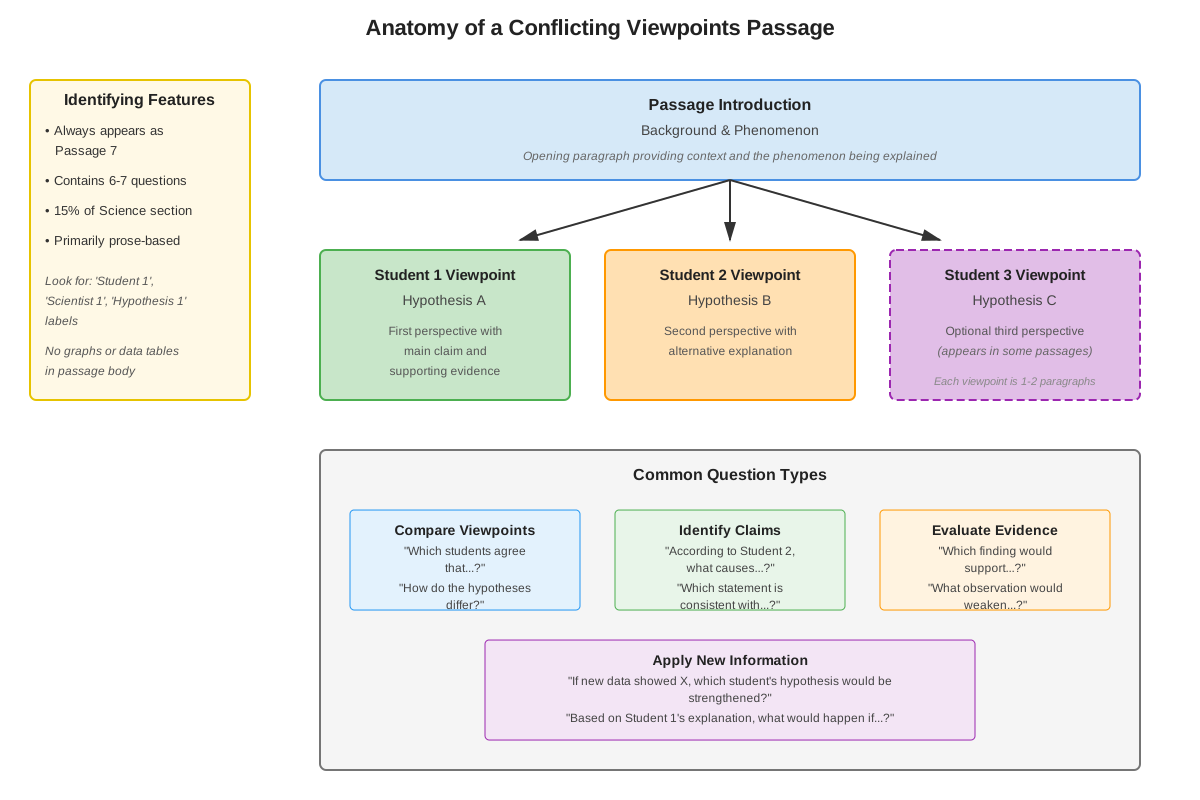
The student viewpoints section represents one of the most distinctive and challenging question types on the ACT Science test. Unlike traditional science questions that test factual recall or data interpretation, student viewpoints questions assess a test-taker's ability to understand, compare, and analyze competing scientific hypotheses, theories, or perspectives presented by different researchers, scientists, or students. This format typically appears in the Conflicting Viewpoints passage, which comprises approximately 15% of the ACT Science section—usually one passage with 6-7 questions per test.
Understanding ACT student viewpoints is crucial because these questions require a unique skill set that blends reading comprehension with scientific reasoning. Students must identify the core claims of each viewpoint, recognize supporting evidence, distinguish between similar-sounding arguments, and evaluate how different perspectives address the same phenomenon. Unlike Data Representation or Research Summaries passages that focus on graphs and experimental procedures, Conflicting Viewpoints passages present extended prose arguments that require careful, analytical reading.
Mastery of student viewpoints connects directly to broader scientific literacy skills, including the ability to evaluate competing theories, understand the nature of scientific debate, and recognize how evidence supports or contradicts different explanations. This topic builds upon fundamental science reasoning skills while preparing students for the type of critical analysis required in college-level science courses. Success with these questions often determines whether a student achieves a score in the upper ranges (30+) of the ACT Science section.
Learning Objectives
- [ ] Identify when Student viewpoints is being tested
- [ ] Explain the core rule or strategy behind Student viewpoints
- [ ] Apply Student viewpoints to ACT-style questions accurately
- [ ] Distinguish between the main claims and supporting details within each viewpoint
- [ ] Compare and contrast multiple scientific perspectives systematically
- [ ] Evaluate which viewpoint would be supported or weakened by new evidence
- [ ] Recognize the underlying assumptions that differentiate competing theories
Prerequisites
- Basic scientific vocabulary: Understanding common scientific terms enables faster comprehension of technical passages without getting stuck on terminology
- Reading comprehension skills: The ability to identify main ideas, supporting details, and logical structure in expository text is fundamental to parsing viewpoint arguments
- Understanding of the scientific method: Familiarity with how hypotheses, evidence, and conclusions relate helps students evaluate the logical structure of each viewpoint
- Basic knowledge across science domains: General awareness of concepts in biology, chemistry, physics, and Earth science provides context for understanding diverse passage topics
Why This Topic Matters
Student viewpoints questions test critical thinking skills that extend far beyond standardized testing. In real-world scientific practice, researchers constantly evaluate competing theories, debate interpretations of data, and refine their understanding based on new evidence. The ability to understand multiple perspectives on complex phenomena is essential for scientific literacy, informed decision-making about science-related policy issues, and success in STEM careers. Medical professionals evaluate competing diagnoses, engineers consider alternative design approaches, and environmental scientists debate the causes and solutions for ecological problems—all requiring the same analytical skills tested in these passages.
On the ACT Science test, the Conflicting Viewpoints passage appears exactly once per exam, typically as the seventh and final passage. This passage consistently contains 6-7 questions worth approximately 15% of the total Science score. The passage format is highly predictable: it presents 2-4 different viewpoints (most commonly 2-3) on the same scientific topic, with each viewpoint spanning 1-3 paragraphs. Questions ask students to identify specific claims, compare viewpoints, determine areas of agreement or disagreement, and predict how new information would affect each perspective.
Common topics for student viewpoints passages include: evolutionary mechanisms, geological processes (plate tectonics, rock formation), astronomical phenomena (planetary formation, stellar evolution), climate change mechanisms, ecological relationships, and theoretical physics concepts. The passages often address questions where scientific debate genuinely exists or where multiple valid explanations can account for observed phenomena. Understanding the structure and strategy for these questions can significantly boost overall Science scores, particularly for students who struggle with the time pressure of the section.
Core Concepts
Structure of Conflicting Viewpoints Passages
Student viewpoints passages follow a consistent organizational structure that students must recognize immediately. The passage begins with an introductory paragraph that presents background information, defines key terms, and describes the phenomenon or question that the subsequent viewpoints will address. This introduction is crucial—it establishes the common ground that all viewpoints share and frames the specific aspect of the phenomenon under debate.
Following the introduction, each viewpoint is clearly labeled (Student 1, Student 2, Scientist 1, Hypothesis A, etc.) and presents a distinct explanation, theory, or perspective. Each viewpoint typically includes: (1) a main claim or thesis statement, (2) supporting evidence or reasoning, (3) mechanisms or processes that explain the phenomenon, and (4) sometimes predictions or implications. The viewpoints are not necessarily contradictory—they may be complementary explanations focusing on different aspects, or they may represent genuinely incompatible theories.
Identifying Main Claims vs. Supporting Details
The most critical skill for ACT student viewpoints questions is distinguishing between the core claim of each viewpoint and the supporting details used to justify that claim. The main claim answers the central question posed in the introduction—it represents what each student or scientist fundamentally believes about the phenomenon. Supporting details include evidence, examples, mechanisms, analogies, and logical reasoning that bolster the main claim.
For example, if the passage discusses what caused dinosaur extinction, Student 1's main claim might be "an asteroid impact caused the extinction," while supporting details would include evidence like iridium layers, crater dating, and climate modeling. Student 2's main claim might be "volcanic activity caused the extinction," with supporting details about flood basalts and atmospheric changes. Questions frequently test whether students can identify these main claims accurately or whether they confuse supporting evidence with the central argument.
Types of Viewpoint Questions
ACT student viewpoints questions fall into several predictable categories:
Identification questions ask students to recognize specific claims, evidence, or assumptions within a single viewpoint. These questions typically begin with phrases like "According to Student 1..." or "Student 2 would most likely agree that..." Success requires careful reading and the ability to locate information within the designated viewpoint without confusing it with other perspectives.
Comparison questions require students to identify similarities or differences between viewpoints. These questions use language like "Unlike Student 1, Student 2 believes..." or "Both students would agree that..." Students must systematically compare the viewpoints on specific aspects rather than making vague generalizations.
Application questions present new information, evidence, or scenarios and ask which viewpoint would be supported, weakened, or consistent with the new data. These questions test deeper understanding of the logical structure and implications of each viewpoint. They often begin with "If it were discovered that..." or "Which of the following findings would support Student 1's viewpoint?"
Assumption questions ask students to identify underlying premises or beliefs that each viewpoint depends upon but may not explicitly state. These questions require inference and critical thinking about what must be true for each argument to be valid.
Systematic Comparison Strategy
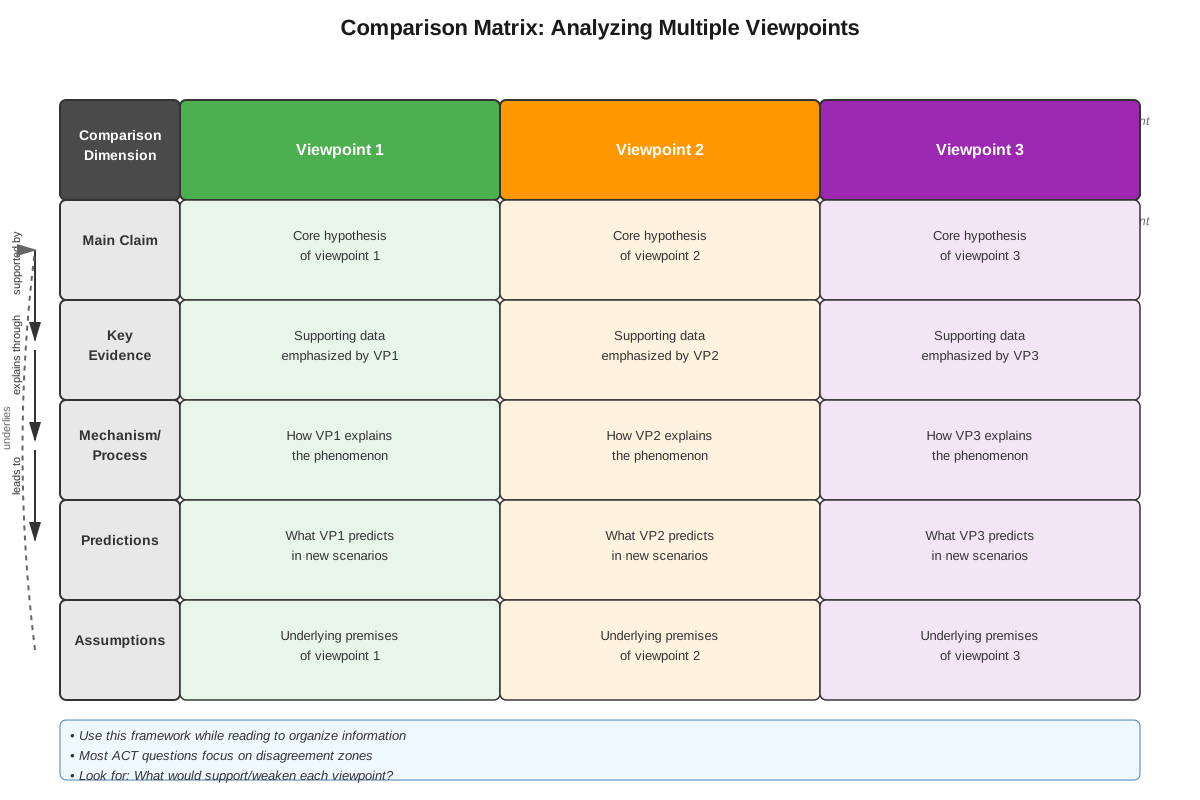
Successful students develop a systematic approach to comparing viewpoints. Creating a mental or written comparison table helps organize information:
| Aspect | Student 1 | Student 2 | Student 3 |
|---|---|---|---|
| Main claim | [Core thesis] | [Core thesis] | [Core thesis] |
| Primary evidence | [Key support] | [Key support] | [Key support] |
| Mechanism | [How it works] | [How it works] | [How it works] |
| Predictions | [Implications] | [Implications] | [Implications] |
This framework helps students avoid confusion and quickly locate relevant information when answering questions. The key is identifying what aspect of the phenomenon each question addresses, then consulting the appropriate row of the comparison.
Areas of Agreement and Disagreement
Many questions specifically test whether students can identify what viewpoints share in common versus where they diverge. All viewpoints typically agree on: (1) the basic phenomenon or observation being explained, (2) fundamental scientific principles, and (3) certain established facts presented in the introduction. They disagree on: (1) the primary cause or mechanism, (2) the relative importance of different factors, (3) predictions about future observations, or (4) interpretations of ambiguous evidence.
Recognizing these boundaries is crucial. For example, in a passage about planetary formation, all viewpoints might agree that planets formed from a disk of material around the early Sun (established fact), but disagree about whether gravitational instability or core accretion was the primary mechanism (point of contention). Questions that ask "Both students would agree that..." require identifying the common ground, while "The main difference between the viewpoints is..." requires pinpointing the central disagreement.
Evidence Evaluation
A sophisticated understanding of student viewpoints includes recognizing how different types of evidence function within arguments. Direct observational evidence (measurements, experimental results) carries different weight than theoretical reasoning (logical deductions from principles) or analogies (comparisons to similar phenomena). Questions may ask which type of evidence would most strongly support or challenge a viewpoint, requiring students to evaluate the logical connection between evidence and claims.
Concept Relationships
The concepts within student viewpoints are hierarchically organized. Understanding the passage structure (introduction → labeled viewpoints) enables students to navigate efficiently. This navigation skill supports identifying main claims, which in turn enables systematic comparison between viewpoints. The ability to compare viewpoints is prerequisite to answering comparison questions and application questions, which represent the majority of questions in these passages.
The relationship flows: Passage Structure → Main Claim Identification → Supporting Detail Recognition → Systematic Comparison → Question Type Recognition → Strategic Answering. Each skill builds upon the previous one, creating a comprehensive approach to these passages.
Student viewpoints connects to prerequisite knowledge of the scientific method by applying its principles to theoretical debates. Just as experiments test hypotheses, new evidence in application questions tests the validity of each viewpoint's predictions. The reading comprehension skills from prerequisite knowledge directly transfer to parsing complex scientific arguments, while basic science knowledge provides context that makes passages more accessible.
This topic also connects forward to college-level science courses, where students regularly encounter competing theories, evaluate research papers with different conclusions, and participate in scientific discourse. The analytical skills developed through student viewpoints practice—identifying assumptions, evaluating evidence, comparing explanations—are fundamental to advanced scientific thinking.
High-Yield Facts
- ⭐ The Conflicting Viewpoints passage always appears exactly once per ACT Science test, typically as the last passage
- ⭐ Each viewpoint's main claim is usually stated or strongly implied in the first sentence or two of that viewpoint's section
- ⭐ Questions asking "According to Student X..." can be answered using only that student's viewpoint—do not consider other viewpoints
- ⭐ When questions ask what "both students agree on," the answer is almost always found in the introductory paragraph or represents basic scientific facts
- ⭐ Application questions that present new evidence require determining which viewpoint's predictions or mechanisms align with the new information
- The passage introduction establishes common ground and defines the specific question under debate
- Viewpoints may be complementary (addressing different aspects) rather than contradictory
- Supporting details include evidence, mechanisms, examples, and reasoning—not the main claim itself
- Questions about assumptions ask what must be true for a viewpoint's argument to be valid
- Comparison questions require identifying specific differences, not vague generalizations
- Time management is crucial—these passages require more reading time but questions are often straightforward once viewpoints are understood
- The number of viewpoints ranges from 2-4, with 2-3 being most common
- Each viewpoint typically spans 1-3 paragraphs of dense scientific prose
- Underlining or annotating main claims while reading saves time during question-answering
- Wrong answer choices often confuse which student holds which position or mix claims from different viewpoints
Quick check — test yourself on Student viewpoints so far.
Try Flashcards →Common Misconceptions
Misconception: All viewpoints must completely contradict each other → Correction: Viewpoints may be complementary, focusing on different aspects of a phenomenon, or may agree on many points while disagreeing on specific mechanisms or causes. The ACT tests whether students can identify both agreements and disagreements.
Misconception: The introduction paragraph is just background and can be skimmed → Correction: The introduction is critical because it establishes what all viewpoints agree upon, defines key terms, and frames the specific question under debate. Many "agreement" questions are answered directly from the introduction.
Misconception: Longer viewpoints or those with more details are more likely to be "correct" → Correction: The ACT does not designate any viewpoint as correct or incorrect. All viewpoints are treated as equally valid perspectives for the purpose of the test. Questions assess comprehension and analysis, not which theory is scientifically accurate.
Misconception: You need extensive background knowledge in the passage's scientific topic to answer questions → Correction: All necessary information is contained within the passage. While basic science literacy helps with reading speed, questions are designed to be answerable using only the passage content. Outside knowledge can actually lead to incorrect answers if it contradicts passage information.
Misconception: Application questions require predicting which viewpoint is "right" → Correction: Application questions ask which viewpoint would be supported or weakened by new evidence based on logical consistency with each viewpoint's claims and mechanisms, not on which theory is scientifically correct in reality.
Misconception: You must read all viewpoints thoroughly before attempting any questions → Correction: While understanding all viewpoints is important, questions that ask "According to Student 1..." can be answered after reading only that viewpoint. Strategic students may answer identification questions for each viewpoint before tackling comparison and application questions.
Worked Examples
Example 1: Identifying Main Claims and Supporting Details
Passage Setup: A passage discusses the formation of Earth's Moon. The introduction states that the Moon formed approximately 4.5 billion years ago and has a composition similar to Earth's mantle but lacks a significant iron core.
Student 1: The Moon formed when a Mars-sized object collided with early Earth. This impact ejected material from Earth's mantle into orbit, which then coalesced to form the Moon. This explains why the Moon's composition resembles Earth's mantle—the ejected material came primarily from the mantle rather than Earth's iron core. Computer simulations show that such an impact would generate sufficient debris in the right orbital configuration to form a moon of the observed size.
Student 2: The Moon formed independently in the same region of the solar system as Earth and was later captured by Earth's gravity. Many moons in the outer solar system are captured objects, demonstrating this is a common process. The similar composition between Earth and the Moon reflects their formation from the same region of the protoplanetary disk, where materials had similar chemical makeup.
Question: According to Student 1, the Moon's composition is similar to Earth's mantle because:
Step 1: Identify that this is an "According to Student 1" question, meaning the answer must come exclusively from Student 1's viewpoint.
Step 2: Locate Student 1's main claim: "The Moon formed when a Mars-sized object collided with early Earth."
Step 3: Find the specific explanation for the compositional similarity: "This explains why the Moon's composition resembles Earth's mantle—the ejected material came primarily from the mantle rather than Earth's iron core."
Step 4: The answer is that the impact ejected material specifically from Earth's mantle, not from the core, so the Moon inherited the mantle's composition.
Key Insight: The main claim is about the impact origin, while the compositional similarity is a supporting detail that the impact hypothesis explains. The question tests whether students can locate specific explanatory details within a viewpoint.
Example 2: Application Question with New Evidence
Using the same passage setup from Example 1
Question: Scientists discover that Moon rocks contain isotopes of oxygen that are identical to those found in Earth rocks, but different from oxygen isotopes found in Mars and meteorites from other parts of the solar system. This finding would most strongly support which student's viewpoint?
Step 1: Understand what the new evidence shows—the Moon and Earth have identical oxygen isotopes, suggesting a very close relationship or common origin.
Step 2: Evaluate Student 1's viewpoint: The impact hypothesis suggests the Moon formed from Earth's material, which would predict identical isotopes. This evidence strongly supports Student 1.
Step 3: Evaluate Student 2's viewpoint: The capture hypothesis suggests the Moon formed independently in the same region. While "same region" might produce similar compositions, independent formation would likely result in some isotopic differences, not perfect identity. This evidence weakens Student 2.
Step 4: The answer is Student 1, because identical isotopes indicate the Moon's material came directly from Earth (as the impact hypothesis proposes) rather than forming independently.
Key Insight: Application questions require understanding not just what each viewpoint claims, but what each viewpoint predicts or implies. The identical isotopes are more consistent with material directly from Earth (impact) than with independent formation in the same region (capture).
Exam Strategy
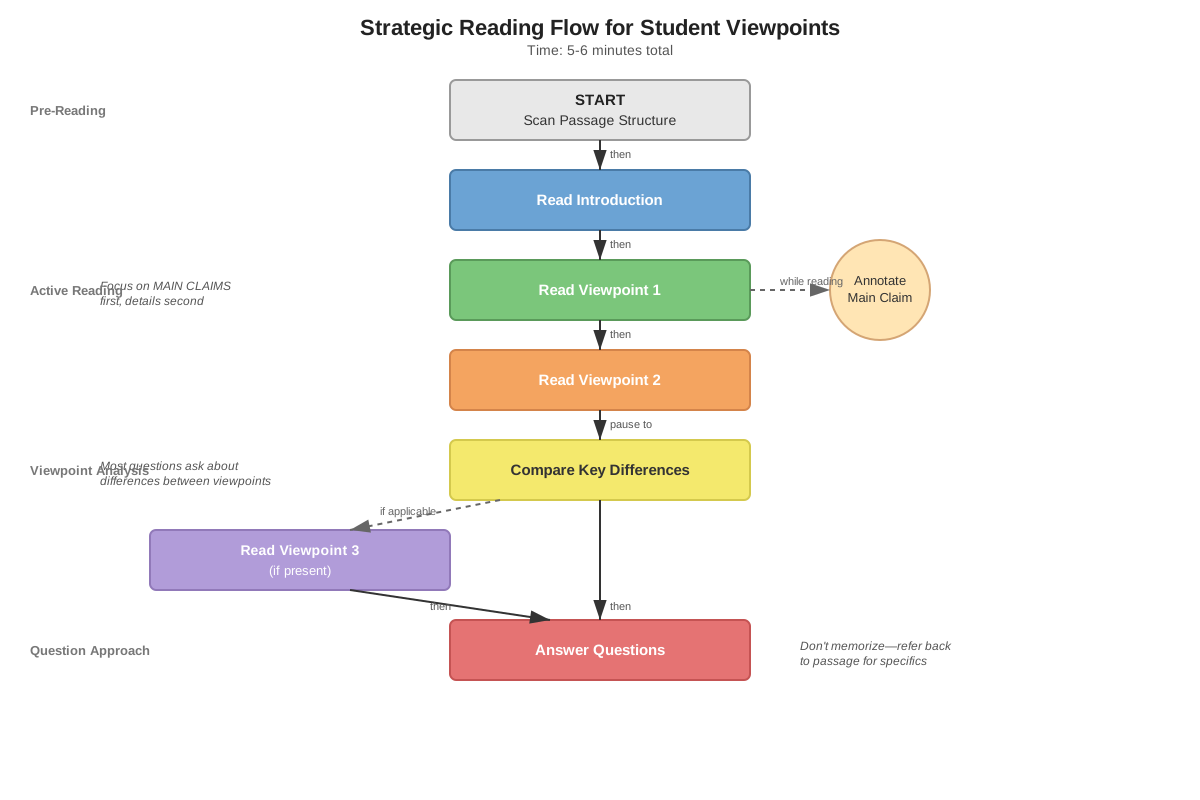
When approaching student viewpoints passages on the ACT, time management is paramount. These passages require more reading time than Data Representation or Research Summaries passages, but the questions are often more straightforward once the viewpoints are understood. Allocate approximately 6-7 minutes for the entire passage, spending 3-4 minutes on careful reading and 3 minutes on questions.
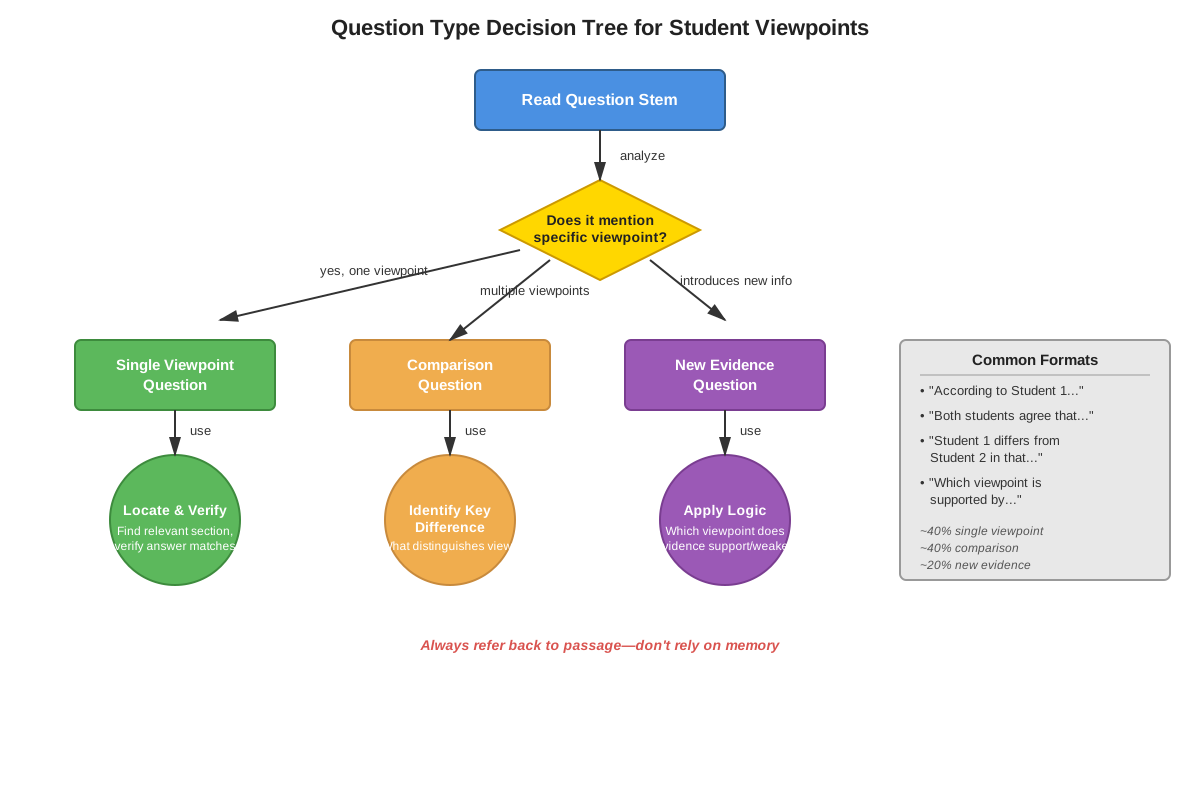
Trigger words that signal student viewpoints questions include: "According to Student X," "Student X would most likely agree," "Unlike Student Y," "Both students," "All students," "The main difference," "Which viewpoint is supported by," and "Which assumption." Recognizing these triggers immediately tells you what type of question you're facing and what strategy to employ.
For identification questions ("According to Student 1..."), use a laser-focused approach: read only the relevant viewpoint, ignore all others, and find the specific claim or detail requested. Do not overthink or bring in information from other viewpoints. The answer is explicitly stated or directly paraphrased.
For comparison questions ("Unlike Student 1, Student 2..."), create a mental comparison on the specific aspect being questioned. Don't try to compare everything—focus only on what the question asks about. Eliminate answer choices that describe similarities when the question asks for differences, or vice versa.
For application questions (new evidence scenarios), use a two-step process: (1) Understand what the new evidence shows, and (2) Determine which viewpoint's mechanisms or predictions align with this evidence. Think about logical consistency, not about which viewpoint seems more scientifically plausible based on outside knowledge.
Process of elimination is particularly effective for student viewpoints questions. Wrong answers often: (1) attribute a claim to the wrong student, (2) confuse main claims with supporting details, (3) describe agreements when asking for disagreements, (4) introduce information not mentioned in the passage, or (5) make extreme statements ("always," "never") that aren't supported by the viewpoint's language.
Active reading strategies significantly improve performance. As you read each viewpoint, underline or mentally note: (1) the main claim (usually in the first sentence), (2) the primary mechanism or explanation, and (3) any specific predictions or implications. This annotation takes 30 seconds per viewpoint but saves minutes during question-answering.
If time pressure is severe, consider answering identification questions for each viewpoint immediately after reading that viewpoint, before moving to the next one. This capitalizes on fresh memory and ensures you earn points even if time runs out before completing all questions.
Memory Techniques
CLAIM - A mnemonic for analyzing each viewpoint:
- Core thesis (What is the main claim?)
- Logic and reasoning (How is it justified?)
- Assumptions (What must be true for this to work?)
- Implications (What does this predict?)
- Mechanism (How does the process work?)
"Introduction = Agreement" - Remember that what all viewpoints agree on is almost always found in the introductory paragraph. When you see "Both students agree," immediately think of the introduction.
"First sentence = Main claim" - The main claim of each viewpoint is typically stated or strongly implied in the first sentence or two. Train yourself to identify this immediately.
The "Three Buckets" visualization: Imagine three buckets labeled "Student 1 Only," "Student 2 Only," and "Both Agree." As you read, mentally sort information into these buckets. This prevents confusion about who believes what.
"New Evidence = Predictions" - When application questions present new evidence, ask yourself: "Which viewpoint predicted this or has mechanisms consistent with this?" This focuses your analysis on logical alignment rather than trying to judge scientific accuracy.
COMPARE - A mnemonic for comparison questions:
- Cause (Do they identify the same cause?)
- Outcome (Do they predict the same results?)
- Mechanism (Do they describe the same process?)
- Premise (Do they start from the same assumptions?)
- Aspect (Are they addressing the same aspect of the phenomenon?)
- Reasoning (Do they use similar logic?)
- Evidence (Do they cite the same support?)
Summary
Student viewpoints questions on the ACT Science test assess the ability to understand, compare, and analyze competing scientific perspectives presented in the Conflicting Viewpoints passage. This passage type appears exactly once per test and requires a unique skill set combining careful reading comprehension with scientific reasoning. Success depends on distinguishing main claims from supporting details, systematically comparing viewpoints on specific aspects, and evaluating how new evidence would support or challenge each perspective. The passage structure is predictable: an introduction establishing common ground, followed by 2-4 labeled viewpoints presenting distinct explanations. Questions fall into identifiable categories—identification, comparison, application, and assumption questions—each requiring specific strategies. The key to mastery is recognizing that all necessary information is contained within the passage, that no viewpoint is designated as "correct," and that systematic analysis trumps outside knowledge. Students who develop a structured approach to reading these passages, actively identify main claims and mechanisms, and practice distinguishing question types can significantly improve their performance on this high-value section of the ACT Science test.
Key Takeaways
- The Conflicting Viewpoints passage appears once per ACT Science test and accounts for approximately 15% of the Science score
- Each viewpoint's main claim is typically stated in its opening sentence—identify this immediately to anchor your understanding
- Questions asking "According to Student X" require using only that student's viewpoint; do not mix information from different perspectives
- Areas of agreement between viewpoints are usually found in the introductory paragraph or represent basic scientific facts
- Application questions test logical consistency between new evidence and each viewpoint's mechanisms or predictions, not which viewpoint is scientifically "correct"
- Systematic comparison of viewpoints on specific aspects (cause, mechanism, evidence, predictions) prevents confusion and speeds question-answering
- Active reading with annotation of main claims and mechanisms saves significant time during question-answering and improves accuracy
Related Topics
Data Representation passages build complementary skills in interpreting graphs, tables, and figures that present scientific data. While student viewpoints emphasizes prose-based arguments, Data Representation focuses on visual information—together, these skills provide comprehensive science reasoning abilities.
Research Summaries passages develop understanding of experimental design, variables, and procedures. The ability to evaluate how evidence supports conclusions in Research Summaries directly transfers to evaluating how evidence supports viewpoints in Conflicting Viewpoints passages.
Scientific argumentation and debate in real-world contexts extends the skills developed through student viewpoints practice. Understanding how scientists construct arguments, evaluate competing theories, and reach consensus prepares students for college-level science courses and informed citizenship.
Critical reading in other ACT sections shares fundamental skills with student viewpoints analysis. The Reading section's emphasis on identifying main ideas, comparing perspectives, and making inferences directly parallels the skills needed for Conflicting Viewpoints passages, creating opportunities for cross-section skill development.
Practice CTA
Now that you've mastered the strategies and concepts behind student viewpoints, it's time to put your knowledge into action! Attempt the practice questions to reinforce your understanding and build confidence with ACT-style Conflicting Viewpoints passages. Use the flashcards to drill high-yield facts and ensure rapid recall of key strategies. Remember: student viewpoints questions are highly predictable in structure, and with systematic practice, you can turn this challenging passage type into a reliable source of points. Every practice passage you complete strengthens your ability to quickly identify main claims, compare viewpoints efficiently, and apply evidence logically—skills that will serve you not just on test day, but throughout your academic career. You've got this!
Sign up free to keep reading
Create a free AnvayaPrep account to finish this ACT guide on Student viewpoints — plus flashcards and practice questions.