Overview
The ACT Science section is not a test of scientific knowledge—it is a test of scientific reasoning and data interpretation skills. Among the three passage types that appear on the ACT Science test (Data Representation, Research Summaries, and Conflicting Viewpoints), Data Representation passages are the most straightforward and typically the fastest to complete. These passages present scientific information primarily through graphs, tables, charts, and diagrams, with minimal explanatory text. Success on these passages requires mastering a specific ACT data representation strategy that emphasizes systematic analysis of visual information, careful attention to axes and units, and efficient extraction of trends and relationships.
Understanding ACT data representation strategy is essential because Data Representation passages account for approximately 30-38% of the ACT Science section—typically 3 out of 7 passages, with 5 questions per passage. These passages offer the highest return on investment for test preparation time because they follow predictable patterns and can be answered quickly with the right approach. Students who master data representation strategy can often complete these passages in 4-5 minutes, leaving more time for the more complex Research Summaries and Conflicting Viewpoints passages.
The skills developed through mastering data representation strategy extend beyond these specific passages. The ability to quickly interpret graphs, identify trends, interpolate and extrapolate data points, and understand relationships between variables is fundamental to all ACT Science passages. These same analytical skills form the foundation for success in Research Summaries passages, where data interpretation combines with experimental design analysis, and even support comprehension of Conflicting Viewpoints passages, where data may be used to support competing hypotheses.
Learning Objectives
- [ ] Identify when ACT data representation strategy is being tested
- [ ] Explain the core rule or strategy behind ACT data representation strategy
- [ ] Apply ACT data representation strategy to ACT-style questions accurately
- [ ] Analyze graphs and tables to extract specific data points within 30 seconds
- [ ] Recognize and describe trends (direct, inverse, exponential, no relationship) from visual data
- [ ] Distinguish between interpolation and extrapolation questions and apply appropriate techniques
- [ ] Evaluate the relationship between multiple variables presented across different visual formats
Prerequisites
- Basic graph reading skills: Understanding x-axis, y-axis, data points, and line/bar graphs is essential for interpreting the visual information that dominates Data Representation passages
- Unit awareness: Recognizing common scientific units (meters, seconds, grams, degrees Celsius, etc.) helps avoid confusion when comparing values across different representations
- Mathematical reasoning: Basic arithmetic and the ability to estimate values between marked intervals enables quick data extraction without complex calculations
- Scientific vocabulary: Familiarity with common scientific terms (temperature, pressure, concentration, velocity, etc.) allows faster comprehension of what variables represent
Why This Topic Matters
Data Representation passages appear consistently on every ACT Science test, making them one of the most predictable and high-yield areas for focused preparation. These passages typically contain 15-19 questions per test (3 passages × 5 questions each), representing nearly one-third of the entire Science section score. Students who develop efficient data representation strategies can often achieve near-perfect accuracy on these passages while completing them in less time than other passage types.
In real-world applications, the skills tested in Data Representation passages mirror the fundamental competencies required in scientific research, medical practice, engineering, and data analysis careers. Scientists regularly interpret experimental results presented in graphs and tables, physicians analyze patient data displayed in charts, and engineers evaluate performance metrics across multiple visual formats. The ACT tests these universal scientific literacy skills rather than memorized content knowledge.
On the exam, Data Representation passages commonly appear as the first passage in the Science section, though they can occur anywhere in the test. These passages typically present 2-4 figures (graphs, tables, or diagrams) with a brief introductory paragraph (2-4 sentences) providing context. Questions focus on reading specific values from figures, identifying trends, comparing data across multiple figures, interpolating values between data points, extrapolating beyond the given data range, and understanding relationships between variables. Unlike Research Summaries passages, Data Representation passages rarely ask about experimental design, control groups, or methodology—the focus remains squarely on interpreting the presented data.
Core Concepts
Understanding Data Representation Passage Structure
Data Representation passages follow a consistent format that, once recognized, enables rapid navigation and efficient question answering. Each passage begins with a brief introduction (typically 2-4 sentences) that establishes the scientific context and defines key variables. This introduction is followed by 2-4 figures—most commonly graphs (line graphs, bar graphs, scatter plots) or tables, occasionally supplemented by diagrams. The figures contain the actual data that questions will reference, making them far more important than the introductory text.
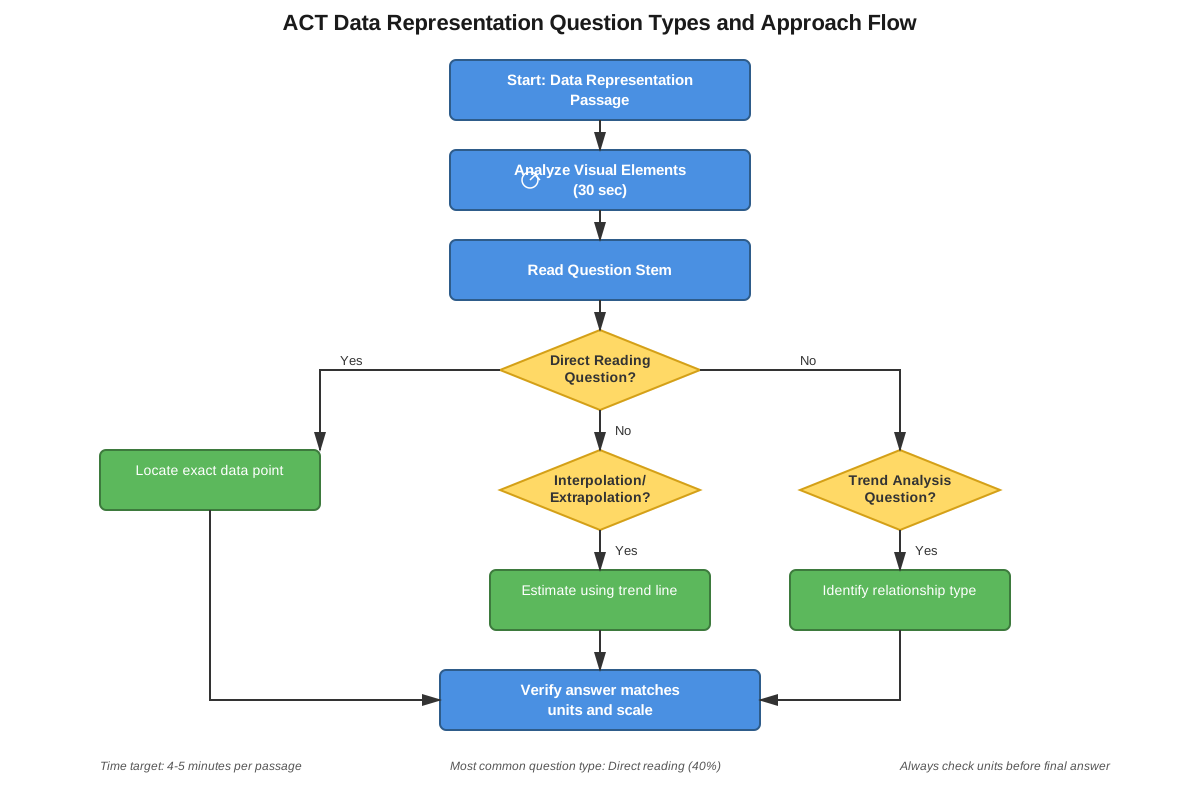
The ACT data representation strategy begins with a systematic 30-second preview of the passage structure. This preview involves: (1) reading the introduction to understand the general topic and identify the variables being studied, (2) examining each figure to note what type of visual representation is used, (3) identifying the variables on each axis or in each column/row, (4) noting the units of measurement, and (5) observing the general trend or pattern in the data. This preview investment pays dividends by creating a mental map of where information is located, reducing the need to search frantically when answering questions.
Types of Visual Representations
Data Representation passages utilize several standard formats for presenting scientific data, each with specific characteristics that affect how information should be extracted:
| Visual Type | Characteristics | Common Uses | Reading Strategy |
|---|---|---|---|
| Line Graph | Continuous data, shows trends over time or across a range | Temperature changes, growth rates, reaction progress | Follow the line to find values; note slope for trend direction |
| Bar Graph | Discrete categories, compares distinct groups | Species populations, experimental conditions, categorical data | Compare bar heights; note which categories are highest/lowest |
| Scatter Plot | Individual data points, shows correlation between variables | Relationship between two measurements, experimental trials | Look for clustering patterns; note overall trend direction |
| Data Table | Precise numerical values organized in rows and columns | Multiple variables, exact measurements | Scan rows/columns systematically; note headers carefully |
| Diagram | Spatial or structural information with labels | Experimental setup, anatomical structures, geological formations | Identify labeled components; understand spatial relationships |
Reading Axes and Units
One of the most critical—and frequently overlooked—aspects of ACT data representation strategy involves careful attention to axes labels and units. Many students make careless errors by misreading what a graph actually represents. Every graph has three essential components that must be identified before attempting to extract data: (1) the x-axis (horizontal) variable and its units, (2) the y-axis (vertical) variable and its units, and (3) the scale and intervals marked on each axis.
The ACT frequently tests whether students notice important details about axes, such as logarithmic scales (where intervals represent multiplication rather than addition), reversed scales (where values decrease rather than increase), or unusual units (such as milliseconds instead of seconds, or kilometers instead of meters). Questions may also require converting between related units or recognizing when two graphs use different scales for the same variable, making direct visual comparison misleading.
Identifying Trends and Relationships
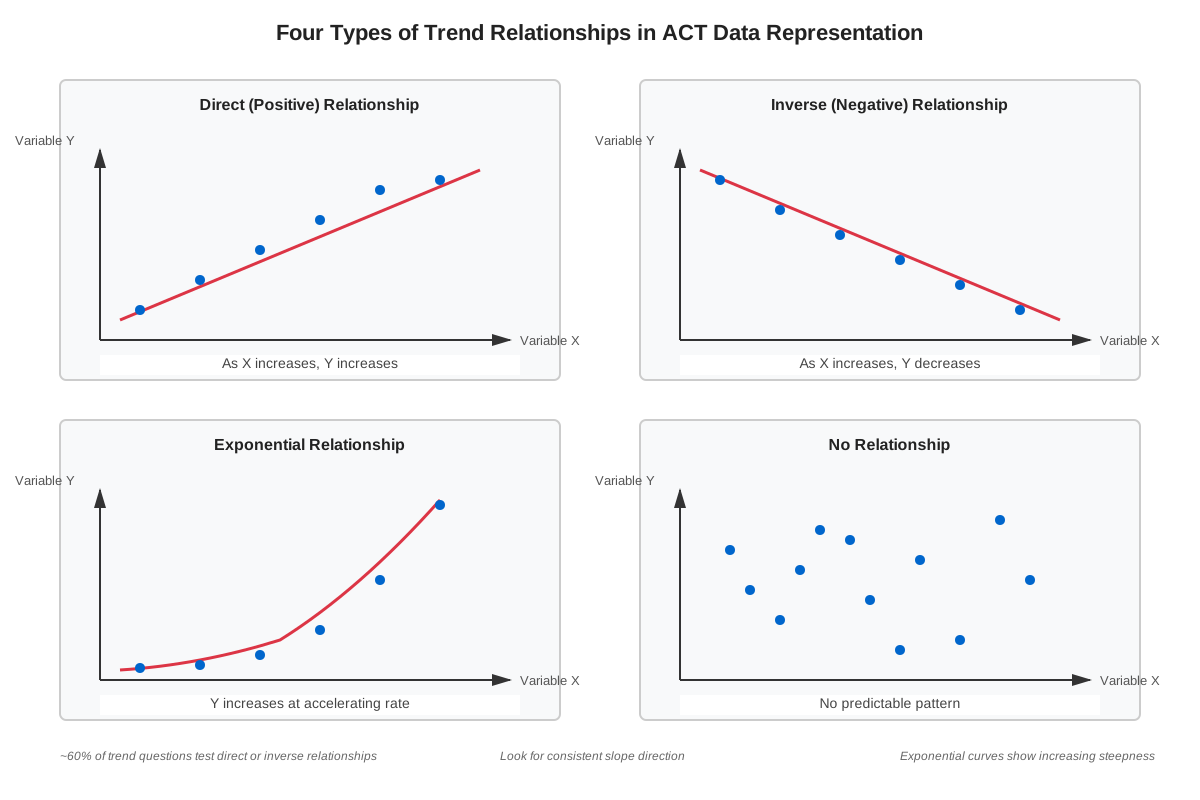
Data Representation questions frequently ask students to describe the relationship between variables or identify trends in the data. Understanding the vocabulary of trends is essential for answering these questions quickly and accurately:
- Direct (positive) relationship: As one variable increases, the other increases (upward slope on a graph)
- Inverse (negative) relationship: As one variable increases, the other decreases (downward slope on a graph)
- Exponential relationship: The rate of change accelerates, creating a curve that becomes steeper
- No relationship: Changes in one variable do not correspond to predictable changes in the other (scattered points with no pattern)
- Constant relationship: One variable remains unchanged regardless of changes in the other (horizontal line)
When describing trends, precision matters. The ACT distinguishes between "increases" (any upward movement), "increases rapidly" (steep upward slope), and "increases then levels off" (curve that becomes horizontal). Similarly, questions may ask whether a relationship is linear (straight line) or nonlinear (curved line).
Interpolation vs. Extrapolation
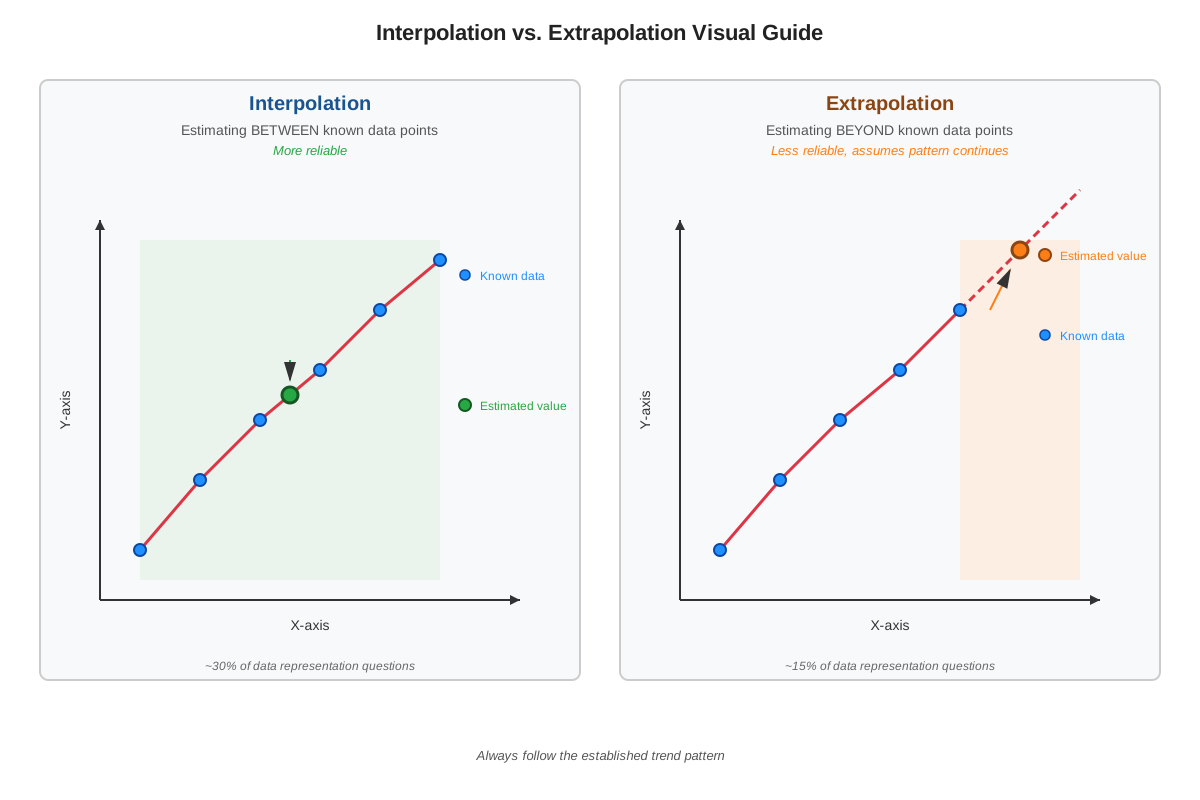
Two fundamental skills tested in Data Representation passages are interpolation (estimating values within the range of given data) and extrapolation (predicting values beyond the range of given data). These skills require different approaches and carry different levels of certainty.
Interpolation involves finding a value between two known data points. For example, if a graph shows that at 10°C the pressure is 2 atm and at 20°C the pressure is 4 atm, interpolation would estimate the pressure at 15°C (approximately 3 atm, assuming a linear relationship). Interpolation is generally reliable because it assumes the trend continues consistently between measured points.
Extrapolation involves extending a trend beyond the measured data range. Using the same example, extrapolation would predict the pressure at 30°C (likely around 6 atm if the linear trend continues). Extrapolation is less certain because it assumes the observed trend continues indefinitely, which may not be true—many scientific relationships change behavior at extreme values. The ACT occasionally includes questions that test whether students recognize the limitations of extrapolation.
Comparing Multiple Figures
Many Data Representation passages include questions that require synthesizing information from two or more figures. These questions test whether students can track a variable across different representations and understand how multiple factors interact. The key strategy involves: (1) identifying which figures contain relevant information for each variable mentioned in the question, (2) extracting the necessary values from each figure, and (3) combining the information logically to reach a conclusion.
For example, a passage might include Figure 1 showing how temperature affects enzyme activity and Figure 2 showing how pH affects the same enzyme. A question might ask: "At which combination of conditions would enzyme activity be highest?" This requires finding the optimal temperature from Figure 1, the optimal pH from Figure 2, and combining them—not comparing the figures directly.
Concept Relationships
The core concepts within ACT data representation strategy build upon each other in a logical progression. Understanding passage structure enables efficient navigation, which facilitates accurate reading of axes and units. Careful attention to axes and units prevents misinterpretation when identifying trends and relationships. The ability to recognize trends forms the foundation for both interpolation (extending trends within the data range) and extrapolation (extending trends beyond the data range). All of these skills combine when comparing multiple figures, which represents the highest level of data representation analysis.
These data representation skills connect directly to the prerequisite knowledge of basic graph reading and mathematical reasoning. The ability to read a simple x-y graph expands into the more sophisticated skill of comparing multiple graphs with different scales or units. Basic arithmetic enables the estimation required for interpolation and extrapolation.
The relationship map for this topic flows as follows: Passage Structure Recognition → enables → Efficient Figure Navigation → requires → Accurate Axis/Unit Reading → supports → Trend Identification → enables → Interpolation and Extrapolation → combines with → Multi-Figure Comparison → produces → Accurate Question Answering.
These skills also connect forward to Research Summaries passages, where data interpretation combines with experimental design analysis, and to Conflicting Viewpoints passages, where data may support competing scientific theories. Mastery of data representation strategy provides the analytical foundation for all ACT Science passage types.
High-Yield Facts
⭐ Data Representation passages account for approximately 30-38% of ACT Science questions (typically 3 passages with 5 questions each)
⭐ The introduction paragraph in Data Representation passages defines variables and context but rarely contains information needed to answer questions—the figures contain the testable data
⭐ Always check axis labels and units before extracting data from any graph; the ACT frequently tests whether students notice scale differences or unusual units
⭐ Direct relationships show both variables moving in the same direction (both increase or both decrease); inverse relationships show variables moving in opposite directions
⭐ Interpolation (estimating within the data range) is more reliable than extrapolation (predicting beyond the data range)
- Line graphs show continuous data and are best for identifying trends over time or across a range of values
- Bar graphs compare discrete categories and are best for identifying which category has the highest or lowest value
- When a question references multiple figures, extract information from each figure separately before combining the data
- Logarithmic scales (often indicated by "log" in the axis label) represent multiplication rather than addition between intervals
- Questions asking "according to Figure 1" or "based on Table 2" can always be answered using only that specific figure—no outside knowledge required
- Scatter plots with widely dispersed points indicate weak or no relationship between variables; tightly clustered points following a line indicate a strong relationship
- The ACT never requires complex calculations; if a mathematical approach seems complicated, look for a simpler visual estimation method
- When comparing trends across multiple lines or bars in the same figure, focus on relative differences rather than absolute values
- Tables organize data in rows and columns; always check whether the question asks for a row value, column value, or comparison between cells
- Diagrams in Data Representation passages typically show experimental setup or spatial relationships; questions about diagrams usually ask about component identification or spatial arrangement
Quick check — test yourself on ACT data representation strategy so far.
Try Flashcards →Common Misconceptions
Misconception: Data Representation passages require extensive scientific knowledge about the topic being presented → Correction: These passages test data interpretation skills, not content knowledge. All information needed to answer questions appears in the figures and brief introduction. A student with no background in the scientific topic can achieve perfect accuracy by applying systematic data reading strategies.
Misconception: The introduction paragraph must be read carefully and contains essential information for answering questions → Correction: While the introduction provides helpful context and defines variables, it rarely contains specific data needed to answer questions. The figures contain the testable information. A more efficient strategy involves skimming the introduction for variable definitions, then focusing attention on the figures.
Misconception: When a graph shows a curved line, the relationship between variables is "no relationship" or "random" → Correction: Curved lines represent nonlinear relationships, which are still predictable and systematic. For example, exponential growth creates a curve that becomes steeper, and logarithmic relationships create curves that level off. "No relationship" describes scattered points with no discernible pattern, not curved lines.
Misconception: Extrapolation beyond the data range is just as reliable as interpolation within the data range → Correction: Extrapolation assumes the observed trend continues indefinitely, which may not be accurate. Many scientific relationships change behavior at extreme values (for example, enzyme activity increases with temperature up to a point, then decreases as the enzyme denatures). Interpolation is more reliable because it estimates values within the observed range where the trend is confirmed.
Misconception: All graphs use the same scale, so visual comparison between different figures is accurate → Correction: The ACT frequently uses different scales for different graphs, even when showing the same variable. A small change on one graph might represent a larger absolute change than a large visual change on another graph with a compressed scale. Always check the numerical values on axes rather than relying on visual appearance alone.
Misconception: Data Representation questions require precise calculations and exact numerical answers → Correction: The ACT Science section allows calculators but rarely requires complex calculations. Most questions can be answered through visual estimation, identifying trends, or comparing relative values. If a calculation seems necessary, it typically involves simple arithmetic or recognizing a pattern rather than complex mathematics.
Misconception: When multiple lines appear on the same graph, they all represent the same type of data → Correction: Multiple lines typically represent different experimental conditions, different substances, or different trials. The legend or key identifies what each line represents. Questions often ask students to compare how different conditions (represented by different lines) affect the outcome variable.
Worked Examples
Example 1: Interpolation and Trend Identification
Passage Context: A study examined how water temperature affects the dissolved oxygen concentration in a lake. Figure 1 shows the relationship between water temperature (°C) and dissolved oxygen (mg/L).
Figure 1 Data:
- At 5°C: 12 mg/L dissolved oxygen
- At 10°C: 10 mg/L dissolved oxygen
- At 15°C: 8 mg/L dissolved oxygen
- At 20°C: 6 mg/L dissolved oxygen
- At 25°C: 4 mg/L dissolved oxygen
Question: Based on Figure 1, at approximately 18°C, the dissolved oxygen concentration would most likely be closest to:
A) 9 mg/L
B) 7 mg/L
C) 5 mg/L
D) 3 mg/L
Solution Process:
Step 1: Identify what the question asks. We need to find the dissolved oxygen concentration at 18°C, which falls between the measured data points at 15°C and 20°C. This is an interpolation question.
Step 2: Locate the relevant data points. At 15°C, dissolved oxygen is 8 mg/L. At 20°C, dissolved oxygen is 6 mg/L.
Step 3: Identify the trend. As temperature increases from 15°C to 20°C (a 5°C increase), dissolved oxygen decreases from 8 mg/L to 6 mg/L (a 2 mg/L decrease). This is an inverse relationship—as temperature increases, dissolved oxygen decreases.
Step 4: Estimate the value at 18°C. The temperature 18°C is 3°C above 15°C, which represents 3/5 (or 60%) of the distance between 15°C and 20°C. Therefore, the dissolved oxygen should decrease by approximately 60% of the 2 mg/L change: 0.6 × 2 = 1.2 mg/L. Starting from 8 mg/L at 15°C and decreasing by 1.2 mg/L gives approximately 6.8 mg/L, which rounds to 7 mg/L.
Step 5: Select the answer. Answer: B) 7 mg/L
Connection to Learning Objectives: This example demonstrates applying ACT data representation strategy to interpolate values within a data range and identify inverse relationships between variables.
Example 2: Multi-Figure Comparison
Passage Context: An experiment studied how light intensity and carbon dioxide concentration affect the rate of photosynthesis in a plant species. Figure 1 shows photosynthesis rate at different light intensities (with CO₂ held constant at 400 ppm). Figure 2 shows photosynthesis rate at different CO₂ concentrations (with light intensity held constant at 500 μmol/m²/s).
Figure 1 Data (CO₂ = 400 ppm):
- 100 μmol/m²/s light: 5 μmol CO₂/m²/s photosynthesis
- 300 μmol/m²/s light: 12 μmol CO₂/m²/s photosynthesis
- 500 μmol/m²/s light: 18 μmol CO₂/m²/s photosynthesis
- 700 μmol/m²/s light: 20 μmol CO₂/m²/s photosynthesis
Figure 2 Data (Light = 500 μmol/m²/s):
- 200 ppm CO₂: 10 μmol CO₂/m²/s photosynthesis
- 400 ppm CO₂: 18 μmol CO₂/m²/s photosynthesis
- 600 ppm CO₂: 24 μmol CO₂/m²/s photosynthesis
- 800 ppm CO₂: 26 μmol CO₂/m²/s photosynthesis
Question: Based on Figures 1 and 2, under which conditions would the photosynthesis rate most likely be highest?
A) 300 μmol/m²/s light, 200 ppm CO₂
B) 500 μmol/m²/s light, 400 ppm CO₂
C) 700 μmol/m²/s light, 600 ppm CO₂
D) 700 μmol/m²/s light, 800 ppm CO₂
Solution Process:
Step 1: Recognize this is a multi-figure question requiring synthesis of information from both figures. We need to identify which combination of light intensity and CO₂ concentration produces the highest photosynthesis rate.
Step 2: Analyze Figure 1 to identify optimal light intensity. The photosynthesis rate increases as light intensity increases, with the highest measured rate (20 μmol CO₂/m²/s) at 700 μmol/m²/s light. Note that the rate increase slows down at higher light intensities (the curve is leveling off), but 700 μmol/m²/s still shows the highest value.
Step 3: Analyze Figure 2 to identify optimal CO₂ concentration. The photosynthesis rate increases as CO₂ concentration increases, with the highest measured rate (26 μmol CO₂/m²/s) at 800 ppm CO₂. Again, the rate increase slows at higher concentrations, but 800 ppm shows the highest value.
Step 4: Combine the optimal conditions. The highest light intensity tested (700 μmol/m²/s) combined with the highest CO₂ concentration tested (800 ppm) would most likely produce the highest photosynthesis rate.
Step 5: Evaluate the answer choices. Choice D combines 700 μmol/m²/s light with 800 ppm CO₂—both optimal conditions identified in Steps 2 and 3.
Step 6: Verify the logic. While neither figure directly shows this exact combination (Figure 1 uses 400 ppm CO₂, Figure 2 uses 500 μmol/m²/s light), both figures demonstrate that increasing either factor increases photosynthesis rate. Therefore, maximizing both factors should maximize the rate.
Answer: D) 700 μmol/m²/s light, 800 ppm CO₂
Connection to Learning Objectives: This example demonstrates identifying when data representation strategy is being tested (multi-figure comparison), explaining the core strategy (extract optimal values from each figure separately, then combine), and applying the strategy accurately to reach the correct answer.
Exam Strategy
When approaching Data Representation passages on the ACT Science section, implement a systematic three-phase strategy: Preview, Question-Driven Reading, and Efficient Answering.
Preview Phase (30 seconds): Before reading any questions, invest 30 seconds scanning the passage structure. Read the introduction sentence to identify the general topic and main variables. Quickly examine each figure, noting: (1) what type of visual it is (graph, table, diagram), (2) what variables are represented, (3) what units are used, and (4) the general trend or pattern. This preview creates a mental map of where information is located, dramatically reducing search time when answering questions.
Question-Driven Reading: Unlike reading comprehension passages, Data Representation passages should not be "read" in the traditional sense. Instead, read each question first, identify which figure(s) it references, then extract only the specific information needed to answer that question. This targeted approach prevents information overload and reduces the time spent processing irrelevant details.
Trigger Words and Phrases: Certain words in questions signal specific strategies:
- "According to Figure X" or "Based on Table Y" → The answer comes entirely from that specific figure; no synthesis required
- "Increases," "decreases," "remains constant" → Identify the trend or relationship between variables
- "Most likely" or "closest to" → Interpolation or extrapolation; estimate rather than calculate exact values
- "Highest," "lowest," "greatest," "least" → Compare values; often answerable by visual inspection
- "Between X and Y" → Interpolation within the data range
- "Beyond," "above," "below" (the measured range) → Extrapolation; extend the observed trend
- "Compared to," "relative to" → Compare two or more values or conditions
- "Both," "all," "neither," "none" → Check multiple conditions or figures
Process of Elimination Tips: Data Representation questions often include answer choices that test common errors:
- Eliminate choices that reverse the relationship (e.g., claiming a direct relationship when the data shows an inverse relationship)
- Eliminate choices with incorrect units or values that fall outside the reasonable range
- Eliminate choices that confuse x-axis and y-axis variables
- Eliminate choices that reference the wrong figure or combine information incorrectly
Time Allocation: Data Representation passages should be the fastest passages to complete—target 4-5 minutes per passage (approximately 50-60 seconds per question). If a question requires more than 60 seconds, mark it and return after completing easier questions. The straightforward nature of these passages makes them ideal for building confidence and momentum at the beginning of the Science section.
Exam Tip: If a question seems to require complex calculations or outside scientific knowledge, reconsider the approach. Data Representation questions are designed to be answerable through visual inspection, simple estimation, or basic arithmetic. The correct strategy is almost always simpler than it initially appears.
Memory Techniques
GRAPH Acronym for systematic figure analysis:
- General trend (increasing, decreasing, constant, no pattern)
- Range (minimum and maximum values on each axis)
- Axes (what variables are represented and their units)
- Pattern (linear, exponential, inverse, scattered)
- Highest and lowest points (identify extremes)
"UNIT CHECK" reminder: Before extracting any value from a graph or table, check the units. Visualize a mental checklist appearing above every figure with the word "UNITS?" to prevent careless errors from misreading scales or confusing similar measurements (e.g., seconds vs. milliseconds, meters vs. kilometers).
Interpolation vs. Extrapolation Visualization: Picture interpolation as "staying inside the fence" (within the data range where you can see the pattern) and extrapolation as "jumping over the fence" (beyond the data range where you're guessing the pattern continues). This mental image helps remember that interpolation is more reliable because you're working within confirmed data.
Direct vs. Inverse Relationship Hand Motion: For direct relationships, move both hands upward together (both variables increase). For inverse relationships, move one hand up while moving the other down (one variable increases while the other decreases). This kinesthetic memory technique helps quickly identify relationship types when analyzing graphs.
"Figure First, Question Second" mantra: Train yourself to always identify which figure a question references before attempting to answer. Repeat this phrase mentally to build the habit of targeted information extraction rather than random searching.
Summary
Mastering ACT data representation strategy requires understanding that Data Representation passages test data interpretation skills rather than scientific content knowledge. These passages present information primarily through graphs, tables, and diagrams, with questions focusing on extracting specific values, identifying trends, interpolating within the data range, extrapolating beyond it, and comparing information across multiple figures. Success depends on systematic analysis: previewing passage structure, carefully reading axes and units, recognizing relationship types (direct, inverse, exponential, constant, or no relationship), and applying targeted question-driven reading rather than attempting to memorize all presented data. The most critical skills involve distinguishing between interpolation (reliable estimation within the data range) and extrapolation (less certain prediction beyond the data range), comparing multiple figures by extracting information separately before synthesis, and avoiding common errors such as misreading scales, confusing units, or reversing relationships. With focused practice applying these strategies, students can achieve high accuracy on Data Representation passages while completing them efficiently, typically in 4-5 minutes per passage, creating time advantages for more complex passage types.
Key Takeaways
- Data Representation passages account for approximately 30-38% of ACT Science questions and are typically the fastest passages to complete with proper strategy
- Always check axis labels, units, and scales before extracting data from any figure—the ACT frequently tests whether students notice these critical details
- Use question-driven reading: read each question first, identify the relevant figure(s), then extract only the specific information needed
- Interpolation (estimating within the data range) is more reliable than extrapolation (predicting beyond the data range); recognize which type each question requires
- Direct relationships show variables moving in the same direction; inverse relationships show variables moving in opposite directions; curved lines represent nonlinear but still predictable relationships
- Multi-figure questions require extracting information from each figure separately before combining the data—avoid trying to compare figures directly
- The ACT never requires complex calculations in Data Representation passages; if an approach seems mathematically complicated, look for a simpler visual estimation method
Related Topics
Research Summaries Strategy: After mastering Data Representation passages, students should progress to Research Summaries passages, which combine data interpretation skills with analysis of experimental design, control groups, and methodology. The data reading skills developed in Data Representation passages form the foundation for the more complex analysis required in Research Summaries.
Conflicting Viewpoints Strategy: This advanced passage type requires synthesizing competing scientific hypotheses and evaluating how data supports different theories. The ability to extract and interpret data from figures, developed through Data Representation practice, supports the evidence evaluation required in Conflicting Viewpoints passages.
Graph Types and Advanced Data Visualization: Deeper study of specialized graph types (logarithmic scales, semi-log plots, box plots, error bars) prepares students for the occasional advanced visual representation that appears on the ACT. Mastering basic Data Representation strategy enables progression to these more sophisticated formats.
Scientific Reasoning and Inference: Understanding how to extend data interpretation into broader scientific reasoning—including hypothesis formation, prediction, and limitation recognition—builds on the foundational data analysis skills and prepares students for science courses beyond the ACT.
Practice CTA
Now that you understand the comprehensive strategies for tackling ACT Data Representation passages, it's time to put these skills into practice. Complete the practice questions associated with this topic to reinforce your ability to quickly identify trends, accurately interpolate and extrapolate values, and efficiently compare data across multiple figures. Use the flashcards to memorize key trigger words and common question patterns. Remember: Data Representation passages offer the highest return on practice time investment—students who master these strategies often see immediate score improvements. Approach each practice question systematically using the GRAPH acronym and question-driven reading strategy. With focused practice, you'll develop the speed and accuracy needed to excel on these high-yield passages and build momentum for the entire ACT Science section!
Sign up free to keep reading
Create a free AnvayaPrep account to finish this ACT guide on ACT data representation strategy — plus flashcards and practice questions.