Overview
Scientific reasoning is a fundamental skill tested throughout the ACT Science section, particularly within the Conflicting Viewpoints passages. This cognitive process involves evaluating evidence, analyzing arguments, comparing hypotheses, and drawing logical conclusions based on scientific data and principles. Unlike the Data Representation and Research Summaries passages that focus primarily on interpreting graphs and experimental designs, Conflicting Viewpoints passages require students to engage with competing scientific explanations and assess the validity of different perspectives.
The ACT Science test dedicates approximately one full passage (typically 7 questions) to the Conflicting Viewpoints format in each exam administration. These passages present two or more scientists, students, or hypotheses that offer different explanations for the same phenomenon or set of observations. Success on these questions demands more than content knowledge—it requires the ability to distinguish between what each viewpoint claims, identify supporting and contradicting evidence, recognize assumptions underlying each argument, and evaluate the logical consistency of scientific explanations. ACT scientific reasoning questions assess whether students can think like scientists by weighing evidence objectively and understanding how scientific debates are resolved through logical analysis rather than opinion.
This topic connects directly to the broader scientific method and critical thinking skills that underpin all scientific disciplines. While Data Representation passages test graph interpretation and Research Summaries assess experimental design comprehension, scientific reasoning integrates these skills with higher-order thinking. Students must synthesize information across multiple viewpoints, recognize patterns in argumentation, and apply logical principles to novel scenarios—skills that appear not only in dedicated Conflicting Viewpoints passages but also in complex questions throughout the entire Science section.
Learning Objectives
- [ ] Identify when Scientific reasoning is being tested in ACT Science passages
- [ ] Explain the core rule or strategy behind Scientific reasoning approaches
- [ ] Apply Scientific reasoning to ACT-style questions accurately
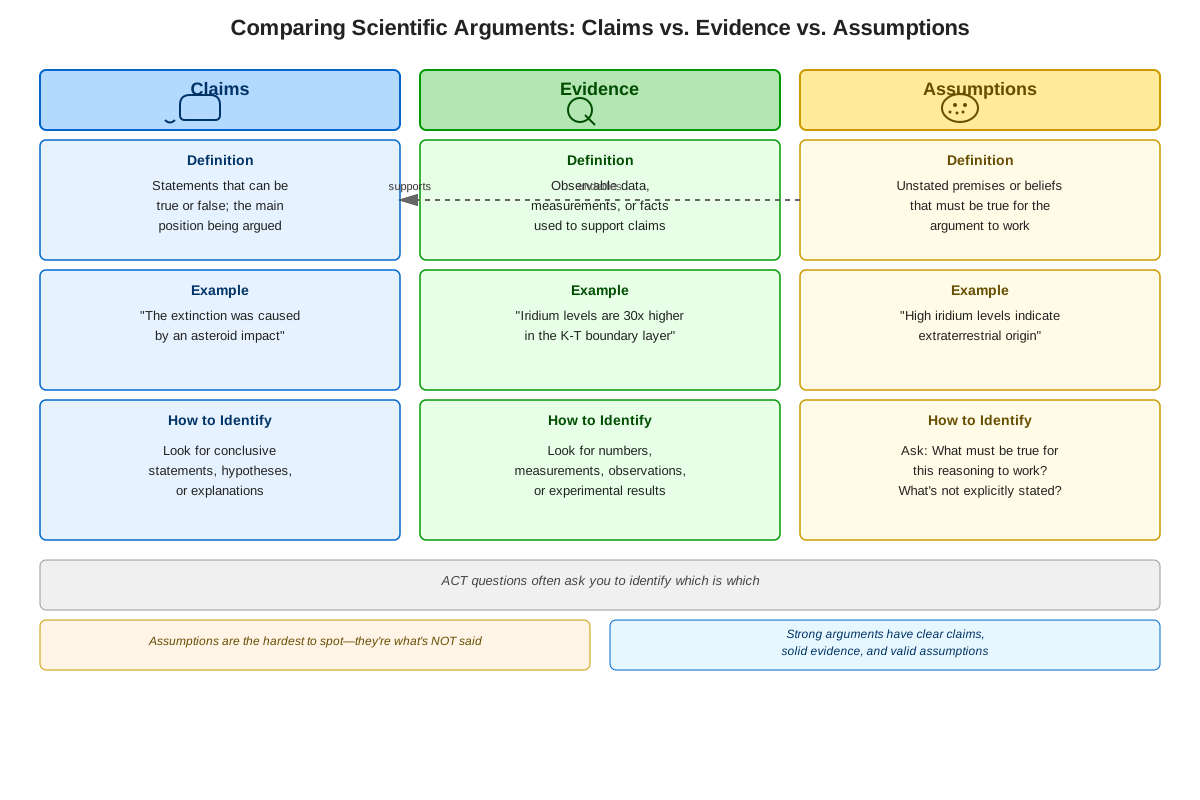
- [ ] Distinguish between claims, evidence, and assumptions within scientific arguments
- [ ] Compare and contrast multiple scientific viewpoints systematically
- [ ] Evaluate the strength of evidence supporting competing hypotheses
- [ ] Predict which new evidence would support or weaken specific viewpoints
Prerequisites
- Basic reading comprehension: Understanding complex scientific texts is essential for parsing the arguments presented in Conflicting Viewpoints passages
- Familiarity with scientific terminology: General science vocabulary enables faster comprehension of passage content without getting stuck on terminology
- Understanding of the scientific method: Recognizing how hypotheses, evidence, and conclusions relate helps students evaluate the logical structure of arguments
- Graph and data interpretation skills: Some Conflicting Viewpoints passages include data that supports or contradicts different perspectives
Why This Topic Matters
Scientific reasoning represents one of the most practical and transferable skills tested on the ACT. In real-world scientific practice, researchers constantly evaluate competing explanations, design experiments to test rival hypotheses, and revise their understanding based on new evidence. Medical professionals weigh different diagnostic possibilities, engineers compare alternative design solutions, and policymakers assess conflicting expert opinions on environmental or public health issues. The ability to analyze arguments objectively, identify logical flaws, and distinguish between correlation and causation extends far beyond science into law, business, and everyday decision-making.
On the ACT Science test, Conflicting Viewpoints passages appear exactly once per exam, typically as Passage 6 or 7, and contain 7 questions worth approximately 12% of the total Science score. These questions consistently rank among the most challenging on the test because they require sustained attention, careful tracking of multiple perspectives, and synthesis of complex information. Students cannot simply locate data points in a graph—they must understand nuanced differences between viewpoints, recognize implicit assumptions, and apply logical reasoning to hypothetical scenarios.
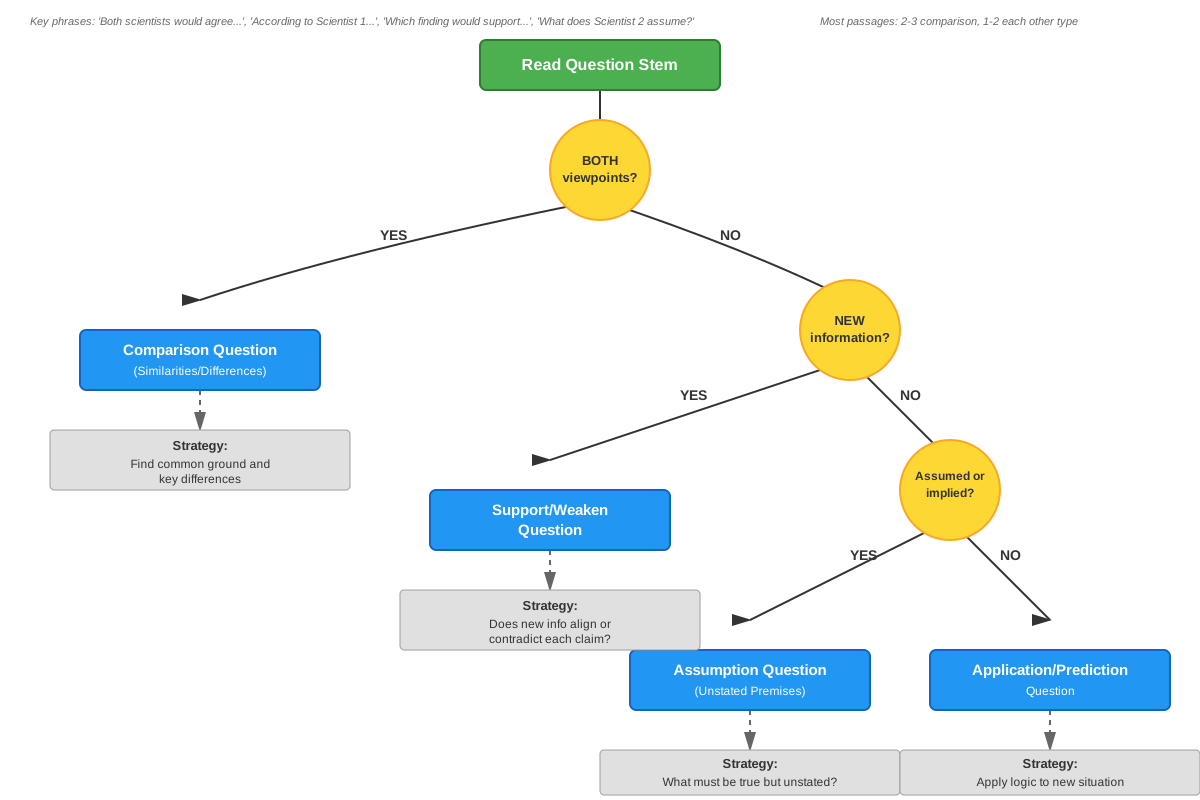
Common question formats include: identifying points of agreement or disagreement between scientists, determining which evidence supports or weakens a specific viewpoint, predicting what each scientist would conclude about new information, recognizing assumptions underlying arguments, and evaluating the logical consistency of claims. Unlike other Science passages where students can often find answers by locating specific data, Conflicting Viewpoints questions demand genuine comprehension of the arguments' logical structure and the ability to extend that reasoning to novel situations.
Core Concepts
Structure of Conflicting Viewpoints Passages
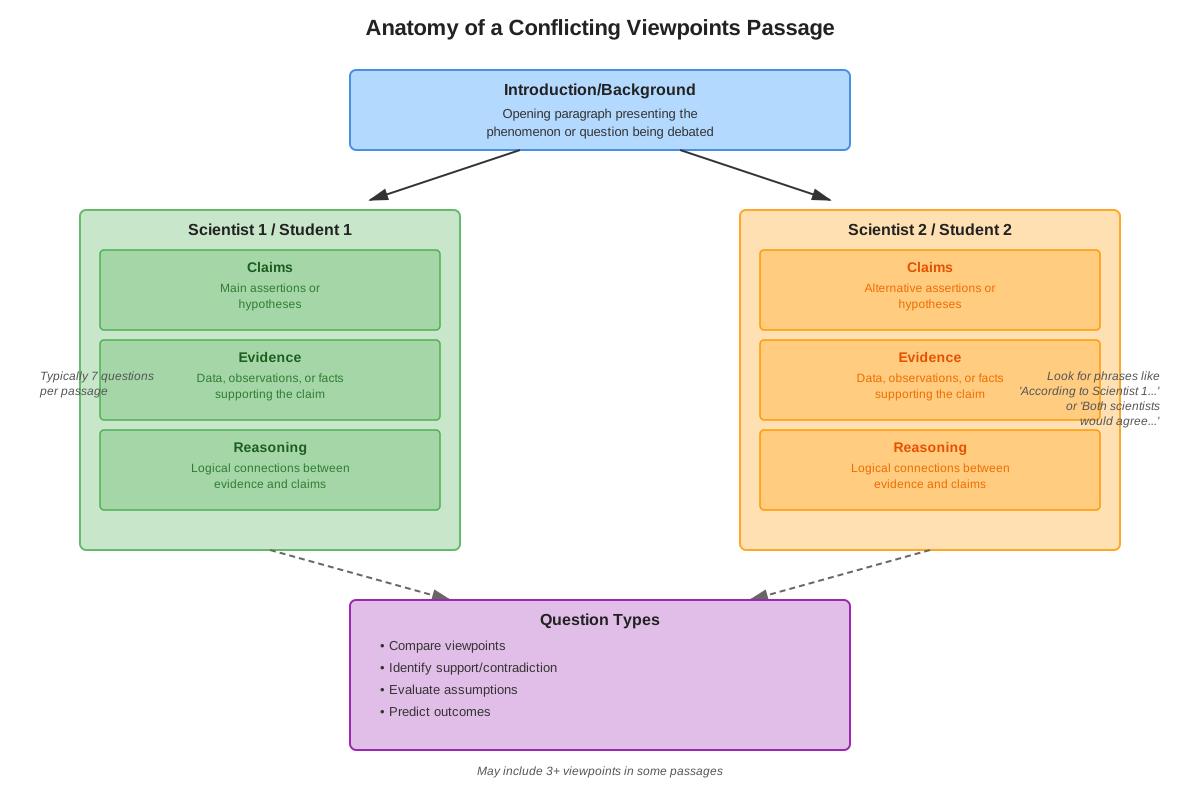
Conflicting Viewpoints passages follow a predictable structure that students can leverage for efficient comprehension. The passage begins with an introductory paragraph that establishes the scientific phenomenon, observation, or question under debate. This introduction provides essential background information and context that both viewpoints accept as factual. Following this setup, the passage presents two (occasionally three) distinct perspectives, typically labeled as "Scientist 1," "Scientist 2," or "Student 1," "Student 2," though sometimes they're labeled as "Hypothesis A" and "Hypothesis B."
Each viewpoint section contains three key components: the central claim (the main explanation or position), supporting evidence (observations, data, or logical reasoning that backs the claim), and implicit assumptions (unstated premises that must be true for the argument to work). Understanding this structure allows students to actively read for these elements rather than passively absorbing information. The viewpoints typically differ in fundamental ways—they might propose different mechanisms for the same phenomenon, emphasize different factors as most important, or interpret the same evidence differently.
Types of Scientific Arguments
ACT passages employ several common argument structures that students should recognize. Mechanistic arguments explain how a process works by describing the sequence of events or interactions that produce an outcome. For example, one scientist might argue that climate change results primarily from increased atmospheric CO₂ trapping heat, while another emphasizes changes in solar radiation. Comparative arguments prioritize different factors, such as one viewpoint claiming genetic factors dominate a trait while another emphasizes environmental influences.
Temporal arguments disagree about timing or sequence—when events occurred or which came first. Scope arguments differ in how broadly they apply a principle, with one viewpoint claiming a phenomenon is universal while another argues it's limited to specific conditions. Recognizing these argument types helps students quickly grasp the nature of the disagreement and anticipate question types.
Identifying Points of Agreement and Disagreement
A critical skill in scientific reasoning involves distinguishing what viewpoints share from where they diverge. Points of agreement typically appear in the introductory paragraph or as basic observations that both perspectives accept. For instance, both scientists might agree that a particular phenomenon exists and that certain measurements were obtained, but disagree about the underlying cause or mechanism.
Points of disagreement represent the core of the scientific debate. These often involve: the primary cause of an observed effect, the mechanism by which something occurs, the relative importance of different factors, predictions about future observations, or interpretations of ambiguous data. Questions frequently ask students to identify statements that both scientists would accept or to recognize claims unique to one viewpoint. The key strategy involves creating a mental (or physical) comparison table while reading:
| Element | Scientist 1 | Scientist 2 |
|---|---|---|
| Main claim | [Core position] | [Core position] |
| Key evidence | [Supporting facts] | [Supporting facts] |
| Mechanism | [How it works] | [How it works] |
| Predictions | [What should happen] | [What should happen] |
Evaluating Evidence and Support
Strong scientific arguments rest on solid evidence, and ACT questions frequently test whether students can assess evidential support. Direct evidence explicitly supports a claim through observation or measurement—if Scientist 1 claims temperature increases with altitude and data shows this pattern, that's direct support. Indirect evidence supports a claim through logical inference—if a theory predicts a certain outcome and that outcome occurs, it indirectly supports the theory even if it doesn't prove it.
Students must also recognize contradictory evidence that weakens a viewpoint and neutral evidence that doesn't clearly favor either perspective. Questions often present new information and ask which scientist's viewpoint it supports, requiring students to extend the logic of each argument to novel scenarios. The critical thinking process involves: identifying what each viewpoint predicts about the new situation, comparing those predictions to the actual information provided, and determining which viewpoint's predictions align with the new evidence.
Recognizing Assumptions and Logical Structure
Every scientific argument rests on assumptions—unstated premises that must be true for the conclusion to follow from the evidence. For example, if a scientist argues that increased exercise improves heart health based on a study of marathon runners, the argument assumes that the study participants are representative of the general population and that other lifestyle factors don't explain the results. ACT questions may ask students to identify these hidden assumptions or to recognize what must be true for a viewpoint to be valid.
The logical structure of arguments follows patterns that students can learn to recognize. A typical structure includes: observation → hypothesis → supporting evidence → conclusion. Flawed reasoning might involve circular logic (using the conclusion to support itself), false dichotomies (assuming only two possibilities exist), correlation-causation errors (assuming that because two things occur together, one causes the other), or overgeneralization (extending conclusions beyond what the evidence supports). While ACT passages generally present scientifically reasonable arguments, questions may ask students to identify what would strengthen or weaken a position, requiring recognition of logical gaps.
Applying Viewpoints to New Scenarios
The most challenging questions require students to extend reasoning beyond the passage content. These questions present hypothetical situations, new experimental results, or additional observations and ask what each scientist would conclude or whether the information supports a particular viewpoint. Success requires genuine understanding of each perspective's underlying logic rather than simple fact recall.
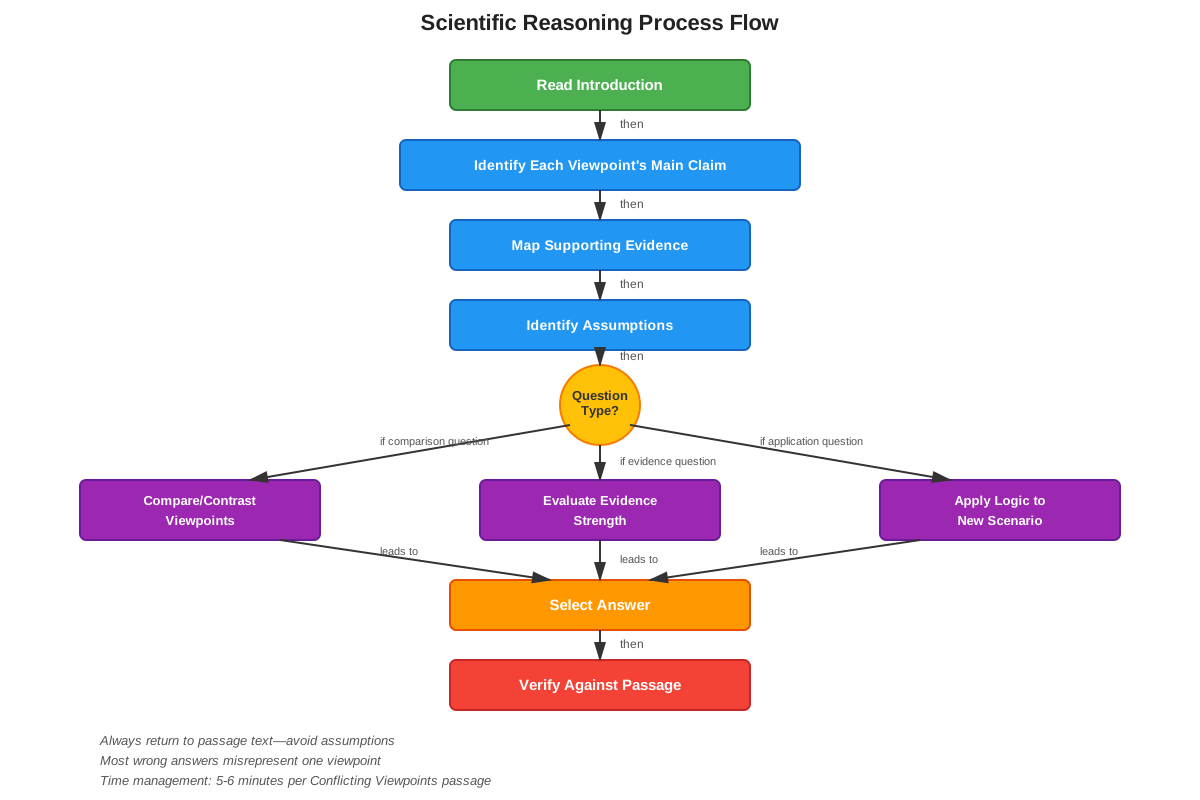
The strategy involves: clearly understanding each viewpoint's core mechanism or principle, identifying what that principle predicts about the new situation, comparing predictions to the actual information provided, and selecting the answer that correctly applies the viewpoint's logic. For example, if Scientist 1 believes a process is driven by temperature while Scientist 2 believes it's driven by pressure, a question about what happens when temperature increases (with pressure constant) requires applying each scientist's framework to predict their respective conclusions.
Concept Relationships
The concepts within scientific reasoning build upon each other in a hierarchical structure. Understanding the structure of Conflicting Viewpoints passages provides the foundation for all other skills—students must first recognize how arguments are organized before they can analyze them effectively. This structural knowledge leads directly to identifying points of agreement and disagreement, as the passage structure highlights where viewpoints align (introduction) and diverge (individual scientist sections).
The ability to distinguish agreement from disagreement enables evaluating evidence and support, since students must understand what each viewpoint claims before assessing whether evidence supports those claims. Evidence evaluation, in turn, requires recognizing assumptions and logical structure—students cannot judge whether evidence truly supports a conclusion without understanding the unstated premises connecting them. Finally, all these skills culminate in applying viewpoints to new scenarios, which demands synthesis of structural understanding, claim identification, evidence evaluation, and logical reasoning.
This topic connects to prerequisite knowledge of the scientific method by applying its principles to complex, real-world scientific debates. While basic scientific method knowledge involves understanding hypothesis testing in controlled experiments, scientific reasoning extends this to evaluating competing explanations in situations where definitive experiments may not yet exist. The skills developed here also enhance performance on Research Summaries passages, where students occasionally encounter questions about alternative explanations for experimental results.
Relationship Map: Passage Structure Recognition → Claim Identification → Agreement/Disagreement Analysis → Evidence Evaluation → Assumption Recognition → Logical Structure Assessment → Application to Novel Scenarios → Accurate Question Response
Quick check — test yourself on Scientific reasoning so far.
Try Flashcards →High-Yield Facts
- ⭐ Conflicting Viewpoints passages always appear exactly once per ACT Science test, typically containing 7 questions
- ⭐ The introductory paragraph contains information that ALL viewpoints accept as true—this is never a point of disagreement
- ⭐ Questions asking what "both scientists would agree" require finding statements supported by the introduction or explicitly stated in both viewpoint sections
- ⭐ When new evidence is presented, determine what each viewpoint predicts about that situation, then match predictions to the actual information
- ⭐ "Strengthen" questions require evidence that makes a viewpoint's conclusion more likely; "weaken" questions require evidence that makes it less likely
- Each scientist's section is self-contained—everything needed to understand their position appears in their designated paragraphs
- Points of disagreement typically involve mechanisms, causes, relative importance of factors, or predictions—not basic observations
- Assumptions are unstated premises that must be true for an argument to work; they're never explicitly mentioned in the passage
- The viewpoints presented are typically both scientifically plausible—neither is obviously "wrong"
- Questions never require outside scientific knowledge beyond basic terminology; all necessary information appears in the passage
- "According to Scientist 1" questions can be answered using only Scientist 1's section—don't confuse viewpoints
- Comparative questions ("How do the viewpoints differ?") require understanding both perspectives' core claims
- Prediction questions ask what each scientist would expect to observe under specified conditions based on their explanatory framework
- Evidence that contradicts a viewpoint's predictions weakens that viewpoint; evidence that confirms predictions strengthens it
- The most challenging questions require applying a viewpoint's underlying logic to scenarios not explicitly discussed in the passage
Common Misconceptions
Misconception: Both scientists must be discussing completely different topics or phenomena.
Correction: Conflicting Viewpoints passages always present different explanations for the SAME phenomenon or set of observations. The scientists agree on what needs explaining but disagree on how to explain it.
Misconception: One viewpoint is correct and the other is wrong, and questions test which one students can identify as right.
Correction: Both viewpoints are typically scientifically plausible explanations. Questions test comprehension and reasoning skills, not the ability to determine which scientist is "correct." The ACT never requires students to judge which viewpoint is actually true.
Misconception: Information in the introduction belongs to Scientist 1 since it comes first.
Correction: The introductory paragraph presents background information and observations that ALL viewpoints accept. This shared foundation is never a point of disagreement and applies equally to all perspectives presented.
Misconception: To answer questions about Scientist 2, students must also reread Scientist 1's section.
Correction: Each scientist's section is self-contained. Questions asking "According to Scientist 2" can be answered using only Scientist 2's paragraphs. However, comparison questions ("How do the scientists differ?") do require understanding both viewpoints.
Misconception: Scientific reasoning questions require extensive background knowledge in the scientific field being discussed.
Correction: ACT Science tests reasoning skills, not content knowledge. All information needed to answer questions appears in the passage. While basic scientific vocabulary helps, students never need specialized knowledge of geology, astronomy, or other fields to answer correctly.
Misconception: Longer, more complex answers are more likely to be correct on scientific reasoning questions.
Correction: Answer length doesn't correlate with correctness. Many correct answers are concise and direct. Students should focus on logical accuracy rather than answer complexity or length.
Misconception: If new evidence is presented, students should determine which scientist is "right" based on that evidence.
Correction: Questions about new evidence ask which viewpoint the evidence SUPPORTS or is CONSISTENT WITH, not which scientist is definitively correct. Evidence can support one viewpoint more strongly without proving the other wrong.
Worked Examples
Example 1: Identifying Support for Viewpoints
Passage Setup: Two scientists debate why certain bird species migrate long distances. Scientist 1 argues that migration is primarily driven by food availability—birds leave when food becomes scarce and return when it becomes abundant. Scientist 2 argues that migration is primarily driven by day length (photoperiod)—birds have evolved internal mechanisms that respond to changing day length, triggering migration regardless of current food availability.
Question: Researchers observe that captive birds kept in controlled environments with constant food availability still show restless behavior and physiological changes associated with migration when day length changes seasonally. This observation would most likely support the viewpoint of:
Solution Process:
Step 1: Identify what each scientist's viewpoint predicts about this scenario.
- Scientist 1 (food availability): If food is constantly available, birds should NOT migrate or show migration-related behaviors since the trigger (food scarcity) is absent.
- Scientist 2 (day length): Even with constant food, changing day length should trigger migration behaviors since day length is the primary driver.
Step 2: Compare predictions to the actual observation.
- Observation: Birds with constant food still show migration behaviors when day length changes.
- This matches Scientist 2's prediction and contradicts Scientist 1's prediction.
Step 3: Select the answer.
- The observation supports Scientist 2's viewpoint because it demonstrates that migration behaviors occur in response to day length changes even when food availability (Scientist 1's proposed trigger) is held constant.
Key Reasoning: This question tests the ability to apply each viewpoint's logic to a controlled experimental scenario. The critical insight is recognizing that the experiment isolates one variable (day length) while controlling another (food availability), allowing us to determine which factor drives the behavior.
Example 2: Finding Points of Agreement
Passage Setup: Two students discuss the formation of the Grand Canyon. Student 1 argues that the canyon formed gradually over millions of years through continuous erosion by the Colorado River. Student 2 argues that the canyon formed rapidly during a catastrophic flooding event that occurred thousands of years ago. Both students agree that the canyon is approximately one mile deep and that water erosion played a role in its formation.
Question: Based on the passage, Student 1 and Student 2 would most likely agree with which of the following statements?
A) The Grand Canyon formed over millions of years.
B) Water erosion contributed to the canyon's formation.
C) The Colorado River is the primary erosive force.
D) Catastrophic flooding shaped the canyon's features.
Solution Process:
Step 1: Identify what the question asks.
- We need a statement that BOTH students would accept as true.
Step 2: Evaluate each answer choice against both viewpoints.
Choice A: "Formed over millions of years"
- Student 1: Yes, explicitly states this
- Student 2: No, argues for rapid formation thousands of years ago
- Verdict: Point of disagreement, not agreement
Choice B: "Water erosion contributed to formation"
- Student 1: Yes, argues Colorado River erosion created the canyon
- Student 2: Yes, argues catastrophic flooding (water) created the canyon
- Verdict: Both viewpoints involve water as the erosive agent
Choice C: "Colorado River is primary force"
- Student 1: Yes, explicitly mentions the Colorado River
- Student 2: Unclear—mentions flooding but doesn't specify the Colorado River
- Verdict: Not clearly supported by both
Choice D: "Catastrophic flooding shaped features"
- Student 1: No, argues for gradual erosion
- Student 2: Yes, explicitly states this
- Verdict: Point of disagreement, not agreement
Step 3: Select the answer.
- Choice B is correct because both students agree that water erosion (whether gradual or catastrophic) played a role in forming the canyon. They disagree about the TIMING and RATE but agree about the MECHANISM (water erosion).
Key Reasoning: Points of agreement often involve broad mechanisms or basic observations while disagreements involve specifics like timing, rate, or relative importance. Students must distinguish between the general principle (water erosion) and the specific details (gradual vs. catastrophic).
Exam Strategy
Approaching Conflicting Viewpoints Passages
Begin by reading the introductory paragraph carefully to understand the phenomenon being debated and identify facts that all viewpoints accept. Then read each scientist's section actively, asking: "What is this person's main claim? What evidence supports it? What does this viewpoint predict?" Consider annotating the passage with brief labels like "S1: temp causes it" and "S2: pressure causes it" to create quick reference points.
Many students benefit from creating a simple comparison table in the margin or on scratch paper, listing each viewpoint's main claim, key evidence, and predictions. This external organization reduces cognitive load when answering questions and prevents confusion between viewpoints.
Trigger Words and Phrases
Questions containing "both scientists would agree" or "all viewpoints support" require finding information in the introduction or statements explicitly made by all perspectives. These are often the easiest questions if students recognize that the introduction contains shared assumptions.
"According to Scientist X" signals that the answer must come from that specific scientist's section—don't contaminate your thinking with the other viewpoint. "Strengthen" and "weaken" indicate evidence evaluation questions where you must determine whether new information makes a conclusion more or less likely. "Differs from" or "unlike" signals comparison questions requiring understanding of both viewpoints.
"Would most likely conclude" or "would predict" indicates application questions where you must extend a viewpoint's logic to new scenarios. These require genuine understanding of underlying principles, not just fact recall.
Process of Elimination Strategies
For agreement questions, eliminate any answer choice that appears in only one scientist's section or contradicts either viewpoint. For "According to Scientist X" questions, eliminate answers that come from the other scientist's section or contradict the specified scientist's position.
For evidence evaluation questions, eliminate answers that describe evidence contradicting the viewpoint for "strengthen" questions, or supporting it for "weaken" questions. For prediction questions, eliminate answers inconsistent with the viewpoint's underlying mechanism or principle.
Exam Tip: If you're unsure between two answers on a Conflicting Viewpoints question, return to the passage and locate the specific section relevant to the question. Avoid relying on memory—these passages contain too much information to remember accurately.
Time Allocation
Conflicting Viewpoints passages typically require slightly more time than Data Representation passages but less than complex Research Summaries. Allocate approximately 6-7 minutes total: 3-4 minutes for initial reading and comprehension, 3 minutes for answering questions. If a question requires extensive rereading or seems particularly complex, mark it and return after completing easier questions.
The key to efficiency is active initial reading that creates a clear mental model of each viewpoint. Time invested in comprehension pays dividends by making questions answerable without extensive rereading. Conversely, passive reading that doesn't establish clear understanding of each perspective forces students to reread repeatedly, wasting time.
Memory Techniques
The CLAIMS Framework
Use CLAIMS to remember what to identify in each viewpoint:
- Central position (main argument)
- Logic (reasoning structure)
- Assumptions (unstated premises)
- Implications (predictions)
- Mechanism (how it works)
- Support (evidence provided)
The COMPARE Strategy
For tracking multiple viewpoints, use COMPARE:
- Core claim of each viewpoint
- Observations they agree on
- Mechanism each proposes
- Predictions each makes
- Assumptions underlying each
- Reasoning structure
- Evidence supporting each
Visualization Technique
Picture each scientist as a person arguing their case in a debate. Visualize Scientist 1 on the left side of a stage and Scientist 2 on the right. When reading Scientist 1's section, imagine them presenting their case from the left side. When answering questions, visualize which scientist would be speaking and from which side of the stage. This spatial organization helps prevent confusion between viewpoints.
The Agreement Rule
Remember: "Introduction = Agreement, Individual sections = Disagreement." Information in the introductory paragraph represents shared ground, while information in individual scientist sections represents points of contention. This simple rule helps quickly identify points of agreement.
Summary
Scientific reasoning on the ACT Science test assesses students' ability to evaluate competing scientific explanations, analyze arguments, and apply logical thinking to novel scenarios. Conflicting Viewpoints passages present two or more perspectives on the same phenomenon, requiring students to distinguish between claims, evidence, and assumptions while tracking multiple viewpoints simultaneously. Success demands active reading that identifies each viewpoint's central claim, supporting evidence, and underlying logic, followed by careful application of that understanding to questions asking about agreement, disagreement, evidence evaluation, and predictions. The introductory paragraph always contains information all viewpoints accept, while individual scientist sections present points of contention. Questions never require determining which viewpoint is "correct"—instead, they test comprehension, comparison, and the ability to extend reasoning to new situations. Mastery requires recognizing passage structure, systematically comparing viewpoints, evaluating evidential support, identifying assumptions, and applying logical frameworks to hypothetical scenarios. These skills represent high-level scientific thinking that extends beyond content knowledge to genuine reasoning ability.
Key Takeaways
- Conflicting Viewpoints passages appear exactly once per ACT Science test and require evaluating competing scientific explanations rather than interpreting data
- The introductory paragraph contains facts all viewpoints accept; individual sections present points of disagreement about mechanisms, causes, or interpretations
- Success requires actively identifying each viewpoint's central claim, supporting evidence, underlying assumptions, and logical structure
- Questions asking what "both scientists agree" require finding statements in the introduction or explicitly supported by all viewpoints
- Evidence evaluation questions require determining whether new information confirms or contradicts each viewpoint's predictions
- Application questions demand extending a viewpoint's underlying logic to novel scenarios not explicitly discussed in the passage
- Never confuse viewpoints—"According to Scientist X" questions should be answered using only that scientist's section
Related Topics
Research Summaries - Experimental Design: Understanding how experiments test hypotheses connects directly to evaluating which evidence supports competing viewpoints. Mastering scientific reasoning enhances the ability to assess whether experimental results support or contradict theoretical predictions.
Data Representation - Graph Interpretation: While Conflicting Viewpoints passages emphasize argumentation, they occasionally include data that supports or contradicts different perspectives. Strong graph interpretation skills enable faster evaluation of evidential support.
Critical Reading - Argument Analysis: The logical reasoning skills developed through scientific reasoning transfer directly to ACT Reading passages, particularly those presenting contrasting perspectives or evaluating arguments.
Scientific Method - Hypothesis Testing: Scientific reasoning represents the application of scientific method principles to complex, real-world debates where definitive experiments may not yet exist, deepening understanding of how science progresses through competing explanations.
Practice CTA
Now that you've mastered the core concepts and strategies for scientific reasoning, it's time to apply these skills to authentic ACT-style questions. The practice questions and flashcards will reinforce your ability to identify viewpoints, evaluate evidence, and apply logical reasoning under timed conditions. Remember: scientific reasoning improves with deliberate practice—each question you work through strengthens your ability to think like a scientist and approach these challenging passages with confidence. Start practicing now to transform these strategies into automatic skills that will serve you on test day!
Sign up free to keep reading
Create a free AnvayaPrep account to finish this ACT guide on Scientific reasoning — plus flashcards and practice questions.