Overview
Axis labels are one of the most fundamental yet frequently tested elements of data representation on the ACT Science test. Every graph, chart, or plot presented in the Science section contains axes that define what variables are being measured and in what units. Understanding how to quickly and accurately read ACT axis labels is essential for interpreting data, identifying trends, and answering questions correctly. Students who master this skill can extract critical information from visual data representations in seconds, giving them a significant advantage in managing the time pressure of the ACT Science section.
The ability to interpret axis labels extends beyond simply reading words on a graph. It requires understanding the relationship between variables, recognizing units of measurement, identifying scales (linear versus logarithmic), and determining whether data is presented as raw values, percentages, rates, or other derived quantities. On the ACT, approximately 30-40% of Science questions involve direct interpretation of graphs, tables, or charts, and nearly all of these require accurate reading of axis labels as the first step toward finding the correct answer.
Axis labels serve as the foundation for all data representation questions on the ACT Science test. Without correctly identifying what each axis represents, students cannot accurately describe trends, compare data points, or make predictions based on graphical information. This topic connects directly to broader concepts in data interpretation, including understanding independent versus dependent variables, recognizing experimental design, and analyzing relationships between multiple variables across different types of scientific investigations.
Learning Objectives
- [ ] Identify when Axis labels is being tested in ACT Science passages
- [ ] Explain the core rule or strategy behind reading and interpreting axis labels
- [ ] Apply axis label interpretation to ACT-style questions accurately
- [ ] Distinguish between independent and dependent variables based on axis placement
- [ ] Recognize and interpret different units of measurement on axes
- [ ] Identify scale types (linear, logarithmic, categorical) from axis labels
- [ ] Extract quantitative information from axis labels to answer comparison questions
Prerequisites
- Basic graph reading skills: Understanding that graphs display relationships between two or more variables is essential for interpreting what axis labels represent
- Unit awareness: Familiarity with common scientific units (meters, seconds, grams, degrees Celsius, etc.) enables quick recognition of what is being measured
- Variable concepts: Knowing the difference between independent and dependent variables helps predict where information will be located on a graph
Why This Topic Matters
In real-world scientific research and professional settings, axis labels are the primary means by which researchers communicate what data they have collected and how it should be interpreted. Scientists, engineers, medical professionals, and data analysts rely on properly labeled axes to ensure accurate communication of findings. Misreading an axis label in a clinical setting could lead to incorrect dosage calculations; in engineering, it could result in structural failures. The skill of carefully reading axis labels translates directly to critical thinking and attention to detail in any STEM career.
On the ACT Science test, axis label interpretation appears in approximately 15-20 questions per exam, making it one of the highest-yield topics for score improvement. Questions involving axis labels typically appear in the Data Representation passages (which comprise about 30-40% of the Science section) but also feature prominently in Research Summaries passages. The ACT frequently tests whether students can identify what variable is being measured, recognize the units, determine the scale, and use this information to compare data points or identify trends.
Common ways this topic appears include: direct questions asking "What does the y-axis represent?"; questions requiring students to find specific values by reading both axes; comparison questions that require understanding units to determine which data set shows greater values; and inference questions where understanding what was measured (via axis labels) is essential to predicting outcomes or explaining results. The ACT also tests whether students notice when units change between different graphs in the same passage or when axes are inverted from typical conventions.
Core Concepts
Components of Axis Labels
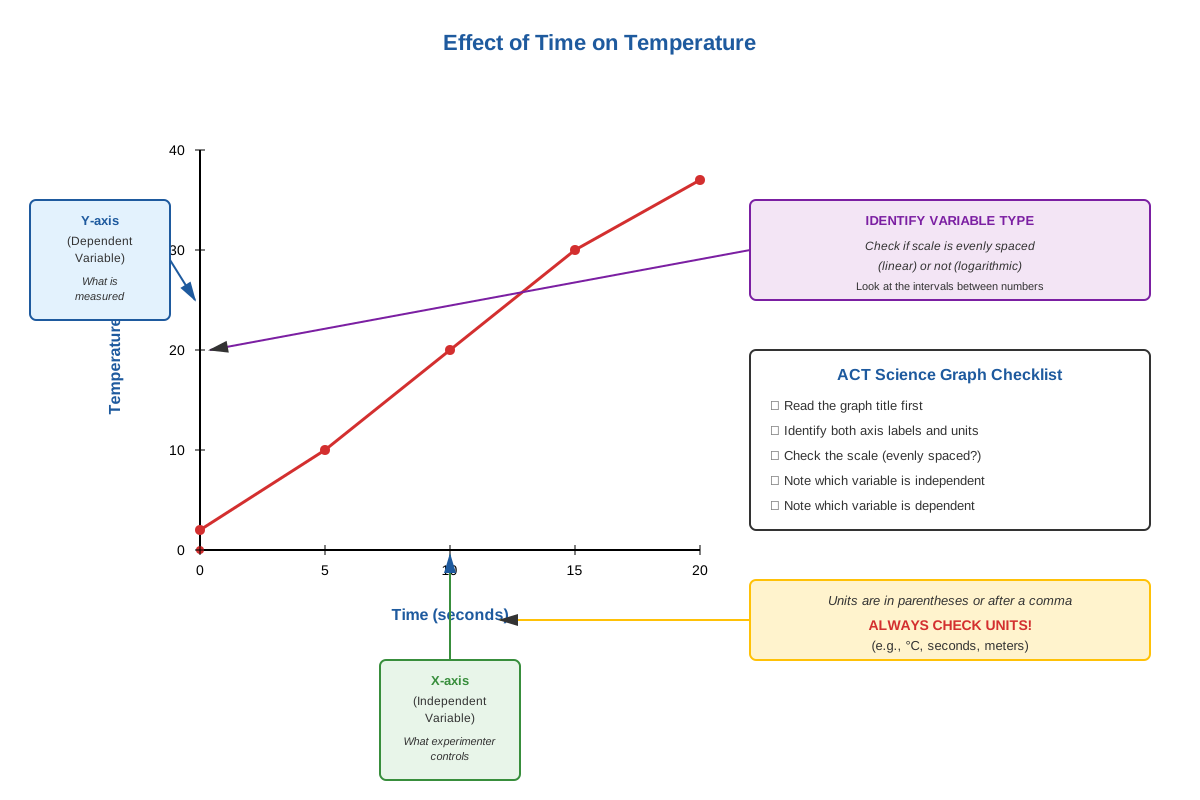
Axis labels consist of three critical components that students must identify and interpret: the variable name, the unit of measurement, and the scale. The variable name describes what quantity is being measured (e.g., "Temperature," "Velocity," "Concentration"). The unit of measurement specifies how that quantity is quantified (e.g., °C, m/s, mol/L). The scale indicates the numerical range and intervals marked along the axis. All three components work together to provide complete information about the data being presented.
On the ACT, axis labels typically follow the format: "Variable Name (unit)" or "Variable Name, unit." For example, "Time (seconds)" or "Mass, kg." Students must train themselves to read the complete label, not just the variable name, because questions often hinge on unit conversions or recognizing that different graphs use different units for the same type of variable. The scale component, while not written in the label text itself, is conveyed through the numbered tick marks along the axis and must be examined to determine the magnitude and precision of measurements.
X-Axis and Y-Axis Conventions
The x-axis (horizontal axis) conventionally represents the independent variable—the variable that the experimenter controls or that changes naturally in a predictable way (such as time). The y-axis (vertical axis) typically represents the dependent variable—the variable that responds to changes in the independent variable and is measured as an outcome. Understanding this convention helps students quickly orient themselves to any graph and predict what relationships might be shown.
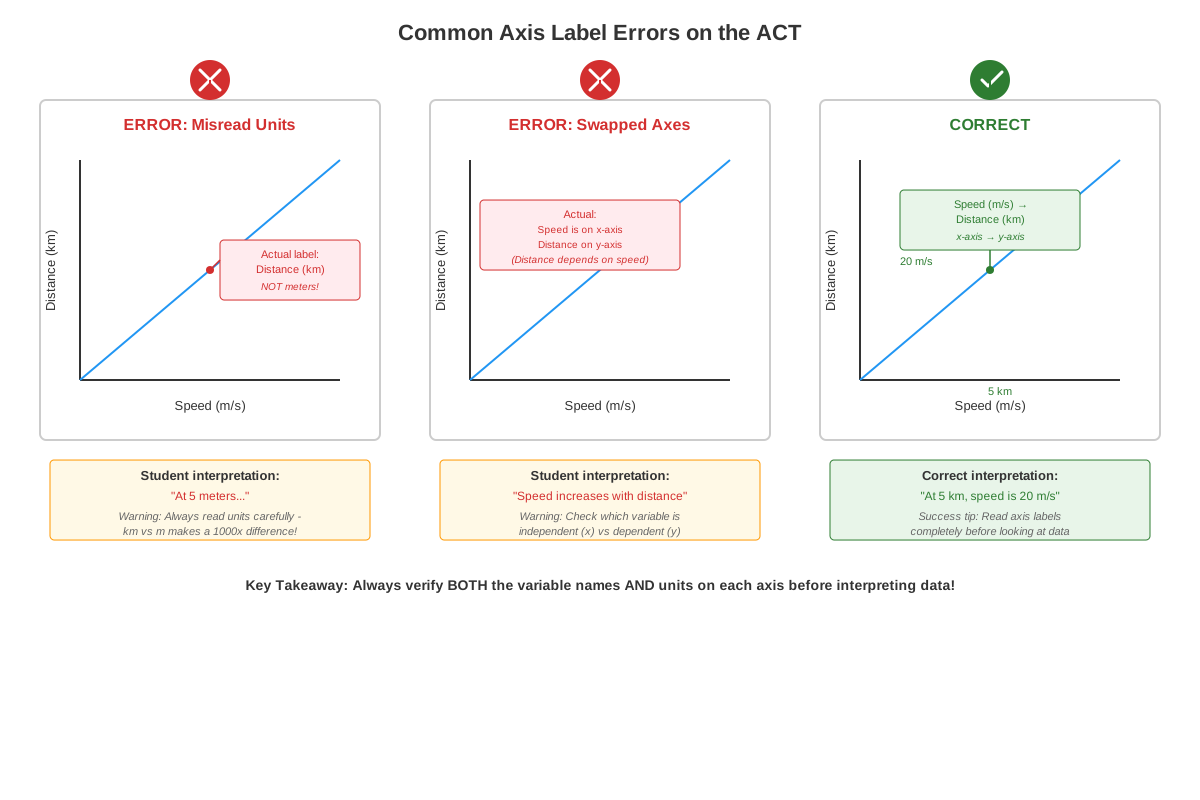
However, the ACT occasionally presents graphs where this convention is reversed or where both axes represent dependent variables measured under different conditions. Students must rely on the actual axis labels rather than assumptions about placement. Reading the labels carefully prevents errors when graphs deviate from standard conventions. Additionally, some ACT passages include multiple graphs where the axes are deliberately switched between figures to test whether students are reading labels or making assumptions.
Units of Measurement
Units provide essential context for interpreting numerical values on axes. Common unit categories on the ACT include: time units (seconds, minutes, hours, days, years), distance/length units (millimeters, centimeters, meters, kilometers), mass units (grams, kilograms), temperature units (°C, °F, K), concentration units (mol/L, g/mL, ppm), rate units (m/s, km/hr), and percentage or ratio units (%, fraction, parts per million).
The ACT frequently tests whether students notice when units differ between graphs or when conversions are necessary. For example, one graph might show temperature in Celsius while a question asks about Fahrenheit, or one axis might show time in minutes while another shows hours. Students must be prepared to recognize these differences and perform basic conversions when necessary. Additionally, derived units (like m/s² for acceleration or J/mol for energy) require understanding what physical quantity is being measured.
| Unit Type | Common Examples | What It Measures |
|---|---|---|
| Time | s, min, hr, days, years | Duration or temporal sequence |
| Length/Distance | mm, cm, m, km | Spatial extent or position |
| Mass | mg, g, kg | Amount of matter |
| Temperature | °C, °F, K | Thermal energy level |
| Concentration | mol/L, M, g/mL, ppm | Amount of substance per volume |
| Rate/Velocity | m/s, km/hr, cm/min | Change in position per time |
| Percentage | %, decimal fraction | Proportion or relative amount |
Scale Types and Intervals
Axes can display different types of scales that affect how data should be interpreted. Linear scales show equal intervals between tick marks, where each step represents the same numerical increase (e.g., 0, 10, 20, 30). This is the most common scale type on the ACT. Logarithmic scales show intervals where each step represents a multiplicative increase (e.g., 1, 10, 100, 1000), used when data spans several orders of magnitude. Categorical scales display discrete categories rather than continuous numerical values (e.g., Species A, Species B, Species C).
Students must examine the numerical labels on tick marks to determine the scale type and interval size. On linear scales, the interval might be 1, 5, 10, 100, or any other consistent value. Recognizing the interval is crucial for reading intermediate values between labeled tick marks. For example, if an axis shows 0, 50, and 100, each small tick mark between them might represent 10 units. Misreading the interval is a common source of errors on ACT questions that ask for specific values.
Reading Intermediate Values
Many ACT questions require students to determine values that fall between labeled tick marks on an axis. This requires identifying the interval size and then counting or estimating the position of a data point. The process involves: (1) identifying two adjacent labeled tick marks that bracket the value of interest, (2) calculating the interval by subtracting the lower value from the higher value and dividing by the number of spaces between them, (3) counting how many intervals the data point is from the lower labeled mark, and (4) multiplying the interval size by the number of intervals and adding to the lower labeled value.
For example, if an axis shows 20 and 40 as adjacent labels with 4 spaces between them, each space represents (40-20)/4 = 5 units. A data point located 3 spaces above 20 would be at 20 + (3×5) = 35. Developing speed and accuracy in this skill is essential for ACT success, as many questions require reading multiple values from graphs under time pressure.
Multiple Axes and Dual Y-Axes
Some ACT graphs feature multiple y-axes, typically one on the left side and one on the right side of the graph, each with different scales and units. These graphs display two different dependent variables measured against the same independent variable (usually shown on the x-axis). Students must carefully determine which data series corresponds to which y-axis, usually indicated by matching colors, line styles, or explicit labels in a legend.
When encountering dual y-axis graphs, students should: (1) identify what each y-axis measures by reading both labels completely, (2) determine which data series uses which axis (check the legend or graph key), (3) read values using only the appropriate axis for each data series, and (4) avoid comparing values from different axes directly unless the question specifically asks about the relationship between the two variables. Mixing up which axis corresponds to which data is a common trap on the ACT.
Concept Relationships
The skill of reading axis labels serves as the foundation for all other data interpretation skills on the ACT Science test. Axis label interpretation → enables → identifying trends because students must know what variables are being compared before they can describe how one changes relative to another. Similarly, axis label interpretation → enables → data point reading because extracting specific numerical values requires understanding both what is being measured and in what units.
Axis labels → connect to → experimental design because the choice of independent and dependent variables (reflected in axis placement) reveals the structure of the scientific investigation. Understanding what the researcher chose to measure and control helps students answer questions about methodology and validity. Axis labels → connect to → unit analysis because recognizing units allows students to perform conversions, compare magnitudes across different graphs, and identify when data is presented in different forms (raw values versus rates or percentages).
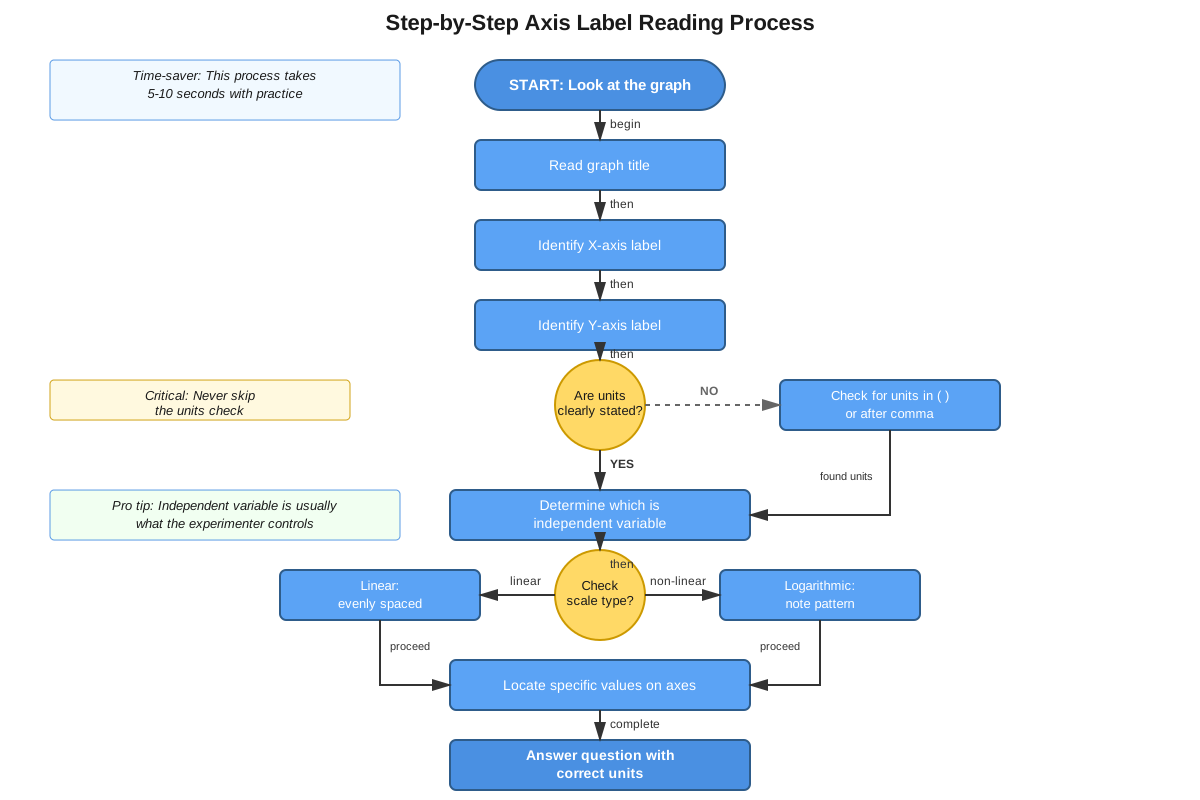
Within the topic itself, variable identification → leads to → unit recognition → leads to → scale interpretation → leads to → accurate value reading. This sequence represents the mental process students should follow when first encountering any graph on the ACT. Mastering each step in isolation and then integrating them into a rapid, automatic process is the key to efficiency and accuracy.
Quick check — test yourself on Axis labels so far.
Try Flashcards →High-Yield Facts
⭐ The x-axis typically represents the independent variable, while the y-axis represents the dependent variable, but always verify by reading the actual labels.
⭐ Units are part of the axis label and must be read carefully, as the ACT frequently changes units between graphs in the same passage.
⭐ To read values between labeled tick marks, calculate the interval size by dividing the difference between adjacent labels by the number of spaces.
⭐ Graphs with two y-axes (left and right) measure different variables; always check which data series corresponds to which axis.
⭐ Percentage or ratio units on an axis indicate relative values, not absolute quantities, which affects how data should be compared.
- Logarithmic scales show multiplicative rather than additive intervals; each step represents a tenfold (or other consistent multiplicative) increase.
- Axis labels sometimes include additional information in parentheses or subscripts that specifies conditions (e.g., "Temperature (at sea level)" or "Concentration₂₀°C").
- When axes show derived units (like m/s² or J/mol), understanding the physical meaning helps interpret what the graph represents.
- The ACT may present graphs where the y-axis starts at a value other than zero, which can visually exaggerate differences between data points.
- Categorical axes (showing names or types rather than numbers) indicate qualitative comparisons rather than continuous relationships.
- Time axes may progress from left to right (standard) or right to left (reversed), requiring careful attention to arrow directions or numerical order.
- Some ACT graphs include broken axes (indicated by a zigzag symbol) that skip a range of values, affecting visual interpretation of slopes and differences.
Common Misconceptions
Misconception: The x-axis always represents time and the y-axis always represents the measured outcome. → Correction: While time is commonly on the x-axis, many ACT graphs show other independent variables (temperature, concentration, distance, etc.) on the x-axis. Always read the actual axis labels to determine what variables are displayed.
Misconception: All tick marks on an axis represent intervals of 1 or 10 units. → Correction: Intervals can be any value (2, 5, 25, 50, 100, 0.5, etc.) depending on the data range. Students must calculate the interval by examining the difference between labeled tick marks and counting the spaces between them.
Misconception: If two graphs in a passage show the same type of variable, they use the same units and scale. → Correction: The ACT frequently changes units or scales between graphs to test careful reading. One graph might show temperature in °C while another uses °F, or one might show concentration in mol/L while another uses g/mL.
Misconception: On graphs with two y-axes, both data series can be read using either axis. → Correction: Each data series corresponds to only one specific y-axis. Using the wrong axis will give incorrect values. Students must check the legend or key to determine which data series uses which axis.
Misconception: The numerical values on an axis represent the only possible values that can be read from the graph. → Correction: Intermediate values between labeled tick marks can and must be estimated by determining the interval size and the position of data points relative to the tick marks. Many ACT questions specifically ask for values that fall between labeled marks.
Misconception: Axis labels are just descriptive and don't affect the numerical answers to questions. → Correction: Units and scales directly affect numerical answers. Reading "50" from an axis labeled in centimeters is completely different from reading "50" from an axis labeled in meters. Ignoring units leads to incorrect answers on comparison and calculation questions.
Worked Examples
Example 1: Reading Values with Non-Standard Intervals
Question: A graph shows plant height on the y-axis with labeled tick marks at 0 cm, 15 cm, and 30 cm. There are 3 evenly spaced unlabeled tick marks between 15 and 30. A data point falls on the second unlabeled tick mark above 15 cm. What is the height of the plant?
Solution:
Step 1: Identify the labeled tick marks that bracket the data point: 15 cm and 30 cm.
Step 2: Calculate the total difference: 30 cm - 15 cm = 15 cm.
Step 3: Count the number of intervals (spaces) between the labeled marks. There are 3 unlabeled tick marks, which create 4 total spaces (one before the first unlabeled mark, one between each pair of marks, and one after the last unlabeled mark before reaching 30).
Step 4: Calculate the interval size: 15 cm ÷ 4 spaces = 3.75 cm per space.
Step 5: The data point is on the second unlabeled tick mark, which is 2 spaces above 15 cm.
Step 6: Calculate the value: 15 cm + (2 × 3.75 cm) = 15 cm + 7.5 cm = 22.5 cm.
Answer: The plant height is 22.5 cm.
This example demonstrates the systematic approach to reading intermediate values, which is essential for accuracy on ACT questions that don't provide values at labeled tick marks.
Example 2: Interpreting Dual Y-Axes
Question: A graph shows time (hours) on the x-axis. The left y-axis is labeled "Temperature (°C)" with a scale from 0 to 100. The right y-axis is labeled "Pressure (kPa)" with a scale from 0 to 500. A solid line represents temperature data, and a dashed line represents pressure data. At 3 hours, the solid line is at the level of 60 on the left axis, and the dashed line is at the level of 300 on the right axis. What was the pressure at 3 hours?
Solution:
Step 1: Identify what each axis measures by reading the labels. Left y-axis = Temperature (°C), Right y-axis = Pressure (kPa).
Step 2: Determine which data series corresponds to which axis. The question asks about pressure, which is measured on the right y-axis.
Step 3: Identify which line represents pressure data. The dashed line represents pressure (this would typically be indicated in a legend on the actual graph).
Step 4: Read the value of the dashed line at 3 hours using the right y-axis only. The dashed line is at the level of 300.
Step 5: Include the unit from the right y-axis label: 300 kPa.
Answer: The pressure at 3 hours was 300 kPa.
Common trap to avoid: Students might incorrectly read the solid line value (60) or might read the dashed line value but use the wrong units (°C instead of kPa). Always match the data series to its corresponding axis and use the correct units.
Exam Strategy
When approaching ACT Science questions involving graphs, follow this systematic process:
- Immediately read both axis labels completely before looking at the data. Identify the variable name and unit for each axis. This takes 3-5 seconds but prevents costly errors.
- Determine the scale and interval by examining the numerical labels on tick marks. Calculate the interval size if you'll need to read intermediate values.
- Check for multiple axes or unusual features such as dual y-axes, logarithmic scales, broken axes, or reversed directions.
- Match data series to axes by examining the legend or key, especially on graphs with multiple lines or bars.
Trigger words and phrases that indicate axis label questions:
- "What does the [x/y]-axis represent?"
- "According to the graph, what was the [variable] at [value]?"
- "The [variable] is measured in..."
- "Which graph shows [variable] versus [variable]?"
- "At what [x-axis variable] did [y-axis variable] equal [value]?"
Process-of-elimination tips:
- Eliminate answer choices with incorrect units immediately
- Eliminate choices that confuse the x and y variables
- Eliminate choices that use values from the wrong axis on dual-axis graphs
- For "what does the axis represent" questions, eliminate choices that describe the data trend rather than what is being measured
Time allocation: Spend 5-10 seconds reading and understanding axis labels when you first encounter a graph. This upfront investment saves time by preventing errors that require re-reading. For questions requiring value reading, spend 10-15 seconds carefully identifying the correct position and calculating intermediate values rather than rushing and guessing.
Exam Tip: If a passage contains multiple graphs, quickly scan all axis labels before reading any questions. Note any differences in units or scales between graphs, as these differences are often tested.
Memory Techniques
Mnemonic for systematic graph reading: "VU-SI"
- Variable: What is being measured?
- Unit: In what units?
- Scale: What is the range and interval?
- Intermediate: Can I read values between tick marks?
Visualization strategy: Picture axis labels as the "address system" of a graph. Just as you need a street name and house number to find a location, you need the variable name and numerical value to find a data point. The units are like specifying whether the address is in miles or kilometers from a reference point.
Acronym for dual y-axis graphs: "MATCH"
- Multiple axes present?
- Assign each data series to its axis
- Track which is which using the legend
- Check units for each axis
- Heed only the correct axis for each series
Memory aid for interval calculation: "Difference Divided by Divisions" (DDD). The difference between labeled marks, divided by the number of divisions (spaces) between them, gives the interval size.
Summary
Axis labels are the fundamental key to interpreting all graphical data on the ACT Science test. Mastering this topic requires developing the habit of systematically reading variable names, units, and scales before attempting to extract any information from a graph. Students must be able to identify what each axis represents, recognize the units of measurement, determine the scale type and interval size, and accurately read both labeled and intermediate values. The ACT frequently tests whether students notice when units or scales change between graphs, when axes are reversed from typical conventions, or when dual y-axes require careful matching of data series to the appropriate scale. Success on axis label questions comes from careful, methodical reading rather than rushing to assumptions based on visual patterns. By investing a few seconds to fully understand axis labels when first encountering each graph, students prevent errors, save time on subsequent questions, and build the foundation for accurately answering all data representation questions on the ACT Science test.
Key Takeaways
- Always read axis labels completely, including both variable names and units, before interpreting any graph
- Calculate interval sizes by dividing the difference between adjacent labeled tick marks by the number of spaces between them
- On dual y-axis graphs, carefully match each data series to its corresponding axis using the legend
- Units matter: the ACT frequently changes units between graphs to test careful reading
- The x-axis typically shows the independent variable and the y-axis shows the dependent variable, but always verify by reading the actual labels
- Intermediate values between labeled tick marks can be determined by calculating intervals and counting spaces
- Systematic graph reading (variable, unit, scale, interval) prevents errors and saves time on ACT Science questions
Related Topics
Data Point Extraction: Building on axis label interpretation, this topic covers techniques for precisely reading numerical values from various graph types, including scatter plots, line graphs, and bar charts. Mastering axis labels is the essential first step before extracting specific data points.
Trend Analysis: Once students can accurately read axis labels and values, they can progress to identifying patterns, slopes, and relationships between variables. Understanding what the axes represent is crucial for describing trends correctly.
Unit Conversion: Many ACT questions require converting between different units (Celsius to Fahrenheit, grams to kilograms, etc.). Strong axis label reading skills help identify when conversions are necessary.
Experimental Design Interpretation: Axis labels reveal which variables were manipulated (independent) and which were measured (dependent), providing insight into the structure and purpose of scientific investigations.
Multi-Graph Comparison: Advanced ACT passages present multiple graphs that must be analyzed together. Comparing axis labels across graphs is essential for synthesizing information and answering complex questions.
Practice CTA
Now that you understand the critical importance of axis labels and have learned systematic strategies for reading them accurately, it's time to put your knowledge into practice. Complete the practice questions and flashcards for this topic to reinforce your skills and build the speed and confidence you need for test day. Remember: every ACT Science question involving graphs starts with correctly reading the axis labels. Master this foundational skill, and you'll see immediate improvement in your data representation scores. You've got this!
Sign up free to keep reading
Create a free AnvayaPrep account to finish this ACT guide on Axis labels — plus flashcards and practice questions.