Overview
Error bars basics represent one of the most frequently tested graphical interpretation skills on the ACT Science test. Error bars are visual indicators on graphs that show the uncertainty or variability in data measurements. They appear as vertical or horizontal lines extending from data points, indicating the range within which the true value likely falls. Understanding error bars is crucial because the ACT regularly includes questions that require students to compare data points, determine whether differences are meaningful, and assess the reliability of experimental results.
On the ACT Science test, error bars appear in approximately 15-20% of Data Representation passages, making this a high-yield topic that can directly impact your score. The test designers use error bars to assess whether students can distinguish between statistically significant differences and random variation—a fundamental skill in scientific reasoning. Questions may ask you to identify overlapping error bars, compare the precision of different measurements, or determine which experimental conditions produced the most reliable results.
Mastering ACT error bars basics connects directly to broader data interpretation skills tested throughout the Science section. This topic builds upon your understanding of graphs, data points, and experimental design while preparing you for more complex questions about data analysis and scientific conclusions. Error bars bridge the gap between simple graph reading and sophisticated statistical reasoning, making them an essential component of the scientific literacy the ACT aims to measure.
Learning Objectives
- [ ] Identify when Error bars basics is being tested in ACT Science passages
- [ ] Explain the core rule or strategy behind Error bars basics interpretation
- [ ] Apply Error bars basics to ACT-style questions accurately
- [ ] Determine whether two data points are significantly different based on error bar overlap
- [ ] Compare the precision and reliability of measurements using error bar length
- [ ] Interpret what error bars reveal about experimental uncertainty and data quality
- [ ] Distinguish between different types of error bars and their meanings
Prerequisites
- Basic graph reading skills: Understanding axes, scales, and data points is essential because error bars are graphical elements that extend from these fundamental components
- Understanding of mean/average values: Error bars typically extend from mean values, so recognizing that data points often represent averages is necessary for proper interpretation
- Familiarity with experimental variables: Knowing independent and dependent variables helps identify which axis error bars should be measured along
- Basic measurement concepts: Understanding that all measurements have some degree of uncertainty provides the conceptual foundation for why error bars exist
Why This Topic Matters
Error bars appear in real-world scientific research across all disciplines—from medical studies comparing treatment effectiveness to environmental science measuring pollution levels. Scientists use error bars to communicate the reliability of their findings and to help readers distinguish between meaningful differences and random variation. When a pharmaceutical company tests a new drug, error bars help determine whether the treatment effect is real or could be due to chance. Climate scientists use error bars to show the uncertainty in temperature measurements and projections.
On the ACT Science test, error bars appear in 15-20% of all passages, with the highest frequency in Data Representation passages (approximately 30-40% of these passages include error bars). The test typically includes 1-2 questions per passage that feature error bars, and these questions often serve as medium-to-difficult discriminators between average and high-scoring students. Students who master error bars can gain a significant competitive advantage because many test-takers either ignore error bars entirely or misinterpret them.
Common ACT question formats include: comparing two treatments to determine which is more effective, identifying which experimental condition produced the most precise measurements, determining whether a change in the independent variable caused a significant change in the dependent variable, and selecting graphs that accurately represent described experimental results. Error bars also appear in Research Summaries passages where students must evaluate conflicting hypotheses or assess the strength of experimental evidence.
Core Concepts
What Are Error Bars?
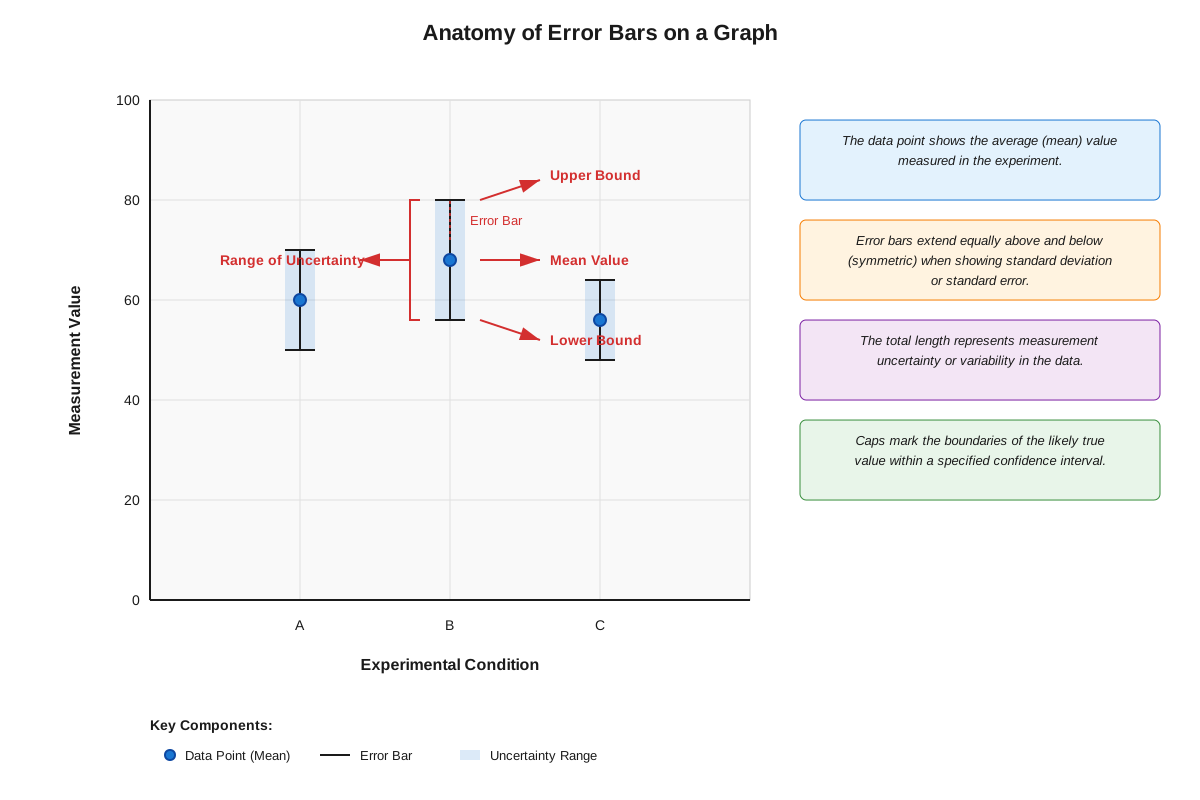
Error bars are graphical representations of the variability or uncertainty in data. They appear as vertical or horizontal lines extending above and below (or left and right of) data points on graphs. Each error bar has a specific length that corresponds to a measure of uncertainty, such as standard deviation, standard error, or confidence interval. On the ACT, you don't need to calculate these values—you only need to interpret what the error bars tell you about the data.
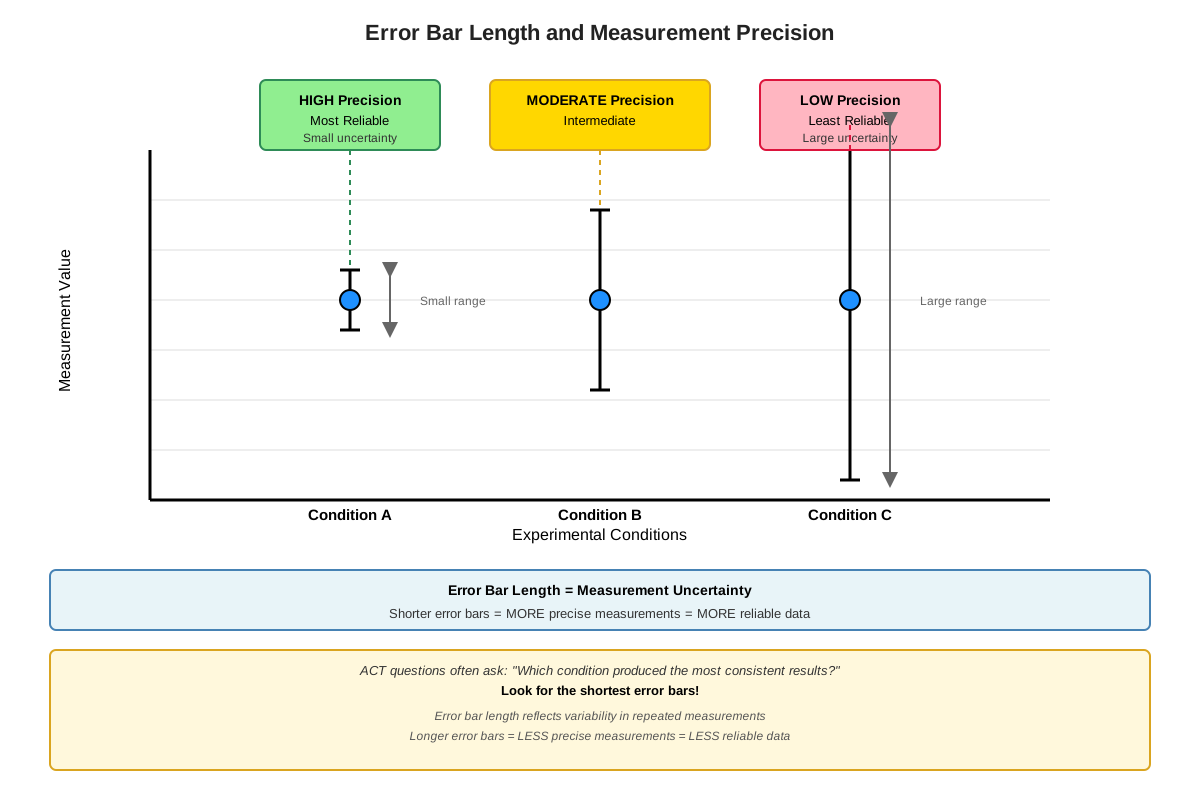
The length of an error bar indicates the degree of uncertainty in a measurement. Longer error bars suggest greater variability or less precision, while shorter error bars indicate more consistent, reliable measurements. When comparing data points, the error bars provide crucial information about whether observed differences are meaningful or could simply result from random variation in the measurement process.
Reading Error Bars on Graphs
Error bars extend in both directions from a data point, creating a range. If a data point is at y = 50 and has error bars extending to y = 45 and y = 55, the error bar length is 5 units in each direction. The total range covered by the error bar is 10 units (from 45 to 55). On ACT graphs, error bars most commonly appear on the dependent variable axis (usually the y-axis), though they can occasionally appear on the x-axis or both axes.
To read error bars effectively:
- Locate the center point (the actual data value)
- Identify the top and bottom (or left and right) endpoints of the error bar
- Note the range covered by the error bar
- Compare error bar ranges between different data points
The Overlap Rule: Determining Significant Differences
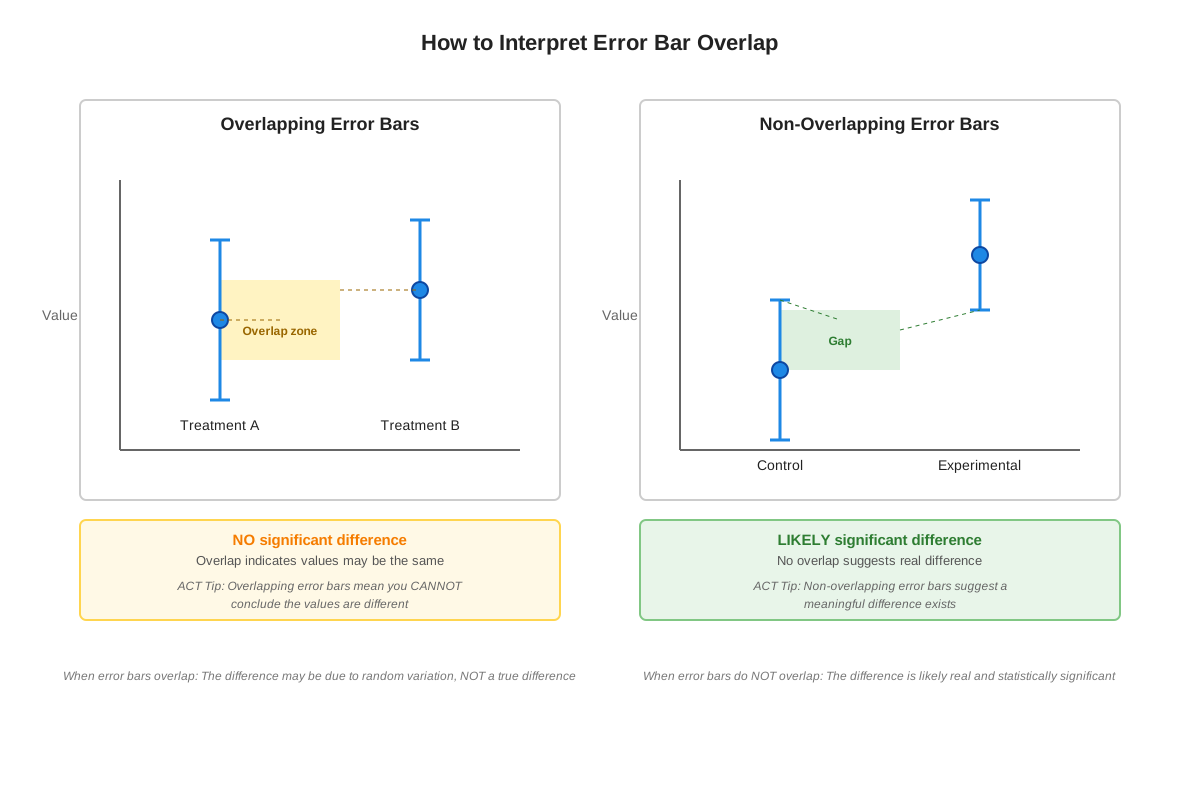
The most important concept for the ACT is the overlap rule: When error bars from two data points overlap, the difference between those points may not be statistically significant. When error bars do not overlap, the difference is likely meaningful and not due to random chance.
Overlapping error bars suggest that the true values of the two measurements could be the same, even though the data points appear different. For example, if Treatment A has a mean of 60 with error bars from 55-65, and Treatment B has a mean of 58 with error bars from 53-63, the error bars overlap (both include values from 55-63). This overlap indicates the treatments might not be truly different.
Non-overlapping error bars provide strong evidence that two values are genuinely different. If Treatment A has error bars from 55-65 and Treatment C has error bars from 70-80, there's no overlap, suggesting Treatment C produces significantly different results than Treatment A.
ACT Exam Tip: When a question asks "which treatment was most effective?" or "did the change produce a significant effect?", immediately check for error bar overlap. No overlap = significant difference.
Precision and Reliability Interpretation
Error bar length directly indicates measurement precision. Shorter error bars mean:
- More consistent measurements
- Higher precision
- Greater reliability
- Better experimental control
- More confidence in the results
Longer error bars indicate:
- Greater variability between measurements
- Lower precision
- Less reliable data
- Possible experimental problems
- Less confidence in the exact value
When comparing experimental conditions, the condition with the shortest error bars produced the most precise, reliable results. This concept frequently appears in ACT questions asking "which method was most reliable?" or "which measurement had the least variability?"
Error Bars in Different Graph Types
| Graph Type | Error Bar Orientation | Common ACT Application |
|---|---|---|
| Bar graphs | Vertical from top of bars | Comparing categories or treatments |
| Line graphs | Vertical from data points | Showing trends over time or conditions |
| Scatter plots | Vertical, horizontal, or both | Examining relationships between variables |
| Box plots | Built into the plot structure | Less common on ACT |
On bar graphs, error bars extend from the top of each bar, showing uncertainty in the measured value. On line graphs, error bars extend vertically from each data point along the line. The ACT most frequently uses bar graphs and line graphs with error bars.
What Error Bars Don't Tell You
Error bars show uncertainty in measurements but don't explain the cause of that uncertainty. They don't indicate whether differences are due to the experimental treatment, measurement error, natural variation, or other factors. Error bars also don't tell you the sample size directly, though larger samples typically produce shorter error bars. On the ACT, focus on what error bars do show: the range of uncertainty and whether differences between data points are likely meaningful.
Concept Relationships
Error bars basics connect directly to fundamental graph interpretation skills. Basic graph reading (identifying axes, scales, and data points) → Error bar identification (recognizing error bars and their extent) → Overlap analysis (determining whether error bars overlap) → Significance conclusions (deciding whether differences are meaningful).
The concept of measurement uncertainty underlying error bars relates to experimental design principles. Controlled experiments produce more consistent results → Shorter error bars indicate this consistency → Greater confidence in conclusions drawn from the data. This relationship explains why ACT passages often ask which experimental setup was "most reliable" or produced "the most consistent results."
Error bars also connect to data comparison skills. When comparing multiple treatments or conditions, you must: Identify the data points → Examine error bar lengths (precision comparison) → Check for error bar overlap (significance comparison) → Draw conclusions about which treatment was most effective or whether changes were meaningful.
Understanding error bars enhances interpretation of experimental results in Research Summaries passages. Hypothesis testing requires determining whether observed differences support one hypothesis over another → Error bar analysis provides the evidence needed → Scientific conclusions become more justified when error bars show non-overlapping differences.
High-Yield Facts
⭐ Error bars that do not overlap indicate a statistically significant difference between data points
⭐ Shorter error bars indicate more precise, reliable measurements with less variability
⭐ Error bars extend both above and below (or left and right of) the data point they represent
⭐ Overlapping error bars suggest the difference between two measurements may not be meaningful
⭐ The length of error bars indicates the degree of uncertainty or variability in the measurement
- Error bars most commonly appear on the y-axis (dependent variable) in ACT graphs
- When error bars are present, you must consider them when comparing data points
- Longer error bars suggest less experimental control or greater natural variation
- Error bars can help identify which experimental condition produced the most consistent results
- The center point of an error bar represents the mean or average value measured
- Error bars never indicate the direction of change, only the uncertainty in measurements
- Multiple data points with similar error bar lengths suggest consistent experimental precision
- ACT questions rarely require calculating error bar values—only interpreting them visually
- Error bars can reveal whether a trend is reliable or might be due to measurement variability
- When all error bars in a dataset overlap, no single data point is significantly different from the others
Quick check — test yourself on Error bars basics so far.
Try Flashcards →Common Misconceptions
Misconception: Error bars show the range of all individual measurements taken
Correction: Error bars typically show standard deviation or standard error, which are statistical measures of variability, not the full range of all data points. Some individual measurements may fall outside the error bars.
Misconception: If data points are different, the treatments must be significantly different regardless of error bars
Correction: Visual differences between data points can be misleading. Only when error bars don't overlap can you confidently conclude the difference is significant. Overlapping error bars mean the apparent difference might be due to random variation.
Misconception: Longer error bars mean the experiment was poorly designed or conducted incorrectly
Correction: Longer error bars can result from natural biological variation, inherent measurement limitations, or the nature of what's being measured. They indicate greater uncertainty but don't necessarily mean the experiment was flawed.
Misconception: Error bars only extend upward from data points
Correction: Error bars extend in both directions (up and down, or left and right) from the central data point, creating a range that encompasses the uncertainty in both directions.
Misconception: The tips of error bars represent the maximum and minimum values measured
Correction: Error bar endpoints represent statistical measures (like mean ± standard deviation), not necessarily the extreme values observed. The actual measurements might extend beyond or fall short of the error bar endpoints.
Misconception: Overlapping error bars mean two measurements are exactly the same
Correction: Overlapping error bars indicate the measurements are not significantly different, but they could still represent different true values. Overlap means you cannot confidently conclude they're different, not that they're identical.
Misconception: You need to calculate statistical values to answer ACT error bar questions
Correction: The ACT tests visual interpretation of error bars, not statistical calculations. You only need to observe overlap, compare lengths, and draw conclusions based on what you see.
Worked Examples
Example 1: Comparing Treatment Effectiveness
Question: A researcher tested four different fertilizers on plant growth. The graph below shows average plant height after 30 days with error bars representing variability. Which fertilizer produced significantly greater growth than Fertilizer A?
Graph description:
Fertilizer A: height = 20 cm, error bars from 18-22 cm
Fertilizer B: height = 23 cm, error bars from 20-26 cm
Fertilizer C: height = 28 cm, error bars from 26-30 cm
Fertilizer D: height = 22 cm, error bars from 19-25 cm
Solution Process:
Step 1: Identify Fertilizer A's error bar range: 18-22 cm
Step 2: Check each other fertilizer for overlap with Fertilizer A's range:
- Fertilizer B (20-26 cm): Overlaps with A (both include 20-22 cm)
- Fertilizer C (26-30 cm): No overlap with A (26 is above A's maximum of 22)
- Fertilizer D (19-25 cm): Overlaps with A (both include 19-22 cm)
Step 3: Apply the overlap rule: Only non-overlapping error bars indicate significant differences
Answer: Fertilizer C produced significantly greater growth than Fertilizer A because their error bars do not overlap. Fertilizers B and D both have error bars that overlap with A, so we cannot conclude they produced significantly different growth.
Connection to Learning Objectives: This example demonstrates identifying when error bars are being tested (comparing treatments), applying the core overlap rule, and accurately determining significant differences—addressing all three primary learning objectives.
Example 2: Identifying Most Reliable Measurement
Question: Scientists measured the concentration of a chemical compound using three different methods. The results are shown below with error bars. Which method produced the most reliable measurements?
Graph description:
Method 1: concentration = 45 mg/L, error bars from 40-50 mg/L (length = 5 in each direction)
Method 2: concentration = 46 mg/L, error bars from 44-48 mg/L (length = 2 in each direction)
Method 3: concentration = 44 mg/L, error bars from 38-50 mg/L (length = 6 in each direction)
Solution Process:
Step 1: Understand that "most reliable" means most precise with least variability
Step 2: Compare error bar lengths (shorter = more reliable):
- Method 1: Total range = 10 mg/L (50 - 40)
- Method 2: Total range = 4 mg/L (48 - 44)
- Method 3: Total range = 12 mg/L (50 - 38)
Step 3: Identify the shortest error bars
Answer: Method 2 produced the most reliable measurements because it has the shortest error bars, indicating the least variability and most consistent results across repeated measurements.
Connection to Learning Objectives: This example shows how to compare precision using error bar length, interpret what error bars reveal about data quality, and apply error bar concepts to determine measurement reliability—addressing the extended learning objectives about precision and reliability.
Exam Strategy
Approaching ACT Error Bar Questions
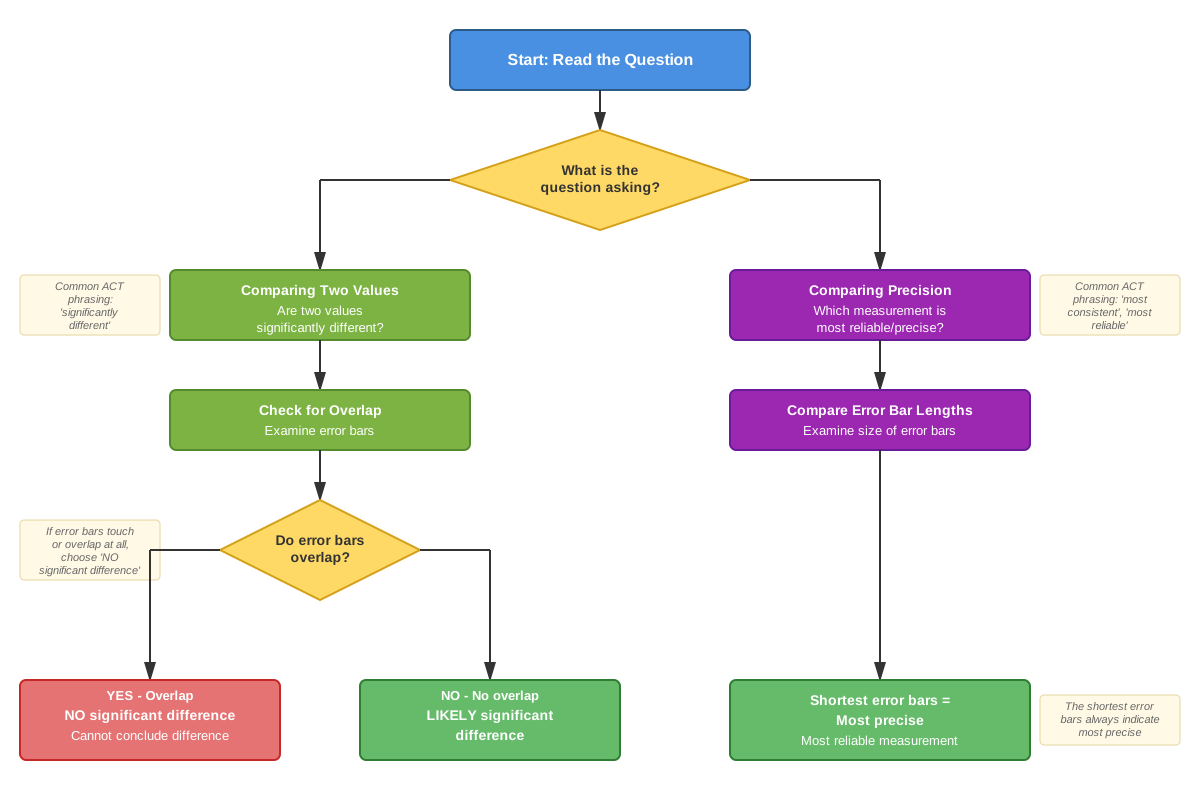
When you encounter a graph with error bars, follow this systematic approach:
- Identify the question type: Is it asking about significant differences, reliability, precision, or which condition produced specific results?
- Locate all relevant error bars: Mark or mentally note the data points being compared
- Check for overlap: Visually assess whether error bars overlap (draw imaginary horizontal lines if needed)
- Compare lengths: Note which error bars are shortest (most reliable) and longest (least reliable)
- Apply the appropriate rule: Use overlap for significance questions, length for precision questions
Trigger Words and Phrases
Watch for these trigger words that signal error bar questions:
- "Significantly different" or "significant difference" → Check for error bar overlap
- "Most reliable" or "most precise" → Compare error bar lengths (shortest wins)
- "Greatest variability" or "least consistent" → Compare error bar lengths (longest wins)
- "Based on the error bars" → Direct signal to use error bars in your analysis
- "Most effective treatment" → Check both the data point value AND error bar overlap
- "Cannot be distinguished" → Look for overlapping error bars
- "Clearly different" → Look for non-overlapping error bars
Process of Elimination Tips
When multiple answer choices seem plausible:
- Eliminate choices that ignore error bars: If error bars are present, they must factor into the correct answer
- Eliminate choices claiming significance when error bars overlap: Overlapping bars = cannot claim significant difference
- Eliminate choices claiming no difference when error bars don't overlap: Non-overlapping bars = likely significant difference
- For "most reliable" questions, eliminate any choice that doesn't have the shortest error bars
- Be cautious of extreme language: Words like "always," "never," or "definitely" are often incorrect when error bars show uncertainty
Time Allocation
Error bar questions typically require 30-45 seconds each:
- 10 seconds: Identify what the question asks
- 15 seconds: Examine the relevant error bars
- 10 seconds: Apply the overlap or length rule
- 10 seconds: Select and confirm your answer
Don't spend time trying to calculate exact values or measure error bars with precision. The ACT designs these questions for visual interpretation, and the correct answer should be apparent from a quick visual assessment.
Quick Strategy: If you're running short on time, error bar questions are excellent candidates for quick points because they follow predictable rules and don't require reading dense passage text.
Memory Techniques
The "NOSE" Acronym for Error Bar Analysis
No Overlap = Significant Effect
When error bars don't touch (no overlap), you can confidently conclude there's a significant effect or meaningful difference. This simple acronym helps you remember the most important rule for ACT error bar questions.
The "SHORT = SURE" Mnemonic
SHORT error bars mean you're SURE about the measurement (more reliable, more precise, more consistent). This helps you remember that shorter error bars indicate better data quality.
Visual Memory Technique
Picture error bars as "uncertainty fences" around each data point. When the fences overlap, the animals (data points) could mix together—you can't be sure they're truly separate. When fences don't overlap, the animals are definitely in separate areas—you can be confident they're different.
The Two-Question Framework
For any error bar question, ask yourself only two questions:
- "Do they touch?" (overlap question → determines significance)
- "Which is shortest?" (length question → determines reliability)
This framework covers 95% of ACT error bar questions and prevents overthinking.
Finger Spacing Technique
When comparing error bars on test day, use your finger or pencil to gauge spacing. Place your finger at the top of one error bar and see if it reaches the bottom of another error bar. If there's a gap, they don't overlap (significant difference). If your finger covers both, they overlap (not significantly different).
Summary
Error bars basics represent a critical skill for ACT Science success, appearing in 15-20% of passages and serving as a reliable discriminator between average and high-scoring students. The fundamental concept is straightforward: error bars show the uncertainty or variability in measurements, with their length indicating precision and their overlap indicating whether differences are statistically significant. The two essential rules are: (1) non-overlapping error bars indicate significant differences between data points, while overlapping error bars suggest differences may not be meaningful, and (2) shorter error bars indicate more reliable, precise measurements with less variability. On the ACT, you'll never need to calculate error bar values—only interpret them visually to compare treatments, assess data reliability, and determine whether experimental results show meaningful effects. Master the overlap rule for significance questions and the length comparison for precision questions, and you'll confidently handle any error bar question the test presents.
Key Takeaways
- Error bars that don't overlap indicate statistically significant differences—this is the single most important rule for ACT questions
- Shorter error bars always mean more reliable, precise measurements with less variability and greater confidence in results
- Error bars extend in both directions from the data point, creating a range that represents measurement uncertainty
- Visual interpretation is sufficient—the ACT never requires calculating error bar values, only observing overlap and comparing lengths
- Always consider error bars when present—ignoring them leads to incorrect conclusions about data significance
- The overlap rule applies to comparison questions while the length rule applies to reliability and precision questions
- Trigger words like "significantly different" or "most reliable" immediately signal that error bars are central to finding the correct answer
Related Topics
Standard Deviation and Variability: Understanding the statistical concepts underlying error bars deepens comprehension of what error bars represent and why they vary in length across different datasets.
Experimental Design and Controls: Error bars connect to experimental quality—well-controlled experiments typically produce shorter error bars, linking data interpretation to experimental methodology.
Statistical Significance: While the ACT doesn't require formal statistical knowledge, understanding the concept of statistical significance enhances interpretation of error bar overlap and strengthens scientific reasoning skills.
Confidence Intervals: A more advanced statistical concept related to error bars that appears occasionally in higher-level science courses and helps explain why error bars indicate the range where true values likely fall.
Data Analysis in Research Summaries: Mastering error bars enables more sophisticated analysis of conflicting viewpoints passages where scientists disagree about experimental results and their significance.
Practice CTA
Now that you understand error bars basics, you're ready to apply these concepts to real ACT-style questions. The practice questions and flashcards will reinforce the overlap rule, help you quickly identify error bar questions, and build the visual interpretation skills needed for test day success. Remember: error bars appear frequently enough that mastering this topic can directly improve your Science score. Each practice question you complete strengthens your ability to quickly assess overlap and length, turning error bar questions into reliable points on test day. Start practicing now to build confidence and speed with this high-yield topic!
Sign up free to keep reading
Create a free AnvayaPrep account to finish this ACT guide on Error bars basics — plus flashcards and practice questions.