Overview
Linear trends represent one of the most frequently tested concepts in the ACT Science section, appearing in approximately 15-20% of all Data Representation passages. Understanding linear trends means being able to recognize, interpret, and predict patterns in data that follow a straight-line relationship between two variables. When one variable increases or decreases at a constant rate relative to another variable, a linear trend exists. This fundamental concept bridges mathematical reasoning with scientific data interpretation, making it essential for success on the ACT Science test.
The ability to identify and work with ACT linear trends is crucial because the exam frequently presents graphs, tables, and charts where students must determine relationships between variables, extrapolate values beyond given data points, or compare trends across multiple data sets. Unlike more complex polynomial or exponential relationships, linear trends follow predictable patterns that can be quickly analyzed under time pressure—a critical advantage when facing the ACT's strict timing constraints of approximately 52 seconds per question in the Science section.
Linear trends serve as foundational knowledge for understanding more complex data relationships in science. They connect directly to concepts of correlation, causation, experimental design, and scientific modeling. Mastering linear trends enables students to tackle questions involving rate of change, proportional relationships, and comparative analysis across different experimental conditions. This topic integrates seamlessly with other Data Representation skills, including reading scales, interpreting axes, and understanding units of measurement, making it a cornerstone concept that supports performance across multiple question types in the ACT Science section.
Learning Objectives
- [ ] Identify when Linear trends is being tested in ACT Science passages
- [ ] Explain the core rule or strategy behind Linear trends analysis
- [ ] Apply Linear trends to ACT-style questions accurately
- [ ] Distinguish between positive linear trends, negative linear trends, and no trend
- [ ] Extrapolate and interpolate values from linear trend data
- [ ] Compare the steepness (rate of change) of multiple linear trends within a single passage
- [ ] Recognize when data points deviate from a linear pattern and understand the implications
Prerequisites
- Basic graph reading skills: Understanding x-axis and y-axis labels, scales, and units is essential for identifying any trend in data
- Coordinate system familiarity: Recognizing how points are plotted on a graph enables accurate trend identification
- Basic arithmetic operations: Calculating differences and ratios helps determine if a trend is truly linear
- Understanding of variables: Distinguishing between independent and dependent variables clarifies which direction trends move
Why This Topic Matters
Linear trends appear in real-world scientific contexts constantly. Scientists use linear relationships to model everything from chemical reaction rates to population growth in controlled conditions, from the relationship between temperature and volume in gases to the correlation between exercise duration and calorie expenditure. Understanding linear trends allows researchers to make predictions, establish baselines, and identify when experimental results deviate from expected patterns—all critical components of the scientific method.
On the ACT Science test, linear trends questions appear in approximately 3-5 questions per exam, making them among the highest-yield topics to master. These questions typically appear in Data Representation passages (which constitute about 30-40% of the Science section) but can also emerge in Research Summaries passages when comparing experimental results. The exam tests linear trends through multiple question formats: direct identification questions ("Which of the following best describes the relationship between X and Y?"), extrapolation questions ("Based on the trend, what would the value of Y be when X equals 50?"), and comparison questions ("Which trial showed the steepest increase in temperature over time?").
Common manifestations of linear trend questions include graphs showing temperature changes over time, concentration changes during chemical reactions, distance-versus-time relationships in physics contexts, population changes under controlled conditions, and dose-response relationships in biological experiments. The ACT frequently presents data with slight scatter around a linear trend to test whether students can identify the overall pattern despite minor variations—a realistic representation of actual experimental data.
Core Concepts
Defining Linear Trends
A linear trend exists when two variables demonstrate a constant rate of change relative to each other, producing a straight-line pattern when graphed. Mathematically, this relationship follows the form y = mx + b, where m represents the slope (rate of change) and b represents the y-intercept (starting value). However, the ACT Science section rarely requires students to calculate exact equations; instead, the focus is on recognizing the pattern and understanding its implications.
The key characteristic of a linear trend is constant rate of change: for every unit increase in the independent variable (typically on the x-axis), the dependent variable (typically on the y-axis) changes by the same amount. This consistency distinguishes linear trends from exponential, logarithmic, or polynomial relationships where the rate of change itself changes.
Types of Linear Trends
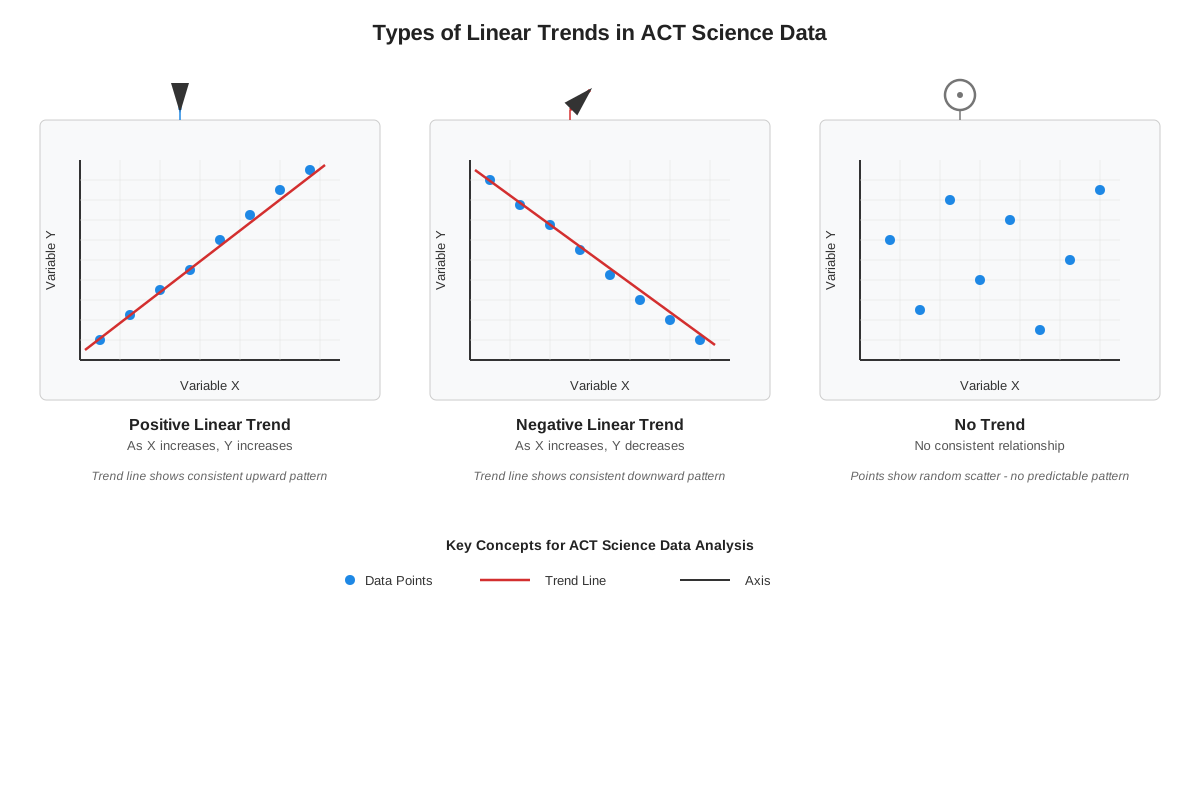
Linear trends fall into three primary categories that the ACT tests regularly:
| Trend Type | Description | Visual Pattern | Example |
|---|---|---|---|
| Positive Linear | As x increases, y increases at a constant rate | Upward-sloping line from left to right | Temperature rising steadily over time |
| Negative Linear | As x increases, y decreases at a constant rate | Downward-sloping line from left to right | Reactant concentration decreasing during a reaction |
| No Trend (Zero Slope) | As x changes, y remains constant | Horizontal line | Control group showing no change |
Positive linear trends indicate a direct relationship between variables. When the ACT presents a graph showing plant height increasing steadily with fertilizer amount, or velocity increasing uniformly with time under constant acceleration, students must recognize this as a positive linear relationship. The steeper the upward slope, the faster the rate of increase.
Negative linear trends indicate an inverse relationship where one variable decreases as the other increases. Common ACT examples include altitude decreasing with time during a descent, reactant concentration declining during a chemical reaction, or battery charge decreasing over usage time. The steeper the downward slope, the faster the rate of decrease.
Slope and Rate of Change
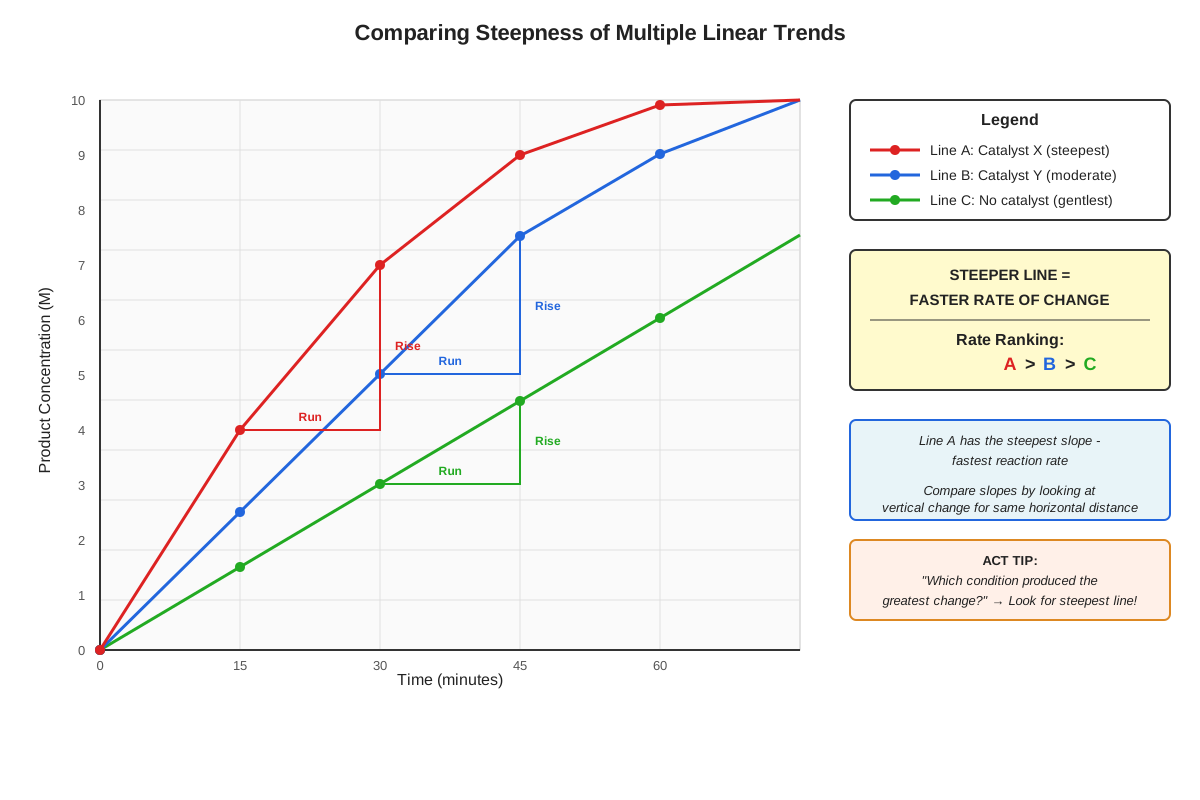
The slope of a linear trend represents the rate of change and is the most critical feature for ACT questions. While students don't need to calculate exact slope values, they must compare relative steepness between different trends. A steeper line indicates a faster rate of change, whether positive or negative.
When comparing multiple linear trends on the same graph, the ACT frequently asks which condition produced the "greatest increase" or "most rapid decrease." The answer always corresponds to the line with the steepest slope in the relevant direction. For example, if three lines show temperature increasing over time, the steepest upward-sloping line represents the fastest temperature increase.
Extrapolation and Interpolation
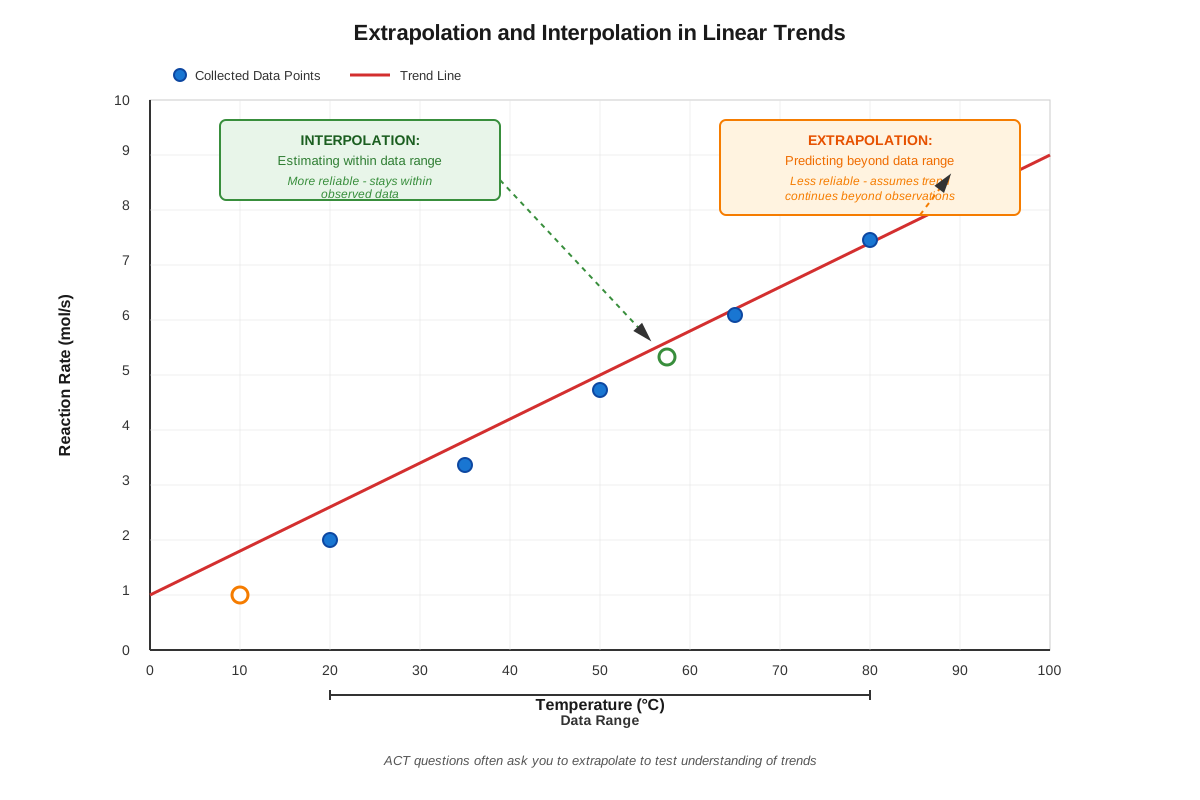
Extrapolation involves extending a linear trend beyond the measured data points to predict values outside the observed range. If a graph shows data from 0 to 100 seconds, an extrapolation question might ask what value would occur at 120 seconds. The key strategy is to identify the rate of change within the measured range and apply that same rate beyond it.
Interpolation involves estimating values between measured data points. If data points exist at x = 10 and x = 20, an interpolation question might ask for the value at x = 15. For linear trends, this value falls exactly halfway between the two known values, making interpolation more reliable than extrapolation.
The ACT tests both skills, but extrapolation questions require more caution because they assume the trend continues unchanged beyond the measured range—an assumption that may not hold in real experimental conditions. However, for ACT purposes, students should assume linear trends continue unless the question or passage explicitly states otherwise.
Identifying Linear Trends in Tables
Not all ACT linear trend questions present graphs; some provide data tables requiring students to recognize patterns numerically. To identify a linear trend in tabular data:
- Calculate the change in the dependent variable between consecutive data points
- Verify that this change remains constant (or nearly constant) throughout the table
- Determine whether the changes are positive (increasing) or negative (decreasing)
For example, if a table shows time values of 0, 5, 10, 15 seconds with corresponding distances of 0, 15, 30, 45 meters, the constant change of 15 meters per 5-second interval indicates a positive linear trend with a rate of 3 meters per second.
Scatter and Best-Fit Lines
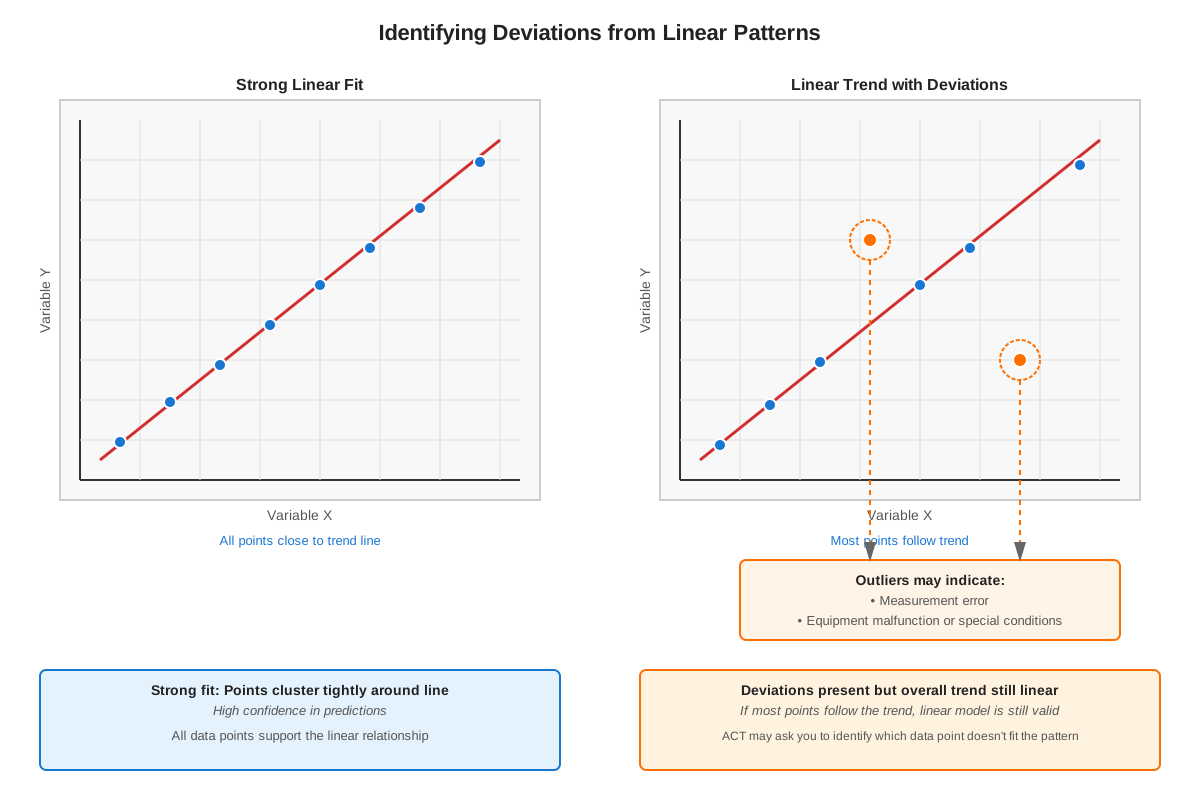
Real experimental data rarely produces perfectly aligned points. The ACT frequently presents graphs with scatter—data points that don't fall exactly on a straight line but cluster around one. Students must identify the overall linear trend despite this scatter, essentially visualizing the "best-fit line" through the data points.
When data shows scatter around a linear trend, the correct answer to relationship questions describes the general pattern, not the exceptions. If 8 out of 10 points suggest a positive linear trend with 2 outliers, the relationship is still best described as a positive linear trend.
Concept Relationships
Linear trends connect directly to fundamental concepts of correlation and relationship strength. A strong linear trend indicates a tight correlation between variables, while scattered data suggests a weaker correlation. This understanding leads to questions about causation versus correlation—though the ACT Science section typically focuses on describing relationships rather than determining causation.
The concept of rate of change in linear trends connects to prerequisite knowledge of ratios and proportions. Understanding that a linear trend maintains a constant ratio between changes in x and changes in y helps students quickly identify whether data follows a linear pattern. This relationship can be expressed as: Δy/Δx = constant for all intervals.
Linear trends serve as the foundation for understanding more complex relationships. Once students master linear patterns, they can better recognize non-linear trends (exponential, logarithmic, or polynomial) by identifying when the rate of change is not constant. This comparative understanding frequently appears in ACT passages presenting multiple data sets with different relationship types.
The connection between linear trends and experimental variables is crucial: the independent variable (manipulated by researchers) typically appears on the x-axis, while the dependent variable (measured outcome) appears on the y-axis. Understanding this relationship helps students correctly interpret which variable is affecting which, essential for answering questions about experimental design and conclusions.
Relationship map: Graph reading skills → Identify coordinate points → Calculate rate of change → Recognize constant rate → Confirm linear trend → Compare multiple trends → Extrapolate/interpolate values → Apply to experimental conclusions
Quick check — test yourself on Linear trends so far.
Try Flashcards →High-Yield Facts
⭐ A positive linear trend shows a constant upward slope from left to right, indicating that as the independent variable increases, the dependent variable increases at a steady rate
⭐ A negative linear trend shows a constant downward slope from left to right, indicating that as the independent variable increases, the dependent variable decreases at a steady rate
⭐ The steeper the slope of a line, the faster the rate of change between the two variables
⭐ When comparing multiple linear trends on the same graph, the line with the steepest slope in the relevant direction represents the greatest rate of change
⭐ Extrapolation extends a trend beyond measured data points, while interpolation estimates values between measured points
- Linear trends maintain a constant rate of change throughout the entire data range
- Data points with slight scatter can still represent a linear trend if they cluster around a straight line
- A horizontal line (zero slope) indicates no relationship between the variables—the dependent variable remains constant regardless of the independent variable
- When a table shows equal intervals in the independent variable, check if the dependent variable changes by equal amounts to identify linear trends
- The ACT assumes linear trends continue beyond the measured range unless explicitly stated otherwise in the passage
- Multiple linear trends can exist in a single graph, each representing different experimental conditions or trials
- The y-intercept (where the line crosses the y-axis) represents the starting value when the independent variable equals zero
Common Misconceptions
Misconception: All upward-sloping lines represent the same rate of increase → Correction: Lines with different slopes represent different rates of change; steeper lines indicate faster rates of increase, even if both are positive linear trends
Misconception: A few scattered data points mean there is no linear trend → Correction: Real experimental data often shows scatter around a linear trend; the overall pattern matters more than individual outliers when identifying the relationship
Misconception: Linear trends always pass through the origin (0,0) → Correction: Linear trends can have any y-intercept; only trends with a y-intercept of zero pass through the origin, and many real-world relationships have non-zero starting values
Misconception: Extrapolation and interpolation are equally reliable → Correction: Interpolation is generally more reliable because it estimates values within the measured range, while extrapolation assumes the trend continues unchanged beyond measured data, which may not always be true
Misconception: A linear trend means one variable causes the other to change → Correction: A linear trend shows correlation (a consistent relationship) but doesn't prove causation; other factors might influence both variables, or the relationship might be coincidental
Misconception: All straight lines on ACT graphs represent linear trends → Correction: Vertical lines (undefined slope) and lines connecting discrete categories don't represent linear trends; true linear trends show a relationship between two continuous numerical variables
Misconception: The steepest line always represents the "best" experimental result → Correction: Steepness indicates rate of change, not quality; depending on the experiment, a slower rate (less steep line) might be the desired outcome
Worked Examples
Example 1: Identifying and Comparing Linear Trends
Passage Context: A scientist conducted three trials measuring the temperature of water as it was heated over time. The graph shows temperature (°C) on the y-axis and time (minutes) on the x-axis. Trial 1 shows temperature increasing from 20°C to 60°C over 10 minutes. Trial 2 shows temperature increasing from 20°C to 80°C over 10 minutes. Trial 3 shows temperature increasing from 20°C to 40°C over 10 minutes.
Question: Which trial showed the greatest rate of temperature increase?
Solution Process:
Step 1: Identify that all three trials show positive linear trends (temperature increases over time in all cases)
Step 2: Calculate the rate of change for each trial:
- Trial 1: (60°C - 20°C) / 10 minutes = 40°C / 10 min = 4°C per minute
- Trial 2: (80°C - 20°C) / 10 minutes = 60°C / 10 min = 6°C per minute
- Trial 3: (40°C - 20°C) / 10 minutes = 20°C / 10 min = 2°C per minute
Step 3: Compare rates—Trial 2 has the highest rate at 6°C per minute
Step 4: Verify visually—Trial 2 would have the steepest upward slope on the graph
Answer: Trial 2 showed the greatest rate of temperature increase
Connection to Learning Objectives: This example demonstrates how to identify linear trends (all three trials), compare rates of change (calculating degrees per minute), and apply this understanding to ACT-style questions that ask about relative rates.
Example 2: Extrapolation from a Linear Trend
Passage Context: A table shows the distance traveled by a car at constant speed:
| Time (seconds) | Distance (meters) |
|---|---|
| 0 | 0 |
| 5 | 75 |
| 10 | 150 |
| 15 | 225 |
| 20 | 300 |
Question: Based on the trend in the table, what distance would the car have traveled after 25 seconds?
Solution Process:
Step 1: Verify the linear trend by checking if distance changes by equal amounts for equal time intervals:
- 0 to 5 sec: increase of 75 meters
- 5 to 10 sec: increase of 75 meters
- 10 to 15 sec: increase of 75 meters
- 15 to 20 sec: increase of 75 meters
Step 2: Confirm constant rate of change = 75 meters per 5 seconds = 15 meters per second
Step 3: Recognize this is an extrapolation question (25 seconds is beyond the measured range)
Step 4: Apply the constant rate beyond the last data point:
- At 20 seconds: 300 meters
- From 20 to 25 seconds: 5 additional seconds × 15 meters/second = 75 meters
- Total at 25 seconds: 300 + 75 = 375 meters
Answer: 375 meters
Connection to Learning Objectives: This example shows how to identify linear trends in tabular data, calculate the rate of change, and accurately extrapolate values beyond the measured range—a high-frequency ACT question type.
Exam Strategy
When approaching ACT Science questions involving linear trends, follow this systematic process:
Step 1: Identify the question type—Look for trigger words like "relationship," "trend," "pattern," "rate," "increase," "decrease," "greatest," "least," "steepest," or "most rapid." These signal linear trend questions.
Step 2: Locate the relevant data—Determine which graph, table, or figure contains the information needed. Check axis labels carefully to ensure you're analyzing the correct variables.
Step 3: Assess the overall pattern—Before getting caught up in individual data points, step back and observe the general direction and shape of the data. Is it going up, down, or staying flat? Is the pattern consistent?
Step 4: Eliminate obviously wrong answers—If the data clearly shows an upward trend, immediately eliminate any answer choices describing a decrease or no change. This process-of-elimination approach saves valuable time.
Exam Tip: When comparing multiple trends, don't calculate exact slopes unless absolutely necessary. Visual comparison of steepness is usually sufficient and much faster.
Trigger phrases to watch for:
- "As X increases, Y..." → describing the type of linear trend
- "Which trial showed the greatest/least..." → comparing rates of change
- "Based on the trend, what would..." → extrapolation question
- "Between X and Y, the value would be closest to..." → interpolation question
- "The relationship between X and Y is best described as..." → identifying trend type
Time allocation advice: Linear trend questions should take 30-45 seconds each. If you find yourself spending more than one minute, you're likely overcomplicating the analysis. Trust your visual assessment of the pattern and move forward.
Process-of-elimination specific tips:
- Eliminate answers that describe the opposite trend direction (positive vs. negative)
- Eliminate answers that suggest non-linear relationships when the data clearly shows constant rate of change
- Eliminate extreme values that fall far outside the reasonable extrapolation of the trend
- When comparing rates, eliminate the slowest and fastest options first if you can identify them visually, then decide between the remaining choices
Memory Techniques
Mnemonic for trend types: "PUN"
- Positive = Up (both variables increase together)
- Negative = dowN (one increases while the other decreases)
Visualization strategy: Picture yourself walking along the line from left to right. If you're walking uphill, it's a positive trend. If you're walking downhill, it's a negative trend. If you're walking on flat ground, there's no trend. The steeper the hill, the faster the rate of change.
Acronym for analysis steps: "RICE"
- Recognize the pattern (identify if it's linear)
- Identify the direction (positive, negative, or none)
- Compare the steepness (if multiple trends exist)
- Extend or estimate (extrapolate or interpolate as needed)
Memory aid for extrapolation vs. interpolation:
- Extrapolation = extra (going beyond the data)
- Interpolation = internal (staying within the data)
Slope steepness reminder: "Steep = Speed" → The steeper the slope, the faster the rate of change (speed of change)
Summary
Linear trends represent one of the highest-yield concepts in ACT Science, appearing in 15-20% of questions and serving as a foundation for data interpretation skills. A linear trend exists when two variables maintain a constant rate of change, producing a straight-line pattern on a graph or equal intervals of change in a table. The three primary types—positive linear (both variables increase together), negative linear (one increases as the other decreases), and no trend (one variable remains constant)—must be quickly identifiable. The steepness of a line's slope indicates the rate of change, with steeper slopes representing faster rates. Students must master both extrapolation (extending trends beyond measured data) and interpolation (estimating values between data points), while recognizing that real experimental data often shows scatter around the linear trend. Success on ACT linear trend questions requires systematic analysis: identify the question type, locate relevant data, assess the overall pattern, and use process of elimination to arrive at the correct answer efficiently within the exam's strict time constraints.
Key Takeaways
- Linear trends show constant rate of change between two variables, appearing as straight lines on graphs or equal intervals in tables
- Positive trends slope upward (both variables increase), negative trends slope downward (one increases as the other decreases), and zero-slope trends remain horizontal (no relationship)
- Steeper slopes always indicate faster rates of change, making visual comparison of line steepness the quickest analysis method
- Extrapolation extends trends beyond measured data while interpolation estimates values within the measured range
- Real data shows scatter around linear trends; identify the overall pattern rather than focusing on individual outlier points
- ACT linear trend questions typically take 30-45 seconds and respond well to process-of-elimination strategies
- Mastering linear trends enables success on approximately 3-5 questions per ACT Science test, making it one of the highest-yield topics to study
Related Topics
Exponential Trends: After mastering linear trends, students should explore exponential relationships where the rate of change itself changes, creating curved patterns rather than straight lines. This progression helps distinguish between different relationship types on the ACT.
Correlation vs. Causation: Understanding linear trends provides the foundation for analyzing whether observed relationships indicate causation or merely correlation, a critical thinking skill tested in Research Summaries passages.
Statistical Variability: Building on the concept of scatter around linear trends, students can explore standard deviation, error bars, and confidence intervals that appear in more complex ACT Science passages.
Multi-Variable Analysis: Linear trends between two variables prepare students for passages presenting three or more variables, requiring analysis of how multiple factors interact to influence outcomes.
Practice CTA
Now that you've mastered the core concepts of linear trends, it's time to solidify your understanding through active practice. Complete the practice questions associated with this topic to test your ability to identify trends quickly, compare rates of change accurately, and extrapolate values confidently. Use the flashcards to reinforce high-yield facts and ensure you can recall key concepts under time pressure. Remember, linear trends appear on every ACT Science test—investing 20 minutes to master this topic will directly translate to points on test day. Your ability to recognize and analyze linear patterns in under 45 seconds per question will set you apart and boost your Science score significantly.
Sign up free to keep reading
Create a free AnvayaPrep account to finish this ACT guide on Linear trends — plus flashcards and practice questions.