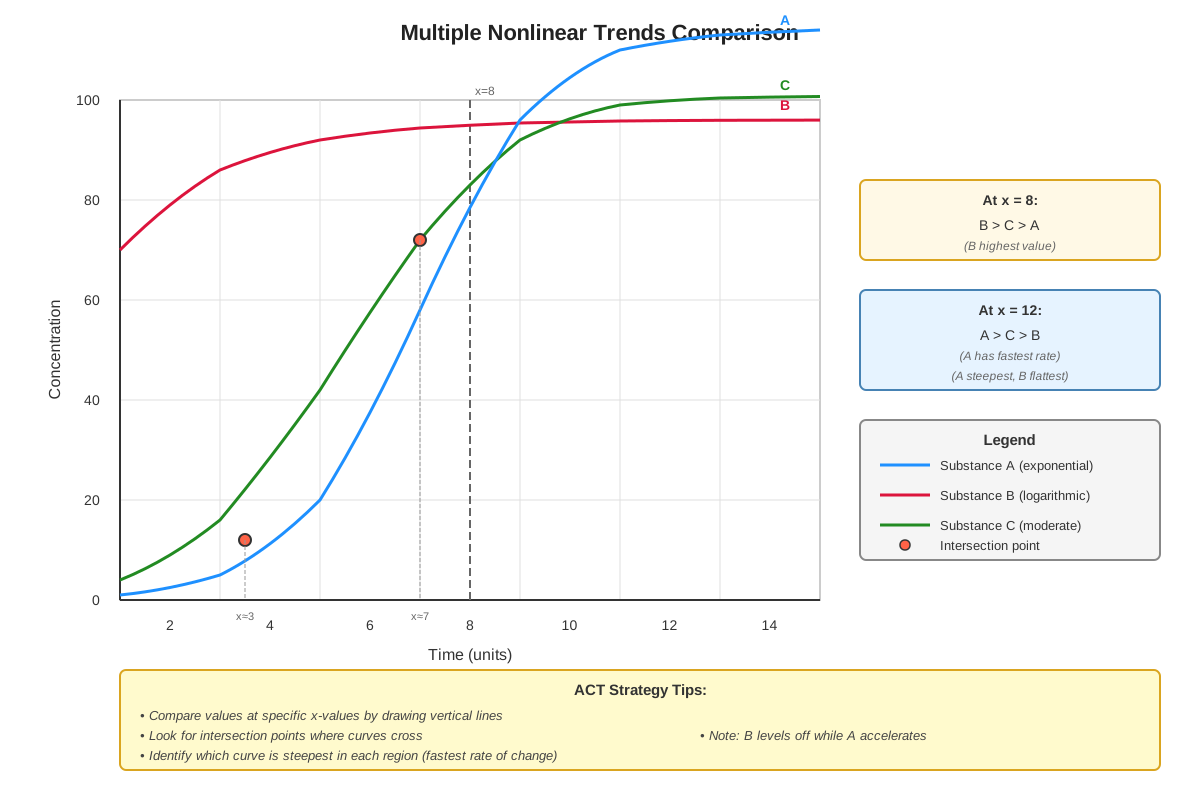
Overview
Nonlinear trends represent one of the most frequently tested concepts in the ACT Science section, particularly within Data Representation passages. Unlike linear relationships where variables change at a constant rate, nonlinear trends describe patterns where the rate of change itself varies. These relationships appear as curves rather than straight lines on graphs, and they're essential for interpreting experimental data across biology, chemistry, physics, and Earth science contexts. Students who master nonlinear trend identification and analysis gain a significant advantage, as approximately 20-30% of ACT Science questions involve interpreting curved relationships, exponential growth or decay, logarithmic patterns, or other non-straight-line data.
Understanding ACT nonlinear trends goes beyond simply recognizing that a line curves. The ACT expects students to extract quantitative and qualitative information from these patterns: identifying maximum and minimum points, determining where rates of change increase or decrease, comparing multiple nonlinear relationships on the same graph, and predicting values beyond the data range. These skills integrate mathematical reasoning with scientific interpretation, making this topic a bridge between the Science and Math sections of the exam.
The ability to analyze nonlinear trends connects directly to broader scientific literacy. Most natural phenomena follow nonlinear patterns—population growth, chemical reaction rates, radioactive decay, and planetary motion all exhibit curved relationships. By mastering this topic, students develop the analytical framework needed for more complex data interpretation tasks, including understanding how multiple variables interact and recognizing when simple proportional reasoning fails. This foundational skill supports success not only on the ACT but also in college-level science courses where nonlinear modeling becomes increasingly important.
Learning Objectives
- [ ] Identify when Nonlinear trends is being tested in ACT Science passages
- [ ] Explain the core rule or strategy behind Nonlinear trends interpretation
- [ ] Apply Nonlinear trends analysis to ACT-style questions accurately
- [ ] Distinguish between different types of nonlinear relationships (exponential, logarithmic, polynomial, inverse)
- [ ] Determine rates of change at different points along a nonlinear curve
- [ ] Predict trends beyond the given data range using nonlinear pattern recognition
- [ ] Compare and contrast multiple nonlinear trends presented simultaneously
Prerequisites
- Basic graph reading skills: Understanding axes, scales, units, and how to locate points on coordinate planes is essential for identifying any trend pattern
- Linear relationship recognition: Distinguishing nonlinear from linear trends requires knowing what constant-rate relationships look like
- Rate of change concept: Recognizing how quickly one variable changes relative to another forms the foundation for understanding why curves differ from straight lines
- Scientific notation and scale interpretation: Many nonlinear trends span multiple orders of magnitude, requiring comfort with exponential notation
Why This Topic Matters
Nonlinear trends appear in virtually every ACT Science test, making this one of the highest-yield topics for focused study. Research passages frequently present experimental results as curved graphs, and students must interpret these patterns to answer 3-5 questions per passage. The Data Representation passage type, which comprises approximately one-third of the Science section, almost always includes at least one nonlinear relationship. Questions testing this concept range from straightforward pattern identification to complex multi-step reasoning about how changes in one variable affect another through a curved relationship.
In real-world scientific contexts, nonlinear trends dominate natural phenomena. Enzyme kinetics follow saturation curves where reaction rates increase rapidly at low substrate concentrations but plateau at high concentrations. Population ecology models use logistic growth curves that accelerate initially but level off as resources become limited. Climate science examines exponential increases in atmospheric carbon dioxide and their nonlinear effects on global temperature. Pharmacology relies on dose-response curves that are rarely linear. Understanding these patterns enables scientists to make predictions, optimize conditions, and identify critical thresholds where system behavior changes dramatically.
On the ACT specifically, nonlinear trend questions typically ask students to: identify the general shape of a relationship (increasing, decreasing, leveling off), determine which variable changes more rapidly at specific points, extrapolate beyond the data range, compare rates of change between different curves, or explain why a relationship is nonlinear based on the underlying science. These questions reward careful graph analysis and pattern recognition rather than memorization, making them accessible to well-prepared students regardless of their specific science content knowledge.
Core Concepts
Defining Nonlinear Relationships
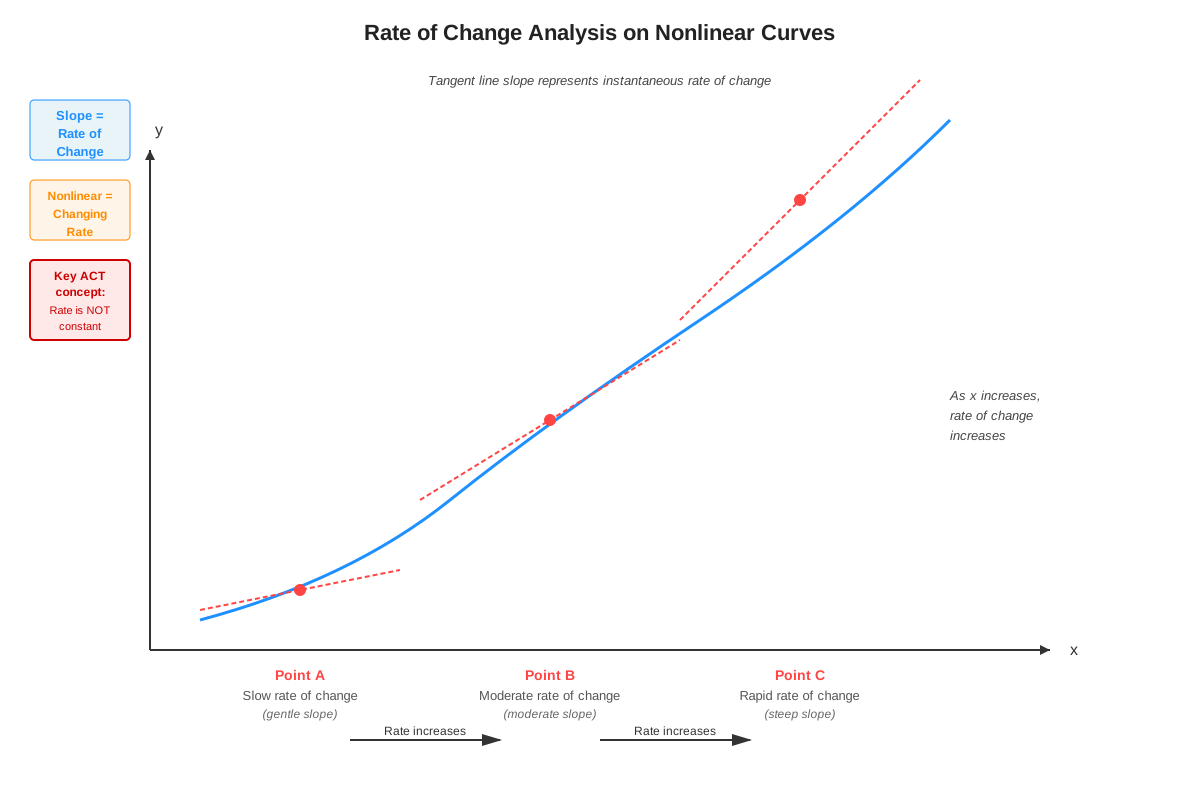
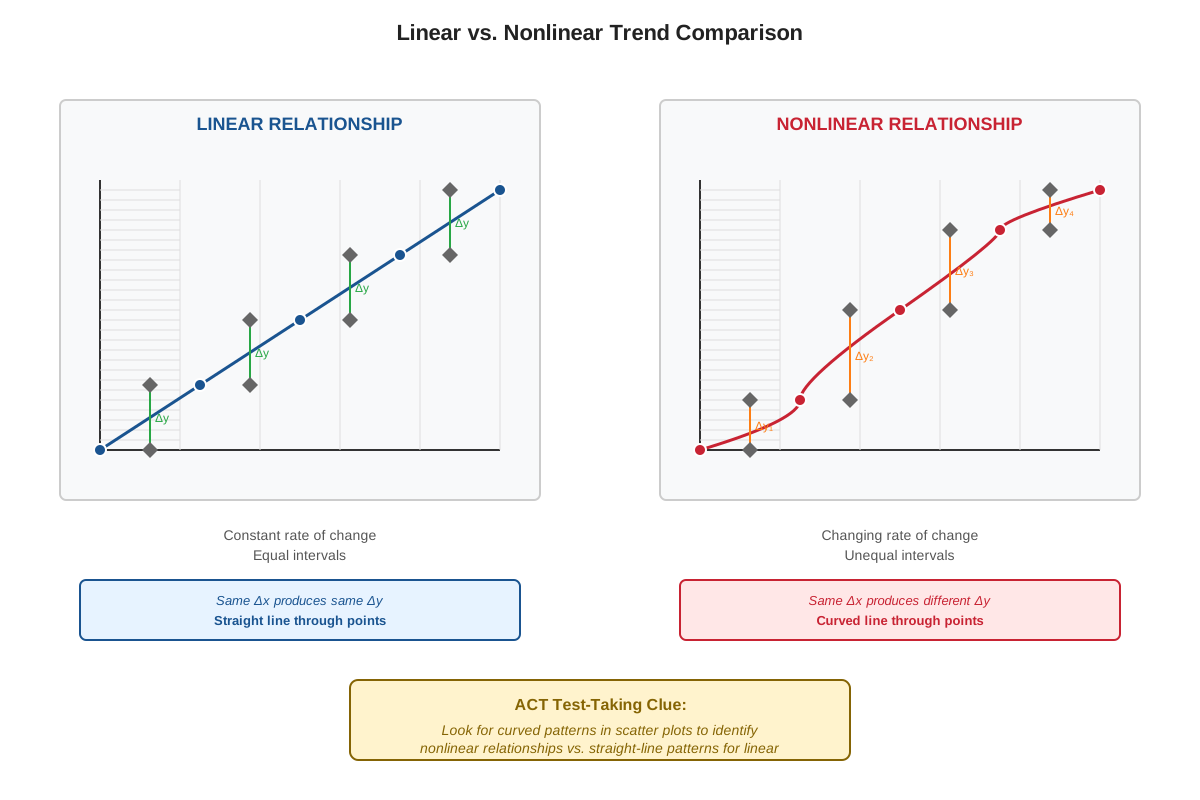
A nonlinear trend exists when the relationship between two variables cannot be represented by a straight line. Mathematically, this means the rate of change between variables is not constant—as one variable increases by a fixed amount, the other variable changes by varying amounts. On a graph, nonlinear relationships appear as curves, and the slope of the tangent line at any point differs from the slope at other points along the curve.
The ACT Science section presents nonlinear trends in multiple forms: upward curves that accelerate (concave up), upward curves that decelerate (concave down), downward curves, S-shaped curves, and U-shaped curves. Each shape conveys different information about how variables interact. For example, an upward accelerating curve suggests that as the independent variable increases, its effect on the dependent variable becomes progressively stronger. Conversely, an upward decelerating curve indicates diminishing returns—each additional unit of the independent variable produces a smaller increase in the dependent variable.
Types of Nonlinear Trends
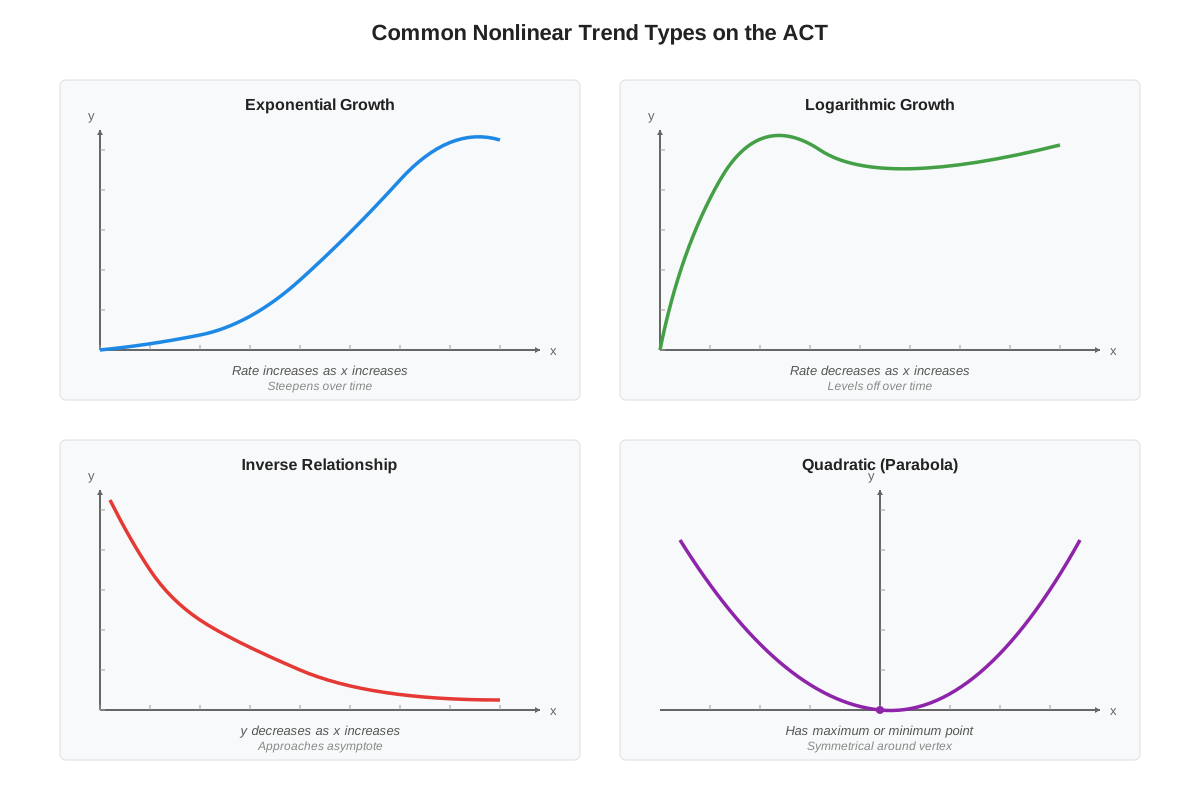
Exponential growth represents one of the most common nonlinear patterns on the ACT. In exponential relationships, the dependent variable increases by a constant percentage (rather than a constant amount) for each unit increase in the independent variable. This creates a J-shaped curve that starts slowly but accelerates dramatically. Examples include bacterial population growth under ideal conditions, compound interest, and chain reactions. The key characteristic is that the rate of increase itself increases over time.
Exponential decay follows the opposite pattern—the dependent variable decreases by a constant percentage for each unit increase in the independent variable. This produces a curve that drops rapidly at first but gradually levels off, approaching (but never reaching) zero. Radioactive decay, drug elimination from the bloodstream, and cooling of hot objects all follow exponential decay patterns. The ACT often tests whether students recognize that the rate of decrease slows over time.
Logarithmic relationships appear as curves that rise or fall rapidly at first but then level off, approaching a horizontal asymptote. These relationships are the inverse of exponential functions. The pH scale, decibel measurements of sound intensity, and the Richter scale for earthquake magnitude all use logarithmic scales. On ACT graphs, logarithmic patterns show that large changes in the independent variable produce progressively smaller changes in the dependent variable.
Polynomial relationships include quadratic (U-shaped or inverted U-shaped), cubic, and higher-order curves. Quadratic relationships are particularly common, appearing in projectile motion (height versus time), area calculations, and optimization problems. These curves have turning points—maxima or minima—where the trend reverses direction. The ACT frequently asks students to identify these critical points and interpret their meaning in context.
Inverse (hyperbolic) relationships follow the pattern where one variable increases as the other decreases, but not linearly. The classic example is Boyle's Law in chemistry: pressure and volume of a gas are inversely related, producing a hyperbolic curve. As one variable approaches zero, the other approaches infinity. These curves never touch either axis and show that the rate of change is greatest when values are small.
Analyzing Rate of Change in Nonlinear Trends
Understanding how rate of change varies along a nonlinear curve is crucial for ACT success. The instantaneous rate of change at any point equals the slope of the tangent line at that point. For curves that are concave up (bending upward), the rate of change increases as you move from left to right—the curve gets steeper. For curves that are concave down (bending downward), the rate of change decreases—the curve gets flatter.
The ACT often presents questions comparing rates of change at different points: "Between which two points does temperature increase most rapidly?" or "At which concentration does the reaction rate begin to level off?" Answering these requires visual assessment of where the curve is steepest (greatest rate of change) or flattest (smallest rate of change). The steepest section of an increasing curve represents the maximum rate of increase, while the flattest section represents the minimum rate of increase.
Identifying Asymptotic Behavior
Many nonlinear trends approach but never reach certain values, creating asymptotes—invisible boundary lines that the curve approaches infinitely closely. Horizontal asymptotes indicate that a variable levels off at a maximum or minimum value. For example, enzyme-catalyzed reactions approach a maximum velocity (Vmax) as substrate concentration increases—the curve rises rapidly at first but flattens as it approaches this horizontal asymptote.
Vertical asymptotes occur when a variable approaches infinity as another variable approaches a specific value. These are less common on the ACT but appear in inverse relationships. Recognizing asymptotic behavior helps students predict long-term trends and understand limiting factors in scientific systems.
Inflection Points and Sigmoidal Curves
Inflection points mark where a curve changes from concave up to concave down (or vice versa). S-shaped or sigmoidal curves contain inflection points and are particularly important in biology. Logistic population growth follows a sigmoidal pattern: slow initial growth (concave up), rapid exponential-like growth through the inflection point, then slowing growth (concave down) as the population approaches carrying capacity. The ACT may ask students to identify the inflection point or explain what it represents in context.
Concept Relationships
Nonlinear trends build directly on fundamental graph interpretation skills. Students must first master reading axes, identifying scales, and plotting points before they can recognize curved patterns. The distinction between linear and nonlinear relationships forms the foundation—understanding constant versus variable rates of change.
Within the topic itself, concepts connect hierarchically: recognizing that a trend is nonlinear → identifying the specific type of nonlinear relationship → analyzing rate of change variations → predicting behavior beyond the data range → comparing multiple nonlinear trends. Each skill builds on the previous one.
The relationship map flows as follows: Basic graph literacy → Linear vs. nonlinear distinction → Nonlinear trend identification → Specific pattern recognition (exponential, logarithmic, etc.) → Rate of change analysis → Asymptotic behavior understanding → Extrapolation and prediction → Multi-curve comparison. This progression mirrors how ACT questions increase in complexity within a single passage.
Nonlinear trends also connect to broader scientific reasoning. Understanding exponential growth relates to population dynamics in ecology, bacterial growth in microbiology, and chain reactions in chemistry. Recognizing saturation curves connects to enzyme kinetics, gas solubility, and receptor binding. These cross-disciplinary connections mean that mastering nonlinear trend analysis improves performance across all ACT Science passage types, not just Data Representation.
Quick check — test yourself on Nonlinear trends so far.
Try Flashcards →High-Yield Facts
- ⭐ Nonlinear trends appear in approximately 25-35% of ACT Science questions, making them one of the most frequently tested concepts
- ⭐ Exponential growth curves accelerate upward (rate of increase increases), while logarithmic curves decelerate upward (rate of increase decreases)
- ⭐ The steepest part of a curve indicates the greatest rate of change between variables at that point
- ⭐ Curves that level off approach an asymptote, representing a maximum or minimum value that cannot be exceeded
- ⭐ Inverse relationships produce hyperbolic curves where one variable increases as the other decreases, but not at a constant rate
- Exponential decay curves drop rapidly initially but never reach zero, approaching the x-axis asymptotically
- Sigmoidal (S-shaped) curves contain an inflection point where the rate of change is maximum
- Concave up curves (shaped like ∪) have increasing rates of change; concave down curves (shaped like ∩) have decreasing rates of change
- Quadratic relationships produce parabolas with a single maximum or minimum point
- Multiple nonlinear trends on the same graph can be compared by examining their relative steepness at specific points
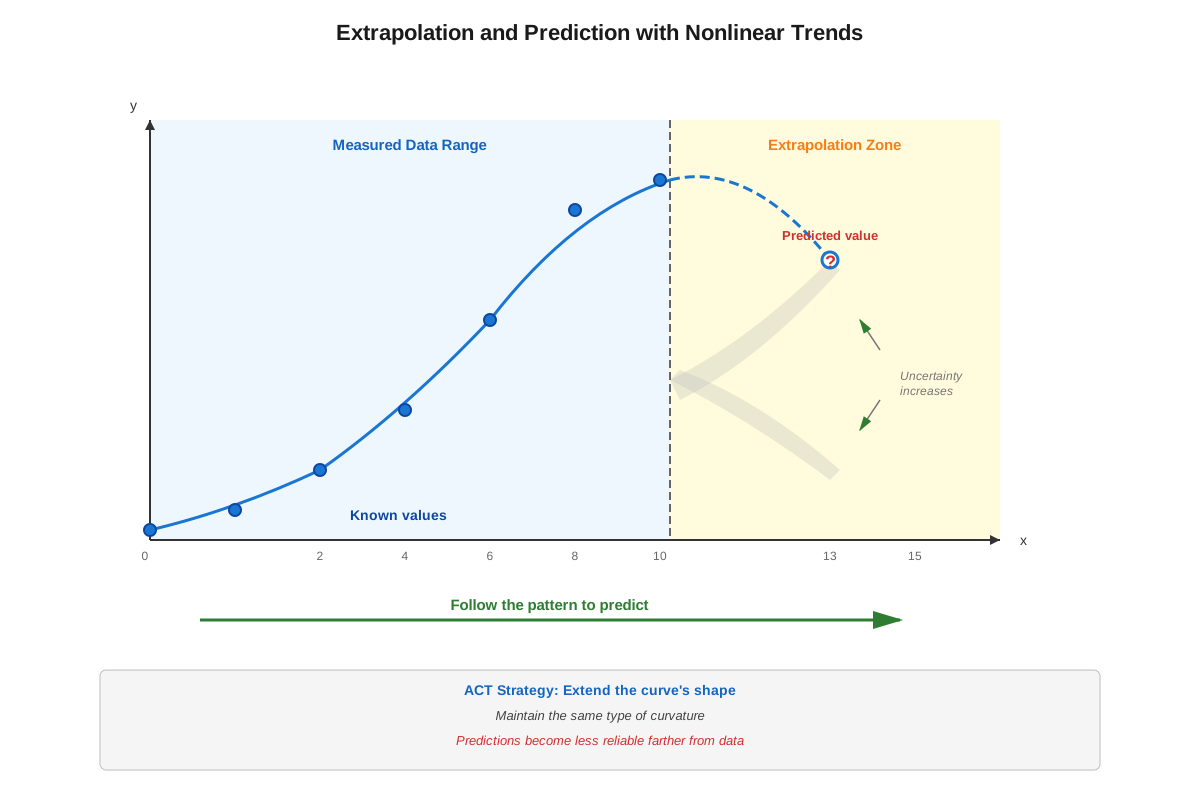
- Extrapolating beyond the data range requires understanding the curve's overall pattern, not just connecting the last two points
- Temperature effects on biological and chemical processes often follow nonlinear patterns due to enzyme denaturation or reaction kinetics
Common Misconceptions
Misconception: All upward-sloping curves represent the same type of relationship.
Correction: Upward curves vary significantly—exponential curves accelerate, logarithmic curves decelerate, and linear relationships (not curves) maintain constant slopes. The shape of the curve reveals how the rate of change varies, which is critical for prediction and interpretation.
Misconception: If a curve levels off, the dependent variable has stopped changing entirely.
Correction: A leveling curve indicates the rate of change is decreasing and approaching zero, but change continues (albeit very slowly). The curve approaches an asymptote but typically hasn't reached it within the data range shown.
Misconception: Steeper curves always mean stronger relationships between variables.
Correction: Steepness indicates rate of change at a specific point, not relationship strength. A curve can be steep in one region and flat in another. Additionally, axis scaling affects apparent steepness—always check the scale before comparing curves.
Misconception: Nonlinear trends can be analyzed by calculating slope between any two points.
Correction: While you can calculate average rate of change between two points, this doesn't capture the varying instantaneous rate of change that defines nonlinear relationships. The slope between two points on a curve represents only the average change over that interval, not the behavior at any specific point.
Misconception: Exponential and logarithmic curves look similar and can be confused.
Correction: Exponential curves accelerate (get steeper), while logarithmic curves decelerate (get flatter). Exponential growth starts slowly and explodes upward; logarithmic growth starts rapidly and levels off. They are mathematical inverses with opposite behaviors.
Misconception: All curved relationships are exponential.
Correction: Many different mathematical functions produce curves—polynomial, logarithmic, inverse, trigonometric, and more. The ACT tests multiple types, and identifying the specific pattern matters for accurate prediction and interpretation.
Worked Examples
Example 1: Enzyme Kinetics
Passage Context: A graph shows reaction velocity (y-axis, measured in μmol/min) versus substrate concentration (x-axis, measured in mM) for an enzyme-catalyzed reaction. The curve rises steeply from 0 to 2 mM, then gradually levels off, approaching but not quite reaching 100 μmol/min at the highest concentrations shown (10 mM).
Question: At which substrate concentration range does the reaction velocity increase most rapidly?
Solution Process:
- Identify the trend type: This is a classic saturation curve (logarithmic/hyperbolic pattern) showing enzyme kinetics approaching Vmax
- Locate the steepest section: The curve is steepest (most vertical) in the low concentration range, specifically between 0-2 mM
- Understand the mechanism: At low substrate concentrations, most enzyme active sites are empty, so adding more substrate dramatically increases reaction velocity. At high concentrations, active sites are nearly saturated, so additional substrate has minimal effect
- Answer: The reaction velocity increases most rapidly between 0-2 mM substrate concentration
Connection to Learning Objectives: This example demonstrates identifying nonlinear trends (the saturation curve), explaining the core strategy (finding the steepest section for maximum rate of change), and applying this to an ACT-style question about enzyme behavior.
Example 2: Population Growth
Passage Context: A graph displays bacterial population size (y-axis, log scale from 10² to 10⁸ cells/mL) versus time (x-axis, 0-24 hours). The curve shows three distinct phases: slow growth from 0-4 hours, rapid exponential growth from 4-16 hours, and leveling off from 16-24 hours, creating an S-shaped (sigmoidal) curve.
Question 1: During which time period does the population growth rate increase most rapidly?
Solution Process:
- Recognize the curve type: This is a logistic growth curve with three phases—lag, exponential, and stationary
- Identify the inflection point: The curve transitions from concave up to concave down around 10-12 hours, marking the inflection point
- Understand rate of change: The growth rate itself increases during the concave up portion (4-12 hours) and decreases during the concave down portion (12-20 hours)
- Answer: The population growth rate increases most rapidly during the early exponential phase, approximately 4-12 hours
Question 2: If the pattern continues, what would the population size most likely be at 30 hours?
Solution Process:
- Analyze the asymptotic behavior: The curve is leveling off at approximately 10⁸ cells/mL, approaching a horizontal asymptote
- Understand the biological context: The stationary phase occurs when resources become limited or waste products accumulate, preventing further growth
- Extrapolate the pattern: Since the curve has already flattened by 24 hours, it will remain near the asymptote
- Answer: The population would remain at approximately 10⁸ cells/mL, as the curve has reached its carrying capacity
Connection to Learning Objectives: This example shows identifying when nonlinear trends are tested (sigmoidal growth curve), distinguishing between different types of nonlinear relationships (logistic versus exponential), determining rates of change at different points (inflection point analysis), and predicting trends beyond the data range (asymptotic behavior).
Exam Strategy
When approaching ACT Science questions involving nonlinear trends, follow this systematic process:
Step 1: Quickly scan the graph to determine if the relationship is linear or nonlinear. Look for curves, bends, or changes in steepness. If the data points don't fall along a straight line, you're dealing with a nonlinear trend.
Step 2: Identify the general pattern. Ask yourself: Does the curve go up or down? Does it accelerate (get steeper) or decelerate (get flatter)? Does it level off? Does it have turning points? This quick classification helps you predict what questions might ask.
Step 3: Watch for trigger words in questions:
- "Most rapidly" or "greatest rate" → find the steepest part of the curve
- "Levels off" or "approaches" → identify asymptotic behavior
- "Initially" versus "at higher values" → compare rates of change at different points
- "If the trend continues" → extrapolate based on the curve's overall pattern
- "Maximum" or "minimum" → locate turning points on the curve
Step 4: Use process of elimination effectively. For questions about rate of change, eliminate answers that contradict the curve's shape. If the curve is getting flatter, eliminate answers suggesting increasing rates. If the curve is accelerating upward, eliminate answers suggesting constant or decreasing rates.
Step 5: Don't over-rely on the first and last data points. The ACT often includes answer choices based on simple linear extrapolation between the first and last points, which fails for nonlinear trends. Always consider the curve's overall shape and pattern.
Time allocation: Data Representation passages with nonlinear trends typically require 4-5 minutes total. Spend 30-45 seconds initially examining the graph to understand the trend pattern, then 45-60 seconds per question. If a question asks about rate of change at multiple points, invest the time to carefully examine each region—these questions reward precision.
Exam Tip: If you're unsure whether a trend is truly nonlinear or just has measurement error, look for consistent curvature across multiple data points. Random scatter around a line suggests linear with error; systematic bending in one direction indicates genuine nonlinearity.
Memory Techniques
EXPONENTIAL mnemonic: Explodes Xponentially, Progressively Outpacing Normal Expectations, Never Truly Infinite Although Large. This reminds you that exponential curves accelerate dramatically but eventually face real-world limits.
LOGARITHMIC visualization: Picture climbing a mountain—you make rapid progress at first (steep slope) but as you near the summit, each step gains less elevation (flattening curve). This mirrors how logarithmic curves rise quickly initially but level off.
Concavity memory trick:
- Concave UP = shaped like a Up-facing cup (∪) = rate of change Up
- Concave DOWN = shaped like a Down-facing dome (∩) = rate of change Down
STEEP acronym for rate of change: Steepest Tangent Equals Extreme Pace. The steepest part of any curve represents the maximum rate of change.
Asymptote visualization: Think "Asymptote = Approaches but Always Avoids." The curve gets infinitely close but never actually touches the asymptote line.
Sigmoidal curve memory: Think of the letter S for Sigmoidal, Slow-fast-slow pattern, and Saturation behavior. This three-phase pattern appears frequently in biological systems.
Summary
Nonlinear trends represent curved relationships between variables where the rate of change varies along the curve, distinguishing them from linear relationships with constant rates. The ACT Science section heavily emphasizes these patterns, appearing in approximately one-quarter to one-third of all questions, particularly within Data Representation passages. Success requires recognizing different curve types—exponential growth and decay, logarithmic patterns, polynomial relationships, inverse functions, and sigmoidal curves—and understanding what each reveals about how variables interact. Critical skills include identifying where rates of change are greatest (steepest sections), recognizing asymptotic behavior where curves level off, locating inflection points on S-shaped curves, and extrapolating beyond the data range based on overall patterns rather than simple point-to-point connections. Questions typically ask students to compare rates at different points, predict future values, identify maximum or minimum points, or explain why relationships are nonlinear based on scientific context. Mastering nonlinear trend analysis provides a significant competitive advantage on the ACT Science section and builds essential scientific reasoning skills applicable across all STEM disciplines.
Key Takeaways
- Nonlinear trends are curves where the rate of change between variables varies, appearing in 25-35% of ACT Science questions
- The steepest part of any curve indicates the greatest rate of change; the flattest part indicates the smallest rate of change
- Exponential curves accelerate (get steeper), logarithmic curves decelerate (get flatter), and both are common on the ACT
- Curves that level off approach asymptotes—maximum or minimum values that limit the relationship
- Sigmoidal (S-shaped) curves represent three-phase patterns common in biological systems: slow initial change, rapid middle change, and leveling off
- Always examine the entire curve pattern when extrapolating beyond the data range; don't just connect the last two points
- Trigger words like "most rapidly," "levels off," and "approaches" signal questions about rate of change and asymptotic behavior
Related Topics
Linear Trends and Proportional Relationships: Understanding constant-rate relationships provides the foundation for recognizing when trends deviate from linearity. Mastering linear analysis makes nonlinear patterns stand out more clearly.
Logarithmic Scales: Many ACT graphs use logarithmic scales on one or both axes, which can make exponential relationships appear linear. Learning to interpret log scales enhances nonlinear trend analysis.
Multi-Variable Analysis: Advanced Data Representation passages present multiple nonlinear trends simultaneously, requiring comparison of different curves. This builds on single-curve analysis skills.
Conflicting Viewpoints Passages: Scientists often disagree about whether relationships are linear or nonlinear, or which nonlinear model best fits data. Understanding nonlinear trends helps evaluate these arguments.
Research Summaries with Graphical Data: Experimental passages frequently present results as nonlinear curves, requiring integration of trend analysis with experimental design understanding.
Practice CTA
Now that you've mastered the concepts behind nonlinear trends, it's time to put your knowledge into action! Work through the practice questions to test your ability to identify curve types, analyze rates of change, and predict trends beyond the data range. Use the flashcards to reinforce key patterns and trigger words that signal nonlinear trend questions. Remember, recognizing these patterns quickly and accurately can earn you valuable points on test day—this is one of the highest-yield topics in the entire ACT Science section. You've built a strong foundation; now practice applying it to achieve your target score!
Sign up free to keep reading
Create a free AnvayaPrep account to finish this ACT guide on Nonlinear trends — plus flashcards and practice questions.