Overview
Sample size is a fundamental concept in experimental design and data interpretation that appears frequently on the ACT Science test. Understanding sample size means recognizing how the number of subjects, trials, or observations in a study affects the reliability, validity, and generalizability of experimental results. On the ACT, questions about sample size typically appear in Research Summaries passages, where students must evaluate the quality of experimental design or interpret the strength of conclusions based on the data collected.
The concept of ACT sample size questions requires students to think critically about experimental methodology rather than simply reading data from tables and graphs. These questions test whether students understand that larger sample sizes generally produce more reliable results, reduce the impact of random variation, and allow researchers to draw stronger conclusions. Conversely, small sample sizes may lead to unreliable data, outliers having disproportionate effects, and limited ability to generalize findings to broader populations.
Sample size connects directly to other critical Science concepts tested on the ACT, including experimental design, data reliability, statistical significance, and the validity of scientific conclusions. Mastering this topic enables students to evaluate whether experimental procedures are sound, whether conclusions are justified by the data presented, and whether additional trials or subjects would strengthen a study. This analytical skill is essential not only for Research Summaries passages but also for Conflicting Viewpoints passages where scientists may disagree about the adequacy of evidence supporting different hypotheses.
Learning Objectives
- [ ] Identify when Sample size is being tested in ACT Science passages
- [ ] Explain the core rule or strategy behind Sample size and its impact on experimental reliability
- [ ] Apply Sample size concepts to ACT-style questions accurately
- [ ] Evaluate whether a given sample size is adequate for drawing valid conclusions
- [ ] Predict how changing sample size would affect experimental results and reliability
- [ ] Compare the relative strength of conclusions from studies with different sample sizes
- [ ] Recognize the relationship between sample size and the presence of outliers or anomalous data
Prerequisites
- Basic understanding of experimental design: Students must know the difference between independent variables, dependent variables, and controlled variables to understand how sample size fits into overall experimental methodology.
- Familiarity with data tables and graphs: Sample size questions often require interpreting numerical data or visual representations, so comfort with reading scientific data presentations is essential.
- Concept of variability in data: Understanding that repeated measurements or observations naturally vary helps explain why larger samples provide more reliable results.
- Scientific method fundamentals: Knowledge of hypothesis testing, data collection, and drawing conclusions provides the framework for understanding why sample size matters.
Why This Topic Matters
Sample size is one of the most practical and universally applicable concepts in scientific research. In real-world applications, researchers must balance the desire for large, comprehensive studies against constraints of time, money, and resources. Medical trials, environmental studies, quality control in manufacturing, and social science research all depend on selecting appropriate sample sizes. A pharmaceutical company testing a new drug, for example, cannot draw valid conclusions about safety and efficacy from testing only five patients, but testing millions would be impractical and unnecessary.
On the ACT Science test, sample size questions appear with high frequency—typically in 1-3 questions per test, most commonly in Research Summaries passages. These questions may ask students to identify weaknesses in experimental design, explain why results might be unreliable, suggest improvements to strengthen a study, or compare the validity of conclusions from different experiments. The ACT specifically tests whether students can recognize that sample size directly affects the confidence researchers can have in their findings.
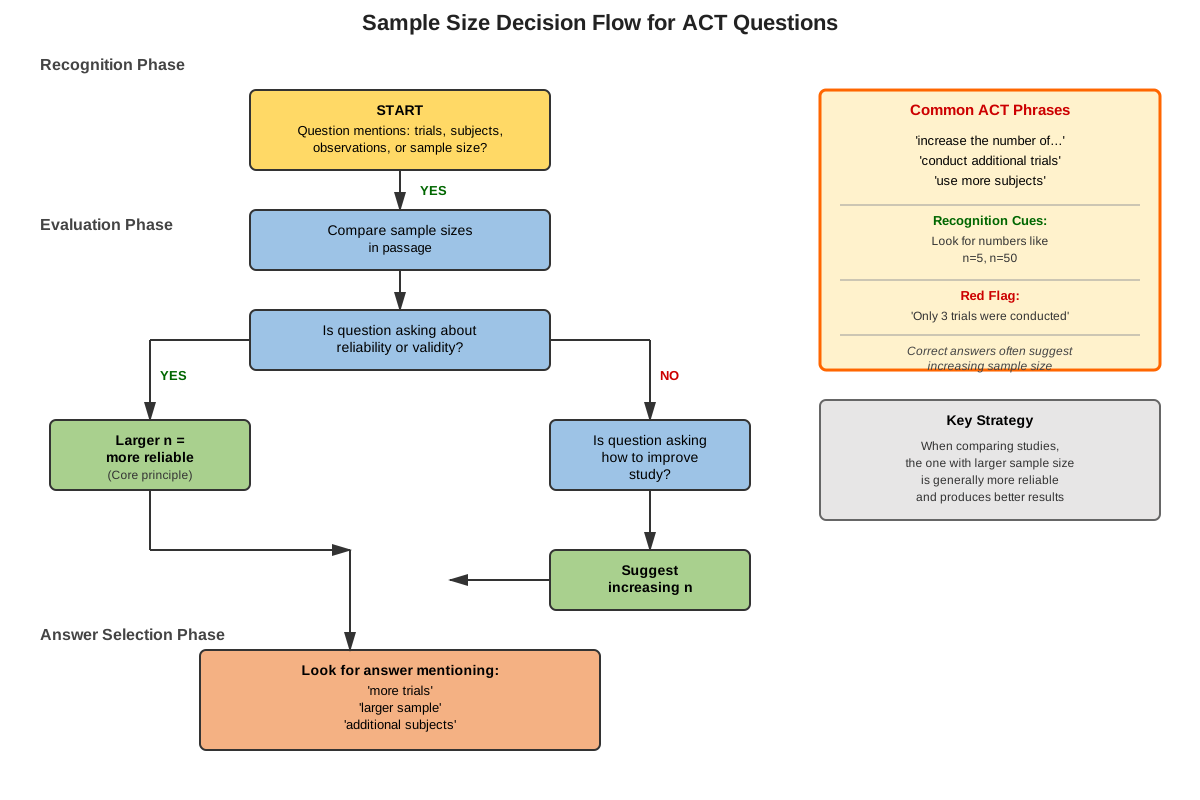
Common question formats include: "Which of the following would most improve the reliability of the experiment?" (answer: increasing sample size), "The scientists' conclusion would be strengthened by..." (answer: conducting more trials), "A weakness of the study is..." (answer: small number of subjects), or "Based on the data, which conclusion is most justified?" (requiring evaluation of whether the sample size supports broad generalizations). Understanding sample size is also crucial for questions asking about outliers, unexpected results, or the need for additional data collection.
Core Concepts
Definition and Importance of Sample Size
Sample size refers to the number of individual subjects, specimens, trials, or observations included in a scientific study or experiment. In biological studies, this might be the number of organisms tested; in chemistry experiments, the number of trials conducted; in physics investigations, the number of measurements taken; and in environmental studies, the number of locations sampled or time points recorded.
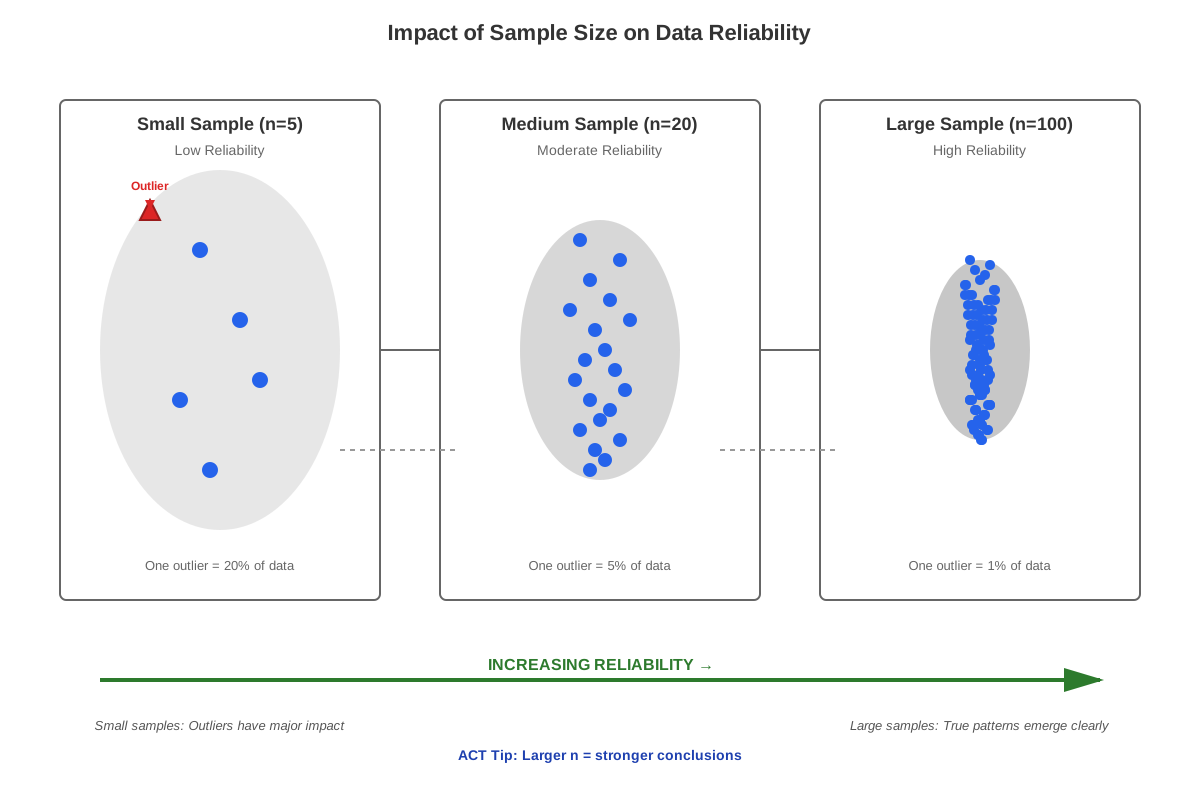
The fundamental principle governing sample size is that larger samples provide more reliable and representative data. When researchers collect data from many subjects or conduct many trials, random variations tend to average out, revealing true patterns and relationships. Small samples, conversely, are more susceptible to chance variations, outliers, and unrepresentative results that may not reflect the broader population or phenomenon being studied.
The Relationship Between Sample Size and Data Reliability
Data reliability increases with sample size because of the statistical principle of reducing random error. Imagine flipping a coin: if you flip it only 4 times, you might get 3 heads and 1 tail (75% heads), which doesn't reflect the true 50-50 probability. However, if you flip it 1,000 times, you'll get much closer to 50% heads and 50% tails. The same principle applies to scientific experiments—more data points provide a clearer picture of reality.
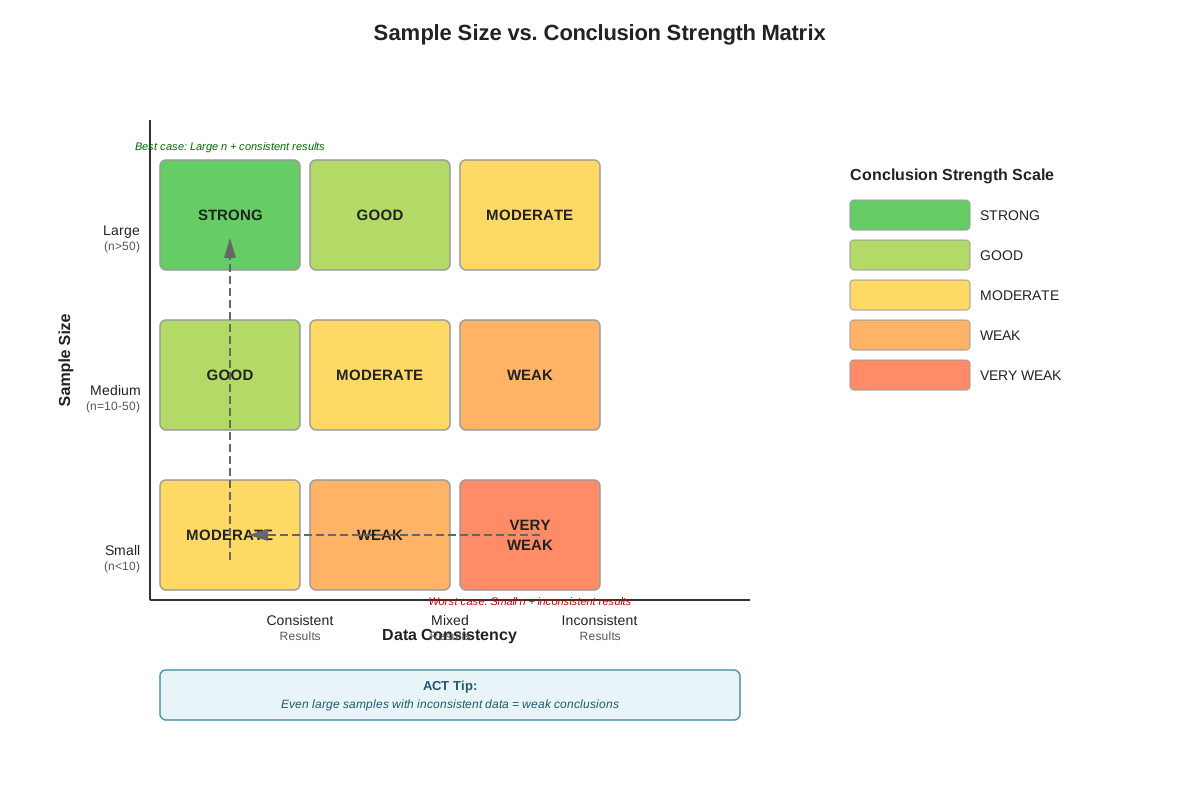
| Sample Size | Reliability | Susceptibility to Outliers | Generalizability | Confidence in Conclusions |
|---|---|---|---|---|
| Very Small (1-5) | Low | Very High | Very Limited | Weak |
| Small (6-20) | Moderate | High | Limited | Moderate |
| Medium (21-50) | Good | Moderate | Reasonable | Strong |
| Large (51-100) | Very Good | Low | Good | Very Strong |
| Very Large (100+) | Excellent | Very Low | Excellent | Extremely Strong |
Sample Size and Outliers
An outlier is a data point that differs significantly from other observations. In small samples, a single outlier can dramatically skew results and lead to incorrect conclusions. For example, if a researcher tests a fertilizer on only 3 plants and one plant happens to be diseased (unrelated to the fertilizer), that one sick plant represents 33% of the data and could make an effective fertilizer appear harmful. With 100 plants, one diseased plant represents only 1% of the data, and the true effect of the fertilizer becomes clear.
On the ACT, questions may present data with an unexpected result and ask students to explain it or suggest how to verify whether it represents a true pattern or random variation. The answer typically involves increasing sample size to determine whether the anomaly persists or disappears with more data.
Sample Size and Generalizability
Generalizability refers to the extent to which findings from a study can be applied to broader populations or situations beyond those directly tested. Larger, more diverse samples allow researchers to make broader claims. A study testing a medication on 10,000 patients of various ages, ethnicities, and health conditions can make stronger claims about general effectiveness than a study of 20 college students.
The ACT frequently tests whether students recognize overgeneralization—when researchers draw conclusions that extend beyond what their sample size justifies. For example, if scientists test water quality at only two locations in a large lake, they cannot validly conclude that the entire lake has similar water quality. More sampling locations would be necessary to support such a broad conclusion.
Determining Adequate Sample Size
While the ACT doesn't require students to calculate specific sample sizes using statistical formulas, students must recognize when a sample is clearly too small to support the conclusions drawn. Several factors influence what constitutes an adequate sample:
- Variability in the population: More variable populations require larger samples to capture the full range of variation
- Effect size: Detecting small differences requires larger samples than detecting large, obvious differences
- Number of variables: Studies examining multiple variables simultaneously need larger samples
- Desired confidence level: Stronger claims require more data to support them
Sample Size in Different Types of Studies
The concept of sample size applies differently across various scientific disciplines represented on the ACT:
Biology/Medicine: Sample size refers to the number of organisms, patients, or biological specimens. A drug trial with 5 participants is inadequate; one with 500 is much stronger.
Chemistry: Sample size often means the number of trials or reactions conducted. Running a reaction once might yield anomalous results; running it 20 times reveals consistent patterns.
Physics: Sample size involves the number of measurements or observations. Measuring the period of a pendulum once is less reliable than measuring it 50 times and calculating an average.
Earth/Environmental Science: Sample size includes the number of locations sampled, time points measured, or specimens collected. Testing soil from one location doesn't represent an entire region; testing 100 locations does.
The Practical Limitations of Sample Size
While larger samples are generally better, practical constraints limit sample size in real research. These constraints include:
- Cost: Each additional subject or trial requires resources
- Time: Larger studies take longer to complete
- Availability: Some populations or phenomena are rare and difficult to study in large numbers
- Ethical considerations: In some cases, exposing more subjects to potential risks is ethically problematic
ACT questions may ask students to recognize these practical limitations while still understanding the ideal of larger samples. A question might present a study of a rare disease and ask whether the small sample size is a critical flaw (it may not be if the disease is extremely rare and the researchers studied all available patients).
Concept Relationships
Sample size serves as a foundational concept that connects to virtually every aspect of experimental design and data interpretation. The relationship flows as follows:
Experimental Design → Sample Size → Data Reliability → Validity of Conclusions
Sample size directly influences data reliability, which in turn determines how confidently researchers can draw conclusions. This relationship is bidirectional: when evaluating conclusions, scientists must consider whether the sample size was adequate to support those claims.
Sample size also connects to the concept of controlled variables. Even with perfect control of variables, inadequate sample size undermines an experiment's validity. Conversely, a large sample size cannot compensate for poor experimental design or failure to control important variables.
The relationship between sample size and statistical significance is crucial: larger samples make it easier to detect real effects and distinguish them from random variation. This connects to the broader concept of reproducibility—results from adequately sized samples are more likely to be reproduced in subsequent studies.
Sample size relates to data representation through graphs and tables. When interpreting data visualizations on the ACT, students must consider whether the number of data points shown is sufficient to support pattern recognition. A graph showing only three data points cannot reliably establish a trend, while one showing 30 points can.
Finally, sample size connects to scientific argumentation in Conflicting Viewpoints passages. Scientists may disagree about conclusions, and these disagreements often hinge on whether the available data (sample size) adequately supports one interpretation over another.
High-Yield Facts
⭐ Larger sample sizes produce more reliable and representative data than smaller sample sizes
⭐ Small sample sizes are highly susceptible to outliers and random variation affecting results
⭐ Increasing the number of trials or subjects is a primary method for improving experimental reliability
⭐ Conclusions drawn from small samples cannot be reliably generalized to larger populations
⭐ When data shows unexpected results, increasing sample size helps determine whether the result is real or due to chance
- Sample size refers to the number of subjects, trials, observations, or specimens in a study
- Adequate sample size depends on the variability of what is being measured and the strength of the effect being studied
- A single outlier has much greater impact on results in small samples than in large samples
- Researchers must balance the ideal of large samples against practical constraints of time, cost, and availability
- Multiple trials of the same experiment with consistent results provide stronger evidence than a single trial
- Sample size affects the confidence level of statistical conclusions and the margin of error in measurements
- Studies with very small samples (fewer than 5-10 subjects/trials) should be interpreted with caution
- Replication of experiments with larger samples is a key method for verifying initial findings
Quick check — test yourself on Sample size so far.
Try Flashcards →Common Misconceptions
Misconception: Any sample size is adequate as long as the experiment is well-designed and variables are controlled.
Correction: Even with perfect experimental design and variable control, inadequate sample size leads to unreliable results because random variation has disproportionate effects on small samples. Both good design AND adequate sample size are necessary.
Misconception: If results from a small sample are consistent (all subjects show the same response), the small sample size doesn't matter.
Correction: Consistency in a small sample might occur by chance or because the small sample isn't representative of the broader population. Larger samples are still needed to confirm that the pattern holds generally.
Misconception: Sample size only matters in biology and medicine, not in chemistry or physics experiments.
Correction: Sample size (in the form of number of trials or measurements) is equally important across all scientific disciplines. A chemistry experiment run once is less reliable than one run 20 times, just as a medical study of one patient is less reliable than one with 100 patients.
Misconception: Doubling the sample size doubles the reliability of the results.
Correction: The relationship between sample size and reliability is not linear. Increasing sample size improves reliability, but with diminishing returns—going from 5 to 10 subjects is a bigger improvement than going from 100 to 105.
Misconception: If a study has a large sample size, the conclusions must be valid.
Correction: Large sample size improves reliability but doesn't guarantee validity. A study can have a large sample but still have flawed methodology, uncontrolled variables, biased selection, or other problems that undermine its conclusions.
Misconception: Sample size and sample diversity are the same thing.
Correction: Sample size refers to the number of subjects or trials, while sample diversity refers to the variety of characteristics represented. Both are important but distinct—a large sample of only one type of subject is better than a small sample but worse than a large, diverse sample.
Misconception: The ACT requires calculating specific sample sizes using statistical formulas.
Correction: The ACT tests conceptual understanding of sample size, not statistical calculations. Students need to recognize when samples are too small, understand why larger samples are better, and evaluate the adequacy of sample sizes for supporting conclusions.
Worked Examples
Example 1: Evaluating Experimental Design
Passage Context: Scientists investigated whether a new plant fertilizer increases tomato yield. They applied the fertilizer to 3 tomato plants and used 3 untreated plants as controls. The treated plants produced an average of 12 tomatoes each, while control plants produced an average of 8 tomatoes each. The scientists concluded that the fertilizer increases tomato yield by 50%.
Question: Which of the following would most strengthen the scientists' conclusion?
A) Using a different type of plant
B) Measuring the size of tomatoes rather than the number
C) Increasing the number of plants in each group to 50
D) Testing the fertilizer at different concentrations
Solution Process:
Step 1: Identify what the question is asking. The phrase "strengthen the scientists' conclusion" is a trigger for sample size evaluation. We need to determine what would make the results more reliable.
Step 2: Evaluate the current experimental design. The study used only 3 plants per group—a very small sample size. With such a small sample, random variation could easily explain the difference. Perhaps the 3 treated plants happened to be healthier for reasons unrelated to the fertilizer.
Step 3: Analyze each answer choice:
- Choice A changes the subject of study entirely, which doesn't strengthen conclusions about tomatoes
- Choice B changes what's measured but doesn't address the reliability issue
- Choice C directly addresses the sample size problem by dramatically increasing the number of subjects from 3 to 50 per group
- Choice D adds complexity but doesn't address the fundamental reliability issue
Step 4: Select the answer. Choice C is correct because increasing sample size from 3 to 50 plants per group would make the results much more reliable, reduce the impact of random variation, and allow the scientists to draw stronger conclusions about the fertilizer's effect.
Connection to Learning Objectives: This example demonstrates how to identify when sample size is being tested (the question asks about strengthening conclusions) and how to apply sample size concepts to select the correct answer (recognizing that larger samples produce more reliable results).
Example 2: Interpreting Data with Different Sample Sizes
Passage Context: Two studies investigated the effect of temperature on enzyme activity. Study 1 measured enzyme activity at 5 different temperatures, with 2 trials at each temperature. Study 2 measured enzyme activity at the same 5 temperatures, with 20 trials at each temperature. Both studies found that enzyme activity peaked at 37°C, but Study 1 showed much more variation in the data at each temperature than Study 2.
Question: Which of the following best explains why Study 2 showed less variation in the data than Study 1?
A) Study 2 used more precise measuring instruments
B) Study 2 conducted more trials at each temperature
C) Study 2 tested a wider range of temperatures
D) Study 2 used a different enzyme
Solution Process:
Step 1: Identify the key difference between the studies. Study 1 had 2 trials per temperature (small sample size), while Study 2 had 20 trials per temperature (larger sample size). Both tested the same temperatures and found the same peak, but Study 2 had less variation.
Step 2: Apply sample size principles. We know that larger sample sizes reduce the impact of random variation because individual anomalous measurements have less effect when averaged with many other measurements. With only 2 trials, one unusual measurement represents 50% of the data; with 20 trials, it represents only 5%.
Step 3: Evaluate answer choices:
- Choice A introduces information not mentioned in the passage (instrument precision)
- Choice B directly identifies the sample size difference (20 trials vs. 2 trials)
- Choice C is incorrect—both studies tested the same 5 temperatures
- Choice D introduces information not mentioned (different enzymes)
Step 4: Select the answer. Choice B is correct because the larger number of trials in Study 2 (larger sample size) naturally reduces variation by averaging out random fluctuations in individual measurements.
Connection to Learning Objectives: This example shows how to explain the core principle behind sample size (larger samples reduce variation) and apply this understanding to interpret experimental results accurately.
Exam Strategy
When approaching ACT Science questions about sample size, follow this systematic strategy:
Step 1: Identify Sample Size Trigger Words
Watch for these phrases that signal sample size is being tested:
- "Strengthen the conclusion"
- "Improve the reliability"
- "Weakness of the study"
- "More confident in the results"
- "Additional trials"
- "Increase the number of subjects"
- "Generalize the findings"
Step 2: Locate Sample Size Information
Quickly scan the passage for numbers indicating how many subjects, trials, specimens, or observations were included. This information often appears in the experimental design description or in table/graph labels (e.g., "n = 5" means sample size of 5).
Step 3: Evaluate Adequacy
Ask yourself: "Is this sample size adequate for the conclusions being drawn?" General guidelines:
- Fewer than 5: Almost always too small
- 5-10: Small, likely inadequate for strong conclusions
- 10-30: Moderate, may be adequate depending on context
- 30+: Generally adequate for most purposes
Step 4: Apply the "Bigger is Better" Principle
When questions ask how to improve an experiment or strengthen conclusions, increasing sample size is almost always a correct answer if it's an option. The ACT rarely presents scenarios where larger samples would be problematic.
Step 5: Process of Elimination
Eliminate answer choices that:
- Decrease sample size
- Change the focus of the study without addressing reliability
- Add unnecessary complexity without improving data quality
- Introduce new variables without increasing the number of observations
Time Management: Sample size questions are typically straightforward once you recognize them. Spend 30-45 seconds identifying the question type, 15-20 seconds locating relevant information, and 20-30 seconds selecting and confirming your answer. Don't overthink—the ACT tests basic principles, not advanced statistics.
Exam Tip: If a question asks about experimental weaknesses or limitations, always check whether sample size is mentioned. Small sample size is one of the most common experimental weaknesses tested on the ACT.
Memory Techniques
The "MORE" Mnemonic for Sample Size Benefits:
- More reliable data
- Outliers have less impact
- Reproducible results
- Extendable conclusions (better generalizability)
The "3-30-300" Rule: Remember these benchmarks:
- 3 or fewer: Red flag—almost certainly too small
- 30 or more: Green light—generally adequate
- 300 or more: Gold standard—excellent sample size
Visualization Strategy: Picture a dartboard. One dart throw (small sample) might land anywhere by chance. Thirty dart throws (large sample) reveal the true skill level of the thrower. This image helps remember that larger samples reveal true patterns while small samples are dominated by chance.
The "Coin Flip" Analogy: Always remember the coin flip example—4 flips might give 75% heads by chance, but 1,000 flips will approach 50-50. This simple analogy can be mentally applied to any sample size question to reinforce why larger samples are more reliable.
Acronym for Question Triggers - "SWIG":
- Strengthen conclusions
- Weakness of study
- Improve reliability
- Generalize findings
When you see any SWIG word, immediately think about sample size.
Summary
Sample size is a critical concept in experimental design that directly impacts the reliability, validity, and generalizability of scientific findings. The fundamental principle is straightforward: larger samples produce more reliable data because random variations average out, outliers have less impact, and results better represent the broader population or phenomenon being studied. On the ACT Science test, sample size questions appear frequently in Research Summaries passages, typically asking students to identify experimental weaknesses, suggest improvements, or evaluate the strength of conclusions. Students must recognize that small samples (especially fewer than 10 subjects or trials) are highly susceptible to chance variation and cannot support broad generalizations, while larger samples (30 or more) provide the foundation for confident conclusions. The ACT tests conceptual understanding rather than statistical calculations—students need to identify when sample size is inadequate, explain why larger samples improve reliability, and apply this knowledge to evaluate experimental designs and interpret data. Mastering this topic requires recognizing trigger words like "strengthen," "improve reliability," and "weakness," understanding that increasing sample size is nearly always beneficial, and avoiding the misconception that good experimental design alone can compensate for inadequate sample size.
Key Takeaways
- Sample size refers to the number of subjects, trials, or observations in a study, and larger samples consistently produce more reliable results
- Small samples (fewer than 10) are highly susceptible to outliers and random variation, making conclusions drawn from them unreliable
- Increasing sample size is one of the most effective ways to strengthen experimental conclusions and improve data reliability
- Questions asking how to "strengthen conclusions" or "improve reliability" almost always involve increasing sample size as the correct answer
- Sample size affects generalizability—small samples cannot support broad claims about large populations
- The ACT tests conceptual understanding of sample size, not statistical calculations, so focus on recognizing when samples are adequate or inadequate
- Watch for trigger words like "strengthen," "weakness," "improve," "reliability," and "generalize" as signals that sample size is being tested
Related Topics
Experimental Controls: Understanding sample size is essential for evaluating whether control groups are adequate. A large experimental group with a tiny control group undermines the entire study. Mastering sample size enables better evaluation of overall experimental design.
Data Variability and Standard Deviation: Sample size directly relates to how much data varies and how confident scientists can be in their measurements. Larger samples reduce standard deviation and increase precision.
Statistical Significance: While the ACT doesn't require statistical calculations, understanding that larger samples make it easier to detect real effects (statistical significance) builds on sample size concepts.
Reproducibility in Science: Sample size affects whether other scientists can reproduce experimental results. Studies with adequate samples are more likely to yield consistent results when repeated.
Bias and Sampling Methods: After mastering sample size (how many), students can progress to understanding sampling methods (which ones), including random sampling, stratified sampling, and how selection bias can undermine even large samples.
Practice CTA
Now that you understand the critical role of sample size in experimental design and data interpretation, it's time to reinforce your mastery through practice. Complete the practice questions on sample size to test your ability to identify when this concept is being tested, apply the principles to ACT-style scenarios, and confidently select correct answers. Use the flashcards to memorize key facts and trigger words that signal sample size questions. Remember, sample size appears on virtually every ACT Science test, often in multiple questions, making it one of the highest-yield topics you can master. Your investment in understanding this concept will pay dividends on test day—approach the practice with confidence, knowing that you now have the tools to tackle any sample size question the ACT presents!
Sign up free to keep reading
Create a free AnvayaPrep account to finish this ACT guide on Sample size — plus flashcards and practice questions.